Tag: Multi System Operators

  • MIB on ‘fastway’ to cleanse systems: Seeks TRAI view to avoid MSO/LCO monopolies

    By A Correspondent


    The Manish Tewari-led information and broadcasting ministry appears to be on a fast track to check on monopolistic practices in the cable business. And in the process, the heat is on Punjab’s Fastway Transmission which has a near-monopoly in the State and has strong linkages with the Deputy Chief Minister Sukhbir Singh Badal.


    After asking TRAI to offer its views on government-ownership in broadcast, the ministry has sought views of the TRAI on the measures to prevent monopolistic operations by MSOs and LCOs. It has requested TRAI to provide its recommendations under Section 11 (1) (a) on the following:


    “In order to ensure fair competition, improved quality of service, and equity, should any restriction be imposed on MSOs/LCOs to prevent monopolies/accumulation of interest? If yes, what restrictions should be imposed and what should be the form, nature and scope of such restrictions?


    Accordingly, amendments required in the Cable Television Networks (Regulation) 1995 Act and Rules framed there under may also be suggested.”


    Multi System Operators (MSOs) and Local Cable Operators (LCOs) are required to be registered with local Post Offices to be able to operate in the permitted areas of registration, adds a communique from the ministry. However as per recent amendments in the Cable Television Networks (Regulation) Amendment Rules 2012, it has become mandatory for MSOs to get registration from the Ministry of Information and Broadcasting to operate in those areas which are notified for analogue switch off.


    The communique further adds that it has been observed that the cable TV distribution is virtually monopolized in some States as operation of the entire cable TV network is dominated by a single entity in that State. At present, there are no restrictions on the issue of accumulation of interest in terms of market share in a City, District, State or country by individual MSOs and LCOs in the Cable Sector. MSOs and LCOs are free to operate in any area(s) of their choice after obtaining registration from the Ministry. It is felt that such monopolies may not be in the interest of consumers and may have serious implications in terms of competition, pricing and healthy growth of cable TV sector in that market.


    Earlier, the Ministry had made a reference to TRAI on May 16, 2012 to examine and recommend measures to address issues of cross-media restrictions and safeguards. With this reference, the issues of monopolies in the broadcasting sector in the most comprehensive sense is set to get addressed by TRAI.
     

  • Ensure digitised feed from July 1: Broadcasters

    By A Correspondent


    Television broadcasters have urged the government to stick to the deadline of June 30 for mandatory cable digitisation in the four metros and slammed vested interests who were trying to create roadblocks.


    Cable digitisation in India has been hailed as the break of a new dawn for the entire broadcasting industry and all stakeholders – viewers, cable operators, multi system operators and broadcasters will benefit from it.


    “By and large, the industry has welcomed this transformation, but it is unfortunate that there are certain pockets of vested interests that are trying to create roadblocks,” said Uday Shankar, president of the Indian Broadcasting Foundation and the chief executive officer of Star India. “We remain confident that the government, TRAI, the parliamentary committee and for that matter even the courts will not allow these isolated voices to jettison what now is a national mandate.”


    Cable digitisation will to allow viewers to get more channels and will give them the option of refusing channels that they do not want. Being digital, it will also provide better quality of sound and picture. For MSOs, this would mean better transparency and ability to get a clearer idea of the number of subscribers. MSOs will therefore be able to declare revenues more precisely. With high bandwidth at their disposal, they will now be able to offer value added services and improve revenues.


    But some cable operators have cited unavailability of digital set top boxes and urged the government to extend the deadline.


    “The deadline must and has to be met. If it doesn’t happen on time, the confidence in this transition will completely evaporate and investments will not come in,” said Sunil Lulla, managing director and chief executive officer of Times Television Network, which runs Times Now, ET Now and Movies Now channels.


    In the current cable regime, broadcasters have been finding it difficult to generate revenues and scale up. “Broadcasters, particularly news broadcasters, have been crippled with huge carriage costs and poor subscription revenues. Digitisation changes all that. We will have far more resources to put into content, which will again benefit the consumer a great deal,” said KVL Narayan Rao, president of the News Broadcasters’ Association and executive vice-chairperson of the NDTV Group.


    Digitisation will benefit broadcasters as they will no longer have to pay large carriage fees and will now be able to get better subscription revenues. In the run up to the deadline, over the last two months, many television broadcasters have been communicating the shift towards digitalization at least five times a day.


    “Yes, there will be some disruption during this process but this is a game changing transition for the industry in India,” said Mr Lulla.


    Source: The Economic Times
    Copyright © 2012, Bennett, Coleman & Co. Ltd. All Rights Reserved


  • Cable operators take on I&B at digitization meet

    By Meghna Sharma


    With May coming to an end and only a month left for digitization, the Information & Broadcasting Ministry is trying its level best to get the stakeholders to a mutual consensus. A forum was organized by FICCI and I&B ministry in Mumbai to share some thoughts on ‘ India going Digital’.


    Present at the event, Supriya Sahu, Joint Secretary (Broadband & Policy) and Rajiv Takru, Additional Secretary of Ministry of I&B heard what the cable operators of the city had to say. It is not a hidden fact that cable operators aren’t very happy with the whole process. Deadline date, revenue share and carriage fee were some of the strong points put forward by them.


    Cable operators’ woes

    The operators stood unanimous as they put their issues in front of I&B Ministry. The issues on which they wanted answers to varied from them being given a ‘chor’ tag to why they should collect entertainment tax for the state government.


    Although the topic of revenue share was top of the list, none of the operators agreed with the 45:55 share with the MSOs and wanted the government to do something about it. “How will we survive?” they questioned. The cable operators want a bigger share in the pie; some even suggested of a full 100 per cent share.


    Some operators even went on to tell the government to re-work the deadline and launch a phase-by-phase change, wherein both analog and digitization be allowed hand-in-hand, with only a few channels being converted in the beginning.


    One operator even compared the cable operators with Jesus and said that they’ll be carrying the set-up boxes to their funerals. Availability of the set-up boxes is a major concern as many reminded the ministry representatives that MSOs have not been able to provide them with the boxes even as the deadline looms in. “How does the government expect us to meet the deadline when we haven’t been provided with the set-up boxes. We don’t even know if the demand will be met before the blackout. And how are we going to face the wrath of our customers when their television sets go blank?” questioned one operator.


    Carriage fee was a topic on which all of them agreed upon, stating that they alone shouldn’t be allowed to bear its burden. They also wanted the ministry to intervene and tell the broadcasters to bring out their rate cards as soon as possible so that they can, in turn, inform their customers.


    Ministry’s assurance

    Rajiv Takru, Additional Secretary of Ministry of I&B, confirmed that no matter the issues raised or problems faced, digitization will not be compromised upon. “There is still some confusion and doubts in many cable operators’ minds, but one needs to be very clear that digitization will happen and shouldn’t be taken lightly.”


    He advised the cable operators to start working on it as very little time is left. He added that it is cable operators’ job to go and talk to their customers about digitization becoming a reality soon. “Multi-system operators (MSOs) have been informed to provide cable operators with set-up boxes before the deadline of June 30 and they will have to follow suit. It is the cable operator’s job to convince customers to change before it’s too late to avoid the chaos.”


    He added that the rules of the game have been changed and if anyone is caught evading rules or indulging in any malpractice then according to the Cable Regulation Act, the person will be arrested and made to shut shop as it has now become a cognizable offence.


    The broadcasters have been informed and will bring out rate cards by end of this month, Mr Takru assured: “Broadcasters and MSOs have to go by the rules and have to come out with bouquet as well as a-la-carte channels. One needs to understand that digitization is a win-win situation. The customer will be able to chose and cable operators will be able to provide the best quality service.”


    Direct to Home (DTH) service is seen as the biggest opponent by cable operators and feel that DTH operators don’t want them to reach the deadline, especially with monsoons approaching as they do not get many customers in the season. To this Mr Takru assured cable operators stating that they shouldn’t see DTH as a challenge: “A lot of DTH operators are still waiting in line to get more channels as they don’t have sufficient signals/transponders whereas cable operators will be able to provide 500 channels to their customers.”


    No end to the chaos

    However, no concrete solutions came out of the meeting as the atmosphere at the forum heated up. The cable operators continued demanding the deadline to be pushed back while Mr Takru only said that their point has been noted.


    Furthermore, the cable operators didn’t let the MSOs present at the event speak their side of the problem or issues. The agitation ended when Mr Takru and Ms Sahu walked out of the venue citing shortage of time and the MSOs escaped with them.


  • Nearly 10 lakh STBs ready for Kolkata

    By A Correspondent


    The Cable Television Networks (Regulation) Amendment Act, 2011 has made it mandatory for switch-over of the existing analogue Cable TV networks to Digital Addressable System (DAS) by December 2014, in a phased manner. In respect of four metros of Delhi, Mumbai, Kolkata and Chennai, the digital switch-over is to be completed by June 30.


    The ministry is very closely monitoring all the activities for the timely implementation and the quality of the Digital Cable TV service. During the high level review meetings by the Ministry, it was revealed that in the case of Kolkata, out of total requirement of about 35 lakhs STBs, over 5 lakhs STBs have already been installed, about 4 lakhs STBs are available in the stock which are being installed and the orders have already been issued for the balance requirements of STBs.


    Further it came to the notice that all the MSOs already have digital head ends and the existing channel capacity in each of the case is over 200, which is the mandatory requirement as per the Telecommunication (Broadcasting and Cable Services) Interconnection Regulation, 2012. The channel capacity is being augmented by the MSOs.


  • 53 Days to D-Day | Govt addresses industry concerns over digitization

    By A Correspondent


    The Cable Television Networks (Regulation) Amendment Act, 2011 has made it mandatory for switch-over of the existing analogue Cable TV networks to Digital Addressable System (DAS) by December 2014, in a phased manner. The digital switch-over is to be completed by June 30 in the four metros -Delhi, Mumbai, Kolkata and Chennai.


    Concerns had been raised by some stakeholders regarding the quality of Set Top Boxes (STBs) and the redressal of grievances of the cable TV subscribers. The necessary provisions have been incorporated in the Cable Television Networks (Amendment) Rules, 2012 to take care of these concerns. As per these Rules, the STBs to be supplied by the Multi System Operators (MSOs) must conform to the quality standards specified by the Telecom Regulatory Authority of India (TRAI).


    The MSOs are also required to devise a mechanism for grievance redressal, as specified by TRAI, and inform the details thereof to the subscribers. The Telecommunication (Broadcasting and Cable Services) Interconnection Regulation, 2012 has a provision that the STBs must be BIS compliant. During a Ministry review meeting with the national level MSOs, it was revealed that out of about one crore STBs required in the four metros, over 22 lakhs STBs have already been installed, about 25 lakhs STBs are available in the stock which are being installed and the orders have already been issued for the balance requirements of STBs.


    MSOs have confirmed that all the indigenously manufactured STBs conform to the BIS standard and the imported STBs not only conform to the international standard but also the BIS standard. Regarding the repair of defective STBs, the MSOs have intimated that within the warranty period of one year, a defective STB will be replaced immediately free of cost. After the expiry of warranty period, a faulty STB will be taken back for repairs by giving a replacement from the available stock.


    The MSOs have further confirmed that the Grievance Cells are being set up for resolution of disputes, if any, and the telephone numbers of the Grievance Cells would be notified.


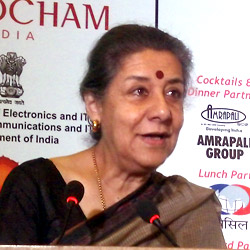
  • Digitization is going to be the biggest reform in broadcast sector: Ambika Soni

    By Shruti Pushkarna


    High drama ensued at the Assocham event inNew Delhias local cable operators (LCOs) flagged black ribbons at the Minister for Information and Broadcasting, Mrs Ambika Soni. The Minister was attending the 6th Annual Summit on Entertainment and Media organized by Assocham, Focus 2012: Digitization for Inclusive Growth. As the theme suggests, one of the primary issues discussed at the event was Digitization of Cable television.


    The LCOs were protesting against the recent tariff order issued by the Telecom Regulatory Authority of India (TRAI), which they claim is an unfair order against all small operators. Following the heated arguments between cable operators present at the event venue and the Minister, one of the cable operators, Sandeep Mcgee who is based inEast Delhithreatened to commit suicide in front of the Minister. Mrs Soni, however, tried to pacify the operators’ fraternity and asked them to file a formal letter with all their grievances against the tariff order and the regulator. She also promised to address their concerns and, if need be, raise the same with the regulator.


    Addressing the concerns of broadcasters on the carriage fee mentioned in the same order, Mrs Soni said that the government will consult all stakeholders before taking a final call on the regulations decided by TRAI under which the Multi System Operators (MSOs) are allowed to charge a carriage fee from broadcasters.


    Earlier, in her inaugural address, the Minister emphasized the importance of digitization for the entire industry and all stakeholders: “Digitization is going to be the biggest reform in broadcast sector and enable operators to expand their revenue sources by providing more choice and variety to customers. Digitization is imperative to tabulate subscriber base and reduce carriage fee. Digitization will also help reduce all human error in the process.”


    Defending the tariff order issued by TRAI recently, she said that the government indulged in exhaustive consultations with all stakeholders on all issues including the carriage fee, and the main aim of the new regulations had been to benefit the consumer. Mrs Soni said: “The TRAI tariff order makes the viewer the most important beneficiary; the choice will be with the viewer.” As for the broadcasters, she said digitization would help reduce the dependence on TRPs and bring in transparency where every broadcaster would be in a position to identify exactly how many people are subscribing to the channel.


    On the issue of media regulation, Mrs Soni said: “Let’s not condemn self-regulation per se because even though self regulation is a slower way of correcting things, it is still a surer way as it involves converting minds and hearts in the process.” She added that in the whole race to growth, the provisions of the Cable Television Regulatory Act were overlooked and it was a fault in the functioning of the government that the act had been ignored.


    On the issue of Paid News, she said that while it was the worst phenomenon that existed, it’s not as easy to detect paid news. She was responding to scathing criticism of the media by the Chairman of Press Council of India, Justice Markandey Katju in his keynote address at the same event.


  • [60 Days to D-Day] Digitization in 4 metros will not happen by July 1: JS Kohli

    Late Monday night, Telecom Regulatory Authority of India (TRAI) announced the new tariff structure for digital cable TV services. Under the new rules, all cable operators will have to mandatorily offer a Basic Service Tier (BST) to viewers which would consist of 100 free to air channels, including 18 mandatory Doordarshan channels, as well as the Lok Sabha channel. The tariff order states that apart from the mandatory channels in the BST, cable operators and Multi System Operators (MSOs) will have to provide customers a minimum of five channels of different genres.


    The authority also stated that MSOs will have to increase their channel carrying capacity. TRAI stated: “The Authority has mandated MSOs to carry a minimum of 500 channels from January 1, 2013. However, keeping in view that smaller MSOs having less than 25,000 subscribers may need some additional time for building capacity, they have been given time up to April 1, 2013.” The TRAI has prescribed that every MSO should have a minimum capacity to carry 200 channels by July 1.


    TRAI has also established new guidelines for revenue sharing between Multi System Operators (MSOs) and Local Cable Operators (LCOs).


    MxMIndia’s Shruti Pushkarna spoke to Mr Jagjit Singh Kohli, a veteran of the cable industry and CEO of cable distribution firm Digicable, on his reading of the latest order issued by TRAI and if he thinks the sunset date of June 30 is still achievable.


    What’s your first response to the Tariff Order?

    Well, the order is on expected lines, no big surprises there. Given the circumstances, I am happy with it, in the sense that we know the regulatory has been operating under tremendous pressure from various stakeholders, so given that situation, I am actually happy with the order.


    TRAI has observed that the Order will help profitability of channels. But carriage fee exists. Do you think the bottom line will be impacted for both broadcasters and the cable trade?

    The channel capacity is increasing to 500 channels, so automatically the pressure on carriage will reduce. So, although the carriage fee remains but the channel capacity itself is increasing so much that the price per channel will come down.


    Given the status as of today, do you see the implementation happening in the four metros before July 1?

    Now, that I don’t think will happen. We will need a postponement of at least three to four months. The tariff order has just come; there are so many other issues such as DAS licenses being not issued till date. To meet the deadline the industry needs to deploy atleast 150,000 boxes every day, only then will we be able to meet that deadline, and that’s impossible.


    What about the availability of set-top boxes?

    Even that is an issue. But even if set top boxes were to be made available, it would be very difficult to meet the deadline.


    Do you think the government is doing enough to promote the switch to digitization and explain the benefits to consumers?

    Yes, you can’t blame them on this. They have been quite aggressive on the timelines and in their campaigns.


    Are there any areas of worry in the run-up to digitization (given that we have just 60 days to go)?

    The only area of worry is that we will need some more time to meet the deadline, otherwise everything is fine.


    Photograph: Fotocorp