Tag: Mudra

  • BTL Baatein: Vandana Verma, Leo Burnett… Powered by VISCOMM

    Vandana Verma has worked with leading organisations in the two decades that she has worked in the marketing services sector. Teamwork Films, TIC Integrated Marketing Services, Big Live, Ogilvy & Mather where she headed North at Ogilvy Action Live, Mudra Max (VP and Country Head, Mudra Celsius) and since 2012 as with Leo Burnett where she is now Executive Vice President and Head of Experience. In this edition of BTL Baatein, Vandana Verma speaks on how experiential is the oxygen brands need to survive in the marketplace, and more…
    What is the importance of BTL in the world of advertising and promotions?

    Experiential is the oxygen brands need to survive in the marketplace. While mainstream advertising works as an announcement platform for most brands, experiential initiatives help brands cover the last mile and trigger purchase decisions.


    What would you say is that the importance marketers given to BTL activity in their overall marketing plan?

    Marketers today understand the need for Experiential. They do realise that experiential solutions is the only way to deliver communication that is targeted at a specific kind of audience. It gives marketers a chance to tailor their message in a more personalised way and establish a stronger connect with consumers.


    ROI measurement on traditional platforms is fraught with issues, but not in the case of Experiential. Tracking down campaign performance in an accurate manner is easier and less complicated in Experiential and that’s a huge plus. Marketers are increasingly becoming fans of Experiential. No wonder we are seeing so many agencies enter this space.


    In Experiential, one can gather feedback easily and take corrective actions immediately in case of any crisis.  Something mainstream advertising can never achieve.


    Are there certain types of marketers who have a greater affinity for BTL? (eg FMCG, durables, auto, etc)


    My answer would be NO. The average spends on experiential across brands is about 35-40%, which has risen from 15% three years ago. Activations are most commonly used for sales promotions, branding, launches, channel partner appeasement, channel expansion and lead generation. There are different objectives for different activities. These requirements would remain across categories of marketers.


    Typically what is the break-up of spends….ATL v/s BTL?


    35-40% BTL, balance ATL and Digital.


    Can you also specify the range of activities that you propose to undertake as part of the below-the-line advertising and promotion for your clients?


    Leo Burnett Experience is a specialist unit that offers holistic experiential solutions to clients including activation, events and exhibitions and rural marketing across metros and 5,000 small towns and cities. We function in an integrated manner by collaborating with a multi-disciplinary team of strategists and creators.


    In terms of generating results esp from consumers and in B2B, do you find BTL a more sureshot avenue than ATL?

    Strategy driven experiential solutions have always guaranteed results for our clients. Going forward we will explore new ways of solving business problems for our clients.


    While sales and salience are good indicators of its success, what are the attributes you/your clients look at to measure the success of a BTL campaign?


    ROI is an obvious measure and every client would use that as a measurement tool, but what clients also look at is the quality of engagement your idea brings to the table. Experiential also seamlessly enables integration across all other media. Most agencies struggle in this regard as they lack the skillsets and the capabilities to enable real integration. Integration of specialists to solve a single brand problem. That’s what makes us unique.


    There are many organisations who often do new launches almost entirely on BTL aided with an outdoor and/or digital blitz? Your view on this. Given rising media costs, do you see BTL managing on its own, without ATL?


    We are still at an early stage where clients do not truly understand the role of BTL in growing their business. Most still treat it as just one part of the media mix. However, we at Leo Burnett, are blessed with some clients like Bajaj Auto, Mc Donalds, ITC foods, Coke etc., whom we have partnered in their journey building where BTL plays a substantial role.


    I don’t think any major brand entirely depends experiential to achieve what it wants to in the marketplace. Integration is key.


    Do you have a view on BTL? Would you like to engage in a conversation on BTL marketing and promotions? Write to us at editor@mxmindia.com with BTL Baatein in the subject line


  • Retirement not to affect popularity, Brand Mahendra Singh Dhoni is not over, say experts

    By Pritha Mitra Dasgupta, Ratna Bhushan & Ravi Teja Sharma


    Indian cricket captain Mahendra Singh Dhoni on Tuesday announced his retirement from Test cricket bang in the middle of the Australia tour, catching many by surprise and fuelling speculation whether this is the beginning of the end of brand Dhoni.


    “It’s clearly a succession plan in the making, so it will definitely impact the brand value of Dhoni in the short term,” says Indranil Das Blah, chief operating officer of sports management company, Kwan.


    But he was quick to attach a caveat. “If India wins the World Cup next year, Dhoni will be bigger than ever. If not, we will begin to see the end of brand Dhoni, as we are certain that others like Kohli will rise.”


    Santosh Desai, CEO of Future Brands, termed the Indian captain’s decision as the “evening of his career and his brand endorsements”, but certainly not the end. “Is this step one of his game plans?” asks Madhukar Kamath, group CEO and MD of Mudra. “It was becoming evident that Dhoni will pull out of Tests and from other formats after the World Cup. Hence brand Dhoni will not get affected till after the WC.”


    Nandini Dias, chief executive officer of Lodestar Media, says that Dhoni has been the most successful captain for India and is currently the costliest sports endorser. “But sports icons quickly lose sheen when they stop playing. Since Dhoni will continue to play in the other two forms of cricket, which are more popular than Test cricket, it will not affect his endorsement or popularity yet.”


    Dhoni has been one of the top brands in India over the past few years, endorsing close to 20 brands such as Pepsi, Reebok, Aircel, Gulf Oil, Star Sports, Reebok Amrapali Developers and many more. He reportedly charges between Rs 10 and Rs 12 crore for a brand, which is way more than the next best Virat Kohli who charges around Rs 6-7 crore for a brand. Dhoni is also known to have done a few revenue share deals.


    Anupam Vasudev, chief marketing officer at Aircel, says their brand endorsement deal with Dhoni ended in October-November 2014 and they are still talking to him on renewing it. A PepsiCo India spokesperson said the company will continue its association with Dhoni. “We wish him all the best for his continuing leadership in the T20 and one-day formats.”


    Dhoni’s decision to focus on the shorter versions of the game will extend the longevity of his brand, says Abraham Koshy, professor of marketing at IIM-A. The dilemma for advertisers in India is that there are only two big names left in cricket at the moment – Dhoni and Kohli. There was a time – and not too long ago – when marketers were spoilt for choice with Sachin Tendulkar, Sourav Ganguly, Rahul Dravid, Anil Kumble, Virender Sehwag, and even Harbhajan Singh, Gautam Gambhir and Yuvraj Singh to pick from.


    Source:The Economic Times

    Copyright © 2014, Bennett, Coleman & Co. Ltd. All Rights Reserved

    Licensed to republish


  • Mudra Ahmedabad on hard facts of olive oil

    By A Correspondent


    When N K Proteins  launched  a new brand of olive oil called Viva across parts of Gujarat,  Mudra Ahmedabad got on to the act of creating awareness of the brand and also differentiate it in the market.


    The campaign created by the Ahmedabad team of the DDB Mudra group was based on a simple observation gleaned through research that though people had an idea about the goodness of Olive oil, they were largely unaware about the variants and the exclusivity of these variants in terms of their usage.


    What was shocking to note, adds a communiqué, was the fact that many brands were communicating wrong information to the consumers just to increase the acceptability of olive oil… they were promoting ‘Pomace’ variant (usable for Indian style of cooking)  of olive oil by communicating the health benefits which are exclusive only to  ‘Extra Virgin’ variant.


    Nilesh Patel

    This led to the creative team to not just create ads that not just created an awareness about the brand but also educate consumers about olive oil.


    Said Nilesh Patel, Managing Director, N K Proteins Ltd: “While consumers are enthusiastic about olive oil, most of them are not aware about the usage of each variant of olive oil. So our plan was to educate them without putting them to sleep.”


    Ronak Shah

    Ronak Shah, AVP, Mudra Ahmedabad added: “We had an interesting challenge before us. While almost every brand tried to occupy the lifestyle space, no one bothered about educating the consumer about different variants of olive oils and what kind of cuisines they’re meant for. The idea was to show things which people would normally not do and then draw parallels with our core communication message.”


  • With Mahindra in tow, Interbrand begins India ops on a high

    By A Correspondent


    This February-end will mark the completion of a year since the unveiling of a new structure and brand identity by creative hotshop DDB Mudra Group in India. As part of the slew of changes that were planned for the network in India, the management had announced that the network would comprise of eight key agencies as under: DDB Mudra, DDB MudraMax, Mudra, DDB Health & Lifestyle, RAPP, Tribal DDB India, Water and Maatra.


    While plenty was reported and written about the performance of the creative, out-of-home, experiential and other units within the group in the past one year, one unit that preferred to stay away from the limelight was Water, the brand consultancy specialist that was rebranded Interbrand India at the time of restructuring. But that is until now. Interbrand India seems to have finally found its footing in the country as it announced the take-off of its operations in India.


    Formed by the transition of Water, the brand strategy and design consultancy of DDB Mudra Group, to Interbrand, Interbrand India will offer Interbrand’s complete suite of brand consulting services including brand strategy, audit/evaluation, design, brand management and verbal identity. The operation will continue to be located in Mumbai.


    A communique issued to media stated the following: “Joining a client roster that includes Tata and Godrej, Interbrand India is pleased to announce that it has begun consulting for the Mahindra Group. Mahindra, one of the more progressive Indian brands, is looking to establish itself as one of the world’s most valuable brands and as part of the journey has engaged Interbrand on an extensive brand valuation project. The Interbrand offices in Mumbai & London will carry out the assignment.”


    “India is one of the most exciting markets in the world for brands today, said Jez Frampton, Global CEO of Interbrand. “We are extremely pleased to have Ashish Mishra and his team join the Interbrand family and to mark the occasion with the start of a relationship with Mahindra, one of India’s most prestigious brands.”


    Commenting on joining Interbrand, Ashish Mishra, Managing Director, Interbrand India said, “We want Indian companies to realize that brands are not mere logos or slogans but rank among the most important assets a business owns. Mr. Mishra continued, “As the world’s leading brand consulting firm, our task, quite simply, is to help the Best Indian Brands graduate to Best Global Brands.”


    Interbrand’s brand valuation methodology – the first of its kind to be ISO certified – analyzes the many ways a brand touches and benefits an organization, from driving bottom-line business results to delivering on customer expectations. The methodology has been leveraged to build value, inform strategic brand management, restructure and create business cases for investments for some of the best global brands.


  • AdStrat | Nutrasweet: Sweet Ban Gaya Nutrasweet

    Shekhar Pandey - Associate Vice President, Mudra Ahmedabad.
     

    1. Name of the Campaign: Sweet BanGaya Nutrasweet


    2. The Brief: It is a better tasting sweetener. Hence world number 1. The brand has to be born big.


    3. Research insights: There are lot of people who are convinced about the “no sugar” or “less calorie” story and have tried these kind of sweeteners and quit because they do not like the taste. These people would be the ideal segment for “Nutrasweet”.


    4. The thought process behind the creative: It is to take ourselves less seriously and not come across as cleaver, intelligent sounding but to sound warm, humane and endearing. Not to look at a particular class of people but look at every sweet loving person.


    5. Media vehicles chosen: TV


    6. Key issues kept in mind while executing the ad: Just come across as warm and human.


    7. Does the treatment do justice to the brief?

    Yes


    8. What according to you is the differentiating factor about the ad?

    It does not talk “no sugar”. It does not talk “less calories”. It simply says don’t hesitate while having sweets because sweet has become nutrasweet.


    9. Market and client feedback: Extremely likeable.


  • 6 Reasons why tonight’s the Big Night @ Goafest

    By A N Chorrea


    Yes, Balki doesn’t care an eff about it and the folks at Cag have serious issues about the innumerable fakes that come in as entries, but the Abby is the Abby is the Abby. So why’s it the Badi Raat?


    1. Because the Creative Abbys will be presented tonight


    2. Because even as some of the Creative Abbys were given away last night (and the Media Abbys too!), the meaty, glamourous ones are happening tonight.


    3. Because it will be interesting to see how many metals Agnello Dias nets tonight. Yesterday, wifey Nandini Dias’s Lodestar UM bagged several honours. Tonight could well be Aggie’s. Total domination by the Diases!


    4. Remember Bobby quit Mudra half-way, just as Sonal quit Bates half-way… It will be interesting to see the mix of emotions as their ex and current agencies walk away with honours (If it was a television event, I am sure the camera would focus on Bobby every time Mudra gets an award or on Colvyn when Aggie gets it for Pepsi… quite like they do in the film awards where you see Rekha’s expressions on Amitabh, Vivek Oberoi on Salman. Etc etc etc)


    5. It’s the last day of Goafest. May as well live it up!


    Click here to view all Goafest 2012 stories


  • From y’day: Yatra.com entrusts McCann with creative biz

    By Shubhangi Mehta


    On the appointment of McCann, Pratik Mazumder Head Marketing & Strategic Relations at Yatra Online Pvt Ltd said,” Yatra and TBWA have decided to part ways, the helped us present ourselves as a ticketing brand and position us but now we felt the need of a bigger agency hence decided to call for a pitch. There was Ogilvy, Percept H, Maccann and TBWA involved in the process and we decided to get MacCann on board.”


    Sources close to the development have confirmed to MxM India have confirmed that there is also a media pitch happening for the online travel company.


    Before TBWA, Yatra.com had appointed Rediffusion Y&R as its creative agency in 2009; while Leo Burnett was the official agency in 2007.


    The online travel company entered the market in August 2006. It had initially appointed Everest Brand Solutions as its creative agency, and Mudra’s media agency, Optimum Media Solutions (which was re-christened Mudra Connext), handled its media duties.


    Yatra Online Pvt Ltd. is a travel company providing information, pricing, availability and booking facility for air travel, hotels, buses and car rentals across 5,000 large cities and small rural areas around the globe. It acts as a complete tour planner for travellers and is a one-stop shop for every travel need.


  • Typically quirky, Mudra ‘welcomes’ Bobby Pawar to JWT

    By Shubhangi Mehta


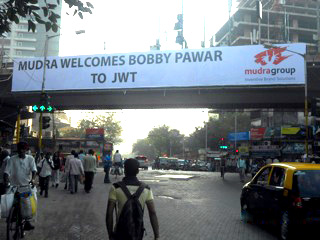
    Mudra showed that it is an agency with a big heart as well as an extraordinary creative bank, demonstrating both innovation and affection in its farewell to Bobby Pawar. In a billboard that has been put up right next to JWT, where Mr Pawar has taken charge of his new responsibilities, Mudra said “Mudra welcomes Bobby Pawar to JWT”.


    The billboard came as a shock to some and a pleasant surprise to some but it undoubtedly managed to catch everyone’s eyes.


    Pratap Bose
    Bobby Pawar

    Pratap Bose, COO, Mudra Communications, said, “Tuesday evening was Bobby’s farewell. The whole idea was to show Bobby how special he is for us. It’s a gesture to show that the fact that Bobby remains in advertising is good news for the creative industry.”


    A generous gesture like this makes one feel proud to be a part of an industry where relationships can be warm as well as professional.


    On the gesture by Mudra, Bobby Pawar, CCO and Managing Partner, JWT, said, “Both the agencies (Mudra and JWT) really touched me with the welcome I received. It feels great to get such a warm greet. My first day at JWT was spent knowing people and understanding the brands. Hope the fun and enthusiasm continues.”


    The way Mudra has wished luck to Bobby for his new innings will sure be remembered by the industry in a very special way. One hopes there are more such instances where people feel proud to be a part of such an industry.


  • Suresh Balakrishna to join LMG, Premjeet Sodhi likely to replace NP Sathyamurthy (who is joining Mudra)

    By A Correspondent


    Senior mediaperson and former chief operating officer of Mail Today, Suresh Balakrishnan is getting back to the Lintas Media Group fold. He is likely to be CEO of one of the agency’s arms and will report to LMG chairperson Lynn de Souza.


    Confirming the news to MxMIndia, Mr Balakrishnan said he’s looking forward to returning to LMG after a gap of nearly a decade.


    In his 25-plus year career, Mr Balakrishnan started his career in publishing with The Times of India group and spent a fair amount of media agency business at Initiative Media. After he quit Mail Today last year, he took a sabbatical and taught media management at the Symbiosis Institute of Mass Communications amongst others.


    Meanwhile, as reported by MxMIndia on December 15, N P Sathyamurthy is moving to Mudra. He is likely to be replaced by Premjeet Sodhi who is currently with LMG as president, The Collaborative. Yesterday, LMG also announced the elevation of Deputy CEO Sudha Natrajan to CEO of Lintas Initiative Media.


    Image courtesy: Stratagem Media


  • Rumour Central: N P Sathyamurthy (Sathya) to head media across Mudra

    By A Correspondent


    Veteran media analyst and planner N P Sathyamurthy is reportedly moving on from Lintas Media Group (LMG). Sathya, as he’s popularly known in the trade, has been COO with LMG and CEO with Karishma Initiative and has worked with the media agency since October 2007.


    Although an official spokesperson at LMG vehemently denied the development, MxMIndia learns that Mr Sathyamurthy may have in fact accepted an offer from the Mudra group. The role at Mudra, it is believed, is a more challenging one and will require work across media and the diverse interests of Mudra.


    Prior to his current assignment, Mr Sathyamurthy was exec director at carat and director-general with MRUC from March 2003 to September 2005. He has also worked with Euro RSCG-MPG, O&M, Mudra, Cadilla Labs and a four-year stint at Heinz.


    While he is known to be a master at dissecting numbers, Sathya (Sathyamurthy Parthasaradhy Namakkal being his full name) is educated to be a zoologist. An MSc from Annamalai Univ, he has done his bachelor’s at the University of Madras having studied at the Presidency College in Chennai.


    Although his last day at LMG is not known, sources inform that he is likely to join by Mudra next month or latest by February 2012.

  • 10 years of ‘Naye India Ka Bazaar’

    Since heralding the birth of modern retail in India in 2001, Big Bazaar has adapted to varying consumption needs over the past decade. It has not only catered to the Indian consumer’s inherent search for value, but also attuned itself to his emerging aspirations. Big Bazaar’s offerings were amongst the first to address these dual needs.


    On the occasion of Big Bazaar’s 10th anniversary, the challenge was twofold. They had to narrate the brand journey and also recast Big Bazaar’s promise – “Iss se sasta or accha kahin nahin” with a new and relevant meaning. They  needed to craft a promise which would mark Big Bazaar’s commitment to continual evolution.


    India of today was different from that of 10 years ago, and so was Big Bazaar. There was an existing symbiotic relationship between the two, which became the inspiration for the new tagline and logo.The promise of continuously evolving and keeping pace with the consumers was captured through the new logo and tagline – “Naye India Ka Bazaar”. The word “Naya” connoted an embrace of modernity while “Bazaar” re-instated the brands belief in rootedness and Indian values


    The journey of Big Bazaar would then be captured in the same way.


    The reason is simple; they are changing with their consumers. And in this journey of 10 years they accept the mistakes of the past, because Big Bazaar believes, ‘only when we accept and acknowledge our mistakes’ can real improvement occur.


    They have expressed their willingness to evolve through one simple word – “sorry”. A bold stance for any advertiser. And they express our gratitude towards our consumers by saying – “Shukriya” – Thank You.


    Credits:

    Mudra India (West)

    Office Head: Arijit Ray

    CCO: Bobby Pawar

    Creative Copy: Anil Bhardwaj

    Creative Art: Vinayak Nayak, Ninad Gharat

    Films: Vishal Sane, Mahen Solanki

    Production House: Red Carpet Entertainment

    Director: Rajkumar Gupta

  • We’ve bn inconsistent in r work: Sonal Dabral


    By Anil Thakraney


    Sonal Dabral’s career has been nothing short of fantastic. In the nineties he partnered Piyush Pandey and together they turned around the fortunes of O&M. He later flew to Malaysia and then Singapore, and did ditto with O&M’s offices there. A few years ago he took on another challenge: To recreate the magic at Bates, where he is Regional Creative Director, Asia Pacific & Chairman for their Indian operations. While he has been over-seeing India, Sonal physically moved here only a few months ago. And though a few cartons still remain to be unpacked, the man is very clear about the way forward for his agency.


    In a rare, frank and a very insightful interview, the 49-year-old reveals his ideologies, his plans for India and his opinions on the ad industry. We also take a trip down his memorable career journey.


    What struck me most is how clued in Sonal is about the key challenges that face brands in contemporary times. I don’t always find that in Indian ad agency leaders.


    Q: There’s a buzz about you joining Mudra.
    No truth in it at all. But I can understand why the rumours must have started. Balki is the face of Lowe, Prasoon is the face of McCann and Piyush, of course, is the face of O&M. So for somebody of stature to walk into a big agency like Mudra… that just leaves me.


    Q: But if they approached you, you would talk to them?
    I won’t be interested. Lots of things to be done out here at Bates.


    Q: What motivated you to shift to India after all these years?
    When I joined Bates about three years ago, the agenda as the regional creative head was to improve the creative health of the agency through the right kind of hiring, inspiration and hands-on involvement. Bates, historically, has had some big clients and pockets of excellence with sporadic good stuff coming out. But overall the network’s creative health has not been good. My additional role is that of Chairman, Bates India, and it was the duality of the role that attracted me to this job. Which is to get back in touch with India and yet have a bigger role than what I was doing at O&M Singapore. So my first job was to ensure that we had the right kind of creative leadership in every place. Once that got done in the last three years, we started looking at India as a very important market for us. And India is a place where I can make a visible difference because of my equity out here, because of all the years I have spent here. And that’s why I decided to locate here.


    Q: Cut to the past. Why did you leave India in the first place? You were Piyush’s blue-eyed boy at O&M. Doing phenomenally well in the agency.
    In the latter part of the nineties, Neil French had taken over as the regional creative director for Asia. On his first trip to India he saw some print work I had done for Cadbury Perk and he was pretty impressed. He cancelled a lunch meet with Ranjan Kapur and Piyush Pandey and took me out for lunch instead! (Smiles.) And he asked that I move to O&M Malaysia. The agency was going down, and they desperately needed a creative head to come and build the place.


    Q: Am sure Piyush must have been upset with your decision to move.
    Neil spoke to Piyush and Ranjan about this. And they called me for a morning cup of tea on a Sunday. They said Neil sees this as a good opportunity for me. They said they wouldn’t like me to go, but wouldn’t stand in the way either. I thought about it for a long time because I was heading O&M Bombay which was 50 percent of the agency’s business, we were riding high. Anyway, I did a recce trip to Malaysia, and the O&M office turned out to be a small one, though they gave me a red carpet welcome. I came back and thought I would never join such a small place. Then they started writing to me, saying they wanted me out there. You know Anil, I believe in destiny, I believe things happen for a reason. Also, the charm of the unknown has always enticed and fascinated me. The discomfort of going to a new place, that too to a place that has nothing to offer, appealed to me. The same thing happened when I left Lintas to join Ogilvy in 1991. Ogilvy was nothing at that time and the only remarkable thing they had done was the ‘Mile Sur’ film.


    Q: But then you eventually left Ogilvy and joined Bates.
    Again, for the same reasons. Helping a place to shape up has always excited me. Maybe it’s to do with a big creative ego, though otherwise I don’t have an ego at all.


    Q: The key difference between working in an international market and working in India…
    In India we work a lot on the individual, friendship level. It’s like if I know Thakraney really well, and he is the agency and I am Unilever, then Thakraney and Dabral will work together and create a campaign. Things happen on a very personal level here. In the international markets… and you can call it professionalism or stuck-up-ness… there are still a lot of procedures and processes that get followed. I prefer a combination of the two methods. We are a very chaotic, free-for-all nation and at times that free-for-all-ness helps creativity. But it also brings with it a sense of indiscipline. And this affects the execution of work, that’s where we fall flat. Obviously, in the last 12 years, I have learnt something that’s different from India. And I am trying to get some systems in place in the way we work out here at Bates.


    Q: When you first came to Bates India, the good and the bad things you noticed…
    (Thinks carefully.) Creatively we have not been consistent. There is potential but the realisation is not happening. We need to correct that so that our number of hits increases.


    Q: The significant changes you’ve made in the last few months.
    I want to make this an agency of people who are not just creative but are intelligent, aware and knowledgeable creative people. True creativity needs you to be curious. The curiosity bit I want to feed as much as possible. Last weekend I invited a film chief from the National Institute of Design to conduct a film appreciation workshop. And it had nothing to do with advertising. Sometime later we’ll have another kind of workshop. Basically, I want to tell people that advertising is the only profession where you don’t learn things from the inside, it will all come from the outside.


    Q: What do you look for when you hire creative people?
    Besides obviously the work, I look for a certain amount of authenticity. It might be difficult to get that in a meeting, but you do get a sense of it. It’s very important for any creative person to let his or her guard down.


    Q: As a client, why should I choose Bates?
    We are the ‘change’ agency. It’s about making strategies that are based on the shifts that are happening within the product category or within the target audiences. And based on the cultural shifts that are happening within the society. We call that positioning ‘Change Engage’. It means a changed thinking which leads to work that has a two-way communication with the consumers. For example, you saw what happened during the Anna Hazare movement. It was about the power of people coming together really fast and having an opinion about something. Or for example what happened with the Kolaveri video. It’s the power of tech that consumers now have. This means advertising has to change in the way we approach things. We need to make an impact on a consumer for him to start conversing or debating about our brands. The other thing is we are an Asia-only network, so we are still small when compared to a JWT or an Ogilvy. So there’s a certain amount of nimbleness and spontaneity that we have. Also, on a personal front, the wealth of experience I bring with my Indian and global experience.


    Q: Why hasn’t Bates really taken off in India?
    It’s to do with the fast changes that have taken place. It’s been only about four years since it has emerged as Bates. Before that all the mergers were taking place. First it was Enterprise, then came David. Also there have been personnel changes. Subhash Kamath left for BBH, I have come now, Sandeep Pathak has taken over as CEO. It’s been going through a churn. It’s only now that we have begun to feel settled.


    Q: What’s all this about Smashing Pumpkins and Cabbage Curry?
    Smashing Pumpkins is something I coined for our annual creative conference. We would smash pumpkins at the event. Bates’s earlier colour was pumpkin yellow. And I said we need to be doing smashing work, so that’s how it got coined. Cabbage Curry Fridays I had started in Malaysia and Singapore. Every Friday we would have a chat session or a presentation which had to do with the culture of curiosity I was talking about earlier. I want to tell people that if you don’t have a passion beyond advertising, then your mind will become like a cabbage. (Laughs.)


    Q: What’s happening on your movie script?
    There are a couple of ideas in my head. I have started working on it but it’s been going very slowly. I have a story in mind that’s solid and substantial. It will not be a time-pass flick.


    Q: I last met you in the late nineties when you were a young, happy creative director. I have a feeling you have become a tough guy since.
    I have changed over the years to an extent which is required to run a place. But otherwise I am not as tough as I should be. Laughter to me is the biggest asset an ad agency can have.


    Q: I think in India you’ll have to kick ass at times.
    I totally agree with you.


    Q: Would it be right to call Piyush Pandey your mentor?
    He is one of the people. There would be others too like Neil French.


    Q: Do you at times feel you should never have left India? Bates is a small player, and had you stuck on, you could have been the captain of a very large ship.
    Not at all. I am extremely happy and I feel very lucky. That I did go and work in Malaysia and Singapore. The exposure that gave me towards communications, advertising, work, etc, couldn’t have happened in India. Also when I was abroad there were offers to head a large organisation here, and those offers won’t run away anywhere. I totally believe in destiny, I wasn’t meant to be here for those 12 years.


    Q: One creative chief of a large Indian agency you most admire.
    (Thinks for a long time.) I like the way Aggie (Agnello Dias) and Padhi (Santosh Padhi) have gone about their work. The way they have approached business, the kind of work they are doing. Their small size has not held them back. In terms of the large agency Chairmen, is there anyone I envy or admire? Well, no, not really.