Tag: MPG

  • Initiative announces two senior appointments

    Venkatasubramanian
    Vishnu Sharma
    Manas Mishra

    By A Correspondent


    Initiative India has announced the appointments of ‘R Venkatasubramanian and Vishnu Sharma as Senior Vice Presidents in the company.


    While Mr Venkatasubramanian or Venkat, as he is universally known, will oversee investments and sports, Mr Sharma will be in charge of strategy and insights for all clients of the agency in Delhi.


    Mr Venkatasubramanian is returning to Initiative, where he worked for almost a decade, after two shorts stints at Maxus and MPG. Mr Sharma is presently national head of Sales Strategy and Business Analytics at HT Media. He has experience of more than a decade working with national brands such as Airtel, Hero Honda, LG and others at Group M and Madison before.


    “These key appointments will help take Initiative to a superior level of delivering business and media solutions for clients. I look foward to welcoming Venkat and Vishnu as part of my leadership team for this agency,” said , newly appointed President of the agency.


  • The Half-Year That Was-III

    By Team MxM


    Presenting the concluding part of our feature asking some business leaders to review how the January to June 2012 period was for the industry as a whole and/or their specific sectors and organizations.


    Read the earlier parts at: Part 1 Part 2


    Mohit Joshi

    Mohit Joshi, MD, MPG

    There has been a marginal growth (under 5 per cent) in adex in Jan-June 2012, as when compared to the same period in 2011. Some sectors that have been slightly depressed are auto and cellular phone service while sectors that have gone up are education/ institutes, jewellery and insurance.


    Jaideep Shergill, CEO, Hanmer MSL

    Jaideep Shergill

    I would say the PR space is growing but it has not been a year where there have been some big pitches that one would expect. That was what 2010-11 was all about. Although there has been some business, it has been more of an organic one. One of the factors that led to the sluggish growth is the economic scenario which has been going through a hard phase recently. But I would want to think of it as otherwise – when there is a general lack of trust in the market, I think that is where PR has a larger role to play. But that is not what usually happens. For our group too, it has been a good year but it could have been better.

    As the market conditions get more complicated, clients are looking at other streams to expand their business. And that’s where social media is playing a huge role. Our social media unit itself has been seeing some tremendous traction and we have hired more people in the unit. So the medium will continue to see some good growth. But the other thing about social media is that it is evolving continuously – what was happening a year ago and what is happening now is completely different. The medium has been evolving at a good pace.


    Pankaj Raj

    Pankaj Raj, Director, Search Value Consultants Pvt Ltd

    I would summarize hiring as still being slow and sluggish in this space. There are 2-3 observations that I would like to bring across. The first is that most organisations today are in ‘sensible hiring’ mode. This is really about replacement, immediate benefit kind of hiring. The second trend that I am seeing is that there is a huge sense on cost consciousness, whose effects are seen in the hiring space as well. The third trend that I am seeing is that increments haven’t been really good. So there is a level of concern amongst employees in the M&E sector. But having said that, some organisations are still hiring and not in standstill mode.


    As for the next six months, it’s a function of revenues – on how the September quarter turns out for the advertisers. Also, the December quarter is a peak season from an advertiser point of view; a lot of advertisers are active during this period. But to predict growth for the March quarter next year is a bit difficult. We will have to wait and watch how the growth pans out till then.


    Abha Kapoor

    Abha Kapoor, Executive Director, K&J Consultants

    The Media and Entertainment sector is not an island. This space is as affected as any other by the global and national environment. What’s going on in the rest of the world, and in our own country – the economic indices, inflation, governance or the lack of it, have a universal effect on all sectors, not just Media. So if the indices and sentiment are looking southward, then we are as affected by it as any other sector. You have to consider the macro perspective as also the ones specific to us to probably understand the lull in the hiring market.


    There is likely to be a spike from September-October onwards, during the festival period. That’s when you see brands spending more. Therefore, there is likely to be a more optimistic/feel good factor and an expansion (need-based) in hiring. But it is not likely to be at the rate and scale that we have seen in the past.


    In our case at K&J – we are used to working on three start-ups simultaneously like television, radio and digital – which used to be the case a couple of years ago, but no more! So the pace has definitely slowed down. Digital is the new kid on the block, so there is a lot of activity happening in that vertical.


    K Jayaraman

    K Jayaraman, MD and CEO of Hathway Cable and Datacom Limited

    The industry is been focused on digitization, as its on the anvil and the Indian broadcasting space is in the process of witnessing the dawn of a new digital era with its implementation proposed by the Government of India. With this, the government has paved the way for transition to a Digital Addressable Cable TV system (DAS).


    For the average Indian family, the TV is the primary source of news, entertainment and education. The liberalization of the Indian economy starting 1991 has led to what it termed as an explosion of channels catering to different genres. Today we have more than 550 channels broadcasting leaving out the count of local channels specific to regions.


    As per The Cable Television Networks (Regulation) Amendment Bill, 2011, the cable TV industry is required to migrate all subscribers from analog signals to digital. The overall objective of the industry has been to expose every television viewer to an experience which will invariably give consumers the opportunity to resolve some of the issues they have faced with analog cable systems.


    At Hathway our aim has always been to providing consumers with enhanced viewing experience.


    Sanjay Dua

    Sanjay Dua, CEO, Network18 News Media

    This year has been a mixed bag for the industry quite frankly. On the advertising front, the decline in economic sentiment has created a challenging environment, especially for some genres. So, while growth continues to exist, its pace has been muted and variable. However, given the positive move towards digitization, a possible revival in outlook and the impetus of festival spending, the second half holds a lot more promise for broadcasters. We are cautiously optimistic about the scenario going forward.


    Rahul Razdan

    Rahul Razdan, President – ibibo Games & Mobile

    The gaming industry in India witnessed a concerted shift towards mobile gaming on the iOS and Android platforms. Games are now ubiquitous across platforms.


    Games exploiting the touch and tilt features of smartphones were very well received. Our game – Can You Draw, which we’d made for our web platform two years back – became one of the top games on the Android platform within weeks of being launched there.


    While the first phase of web social games plateaued out, live multiplayer games maintained their growth and continue to be the top games on our platform.


    Dr. Subho Ray

    Dr Subho Ray, President – Internet & Mobile Association of India (IAMAI)

    I would say that the year began with a bang. Between January and April there were serious hopes that that this would be a bumper year for the industry. However, in the last two months, there have been some caution and apprehension. The very positive performance was the result of key factors like secular growth of traffic both in urban and rural areas, investments coming in on time and some friendly regulatory announcements like removal of service tax on digital advertisement. The more recent sentiment of caution is led by primarily European crisis. However, so far it is only a caution and alert stage.


    Jogi George

    Jogi George, CEO, Percept Sport & Entertainment

    To be frank, the first half wasn’t as it was expected to be. There was business, but it was more about collections. Also, for our company, some of the major projects have been moved to the second half. Hopefully, this trend won’t continue and things will improve once the rupee stabilizes. As for the overall industry, it’s not that people aren’t  ready to spend, but they have become more cautious and selective as some of the sectors are experiencing a gloomy outlook. Hence, there is a wait and watch attitude.


    Hemal Thakkar

    Hemal Thakkar, producer, Playtime Creation

    It’s been a mixed year so far, a major setback was Imagine shutting down and a big welcome was Life Ok. Lot of new format shows have been launched this year – the biggest being Satyamev Jayate. Inflation has put lot of pressure on the industry, and with rising cost of programmes, we have to put together a skilled team to manage our shows within budgets. In future, rising expenses are going to be major burden for the industry. Playtime Creations has had good start with Ruk Jana Nahi and as a company, we feel that this show has given us the opportunity to experiment with new content. There are couple of other projects in the pipeline which we are excited about. The best aspect of our industry is it keeps us on our toes and so we expand rediscover and reinvent and keep breathing.


  • So why did Turner stop Imagine(ing)?


    By Team MxMIndia


    Just when the Hindi general entertainment space was getting interesting with the top 3-4 players all coming within sneezing distance of each other in the numbers game, the industry was jolted by news of the closure of Imagine, which given its pedigree, was launched with much fanfare not many moons ago. From shock to sadness and even rage (at least on the social media) admirers and naysayers were seen on an overdrive trying to piece the chain of events that had led to the downfall of the channel that was seeing red for some time now.


    This was in stark contrast to the kind of emotions that were flying thick and fast exactly a year ago, when Turner General Entertainment was merged into its parent company Turner Broadcasting System Asia Pacific, Inc. The emotions then were almost similar to what the channel heads were going through when they flagged off the channel more than four years ago, making it one of the most loud and admirable launches of the time. While anticipation and expectations were riding high on the faces of each and every member of the team at launch, the same was the scenario during the merger exercise last year as the company was probably taking a last shot in reviving the fortunes of the network to see themselves battle against the competent lot at the top. But all that was not to be as tribes from the world of media and outside woke up to the news of the channel shutting down yesterday.


    Siddharth Jain

    Replying to questions put forth by MxM India (read interview),  Siddharth Jain, Managing Director- South Asia, Turner International India Private Limited put it out right and straight as he said: “This is a carefully considered business decision based on performance of the channel. We invested substantially and put all possible resources behind Imagine TV throughout. As in any other business, the investments were directly linked to reaching a certain performance benchmark. However, in the two years Imagine did not grow or perform as per expectations and as a result, Turner made the carefully-considered decision to cease operations of the channel.”


    Mr Jain is probably being modest in quoting that the channel did not perform as per expectations in the past two years, but the writing was on the wall in the first three months of 2011 itself, when the channel failed to get the viewers and advertisers excited with its most expensive property that cost the company in excess of Rs50 crore to produce. ‘Zor ka Jhatka’, hosted by Shah Rukh Khan, failed to get the desired ratings and didn’t do much to push the channel in the top league as was expected. In fact, in an interaction with the media before the show went live, an exuberant Sameer Nair had vouched that the show along with a few others would catapult Imagine among the top 3 in the Hindi GEC space. Wishful as he was, that was not to be. Its failure forced the thinktank at Turner to come up with steps to plug the loopholes, even if it meant changing its course altogether.

     

    Sameer Nair

    Thus in April 2011, Turner announced the merger of Turner General Entertainment into its parent company Turner Broadcasting System Asia Pacific, Inc. This was followed by the formation of a special committee comprising various Turner officials such as Monica Tata and others along with officials from Turner General Entertainment Network including Sameer Nair and Harsh Rohatgi with the intention of charting out a long-term course for the channel. This move was even vindicated by Steve Marcopoto, President, Turner Broadcasting System Asia Pacific (TBSAP), who went on to explain the need for such a proposal, which was to assess its performance and chart a long-term course for Imagine. But just when the merger was announced, Sameer Nair did the unthinkable by announcing his decision to exit the company.


    In an interaction with MxMIndia Editor-at-Large Anil Thakraney, Sameer Nair was quite upfront about the reason for his decision to move on: “I was used to operating independently. After Turner took over, one had to integrate into the Turner system. And this made me just a department head. And so I left.”


    Expressing concern towards the chain of events that led to the closure of the channel he said, “I am quite shocked and disappointed to hear that they’ve decided to shut the channel down. They (Turner) seemed to be quite gung ho about Imagine, and I thought they were going full steam ahead. There is a lot of investment and a number of jobs at stake.”


    Mr Nair’s exit from Imagine was followed by a few other key exits and the network’s failure to find a suitable replacement. Even attempts to vow the audiences by launching a slew of reality and mythological shows didn’t do much for the channel as it still figured in the #6/7 slot amongst its peers in the space.


    In fact, even as recently as 2-3 months ago, the channel was going all out with its promotional activities as it announced the launch of new shows. But that too has been brought to a halt as Mr Jain explained: “We cease all business operations of Imagine TV. The closure is a complicated process as we are ensuring fulfillment of all our business commitments to advertisers, distributors, production houses and other partners.”


    The news came as a rude shock to producers, some of whom were in the midst of production schedule (see story: Rude Shock for Producers & Performers). Rajan Shahi who had launched ‘Jamuna Paar’ on Imagine just a little over a month ago, refused to comment on it saying “it would be too premature”. Other producers like Siddharth Tewary, the Sagars who had ‘Chandragupta Maurya’ and ‘Dwarkadheesh’ aired during primetime were incommunicado as they grappled with the sudden turn of events.

     

    JD Majethia

    JD Majethia who had launched two shows, ‘Jassuben Jayantilal Ki Joint Family’ and ‘Ek Packet Umeed’ four years ago said: “It’s sad and shocking. It was a channel which with the entry of Vikas Behl at the helm of things looked poised for bigger things, a turnaround but that was not to be. It’s a huge setback for producers and for those who work on a per day basis. A daily show means a minimum of 100 people associated with it in various capacities and with Imagine closing down, it spells doom for them. All that talent and labour goes down the drain. It’s a loss of about Rs200 crores worth of yearly business for Imagine and the industry on the whole.”


    Veteran producer Dheeraj Kumar of Creative Eye Productions said: “It was an overnight decision but it could have been done a bit smoothly. I am hopeful that Turner with its huge umbrella of channels would give us a chance of providing content to them. I am optimistic.”


    Programming propaganda

    Ever the one to influence viewers and attract the attention of the advertisers too, content was one of the biggest setbacks for the channel, going by the buzz emanating from experts. While the start for the Imagine was glorious, as it did manage to attract sizeable channel share (see chart below) and even break into the 150+ GRP mark at some point, it was an experience that was shortlived. The maximum channel share that the channel attained was 8.5 in H2 2009.
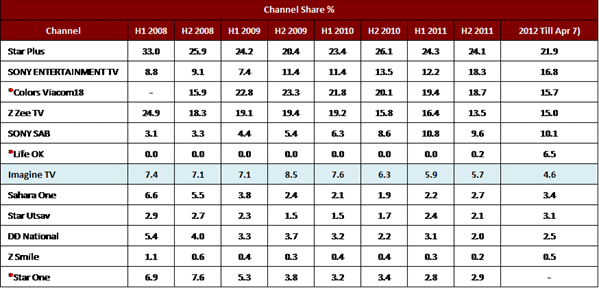
     

    Source: TAM Media Research / TG: CS 4+ yrs / Market: HSM / Period: H1 (Jan-Jun) & H2 (Jul-Dec) 2008, 2009, 2010, 2011 till April 7, 2012

     

    Mohit Joshi
    Divya Radhakrishnan
    Karthik Lakshminarayan
    Pankaj Krishna

    Explaining the implications, Mohit Joshi, Managing Director, MPG said, “The General Entertainment domain is very competitive and each channel is constantly improving content and production. The viewer has many options today and hence has become more ruthless with the channel choice. In spite of a great start, Imagine lost it mid-way. In an attempt to gain viewership and numbers, it resorted to telecasting shows like Rakhi Ka Swayamvar, Rakhi Ka Insaaf and so on. Though these shows could have given a short-term boost in numbers, in the long run, viewers didn’t find the content appealing enough. Also these shows dented the channel image by giving it a ‘sleazy’ tag – which is not acceptable in the GEC domain.”


    Divya Radhakrishnan, Founder, Helios Media, said, “GEC is a highly competitive segment and the cost of running a GEC is very high. Imagine had reached a level of stagnation especially in the last six months, however shutting down was not expected.”


    Karthik Lakshminarayan, COO, Crest, said: “Imagine had the brand heritage of NDTV and Turner. I think it was sheer bad luck that they eluded that one show which could give them success like Kyunki did for Star, Saat Phere did for Zee, Ballika Vadhu for Colors and Bade Acche Lagte Hain is doing now for Sony. For a GEC to break even it takes 4-5 years so one needs to stay invested for a long period to see the returns, hence the move is a surprise.” In fact, he has a surprising statement to make: “Their overnight decision has caught us unawares and our media plan needs a quick revision. We had spots to go on air on the channel as we talk. I think now those spots are up for grabs and may the best player win.”


    Blame customer pull, not distribution!

    There are primarily two ways of impacting Channel Trials – namely Consumer Pull led by content affinity, and Broadcaster Push led by Distribution initiatives, explains Mr Pankaj Krishna, Founder and Managing Director, Chrome Data Analytics & Media (see Analysis: How Imagine lost due to consumer pull, not distribution. “Going by Chrome OTS numbers (Opportunity To See – percentage of households that have access to a channel) – Imagine TV has clearly been in the league of the top GECs with an OTS of 95% across HSM.”


    According to Mr Krishna, “consumer pull clubbed with Strategic Distribution Planning has a huge impact on the overall performance of a channel”. “Over the years, Imagine lost out on factors contributing to the former.”


    Staff shocked

    It was Terrible Thursday for the staff at Imagine. They had no clue of the closure, even as they had faced yet another week of dismal ratings from TAM. Said Jain on the fate of the staff: “Turner will retain some employees for a transition period and some others are being offered permanent roles within other Turner channels to fill current vacancies. For the other Imagine employees getting impacted, Turner has set up an HR outplacement service which will provide advice on how to write a better CV, interviewing techniques and other job hunting skills. We will also introduce the employees to recruitment consultants, HR professionals from other media organizations and facilitate their new job search. Our focus is to ensure the closure is executed in a fair and appropriate manner for all of them and in full compliance with all legal requirements, employment terms and company policies. We will use our best endeavours to make this as smooth a transition as possible for them.”


    There has been much dismay in the brodcast fraternity too. Colors CEO Raj Nayak in fact made a clarion call to the industry via Twitter: “To all my friends in the TV business. Let’s try & accommodate our friends from Imagine wherever we have vacancies in our system.”


    Way ahead

    The move does spell a warning for other broadcast majors to sit up and take notice. Let’s not forget examples of a few channels that had to shut shop midway including Star One, Zee Next, 9x and Real for lack of vision and programming blunder.

     

    Ashish Pherwani

    As Ashish Pherwani of E&Y writes in his analysis for MxMIndia (when is it right for a channel to pull the plug): “Over the last decade or so, most unsuccessful channels which have tried ‘overhauls’ and ‘makeovers’ that have failed to achieve their objectives within six to eight months, have eventually shut down their operations.” According to him, for a channel to succeed, “the only asset it has is viewership. Channels which operate without a robust management team, a unique market position, and a defined target audience, won’t be able to garner sustained and loyal viewership. If channel management is able to make these three aspects fit seamlessly together, chances are the channel will succeed as a business, else, it would make business sense to pull the plug!”


    Turner may probably pay heed to Pherwani’s suggestions if it ever were to take another swipe at launching a Hindi general enterainment cahnnel  channel. Going by its past track record where it teamed up with Alva Brothers to launch Real and proceeded by acquiring Imagine from NDTV, chances are that the network may already be on the prowl hunting for its next prospect. Until then, the network seems content to bask in the laurels of its sister channels that have been showing good growth in the genres they operate in.


    Written by Johnson Napier with inputs from Anil Thakraney, Ashish Pherwani, Pankaj Krishna, Kshama Rao, Tuhina Anand and Robin Thomas


     

  • Havas Media wins Air France global account

    By A Correspondent


    Havas Media retained the global Air France account following a competitive pitch with VivaKi (Publicis Groupe) that commenced in the second half of 2011. MPG, the largest media network under Havas Media, will support the win. MPG will manage the Air France account out of the French hub.


    As the global agency of record, MPG and Havas Digital will continue to handle both the online and offline media responsibilities for the airline in all 54 Air France markets. In addition, Havas regained digital markets throughout Asia that had previously been managed by VivaKi, including China, Hong Kong, India, Malaysia, Vietnam, Singapore and Philippines.


    “On behalf of the whole team, I would like to thank Air France for renewing their confidence in Havas for the fourth time, thereby continuing the relationship that has been in place since 1992,” said Pascal Dasseux, COO Havas Media France.


    Havas Media – a real-time Global media agency leader – seeks to bring to Air France real-time solutions and constant reactivity thanks to a widely interlinked network; all Havas Media agencies will collaborate more closely and efficiently using their proprietary Flightdeck tool as well as the management and optimisation of paid, owned and earned media.


    MPG anchors the world’s fastest growing global media network, Havas Media. MPG provides media planning & buying, strategic consulting, branded entertainment and interactive marketing services for a range of clients in every region of the world. With offices in over 100 countries, MPG consists of over 5,000 media professionals working across a broad variety of disciplines and categories. MPG was named Mediapost’s Media Agency of the Year 2009-2011.


    Havas Media, the global media network of Havas, is one of the world’s fastest growing media groups having grown from 10 markets in 1999 to 122 markets in 2012. The companies within Havas Media include: MPG (Havas Media’s global media communications network), Arena Media (Havas Media’s tailor-made communications network), Havas Digital (Havas Media’s global interactive network) and Havas Sports & Entertainment (Havas Media’s global sports and entertainment communication network).