Tag: Mobile

  • Star World to showcase Packed to the Rafters digitally ahead of TV launch next week

    By A Correspondent


    Star World is all set to air Packed to the Rafters for the first time in India. Packed to the Rafters’ is an Australian drama series which revolves around the story of the Rafter family, who are fighting different problems of life together.


    To make the show more relatable to the audience, Star World got Karan Johar as the face of its campaign. The channel launched a six week on-air campaign with him. And the channel has unleashed robust print, digital, DTH, cinema, radio and OOH campaign given the launch next week.


    In keeping with the growing importance of the digital platform, the channel will be hosting a Web Premiere across the Star World website (www.starworld.in/PTTR) and other social networking sites to give the viewers an experience of the show before it goes on air. Star World will be taking such initiatives up for key shows to create reach and buzz. The digital premiere will be held today (November 30) before its official launch on the channel on December 4.


    Subsequently, each of the episodes of the show will be available to be streamed and viewed on the Star World web and WAP platforms after it telecast on air. A tie-up with Vodafone will ensure viewers can catch up on the key moments of the show at their convenience.


    Commenting on the show, Rasika Tyagi, Senior VP, English Programming, Star India said, “From our Hindi and Regional GECs, one of the biggest learnings is that viewers seek life lessons from the daily soaps they watch. The issues faced by the Star World audience, the English speaking, urban Indian youth, is quite myriad and they don’t get to see shows which reflect their life on TV. Our audience will be able to resonate with the issues faced by the characters in Packed to the Rafters and emulate the way they resolve the conflicts.”


    Commenting on the digital catch-up service, Rasika Tyagi said, “When we go for consumer home visits, we get a reality check on how content is being viewed by the youth today. They want to watch a show at their convenience – anywhere, at any time. So, we as content providers have to gear up to share our content across platforms, on internet or on mobile.”


  • Watch IPL on mobile through Apalya

    Apalya Technologies, specializing in mobile video streaming delivering more than 150 plus million minutes and the leading mobile TV service provider for all telecom service providers will provide exclusive, mobile, video streaming for all the matches of the 5th edition of the IPL. This will be the 4th consecutive year for Apalya for IPL Streaming.


    Apalya Technologies, this year again, through its platform will enable sports fans to catch all the DLF IPL action real-time on their mobiles even when they are ‘on-the-move’. Subscribers will be able to watch it on the mobile through their existing mobile service providers, as Apalya has tied-up with all the leading telecom partners in India to enable the DLF IPL Mobile stream on the existing Mobile TV service. To avail this, subscribers can SMS TV to 58888.


    Speaking about this alliance, Vamshi Krishna Reddy, Co-founder & CEO, Apalya Technologies said, “We are happy to announce that we are yet again the Official Mobile Streaming Partner for IPL 2012.  This year we aim to cross 10 million subscribers with IPL V and expect the viewing minutes to more than double. Thanks to the evolving 3G network, better and stable 2.5G network coupled with advanced smart phone proliferation in the market, mobile TV has been a big success among consumers who are always on the go.”


    With emerging technologies and growing mobile video viewing habits, India records over 200 million video views a month on mobile devices and Apalya is all set to capitalize the opportunity to tap the interest of the youth, allowing them mobile video viewing for various popular events. During the World Cup season in April 2011, Apalya generated 17 TB of streaming and with close to 50 minutes of usage per user for the 6 matches India played. Currently, Apalya powers mobile TV for all the major telecom service providers in India and has also launched its services with leading operators in Sri Lanka & Indonesia.


  • Why FM is more than just a recall medium: Rabe Iyer

    By Rabe T. Iyer


    Old media don’t die! They just bounce back in new avatars. Not so long ago, radio had been written off as dreary, downmarket and not so cool. Television and, later, “new media” were touted as being media of the future. Thanks to advancements in technology and a change in lifestyle, radio has made an incredible comeback.


    FM radio stations are one of the most popular entertainment mediums, offering millions of Indians a great mix of shows covering music, contests, discussions, humour and gossip, delivered in local flavour by popular young radio jockeys.


    Radio is a medium of the senses, bringing the listener’s imagination to life and taking him into an exciting new world of his own. Thanks to local FM stations, marketers have been able to connect with their target group, especially the youth, like never before.


    According to industry experts and analysts, there are 250-300 million radio users today. This penetration is surprisingly more than that of newspapers, known to be the oldest among present day media. In addition, at 145-150 minutes per day, the consumption time of radio is more than that of television, which stands at 140.  Today, 80-90 per cent of mobile users access the radio on their phones.  The fact that the medium is mobile has clearly helped to increase its usage and popularity.


    With the rollout of Phase III licensing, the Indian radio industry is optimistic of huge growth. The industry, which currently brings in around Rs1,100 crore revenue, will see 800 new radio stations across 300 towns coming up.


    Here, radio-based advertising can be used effectively for communication and positioning. It is to be used well since it can target a large audience because of its immense reach. It is useful in increasing awareness about a brand or business and helps in enhancing the brand image. The past couple of years have witnessed a flurry of activity in the FM sector. Not surprisingly, the radio industry of today can be compared to television in the early and mid-nineties, and one that is all set to boom further.


    With carefully worded scripts, brilliantly created situations, and tailor-made strategies, radio advertising is getting more innovative and effective day by day. It is perhaps one of the simplest yet most cost-effective and powerful means of communication in today’s world.


    Studies indicate that instead of two back-to-back commercials on television, one commercial on television and another one on radio give about a 20 per cent higher brand recall. Also, a television commercial, if aired on radio, works very well as the listener can then visualize the entire advertisement. Hardly surprising that over the years, print based publications and television channels have been using radio as a support medium, as a reminder medium, and as a mean to building up frequency.


    As mentioned earlier, another interesting facet of the Indian radio story is the mobile phone explosion and its convergence with FM. This has exponentially increased the width and depth of the market.


    Radio offers tremendous opportunities for advertisers and media planners who need to explore various options, following which they can effectively use the medium in their media mix. Conversely, broadcasters need to develop the market by being more responsive to an advertiser’s needs. This will provide an opportunity for the market to arrive at the final verdict on the effectiveness of the medium inIndia.


    Rabe T. Iyer is Business Head, 92.7 BIG FM


  • Digital Summit: Business in the time of the cloud

    By Akash Raha


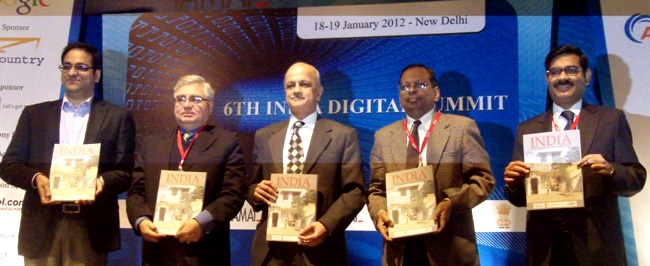
    The second day of the Sixth India Digital Summit hosted by IAMAI and Ministry of Information & Technology got underway in Delhi on January 19, 2012. The last day of the summit featured a wide array of discussions and debates between prominent members of the industry.


    Leadership Session 3: The connected home: devices and service revolution

    In the current scheme of things there is a proliferation of newer devices. Each and every day there are a plethora of newer devices coming in the market. To support all these devices a new service industry came up to support them. The session spoke about the nexus of devices, connectivity and the service sector in the back drop of the nuances of the industry, such as security.


    The session was chaired by Mr Sanjay Trehan, Head MSN India, Microsoft and the stage along with him was shared by Mr R Sivakumar, Managing Director, Intel South Asia.


    The discussion started off with Mr Sivakumar talking about the connected home. He said that the times have changed from connected homes to connected life. Earlier, Home was where the first use of technology begins. We have been using technology over the past decade without knowing about it. But some of those ideas are fast dissipating as our devices are no longer wired and we can move outside the periphery of our house and hence the idea of connective life.


    As technology has developed, the proliferation of devices too has increased. He said that the technology in the future will be dominated by three screens out of all the new devices based on convenience and ultra mobility – smart phones, netbooks and large television screens.


    He spoke about the growth of ecommerce and gave the example of the Indian Railway site irctc.co.in which does business of Rs 500 cr each month. The service provided is getting more sophisticated and more available as time goes by. With proliferation of device and connectivity, services provided online are increasing.


    When posed a question on security threats by Mr Trehan, Mr Shivakumar said that the security capabilities are still at its early stages and have to be built on. In terms of new technology, the bogey that we often ride is the talks of national security. National security and integration of security protocol is very important and yet there has to be ways to streamline the whole process and allow newer technologies to come in.


    Power Panel 7: Cloud Cluedo – Solving the mysteries surrounding the cloud

    The following session tried to unveil the mystery of cloud computing technology. Even though everyone in the technological domain are talking about this technology and its use, few people know about the intricacies of it, which the panel tried to unveil. Cloud computing gives one the ability to put business applications on the ‘cloud’ which would then make it possible for the users to access it from wherever he or she wants to.


    The following session was moderated by Manoj Chugh, President India & SAARC, EMC Corporation while the panelists were Mr Fredric Moraillon, VP – Marketing, Asia Pacific & Japan, Akamai Technologies and Rajnish Menon, director – ISV & Cloud Strategy, Microsoft.


    In his opening remark Mr Chugh explained that there are various kinds of clouds, such as Private Clouds and Public Clouds… Moreover, there is a whole mix of these clouds which gives rise to Hybrid Clouds of all shapes, sizes and colors. Cloud computing saves cost of infrastructure and will help businesses grow in the future, thereby creating new job opportunities. Moreover, while the old skill sets are going to remain important, new skill systems are needed for Cloud.


    According to sources, 50% of the cost of infrastructure can be saved when a business employs and moves their infrastructure to the Clouds. The initial cost of the infrastructure will depend on what kind of a Cloud it is. No two clouds are alike and clouds constantly grow and make newer clouds.


    Mr Menon explained to the audience that Cloud is very useful as it standardizes IT capabilities. To show the efficacy of cloud, he pointed out how all the fortune 500 companies have some sort of Cloud or the other. The point is, that Cloud is already here and is all pervasive.


    The next question that Mr Menon talked about is, is Cloud secure? The answer that he proposed was, yes, it is one of the most secure one as authority is given to only one or two who can see all the data. For those who wondered how costly cloud is, Mr Menon told that “Cloud is really cheap, but it depends on what applications you are using etc.”  In terms of regulation, currently, there is no cloud law in place in India and it is all about interpretations of the other existing laws.  Cloud computing has therefore become a new way in which one can deliver and consume IT.


    Talking about the cloud, Mr Moraillon said “From the Cloud perspective the consumer and the business are constantly merging.” He said that one can put anything on Cloud…But the question is what do you want to put on the cloud but the question is what the security level you have to secure that data is? Information is of value and it is important to keep it in the vault. But yet Cloud is useful as it is helpful and makes work and processes much easier. “You can do a campaign, a budget, file travelling expenses etc… Cloud can do all of that very easily and efficiently.” Today, one feels disconnected when ones hard disk crashes – a lot of hard work goes away, but such a thing does not happen with Cloud as the data will be present and secure on the cloud.


    The three important aspects which Cloud is efficient on is Time, Money and Labour; Wherein, it saves time and money, and allows employees to work just the way they want to work, from wherever they want. In the modern times markets are extremely fragmented and clouds helps adapt, open newer avenues to connectivity and the way work is done. The only possible concern that some businesses still have today is that of accessibility and security, however, cloud is developing and is developing fast. It is imperative that businesses move to cloud to be successful in the future.


    The panelists explained that one should move easier process on the cloud first and then go on to bigger process which have legacy and are relatively harder to move. But to start moving to the Cloud, maintained all the panelists, is essential.


    Power Panel 8: “To be or not to be an Entrepreneur”

    Being an Entrepreneur and building a business out of the scratch is never easy. In the current session the panelist discussed and talked about their difficulties in becoming successful Entrepreneurs. The talked about their experiences and shared their visions with the crowds.


    For many, starting a venture was a triggered by their situation, for some it was a choice and for the rest it was a mix of the two. The session was moderated by Manish Vij, Founder and CEO, Vun Network. The panel members for this session were Dhruv Shringi, Co-Founder & CEO, Yatra.com; Dinesh Aggarwal, Founder & CEO, IndiaMart; Rishi Khiani, CEO, Times Internet and Anisha Singh, Founder & CEO, Mydala.com.


    Mr Shringi said that currently the entry barrier is low to get into the business and it is a very good time for people to get into the business as the growth rate is good. Yet, Mr Aggarwal warns that people should not get into the business just because there is opportunity and growth. What is really required is a will to do ecommerce.


    To start off a business, funding is an important issue… Ms Singh pointed out that to garner funding and make profit eventually one has to have conviction in once business. Funding is tough and one has to have the ability to convince the investor, moreover, immense trust in once own vision is required.


    A few of the members in the panel also had a co-founder and investor… Talking about the aspect, Mr Khiani said that it not important that your partners are like you and think like you, but it is important that they have the same vision as you and believe in the product as much as you do.

     

  • Digital Summit: The new wave of mobile and social – are we strong enough for it?

    By Akash Raha


    The Sixth India Digital Summit hosted by IAMAI and Ministry of Information & Technology got underway in Delhi on January 18, 2012. The two-day summit will host a wide array of discussions and debates along with award ceremony, commemorating those who have done well in this field.


    Power Panel 2: Mobile VAS: What’s New?

    The post lunch session discussed and deliberated on the topic, ‘Mobile VAS: What’s new?’ The panelists for this session were Mr Vijay Shekhar Sharma, Founder, Chairman & MD, one97; Jay Seth, President & CEO, Air2Web India – a Velti company and Kunal Bajaj, Partner & Director, Analysys Mason India. Vishwanath aluuri, founder, Chairman & CEO, IMI Mobile was moderating the session.


    He panel debated how new technologies are coming in the market each day and how it brings newer mediums, newer devices and newer services. Each and every day technological innovations are pushed to new extremities and it gives the consumer a whole lot of options. But are these newer innovations helping the existing businesses to grow or are they hurting it?


    According to Mr Bajaj, technological innovations are constantly helping the business to grow. However, Mr Sharma was not of the same opinion. He said that currently the platforms are too digital to be efficient and new addition to digital innovations does not necessarily help the existing business to grow.  He gave the example of piracy which is constantly on the rise with the rise of technological innovations.


    Talking about mobile applications Mr Bajaj said that the future will be that of paid applications and more investment has to be made in the knowledge of how can people be made to pay. Mr Sharma too said that currently there are over 100 million people spending approximately Rs 30/- on mobile apps, which makes future even more heartening.  Mr Seth pointed out that the essence of it all remains in the fact that the end consumer is happy. An application is going to do what it is meant for and it should make a consumer happy,yet from a business perspective a profitable business model has to be made out of it.


    Power Panel 3: Social Entertainment: the merger of Content, social media and video platform.

    In the current times movie, television experience and social media all work hand in hand. Movie producers and TV shows are posting tweets and encouraging an immediate social relationship among viewers. Kicking off the discussion the moderator, Mr Neeraj Roy, Managing director & CEO, Hungama Digital pointed out how in the last 2-3 years all the newer devices that are coming in the market have internet connectivity. According to sources, he explained, by the year 2015 10 billion people will be connected to the internet, and not only through their phones and tablets but through cars, television nd other home appliances. In all of these, one thing remains constant which is a screen. At such a situation, the content provider is threatened as the system is so dynamic and yet is excited and sees the development as an opportunity. In a year and a half India will jump from 3G to 4G and sky will be the limit for content provider, seller and receiver.


    Vivek  Bhargava, Founder Communicate2 gave the example of Kolaveri di which became viral. It essentially shows the reach of the digital. Internet has become a mass medium and video consumption trends have become as such. The only option is that brands have to evolve now with changing times.


    Rahul Saighal, CMO, Aircel said “There are three important elements – content, social and video (behind which it there is broadband) and all of these are hugely disruptive force. Sale of internet TV in 2012 was 10 percent of the market share in US… the numbers in 2012 is set to rise at 50 percent. And with growth, the era of mass customization will be reached. He went on to say that the concepts of time has changed too…Time is now internet specific time (IST) rather than Indian Standard Time.


    George John, Director Marketing, Warner Bros India explained how WB has actually thought about the future and taken steps to provide content anytime and anyplace. 9 O clock is no longer prime time, rather, you can choose for yourself when your prime time is going to be in future. To be specific about social media, it is an interactive activity… The question is, is it possible to make it more interactive and entertaining is what will drive the industry forward.  Mr Saighal said that “The future of content is that you create content for a psychographic and allow the audience to engage and  share the content and make it successful.”


    Power Panel 4: eCommerce in India: Today and Tomorrow

    Online buying habits have recently picked up in India and is growing at a very fast pace. It has taken us from the high street markets to the iStreet markets and has changed the way retail industry and buying in India. A power panel deliberated on this issue and on what is the way forward for the ecommerce business in India.


    While Harish Bahl, Founder & Group CEO, The Smile Group moderated the session other panel members who participated in the discussions were Muralikrishnan B, Country Manager – India & Philippines, eBay; Sundeep Malhotra, CEO, Homeshop18; Binny Bansal, Co-founder  & COO, Flipkart and Vinay Gupta,Founder & CEO, Via.com.


    Mr Bansal maded the initial comment and said that one should forget about profitability to start of with as it is all about market share and the consumer. Mr Bahl further added that the ecommerce business has just started in India and we have to start our business thinking about the end customer. Their needs are very simple; we deliver to them what they ask for. Mr Malhotra said that currently we are not strong enough to reach a consolidation and right now we need to engage and build on customers.


    When asked how to build a lifetime of customers, Mr Malhotra said that “For a lifetime of customers one has to spend a lifetime in a business.” What is important in the current scheme of things is the frequency and not the basket size of the buy. We are too new in the business to even think about profitability and yet, one have to maintain a fine balance in our business to sustain it. Mr Muralikrishnan said that the fundamentals are imp to be built on. One has to build on consumers and engage with them but not through push marketing, but not spam marketing. There is a need for more research and understanding on the customers buying habits which would eventually help the ecommerce business to sustain, be profitable and serve the customers better.


    The panel members were of the unanimous opinion that ecommerce is a potential big industry in the times to come, and yet, comparison with western markets is unfair as it is still relatively new. The ecommerce industry is going to be the next big thing, considering the rising real estate prices too. The idea, as one of the panelist said, is to make “Malls within shops.”


  • Got an idea? Write to Times Internet to help kickstart it

    By A Correspondent


    TLabs, a mentorship-driven accelerator program developed by Times Internet Limited (TIL), is inviting bright business ideas in the field of technology, mobile and Internet to develop into world-class products. TLabs is looking for young energetic teams with a marketable idea, who have the passion and skill to execute that idea.


    Backed by Times Internet Limited (TIL), TLabs will provide funds, mentorship, and strategic and execution support to entrepreneurs in order to shape their plans into sustainable and scalable products.


    Applications are now open for the program, which commences February 2012. The 13-week programme seeks to mentor 10 start-ups. Besides an initial seed funding of up to Rs 10 lakh, it will feature interactions with experienced and eminent leaders and domain experts in India and abroad, once every week. Entrepreneurs will also benefit with rehearsal demos for the project before they ultimately present their ideas and come face to face with angel investors and venture capitalists. Entrepreneurs are free to engage with these investor communities, and execute the plan independently.


    “What sets the program apart is the access to TIL’s huge infrastructure and domain expertise. This gives entrepreneurs at TLabs the edge over other start-ups,” says Gautam Sinha, Director – e-Commerce & Technology, Times Internet Limited.


    Rishi Khiani, CEO, Times Internet Limited, said, “We want to make this a very high quality program, with very significant value addition to support entrepreneurs as well as the entire innovative ecosystem.”


    One of the companies that benefited from the TLabs program this year is DataWeave, a young start-up founded in 2011 by Karthik BR and Vikranth R from Bangalore.


    “Being chosen by TLabs strengthens our belief in our product offering. The experience of the Indiatimes network’s mentoring and the infrastructure support has already begun to show in the way we work and in the way we are perceived,” said Karthik Bettadapura, www.dataweave.in.


  • The Anchor: 5 reasons mobile advertising hasn’t gained momentum

    By Damandeep Soni


    #1 Digital is seen as an afterthought in the overall media plan. Ditto in the case of Mobile. While everyone talks about it, thinks about it and wants to do Digital, traditional media momentum starves marketers of time to think about utilizing the mobile medium. Many agencies often fail to recognize the importance of Mobile and miss out on opportunities to engage their audience.


    #2 You need a different mindset to think about engagement models using Mobile. It’s much more personal than other media consumption devices. A video, for example, created for a mobile ad should be very different from a TVC as there can be a huge amount of engagement hooks built for Mobile. While Mobile offers advertisers new opportunities for interacting with consumers, many agencies just use their web creatives for mobile ads. A lot more needs to be thought out on in-app experiences, mobile-optimized sites or landing pages rather than just repurposing creatives.


    #3 Apps have only started to take off in India very recently. In-app inventory is yet to be fully utilised. Smartphones have started making significant inroads into the country, which means apps (specifically Android apps) are set to proliferate. With a sizeable population of smartphones, an in-app ad revolution is around the corner.


    #4 Brands that are using Mobile are still thinking about the engagement model with the user – the push v/s pull debate. Do you show the user a location-specific advertisement when he is in a locality (and will that become an annoyance to the user and will he start ignoring the ad?) or do you want the user to pull the ad after checking in, using a service like Foursquare, and will there be enough users who would want to do this?


    #5 Lack of mobile sites is another issue. Most brands do not offer a tablet/mobile optimized experience to the user. Hence, even if they embark on a mobile campaign it does not give them the expected results.


    But it’s not all doom and gloom. Mobile advertising will pick up in the next two to five years. In India we are still in the early adopter stage of mobile advertising. However, once brands get to know of the engagement stats and get innovative with campaigns, there is no turning back. After all, even today, a person is six times more likely to click on mobile banners.

     
    Damandeep Soni is Vice President, Global Sales and GTM, Percept Knorigin.