Tag: Ministry of Information and Broadcasting

  • Comment: Government must not interfere in TV measurement!


    By Pradyuman Maheshwari

     

    MxMIndia has been consistent on its position that the government mustn’t have any role in the television ratings process. We wrote this in 2018, and earlier in 2016 and perhaps a few more times. That the government would appoint a committee to review guidelines on television rating agencies in India, was known. Earlier this year,  on the eve of BARC’s fifth anniversary (https://www.mxmindia.com/2020/04/on-eve-of-barcs-5th-birthday-trai-issues-recommendations-on-tv-audience-measurement/), TRAI issued recommendations on the way ratings should happen.


    So while we were appalled when on Wednesday, the Ministry of Information and Broadcasting constituted a committee to review guidelines on television rating agencies in India notified by it in 2014, we weren’t surprised. We thought that in the spirit of ‘Ease of Doing Business’, the government wouldn’t interfere. That we guess was asking for too much. It’s the government after all.


    It’s time the media ecosystem – broadcasters, advertisers and media agencies – must ask the government to not interfere.


    While a review of how BARC is performing is good to do, and what measurement should be like is a must and must be evaluated often enough, did it require the MIB to do it? Couldn’t the joint owners of broadcasters, advertisers and advertising agencies have conducted this? After all, they run businesses of over crores of rupees and are mostly fair in their decision-making. Mostly fair, because we’ve seen some regressive acts in the past. It may be noted that the BARC Board – the meetings of which happen very regularly – is constituted of members of all stakeholders.


    But back to our concern that the government shouldn’t be getting involved in measurement. As always, vested interests have evidently got onto the act and prevailed upon the government to do this.


    It appears that the genesis of the problem is the unity (or lack of it) amongst and within the three constituents. It is incorrect to let the government interfere. In fact, I may add here that the government’s intervention is a slap in the face of the stakeholders.


    The government-appointed TRAI should not have any role in the television audience measurement. Just as it doesn’t have any role in print, radio and internet audience measurement. There is some bizarre view that the reason why the government is involved is because its ads buying arm – the DAVP – loses monies because of incorrect measurement. So what about print which also earns its largesse? The government is scared of the big print players and isn’t able to bully them the way they are able to control the TVwallahs.


    The data that is thrown up by measurement is used by advertisers (and hence ad agencies) to decide on advertising and by broadcasters to aid its content and distribution. And since successive governments are aware that the media ecosystem is divided and people love to pull down others, it takes advantage of the situation. Look at print: even though an HT may hate Times, a Dainik Bhaskar may take on Dainik Jagran or Rajasthan Patrika, all rivals are almost always on one page when it comes to warding off government influences.


    Frankly, if I am advertiser, I can decide on the criteria for advertising on a certain channel. It could be ratings, it could the colour of the CEO’s shirt or saree, it could be whatever. Why should anyone else decide what the ratings should be. Will the government ask HUL, Amul, Dream11 to give reasons why it is paying XYZ crore rupees to Channel X or Y for its ads? Will the government ask Media Agency ABC why it is suggesting Channel V or W for its advertising. That’s a contract between the advertiser and the agency… Aap Inke Hain Kaun?


    Also, there can be multiple ratings agencies that can co-exist. Competition is always good to have, but measurement is an expensive exercise to conduct, and someone has to pay for it. From what I understand, the downturn has already impacted the subscription monies of BARC. It’s alright to talk of the need for competition, but one must remember that it doesn’t come free. That is if you want a quality measurement exercise.


    Bottomline: Broadcasters, advertisers and advertising agencies need to do some tough talking with the government. BARC must not toe the government’s line. BARC must not subject itself to the government’s demands.


    If BARC doesn’t do its job properly, its joint owners and subscribers will stop paying for its services. That by itself will ensure that it will provide good service. If a channel feels aggrieved, it can petition the association it is a part of to advise/tell/order BARC.


    Simple. Hai na? Time for the ecosystem to flex its muscles. And say: Hum Aapke Hai Kaun? And Kyun?


    This is the communique from the Press Information Bureau website:


    Ministry of I&B constitutes committee to review Guidelines on Television Rating Agencies in India

    Ministry of Information and Broadcasting has today constituted a committee to review “Guidelines on Television Rating Agencies in India” notified by the Ministry in 2014.

    The present guidelines issued by the Ministry of Information and Broadcasting (MIB) on Television Rating Agencies in India were notified after detailed deliberations by the Parliamentary Committee, Committee on Television Rating Points (TRP) constituted by the MIB and recommendations of Telecom Regulatory Authority etc.

    It has been found, based on the operation of the guidelines for a few years, that there is need to have a fresh look on the guidelines particularly keeping in view the recent recommendations of Telecom Regulatory Authority of India (TRAI), technological advancements / interventions to address the system and further strengthening of the procedures for a credible and transparent rating system.

    A committee has been hereby constituted to study different aspects of the television rating system in India as they have evolved over a period of time.  The Committee shall carry out an appraisal of the existing system; examine TRAI recommendations notified from time to time, overall industry scenario and addressing the needs of the stakeholders and make recommendations for robust, transparent and accountable rating system through changes, if any, in the existing guidelines.


    The composition of the Committee shall be as under:-

    i)             Shri Shashi S. Vempati, CEO, Prasar Bharti                 …. Chairman

    ii)            Dr Shalabh, Professor of Statistics,

    Department of Mathematics and Statistics,

    IIT Kanpur                                                                           ….Member

    iii)           Dr. Rajkumar Upadhyay, Executive Director,

    C-DOT                                                                                  ….Member

    iv)           Professor Pulak Ghosh, Decision Sciences

    Centre for Public Policy (CPP)                                         ….Member


    The Terms of Reference for the Committee shall be as under:

    a. Study past recommendations made by various forums on the subject of television rating systems in India and matter incidental thereto;

    b. Study recent recommendations of Telecom Regulatory Authority on the subject;

    c. Suggest steps for enhancing competition in the sector;

    d. Review of the presently notified guidelines to see if the intended purpose(s) of issuing the guidelines have stood the test of time and has met needs of various stakeholders involve The lacunae, if any, shall be specially addressed by the Committee;

    e. Any issues related or incidental to the subject;

    f. To make recommendations on way forward for robust, transparent and accountable rating system in India; and

    g. Any other related issues assigned by MIB from time to time.


    The Committee can invite any expert as a special invitee. The Committee will submit its report to the Minister for Information & Broadcasting within two months.


     

  • MIB alert on live coverage of anti-terror operations

    By A Correspondent


    The Ministry of Information and Broadcasting has notified the Cable Television Networks (Amendment) Rules, 2015, which states that no programme shall be carried in the cable service which contains live coverage of any anti-terror operations by security forces and that media coverage shall be restricted to periodic briefing by a designated officer till such operation conludeds.


    An advisory put out says that it has been brought to MIB’s notice that Monday’s anti-terrorist operations in Gurdaspur, Punjab, had some news channels carrying telecast of these operations without retstricting themselves to periodic briefing by a designated officer.


    This, the advisory notes, is in clear violation of the Cable Television Networks (Amendment) Rules, 2015 and is liable for action. The MIB has issued a desist-from-further-violation advisory.

  • So who did the ‘keeda’ on BARC with the MIB?


    By Your Editor [updated]

    The issues with the information and broadcasting ministry have been resolved. According to a tweet by BARC CEO Partho Dasgupta, the data will be released at 3pm today.

    Some of those very people who would flock to the Ministry of Information and Broadcasting against TAM are now seeing their prized project BARC (short for Broadcast Audience Research Council) getting outwitted by the MIB.

    MxMIndia has had a simple, one-line view on this: The government must have no role in audience measurement.

    Not many moons ago, some of the private channels – the news channels specifically – would go to the Ministry of Information and Broadcasting asking for it to intervene on a variety of issues.

    At that time, many in the world were against TAM. NDTV took TAM and its parent to court. The allegation was that TAM’s measurement was flawed and there was corruption in the system. Or so it appeared because that’s precisely why some of the channels which the intelligentsia thought were superb didn’t score well on the ratings roster. The story is not dramatically different for some of the elite channels in the BARC regime.

    But this is not about the ratings of the English and assorted news channels. It’s about the role of the government in ratings and the tendency of channel-owners to go to Shastri Bhavan for all and sundry requests.

    Indulging the government is like playing with fire. Our government has enough dirt to clean as part of its Swachh Bharat campaign. Leave the dirt of the industry to the stakeholders themselves and to market forces.

    The government must step in only if players go out of hand or there is a cartel leading to unfair trade practices where the public suffers.

    In the case of print, where the players are benefactors of DAVP-issued advertising largesse, it looks away from readership survey imbroglios.

    For now, the industry must find who got someone in the ministry to point out a minor procedural flaw in the way things work. Frankly, with all the contacts that some of the BARC top deck has, this could’ve been taken care of.

    Perhaps they didn’t think much about it, and rightly so. The government has no business to get involved. And not even issue any advisories. There are enough checks and balances, and in a sense until TAM exists, there is no clear monopoly for BARC.

    Meanwhile, TAM has issued a statement: “For TAM Media Research, weekly TV Viewership  data release to the Industry will continue as normal. Pursuant to the interim order issued by the Hon’ble High Court of Delhi on Feb 12, 2014, 1.7(a), 1.7(d), 16.1 & 16.2 of impugned guidelines have been stayed till the disposal of the Writ Petition 494/2014 (Kantar Matter).”

    At the time of writing (10.15am), one learns that the Minister of State has been spoken with and he has promised to intervene. So BARC data will get released by the afternoon.

    So all those souls in media agencies and TV channel offices who came in early to the offices to do the analysis, our commiserations.

    Meanwhile, the BARC folks would do well to find out who did the ‘keeda’ to unearth the licence bogey. And ask its constituents not to flock to the mantrijis for all and sundry. Keep them at bay!


  • Action time at ASCI


    Narendra Ambwani, chairman of advertising self-regulator Advertising Standards Council of India (ASCI), talks to ‘dna of brands’ about the extensive campaign to connect with consumers and educate them on how to file complaints, and seek redress, against ads which make tall claims. Everyone, from local agencies and state governments to the Centre, are now happy to partner with ASCI.


    Although established way back in 1985, would you say that 2014 was a landmark year for the Advertising Standards Council of India (ASCI), given all the activities that were undertaken in its capacity as a self-regulator for advertising?

    We have seen growth in leaps and bounds at ASCI every year, but 2014 was definitely a notable year for the organisation.


    The year started off with ASCI bagging a gold at The European Advertising Standards Alliance (EASA) Global Best Practice Awards for ‘significantly reducing’ average time taken to handle complaints. We were credited with reducing the lead time for processing complaints from an average of 45 days in 2011-12, to 28 days in 2012-13 and just 12 days in 2013-14. Recognising our efforts to curb misleading advertisements, ASCI was also made a key stakeholder in the Inter-Ministerial Monitoring Committee (IMMC) by the Department of Consumer Affairs. Further, during the year, ASCI’s role was strongly appreciated and acknowledged by the Medical Council of India (MCI) for taking action against misleading advertisements by doctors. We were approached by various ministries for a potential partnership to look into this issue. So all in all, last year was indeed a landmark year for ASCI.


    From a government that was, some years ago, questioning the role of ASCI as self-regulator, to one that is collaborating with it, ASCI has a come a long. Your comments?

    Even though ASCI was considered a self-regulating industry body, it has received considerable support from the Ministry of Information and Broadcasting (MIB). A notification dated August 2, 2006, issued under the Cable Television Network Rules, 1994, states that “no advertisement which violates the Code for Self-regulation in advertising, as adopted by the Advertising Standard Council of India, Mumbai, for public exhibition in India, from time to time, shall be carried in the cable service”. After that, ASCI received statutory recognition. The FDA authorities have also been sending us complaints against advertisements violating the Drugs and Magic Remedies Act. Besides this, ASCI is a key stakeholder in the Inter-Ministerial Committee of the MIB, as well as the Inter Ministerial Monitoring Committee of the Department of Consumer Affairs. Efforts at ensuring ethical advertising practices have earned ASCI its credibility, and the confidence of the government of India.


    While policing unethical ads is taking place through ASCI’s Consumer Complaints Council (CCC), there is still a view that by the time any penal action is taken, the damage is already done. Is this correct?

    ASCI has to provide due process for the advertiser, whose advertisement has been complained against, to respond to the allegations. Providing adequate time for the advertiser to respond, is mandated by law. However, ASCI has recently instituted three new initiatives to speed up the CCC decision process. One is to have the CCC meet four times a month instead of once, so that decision-making takes places within 12 days on an average (as opposed to a month or 45 days previously). And two, starting the Fast Track Intra-Industry complaint (FTCC) redress process, where decisions regarding complaints from one member advertiser against the advertisement of another, are taken within seven working days. Since March 15, 2013, ASCI has initiated the Suspension Pending Investigation (SPI) process. According to this, ASCI can, ex-parte, ask an advertiser to suspend an advertisement, pending final decision by the CCC if, prima facie, it is seen to cause harm or hurt to consumers and the society in general.


    If one feels an ad is making unrealistic claims and complains to ASCI, in how much time can one expect a response?

    In the past few years, ASCI has made significant changes in the complaints processing system. Thanks to electronic communication, weekly meetings of the Consumer Complaints Council and the Online Complaint Monitoring Services, the average lead time to take a decision on a complaint is 12 working days from the date a “complete” complaint was received. This includes full details of the print advertisement, the name and date of publication, and clippings or a copy of the print advertisement. In case of a TVC airing, we require the name of the channel, the date and time of the broadcast; a reasonable description of the clip, specific claims or visual depictions which are considered to be false, misleading or objectionable, and the reasons for the same.


    Would you recommend a Censor Board-like pre-release certification for ads, just as it exists for films?

    Throughout the country, there are a large number of advertisements being released every year. Under our National Advertisement Monitoring Service (NAMS) initiative, we scan at least 45,000 print ads and 1,500 TVCs every month. It is impossible to create a mechanism and run an efficient system to pre-approve every advertisement which is released in the country. No system would be able to cope with such a large number. So we as an organisation, from inception, have been promoting the concept of “self-regulation in advertising content”, and truly believe in this best practice which is being implemented all over the world.


    There are several advertisers who release ads directly through specific media, like mailers or SMS blasts. How do you check these, especially if the publication is not an ASCI member?

    Ever since the launch of our Online Complaint and Monitoring Service (OCMS), we have received complaints against misleading advertisements across all media. While complaints relating to mailers and SMSes comprise a small percentage, they are increasing year on year. Currently, we are monitoring print and TV advertisements via NAMS. However, we do have plans to also track digital media. The processing of complaints is uniform across advertisers, regardless of whether they are an ASCI member or not.


    Your Clean Ad Campaign seemed to have been quite a hit. Tell us more about it. Are you going to make it an ongoing exercise?

    We launched the ‘Swachh Ads Abhiyan’ to mark National Consumers’ Day on December 24, 2014, and made a splash about it on social media (Facebook, Twitter, LinkedIn and YouTube). Since it resonated with the Swachh Bharat campaign, it created a great amount of media buzz. The aim of the campaign was to increase awareness about false claims [made by advertisers] and combat misleading advertisements to safeguard consumer interests.


    We engaged with consumers through our virtual platforms, and this drove consumer attention towards the campaign, educating them about not to be misled through advertisements, and the importance of taking action by lodging an online complaint. We believe this initiative has empowered and encouraged consumers to make the right choices, when it comes to advertisement claims.


    The campaign was conducted through videos that lent clarity to misleading claims and invited interaction from consumers culminating with a call for action to lodge a complaint online. This resulted in 150% more people engagement and the message reached more than 2.5 lakh consumers. It also resulted in tangible change that was sustained by the social media thrust. For instance, the number of online complaints increased by 166%.


    What’s next at ASCI? What are the other activities you propose to take up?

    Our priorities for the year have been chalked out as self-discipline by creators of advertising, easier access to ASCI services, collaboration with regulators and we are keen on being viewed as fair by all stakeholders. Our major focus, therefore, would be on activities enabling these goals. We are going to launch, shortly, an online training programme called the ASCI e-learning. We have plans to further increase awareness and accessibility regarding ASCI. As mentioned earlier, in terms of collaboration with the regulator, we are in talks with the Department of Consumer Affairs and the FSSAI.


  • MIB issues Info Memorandum for first batch of Phase III FM auctions

    By A Correspondent


    The Ministry of Information and Broadcasting, Government of India issued the Information Memorandum (IM) for e-auction of 135 channels of Private FM Radio in 69 existing cities of Phase II in the first batch. It was issued in continuation of the Union Cabinet’s approval on 16.01.2015 for conduct of FM Phase-Ill auctions for these channels and migration (renewal) of Private FM Radio licences from Phase-II to Phase-III.


    Issuance of the Information Memorandum is part of the process of FM Phase III Policy for expansion of FM Radio Broadcasting through private agencies, with the objectives of attracting the agencies to supplement and complement the efforts of All India Radio by operationalising radio stations that provide programmes with local content and relevance, improving the quality of fidelity in reception and generation, encouraging local talent and generating employment.


    The memorandum comprises the rules and timetable applicable to the auction and is aimed at informing the prospective bidders about the steps they needed to take in order to pre-qualify and take part in the forthcoming auction.


    The memorandum is for information purpose only and has no binding force. Broadly, it outlines the government’s expectations in relation to the proposed auction.  All information contained in it is subject to updating, modification and amendment and does not purport to be complete.


    The ministry has issued it to facilitate and encourage potential new entrants to the Indian Broadcasting sector, as well as existing operators, to take an informed decision while participating in the auction.


    The ministry has clarified that the memorandum is not intended to form any part of the basis of any investment. Also, neither does it constitute an offer or invitation to participate in the auctions, nor does it constitute the basis of any contract which might be concluded in relation to the auction. It has been put in public domain to merely supplement and update Phase III Policy guidelines and to acquaint the prospective bidders with the design of ascending e-auction.


    The ministry has also informed that the recipients of the memorandum intending to participate in the forthcoming auctions should note that Ministry of Information & Broadcasting would separately issue a Notice Inviting Applications (NIA) for participation in the Auction which would be definitive and would take precedence.


    Details of the Information Memorandum are available on the Ministry’s website www.mib.nic.in.


  • I&B intervention gives ASCI more teeth to curb ads that violate guidelines

    By A Correspondent


    In a recent development, the Ministry of Information and Broadcasting (MIB) has ordered broadcasters not to air advertisements that have been found in violation of the Advertising Standards Council of India’s (ASCI) code and not complying with the decision of its Consumer Complaints Council (CCC). While deliberating on the complaints received in ASCI, the CCC observed that many of the teleshopping advertisements made unsubstantiated claims & violated the provision of code for self-regulation as well as provisions under Drug & Magic Remedies (Objectionable Advertisements) Act, 1954. MIB has in its Advisory compiled a list of these ads and asked broadcasters not to carry them in their respective channels and to ensure strict compliance of the advertising code in the Cable Television Networks Act (CTN).


    The CTN code and rules state that ‘no advertisement which violates the code of self-regulation in advertising, as adopted by ASCI for public exhibition in India, from time to time, shall be carried in the cable service’. Therefore, the ASCI decisions are not just bound for compliance by advertisers but also by TV channels.


    Partha Rakshit

    Partha Rakshit, Chairman, ASCI shared, “This is another feather in the cap of ASCI, in its efforts to make advertising more responsible. We were finding that some advertisers on TV channels, especially Tele Shopping Networks, were not complying with the ASCI decisions. We submitted the list to the Inter Ministerial Committee (IMC) of the MIB for their consideration. Based on that, IMC observed that any violation of ASCI code also violates the Advertising Code enshrined in the CTN Act and its rules. In short, IMC has directed that advertisements found to violate the ASCI code cannot be carried on TV channels.”


  • As time ticks on measurement guidelines, will TAM take MIB to court?

    By A Correspondent


    With the government guidelines notified on January 16, the time’s literally ticking for TAM and the entire prevailing broadcast ecosystem.


    Thanks to the persistent demands of broadcasters – especially those representing news channels – to police TAM, the Ministry of Information and Broadcasting has been on an overdrive on the issue of measurement guidelines. The perception created is that news channels are required to sensationalise to score high ratings and the government, in its effort to to keep newswallahs happy and in check in an election year, is on an overdrive. How the ratings scenario will change in the new BARC-administered regime beats us, but what we do learn is that existing player TAM is contemplating taking the Ministry of Information and Broadcasting to court.


    The plea will most likely be that it cannot comply with the requirements on ownership within 30 days so it needs to be given time. The advertisers, media agencies and select advertisers too believe that a measurement-free regime will be counter-productive. Some advertisers in fact believe a measurement blackout will force them to review their spends on television.


    According to the grapevine, TAM’s co-owners had some concerns on taking the Court route. Nielsen, we were told, was averse to litigation, while Kantar wanted it. Both Nielsen and WPP, the owners of Kantar, have steady businesses in India and there’s a concern on how taking on the government could impact its relations with the government. Industry veterans though site several instances when relations with government hasn’t been impacted by legal tangles.


    Meanwhile, even as you read this, BARC has convened a press conference in Mumbai to make some significant announcements – possibly the name of the vendor – Mediametrie or Nielsen.


  • The clock is ticking… Guidelines on TV audience measurement issued. 30 days wef Jan 16

    By A Correspondent


    Valentine’s Day this year is when the broadcast system may need to kiss the current audience measurement system goodbye. That is, if the government, the Courts or some divine power do not intervene. Or of course if TAM, the sole operator of the current audience measurement system, is unable to take some urgent measures to comply with the guidelines.


    There was a meeting with the Minister of Information & Broadcasting and officials of the ministry and key BARC functionaries in Delhi on Thursday (Jan 16) and even though Advertising Agencies Association of India President Arvind Sharma underscored the need to extend the deadline for the guidelines by five to six months, the Minister said there was not much he could do since the guidelines were being uploaded on the website and since the Cabinet had approved them, there’s little he could do in the matter.


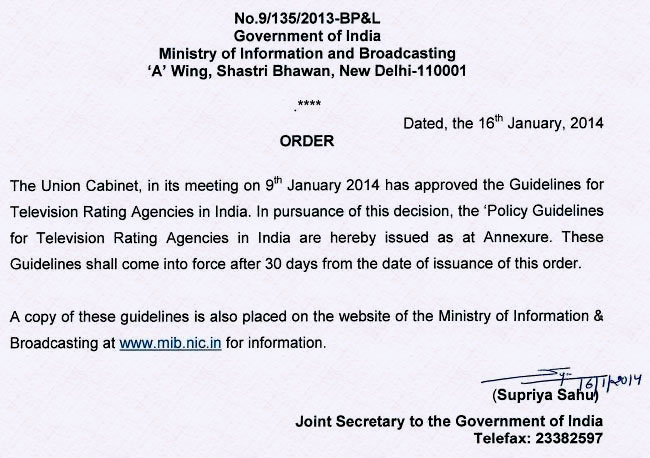
    The order on the guidelines uploaded on the ministry website is dated January 16 and it clearly states that the guidelines will come into force 30 days from the date of issuance. The 30th day would be either February 14 or 15 given when the 30-day notice comes into force – from Jan 16 or 17.


    Meanwhile, the industry is bracing for a measurement-free era. While some of those who got the government to intervene have reason to wonder if they have scored a self-goal, the real worry is for broadcasters who could now face the heat from advertisers.


    The pressure is also on the stakeholder-led BARC to ensure timely delivery of its measurement system. It may be recalled that BARC spokespersons have promised the commencement of a new television audience measurement regime by the second quarter of 2014.


  • FM Phase III: Pre-qualification bid for e-auctions starts Sept

    By Robin Thomas


    The FM radio industry has moved one step closer to the Phase III expansion as the Ministry of Information and Broadcasting (MIB) has called for tenders starting September 2012. The pre-qualification for the bidders is expected to be complete in another two months, following which the qualified companies will be allowed to participate in the e-auction for FM Phase III. The e-auction for Phase III is expected to begin in January 2013 and may take another two or three years until the entire FM Phase III expansion is completed.


    CS Kaushik, Deputy Secretary (FM), MIB (Ministry of Information and Broadcasting) and Uday Chawla, Secretary General, Association of Radio Operators for India (AROI) have confirmed the development to MxMIndia.


    It may be recalled that the Union Cabinet had given its nod to the e-auction for FM Phase III. In November 2011, an Inter-Ministerial Committee (IMC) was constituted in the MIB with an aim to guide and supervise the process of e-auction and to award the license of FM radio stations to private agencies under the FM radio Phase III expansions.


    FM Phase III policy seeks to extend FM radio services to about 227 new cities. Phase III will cover all cities with a population of one lakh and above, simultaneously, there will be a total of 839 new FM radio channels in 294 cities. In addition, FM radio stations will also be allowed to air news, but sourced from AIR (All India Radio) only.


  • Industry welcomes DAVP plans to embrace digital with cautious optimism

    By A Correspondent


    Directorate of Advertising and Visual Publicity (DAVP), the multi-media advertising agency of the Government of India, in its Annual Report 2011-2012 stated that out of the total value of advertisements released by DAVP, 15 per cent goes to small newspapers, 35 per cent to medium newspapers and 50 per cent goes to big category of newspapers. DAVP also has an audio visual wing which undertakes various advertising or publicity campaigns through various other multimedia vehicles like the television, radio, out of home and now even the internet and mobile.


    In what could be a shot in the arm for the digital industry, DAVP has been conducting pilot projects on websites and through SMSes. According to DAVP’s Annual Report 2011- 2012, 33 of India’s top websites were empanelled for releasing advertisements. In addition to this, more than 110 advertisements via SMSes were also sent.


    Rajan Anandan

    According to Mr Rajan Anandan, VP and Managing Director, Google India: “This is a welcome development for the entire digital advertising industry. With over 120 million Internet users in the country, digital is already the third largest advertising medium in terms of revenue in the country. It’s too early to talk about the impact, but it’s definitely a step in the right direction as the overall marketing/advertising approach is making a shift to being more accountable and measurable.”


    In fact on July 26, The Sectoral Innovation Council by the Ministry of Information and Broadcasting submitted a list of recommendations to the Minister of Information and Broadcasting, Ms Ambika Soni. One of these recommendations stated: ‘New Media should be utilised for media campaigns by the government’. In addition to this, it also recommended that ‘E-mode transactions should be a priority for the functions of DAVP, RNI, CBFC and licensing activities of the Government for ensuring transparency’.


    Arpan Chatterjee

    Mr Arpan Chatterjee, online media professional and consultant with webdunia.com noted: “This is a logical extension by DAVP to focus on digital media, which is generating a critical mass in the country. It is to be noted that DAVP started digitization of its own system of issuing release order and payments to media companies over a year back and the fact that it is now looking at digital media more seriously was only a matter of time. DAVP’s move to enter the digital media will only add to the importance of the digital medium, but how it uses the medium is something one has to wait and watch. DAVP ads can also help create certain guidelines for internet advertising in India, which currently is self-regulated.”


    Even before these recommendations were made by the Sectoral Council, the IAMAI (Internet & Mobile Association of India) is said to have lobbied hard to bring a shift in the government’s approach towards digital media. The IAMAI is also said to have played a key role in getting the mobile SMS aggregators empanelled.


    Dr Subho Ray

    Dr Subho Ray, President – Internet & Mobile Association of India (IAMAI) explained: “Today with 100 million internet users and growing every day, digital is the most cost effective way to reach out to youth and, through them, their parents. The engagement with internet and mobile of the youth is very deep and the relevance of the message too gets transmitted on this medium. Young urban voters aged between 18 and 35 are a major constituency today for all political parties. And the internet, whether through mobile or PC, has surfaced as the best medium to reach this group.”


    DAVP recently revamped its website with an aim to make it user-friendly, it has also adopted digitization by issuing release orders and payments to media companies online. In fact the Ministry of Tourism is said to have been one of the early adapters and a large advertiser online. While these developments also show the government’s willingness to use digital, nevertheless what remains to be seen is how effectively the medium is used by the government in the long run.


    Mr Gyan Gupta, CEO, Dainik Bhaskar Digital Division pointed out that although these are good recommendations and a welcome step, it all depends on how much DAVP is willing to spend on digital. Just like any other medium, digital too needs a sizable ad spend: “DAVP has started this process last year and the trial is still on. Although this is a fantastic move, the question really boils down to how much is the government willing to spend on digital? What will be the ad spend from DAVP on digital? Digital today has become the third largest medium with increasing reach – it has become a medium which cannot be ignored. But, if the government is not willing to spend a sizeable amount or if each publisher does not get a decent money or ad revenue then it is not worth it, it will be irrelevant.”


    Mr Gupta too had a set of recommendations for the DAVP, which is said to have had a consensus among the other local language publishers: “First, they have to look at the categorization of the website very clearly and second, DAVP must also ensure that enough volume of advertisement is pumped into digital.”


    Now that more and more people are gaining access to the internet and spending more time online, not just in urban but also in rural India, perhaps the government has realized that it is a medium it can no longer ignore. With the 2014 general elections fast approaching, the government is expected to increase its advertising spends in order to showcase its achievements and with the Council’s recommendations to use digital, the government could well use digital extensively to reach out to the youth.


    Mr Upen Rai, Director, Times Internet Ltd, observed: “By bringing digital publishers into the DAVP fold, the signals are very clear from I&B ministry that it is digital all the way. With e-filing of taxes and other e-govt frays including Passport Kendras, it was a matter of time! Next stop would ideally be its relevance to general elections, yes this time around social, and digital will play a large part… Watch out for this space…”


    The 2009 Lok Sabha elections or general elections saw political parties advertising online and the next general elections could well see political parties further increasing their spends online.


    BG Mahesh

    Mr BG Mahesh, Founder and MD, Oneindia.in said: “Considering the contribution of Government ads in Print and TV channels, if the similar importance is given to the digital medium, it will be a very good sign for the Digital industry. It will not only fuel the higher growth rate for the digital industry, but will also provide the government a better connect with youth of country who spend a lot of time on Internet. Furthermore, if DAVP also extend the digital spends to mobile internet, the reach would be much broader as today phones with internet connections, or smart phone, start from as low as Rs5,000 and their dependence on electricity is very less as compare to desktop/laptops.”


    So, how would the youth of today react to government advertisements? Will it have any positive impact on them? Ms Chhaya Balachandran Aiyer, CEO and MD, BCWebWise said: “Awareness will increase, and we can pave the way for a betterIndia. We will see more open forums, debates and discussions. There are perils of uncensored content, at the same time, and this is something India needs today.”


    Chhaya Balachandran Aiyer

    So, while the industry has welcomed the Sectoral Innovation Council’s recommendation that the Government must utilise the new age media for its media campaigns, there is a cautious optimism among industry players as far as ad spends in the medium is concerned.


    Mr Anurag Gupta, MD, DGM India stated: “Government spending should be seen in the same light as spending by any brand. A marketer spends his monies where the users are, and if users are online then the best way to reach them is by advertising online! Any online media consumer whether it is youth or the older people will react to online advertising by the Government in pretty much the same manner as they would seeing the same ad in print or on TV.”


    Anurag Gupta

    Nonetheless if the government approves of these recommendations and does increase its digital ad spends, it would be a major boost for the entire digital industry particularly for increasing the digital advertising revenue. Currently, DAVP ad spends seem majorly skewed towards print and, to an extent, even television. However as the government increasingly uses the new age medium, what kind of implications digital advertising may have on DAVP ad spends only remains to be seen.


  • MIB amends law, asks cable trade to furnish correct DAS info or face cancellation/ suspension

    From the MxM Infodesk


    Although the news was flashed by the wires last week, it got official only on Saturday. The Ministry of Information and Broadcasting has decided to amend the Cable Television Network Rule, 1995 (Cable Rules) making it obligatory for every Multi-system Operator (MSO) and Local Cable Operator (LCO) to provide correct and timely information to the Ministry as and when it is sought for.


    The background: The I&B ministry has been closely monitoring the preparedness of various activities for the implementation of Distributed Antenna System (DAS). The success of DAS depends on timely seeding of STBs at the consumer premises. As such, availability and deployment of set-top boxes (STBs) by MSOs / LCOs are paramount important for the implementation of DAS. Timely availability of accurate data with regard to the seeding of STBs by service providers (MSOs/LCOs) is also critical for the Ministry to ensure digital switch over within the timeframe as well as for taking mid-course corrections if necessary. While assessing the preparedness of DAS in four metros, the Ministry has come across numerous inconsistencies of data provided by the service providers, particularly MSOs, in regard to inventory position of STB and its deployment.


    In the Cable Television Network Rule, 1995(Second Amendment) Rule, 2012, a new rule, namely, rule 10A – Obligation to furnish information – has been inserted making it mandatory for MSOs and cable operators to provide information as and when it is sought for by the Central government or state government or authorized officer or any agency of the Central government. The obligation to furnish information under the amended rule 10 A has been incorporated as one of the terms and conditions of registration of cable operator under Rule 5 A and MSOs under rule 11 D.


    As per sub-section (7) of section 4 of the Cable Television Networks (Regulation) Act, 1995, the Central government may suspend or revoke the registration of cable operators or MSOs if they violate one or more of the terms and conditions of registration. Incorporation of rule 10 A as one of the terms and conditions of registration of cable operators and MSOs will empower the Central government to cancel or suspend the registration of cable operators or MSO if the information sought for by it is not provided by them. This, MIB hopes, will ensure correct and timely submission of information by cable operators and MSOs.


  • The Anchor: Rohit Bansal on 5 must-dos for the sun to rise on Digitization on Nov 1

    By Rohit Bansal


    1. Govt and Ambika Soni must stay

    To state the obvious, for The Cable Television Networks (Regulation) Amendment Act, 2011 to kick in the mandatory switchover of the existing analogue cable TV networks to Digital Addressable System (DAS) in the four metros of Delhi, Mumbai, Kolkata and Chennai, the government must survive.


    Even if that’s a given, the minister Mrs Ambika Soni mustn’t be allowed to meander into party work. If she does, a new minister will take his or her own to time settle down, and pernicious lobbies for a status quo will have an upper hand.


    2. Ambika Soni and her babus get three states into action

    Though Shastri Bhavan bears the mantle of implementing the Act, the ministry of information and broadcasting (MIB) has no boots on the ground. So, unless Maharashtra, Tamil Nadu andBengalsee the DAS in their own interest, Mrs Soni, Uday Varma and Rajeev Takru, her two key satraps, won’t make progress beyond impotent bluster.


    3. There’s deeper monitoring and a few scalps on the lamp post

    Albeit coming late, TRAI regulations on Tariff & Interconnection would have had enough time since April 30 to sink in. The Quality of Service Regulations and the Consumer Complaint Redressal Regulations would have existed since May 14, requiring every Broadcaster and MSO to publish its Reference Interconnect Offer within 30 days of issue of the regulation, and the stipulated 30 days for negotiations between Broadcasters and MSOs, and thereafter, the MSOs and LCOs to arrive at agreements for us ordinary Joes would have been exhausted many times over. No one could then cite lack of time for fuzziness over the terms and conditions for installing Set Top Boxes and the prices of channels on an a-la-carte as well as on a bouquet basis. Also, every MSO or its linked Cable Operator would have no excuse for failing to put a Consumer Complaint Redressal System consisting of a complaint centre with toll free consumer care number, web based complaint monitoring system, as well as appoint or designate one or more nodal officers and publish consumer’s charter for DAS.


    Thus Verma and Takru have their tasks cut out. Implementation is their dharma, the concerned states their believers.


    4. ISRO delivers the promised launch

    For any stick that Takru and Varma may hold, the cable operator is wily enough to dodge them. What she can’t is if Indian Space Research Organisation’s much-delayed GSAT-7 multi-band satellite, carrying payloads in UHF [ultra-high frequency], S-band, C-band and Ku-band, leaves the ground and starts doing some work. It would then be left to Doordarshan’s Tripurari Sharan to show his mettle and put together a free-to-air DTH platform of 200+ channels on GSAT-7. If Sharan can swing that, the cablewalla will embrace DAS with a measure of fear if not conviction.


    5. The DTH Gorilla Begins to Maraud

    These folks have sat on their backsides sleeping over the opportunity that “DAS Confusion” presents to them. If only they can get cable operators to become LMOs and leverage some Rs6,000crore residing in their war chests, the pure-play cablewalla will see more in digitization than what the long-arm of the regulation can ever achieve by scaring him.


    Rohit Bansal is CEO & Co-Founder, Hammurabi & Solomon Consulting