Tag: Mindshare

  • Mediacom wins big at FOMA. Mindshare, Lodestar UM, others shine

    By A Correspondent


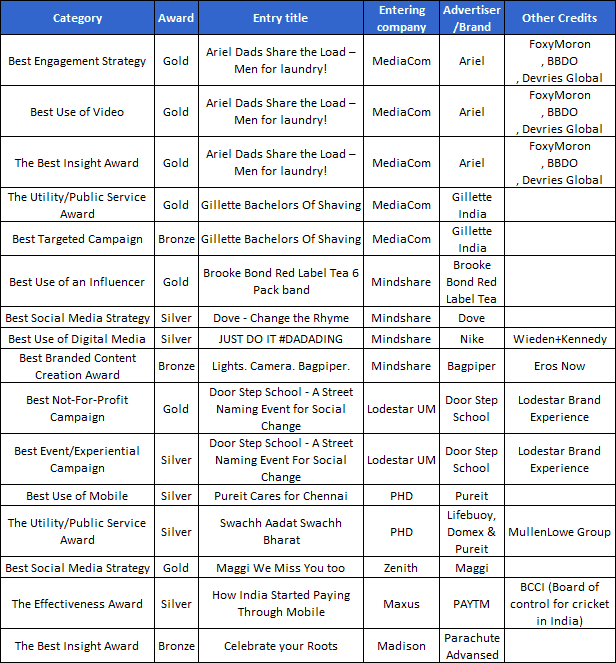
    MediaCom India won the prestigious Campaign of the Year title for ‘Ariel Dads Share the Load — Men for Laundry!’ as well as Agency of the Year. Specifically for India, Mediacom won four golds and one bronze, Mindshare won one gold, two silvers and one bronze, Lodestar won a gold and silver, PHD bagged two silvers, Zenith bagged a gold, Maxus a silver and Madison a brand.


    Overall, MediaCom won seven golds and four bronzes, Mindshare four golds, five silvers and three bronzes, while UM (Lodestar UM in India) took home four golds, four silvers and one bronze. Mindshare retained its title of Agency Network of the Year for the APAC region.


    In total there were entries from 20 countries, while the winners represented a wonderful mix of campaigns from across the region including golds from Australia, China, Indonesia, New Zealand, Singapore, India and the Philippines. India topped the country rankings with seven golds, while Australia and New Zealand were second and third with five and four golds respectively.


    Key trends and insights that came out of the judging process included a significant increase in e-commerce, m-commerce, CSR, content, social, mobile and events as part of campaigns from around the region. Judges found the Best Experiential/Event, and Best Content Awards to be two of the toughest to decide on a winner as the competition and quality of work was so strong.All winning campaigns can be seen on http://www.creamglobal.com/.


  • What is the real size of Indian Ad Industry?


    By Indrani Sen

    Last week was exciting for the advertising and media industry as the two major reports on industry Adex were released on two consecutive days. GroupM released its ‘This Year Next Year’(TYNY) 2017 report on February 14 followed by the release of ‘Pitch Madison Advertising Report’(PMAR) 2017 by Madison on February 15. In the last few days, both the reports have been published and analysed in the business newspapers and websites, leaving hardly any scope for adding any comment on the same.

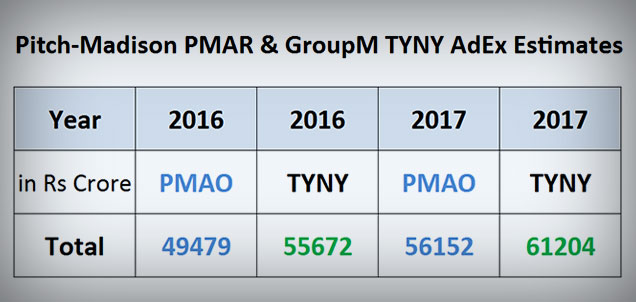
    As usual there is a difference between the two projections, this time it is of around Rs 5000 crore. The biannual report on advertising expenditure TYNY 2017 has forecast India’s advertising investment to reach an estimated Rs 61,204 crore in 2017 based on a growth rate of 10% over 2016. On the other hand, PMAR 2017 has projected a growth of 13.5% in 2017 over 2016 and has estimated the size of the industry to reach Rs 56,152 crore.

    According to Sam Balsara, AdEx dropped by Rs 1650 crore in the last two months of 2016 after demonetisation and as a result, the industry adspends narrowly missed the mark of crossing Rs 50,000 crore. On the other hand, the GroupM report, Indian advertising industry clocked Rs 49,758 crore in 2015 and crossed the Rs 50,000 crore mark comfortably in 2016 by scoring Rs 55,671 crores. Madison estimated Indian adspends as Rs 43,991 crores in 2015, Rs 49,480 in 2016 and has projected Rs 56,152 crore in 2017. The difference, between the two sets of estimates, has been hovering between Rs 5000 to Rs 6000 crore, which is not a small amount.

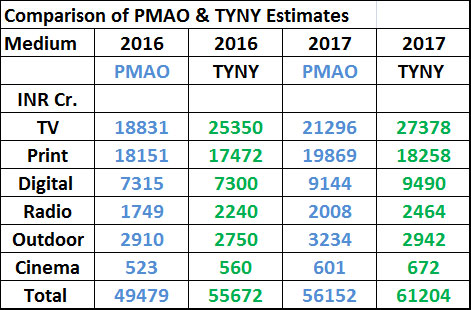
    If we compare the two sets of estimates by medium, we find that the major difference lies in the estimates of TV advertising expenditure, which is bit surprising as TV AdEx is very well-documented. Is there a difference in the way the two estimates are drawn up which leads to a gap of almost Rs 6000 crores between the estimated TV advertising expenditures?


    PMAR has shown more favourable estimates for Print and Outdoor than TYNY, while TYNY estimates for Radio and Cinema are higher than the estimates of PMAO. It is interesting to note that for Digital medium, the two estimates ran neck-and-neck for 2016 and are quite close for 2017.

    GroupM Report mentions that Media Adex reported do not include:

    • TV – special inventory like astons, L-bands, tickers, etc
    • Print – tender notices, appointments, classifieds/ matrimonial
    • Radio – activation spends
    • Digital – ad spends by SME segment
    • Outdoor – wall painting

    The above leads us to conclude that the numbers shown in the TYNY for the above five media would be actually higher than their estimations, particularly for Radio, where activation/ events tied up with digital has become a major source of earning for the FM radio stations.

    The Pitch Madison Advertising Report does not mention about the ad expenditures which are not covered in the report, but we can assume that Madison also has not covered the above expenditures which are not included in Media AdEx in their report.

    So, what is the real size of the Indian Ad Industry? Are we yet to cross the Rs 50,000 crore mark or did we cross it last year?


    Indrani Sen is a media services veteran, having worked with JWT, later Mindshare and then with Emami. In recent years, she is an independent consultant and academic. She is Adjunct Professor incharge of the Media Management programme at the Symbiosis Institute of Media & Communication, Pune. The views expressed here are her own.


  • Programmatic will not displace humans…


    GroupM has been on the forefront on programmatic over the years, and beyond what’s being at the group level, last year, Mindshare appointed John Thankamony to lead its programmatic agenda. In a freewheeling chat with MxMIndia, Thankamony spoke about the status of programmatic in India, the need for good talent and how a data-led tech-driven regime will not displace the need for humans (and negotiations). Excerpts:


    While programmatic is here to stay, and since you were with Amnet earlier in environments other than India, how would you rate India’s progress in the adoption of the new order?

    I’ll step back and take it from a few different standpoints. I think from a programmatic standpoint and where we are going from platforms, understanding user data and being able to identify data and use data effectively to buy, India is in a fairly decent space, I think. Like lot of holding groups have focused on getting programmatic in place and there have been companies coming and talking about digital and how you can target people better on digital than you can on probably other mediums.

    I think some of the challenges that you have in India are systemic, in terms ofhow we define what is effectiveness and how we measure it and I think those are challenges which are just beyond programmatic. Those are challenges that each client is trying to address like, ‘Is my advertising working for me?How is it working? What direction is it changing and things like that.’ So I think what I have seen in other markets is beyond a point, the effectiveness of programmatic is measured in a few different ways.

    One is you have data and how well can you find people that you are looking for. Lot of brands are looking for mothers. How well you can find mothers or do you have enough mothers you can target. So in that aspect India is quite high up.


    If you have to rate our progress on scale of 10, where do you think does India stand?

    For programmatic, I think I would put it on a level of around 5 or 6.


    Five or six is very good. And where would you place a market like Singapore, UK and the US?

    I think Singapore is still probably somewhere around 6 or 7 only because you don’t actually have a lot of data in Southeast Asia. It is one of the problems that Southeast Asia market has is getting the data into the ecosystem. US is probably going to be on the 9 side. Australia and US are going to be around 9 or 10. UK is also around 9 or 10 because the market is very matured, lot of buying happens programmatically, platform-led with data coming into the ecosystem and publishers are also fully enabled and the entire ecosystem is going in that direction.


    You joined Mindshare in August 2016. How would you say has it progressed in acceptability since then?

    I think there have been a lot of conversations, definitely with the clients, and also internal. Externally I think it is about having clients ready for the conversation. And I think a lot of big clients are actually ready because they are saying we want to be able to identify our audiences better, yes definitely, and being able to measure better, bringing things such as effectiveness goals such as durability in target measurement all of them to play. I think internally a lot of the conversation has been what are the kind of skills that you need, because we as a market and also Mindshare and GroupM, very strong from media buying understanding how users behave from media buying perspective. But the analytic and data-led scenario is still to come in. so, I think that is probably the gap that is going to be at rest in the next couple of years. I would say It is kind of like saying how do you transform organisations. Because it’s just not about bringing in new processes and practices but we need to get different type of people also into play.


    How do you think India can go from your score of 5-7 to a 9? What are the stepping stones to that path?

    I think one of the important considerations is definItely the kind of people you have as part of your teams, the way your teams are builtbecause technically if you look at it the very foundational aspect of it, programmatic is about being able to work on platforms and understand platform and the technology and while also bringing into the play the understanding of media and of audiences. So what we are looking at is bringing all the skills into play. When I was building my team in Southeast Asia, we had analysts come in from different industries, who had never worked in advertising. It could be from the hotel industry…we need very number-focused people who could understand how numbers flow and who could actually read the data in different ways. They didn’t approach the scenario in just the normal singleminded way. So I think it is about opening up to having new people entering and bringing new ideas and new ways to read data. That is one. People who can actually appreciate and learn platforms is very critical. I think teams like Xaxis have been embodying that very well, where they have managed to get skilled sets which are not typically  available in our media agencies together, to form a team that is technically very competent. And I think all agencies will have to undergo that journey and that’s what you can see internationally as well.


    Talent is the big issue that is there, and probably the #1 factor. In a sense even Mindshare has to look beyond its own corridors to get someone  like you. So there is an issue of talent everywhere. Would you say that as a correct assumption?


    Ya, I think it is because the need for such people has not existed until  now. We are trying to also change the market so, we are bringing in new pieces into play. We will probably be a media plus technology agency so as we move along.


    In terms of the actual spends of your clients deploying programmatic to plan and buy, how has it been for some of your large advertisers, because Mindshare has the biggest of them all.

    Ya, so I would say, and this is the journey I would say which Mindshare started with all that theme even before I was here, and I think a lot of once I came on board, I made sure I help the journey along especially for those conversations where I think where we needed some more welding of what the offering was. We have seen for some clients they were already very heavilyinto programmatic, we have clients who are 70-80% programmatic life.


    Are there certain types of clients who are really heavy on programmatic and have adapted well to the environment?

    Ya, sure I will get to that as well, like I was saying there were 70% clients and then of course there are clients at the digital mix who were at 5 to 10%, some of the clients who were at the 5-10% we have actually managed to get them to 20% to 30%. And obviously the message there has been, find your audiences better or with programmatic, find the people that you are looking for. I think there are different types of clients, and when we say programmatic it is a very broad umbrella, because we are using data to identify our users better. So there are different ways you can use programmatic. I think a lot of FMCG clients have started seeing the benefits because for them it make a lot of sense.They know the kind of audiences they want and they are very clearly define them out and they go after them. So for them it makes sense to a have set of audiences and be able to talk to them on an ongoing basis.


    A lot of buying is done based on negotiations… how does that work with programmatic? Also, if you remember a few years back in India, a leading marketer had told the agencies pitching for itsbusiness that it was not going to pay any commissions given the monies it would make from its business. How do you factor in these things?

    Absolutely and I think these are things which are definitely going to part of the way you do business. Programatic in the simplest scenario is layering data and analytics to understand how you are buying media better.  We are trying to automate whatever you can so whether it is a TV or whether it’s a digital, whether it’s radio extra.  So and I think there is a lot of the effort internationally to do this. Negotiations, discussions whatever you have at play with all partners is always going to be a piece of this.  So technology is not going to remove the thought where humans do.  It is a way of improving things and I think a lot of programmatic players across the world have been able to get this into their DNA, and they managed to get the business aspect of it into this.  Now


    As head of the entire programmatic agenda at Mindshare but do all these things worry you?  The way I can see it is in course of the interview, I am sorry not to put you in discouraging tone on a Monday morning, but I see that you said that talent doesn’t exist.

    I didn’t say that[laughs]


    I mean there is a shortage of talent. Forget shortage of good talent externally, short of good talent internally right.  And the need for clients to be educated. And then this whole thing about negotiation. Does this entire scenario – the way it is today – worry you?

    That’s a good question and I think like a lot of these things are the way you position it right.  So I think this is transitional phase and in the last 3-4 years, GroupM has been focusing on how we get into a phase where we can actually say we will do more programmatic, more data-led stuff, more content, so all of these things have been like a central focus area in Mindshare and GroupM as well. I think these are all facets of the Indian market which you have to deal with on anongoing basis and I think there are different ways to solve it and different people at play.  Will technology solve all of the issues that we are trying to sort out?I think not all of the issues. But what happens is technology gives us better understanding of what’s going on and how we can make better conversation happen and that’s the idea eventually. And it doesn’t happen overnight… it’s going to be a longer term discussion. For example, in the case of viewability and the chance for an ad to be seen into play, we understand how effective our audiences are and where they are going, right.  So if we know this across all our publishers it gives a better idea of what we are doing and what we are buying and that’s what technology allows you to do. Now if you start layering in data to understand where your real audiences are in terms of the TGs, there are measurement systems for all of that.  So it gives you better conversation and while negotiations will always be there but there will be better conversations rather than just one or two points: how much do you have and how much price can you give it to me.


    I want to ask you an unfair question and you can choose not to respond to it.  Is that– I see the success of programatic in any agency and and I’m familiar with the structure of groupM, I see the success happening when your role and that of the head of a CTG is merged, right. When do you think that could happen?

    That’s a good question and I am not going to shy away from it because I think I agree with you on some point because I think I have said this to different clients and at different points I think eventually buying programmatically should be how you move forward because you have data-enabled platform-led ways.  Now there is obviously a journey to get there because you need resources, we need people.  And I think the idea is to have a person who lead that journey to start that off and that’s where I come into play really very heavily from 2017-2018. There are a lot of people who are doing programmatic so it;s not that programmatic is only being done at Mindshare or GroupM. Programatic is a part of literally every plan.  I have said it before and I will say it again, the idea is probably five years from now programmatic won’t be a separate job description because it’s going to be part and parcel of what everyone is doing.  But it’s a journey that we have to take along and we have to bring along and it’s a journey that we have to take our clients also on and that’s where we are at here.


    There is a belief that the word programatic itself puts people off  and  makes it sound very technology and programming and code-linked.

    I think there is definitely a plus and minus to it, it’s obviously a lot of people I think have plus and minus experiences with programmatic and then they sayprogrammatic doesn’t work, programmatic is not for me and they I am doing programmatic or I am not doing programmatic.  In the modern digital advertising systems most of the times you are indulging in some form of programmatic because there are a lot of platform led, data enabled byte.   So I think the idea is you need– yes I would probably agree with you it would probably help on as it is— as we move along.  But I think having programmatic as a separate word and a separate network and as a separate channel– it’s not a channel it’s a buying type I think to start off to get people on that journey.  I think it’s the journey that we need to start off on.
     

  • Mindshare adds three more titles in recent days

    By A Correspondent


    Mindshare recently bagged three leading awards in a row recently – Ad Club Bangalore’s Big Bang Awards, DIGIES 2016 & MADDIES 2016.


    Prasanth Kumar

    Commenting on the wins, Prasanth Kumar, CEO Mindshare South Asia said, “It’s definitely been great last 10 days to have three additional and prestigious accomplishments. These awards are the celebration of some great work across platforms and especially in digital and mobile media. We understand that these recognitions are judged and recognized by jury members comprising marketers across categories. This motivates and helps us to do more disruptive and bring in incremental value to all our clients businesses. The fact that our work continue to get recognized across years and platforms clearly inspires us. We are thankful to all our clients and partners to push, support and encourage us to keep doing the best.”


  • Mindshare, Maxus win big at Ad Club Bangalore’s Big Bang Awards

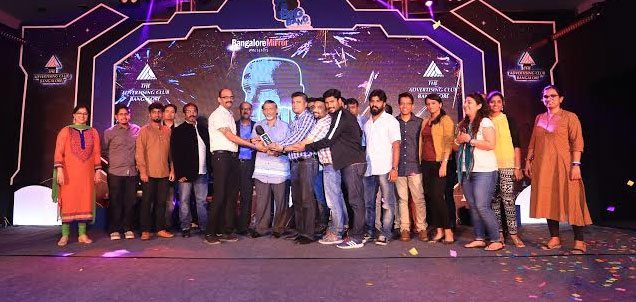
    ​Prasanth Kumar, CEO, Mindshare South Asia and team winning the Media Agency of the Year award of the Advertising Club Bangalore


    By A Correspondent

    Ad Club Bangalore successfully concluded the 21st edition of its annual awards – Big Bang Awards for excellence in communication and media on September 23, 2016 at Jayamahal Palace, Bangalore. This year, the event wasn’t just confined to awards night but was conceptualised in a manner to encourage the ideology of Connected India, which was the theme of the event. The evening commenced with Nihaal Kashinath (Founder, IOT Bangalore), S Anand (Chief Executive Officer, Gramener) and Arunabh Kumar (Founder & CEO, The Viral Fever & TVF Media Labs) sharing their opinion and views as guest speakers on Internet of Things, Connected Data, and Connected Content respectively.

    The programme hosted some leading names of the communication and media industry and was a showcase of the impressive and outstanding work of organizations in this sector. Stark Communications was named Creative Agency of the Year. Mindshare and Maxus were the biggest winners of the night bagging awards for Media, Digital, and Social Media Agencies of the year, respectively. Saatchi and Saatchi Health won the Healthcare Agency of the Year. Tata Sky won the Client of the Year Award winning across several categories.

    Commenting on the awards programme, Sanchayeeta Verma, President Ad Club Bangalore and Managing Partner, Maxus, South India & South Asia, said, “We had unprecedented interest and participation in Big Bang Awards this year and the effort was to have a meaningful and enriching event for our media, creative and marketing fraternity. I am happy that we were able to do so. Also, we had really interesting and spirited work which truly epitomised Connected India. Our heartiest congratulations to all the winners.”

    This year Big Bang awards were presented under four major categories – Creative, Media (Including Data & Tech), Digital, and Health. The awards assessment involved an online jury selection process. On the panel, 56 senior advertising, marketing, media, PR and digital industry experts and thought leaders were deployed by Ad Club. “We are the only Indian Ad Club using a sophisticated online jury process. Every jury member scores independently based on the facts presented in the entry form. No jury member knows who else is in his group and the identity of the entrant,” explained Arvind Kumar, Executive Director of The Ad Club Bangalore.


    ​    ​
    ​  ​

    Client of the Year

    Tata Sky

    Media Agency of the Year
    (Covers Digital, Mobile and Traditional Media)

    Mindshare

    Social Media Agency of the year

    Maxus

    Creative Agency of the Year

    Stark Communications

    Healthcare Agency of the Year

    Saatchi & Saatchi Health


  • Kelly Clark is new Global CEO at GroupM

    By A Correspondent


    Kelly Clark

    Kelly Clark is the new Global CEO at GroupM. Making this announcement on Thursday evening India time, the media investment group of WPP also informed the media that Dominic Proctor was stepping down from the role to work on strategic projects.


    Clark most recently served as the CEO of GroupM in North America from 2012 to 2015.  He stepped aside last year to spend more time with his family. Prior to that role, he was the Worldwide CEO for Maxus between 2008 and 2012. He served as GroupM’s CEO for Europe from 2005 to 2008, and earlier he held CEO roles with Mindshare in the UK and in Asia Pacific. Clark began his WPP career at J. Walter Thompson New York in 1988.


    “Kelly has demonstrated inspiring leadership at every turn in his career, and he has earned the respect of our clients and our people,” said GroupM’s Global Chairman Irwin Gotlieb. “He has broad experience in North America, Asia and Europe and is focused intensely on delivering advantage to our clients.  I am looking forward to working with him to build on our momentum.”


    Meanwhile, Proctor will remain with WPP to work on strategic projects. His exact role has not been defined. “Dominic helped make Mindshare and GroupM the successful global businesses they are today.  It has been a great pleasure to work side by side with Dominic over many years and we all wish him the very best,” said Gotlieb.


    And this is what Clark said in a statement issued: “GroupM is in a great position to help our clients win in an incredibly competitive marketplace. Our investments in data, technology and most importantly, our talented people will help us achieve that ambition. It will require a lot of change and a united focus, so I can’t wait to get started with Irwin and our leadership team.”


  • Our job is to challenge the status quo: Prasanth Kumar (+Video)

    It was a big haul for Mindshare at the Emvies 2016. MxMIndia caught up with Prasanth Kumar, Mindshare, CEO South Asia for a quick chat right after the event.


    395 points, Dho dala! Quite a clean sweep!

    Maine team ko 300 hi bola (I had told the team about 300). My team is wonderful. The success of Mindshare is only because of the army of talent on which it is built on. I am so happy and delighted that the dream of the ability to get fantastic outcomes. It is a fantastic moment for me and the company as well as the brands we worked for.


    What is the secret behind winning year after year?

    One is you are habituated to doing something different… you get habituated to doing something that is working for your brands. There is a sense of responsibility that comes from leadership and being a leader in the market. Our job is to challenge the status quo and get the work done for the brands. The end result is that we are winning awards.


    The body of work that you have done and won awards for can put a creative agency to shame

    The statement is wrong and it does not put any shame on any creative agency. Ideas, we believe, can come from anywhere. We are so lucky that we have talent who are able to bring in more and better results. We are not competing with any ecosystem; we are competing with the results we produce, we want success of all the brands we work for. If you have all the brands that you work for succeed, that is the ultimate success.


  • Mindshare & HUL bag top Emvies honours


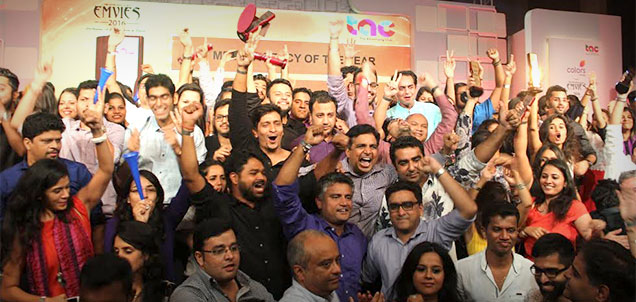
    While the city was getting set for the dhol tasha brigade for Ganesh Chaturthi, at Lower Parel’s St Regis Hotel, there was another kind of drumbeating and hooting. It was the evening of Emvies 2016, the biggest and most coveted awards for media agencies in India.


    Ad Club President Raj Nayak initiated the event (emceed yet again by Brian Tellis) by stating that the 16th edition of Emvies is special not only because it is his first time as the President but this time all records have been broken with close to 1000 entries coming in. He set the tone of the evening by finishing his speech with the chants of ‘Ganpati Bappa Morya!’


    Mindshare maintained the top spot in the 2016 Emvies, with eight Gold, 18 Silvers and 15 Bronze metals. The agency has always had anexciting run at the Emvies, winning the media agency of the year award for six straight years till 2013. In Emvies 2014, Maxus broke Mindshare’s winning streak and won the top agency title. “One is you are habituated to doing something different. You get habituated to doing something that is working for your brands. There is a sense of responsibility that comes from leadership and being a leader in the market. Our job is to challenge the status quo and get the work done for the brands. The end result is that we are winning awards,” said Prasanth Kumar, Mindshare, CEO South Asia, about the reason behind their success.


    The agency’s golden run included Best Media Strategy–Consumer Products- for Hindustan Unilever Limited’s (HUL) ‘6 Pack Band’ for Brooke Bond Red Label. In the Best Media Innovation –Branded Content, Mindshare swept up two silvers. The first came for the award winning Brooke Bond Red Label campaign, while the second was for PepsiCo India’s ‘Pepsi- When consumers became co-marketers’. They also won gold for HUL’s ‘Before Iftar time, its Lifebuoy time’ for Lifebuoy in the Best Media Innovation: Digital-Mobile. The Grand Emvie was bagged by Mindshare and Pepsi for  ‘Pepsi- When consumers became co-marketers’.


    Lodestar UM and Maxus were tied at the second place in the media agency tally with 135 points. The former won six gold, three silver and three bronze metals while the later won four gold, five silver and five bronze metals. Lodestar UM gave a tough fight to both Maxus and Madison Media. Half-way through the results there was tug of war going between these three for the second, third and fourth position. But at the end, Madison Media had to settle for the fourth position with 75 points. Speaking about their win, Dhruv Jha, GM, IPG Media Brands said, “We always love winning and we always have been winners. IPG Media and Lodestar UM plus Initiative Media, we have done really well today. We had a shortlist of about 14 and we have converted 12 of them. I was confident we are going to win but winning so big was a little surprise, but when we came close we knew we were there.”


    The other big award of the evening, Best Media Client of the Year went to HUL. “The biggest award that we get is the kind of love consumers have for our brands and that is what we work for. But it is always nice to have peer appreciation for the work that we do and it is inspiring and pushes us to do more. You get appreciation for something consumers responded to positively and loved it. That is the reason why we feel awards are important,” said Gaurav Jeet Singh, Head, Media Services, HUL, after the win.


    Another highlight of this year’s Emvies was the entry of the newbies like The Social Street and ibs in the Top 15 of the point’s tally, with The Social Street finishing seventh with 35 points.


  • Mindshare appoints Mahendra Upadhyay as Head of Data & Technology

    By A Correspondent


    Mindshare has announced the appointment of Mahendra Upadhyay as Head of Data & Technology.


    In his new role, Mahendra will be responsible for data and technology duties within the Product team at Mindshare. While he will operate out of the Mumbai office, Mahendra will also regularly be involved with the Bangalore and Gurgaon office and will be reporting in to M A Parthasarathy (MAPS), Chief Product Officer, South Asia, Mindshare.


    M A Parthasarathy, Chief Product Officer, Mindshare – South Asia, commented on the appointment, “We are very pleased to have Mahendra on board. We have a clear agenda to create category and client solutions powered by data & technology. We recognize the need for very different skill sets to drive this. Mahendra has a proven aptitude to create clarity & drive innovation through data. He has delivered growth & business results across categories. We have full faith that his passion for data and technology will ensure that Mindshare continues to deliver revolutionary solutions that significantly impact business results.”


    Commenting on his new role, Mahendra Upadhyay said, “I am both honored and excited to be a part of the Mindshare family. I strongly resonate with Mindshare’s values of speed, team work and provocation and am eagerly looking forward to work alongside a fabulous team and help redefine standards”


    Mahendra brings to Mindshare a rich experience of over 15 years, 12 of which have been in the Data and Technology space. He has worked with companies like SAS India Pvt. Limited, Reliance Retail Ltd, Bharti Telenet Limited – AirTel etc. He has expertise in various facets of Business Information Management with strong emphasis on Data Management (Integration, Migration, Data Quality, Data Governance, Master Data Management and Performance Management) and Customer Analytics


  • Borders between media & creative are getting blurred


    Mindshare India is on a roll. The GroupM agency network notched up over 176 awards last year, and this year, the agency’s Unilever team in Mumbai bagged a Grand Prix Glass Lion at Cannes for creating India’s first transgender pop group, the Six Pack Band, in partnership with tea brand Brooke Bond Red Label. Started last year, the Glass Lion honours creative work that highlights some significant cultural or gender issue. Hindustan Unilever’s Brooke Bond Red Label partnered with Mindshare Mumbai and Y Films on a campaign that would draw attention to — and generate debate around — transgenders, by creating a band unlike any other. In an exclusive interview, Prasanth Kumar, CEO of South Asia at Mindshare took questions from Pradyuman Maheshwari and Anuka Roy, about the Grand Prix win and the agency’s relationship with long-time partner HUL.


    This must be the first-ever Grand Prix where a home team, which worked on a winning campaign, wasn’t these to collect a Lion. How come all of you were in Mumbai,not enjoying the salubrious climes of Cannes?

    First of all, we are very excited and delighted that we could win a Grand Prix for the work we have done. We were planning to be there, but some things came up, and we decided to celebrate the award from India. Ours is a large network, and some of our colleagues are there. If everything goes well, next year a couple of us will surely go to Cannes.


    HUL believes in our ideas and solutions

    Winning the Grand Prix at Cannes is not just special for Mindshare Fulcrum, a unit of Mindshare India, but also for partner Hindustan Unilever (HUL). Amin Lakhani, Head, Team Fulcrum, Mindshare talks to Anuka Roy about the 20-year relationship Mindshare has with HUL, and what this win means to both of them


    Talk to us about the bond that Mindshare Fulcrum shares with Hindustan Lever (HUL)…

    It’s a journey both Unilever and Mindshare have co-created. We celebrated our 20-year anniversary last year. And after the celebrations, there could not have been a better gift from Mindshare for Unilever than a Grand Prix for the work we have done together. I am sure this will go a long way in increasing the amount of work we do, and belief in the work that Mindshare does.


    How did the Glass Lion-winning campaign come about?

    We initiated this entire brand-centric content solutions conversation. It is a matter of great happiness that one of the great ideas went on to win a Grand Prix at Cannes. It has reached the pinnacle of all work we have done through the years. What makes it more special is that we are the first media agency to win a Grand Prix in the Glass Lions.


    The success here is indicative of the creative powerhouse that is Mindshare. But how much of that does a client like Hindustan Lever value over better media rates or cheaper GRPs?

    When clients put down money, they deserve to get the best value. Given Unilever’s scale and size, and our relationship with them, it is critical that they get the best value out of it, and there can be no compromise on that. I do not think that because we seek great value, we do not see creativity. They don’t either, because Unilever also believes in the ideas and solutions that we bring to the table.


    Talk to us about the sentiments of the team that worked on this.

    They are ecstatic. I think many of my team members have not slept since they got to know [about the win]. Ad this is not only the Fulcrum teams in Mumbai, but our Unilever media team is also celebrating. The brand teams and our content partners at Y Films, are also celebrating with us. Not only these teams, but the entire Mindshare fraternity across the country, whether it is in Delhi or in the Bangalore office, everybody is joining us in the celebrations because it is a matter of great pride. As we call it in our system, the ‘purple pride’….


    Though there is no bar on anyone from sending in an entry for the Lions, typically entering the Glass Lions is the preserve of a creative agency, right?

    From what I’ve been told, the Glass Lions are about the creative work that gets picked up. We believe that every work and stakeholder in the ecosystem can be creative and do the right things needed for the brand. A lot of understanding of the brand, the market and consumer, [provides the] right perspective. Then, it is about being creative, by putting the right treatment of what communication to use, what platform to adopt, which is what every team gets into. That is how we look at this category as well. Today, it is also important that brands get integrated treatment and they are able to get the right insights, creativity and technology to use. Therefore, all this enablement should provide the right solutions for the brand.


    While one might say it’s the clients’ business that is the best thing for any agency, what does the Grand Prix for the Glass Lion mean for you as CEO of Mindshare South Asia?

    It means a lot to me. We were told that this is the first time ever that a media agency is winning a Grand Prix for a Glass Lion. We need to be lot more creative and innovative to break the clutter. This means so much to us that it encourages and motivates us [to opt for] the new things and the new innovations and product frameworks that we are putting out; our content is a separate focus where our content team is working on getting some newer products, partnerships and a better ecosystem in place, so that we are able to bring more and more precise solutions, and also bring in some clutter-breaking creativity. It also reassures us that some of the actions we have taken have started resulting in recognition for the work that we do.


    Please talk us through your relationship, as an agency, with Hindustan Unilever…

    We just completed 20 years of our relationship last year. It almost feels like an anniversary gift, and God has been kind to both of us. A lot of things have gone into the relationship: Shaping brands for two decades, launching new brands, inventing new practices that are born off more challenges. In this space, we do not feel tired even when we challenge each other, because we feel and believe that when we debate and are able to be radical, which encourages us to get precise solutions for the brands. We are happy that Unilever has also grown from strength to strength in terms of recognising our work, and also being a part of us as we feel a part of them. [Over the years] the leadership has changed, and new people have come in, but we have only grown from strength to strength. We celebrate this relationship as one of the best that we have.


    Specifically on this campaign, what was the brief and how did it come about?

    This is primarily a content initiative, and many of the ideas got discussed, co-created and stumbled upon. That is how winning ideas get formed; they develop from A to B to C, and then the teams debate on it. It then gets co-created with clients, such as us and the Y Films team. It is not a single campaign; it is an ongoing one, and we have a sixth video coming out. It is more about creating a particular cause and a platform for it, so that the associated brand is able to leverage that platform.


    Media awards are being won by creative agencies and creative awards like yours are being won by a media agency. Your comments.

    The borders are getting blurred. New technology, a way of looking at solutions, insights-driven and creativity-driven solutions are all getting into a more exciting space. What’s more, people are trying to break our records for what we did earlier, which is very encouraging because we have just won at Cannes and we cannot be complacent. We need to look at how to keep innovating.


    Media agencies are typically retained for media planning and buying. How much is creativity a focus area at Mindshare India?

    I don’t think a media agency does only planning and buying today. Our focus on data, content and digital has been so intense that our products have also evolved over the years. And being the leaders in the market by far, we also take the responsibility of shaping the practice and the market to a certain ‘right way’ of looking at solutions for brands. We have a very large content team, headed by Deven, while Ajay Mehta is content head of Fulcrum and works with Deven and Navin. Ideas can come from the media, message, and content, or from anywhere. We deal with it in every form. Some use media to understand consumers, their tastes and what they like and dislike. All of these allow the creator to understand things better and get a little closer to magical idea of creativity, which can help the brand more.


    Hindustan Unilever has some of the best creative shops working for it. So why did it get this campaign created by Mindshare and not a creative agency?

    It’s not about why they didn’t go with someone else. We had the content, and the content team’s purpose was to come up with different ideas. This magical idea happened and that’s how we got the job. We believed in the capability of doing it and had our own partners, Y Films, and came together to create a story. We are happy we won a Grand Prix for that. We’re also happy that the client supported and encouraged us so much that we able to come up with some great work.


    Last year has been good for Mindshare – the Emvies, Media Abby, the Grand Prix and various others. And we have the Emvies coming up soon.

    We have got to win the Emvies and make sure we fight for that. Last year, we won some 176 awards as well as ‘Agency of the Year’ across platforms, besides ‘Digital Agency of the Year’ and ‘Global Agency of the Year’ too. We began this year with a bang, with ‘Festival Agency of the Year’. We topped the Abbys by far and won the IDMA digital awards. And, now we have a Grand Prix. We are not going to get tired, but we are hungry: Every day and every award makes us hungrier. Every good work makes us hungrier to do better.


    Indian media agencies, including Mindshare, typically don’t do well at the Media Lions at Cannes. Why?

    Better understanding and better creativity and ability to get the brand reciprocate on better ideas, is required. It is a global platform. We see lots of work from different part of the world, and the best of the best ideas win over there. But making the shortlist is equal to a great award. However, if you have not done well as a country, it is because we need to focus on how others look at you. Many a times, learnings from others gives us more clarity on what we should do. We are happy that we have been able to make the country proud. We take it as an opportunity to learn and be better the next time.


    Many critics say that ’cause’ campaigns are done more to generate buzz and free publicity. And of course awards. Your views?

    This happened 13 months ago and was not created for Cannes. It was done for the brand. We will continue to do it, with the sixth song coming out soon. It is also true that for some of the band members, it has changed their lives. This band has made them more acceptable. It is not easy to start with an idea like this. We do not want to do it for the sake of it. Our philosophy and that of our clients is that we believe in it, and we would treat [transgenders] with the same dignity as any other celeb. That is what Y Films also did, and hats off to them for managing that. That is what we believe in, and would continue to do.


    This interview first appeared in dna of brands on June 27.


  • Mindshare appoints Maneesheel Gautam as Digital Leader of SE Asia

    By A Correspondent


    Maneesheel Gautam

    Global media agency network Mindshare has appointed Maneesheel Gautam to the role of Digital Leader of South East Asia.  Gautam is currently based in Jakarta, Indonesia.


    A true home-grown talent of Mindshare, Gautam has over 16 years of multi-function media experience across disciplines and countries. An MBA from IMDR Pune, Gautam schooled in St Xavier’s High School, Patna.


    As Digital Leader of Mindshare South East Asia, Gautam will focus on strengthening FAST (Future Adaptive Specialist Team), Mindshare’s service offering aimed at building sector-specific solutions for marketers to drive marketing and media actions using real-time insights. He will also be responsible for the growth of the Agency’s performance business in South East Asia.


    In his new role, Gautam, will report to Himanshu Shekhar, CEO of Mindshare South East Asia, and work closely with the Mindshare Asia Pacific team.


    Commenting on the promotion, Shekhar said: “Maneesheel is respected by clients, teams, and media partners alike. Being named Planner of the Year by Campaign Asia Pacific, he played a key role in driving Mindshare and our clients’ digital ambition in the market. His great work not only won industry awards for the agency, but also helped grow Indonesia’s digital sector overall. I have no doubt that he will achieve even more in his new role.”


  • GroupM wins media mandate of Malaysia Airlines

    By A Correspondent


    GroupM, along with Mindshare and m/SIX, has been appointed in Malaysia as the media agency for Malaysia Airlines, the country’s national carrier and a member of the Oneworld airline alliance. GroupM won the account following a competitive pitch, which included incumbent IPG, Starcom, Havas, and Zenith. The appointment is effective May 1, 2016, and covers Global Channel Planning, Media Buying and Optimisation, and Search Engine Marketing and Re-marketing. The entire global digital buying will be done by the Malaysia office.