Tag: Millward Brown

  • Kantar unveils new corporate identity & management structure

    By A Correspondent


    WPP-owned data, insights and consultancy network Kantar has announced the launch of a new corporate identity- for the parent brand and its 12-strong family of operating brands- designed to create a unified look-and-feel across the whole business. Operating brands not previously Kantar-branded will now take a Kantar prefix and a new, common typeface.  For example: Millward Brown, IMRB, and TNS will now become Kantar Millward Brown, Kantar IMRB, and Kantar TNS.


    Kantar’s new identity reflects and externalises an on-going change programme that started in January. The programme includes greater collaboration between operating brands and the creation of a new insights group through much closer alignment of the company’s custom brands. In addition, global operations capabilities have been brought together into a single entity and the company is moving towards more aligned shared services in HR, finance and IT. The company will shortly be adding to the portfolio of expert brands with the launch of Kantar Public, uniting its global expertise in governmental and public policy work; and Kantar Consulting, which will draw expertise from several of our brands to provide a full and broader range of marketing and sales consulting solutions and capabilities to our clients.


    Commented Kantar CEO Eric Salama: “The rebranding is a tangible, visible expression of our desire to present clients with more easily-navigable and connected solutions that bring together the best of Kantar’s expertise,” adding: “We believe our clients and partners have started to experience the benefit of this approach – in more rounded, detailed and holistic research and recommendations. And it is helpful that for the first time we really look like a single family of brands serving a common purpose.”


    Along with the rebranding, Kantar is introducing a new tagline, “Inspiration for an extraordinary world”, drawn from its new corporate purpose statement, “To inspire our clients, our people and society to create and flourish in an extraordinary world.”


    Said Preeti Reddy, CEO, South Asia – Insights, on the rebranding: “Clients have consistently asked us to be more collaborative in the way we work with them; faster and more agile at a local and global level. They want the ‘best of Kantar’ on a consistent basis, not just on occasions. Earlier this year, we put in place a whole new way of working to remove siloed thinking and barriers between the Kantar companies to collaboration for client benefits. In South Asia, we will be able to bring together the thought leadership of three powerful brands and harness the power for our clients. This combination brings with it an ability to converge thoughts when required to solve a problem as well as an ability to diverge solutions when clients need choice. That is a unique mix and in, my view, will make Kantar an even more dominant force in South Asia.


    The new identity, developed by WPP branding firm The Partners, will be rolled out across all external and internal communications channels in the coming months.

  • ‘Digital campaigns tend to drive women audiences’


    By A Correspondent


    Millward Brown, the WPP-Kantar brand, communications and media research unit, conducted its annual media gathering – ‘Millward Brown Media Conclave 2016’ in Mumbai on Tuesday. This year’s event focussed on the growing importance of digital in the larger media mix and played host to some of the country’s top most CMOs, media heads and media insights leads.


    Mark Henning

    From the complexities of consumer journey marketing, the constantly evolving media mix and the challenges in programmatic buying, there is an interesting content versus context battle underway. All of these were discussed as part of the conclave. In the words of Mark Henning, Head of Media & Digital, Millward Brown (AMAP): “We at Millward Brown have focused on the growing importance for brands to manage content to be delivered in the right context. In India, we have invested in campaign measurement capabilities that will be available to advertisers, agnostic of whether their campaigns are static or programmatic.”


    The Media and Digital team at Millward Brown collated and mined close to 130+ Indian campaigns they’ve evaluated in the recent past. A consolidated analysis of the studies, revealed some thought provoking insights. Some of the findings include,

    :: Digital adds newer audiences, incremental to the reach delivered by the traditional media channels
    :: Despite low internet penetration, digital campaigns tend to drive female audiences; especially ‘favourability towards brands’ and ‘Purchase Intent’
    :: Performance of ‘made-for-web’ ads has been observed to be far higher than ‘repurposed’ ads for video campaigns
    :: Mobile ad campaigns perform as well as the Desktop ad campaigns


    Ashish Karnad, Director, Media & Digital Solutions at Millward Brown (South Asia) said “Marketers in India have not been able to keep up to speed with the growth of the Digital medium. While I see an intent to spend more on Digital, the actual spends tell a different story. We, at Millward Brown, have been doing studies on the efficacy of the digital medium for some time now. We now have quantified evidence to prove that Digital is a very cost efficient medium and can be very effective in building brand metrics across the purchase funnel.”


    At the event, Millward Brown also took the opportunity to launch the India chapter of its global partnership with ComScore to announce a joint offering. The partnership, to jointly offer vCE (validated Campaign Essentials) and Brand Lift Insight, is designed to give brands a far deeper understanding of how their digital campaigns are performing.


  • Gaurav Hirey appointed Chief HR Officer for Africa, Middle East and APAC region at Millward Brown

    By A Correspondent


    Millward Brown, a world leader in brand, digital and communication research announced the appointment of Gaurav Hirey as Chief Human Resource Officer for its Africa, Middle East and Asia Pacific region.


    Gaurav brings more than 20 years of HR leadership experience to Millward Brown. Previously, he spent seven years with WPP’s GroupM, most recently as Executive Board member and Chief Talent Officer, South Asia. Before that, Gaurav was regional Chief Talent Officer for Maxus Asia Pacific and, earlier, Head of Human Resource for GroupM South Asia.


    Gaurav is credited with establishing a thriving value-added HR function at GroupM South Asia and has helped drive various path breaking talent initiatives which earned GroupM India the titles of the “Dream Employer in Media” and the “Best Employer Brand in the Media and Entertainment Industry” in India. He was also a part of the core team which created the Maxus PACE behaviours that have now been adopted globally by Maxus. Gaurav was awarded the HR Leadership and HR Achiever of the Year award at the World HRD Congress this year in February 2015.


    Adrian Gonzalez, CEO of Millward Brown Africa, Middle East and Asia Pacific, said, “I am delighted to be working with Gaurav. He has a superb talent leadership pedigree with WPP and will add greatly to our development as we support our clients through a period of immense change.”


    Gaurav Hirey

    Commenting on his appointment, Gaurav said, “These are interesting transformational times for the brand and communications industry. I am honoured to join a hugely credible organisation with an equally inspiring and passionate leadership team. I look forward to working with Millward Brown to help add value to our clients and employees.”


    Gaurav is passionate about helping children and was the chief sponsor for GroupM India’s corporate responsibility initiative, Lighting the Sparks. The program provides education, health facilities and support to the economically challenged children in the country. Lighting the Sparks has touched more than 10,000 children in India over the past six years and is now part of WPP’s CSR initiative and will continue helping children in need.


    Gaurav’s appointment commences on 1st November and he will be based in Singapore.


  • Insights2020 study highlights role of Insights and Analytics in driving customer-centric business growth

    By A Correspondent


    Seventy-four percent of companies that over-perform on revenue growth create customer experiences based on data driven insights, with only 30 percent of under-performing companies reporting the same, according to initial findings from Insights2020 – Driving Customer-Centric Growth, a global marketing leadership initiative. The study, led by Millward Brown Vermeer in partnership with The Advertising Research Foundation (ARF), ESOMAR, LinkedIn, Kantar and Korn Ferry, builds on the findings of Marketing2020 and is focused on aligning insights and analytics strategy, structure and capability to drive business growth.


    Based on more than 325 in-depth interviews with senior marketing and insights leaders and 10,000+ interviews with practitioners across 60 markets, the Insights2020 initiative examines the drivers of customer-centricity and how being a customer-focused company impacts business performance. The research team analyzed over-performing and under-performing companies in terms of revenue growth to understand what over-performing organizations are doing differently to drive success.


    “More than a set of activities, customer-centricity is a strategy to deliver business value against customer needs, guided by brand purpose,” said Frank van den Driest, Chief Commercial Officer, Millward Brown Vermeer and Insights2020 global program leader. “Building on the findings from Marketing2020, Insights2020 found that companies that out-perform their peers on revenue growth do so by over-performing on key drivers of customer-centricity. With a robust and global sample, we are able to quantify the financial opportunity for any business and guide organizations on their journeys to customer-centricity. The connection is clear and it is time to elevate insights and analytics to the boardroom.”


    The research revealed a number of striking differences between over- and under-performing organizations, and all tie back to three key dimensions of customer-centric growth: Total Experience, Customer Obsession and Insights Engine:

    :: 83 percent of revenue growth over-performers link everything the company does to its brand purpose, as opposed to only 31 percent among revenue growth under-performers.

    :: 62 percent of over-performers leverage insights and analytics to drive consistency across all customer touch-points, only 26 percent of under-performers do.

    :: In 78 percent of over-performing companies, customer-centricity is fully embraced by all functions whereas this is only true in 12 percent of the under-performing companies.

    :: 66 percent of all over-performers are working to link their disparate data sources, compared with only 33 percent of under-performing companies doing so.

    :: The Insights and Analytics function reports straight into the CEO in 33 percent of over-performer companies; this is true for only 13 percent of the under-performers.


    Phase two of Insights2020, available in early 2016, will build on the key drivers of customer-centric growth and will explore the roadmap for helping brands reach customer-centricity.


    Laurent Flores, President of ESOMAR added, “Our industry and clients’ businesses are in a period of significant transformation. These findings present an opportunity for the research industry to increase our impact and play a pivotal role in driving customer-centricity and business growth.”


    Keith Weed, Chief Marketing and Communications Officer, Unilever, and chair of the Insights2020 advisory board said, “I am particularly excited about practical application opportunities highlighted by the initial findings. These findings offer every CMO and Insights and Analytics leader a clear list of focus areas and I look forward to building on our initial learning as we share and explore the findings with the industry.”


    Harish Bhat, Member, Group Executive Council, Tata Sons says, “Our market is changing very rapidly, the role of marketing too has changed beyond all recognition. Most marketers are probably asking themselves, how ready are each of our organizations to drive growth in this new age of the connected consumer.  This is indeed the dawn of a new age of marketing, with limitless possibilities and equally daunting challenges. Insights 2020 has looked to understand the role of insights and analytics profession in this context, and you will agree with me that the insights and analytics profession is critical to each of our organizations, our CEO’s and CMO’s, as we take our business forward into the future. This is a study of how companies in India and other parts of the world can make best use of insights and analytics to drive customer centric growth.  Its findings are an important foundation on which marketers can build.”


    Dinesh Kapoor, Chief Solutions Officer – South Asia, Millward Brown, said “Insights2020 underscores the point that in today’s fast-changing environment, being in constant touch with the customer is fundamental to continued business success. The only way to achieve that is to create a culture where customer-centricity is fully embraced by all functions, and all data sources are linked to get the sharpest insights that deliver the best customer experience across all touch points.”


  • HDFC, other finance brands dominate WPP’s BrandZ

    By A Correspondent


    Finance brands are highest risers in the BrandZ India Top 50 with HDFC Bank being the most valuable brand for second year. The total value of India’s strongest brands has risen by a third (33%) over the last year, according to the second annual BrandZ Top 50 Most Valuable Indian Brands ranking announced on Wednesday by WPP and Millward Brown. This is the highest rate of growth achieved by any BrandZ ranking in the 10 years since valuations began, exceeding that of the Global Top 100 as well as the rankings forChina, Latin America and Indonesia.   India’s Top 50 brands are now worth $92.2bn (up from just under $70bn in 2014). The record-setting value increase has been driven by brands’ successful response to the rising sense of empowermentamong Indian consumers, and the government’s efforts to create a more conducive business environment.


    Brands in the financial sector (+49% growth) made the largest contribution to the overall increase in value, but significant lifts were also seen across most other sectors, indicating the broad strength of India’s economy and Indian brands. Home and personal care brands achieved a combined increase of 32%, followed by the auto aftermarket sector (28%), automobile brands(27%) and telecom providers (21%).


    Private companies, state-owned enterprises (SOEs) and brands owned by multinational corporations that are publicly traded in Indiaall experienced growth, illustrating how receptive the market is to brands of all kinds. 52% of the brands in the Top 50 are privately-owned, evidence of India’s entrepreneurial energy. 30%of the brands are owned by multinationals, which have successfullyadapted to the needs of Indian consumers, becoming so embedded in their lives that they are perceived as ‘local’.


    The BrandZ™ Top 50 Most Valuable Indian Brands 2015

    Rank 2015

    Brand

    Category

    Brand value 2015 ($m)

    Brand value change

    Rank 2014

    1

    HDFC Bank Banks

    12,577

    33% 1

    2

    Airtel Telecoms

    11,039

    34% 2

    3

    State Bank of India Banks

    9,374

    37% 3

    4

    ICICI Bank Banks

    5,122

    45% 4

    5

    Asian Paints Paints

    3,867

    38% 6

    6

    Bajaj Auto Automobiles

    3,345

    10% 5

    7

    Hero Automobiles

    2,907

    34% 7

    8

    Axis Bank Banks

    2,494

     New New

    9

    Kotak Mahindra Bank Banks

    2,394

    39% 9

    10

    Maruti Suzuki Automobiles

    2,318

    54% 11

    11

    Idea Telecoms

    1,981

    5% 8

    12

    Castrol Lubricants

    1,773

    40% 15

    13

    IndusInd Bank Banks

    1,542

    46% 19

    14

    McDowell’s Alcohol

    1,516

    9% 13

    15

    Nestlé Food/dairy

    1,498

    22% 16

    Key highlights of the 2015 BrandZ Top 50 Most Valuable Indian Brands study include:

    • Financial brands continue to dominate.With 13 brands in the Top 50, accounting for 41% of its value ($38.1bn), the financial sector has built brand strength by making a consistent effort to serve consumers better. Biggest risers: Union Bank of India (no.46, +72%), Punjab National Bank (no.22, +61%) and IndusInd Bank (no.13, +46%).
    • Home and personal care brands grew 32%, driven byincreased disposable income and spending on premium products, and investment by marketers across traditional and new media. These 12 brandshold 15% ($13.4bn) of the ranking’s total brand value. Fastest risers: Lakme (no.44, +69%), Lifebuoy (no.31, +49%) and Colgate (no.26, +44%).
    • Purpose is power. Indian consumers expect brands to actively participate in building a better society, and those that do have a higher brand value. Lifebuoy (no.31) has a social mission to change consumers’ hygiene behaviour, while Asian Paints (no.5) aspires to rejuvenate people’s living spaces and bring joy to their lives.
    • Indian consumers trust brands.In stark contrast with other markets, trust in brands is growing steadily. Consumers in Indiaappreciate brands, and 33% say they trust them. Among the most trusted are jeweller Tanishq (no.21), part of the respected Tata conglomerate, and Colgate, which is part of Indian folklore, and has been instrumental in organising dental check-up camps to raise dental hygiene awareness.
    • All four new entrants are of Indian origin – Axis Bank, Canara Bank, MRF (tyres) and Royal Enfield. Three are privately owned, and one is an SOE.
    • Disruption is on the horizon – from e-commerce and mobile brands that are building scale and connecting with consumers at a frenetic pace. These are not yet eligible to be ranked in theTop 50because they are not publicly traded.

    David Roth, CEO of WPP’s The Store commented: “The 2015 study shows that India is a market of great opportunities where consumers are feelingempowered, and this is increasingly reflected in their brand choices. The new Modi government is committed to creating an environment in which brands can flourish. India is distinct in many ways from other fast-growing markets, however, so simply applying strategies that have proved successful elsewhere will not work in India. Any brand intending to compete in India must gain deep insights into its nuances – such as the need to modernise while respecting the past, and the desire to remain fundamentally Indian.”


    Added Prasun Basu, Millward Brown’s Managing Director, South Asia:“India’s top brands are strong, and getting stronger – but there is no room for complacence. The top four had to grow their value by 37% on average to hold on to the same positions as last year, and close to 10% of the brands that made the Top 50 in 2014 have dropped out. To benefit from the continuing rise in consumer confidence and optimism brands need to understand the changing consumer, respond with innovative products and breakthrough communication, and experiment and invest in new media that reflect the spirit of the country today.”


    Said Ranjan Kapur, Country Manager, WPP India: “Building a successful brand in India also means helping to build India itself. Consumers are trustful of brands, but trust can crumbleovernight. Brands must work hard to sustain trust by connecting with thecountry’s communal sense of responsibility. Brands need to find ways to support the national agenda, and help to develop a more modern, prosperous and equitable society.”


    The BrandZ Top 50 Most Valuable Indian Brands 2015 report, charts and photography, can be downloaded from www.brandz.com.

  • Millward Brown unveils Media & Digital predictions report for 2015

    By A Correspondent


    Millward Brown has released its Annual Digital & Media Predictions for the year ahead. For the seventh year running, the company is providing marketers with a clear guide to the challenges and opportunities of the next 12 months.


    Authored by Millward Brown experts from around the world, the 2015 report identifies the need for marketers to empower programmatic media buying systems to do more than simply access cheaper and more targeted impressions.


    To make this transition, marketers will need to build creative that can be customized and seamlessly delivered by media buying algorithms. Millward Brown says brands that achieve this will be able to create a new form of dynamic and relevant storytelling.


    At the same time,marketers will need to ensure the advantages that come from programmatic targeting are not delivered at the expense of other key campaign objectives such as communicating brand messages and building long-term desire. Successful programmatic providers will increasingly differentiate themselves based on their ability to deliver campaigns that not only drive behaviors but also improve brand metrics.


    “To date, the debate around programmatic media has been firmly centered on the ‘how’ of operations and behavioral metrics such as cost per click,” said Mark Henning, AMAP Head for Media &Digital at Millward Brown. “In 2015 we expect marketers to be equally focused on the benefits programmatic may be able to bring to building meaningful brands and the opportunities to leverage it more creatively.”


    Prasun Basu, Managing Director, South Asia Region at Millward Brown said,” Millward Brown’s Annual Digital & Media Predictions provide a guide to how marketing is likely to change in the next 12 months. A series of media conclaves in Mumbai, Delhi and Bengaluru will provide marketers and media professionals a platform to discuss these trends and exchange ideas that will impact the way brands reach out to consumers.”


    Millward Brown also anticipates other important changes in the media landscape around the world and describes in the 2015 predictions how marketers can “get media right”.  These include:

    :: As native advertising becomes an established medium, advertisers should partner with best-in-class publishers who strike the right balance between advertising and editorial.

    :: New and exciting paid marketing opportunities will emerge on micro-video platforms, but only brands who know, learn and love those platforms will succeed.

    :: Location-based marketing opportunities will become powerful when brands focus on consumers’ interests rather than on their own.


  • HDFC Bank is India’s Most Valuable Brand


    By A Correspondent


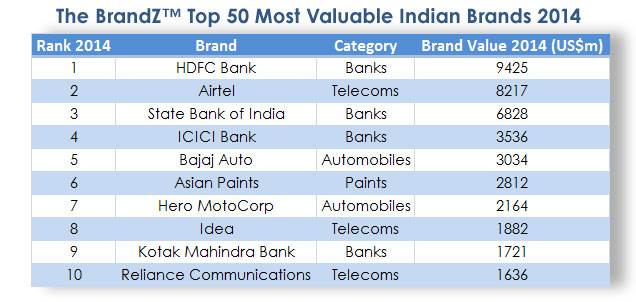
    The combined Brand Value of all the brands in the inaugural BrandZ Top 50 Most Valuable Indian Brands ranking is almost $70bn BrandZ. HDFC Bank is India’s most valuable brand with a value of $9.4bn. Carried out by marketing and brand consultancy Millward Brown in conjunction with WPP, the valuation is the only one in India that takes into account consumers’ opinion of brands to calculate the contribution that product brands make to business success.


    The BrandZâ„¢ India study shows that India’s unrestricted ‘right to play’ for businesses has nurtured great diversity amongst brands in the ranking. The Top 50 come from 13 different categories. Seventeen are multinational corporations (MNCs), 26 are private Indian brands and seven are state-owned brands. This indicates that India is an open, fertile market for building valuable brands, irrespective of age, origin, structure, category, ownership or even price range.


    HDFC Bank, the No 1 brand, has a network in more than 2,100 cities. It is popular with its 28 million customers for launching mobile apps designed to make banking easier, and running literacy, education and skills training programmes in rural areas. The No 2 brand, Airtel, is the fourth largest mobile operator in the world with nearly 300 million customers, while India’s largest commercial bank, State Bank of India, is at No 3 in the ranking.


    Services businesses (Banking, Telecoms and Insurance), which are the nerve centre of today’s Indian economy, are prominent in the ranking. Seven of the Top 10 brands, and 30% of the Top 50 brands, come from the service sector. Financial services stand out, with the 12 banks and insurers in the ranking holding the largest proportion (37%) of total Brand Value. Analysis shows these brands have built value by successfully achieving scale – both in geographical reach and the diversity of their offerings. Telecoms, Personal Care, and the Food and Dairy sectors also feature strongly in the Top 50. The data shows that these brands – along with the other FMCG brands in the ranking – excel at connecting with Indian consumers.


    The average Brand Contribution (a measure of the impact brand alone has on value) of the Top 5 brands is far higher than the overall average of the Top 50, illustrating the positive impact that building a strong brand has on the financial valuation of the brand. These brands create powerful connections by being meaningful to consumers, and differentiating themselves from others.


    Key findings highlighted in the BrandZ Top 50 Most Valuable Indian Brands include:

    :: Being meaningful and different builds value – India’s most valuable brands are highly relevant to consumers and differentiate themselves through service, new offerings and brand experiences. One such example is personal care brand Colgate (No 28) – even after 70 years in India the brand has successfully remained relevant and continues to differentiate itself from the competition.


    :: India has evolved into a brand powerhouse – India’s Top 50 most valuable brands have as much Brand Power (consumers’ predisposition to choose that brand over another) as the global Top 50, and are ahead of the other emerging economies.


    :: Private sector players and multinational corporations dominate – together these contribute around 85% of total brand value. They have succeeded by nurturing a strong relationship with Indian consumers.


    :: Megabrands lead the game – like other fast growing economies, India is dominated by a handful of big brands or companies that own stables of brands: the Top 5 account for 45% of the ranking’s total value. Their tremendous scale and ability to cater to a wide spectrum of the population has translated into financial gains.


    :: ‘Balanced brands’ is the mantra – brands that are able to build both strong connections with consumers and business scale that leads to the creation of financial value are contenders for entering or rising up the BrandZ ranking. Three out of the Top 5 Indian brands demonstrate this balance.


    :: Consumer technology is ‘the category waiting to happen’ – there are currently no homegrown consumer technology brands in the Top 50, but this category is on the verge of emergence. The presence of Indians working in the sector globally is high, and consumer-facing technology brands founded by young entrepreneurs have already started to gain ground.


    :: ‘Indianizing’ products and services is important – the many successful international brands in the ranking have taken the time to understand Indian needs and tastes and adapt to them. Noodles, food seasoning, soup and sauce brand Maggi (No.18), personal care brand Colgate (No.28) and beverage brand Horlicks (No.20) are masters at this – and are thought of as Indian brands by most consumers as a result.


    :: Old and new sit side by side – living with one foot in the ancient world and one in the modern makes consumers equally receptive to heritage brands (Bajaj Auto, No.5, established 1945) and new brands (Airtel, No. 2, established 1995). More than a quarter of the Top 50 brands were created after the economic liberalization in 1991 while Dabur, No.22, was established 130 years ago.


    Said Prasun Basu, Millward Brown’s Managing Director – South Asia: The stronger the relationship a brand can build with consumers in its category, and the more it can leverage that to build scale, the more sustainable and profitable it becomes. All of the Top 50 brands are reputable, successful engines of growth for the future of India. Any global manufacturer that makes the effort to understand the diversity of the Indian consumer’s needs, tastes and aspirations, and which can build a proposition that is both meaningful and appropriately differentiated, will succeed in building a strong brand.”


    Added David Roth, CEO of The Store, WPP: “With the second highest number of social networking users in the world, and the third highest number of users of mobile devices, developing an e-commerce strategy that focuses on social and mobile platforms is essential for brands in this region.”


    Said CVL Srinivas, CEO GroupM – South Asia, “We are already seeing the impact of the purchasing power of the internet and mobile users in India, with the exponential growth of e-commerce companies in the space of travel, e-tailing, ticketing and many main line brands increasing their brand building budgets to digital media in multiples.”


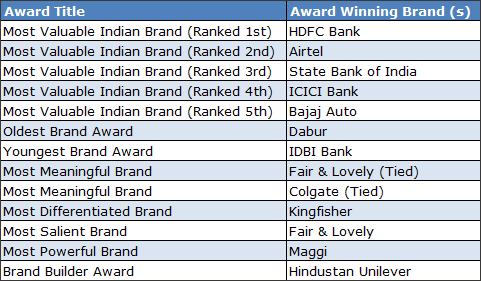
    In addition to the rankings, special awards were also presented to brands among the Top 50 under the following categories.


    Millward Brown BrandZ India Awards 2014
    A copy of the BrandZ™ Top 50 Most Valuable Indian Brands 2014 report can be downloaded at www.brandz.com



  • Vuclip provides third party authentication with Millward Brown for mobile ad effectiveness metrics

    By A Correspondent


    Independent mobile video and media company Vuclip has announced that it now offers a solution to evaluate mobile campaign effectiveness. Vuclip has partnered with Millward Brown to give brand metrics that provide meaningful insights beyond click-through-rates. This enables brand advertisers to measure and optimize the brand metrics on mobile ad campaigns, allowing them to measure performance against their key marketing objectives and compare effectiveness against industry averages.


    Reaching 45 million monthly users on 5,500 different mobile handsets, Vuclip has an unparalleled, global consumer base. This critical mass, combined with Millward Brown’s independent survey capabilities and robust analytics, allows Vuclip to analyse six metrics: top-of-mind brand awareness, brand familiarity, mobile ad awareness, brand association, brand favourability and purchase intent.


    Vuclip and Millward Brown recently conducted an AdIndex Advertising Effectiveness Study to assess the success of a mobile video advertising campaign on behalf of one of India’s leading toothbrush brands. The study included respondents from the 18-45 years age groups, with 41 percent belonging to the 25-34 years of age category. Respondents were segregated into two groups, one of which was exposed to a banner brand ad, while the control group was not.


    Advertisements displayed on the Vuclip site generated favourable opinion among the online audience. Purchase intent towards the brand was significantly higher post campaign exposure. Brand favourability was 7.9 percent higher among the exposed group compared to the control group, while purchase intent went up by 11.1 percent.


    “Mobile technology has become a ubiquitous part of our lives. Anywhere in the world, consumers turn to their mobile device for instant news, videos and product information. While brands have recognized this shift from ‘prime time’ to ‘real time’ advertising, mobile metrics have not kept up with the changes. Click-through-rates reveal little about brand engagement or purchase intent,” said Meera Chopra, Global Head & Vice President, Ad Sales at Vuclip. “By partnering with Millward Brown we have found a way to successfully apply traditional TV and online metrics to mobile. This gives brands the opportunity to measure the impact of their mobile initiatives against their overall marketing goals.”


    Ritesh Dutt, Head Media Practice, India of Millward Brown commented, “As an industry leader, Vuclip is helping brands define success on the most important platform of our age – mobile. We are delighted that Vuclip has recognized our track record in mobile ad metrics and analysis. Through our partnership, we can help transform the way brands view mobile measurement and believe the impact will benefit the entire mobile ecosystem.”


  • ICICI Bank ahead of Pepsi, Airtel beats Siemens, Sony in Top 100 Global Brands rankings

    By A Correspondent


    Bharti Airtel has joined an elite club of global brands by making it to this year’s BrandZTop 100 Most Valuable Global Brands list by WPP firm Millward Brown. ICICI is the only other Indian brand in this group.


    With an overall ranking of 63 (brand value: $ 12.7 billion) and 71 (brand value: $11.5 billion) respectively, ICICI and Airtel have been ranked ahead of top global brands such as Citi (82), Sony (86), MTN (88), China Telecom (90) and Volkswagen (96).  ICICI is in fact ahead of even Pepsi which ranks at #67.


    The BrandZ Top 100 Most Valuable Global Brands study is conducted annually by leading global research firm Millward Brown. It is the only brand valuation that takes into account what people think about the brands they buy along with rigorous analysis of financial data, market valuations, analyst reports and risk profiles. The ranking is arrived through a continuous in-depth quantitative research on a category-by-category and a country-by-country basis. The research covers some 2 million consumers and more than 50,000 brands in over 30 countries.