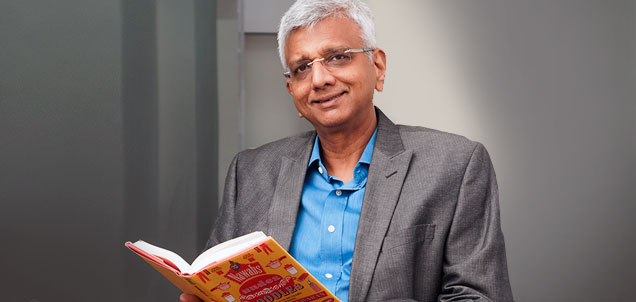
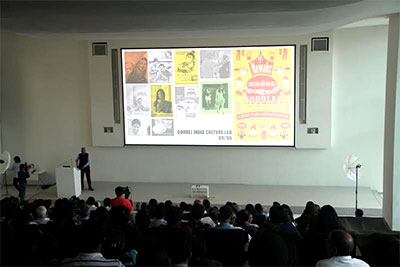
The author was very apprehensive at the beginning to launch his book at Godrej India Culture Lab because he thought there would not be enough people to fill the huge auditorium. But he was in for a surprise when not only was the auditorium full; people had to occupy the aisles to sit through the book launch. We are talking about MG Parameswaran or Ambi as he is popularly known, who launched his book ‘Nawab, Nudes and Noodles’ on June 9.
Presented by Pan Macmillan and Godrej India Culture Lab, the launch saw a cross-section of the fraternity and many students congregate in the auditorium.
The book is as much the story of Indian advertising as it is about India. From sartorial taste and food habits to marriage and old age, music and language to celebrities and censorship, the author examines over a hundred ads to study how the Indian consumer has changed in the past five decades and how advertising and society have shaped each other.
He gave the audiences an insight of the book through a very interesting and interactive presentation. He started from the very idea of the social concepts about marriage, gender, music and language is changing and ended with how advertising is important for the economy to grow. Combining anecdote and analyses he shared a slice of modern history and evaluated the relationship between affluence, aspiration and desire in India. He spoke about the changing trends in our country where he discussed the ads that caught imagination of the entire country. From ‘Jo Biwi Se Kare Pyaar’ to the controversial Tuffs shoes campaign, the book delves in to a memorable journey through brands, consumers and the world of advertising.
The presentation was followed by a chat between the author and brand expert and MD and CEO of Future Brands Santosh Desai. They spoke about the challenges and the approach he took while researching about this book. The trend in advertising these days seem to be moving from traditional mediums like television to more contemporary mediums like digital. So, when Desai asked whether the consumer approach of advertisers has changed due to digital, Parameswaran said, “I do not think as yet but it will change. Most people who are below the age of 30 or 25 do not read the newspaper and do not watch television. We have to figure out new ways to reach them. The interactive medium gives you an option to do a lot more. I am sure if we have been able to fully exploit that. The other worry I have is in India we have this huge power distance equation. May be our consumers do not want interaction. But that story will play out in the future. As of now, I think it will change eventually.†Parameswaran also stressed on the fact that due to digital evolution the society is also changing and people are very aggressive in the manner they express their opinions due to the emergence of social media.
The Indian advertising industry has several leading lights but few have got down to chronicling the industry and documenting case studies like MG Parameswaran has. Ambi, as he’s known in the fraternity, recently set up Brand-Building.com after 35 years in advertising, sales and marketing, a large part of it was helming FCB Ulka. He is also President of the Advertising Agencies Association of India (AAAI). In his new book titled ‘Nawabs, Nudes, Noodles’, Ambi writes how advertising has changed society and adapted with the times. Excerpts from a free-wheeling interview with Pradyuman Maheshwari:
You are among the few advertising professional who have written books, and this is your eighth. How do you manage to make time for writing?
The writing started in reverse. In 1997-98, I was looking for cases to use for teaching when I discovered they were still using some veryold books. Then I started writing some short cases based on brands I’d worked with and . Tata McGraw Hill was interested [in publishing them as a book] so that’s how it started. I wrote cases for teaching, and those became books. Once the books came out, they actually sold, and the publisher stared asking what are you writing next? Then I wrote the second, and the next, and it just continued. Obviously, there was a big lacuna of professionals writing books, in the late 90s. Now there are a lot more people writing, which is good. Myfirst bunch of books was more academic. Then my agent, Anish Chandy, said I need to write for a larger audience and that is how ‘For God Sake’ was born. It was based on my thesis, but it was a light book. And, after I finished writing it, the idea for [the latest] book came up and we started discussing.
How much time did this last book take?
40 years (laughs).
And it’s packed with loads of information…
80,000 words (smiles). The idea for the book happened about two years ago, and it took a year of writing. I was working full time so I used to devote three or four hours every weekend to compile stuff. I did not want to do a history of agencies, but wanted to look at how society has changed. First you have to compile information, and I went through 30-40 books. Also, one had to not just write about different topics but also see if there are any international parallels. So I had to hunt for relevant books on that topic. Fortunately, some of my friends are senior professors, so they helped identify the books I should look at. It took six months of collecting information, and six months of writing.
In the book, there are a fair number of references to influences in society and how it has changed. For instance, you write on ads having helped Indians discover new products and services. Really?
If you ask a consumer ‘did you buy this product because of the ad’, the response will be no, I heard about it from a friend. But where did your friend hear about it? She heard it from her friend. There might be an ad involved. Take the example of Dalda, which was the first Indian product advertised in 14 different languages in print. Each ad was different because it was specific to the cuisine of a particular region. Ads were written in 14 different languages to convince Indians that Dalda was as good as ghee, during the days of a ghee shortage. And it succeeded. Today I saw an ad where they were trying to sell 4G services saying you can use it to locate a loo for your kid. That is education. Advertising is performing the role of disseminating education so consumers do learn from ads. They may not admit it, but they definitely learn a lot.
At the same time, there is a lot of advertising which is possibly instilling values you don’t want, like fairness creams or ads for colas which are not good for health. Advertising can be educational, but there are many brands which don’t sending out positive messages…
I believe if it is legal to sell a product in a country, it should be legal to advertise a product. If it is legal for me to make and sell beer, it should be legal for me to advertise the beer too. If you go back to how this idiocy started in this country, 25 years ago the government suddenly decided that sanitary napkins would not be advertised on TV. They said the ads could only play after 10 pm. Maybe that has caused a problem. Today, one of the biggest issues we have is girls are afraid to go out because of their menstrual cycle. If they had allowed those products to be advertised widely, maybe we would have had more innovative products coming out. But why was it was not allowed before 10pm? Because it was considered a bad, female hygiene thing, which could not be shown on TV. We banned the ads, and now we are saying girls are not going to school, not going to work on those days because of this problem, and now we are regretting it.
Every month, the Advertising Standards Council of India (ASCI) comes out with a list of ads against which complaints have been registered. A fair amount of such advertising shows that not all practitioners are doing their job correctly…
Yes, it is a combination of the agency and the client. Often the agency pushes the limit and the client says okay let’s do the ad and see what happens. I am happy that ASCI has become powerful now because in the good old days, it used to take a month to respond to a complaint. Now they come back to you within a week, whether they uphold the complaint or reject it. The government has also mandated that if some ad complaint is upheld by ASCI, TV channels cannot run that ad. To be fair, every brand owner and agency is trying to claim whatever they can do to the maximum.
In your book you have referred to the Tuff shoes ad, and the case against it that went on for two decades. Do you think the ad was beyond decency? And would it be accepted now?
I do not think it would be accepted. Today we will probably react just as badly to that ad. As a piece of art, it was brilliant and beautifully art directed, and launched an unknown brand in a sensational way. But it got into all sorts of trouble and the court case ran for 20 years…. Today, the complaint would have gone to ASCI, which would have either upheld or rejected it. For all you know, ASCI may have even passed it.
There is a lot in your book about the changing man, woman, child or youth. You have mentioned that the Raymond ad was a milestone in the way it depicted men.
I have been a follower of Raymond advertising for a long time, and for a hot country like India, Raymond made suitings cool. But it moved away from an executive suit to embrace the concept of a complete man. One of the best ads they had was about this man from abroad looking for his friend and discovering that his friend has lost his legs and is in a wheelchair. He takes him to Marine Drive and they are shown having fun, chatting about old times. There is no mention of suits except for the fact that this guy was dressed in suit but carried his jacket in his hand. Suddenly this presented a whole new face to the guy who wears suits — that he is not an automaton but a guy with a heart. Such ads have redefined suiting advertising.
You have written about men, women, children and teens in ads. Which of these strata do you think have changed the most in terms advertising in the last 15 years?
All of them. May be women more significantly, because earlier, women were never featured in a financial services ad or in motorcycle, scooter or car ad. Like the ads for Hero Pleasure, which is a scooter for women. A lot of car brands are showing the woman driving the car. The biggest change in Indian society has been with respect to women. Their education and desire to work has dramatically changed over the last 20 years. Therefore, the depiction of women in ads has also dramatically changed.
Yet there is a lot of advertising that is not gender-sensitive…
I think there is a need to sensitise people to this. Sometimes you do it even without thinking. Some ads are being created without any deep agenda on pushing down of women. It’s just a lack of awareness.
Do you find that in the last 10 years, effectiveness awards have become very big and that even creativity in advertising tries to earn brownie points from social media and the buzz created?
I do not think so. Advertisers today are looking at two different kinds of advertising. First is the classic way, where you spend a big amount on advertising. The second is the ad which is created for social media. One is the 30-seconder which will run on TV channels, and the other is the three-minuter which will run on YouTube. Today, these two are working on two different agendas, but one day the two will meet.
The book covers about 50 years of advertising, but perhaps some inside stories and gossip would have made it more juicy. You have stayed clear of controversies…
The last chapter is all about the problems advertising has faced. It deals with the Tuff shoes ad, the Kamasutra ad or the problem I had with an innocuous Sweetex commercial, where I was showing the navel of a model, which got into trouble. I have not discussed any gossip, such as who copied whose idea, because that is not the domain. I am writing this book because I hope the young people entering advertising can, in just a few hours of reading, understand how this business works and have a positive impression of the industry.
If you were to pick three, five or 10 ads that have been game-changers, what would they be?
I would say go back in history. The Maharaja ad for Air India is one. The Amul hoardings (which even the client gets to see only after it goes up, shows the kind of trust you need to have with your agency partner), the Lalitaji ad which re-defined and put the middle-class woman in the market. Or ‘Doodh’, which made milk cool. Also, the Cadbury cricket film….
And Liril?
Yes, Liril was path-breaking. And in recent times, stuff like the Gundappa film for Lifebuoy and the Airtel ‘Hare ek friend zaroori hota hai ad.’ So, there have been quite a few films, Fevicol take a very humble adhesive in to landmark creative, again that is a very good client-agency partnership.
Ads like ‘Doodh’ for Amul that you have worked on at Ulka, which you are extremely proud of?
I am proud of what FCB Ulka has done with Naukri.com – the Hari Sadu ad. I am especially proud of the work done on Tata Indica. Then of course the work we did on Santoor, Sundrop – two brands which took on the might of Levers and succeeded. Some fabulous work we have done on Zee, Zee Cinema especially.
What next?
Well, I do not know. I hope this book does well and serves the purpose of both making people like you and me nostalgic about the past and make young people say these guys actually did some good work and now we need to do better.
This interview first appeared in dna of brands on May 23
MUMBAI: Facebook didn’t get the tone of its extensive Free Basics campaign right, said brand consultants and advertising veterans.
The social media company failed to gain enough public support, win over the government or convince the Telecom Regulatory Authority of India (Trai), which ruled against discriminatory pricing for data services on Monday, effectively shutting down the initiative.
“It’s fair to say it was a mishandled campaign for a company that’s trying to launch a new initiative,†said Futurebrands India CEO Santosh Desai. “It was a naked show of muscle power.
Also, the campaign didn’t fit with their alleged intention at all.†The campaign was accused of seeking to manipulate opinion, with Trai publicly expressing displeasure over a Facebook survey that purported to show widespread public support for Free Basics.
It may have been a better idea to show that Facebook was working in collaboration with the government’s objectives instead, the experts said. The campaign was too “in-your face,†said brand expert Harish Bijoor. “Bureaucrats’ political masters are a voter-sensitive audience,†he said.
The Narendra Modi government has been at pains to distance itself from allegations of crony capitalism, he pointed out. It was surprising that Facebook seemed to get this wrong.
Industry sources say Facebook had earmarked upwards of Rs 150 crore for the Free Basics campaign. By November last year, the company had spent around Rs 25-30 crore on print, digital and outdoor campaigns, according to media agency sources, including ads in this paper.
It may have spent about Rs 50 crore on the Free Basics advertising campaign until this week, they said. “I think the campaign missed a trick or two,†said Sam Balsara, chairman of Madison World.
“While the campaign or its aggressive nature cannot be the only reason behind Trai’s decision, I think Indians didn’t relate to it so well.†MG Parameswaran, former executive director of FCB Ulka, said Facebook should have employed more subtle methods.
“They should have reached out to influential bloggers and used social media more effectively to explain what it actually meant,†he said. Some experts pointed to the manner in which overseas companies such as Uber and Nestle have sought to deal with difficult situations in India.
The taxi aggregator has had to deal with the fallout of a passenger being raped in an Uber cab and hostile scrutiny of the way in which it does business.
Uber hasn’t embarked on advertising campaigns to build its business in India as it has overseas. It has instead tried other strategies, including social media messaging.
After being banned briefly, Nestle’s Maggi noodles returned with an advertising campaign created by Prasoon Joshi of McCann India aimed at winning both the trust of consumers and the government. And Joshi’s take on the Facebook campaign? “It will be unfair to blame an ad campaign for what the democracy or the government decides,†he said.
Advertising Agencies Association of India (AAAI) announced that under the aegis of the AAAI Prowess brand, a one-day Leadership Workshop will be held on 15th October 2015 at AAAI’s Training Centre. This workshop has been titled ‘Unleash The Leader Within’ and is targeted at young managers with 5-10 years of experience and those who have moved to a leadership role managing teams of 3 to 10 people. The workshop to be conducted by Prakash Iyer will focus on practical advice, powerful tips and actionable strategies that can be put to use right away by participants and is designed to meet the following objectives:
Learn what successful leaders do
Becoming a better coach, a builder of great talent
Communicate better
Get better at working with people
Leverage the power of story-telling and building your own leadership brand
Build winning teams and become an inspirational leader
Commenting on the workshop, AAAI President Dr MG Parameswaran said, “We announced this workshop based on feedback we got after our first workshop on Negotiation Skills organised by AAAI recently. And when one talks of leadership, who better to conduct such a workshop than Prakash Iyer who has successfully helmed companies across various industry verticals in leadership roles including being CEO of the victorious Mumbai Indians franchise during the last IPL season.â€
Prakash Iyer has spent nearly three decades in various companies selling everything from soaps and colas to yellow pages and diapers before deciding in 2014 to step out of the corporate world to pursue his passion for writing, speaking and helping other people unleash the leader within. In his last role, he was the Managing Director of Kimberly Clark Lever in India. Apart from being a best-selling author and a leadership coach, Prakash is also an independent director on the board of Xerox India and an advisor to Multiples (a Private Equity fund).
The Advertising Agencies Association of India (AAAI) and the Indian Outdoor Advertising Association (IOAA) have signed a joint agreement for the first time, AAAI President MG Parameswaran and IOAA Chairman N D Mehta announced recently.
The overall objective of coming together is to help the outdoor advertising industry in India grow in an organised and regulated fashion, to ensure that proper systems and processes are followed and timelines adhered to, as well as commitments honoured on both sides, Parameswaran said. He added that a suitable mechanism will also be set up to penalise defaulters, with a view to preventing future defaults and bringing everybody in line with policies and good practices. Alongside all this the agreement will also focus on regulating and disciplining advertiser behaviour in matters concerning outdoor trade, agency remuneration, corporate governance and adherence to payment deadlines.
A special feature of this agreement is that the advertiser will not be allowed to shift their business to another agency until dues of the earlier agency are cleared. Mehta mentioned that IOAA, on its part, has also embarked on an ambitious project to conduct viewership studies on OOH, initially in the major cities. Further, it will ensure 100 per cent listing of all sites with a unique ID number, in a scientific manner, for the benefit of all concerned. The AAAI is the official, national body of advertising agencies, which protects their interests by promoting professionalism and sound business practices between advertisers, agencies and various media.
The IOAA, registered as a not-for-profit company, has been actively promoting legal media and ethical, best practices among outdoor media owners.
Caution:The tone of this article is slightly harsh. In our defence, if you are in advertising you had it coming.
Under ordinary circumstances, you empathise with a victim. Not with the Indian advertising industry, at least not this time. Why not? Because for the longest while now, agencies who claim to be problem solvers haven’t figured out how to prevent a basic issue that mars their existence: the theft of ideas at pitches.
A few weeks ago, we had an anonymous senior adman pen a much discussed column about idea theft. It’s this convenient thing clients do as agencies present their most ‘groundbreaking’ work. They adopt (read: steal) ideas that catch their fancy without so much as a by your leave.
The Legalese Simplified
– Ideas cannot be protected under any law pertaining to intellectual property rights (IPR).
– Copyrights protect expression of an idea. Patents protect inventions.
– But, an agency can enter into an agreement with a client whereby heÂ’d be bound to keep information given at the time of pitching confidential.
– While industries like cinema, music, photography have strong unions safeguarding the creative folks rights, ideas are not protected under IPR anywhere. Only its embodiment in a tangible form can be protected.
– The best way forward for a creative in any field is to be wise about their sales pitch.
– If you’re a lyricist, share a stanza; a musician, share a tune; a scriptwriter, share a chapter.
– And if you’re an adman, show your past work to the client or sign an NDA before showing speculative work.
– If you are desperate, God save you.
Inputs by Rahul Chaudhry, managing partner at Lall Lahiri & Salhotra, an Intellectual Property law firm)
Some other agency gets to work on the campaign and soon Agency No 1 is staring at a YouTube video, now gone viral, that keeps clocking like after like. Leaving its staffers seething in impotent rage and the desire to scrawl ‘Hey, this was my idea’ in the comments thread.
If this sounds distressingly familiar, look no further than the mirror while trying to find people to blame. First, agencies don’t do their homework. All clients aren’t cut from the same righteous cloth.
There are Bermuda Triangles of the marketing world, who have a reputation for idea shopping. It was something a large Indian conglomerate was frequently accused off especially given its close ties with a particular agency. But typically, such clients opt for whoever quotes the lowest. And yet, pitch after pitch, ad shops go in all guns blazing, their finest creative minds working overtime, effectively delivering their best ideas free of charge.
Mostly, the idea gets mutated by the time it comes to fruition so the original agency often finds its ownership hard to prove. To quote a few instances, the preorder strategy, a digital queue for the launch of a fast food chain in India was supposedly presented by an agency that didn’t get the account.
A knit-wear brand is notorious for idea shopping. A creative head remembers writing a campaign for the Ministry of Tourism once. He didn’t win the account but one of his lines showed up in the final campaign. 8 out of 10 creative directors have been on the receiving end of this unabashed thievery of ideas.
On the other hand, there are the rare cases of magnanimous clients like VIP who compensated an agency for using a modified version of its brand name suggestion for a new line of women’s bags – Caprese.
Idea theft, like many advertising grievances, isn’t confined to India. Remember the #ShareACoke campaign? A veteran adwallah told us that when the original idea (by O&M, Sydney) was adapted by another agency in a different market, the Australian network agency created a mini uproar and got compensated. Good for them if that’s what actually happened. And what do their Indian counterparts do? Nothing. Actually, they discuss it grudgingly over a pint or few of beer.
So, next to nothing would be more like it. The conversation brings about life-altering thoughts like – If the client can make us sign an NDA (non-disclosure agreement), why can’t we do the same? Legally, they can. But with agencies shying away from asking for a meagre fee hike, the chances of them demanding an NDA are slim to none.
With undercutting and declining margins, agencies are under so much pressure to achieve topline, they can’t afford to say no to any fresh stream of revenue or upset a marketer by bringing up the NDA. The last thing anyone wants is the reputation of being a difficult agency.
“The irony of it all is that despite being the biggest supplier of ideas, we have no command over our own product,” laments Anil Nair, CEO and managing partner of L&K Saatchi & Saatchi. The client knows agencies are desperate for new business. If he is unscrupulous, he will take advantage of the situation. It’s a sign of a shortsighted client though, says Ajay Kakar, CMO, Aditya Birla Group – financial services, to relinquish Lord Krishna for his army. We know how that panned out.
Nonetheless, it’s the agency network that should boycott such clients. So, why haven’t the doyens of this industry done anything to check these defaulters? “It’s because most of our senior leaders are on extension and they don’t give a damn about where this industry is headed,” says Satbir Singh, managing partner and CCO of Havas Worldwide India.
You have people who should’ve retired two years ago, getting paid a crore annually. Why would they risk anything? Rather why do they need to risk it for something that in most cases doesn’t even concern them? Celebrated creatives are typically insulated from this phenomenon; it’s mainly the mid-level creative who often ends up feeling violated. Ideas are likely to build his career and the stuff histories are made of.
The agency ecosystem needs to safeguard these or run the risk of losing talent to another industry (a fad plaguing advertising but that’s for another edition). The AAAI (Advertising Agencies Association of India) says it’s working towards protecting ideas.
While the call for a pitch fee went nowhere – rumour has it that agencies keen to pitch coughed up the fee themselves – in the last few years; they are looking to revisit pitch guidelines along with the ISA (Indian Society of Advertisers), shares MG Parameswaran, the association’s president and the advisor to FCB Ulka.
The NDA clause will be a part of the revised guidelines, we’re told. So, when do we get this revised charter, we ask? In about three to four months, says Nagesh Alai, chairman of the legal wing. Until then, and maybe even after then, it’s open season on ideas.
Advertising Agencies Association India (AAAI) has elected Arvind Sharma, Chairman, Indian Subcontinent, Leo Burnett as the President for the year 2012-13. MG Parameswaran, Executive Director and CEO, Mumbai at Draftfcb Ulka has been elected as the Vice President. Nagesh Alai, the outgoing President will be the ex-officio member of the new AAAI Executive Committee.
When MxMIndia congratulated Mr Sharma and asked about his agenda for the year ahead, he said: “AAAI is an industry body and it is a team work. We will be meeting on August 17, where we shall be listening to each other’s views before setting up the agenda.”
He added: “The industry is growing and transforming at a rapid speed, thereby also providing newer opportunities to an advertising agency for growth. The amount of monies being invested in advertising has increased, and newer avenues have opened up for investments, thus the challenge is to understand and adapt to the changes. As an industry, we need to understand what lies ahead and prepare the agencies for the future.”
Other elected members of the Executive Committee include Ganesh Baliga (Fifth Estate Communications), Ashish Bhasin (Aegis Group), Nakul Chopra (Publicis Communications), Tanya Goyal (Mogae Group), Kunal Lalani (Crayons Advertising), Vinod Nair (Network Advertising), Pranav Premnarayen (Prem Associates Advertising & Marketing), Sridhar Ramasubramanian (Matrix Publicities and Media India), Vikram Sakhuja (Group M), Umesh Shrikhande (Contract Advertising) and Srinivasan Swamy (RK Swamy BBDO).
 The author was very apprehensive at the beginning to launch his book at Godrej India Culture Lab because he thought there would not be enough people to fill the huge auditorium. But he was in for a surprise when not only was the auditorium full; people had to occupy the aisles to sit through the book launch. We are talking about MG Parameswaran or Ambi as he is popularly known, who launched his book ‘Nawab, Nudes and Noodles’ on June 9.