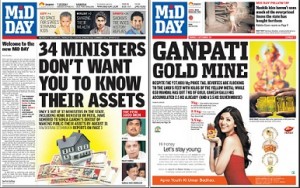

Tag: Medianet

  • The Big Bad World of Bought Likes & Trends


    By Bhuvi Gupta


    Bhuvi Gupta

    The business of news and entertainment is unique from other businesses as there is no underlying need for consumption and content is easily replaceable with similar alternatives. Hence, the entertainment industries have always relied heavily on glitz, gossip and glamour to garner consumption.


    This has taken many avatars through the decades. In the early 2000s, the Times Group innovated and changed the PR landscape when they launched Medianet, renamed as Optimal Media Solutions (OMS) since. It was very successful for the both the media and entertainment industries, because of the blurred lines between ads and news. The audience was oblivious as long as gossip and entertainment was delivered and hence many a film were boosted due to entirely manufactured gossip on link-ups and skirmishes on set. TV news followed soon after. NDTV was the front-runner of branded content in TV with shows like Earth Hour, Greenathon etc. Today, weekend programming across English news channel almost entirely comprises such branded shows.


    The digital equivalent of Medianet is the manufactured views, likes, followers and trends because the lines between the inorganic and organic are blurred. This is more dangerous than Medianet, because all social media platforms have Achilles’ heels which can be exploited to manufacture reach that is invisible even to the discerning viewer.


    All this changed when last month, the Mumbai police launched an investigation into the 75 Lakhs worth of YouTube views purchased by Aditya Singh Sisodia aka Baadshah for his 2019 single, ‘Pagal’. The song launch was a mega-affair with influencer marketing campaigns on Instagram and TikTok, YouTube advertising and other dubious means employed in an attempt to break records. Baadshah claimed that ‘Pagal’ was the fastest video to reach 75 million views on YouTube, which was promptly shot down by them due to inorganic means employed. This has subsequently lead to the ongoing criminal case filed by the Mumbai police and the investigation thereafter. The case has opened a can of worms, as newer unethical practices of the digital ecosystem of the entertainment industry began slowly getting exposed.


    To be honest, in 2020, Baadshah’s admission to buying views would not have come as a  shock to most of us. Even the undiscerning viewer sees enough chinks in the digital armour – screenshots of identical tweets from celebs (right down to grammatical errors) praising a government or a popular icon, TikTok’s Playstore ratings being brought down in a day and then restored are two of many examples. What is not common knowledge is the sheer mechanics and extent of what goes into digital influence manufacturing and the reasons behind it.
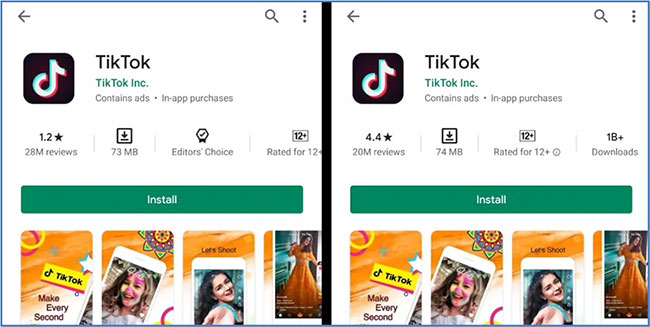
     

    In May 2020, TikTok’s app store ratings were restored after Google deleted 80 Lakh negative comments made in the span of a week in response to the Galwan Valley skirmish. The Chinese app has since been banned in India.


    Why do Indian Artists companies do this?

    Creating a buzz in the entertainment business is crucial to remain relevant. Social media metrics have come to define the salability of the artist for producers and distributors. It is a flawed ecosystem exploited by all the players. To elucidate –


    The problem with the Algorithm

    View counts on YouTube, don’t differentiate between paid and unpaid views or the viewership duration (a view is counted after only 30 seconds of consumption). Views are a key metric for YouTube’s algorithms, especially when it comes to search result rankings and recommendations, which help drive organic views and hence generate revenue. Hence, paying for views is a natural choice because they help recoup advertising investments through organic views, while adding the credibility that higher view counts get.


    Not only vanity metrics

    For films, OTT and satellite TV, rights are often sold after movie trailers are released and the view metrics of the trailer, contribute to the negotiating power of the producer. Likewise, in the music industry, licensing deals, terms of contracts, concert tours and appearances are often measured basis song popularity. Hence, paying for YouTube views is a natural investment that pays for itself many times over.


    The problem with the platforms

    It serves social media platforms to have higher view counts because, it drives up daily traffic on the platform, while generating ad revenue. This problem of fake news, fake views, and bots serves social media portals which rely on user metrics to help set ad rates. In the absence of stringent laws, while popular social media platforms do make the right noises about removing bots and fake profiles they have little incentive to actually follow through.


    It’s not a crime in India… not yet!

    Many countries across the world like Singapore, France and Germany, are enacting strict cyber laws that punish hate-speech, threats, and impersonations (under which fake followers lie) as criminal offences, liable to both imprisonment and fines. In the absence of such laws in India, manufacturing inorganic views becomes dishonest but not illegal. While the fake likes industry has been thriving for the last few years, the case against Badshah may just be a watershed moment in the creation of cyberlaws, which will bring more transparency in Indian cyber space.


    Till laws change, as a marketer, I leave you with my content checks to avoid being gamed. On YouTube, I check engagement (likes and comments as a percentage of views), for highly viewed content before investing the time to watch. If the number is low, it is safe to say that the views have been bought. And on Twitter, inorganically trended hashtags will have a majority of tweets with the same sentence structure and central thought – so a quick scan of tweets under a trending hashtag will help check ingenuity.


    Bhuvi Gupta is a marketer with over 10 years across industries, of which the last six have been in Media & Entertainment. She has been a part of many launch marketing campaigns – specifically at the Times of India group, Republic TV and the latest in marketing a Bollywood film. She will write on A&M (mostly marketing, but often on advertising too) every other Tuesday. Her views here are personal. She tweets at @bhuvigupta3



  • Das ka Dum with Dr Bhaskar Das: Is it right for a news media company – respected or otherwise – to pass off paid content as editorial-generated and editor-okayed?

    Bhaskar Das

    Greetings on this Friday before Dassera. We’re here with a question that a lot of us have been seeking an answer to. So read on for Dr Bhaskar Das’s views on paid content… in Das ka Dum.

    Please go to the Das Ka Dum tab on the website’s top navigation bar, to visit the archives of Q&As.


    Q. Is it right for a news media company – respected or otherwise – to pass off paid content as editorial-generated and editor-okayed?


    A. The slant of the question has a definitive drift towards an answer of  ‘right’ or ‘wrong’. These days, more often than not, answers may not be in black or white but somewhere in between. What the media industry eulogises as native content can also be clubbed under your question. Or for that matter how some public relations companies facilitate content in the media.


    I think a more fundamental question needs to be asked if the veracity of a story is compromised. Or if the concerned story has been flagged as sponsored content. Infomercials are a legit route to consumer awareness. The problem starts when the paid  content is camouflaged as non- sponsored content. One can’t take the audience’s intelligence for granted. They can see through it in case paid content is masqueraded as news.

  • Ranjona Banerji: So why did Times make a front-page statement?

    By Ranjona Banerji


    Truth is, we have no political masters, nor do we have any hidden agenda. The only side we take is that of our readers.”

    So what compels a newspaper to make this statement, especially one that declares it is “the world’s largest circulated English newspaper”?

    The Times of India’s edition of January 23, 2014 carried this on the front page. The rather thin (leading to some very ugly hyphenation) single column headlined “To Our Readers” was a declaration that although the newspaper had been accused of first supporting and then turning against the newly formed Aam Aadmi Party, in fact it is for no one and against no one and will support whoever does the “right thing”.

    The newspaper also pointed out its philosophy, such as it is, which includes belief in “the primacy of the individual over the state, and that democracy in its truest sense is the power of one. We believe in personal liberty and in freedom of choice.” There is more in the same vein.

    As to why TOI decided to make this announcement is unclear, except for the allegations that it had switched horses mid-stream regarding the Aam Aadmi Party. But so what? As it itself declares, it has been accused supporting one or the political party in the past and has not bothered to make any front page announcements. Is it because the AAP is the new party of the middle classes, which is TOI’s core readership? Or has someone inside Bennett Coleman suddenly developed a very thin skin?

    The worst that The Times of India has been accused of is not patronage of a political party. The worst has to do with money: the introduction of Medianet where news items are sold for a hefty price and for private treaties, where certain business houses and entities can ensure good coverage for themselves.

    Obviously, there were no mentions of either in this intriguing, and if one may point out, clumsily written and punctuated, front-page editorial declaration.

    **

    However, it is also true that the media seems to be getting polarised politically in a manner last seen during the BJP’s Ram Janmabhoomi movement of the late 1980s. Journals and journalists both declared themselves to be pro-BJP and Hindutva, with an emphasis on a preference for economic reform as well as religious majoritarism. Much of this media anger was also against Congress hegemony and also showed itself in massive support for VP Singh’s breakaway movement.

    Since then, the media has been seen as supporting one or the other political direction although very often the accusations are quite wild. Right now the Indian media is clearly heading towards the Right – except for the gauntlet thrown down by the Aam Aadmi Party and its particular brand of agitation politics. And perhaps that is where TOI’s confusion begins.

    **

    The biggest current problem for the Indian media and television in particular is that it cannot see beyond Delhi. If the Gujarat chief minister was the front page hero for almost six months, he has been ousted by Arvind Kejriwal. Much as the AAP and Kejriwal have changed the game, they are certainly not the only stories in India. Yet day after day we are subjected to a series of Delhi-centric stories.

    Part of the problem is that Delhi has become the epicentre of journalism in India. As a result, once strong regional media entities have been forced to pay extra attention to the national capital. Most TV channels are headquartered in Delhi – Times Now being the notable exception amongst the top English channels. And our star TV anchors cannot see beyond their neighbourhood. Who knows what has been happening in India and the world over the past couple of weeks. All we know is that Sunanda Pushkar thought her husband was having an affair and then may or may not have killed herself and that Arvind Kejriwal slept on the streets next to his car for a few night until he was sent some hot paranthas.


    Ranjona Banerji is a senior journalist and Contributing Editor, MxMIndia. The views expressed here are her own. Ranjona Banerji can be reached at @ranjona

  • MxM Monday: Paid news – yes or no?


    By Ananya Saha


    Mediaah! Are disclaimers enough to pass off paid content?

    Readers expect the content in the newspaper to be published based on the decision of the editor, and not an advertiser paying for it, writes Pradyuman Maheshwari. Read more…


    Paid content such as Medianet has gained much ground. Despite flak from different quarters, it appears that buyers are still willing to pay for space that resembled news and features. And readers may never know the difference. More media houses have begun indulging in paid content, but surely that does not make it right?


    We ask industry folks to weigh in with their views.


    Arun Anant, CEO, The Hindu Group of Publications


    People may not know that some newspapers carry paid-for articles, and some people do not care either. That does not make it right. If an article is paid for by an advertiser, it should be made clear that there is an interested party that has paid for it.


    Ranjona Banerji in ‘Freaking News’
     

    :: Medianet mars an otherwise trendsetting paper

    :: Not too late for TOI to correct practices


    Santosh Desai, MD, Future Brands

    Globally, it has become a phenomenon where sponsors pay for news. There needs to exist a clear difference between journalism and an act of promotion. If not kept separate, the line of demarcation will blur between the two. However, what is more dangerous is that when news is influenced by a transaction. Many do not care about Page 3, so if you have paid for it, it does not matter. The issue arises about hard news, when you do not know who has paid for it. MediaNet in itself not a wrong thing as long as you are announcing it who is paying for it. For instance, if you are reporting about a policy being announced and you do know which political party or a corporate house has paid for it. What is a much bigger issue is the corporate ownership of the media houses. There has to be a divide between news and advertisement: and how do you tell it? How do you divide ownership and journalism: and do you – that is more serious threat than MediaNet, in my opinion. The bigger point is about trusting the ‘news’.


    Bharat Kapadia, Chairman, Whatuwant Solutions, and Founder at ideas@bharatkapadia.com

    Using Medianet is completely unethical – whether readers do not seem to notice it or whether they do not care. There are two parts to it: the publisher and the readers. The publisher has been doing it for a much longer time than visible, especially at the time of elections. The readers, unless told, would not know which news is being paid and which is not. When, it all began, Bombay Times used to mention with a small symbol that it is paid news. Now even that is gone. People buy or consume news media trusting for a fair perspective. Now, if this perspective can be influenced, it is definitely not fair.


    Anamika Mehta, COO, Lodestar UM

    My personal point of view is, for a newspaper or any other medium, there are different and more questions about paid content. It happens globally in various forms but of course, it is not a good practice. A lot of brands and advertisers have jumped on this wagon, yes, but as a responsible media one should know where to draw the line. If one considers Page 3, where you can pay to get featured, it is all for entertainment. So one does not seem to mind. The moment it starts entering news or motivate political, business or economic sentiment, then it is a problem.


    One can see that business pages also carry small snippets or news that might sway the reader into investing in a particular stock, or to create impact. Some of the brands do MediaNet for promotion. However, a line needs to be drawn. The reader should not be misled, and motivated information should be kept under check.


  • Ranjona Banerji: Not too late for TOI to correct practices

    By Ranjona Banerji


    Watching the fury of nature is an awe-inspiring and fascinating experience, thanks to non-stop coverage of Hurricane Sandy by CNN. The storm that has hit the eastern seaboard of the United States is not the first but the sheer scale of water and wind, the potential threat to life and property and the peculiar timing with the US presidential election makes it even more compelling.


    CNN is very good with weather and takes it very seriously. Plenty of information is provided to the viewer about the meteorological aspects of the weather systems with enough scientific mumbo-jumbo to make you feel like you’re on the sets of The Day After Tomorrow. While the coverage is going on however, CNN does not venture into the whys and the wherefores. It’s more about the what.


    This is because not all media are infected by the Indian disease of making everything into a discussion. The global warming argument – and it cannot be far away – can be dealt with later. Nor were there any touchy-feely interviews with those suffering the storm, where bemused people are hard-pressed to find the right answers. Undoubtedly all those will come later.
    A shout out to all the intrepid reporters, star anchors and citizen journalists on CNN. This is a cruel comparison but one cannot help but compare this coverage to an abiding Indian image in similar situations: NDTV’s star anchor and now very very senior editor Sreenivasan Jain standing under an umbrella at Mumbai’s Milan subway, talking about flooding in breathless tones. As any long-suffering Mumbaikar knows, Milan Subway is so much lower than road level that it will flood if you pour a bucket of water into it.


    **


    Battles within the media and with the media seem to be getting tougher and are heading to the courts. Salman Khurshid against Aroon Purie and the TV Today group, Naveen Jindal against Zee News and Zee Business, the Bennett Coleman group against Zee News and Zee Business, Zee hitting back as well… Bennett Coleman has objected to Zee editors being heard on tape telling Jindal that news pages in the Times of India and Economic Times were up for sale.N


    BCCL CEO Ravi Dhariwal’s defence of Medianet goes thus: “We will make no excuses for Medianet. It is an initiative with a different purpose. It is for our advertorial and promotional supplements. But as far as our newspapers go, there is nothing that is bought or sold. No respectable newspaper will do that.”


    This is a weak argument since Medianet is at the heart of the current debasement of the media and had been picked up by every other news organisation as a legitimisation of “paid” news. To now argue that some parts of the newspaper are sold to advertisers but masquerade as news for readers is mere semantics. It took Bennett Coleman a very long time to add the line “entertainment promotional feature” to its glamour supplements like Bombay Times and it is still not clear that all readers understand that this means that the news in these papers has been supplied by the so-called newsmakers for a fee and not collected by journalists.


    As a “responsible newspaper”, perhaps it is not too late for The Times of India to correct its earlier practices. In many ways, Times of India is India’s most complete newspaper and unfortunately, this includes being complete with the good as well as the bad.


    Ranjona Banerji is a senior journalist and commentator. She is also Contributing Editor, MxMIndia. The views expressed here are her own


  • Freaking News: Mamata Banerjee, media’s favourite whipping girl

    By Ranjona Banerji


    This was an unexpected find: I had assumed (and from past experience) that the Hindustan Times would be strongest in local coverage amongst the national dailies in the national capital, given that New Delhi is (or was) its stronghold. But while HT does score on nitty-gritty local happenings, its biggest rival, The Times of India, is still going strong as far as blanket coverage of all news is concerned.


    This should be troubling for Hindustan Times because although it has the advantages of first choice as far as old-timers are concerned and its long history with the capital, its rival appears to be hitting where it hurts the most – with content. TOI and HT have been running neck and neck in Delhi for years, with both claiming ownership of the city at different times but conventional wisdom usually gave HT the edge. Now, I wonder.


    * * *


    James Murdoch has had to step down from the chairmanship of News International UK and is now being called a “shadow man with no role in the empire” (Sydney Morning Herald). This is of course the outcome of the phone-hacking scandal involving not just the defunct News of the World but other titles in the Murdoch stable of newspapers. Whether Junior’s moving aside is going to change company policy is another matter. Just as paid news and Medianet and its variations remain giant ogres for the Indian media to deal with, the dodgy practices of News Corp’s newspapers and journalists are the core problems. Removing James may not therefore be enough. As we have seen over the past year, the connections between the Murdoch empire and subsequent governments in the UK run deep and the favour system appears to have corrupted everyone, even the once highly-admired Scotland Yard.


    * * *


    The Mamata Banerjee government in West Bengal finds itself under greater media scrutiny with every passing day. The tendency of the chief minister to blame every event on the previous Left government and turn every criticism into a conspiracy theory has only made matters worse. Perhaps she needs some better media advisers and spin doctors? Right now, she’s the media’s favourite whipping boy (girl) and unfortunately for her, she, her ministers and her party only make matters worse every time they open their mouths!


  • Wanted: a mast, mast Mid-Day

    Pradyuman MaheshwariBy Pradyuman Maheshwari

    We’ve been promising a review of Mid-Day. It would’ve been unfair to do one by just appraising a single day’s edition, so we thought of doing that over the last 10-odd days since the paper went for a new look.

    First off, a couple of disclosures. Okay, let me use the ‘I’ instead of ‘We’. I worked with the group for seven years (1993-2000), was a shareholder for a bit and I take great pride in the rapid strides that current executive editor Sachin Kalbag has been taking in his career.


    Yet another disclosure, I was invited to write for the paper’s new-look, but declined the offer because of a Medianet-like scheme that Mid-Day runs for part of the paper.
    But let’s get to the relaunch. I’ve always perceived Mid-Day as a Mumbai institution, with the paper celebrating the city and reporting on what’s happening in here. At first, it lost its constituency of the society circuit to Bombay Times and over the last six-odd years, Mumbai Mirror has been steadily eating into Mid-Day’s dominance on civic and Bollywood news.

    The Medianet-like practice that the paper started was the final nail on the coffin. When I spoke to former owner Tariq Ansari for an interview with Impact last year, he said he was against the concept but was forced to given commercial considerations. Well, a couple of crores of revenue is good to have, but all of it at the cost of integrity?

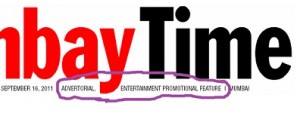
    While The Times of India group clearly says that Bombay Times is an ‘advertorial entertainment promotional feature’, while the statement upfront is a step in the right direction, it’s not enough as it ought to make a very clear announcement of what it means on its main Times of India page as well as on Bombay Times. I’m sure not many have noticed that small line under the Bombay, Delhi etc Times mastheads

    Back to Mid-Day, I believe it must reinforce as identity as a Mumbai paper. The Page 1 story must be ‘Bambaiyya’ in content and outlook, the feel ought to be tabloidy and the stories must have punch. I would like to see the Mate and snippety Diary back on Page 3. Or at least Page 2.

    Despite an edit page and some pretty good (and serious) content, Mid-Day was always known as a timepass read. Sachin was around in Mid-Day those days, so he should know.

    Agreed the look-and-feel has got to be more contemporary, but if it wants to create the same magic as it did until a few years back, it’s got to get its masti back.

    Why jail only for political paid content

    Beware, media barons and editors accepting money for publishing editorial content. While the election commission can do precious little about the corrupt practices of media entities carrying content in lieu of money and not clearly tagging it as an advertisement, it’s heartening to note that all those who are doing it for politics will be put behind bars for 2 years.

    Now, what about those doing it for lifestyle products? Shall we count the years?

    Read: an IndianTelevision report

    What’s a piece on the Campaign A-List doing on MxMIndia.com?

    If you’re surprised why the MxM anchor has Everest Brand Solutions president Dhunji Wadia telling us why it’s great to be on the Campaign India A-List, don’t be. It’s not that he put my name on the mail instead of the Campaign editor’s. We asked him to write it. He did that in record time, in between meetings. (Read Dhunji on the A-List)

    Here’s my take on the issue: MxMIndia is media-neutral and would like to write about every media entity. We will write about all the activities of even those who consider MxMIndia it’s rival. For in my books, no one is. I’ll be happy to cover the activities of all business publications and the media trade publications. This includes the Campaign A-List, the afaqs events, the exchange4media group events etc etc. That is, of course, if an MxM reporter is allowed in.

    Buzz me if you have a story to tell. Confidentiality assured. There are various ways you can reach me: pradyumanm[at]mxmindia.com, 23050B5D, Gtalk: pradyumanm[at]gmail.com, @pmahesh, 98338 76278