Tag: Mediametrie

  • Eurodata TV integrate BARC India nos

    By A correspondent


    BARC India (Broadcast Audience Research Council) and Médiamétrie announced the integration of Indian TV audiences into the Eurodata TV Worldwide service.


    In October 2015, Eurodata TV Worldwide, the world leader in the commercialisation of overseas TV audiences, will integrate the television audiences of BARC India into its services. Eurodata TV already covers more than 100 countries and 6,300 channels in five continents.


    Indian television market audiences will also enrich NoTa (News On The Air), Eurodata TV’s new international programme monitoring service launched in 1997. India represents a strategic territory for international audiovisual market stakeholders thanks to a population of 1.2 billion inhabitants, an average age of 27 years, its economic dynamism (3rd GDP in the world, 7.2 per cent of growth in 2014), and the size of its television market with 153.5 million households equipped with TVs as on March 2015.


    With this partnership, Eurodata TV will provide daily data (with a weekly reporting lag) for its customers about programming, content and programme audiences in India by target group: producers, distributors, broadcasters, rights managers, sponsors, etc. For example, on 18 September 2015, 114 million Indians watched television between 7 pm and 11 pm. And, BARC will be able to compare the data for its television market with that from countries already covered by Eurodata.


    “Thanks to this agreement, Médiamétrie will offer its international customers a more in- depth analysis of the Indian television market, which is one of the leading markets in the world” declared Laurent Battais, Executive Director of Eurodata TV Worldwide. “BARC will be able to benefit from our international sales force and offer the Indian market visibility in five continents.”


    Partho Dasgupta, CEO of BARC India said, “There is a lot of demand for Indian audience data globally and this tie-up will satisfy that demand. We are very happy to partner with Eurodata TV as our reseller for the rest of world which will help us grow in reach and popularity. I am certain that with the immense experience of Eurodata TV the relationship will be mutually beneficial.”


  • BARC appoints Dutch firm Civolution for watermarking tech

    By A Correspondent


    Amidst issuing requests for proposals and advanced-level testing, the joint industry body of broadcast stakeholders BARC (short for Broadcast Audience Research Council) has contracted Dutch tech firm Civolution to provide the watermarking technology for its proposed measurement platform. The decision comes weeks after the announcement of Médiamétrie as its key technology vendor.


    Partho Dasgupta

    “India has one of the largest TV audiences in the world so it was critical for us to create an audience measurement system that is gold standard,” said Partho Dasgupta, CEO, BARC. “By leveraging Civolution and Médiamétrie’s expertise in audience tracking, technology and analytics we can now study viewers’ TV habits in precise detail, enabling broadcasters and advertisers to implement efficient strategies to reach their target audience.”


    According to a communiqué, the audience measurement system – which has already successfully been deployed by Médiamétrie in a few TV markets – relies on Civolution’s audio watermarking coding technology for automated content identification and integrates seamlessly into Médiamétrie’s TV meter system for panellists’ equipment and data processing.  It provides broadcasters with a detailed analysis of their exposure to the public, whether by the number of households tuning in to the programme or the amount of time spent watching each piece of content.


    Gwilherm Nicolas, Head of International Business Development at Médiamétrie added: ”We are very enthusiastic to embark on this project with Civolution and its watermarking technology, which is definitely the most powerful and error-free content detection technique available for TV audience measurement.  This means we are future-proofed in the fast-changing world of TV.  Médiamétrie has relied on Civolution’s technology for many years”.


    ”With so many new ways of watching TV content in this multi-screen universe, precise audience measurement has become increasingly complex. Audience measurement services must now report more accurately and reliably, from a larger number of channels, delivered through a fast-changing and diverse mix of broadcast platforms, and consumed either in real time or time-shifted” said Alex Terpstra, CEO, Civolution.


    Civolution’s audio watermark is embedded in the TV’s sound track prior to broadcast. Upon airing, the content is then identified by Médiamétrie’s TV meter, in real-time. In addition to granular measurement of the content being watched, the solution features support for catch-up TV. The technology provides cross-platform audience measurement and will enable mobile device measurement, triggering the creation of new services  and the reduction of operating costs. In parallel, the same watermark infrastructure deployed by Indian broadcasters could be used to synchronize with great accuracy their own interactive second screen applications.


    ”Through our close collaboration with Médiamétrie, we have devised a powerful solution that provides accurate and reliable audience data that will allow BARC to help broadcasters plan, entertain and monetize their TV audiences,” added Jean Michel Masson, SVP Watermarking Solutions, Civolution.


  • It’s official now: BARC chooses Mediametrie as tech partner


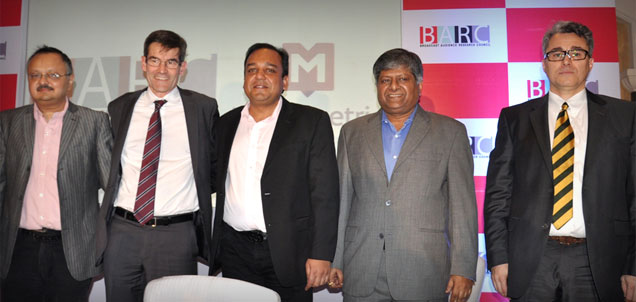
    For BARC chairman and Zee Entertainment MD and CEO Punit Goenka, the announcement of Mediametrie as the technology partner and the signing of the Letter of Intent in Mumbai is a big step towards the new audience measurement regime. Ditto for Benoit Cassagne. Mediametrie’s Executive Director of audience measurement and Senior Vice President for whom entering a large market like India is a significant recognition of its captabilities. Soon after making the announcement, both Messrs Goenka and Cassagne took time out to speak with Shobhana Nair


    Technology & cost were factors in choosing Mediametrie: Punit GoenkaIn a sense, the future of the broadcast sector depends a lot on the decision to select Mediametrie as BARC’s technology vendor.  Are you fully convinced about the path chosen?

    The first and foremost is that fact that it is a far more advanced technology that Mediametrie has brought to us. Apart from the watermarking solution that they are using, it is an open source technology. And any PC-based technology is far better and cheaper than a propriety system.  Other than technology, cost too was a factor in choosing Mediametrie. The entire process of audience rating is broken into three different stages and no one stage can go to another vendor. This in itself brings in checks and balances on who does what.


    With so many parties involved, will it not complicate things?

    Yes, it will complicate, but that’s part of life if you want a robust system to come in. We see the same happening in the UK which is a large market. I don’t see any reason why we can’t make it happen here.


    TAM says it was appointed jointly by the three bodies – IBF, AAAI, ISA – for audience measurement. These three associations are also statekholders of BARC. Why do you think nothing can go wrong even now?

    I am not sure whether TAM was officially appointed by all three bodies. We can go wrong however we have to work very hard. We have taken solutions after studying the models adopted by several countries. Our core proposition is based on the UK-model of BARB where you outsource it to three to four agencies so that no single agency controls the entire process and there is complete transparency.


    Do you think you will be able to meet all your deadlines that you have set for BARC?

    I am very confident that we will meet the deadlines.

    Journey might be difficult but I know we will succeed: Benoit CassaigneThe technology you have has been adapted in stable markets like France. Do you think India is ready for this kind of a system?

    India is ready for the change. We have met the people at BARC several times and we think these people are very qualified about audience measurement and they know exactly what they want to achieve. They have a clear roadmap. My belief is that the journey might be difficult but I know we will succeed


    Is the watermark technology really the best way to measure television audiences?

    Watermarking is very precise and I am very confident in our technology. Watermarking is very precise for time-shifting audience and to make difference between a live and time shifting edition. This is beneficial for new screen measurements. I think it will work well here in India.


    Did you study the current Indian television audience measurement system. Being an outsider, did you study the current TV measurement system? What are the loopholes in them?

    This is not an easy question and I am not a specialist. I don’t know the situation here but I do know there are complaints. I don’t know whether it is a question of governance, size of panels or technology. I can’t say really what was wrong. I am too new and too far from this market. But I have a lot of respect for them.


    Are there any peculiarities about India for the development of a measurement system? Do you think it’s tougher to administer one here in India than it’s in your home market France?

    Media measurement is a small world and the Indian situation is not-so-special. TV ratings systems are very comparable from country to country. The technology is comparable but the size of the market is not. Likewise, the local channels cannot be compared. Clearly, the Indian demand and market conditions are not difficult.

    The announcement: BARC signs deal with Mediametrie, a joint industry body in FranceBARC announced the formal tie-up with Mediametrie of France for some key technology services and licensing for the proposed television audience measurement system. Mediametrie is the Joint Industry body in France, operating the TV, Internet and Radio currency ratings systems, engaged in multimedia audience research for the last 25 years. They have been designing and developing their own TV metering systems for 15 years.
They are pioneers in the development and usage of watermarking technology in audience research and have been using this successfully for the last seven years. This technology is used in 3 currency markets : France, Morocco and the Netherlands.


    Under the arrangement, Mediametrie will provide technological knowhow and licenses to BARC to use their TV metering system and also help BARC procure its own metering hardware.


    Speaking about the same, Punit Goenka, Chairman, BARC said “I am delighted at this association with Mediametrie. Our Technical Committee and the Management had scouted the global marketplace for suitable technology and we are happy with our choice. We will take a quantum jump in technology for audience measurement in the country with this.”


    Benoit Cassaigne, Senior Vice President, Mediametrie said “We are very happy and proud of BARC’s confidence in our solutions and expertise. We are thrilled to bring our know-how on such a TV market and share it with BARC a company very similar to us in its DNA. We are sharing a lot already in term of philosophy and vision and I am sure we will go far together”


  • Mediametrie… who, why, how?


    By A Correspondent


    If the question in our headline is what a lot of broadcast industry stakeholders have been asking this weekend, there’s reason. The US- and UK-exposed Indian media fraternity do not know much about Mediametrie, the French joint industry body for TV measurement that’s been chosen as the primary technology vendor by the Broadcast Audience Research Council (BARC).


    The BARC Board met on Saturday, November 30 and is reported to have given an in-principle clearance for awarding the measurement contract to the French measurement body. However, that’s as per the information leaked. Officially, the BARC communiqué issued doesn’t name any vendor.


    On Saturday, the BARC Board met to decide on the technology and the path ahead. “There was unanimity in deciding on a leap in technology to be used in television measurement. The Board approved the management and the technical and commercial committees to go ahead and finalize with a couple of international companies for this. The team will be completing the pilots and will start deployments soon. The Board also decided on the funding mechanism and is encouraged by the response received from banks for funding the project,” the release noted.


    As per reports earlier this year that were later denied by a BARC official, there were five vendors shortlisted for the key function of installation of set-top boxes and generate measurement viewership numbers. These included Kantar and Nielsen. Sources say Nielsen was in the final shortlist of three and was close to being selected, but the solution it offered was far more expensive than that of Mediametrie. TAM, a joint venture of Nielsen and WPP-owned Kantar, was not involved with the bid process at this stage.


    The vendor selected will not be involved with the analyzing of data, and that contract will be awarded separately by BARC. TAM is a likely contender for this, subject to the cross-ownership not being a stumbling block in its participation in the bidding process.


    So what is it that got Mediametrie to win the race? And who and what is Mediametrie?

    The reasons, in brief:

    First, the technology.

    Second, the low cost.

    Third: Mediametrie is not married to any set-top box provider

    And fourth, Mediametrie is structured like BARC and is not a solely-for-profit body


    The technology Mediametrie is likely to deploy is called ‘watermarking’ which entails inserting into programmes a ‘mark’ that is inaudible to the human ear. This ‘mark’ contains the identification of the channel which airs the content and the regular broadcast time markers. The audimeters installed in panellists’ homes can then recognise this information. According to sources, BARC officials have discussed the viability of inserting these markers with private channels as well as with Doordarshan. The technology allows for measurement of TV content on mobile phones as well as sedentary computers.


    The watermarking technology is being licensed from a Netherlands-headquartered vendor Civolution.


    The cost is indeed low for the technology and the set-top boxes and that’s the reason why BARC is bullish about achieving a 50,000 panel base in a year-and-a-half (See: http://www.mxmindia.com/2013/10/barc-eyes-50k-panel-in-1-5-years/) .


    A key irritant in the increase of the panel base of TAM was the cost of set-top boxes deployed. While TAM was willing to buy more, the costs were high and the taxes made them even more pricey. With the Mediametrie deal, the measurement technology is the key and not the set-top boxes. In fact, the boxes will need to be procured by BARC separately through one or more vendors. As per a source, Nielsen almost won contract due to this clause, as it was a tried-and-tested offering. However, buoyed by the confidence reposed by various stakeholders, the BARC technical committee is understood to have taken the decision to get into a separate contract with one or two hardware providers who can bring in the mandatory 20,000 set-top boxes required within six months of the government guidelines for TV measurement coming into force. Cisco was also rumoured to be in the running for this contract, but sources say that it may not among the chosen ones.


    As per info on its website (hence not verified by this correspondent), Médiamétrie was founded in 1985 in response to the changing demands in the French audiovisual sector. The government encouraged the creation of an independent company to ensure that audiences of the principal audiovisual media could be measured scientifically. This independence for Mediametrie is guaranteed by the presence of all professional parties, in all its decision-making processes and in its stakeholding, including the media, advertisers and agencies without any of them having a majority holding to take a decision alone. The ownership and structure of Mediametrie is hence quite like BARC and it isn’t a solely-for-profit set-up.


    Médiamétrie is now developing its range of services and extending its scope by working on new media, telephony, new multimedia practices, crossmedia, etc. It offers original products designed for specific users and launches offers on the international market that have become essential due to changes in consumers’ listening and viewing habits. Mediametrie has also created Eurodata TV Worldwide for analyzing and distributing info on over 5500 channels across over 100 countries.


    Civolution was  formed in October 2008 as a spin-off of Royal Philips Electronics.  In August 2008, Philips Content Identification, a business unit of Philips Electronics, assumed full ownership of its joint venture Teletrax. The combined entity was spun out of Philips in October giving birth to Civolution. In July 2009, Civolution took over the Software and Technology Solution from Thomson (Thomson STS), formerly NextAmp. Mediatmetrie’s technology is aided by that of Thomson (and hence Civolution).


    So, a source close to the developments, told MxMIndia that while Mediametrie is the primary tech vendor, Civolution and the set-top box vendor(s) will also play a key role in the implementation.


    When will the new BARC measurement come into force?

    BARC as we know is a Joint Industry Body (JIB) set up in 2012 with the specific purpose of designing, commissioning, supervising and owning India’s Television Audience Measurement System. IT is a joint venture bringing together the three key stakeholders – broadcasters, advertisers and advertising and media agencies. Their respective apex bodies, the Indian Broadcasting Foundation (IBF), the Indian Society of Advertisers (ISA) and the Advertising Agencies Association of India (AAAI), represent the three sectors.


    Although the public position for BARC may be that the new measurement regime will be up and about by the end of Q2 of 2014 (that’s by June 30, 2014), MxMIndia estimates as per discussions with various stakeholders in the industry, given the criticality of the data, subscribers will switch off the tap only after they are a hundred thousand percent convinced about the data.


    “Remember Q3 and Q4 are the all-important adspend seasons and we can’t afford to risk any mess-up due to the non-availability of data that has a buy-in of all parties. So even though we want the new BARC system to be a success, we need to be realistic,” said one industryperson. A broadcast sales head was more pragmatic. “Although it appears that the market will improve and we will be done with the elections, over the last few years there have been too many extraneous factors impacting broadcast sales. We can’t have one more variable in the system,” he said, indicating that the transition to the new measurement regime from TAM could well be done in a phased manner. So the new BARC data will start coming in from August 2014, as per scheduled, but subscribers may dispense with the current system only later.


    In the meantime, BARC needs to also contend with the government and a zealous Minister of Information and Broadcasting who is keen on effecting the new measurement regime in his tenure. “Minister Tewari’s intent is well-placed,” said a key BARC stakeholder, adding: “In reality, the system just can’t be executed in the UPA-2 tenure. Also, we do not a half-baked system to get operational.”


    The minister (and the ministry) is keenly keeping tabs on the progress being made on this front and it is learnt that key BARC officials are likely to meet them in Delhi this week.