Although I would hold her responsible for the mess that we have in digitization, Ambika Soni was among the better I&B Ministers we have had in the last decade.
In my report card, I would give her a 7 on 10.
In fact had it not been for digitization and the lack of gamechanging vision, she’s could’ve scored higher.
Remember she took over from Anand Sharma and earlier Priyaranjan Dasmunshi who had made life tough for industry practitioners. Ms Soni’s tenure came as a breath of fresh air. Reportedly, the advisory she received from her predecessors was that she shouldn’t go easy on media biggies, but she would’ve none of that.
Everyone has a view on the content dished out on television and in the print media. Parliamentarians, legislators and politicians of all hues, consumer and advocacy groups, corporate, citizens, et al would engage with her to act on their demands. For instance, Balika Vadhu in Colors was found by some to be glorifying child marriage or Sach Ka Saamna and Bigg Boss were found to be unfit for family viewing. Ms Soni heard the complaints and kept the complainants at bay. The general entertainment channels must thank the former minister to ward off a variety of pressures.
I think just letting various players do their job with a nudge here and there was an achievement. Ms Soni also ensured that entertainment and news broadcasters work out an effective self-regulatory mechanism. This had had its share of hiccups in the past, but in her tenure it happened.
Ambika soni
But though her progressive outlook ensured that the industry benefitted, various factors pull her down in this appraisal. In fact, according to one magazine study a few years back, she was judged to be a non-performer.
Let’s look at the areas where Ms Soni failed:
1. Doordarshan. The pubcaster had turned 50 in 2009 and there was an opportunity to make it a more professional BBC-like body. Didn’t happen.
2. Radio. News on FM radio is not allowed due to some silly Home Ministry objections even as there are several cable channels in every nook and corner of the country.
3. Paid news. If paid news is being discussed much it’s thanks to the Election Commission and a section of the fraternity. The minister had an opportunity to cleanse the system, but she didn’t want to upset the holy cows in the business
4. Tougher on measures: Had she adopted a sterner stand and asked the industry to act faster, we wouldn’t have seen an NDTV taking TAM to court as BARC would’ve been set up and offered the necessary guidelines.
5. Digitization. Agreed it’s a bold measure and it’s in her tenure that it gained momentum and was being executed. But the fact that it didn’t was all thanks to the way her ministry went about the task. Even as there are just two days to go, 100 per cent digitization will take another two or three months to happen in the four metros.
Could this embarrassment have been avoided? Yes, of course.
I am also shocked at how and why she quit less than a week before what was decidedly the biggest thing in Media and Entertainment in the last decade. Bigger than DTH and other policy initiatives. Yes, it’s a good idea that a senior political leader goes back to help the party in the run-up to the elections, but why do it when the Sunset Date is just a week after?
Why did the Prime Minister allow her to do so? Why did the UPA chairperson allow it?
This, I guess, is the reality check for all of us in the media. The powers that be don’t really care.
As for Madame Soni’s score in my report card. 7/10. And a red line for being irresponsible and leaving the ministry a week before her biggest project was being executed.
Pradyuman Maheshwari is Editor-in-Chief, MxMIndia. The views expressed here are his own. Inbox him at pradyumanm@mxmindia.com or use the messageboard below
That the meeting last week where the ISA and AAAI met with TAM did not have the IBF in attendance made one wonder whether all was still not well between the three bodies on the constitution of BARC, and perhaps television measurement itself. This despite the fact all key officebearers from the three apex bodies of advertising, ad agencies and broadcasters have been working overtime to make it happen.
The controversy that’s erupted thanks to NDTV taking TAM and its principals to court is the biggest that Indian commercial television has faced thus far.
And the governmental threat of setting up a TRAI-like Broadcasters’ Regulatory Authority of India is for real. Ideally it ought to be a Media Regulatory Authority of India which will also include newspapers, radio and the digital media in its fold, but successive governments and bureaucrats are too scared of taking on newspaper barons and editors. It’s the threat of a government-imposed regulator that got warring Hindi news channels Aaj Tak and India TV to smoke the peace pipe. If a TRAI-like regulator happens, all media entities know that could face a tough time.
I don’t want to get into the merits of the NDTV v/s TAM, etc case. The matter’s sub-judice and discussed to death.
Note the statement says the formation of BARC is on the anvil. Given the extent of time the print readership council took to happen (note the appointment of the research company/alliance awarded the contract has still not been announced), my guess is that it will take it around 12-18 months for any alternative to be set up.
None of the stakeholders – at last week’s meeting or outside of it – have announced stopping their subscription to the current system. So if they haven’t done it, and in fact still sport TAM numbers whenever the ratings are favourable to them, isn’t it time that stop having double standards?
Already the ownership structure of BARC is not a healthy one. Advertisers ought to be paying the lion’s share since any research will help their money being better utilised. The broadcasters could’ve contributed to the corpus that will facilitate the operations of BARC and the research process (the boxes et al). But now all of this is history. Broadcasters will own 60% of BARC, and advertisers and ad agencies will own 20 percent each.
Thankfully for the broadcasters, the I&B ministry is busy elsewhere (Assam, social media etc). One wrong move, you can be sure that the government will flex its muscles.
My guess (and information) is an announcement on BARC will happen sooner than that.
Mediaah! is written by Pradyuman Maheshwari, senior journalist and Editor-in-chief, MxMIndia. He can be reached at: pradyumanm[at]mxmindia.com, Gtalk pradyumanm@gmail.com, BBM 29FEA79C. Twitter @pmahesh. The views expressed here are his own.
As a term, Indian media loves to define copyright as the right to copy than a protection of the intellectual property of a body of work. Under the garb of inspiration, many of our films are ‘lifted’ from their international counterparts without permission. Television is a nicer place with channels paying fair monies for formats of popular shows like Kaun Banega Crorepati, Indian Idol, Bigg Boss, Jhalak Dikhla Jaa, etc. Radio has had its issue on copyright for payments for airing of songs, but not for filching ideas.
Fareed Zakaria’s apology (and comments): http://globalpublicsquare.blogs.cnn.com /2012/08/ Â 10/a-statement-from-fareed/
The article with the plagiarised text: http://www.time.com/time/magazine/article/ 0,9171,2121660 2,00.html
The original New Yorker article by Jill Lepore: http://www.newyorker.com/reporting/2012/04 /23/ 120423fa_fact_lepore?currentPage=all
The Economic Times Code of Conduct http://articles.economictimes.indiatimes.com/2010-09-18/news/27597028_1_editors-confi dentiality -church-and-state
The MxMIndia Code of Conduct http://www.mxmindia.com/code-of-ethics/
The Slate controversy http://www.slate.com/articles/arts/culturebox /2010/10/great_writers_steal.html
For many years, a majority of Indian print media editors have condoned plagiarism. In fact, many encourage it, some even indulging in them. News reports – in full or part – are often copied without permissions or attributions and no one really appears to worry about it much.
When Mediaah! ran as a standalone blog in the early 2000s, it wrote about how a reporter with a business daily had plagiarised from a report on the website of a rival paper. My attention was drawn to the apology that appeared.
At that point, my contention was while the reporter was to blame, her team leaders were equally responsible as they ought to have been more vigilant and tracked what immediate competition had written.
The reporter went on to work at various workplaces later, and I haven’t really tracked whether she has repeated the act or not. At another former workplace, I was faced with a situation where a columnist confessed to plagiarising. The column was dropped with immediate effect.
Many years back, a Hindustan Times editor also disgraced himself (and the paper) by plagiarising. His services were dispensed with after a furore over the issue.
Plagiarism – in any form is a crime – and it’s critical that organizations adopt strict rules. At the Economic Times and ET Now, for instance, it’s a “firing offence” as per the code of conduct. At MxMIndia too, we have a no tolerance policy towards plagiarism and it could mean an immediate termination of employment, regardless of the utility or seniority of the journalist. However, as we figure, not all organizations have stringent standards on plagiarism. Some just let it be.
If it was easy to escape plagiarism a decade back, the wide use of the internet and social media in particular will ensure that those caught in the act will not be forgotten in a hurry.
For instance, I am sure India Today group chairman and editor-in-chief Aroon Purie had no role to play in his signed editorial picking up generously from a Slate.com article two years back. Sadly, whenever there is a discussion on plagiarism, his name will surface in the list of well-known Indian editors indulging in the act. In fact, a Wikipedia entry on the media baron has a fairly visible mention of the Slate case.
I guess the same would hold true for Fareed Zakaria. This is what Zakaria’s bio reads on the homepage of his website (fareedzakaria.com):
Fareed Zakaria hosts CNN’s flagship foreign affairs show, is Editor-at-Large of TIME Magazine, a Washington Post columnist, and a New York Times bestselling author. Esquire Magazine called him “the most influential foreign policy adviser of his generation.”
The Wikipedia entry on Zakaria already highlights the plagiarism case.
Books on media history and ethics will now have one more way to describe Fareed Zakaria: great mind, writer, TV host, author and a plagiarist.
Sad.
Mediaah! is written by Pradyuman Maheshwari, senior journalist and Editor-in-Chief and CEO, MxMIndia. He can be reached at: pradyumanm[at]mxmindia.com, Gtalk pradyumanm@gmail.com, BBM 29FEA79C. Twitter @pmahesh and of course the mobile: 98338 76278. The views expressed here are his own.
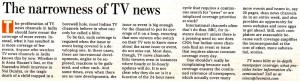
I find the media coverage in the Mint by far the most balanced from the time it started and was quite surprised to see a bizarre second edit in today’s edition titled ‘The Narrowness of TV news’.
Now we all know the problems with the news on television: it’s often sensationalized, it can go and on over an inconsequential issue and do whatever it takes to garner ratings.
While making a case for its argument on the narrowness, the editorial concludes:
One shouldn’t really be complaining because such coverage ensures the continued relevance of newspapers, which actually cover many more events and issues in, say 20 pages, than news channels do in an entire week, and also provides an opportunity for news websites and news apps to get ahead. Still, such complaints are reasonable because such coverage amplifies the inconsequential at the cost of other, more substantial, stories.
I don’t think there’s anything wrong in what the Mint has said, except that it has made some gross omissions. One, it bases its arguments only on the primetime slots on news channels. For instance, let’s take Times Now among the English. Yes, the 9-10/10.30 blocks are taken up by extended studio discussions on one or two or at most three topics and an end-piece, but at around 8.30 it does carry news snippets from across the country. I must confess I don’t watch enough of news television to be able to give you specific timeslots across networks, but I’m certain every channel has a slot for round-up albeit not at the 9-10pm slot.
Mint’s editorial evidently doesn’t take factor in the news on the Doordarshan channel (DD News) which is possibly more all-encompassing, though the emphasis is more on the ministers and government events.
My peeve against the comment is that it assumes that news in our newspapers is perfect. It may be noted that HT Media, the company that owns and publishes Mint, doesn’t own a news channel, though it actively allies with CNN-IBN for special surveys and events.
The fact is that just as the malaise afflicts news on TV, it also exists in newspapers. In fact there are enough biases in the papers. And these move from news to editorial pages too. A leading national daily who the Mint editors may be familiar with dropped the column of a well-known commentator because he/she had written a slightly negative article on an emerging politician of a disposition that the newspaper group is close to. Then there are cases of paid news and a variety of vested interests at play.
The primetime slot on television news is like the front page of the newspaper. Just as you’ll not get a hundred news stories on Page 1, the same holds good for television news.
So to damn the content mix of one medium on its editorial page is not on, dear editors of Mint. The decay is huger in print – in the big and small cities. The narrowness exists in newspapers too — on the news pages and beyond.
Buzz me if you have a story to tell. Confidentiality assured. There are various ways you can reach Mediaah!: pradyumanm[at]mxmindia.com, Gtalk pradyumanm@gmail.com, BBM 29FEA79C. Twitter @pmahesh and of course the mobile: 98338 76278. The views expressed here are my own.
Hardly had the news of the acquisition of English news channel NewsX by ITV Media Group and Hindi news channel Live India by Prosperity Agro filterd in, there were murmurs on whether it was vital for the government to impose entry barriers for the news media. ITV of course has been in the news for around five years and Live India already had a sizeable stake by a property developer HDIL.
As part of MxM Mondays, we spoke to a cross-section of news media practitioners to offer their views on the issue.
This issue of media ownership has been debated on in the past, and more so recently, because of the entry of corporate groups into the news media. Earlier this year we saw two big corporates enter the media domain, when Reliance Industries bought a stake in Raghav Behl-led Network18 and Aditya Birla Group invested in the Aroon Purie-led Living Media India.
While big business owning media is not a new phenomenon, there are numerous instance of politicians owning and controlling sections of the media, especially in Southern India.
Hence the question arises: Is it a cause for worry when people with non-media interests start owning the mass news media?
Here are a cross-section of views from captains of the industry (in alphabetical order of their last names):
Tariq Ansari, Chairman and Managing Director, Next Mediaworks Ltd
Tariq Ansari
The worry is not around who owns the media but whether they act in a way that is consistent with journalistic standards of integrity and fair play. We seem to have forgotten simple journalistic conventions like a declaration of interest from the owner of the publication/channel on stories in which there is a substantial commercial interest.
Media, much like steel or fertilisers or communications, will eventually belong to those who have the means and desire to invest in it. The point about it being the preserve of a few is inexplicable. Nobody is stopping anyone from raising the capital to start a newspaper/magazine/TV station/radio station/website. We live in a free country. Anyone who has the ability to own media should be able to do so, without limitation. Clearly my preference would be that criminals or those with clear vested interest should not own media, but I am not sure if the law of the land can prevent this from happening.
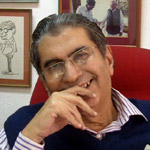
Vinod Mehta
Vinod Mehta, Former Editor-in-Chief, Outlook magazine
I am worried. Media diversity is very important for freedom of the press. I don’t want Media in the hands of a few owners. It should be open to all.
And here’s what MxMIndia’s regular columnists say:
Ranjona Banerji, senior journalist, columnist and Contributing Editor, MxMIndia
Media ownership is a worry to the extent that journalists are not able to withstand corporate pressure. For instance, the Birlas started Hindustan Times and the Tatas has a stake in The Statesman (to name just two) and the battle between marketing and editorial is as old as the profession. The problem comes when senior editors capitulate and reader interest is surrendered or sacrificed. I would turn the spotlight back on journalists: are we fighting the good fight?
Many years back when I asked a leading industrialist why he was keen on starting a news channel he replied with the famed Deewar dialogue (some alcohol in the system did the trick): Aaj mere paas buildingey hai, gaadi hai, bank balance hai, but even then these guys owning newspapers and channels are ruling the world. We were in the late 1990s, and journalists and news media owners were indeed much sought after. That may have waned over the years, but the desire to own news media stays. What hasn’t changed is that the intent of owning the news media goes far beyond returns on investments.
When the British ruled India, it was the desire to mobilize public opinion that led to several national leaders and even businessmen to embrace news. Post-Independence, with the birth of a new economy, it was a mix of nationalistic sentiment and also to use it as an ally in a tightly controlled business environment. The ’60s and ’70s saw the media taking off with magazines like the Illustrated Weekly of India, later India Today and several others in regional languages. The imposition of the Emergency got people to realize the importance of the news media as the liberalization of the economy and and the airwaves ensured that there is no looking back.
Being a democracy, there are no entry barriers to the media. And rightly so. However, when a few years back a few real estate and assorted players jumped into news television there were representations to the information and broadcasting ministry that there ought to be tighter controls.
The current murmurs are being heard because NewsX has been acquired by businessman Kartikeya Sharma. ITV, his media company, also runs the newspaper Aaj Samaj and regional and Hindi news network India News. And the reason for the concern: it was feared that being the brother of Manu Sharma who has been convicted in the Jessica Lallmurder case, he could misuse his position to influence the executive and the judiciary. Well, the Supreme Court upheld its sentence of life imprisonment in 2010, so evidently he didn’t achieve much. To be fair to Sharma, a senior editorial and business executive who has worked with him, told me that he saw no interference on content, especially on the Manu Sharma front.
Clearly, the money power of rich businessmen and politicians cannot bring in readers or viewers, as the case may be or make a success of the media enterprise. In the late’80s, the Ambanis acquired Commerce Weekly and converted it into a business daily. They also acquired The Sunday Observer that was once edited by Vinod Mehta and was exceedingly popular.  The Ambani indulgence in the media failed despite hiring top journalists and publishing executives. They could only use the papers to fight a few minor battles, and even those without much success.
Mehta worked and fell out with industrialists Vijaypat Singhani and L M Thapar as both found news too hot to handle and counter-productive to their primary businesses (and revenues). One had assumed he would meet the same fate when Rajan Raheja, a then-emerging industrialist with some interests in real estate, set up the Outlook magazine group. Mehta has led many battles with the mighty and powerful in his magazine and both Raheja and Mehta have survived each other.
Save the Outlook example which is a good indicator of business interests and independent journalism co-existing, clearly big money is not enough to drive consumption of news media. My worry though lies elsewhere:
1. Lack of transparency in the ownership of media.
2. Creation of a monopolistic scenario with business groups investing in multiple and similar vehicles
3. Level playing field for competition in case of vertical and/or horizontal cross-ownership, and
4. Diversification of media companies into entities beyond news
1 & 2. Transparency requirements in media ownership are critical. When the government announced recently that a certain conglomerate doesn’t not have interests in the media, is it really the case, or is that what is on paper and hence deemed correct? While doubts have been raised about how the acquisition of a sizeable chunk of Network 18 via an independent trust would impact the editorial independence of the group, the real worry is the rumoured interests of the group in other media ventures too.
Could we have a situation that a genre of channels or newspapers or the media entities in particular region of the country be owned – directly or indirectly – by one group? How do we tackle a monopolistic scenario such as this?
3. The PR head of a radio station in Delhi once complained that she could never hope to get her press release into the two main English dailies in the city because both had their own FM stations. So, while the most inane event from the group’s radio station gets covered, the lady’s FM frequency never got a mention even for a big activity. So rampant is this blacking out of a rival group’s activities that it’s now considered standard practice. In many countries there are strict rules for horizontal and vertical cross-ownership. While the TRAI has suggested restrictions in vertical ownership (a TV channel can’t fully own a DTH or cable platform etc), horizontal ownership is fine (so a TV channel can also run a newspaper, radio station etc).
4. The last of my worry areas can be a bigger concern, and, if misused, even graver than big business or a political party getting into the media. Many news media groups have invested in sectors outside of news and doubts have been expressed if there is any connect between the relationships with governments via the news media and the winning of such contracts.
Even though the government at the Centre is weak, and we can be sure it will flex its muscles often enough in the run-up to various elections until 2014, I don’t see any immediate solution to the problem. But what can play a deterrent for those who abuse the media will be public opinion via social media.
Sevanti Ninan, Editor, thehoot.org and Columnist, Mint
Sevanti Ninan
Yes, it is a cause for worry when people with vested interests start owning the mass media because political ownership of the media is increasing, and there are no transparency requirements on media ownership.
Readers and viewers are unable to discern ownership-related biases. There is also a renewed trend of corporate investment in media increasing. Media companies are supposed to file ownership details with the registrar of companies, but one, it is not properly done, and two it is very difficult for lay people to access the correct and latest data.
On the issue of media being a preserve of only a certain groups, even now it is fairly widely owned.
Maheshwar Peri, Chairman, Pathfinder Publishing India Pvt ltd
Maheshwar Peri
In my opinion there is no cause for worry. I think, increasingly, the cause for worry comes from a few industrialists who’ve gotten into media. But if you go back to the flag bearers of Indian journalism in the 1980s, Indian Express was owned by RNG, an industrial group. So, to say that ownership by industrialists would hurt media is a slightly wrong way of looking at it.
There is definitely a cause for worry when people get into media for reasons other than running it as a professional empire. If you look at some of the politicians who’ve come into media or political parties that are launching their own channels, that’s a cause for worry because they have a reason to dish out news which suit their needs and opinions.
So there is a problem when people in public office get into media, but it’s not so much of a problem if industrialists or venture capitalists or any others moneybag get into it because they want to make it a commercially viable operation. And they know they can make it commercially viable only when the reader/viewer respects them. In case of politicians, they are not interested in making it commercially viable; they just want to ensure that their point of view finds a space in the public domain.
I think unless a reader or consumer respects you, you won’t be able to sell beyond a point. So all of us, whether or not owned by corporates, are always trying to ensure that we give unbiased and credible information so that the reader continues to respect us as well as the advertiser continues to invest in us.
And what makes one think that they have a better opinion about media than a fruit vendor? I don’t think there can be a classification of who has a better opinion about certain things in this country – we are a democracy. So the worse thing is to say that ‘these’ kind of people can get into media and ‘those’ kind cannot.
Tarun Tejpal, Editor-in-Chief, Tehelka magazine
Tarun Tejpal
To some extent, there is cause to worry about media ownership. We have to air, discuss and examine issues of monopolies, cross media ownerships, and of cross business ownerships. And to try and build in some structural safeguards that both help ensure the financial viability of honest, robust media, and deter media owners from using their media instruments for unfair advantage in their other businesses.
Theoretically, it (media) should be open to all. But we must build in safeguards that minimize the misuse of public discourse and public instruments of media. This is not easy, but a discussion must start on this issue at all levels.
Paranjoy Guha Thakurta, Senior Journalist
Paranjoy Guha Thakurta
The growing corporatization of the Indian media is manifest in the manner in which large industrial conglomerates are acquiring direct and indirect interest in media groups. There is also a growing convergence between creators/producers of media content and those who distribute/disseminate the content.
In India’s unique ‘mediascape’, it is often contended that the proliferation of publications, radio stations, television channels, and internet websites is a sure-fire guarantor for plurality, diversity, and consumer choice. There were over 82,000 publications registered with the Registrar of Newspapers. There are over 250 FM radio stations in the country. Despite these impressive numbers of publications, radio stations and television channels, the mass media in India is possibly dominated by less than a hundred large groups or conglomerates, which exercise considerable influence on what is read, heard, and watched.
One example will illustrate this contention. Delhi is the only urban area in the world with 16 English daily newspapers; the top three publications, the Times of India, the Hindustan Times, and the Economic Times, would account for over three-fourths of the total market for all English dailies.
However, what is unacceptable is media barons using news outlets as tools to further their business interests. In this country, as in the world over, large media corporations are clearly playing a bigger role in the political economy that they report on. Though a free media is fundamental to the existence of a liberal democracy, concerns about the accountability and transparency of media companies remain. For instance, the RIL deal has enabled Network 18, Eenadu, and the merged group to expand its offerings to benefit its stakeholders and its advertising target audiences. What remains to be seen is whether clear boundaries can be etched between the boardroom and the newsroom.
There’s absolutely no doubt about the fact that if it’s truly going to be a responsive media, then the media should reflect the views, the interests, the aspirations of a larger section of population as possible. The problem with much of our media is that they are too busy trying to ‘reach’ consumers to potential advertisers than providing information to citizens.
Next Week:
Why do we all like to damn TAM?
The Sectoral Innovation Council recommendations last week said that there was need for an alternative to TAM, short for the media research company formed by a jv of two international research biggies: Nielsen and Kantar. This is a view that has been expressed several times over the years.
One of the main peeves against TAM is the number of Peoplemeter boxes present to collect data. Can 8000+ boxes effectively poll a populace of 1.2 billion, is what many broadcasters keep asking in public. In private though, not many are ready to pay up by increasing their subscription fee to enable the installation of more boxes across the country.
Also, what’s happening to BARC, the joint industry body that was to provide an alternative?
MxMIndia will speak to a cross-section of the industry to get answers. Meanwhile, if you have a view, email it to us at editor@mxmindia.com with the subject ‘MxM Mondays #2’
The Cannes Lions is no Olympics, so if India returned home with no Grand Prix and just three Golds, there is no reason to despair. Â Yes, there’s a jury out there, and there are many people comprising each of them, so it’s not easy to please all or most of them. Hence those who have come home with the honours deserve a huge pat on their back since they’ve managed to impress some of the best brains in the business from across the world.
Sad, because India is big news internationally. This is because of our bigness. People know that the real consumers exist in China and India. The one billion-plus population ensures that. The world recognises that being a democracy means that a lot of commerce-friendly measures are tough to implement. So there is much action in China and hence sexier work in advertising. That last bit also translates to more awards in the tally and more attention to that country.
This year’s Cannes Lions has seen a Abby-like controversy. I’m sure the folks at the Advertising Club Bombay will say “See, it happens there too”. While the Cannes Lions organisers aren’t at fault for what could’ve happened, but I guess there’s got to be some action else the festival will not see the 11000+ delegates who turned up for one or more days.
#CannesLions Stats
I was unable to get to Cannes as there was more pressing work here, but the best way to keep track was decidedly #CannesLions. In fact, as someone said, even if you were physically present at Cannes, it was a great way to get the buzz.
Here are some stats courtesy the Twitter Advertising blog (http://advertising.twitter.com/2012/06/twitter-celebrates-users-and-brands.html):
There were 103,389 mentions of #CannesLions on Twitter during the six days of the festival – a substantial increase from the 20,000 in 2011. Over 5,000 pictures were tweeted.
That’s 17,232 Tweets a day and 718 Tweets an hour with a peak of 3,000 Tweets an hour during key seminars – up from 40 per hour on average in 2011.
The total #CannesLions earned media on Twitter has been calculated at over 61 million impressions.
Often, the 3k tweets an hour looked a hundred thousand. They just didn’t stop coming! And even after the last day, there were several tweets on celebrations, discussions and there’s one exceedingly painful on a book written on the future of advertising. Tweets are fun, informative but can also be a pain!
Nikhil Pahwa’s Medianama is 4
My hearty congratulations to Medianama and Nikhil Pahwa on the popular tech-telecom-media site’s fourth anniversary.
I know there are some who think Nikhil is brash, but that’s only because a lot of people in important offices are used to puffs and plugs from journos and trade sites. Although it may be styled as a blog, I am aware that he follows the same rigour as any journalist ought to.
Medianama went live on June 27, 2008. It’s got a small team and has advertisers on board. So revenues are happening. When I asked Nikhil about revenues, he replied (rather tweeted back): “Healthy. We’re slowly learning to grow. Is tricky, but learning.” Guess I know what he means.
Buzz me if you have a story to tell. Confidentiality assured. There are various ways you can reach me: pradyumanm[at]mxmindia.com, Gtalk pradyumanm@gmail.com, Twitter @pmahesh and of course the mobile: 98338 76278. Â The views expressed here are my own
Yes, she must. There’s no point making a charade of it when the on-ground reality is not what it should be with just 23 days left for the scheduled compulsory switch to digitally transmitted television in the four metros of Chennai, Kolkata, Mumbai and New Delhi. Over the last five months, MxMIndia has been speaking to various stakeholders on digitization. In fact right from the day our countdown started when there were 100 days to go for the June 30 Sunset Date, key stakeholders have been telling us that the deadline is unachievable.
The government has itself to blame. The digitization deadline has been known for a while, and one would’ve expected it to have moved faster if it was serious about the Sunset Date. The tariff order came in rather late, and one would’ve expected the babus to have worked backwards and establish a foolproof schedule.
Now, we have a situation that’s going to embarrass all.
A senior industry professional told me that after the June 1 taskforce meeting it was clear that deadline will be pushed by at least two months, if not three. Some influential cable professionals have been rooting for six months, but I think three months is fair, with a diktat that within six months, it ought to be total.
I also believe that there ought to be a significant incentive for early birds. Those who’ve switched subscribed and those who will in by September 30. The government must cut its levies and ask for these to be passed on to subscribers. Something like: buy a set-top box and get free connectivity for six months! Ensure this offer is only for the first three months, and after that it should be withdrawn. Also, subscribers should be allowed to pay in instalments.
Today, Anil Thakraney’s maid asked him for a thousand-buck loan. I am sure I am going to be asked for the same soon. It’s critical that the lowest common denominator in our country – and there is a sizeable population that can’t make ends meet – is finding it tough to embrace digitization. There’s of course the argument that no one likes to pay for software in India, but there is no denying that the move will impact the household budgets of crores of Indians.
So what’s the solution. Extend the deadline, yes, but just by two or three months. Offer an incentive for this period, and then bring back the taxes. Let this be the first deadline and have a final one of six months and ensure that all comply post that. A ‘Good Night’ date after the ‘Sunset’.
Buzz me if you have a story to tell. Confidentiality assured. There are various ways you can reach me:
pradyumanm[at]mxmindia.com, BBM 23050B5D, Gtalk pradyumanm@gmail.com, Twitter @pmahesh and of course the mobile: 98338 76278.
Disclaimer: Although he is CEO and Editor-in-Chief of this site, Pradyuman Maheshwari’s views in Mediaah! are not necessarily those of the rest of the team and MxMIndia.com.
There is no official word on it on the ministry website, but some journalists in Delhi were told about how the I&B secretary Uday Varma has written to newly appointed TRAI chairman Rahul Khullar to look into issues of cross-media ownership.
“Major players are looking for expanding their business interests in various segments of print and broadcasting sectors. In this scenario, issue of media ownership and the need for cross media restrictions assumes great significance,” Varma wrote in his letter to Khullar, according to a Press Trust of India (PTI) report on EconomicTimes.com
Adds the report: “Sources said that the I&B Ministry has asked TRAI to look into both horizontal and vertical aspects of cross media ownership, and then give its recommendations. In his letter, Varma has written that at present companies have control and ownership across Print, TV and Radio leading to horizontal integration. While at present there is no restriction for a company to have ownership across Radio, TV and Print mediums, but apprehension have been expressed in the past that control of media organisations in a few hands may prevent plurality of news and views, official sources said.”
According to the PTI report, in his letter, Varma is also have said to noted that there were other implications related to cross-media ownership which included ensuring quality services at reasonable prices. The I&B secretary is reported to have further asked TRAI to look into the issue of vertical cross-ownership where companies owning TV channels were venturing into various distribution platforms like Cable TV distribution, Direct to Home (DTH) and Internet Protocol Television (IPTV).
Hmmm. So this is why the headline: will cross-media restrictions force Star, Zee & Sun to exit distribution?
Now before going any further, and for the benefit of those not in the know, let’s understand what vertical and horizontal cross-ownership means.
Vertical would mean a media company that has ownership of, say, a TV channel also controlling a distribution (cable/direct-to-home/satellite/etc) company. And horizontal cross-onwership would be a company that has interests in various media vehicles – newspaper, radio, TV, digital and even telecom!
Way back in 2009, TRAI had issued some recommendations which I had commented on. My belief then and now is that the government and TRAI seem to be ducking the more sensitive issue of horizontal integration – namely, a media company with interests in print, radio, television etc. The TRAI believed that there was no threat due to horizontal ownership, but vertical integration – for television was a problem. So, while it was okay for a newspaper or a magazine to have its own distribution facility, that’s not the case for television. But of course the circumstances for print and television are different. In the 2009 recommendations, TRAI felt that there should be a 20 per cent cap on ownership and existing players would get three years to restructure.
It’s been over three years already, and I guess that’s what has got the government moving its feet again.
Mediaah! view: I don’t really think there’s any need for the government to intervene as regulatory and legal actions are already in place. And competitive pressures of course. For instance, a DTH operator cannot blank out a rival network’s channels.
Mind you, the problem is graver with horizontal ownership. The PR executive of a radio station complained to me how she couldn’t ever get publicity in some key markets because rival stations were owned by newspapers. Thus even a minor activation gets a photograph and a report in the paper while that of a rival does not. Competition writes about you only if there’s something negative, she complained.
Similarly television marketers crib how channels owned by newspaper companies have it easy with advertising and editorial space. Thankfully, media buyers are discerning and don’t get taken in by claims – correct or otherwise.
The 2009 recommendations had also seen TRAI saying that limits on licences by a single entity were “adequate” and there is no restriction on control of ownership across telecom and media. Note this was to be reviewed after two years (that is, 2011), though the real changes in dynamics have happened since January 2012 given Reliance Industries and the Aditya Birla group getting involved, albeit indirectly.
My sense is that given recent developments, the TRAI will also look at the issues of mergers, acquisitions and alliances in a bigger way. What the government/TRAI needs to also do is ways to determine and factor in ‘benaami’ ownership. For instance, even if as a broadcaster I may not own over 20 per cent of another ‘vertical’ media entity, what prevents a family member/friend to do it?
It’s not an easy policy to work on, but am sure like various other complex issues it has tackled over the years, TRAI will come up with recommendations for this too.
Buzz me if you have a story to tell. Confidentiality assured. There are various ways you can reach me:
pradyumanm[at]mxmindia.com, BBM 23050B5D, Gtalk pradyumanm@gmail.com, Twitter @pmahesh and of course the mobile: 98338 76278.
Disclaimer: Although he is CEO and Editor-in-Chief of this site, Pradyuman Maheshwari’s views in Mediaah! are not necessarily those of the rest of the team and MxMIndia.com.
On April 10, the TV Today network clarified to the Bombay Stock Exchange on rumours that the Aditya Birla group was acquiring a stake in the India Today group. The clarification said the Company (TV Today) was not aware of any such transaction and was not in a position to confirm the contents of the media reports.
A little over a month later, the same organization sent the BSE a copy of the press release stating that 27.5 per cent of Living Media India, better known as the India Today group, was sold to the Aditya Birla group.
A senior member of the AV Birla group told this correspondent that the investment was made by chairman Kumar Mangalam Birla on a personal level and not by any of the group companies. Â After the customary approvals in a few months, we would get to know the real numbers. Late on Friday, Ashish Bagga, recently appointed CEO of the entire group (including TV Today), informed staff of the development by way of an email.
The question which everyone wants to know is the price that Mr Birla paid for the 27.5%. There have been various figures floating around… that the money paid is in the region of Rs 350-500 crore. In the communique issued, Mr Birla is quoted saying: “The media sector is a sunrise sector from an investment point of view. I believe that Living Media India offers one of the best opportunities for growth and value creation.”
Also read:
AV Birla group buys 27.5% in India Today group
Birla may use personal money for buy, Mail Today may now launch editions in Mumbai, other metros
Loss of plurality is worrying: Paranjoy Guha Thakurta
And here’s what Aroon Purie, chairman of the India Today group said: “I am delighted to partner with the Aditya Birla group to aggressively address the current and future potential of the Indian media business which is at a tipping point. The Aditya Birla group with its strong leadership global footprint, diversified business interests and its shared values of integrity, commitment and social responsibility make it a perfect fit with the India Today group.”
So where’s the money going to be used? For one, it would mean expanding its current businesses. Specifically, Mail Today to move to markets like Mumbai and other cities and for TV Today to get into the regional space, and possibly a business channel. With a question mark on overall growth of newsmagazines, Living Media needs to invest its resources on segments with a growth potential.
It has already done so by investing in smaller, niche magazines which have a smaller print run and attract fair amount of advertising as also bringing in international content.
The TV Today network has also been in pressure in recent months with competition gaining ground. The radio station -Oye 104.8 – also needs to grow on the ratings roster.
And what does it mean for the industry? Although a 27.5% equity will give Mr Kumar Mangalam Birla a toehold in media, it’s not significant enough for him to wrest editorial control. However, while there is fear of how big business money may impact the media, the fact is that it is already doing so. Even today, there exist managements and editors which buckle under pressure from large advertisers and influential individuals. There are enough stories of vested interests at play in Indian journalism, and for the media as a whole, the infusion of money from big business houses and foreign players could possibly ensure better salaries and hence lesser corruption. Standards of journalism are bound to improve.
Also, it’s not that business empires haven’t been in the media already. The KK Birla group runs Hindustan Times, the Tatas would own the Indian title of Reader’s Digest until it sold to Living Media and there are other smaller players too who are known to back media players. Zee TV’s Subhash Chandra has a successful enterprise running under the Essel brand and even The Times of India group’s Jains have had long-standing interests in other fields.
Since the media needs to increase scale, it needs the money for expansion. A route followed by some groups like Dainik Jagran, Dainik Bhaskar and Deccan Chronicle has been to go public. Still others – like Network 18 and Television 18 – have been public and also secured investment. Last year, the Abhey Oswal group bought 14.17% in NDTV.
The Reliance Anil Ambani group has significant presence in the media with radio and television. It has also acquired a majority stake in business channel Bloomberg UTV. Just yesterday (Sunday, May 22), one saw a programme airing consumer complaints with a subscribers’s peeve against Reliance Communications. So it’s not that Bloomberg UTV blanks out all criticism of Reliance ADAG activities.
According to me, more than the possibility of business empires exerting pressure after investing in the media, the worry is when the situation reaches oligopolistic proportions. This has in fact been seen with media groups having a stake in allied business like radio, television and events.
Buzz me if you have a story to tell. Confidentiality assured. There are various ways you can reach me:
pradyumanm[at]mxmindia.com, BBM 23050B5D, Gtalk pradyumanm@gmail.com, Twitter @pmahesh and of course the mobile: 98338 76278.
Disclaimer: Although he is CEO and Editor-in-Chief of this site, Pradyuman Maheshwari’s views in Mediaah! are not necessarily those of the rest of the team and MxMIndia.com.
So the TRAI has finally chosen to subject the television channels to its regulation over ad duration in the guise of quality of service. Assorted politicians and consumer groups who’ve been complaining about the ads on telly should be happy, but I would see the development as unfortunate.
Yes, some of the practices adopted by our broadcasters are reprehensible. They deserve to be damned. But should the government directly or via a regulator like TRAI be getting into the act? I don’t think it should.
Market forces will force channels to ensure viewer experience isn’t impacted beyond a point. In fact in the chase for ratings, the entertainment-wallahs have already done that.
My heart goes out to the news channels who are going to be impacted the maximum. Ads in the form of tickers etc amount to revenues of around Rs 100 crore across channels, I was told.
The battle is going to move to the Courts/TDSAT, I am told. I hope the learned souls there see reason.
What about other media?
If broadcasters get carried away with commercials and if the government and/or TRAI sincerely believe that they are taking consumers for a ride, then what about newspapers, radio and the internet?
Full page ads on Page 1, half-jackets, ads flowing through editorial… etc etc etc. All of this in print. Radio has ads camouflaged as RJ mentions. On the web: innumerable innovations, site captures, interstitials, awful and annoying innovations done by some of the trade sites. And then innumerable advertising mailers. I must add here MxMIndia too carries site captures and while we don’t send more 5-6 mailers or at most 10 a day, guess we’re getting there.
Now, other than our readers cursing the publications in question, there’s no one stopping the print and web players from carrying intrusive adverising. Also, the ad-edit ratio can well exceed 70-30 on big occasions like Diwali or Akshya Tritiya.
Wanted a top quality lobbyist for TV!
Perhaps the television industry must hire a top draw bureaucrat to lobby its case to the powers that be. The fact is that the Indian government policies are skewed against the television media. Even on issues like service tax, while advertisers don’t have to pay any levy for an ad in print, they’ve got to cough up the entire 12.36% for TV, the web and I guess radio too.
Even though television has some rather powerful players, it’s evident that the print folks command more respect. Or at least the government tries to not meddle in their affairs.
It’s not that established print players don’t have a broadcast interest… we have BCCL, India Today, ABP, Malayala Manorma, Lokmat, Sakal, Mathrubhoomi and Eenadu amongst others, but it’s just that they are more revered for print than television.
Now that INS president Ashish Bagga also heads up the TV Today Network as CEO of the India Today group and the MCCS channels are better integrated in the ABP group, perhaps the old warhorses must exert pressure.
Buzz me if you have a story to tell. Confidentiality assured. There are various ways you can reach me:
pradyumanm[at]mxmindia.com, BBM 23050B5D, Gtalk pradyumanm@gmail.com, Twitter @pmahesh and of course the mobile: 98338 76278.
Disclaimer: Although he is CEO and Editor-in-Chief of this site, Pradyuman Maheshwari’s views in Mediaah! are not necessarily those of the rest of the team and MxMIndia.com.
I know it’s not a great idea to gush thus about a television channel, network and presenter. But can’t help doing that, for, in one masterstroke, Star India and its flagship channel Star Plus have atoned for the sins of not only unleashing regressive saas-bahu/domestic disharmony content over the years, but also shown the finger to all those who’ve been calling our broadcasters irresponsible.
There’s been much buzz about how it was going to be a desi Oprah Winfrey Show. Perhaps that may have been the inspiration and the impact created is possibly quite like that of an Oprah. It’s not that Indian television hasn’t attemped social issues earlier. There have been some groundbreaking talk shows on social issues in the past. Priya Tendulkar’s Rajani in the mid-1980s was splendid. It was entertaining, thought-provoking and activisty. I remember noted litterateur Kamleshwar doing a show on social and current issues called Parikrama on Doordarshan in the late 1970s and 80s, but am fuzzy about its content and don’t find any detailed reference to on the internet.
There’s a lot being said about Satyamev Jayate. On MxMIndia and elsewhere. What Satyajit Bhatkal and Co have done is no rocket science. It’s what a good, well-researched story in a newsmagazine or a weekend paper would be (and ought to be). Or a nice, detailed focussed programme on news television (sadly, the concentration these days is on panel discussions). But the dramatic differences are: 1. Aamir Khan and 2. The way the call-to-actions and online media have been weaved in.
Every big star in Bollywood has been associated with social causes, and so’s Aamir. But given the movies that he’s been making over the years, his insistence on not accepting film awards, and more importantly his style of commitment and involvement with projects has worked towards building a unique aura around the man. Yes, there are many stories of directors exiting films or not wanting to be associated with projects that Aamir is involved but the proof of the pudding is in the eating. And if the final outcome of his films is any indication, I see nothing wrong with the star being aggressively active in the projects he has immersed himself in.
Will Satymev Jayate make a difference? Yes, it will. The female foeticide problem is now a national problem. Don’t be surprised if you find the Rajasthan Chief Minister making a statement soon. Or it turning into a political issue. I am sure forthcoming episodes of the show will be as well-researched. That’s something you can be sure an Aamir Khan productions show will guarantee.
It’s strong on the Emotional Quotient no doubt. I must confess I was much moved even though one is hardened by many such accounts as a journalist. I know of people sobbing almost uncontrollably in the first two segments, and it required an Aamir Khan to calm us down and get to action.
He does it so very well.
I am happy to learn that Star News (ABP News wef June 1) has tied up with Aamir to take the discussion forward after every episode.
What next? What do other GECs do to counter AK’s SJ? Or SMJ as the Twitter handle abbreviates it.
Since the season is going to last just 13 weeks, they just need to sit back and see how it unfolds. After all, the investments that Star has made are phenomenal and if it works for the channel, it would be nice to other GECs too trying something similar.
My hearty congratulations to Uday Shankar and his team at Star India for boldly doing what no private television network CEO has ever done before. I met Uday on the evening before the show at the Press Club awards and he appeared confident that it would work. He also praised the attention to detail by Aamir and said he hadn’t seen anything before.
I must confess I have been a little upset with Star for the way it has ignored many in the non-mass business and trade media on Satyamev Jayate. Sad. Perhaps we need an Aamir to champion our cause.
For me, what Satyamev Jayate has achieved is beyond just a victory for Star India, Uday Shankar or Aamir Khan. It’s a huge win for the Indian entertainment television sector. Activists, retired judges, commentators and politicians of all hues have dubbed it irresponsible. Not all of it is without reason. Also, for too long have entertainers said that non-fiction shows like Satyamev don’t work. If the mix and presentation are right, we’ve seen that it can. Even news channels which have been riding on primetime chatshows should feel encouraged to attempt documentaries and discussions that may not be very ratings friendly. I am certain if the programme quality is good, the ratings will happen.
Buzz/ping me if you have a story to tell. Confidentiality assured. There are various ways to do that: Mail: pradyumanm[at]mxmindia.com, BBM: 23050B5D, Gtalk: pradyumanm@gmail.com, Twitter: @pmahesh and the mobile: 98338 76278.
Disclaimer: Although he is CEO and Editor-in-Chief of this site, Pradyuman Maheshwari’s views in Mediaah! are not necessarily those of the rest of the team and MxMIndia.com.
Under normal circumstances, we wouldn’t write about an event until we were physically present at an event. But, in India, sadly media entities in the same space are normally not invited by peers (rivals), and so MxMIndia wasn’t present at the annual News Television awards of Anil Wanvari’s IndianTelevision.com. Sad, because we would’ve loved to report on the event. Okay, we would’ve have networked with people, exchanged cards and consumed some alcohol and food, but, heck, by not getting due coverage, the very industry you are trying to promote loses out.
Regardless of this and since I was associated with one edition of the awards, here’s a quick, politicially incorrect report – Mediaah-ishtyle:
Network 18 channels (and website ibnlive.com) bagged maximum honours at the annual News Television (NT) awards presented by IndianTelevision.com in New Delhi on Wednesday.
MCCS channels bagged 24, TV 9 with 15 and NDTV and TV Today with 12 metals awards each. CNN-IBN (and its website ibnlive.com) bagged 17 awards followed by IBN Lokmat in Marathi and TV 9 in Telugu with 14 awards each. MCCS channels Star News and Star Majha (Marathi) bagged 12 awards each.
Some trivia: in general English channels, Headlines Today bagged 7 awards while NDTV 24×7 had 5. Also, ET Now with 5 and Bloomberg UTV with 3 was ahead of CNBC TV18 with 2 in the final tally. CNBC Awaaz was the only Hindi business channel in the awards list with 4 awards. Times Now does not figure in the list of awardees, though ET Now from the stable does.
Note: Since MxMIndia was not invited to the event, this is based on the Indian Television report at link
Full list of winners can be accessed at link.
Important: while reading the tally and list of winners, it is vital to note the number of entries sent by each channel as well as who participated and who didn’t. Reason: the more you participate, the more you are likely to win. And, an obvious observation, but must be underscored, if you don’t participate, you don’t win.
It’s good to see Star News bag a good number of awards… they’ve been consistent at their work and also playing second-fiddle to Aaj Tak in mass and NDTV India in class. Though I don’t find anyone more mass than Deepak Chaurasia and class as some of the other anchors whose names I forget.
Anant Rangaswami on afaqs
It was nice to read Anant Rangaswami on afaqs.com. He’s a great writer, and having been in the business for a few decades, is on backslapping terms with a host of folks. More importantly, he has a good understanding of advertising and media issues.
The footnote in the afaqs article says he’s a consultant at firstpost.com, but the site notes he’s senior editor, but those aren’t significant issues. I think firstpost.com is picking up well, and I’m beginning to enjoy some of its commentary, even though I don’t agree with some of it.
I had stopped reading Campaign India after Anant quit, but his successor (seasoned theatreperson and Printweek editor) Ramu Ramnathan is a great guy and has managed to set it back on sail. It’s credible, looks good and is still popular… guess that’s what matters.
But lemme not digress any further and get back to Monsieur Rangaswami’s afaqs piece. I was quite surprised to see him believe that regulating ad duration on television is good. Agreed what we have on some of the channels is obnoxious, but that’s because all of them are doing the same. The moment a few channels change their standards, I am sure the rest will follow.
In fact Anant’s very argument that digitization should reduce the pressure on revenues from advertising is what should make things exciting. If the government really want to reap the benefits of a free-for-all, it must watch the fun post digitization. I understand TAM is also getting digitization-ready and the master strategists amongst all broadcasters will be put to test to figure what their revenue policies must be in the wake of viewership data coming in from addressable set-top boxes.
Let the free market prevail, my friend!
The views expressed here are my own and not necessarily those of MxMIndia.com and the team working with it.
 By Pradyuman Maheshwari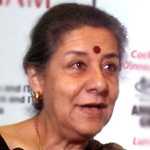

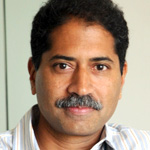
 Media ownership is a worry to the extent that journalists are not able to withstand corporate pressure. For instance, the Birlas started Hindustan Times and the Tatas has a stake in The Statesman (to name just two) and the battle between marketing and editorial is as old as the profession. The problem comes when senior editors capitulate and reader interest is surrendered or sacrificed. I would turn the spotlight back on journalists: are we fighting the good fight?




 By Pradyuman Maheshwari
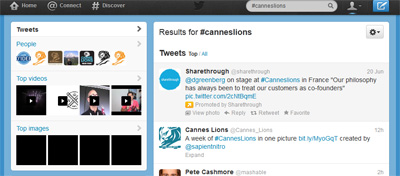 I was unable to get to Cannes as there was more pressing work here, but the best way to keep track was decidedly #CannesLions. In fact, as someone said, even if you were physically present at Cannes, it was a great way to get the buzz.
 My hearty congratulations to Medianama and Nikhil Pahwa on the popular tech-telecom-media site’s fourth anniversary.
 Market forces will force channels to ensure viewer experience isn’t impacted beyond a point. In fact in the chase for ratings, the entertainment-wallahs have already done that.
