Tag: Media Research Users Council

  • MRUCI elects Shashi Sinha as chairman

    By Our Staff


    Shashi Sinha
    Shashi Sinha

    Media Research Users Council India (MRUCI) has unanimously  elected Shashi Sinha, CEO – India, IPG Mediabrands, as chairman and Shailesh Gupta, Director, Jagran Prakashan Ltd, as vice chairman. The announcement was made at MRUCI’s Board meeting which was held shortly after its AGM on Thursday.


    Sinha takes over the mantle from Pratap Pawar, Chairman, Sakal Media Group, who served as MRUCI’s Chairman for two consecutive terms.


    While handing over the mantle, Pawar said: “We faced some challenging times due to the global pandemic, but I am glad we are soon returning to normalcy. With the change in name from Media Research Users Council (MRUC) to Media Research Users Council India (MRUCI), and the modification of IRS questionnaire, we will not only further boost our national stature and representation, but also successfully meet the fast evolving needs and expectations of our stakeholders. I thank all our Board Members and Stakeholders for all their support and I give my best wishes to Mr Shashi Sinha and all the new Board Members.”


    Said Sinha in his vote of thanks: “I thank Mr Pawar for his selfless leadership and valuable guidance especially in these unprecedented times. MRUCI has long played a very crucial role in providing the industry with a reliable, robust and realistic data, and now more than ever, the industry looks toward us to meet their expectations in maintaining and propagating the highest possible standards of integrity, fairness and reliability in media research. As our Country slowly resumes to normalcy, our priority will be to begin the IRS fieldwork at the soonest, in consideration with the ground realities.”


  • MRUC to be now known as MRUC India

    By A Correspondent


    Media Research Users Council (MRUC), a registered not-for-profit industry body, has announced its new name – Media Research Users Council India (MRUC India). This change in name will enable the organisation to effectively capture its national stature, notes a communique.


    Said Pratap Pawar, Chairman of MRUC and Chairman, Sakal Media Group: “The change in name only reaffirms our commitment in advancing the cause of media research in India. MRUC India will continue to provide the industry with research studies that are robust, reliable and of global standard.”


    Established in 1994, MRUC India has over 150 members with representation from advertisers, agencies, publishers and broadcasters.


  • MRUC releases IRS 2019/Q3

    By A Correspondent


    Just last evening young Ramesh was celebrating with his family that his parents would celebrate New Years’ Eve at home with him. He still recalls how the big Independence Day holiday that he was hoping to celebrate got messed thanks to IRS 2019/Q2 being released. But alas, Ramesh’s dream of a holiday are going to be shortlived. Earlier today (December 28), at 5.08am to be precise, our inbox received the all-important communique:


    The Media Research Users Council (MRUC) has announced the release of IRS 2019Q3 data. The 2019Q3 data is a rolling average of the last quarter of IRS 2017 (Q4) and three quarters of IRS 2019 (Q1+Q2+Q3). IRS 2019Q3 fieldwork covers August 2019 through November 2019.


    Notes a communique: “Multimedia consumption is the order of the day with each medium holding on to their loyal consumers. Overall media reach has grown with digital leading the growth trajectory.”


    In view of sample shortfall in Andhra Pradesh, the IRS Technical Committee has decided to release IRS 2019Q3 data excluding AP, as of now. The IRS 2019Q3 data including AP will be released in a fortnight’s time. Comparative analysis until then, at all India level, will not be permissible. While the reporting sample size at all India level (including AP) is 3.30 Lakh Households (Urban: 2.14L Households and Rural: 1.15L Households), without AP, the reported all India sample size will be 3.15Lakh Households (2.05L HH in Urban and 1.09L HH in Rural).


    IRS2019Q3 fieldwork in Jammu and Kashmir was adversely affected because of political and administrative developments in the State (now union territory). In consultation with the IRS Technical Committee, it has been decided to report J&K data  by utilising and projecting the last four quarters of IRS data i.e. Q3+Q4 2017 and Q1+Q2 2019 to the updated universe for the current round of IRS 2019Q3.


    Commenting on the release of IRS 2019Q3 data, Pratap Pawar, Chairman, Sakal Media and Chairman of MRUC said, “IRS being the world’s largest survey not only reflects the ground reality in terms of print readership, but also for other media and product consumption. The stringent field monitoring system, rigorous data validation processes and the overall methodology of IRS ensures the industry gets a robust and reliable data.”

    Added Vikram Sakhuja, Group CEO Madison Media & OOH, Madison World and IRS Technical Committee Chairman: “The IRS is a fascinating barometer of how India consumes Media.  From this round we see that Indians consumption of media continues to grow with digital growing on top of other mediums remaining steady. I would urge all marketers to deep dive into the data. There are fascinating insights about the diversity that is India waiting to be found.”


    Please click here for deck of IRS 2019Q3 Highlights

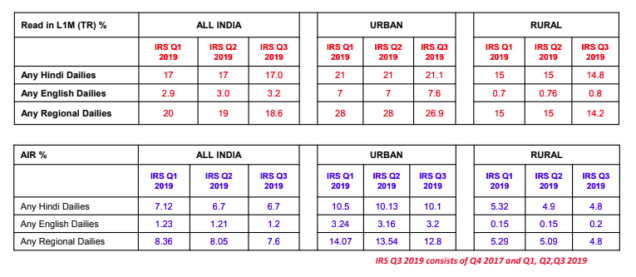
    Some pointers from the all-important AIR and TR slide:

    • English readership grows. Grows or stays steady in most of the country except for Uttarakhand where it has gone down by 1%

    • AIR Hindi dailies All-India is the same vis Q2. Urban has degrown by 0.03%. Rural goes down by 0.01%

    • AIR English dailies vis-a-vis Q2 All-India has degrown by 0.01%. Urban has grown by 0.04% and rural also by 0.05%

    • Any Regional dailies AIR: vis-a-vis Q2 AIR has gone down by 0.09% in All-India. Urban has gone down by 0.06%, and Rural by 0.29%

    • TR Hindi dailies All-India is the same vis Q2. Urban has grown by 0.1%. Rural goes down by 0.2%

    • TR English dailies vis-a-vis Q2 All-India has grown by 0.2%. Urban by as high as 0.6% and rural also by 0.04%

    • Any Regional dailies TR: vis-a-vis Q2 AIR has gone down by 0.4% in All-India. Urban has gone down by 1.1%, and Rural by 0.8%


  • Pratap Pawar is MRUC chairman for 2019-21, Shashi Sinha is vice-chair

    By A Correspondent


    Shashi Sinha

    It may have been raining cats and dogs in the rest of the city, but Media Research Users Council (MRUC) held its Annual General Meeting and unanimously elected Pratap Pawar, Chairman of Sakal Media Group as its new Chairman, and Shashi Sinha, CEO, IPG Mediabrands as its Vice Chairman. The announcement was made at the MRUC’s Board meeting following the 25th Annual General Meeting. Pawar took over from from Ashish Bhasin, CEO – Greater South and Chairman & CEO – India, Dentsu Aegis Network.


    Pratap Pawar

    Said Pawar while thanking the MRUC Board: “I thank Ashish Bhasin for his immense contribution to the growth of the Council and the IRS in particular. I assure the stakeholders of MRUC that together we will indeed take IRS to new heights and provide the industry with a more robust, reliable and accurate study. We will continue with our all-inclusive and democratic approach to address industry concerns and provide acceptable solutions which will help the industry make effective business decisions.”


    Ashish Bhasin

    Added Bhasin: “It was indeed an honour and privilege to helm such an august body of industry stalwarts over the past couple of years. There were challenges MRUC was faced with when I took over, with the existence of the IRS study itself being questioned, having been out of the market for almost four years. From there to today – where, not only is the IRS back on track with quarterly updates, butis now universally accepted as the currency for print – it has been an incredible journey.I truly appreciate the support of the MRUC Board as well as key industry stakeholders who helped us restore the IRS to its past glory. I am confident that Pratap Pawar will take the IRS and MRUC to even greater heights. My best wishes to him and the new Board members.”


  • ‘It takes time to align everybody’


    The Media Research Users Council (MRUC) released the much-awaited 20019/Q1 edition of the Indian Readership Survey last Friday. MxMIndia spoke with Chairman Ashish Bhasin immediately after the release of the report. Editor’s Note: There’s a lot that Mr Bhasin has said on record. And there’s a lot that he hasn’t. With reason. However, MRUC and all the players in the ecosystem need to be commended on the release. Read on…


    Congratulations on the release of IRS 2019/Q1. As a media professional and media-watcher what is the biggest takeaway for you from this round?

    I think the biggest thing that I have seen is that print continues to grow, because the general feeling seems to be doom-and-gloom around print. It is a fact that digital and other media are growing fast but that doesn’t mean that print is not growing. And from a mediaperson’s perspective, if I look at the overall picture, I think India is the only major market in the world where all media are growing. We are in a lucky phase.


    But there is a marginal reduction in the AIR numbers.

    Yes.


    It may be be marginal, but it’s a degrowth for sure.

    So Total Readership is if I have read the paper in the last 30 days, even once. AIR is if I’ve read it yesterday, right. People today are travelling a lot more. People today are sometimes very busy, and don’t have time to read and therefore may not read the paper every single day. But that doesn’t mean they are not readers.


    That’s the currency which your media agency business uses.

    That’s the currency we were all used to.

    But now there is a new reality. So, what we have done is, we have given both the options for even more cuts. All the options are available to our users, to our subscribers. They can see a three-day cut or a five-day cut, one-day cut or seven-day cut or a 30-day cart. The more information that you have means the more informed a decision one will make.


    But that actually results in multiple currencies, right?

    No. Currency is IRS. How you cut and dice that, how you look at the data is different. Some body might want to look only at males, somebody might want to look at only north.

    That is up to you how do you want to analyse it. But the more information you give to people, the better decisions they will make. So why should we not give that.


    Back to the growth in readership. What would you attribute this to?

    I think one is, literacy levels are increasing in India, which is reflecting even in our socio-economic information that is coming in general. Secondly, by and large if you see, any developing country, readership increases are dependent upon two things. One is literacy level, and the other is disposable income… because only if you have money, will you go out and buy a newspaper otherwise you will wait for somebody else to buy it. Because we have had a reason very good monsoon, it is not a bad monsoon you had general economic growth happening because your English and literacy levels are increasing. I think that is what is really saving the day….


    Does it also mean that, digital hasn’t really grown as it should have?

    No, no not really. If you have seen digital has actually grown significantly, and today is a first time that IRS is now starting to reflect numbers in the same ball park as what…


    Given that if readership is growing and so is literacy growing…

    Well the universe itself itself is growing, so people who were consuming less media today are consuming much more media. Of course the growth is much more in digital and that is no doubt. Even digital newspapers if you see have been reported.


    E-papers

    It was the second time e-paper, e-publications, that has grown remarkably, but particularly in the larger areas and particularly in the NCCS A+, it has really grown very rapidly.


    As a media-watcher, in what way will the growth in digital impact print?

    I think for some time everything will grow and therefore print will also grow, because of various reasons that we have discussed. But in the long run, a consumer will not consume only one media, he will, he or she will consume several media along with each other and print as a medium will have to evolve and adapt to that. Like, for example, for a digital you might get more topicality, but you might get more analysis in the physical copy etc. And according to the readers evolving, I think print as a medium needs to evolve and keep up with what’s the need of the consumer and not go on doing what they are best at, learned best how to do over the previous hundred years.


    So, will we now see IRS being released quarterly?

    That is the intent, and we work very hard towards it. As we are speaking, the field work for next quarter has started. So the intent is that, every quarter we should have a release so that continuity remains. And that’s what we are working towards.


    It’s been 15 months since the last IRS was released. Why the delay?

    So it was supposed to be an annual report. It should have released around Feb-March 2019, that is what the intent was. But various factors came in, and the field work took much longer…  for example, the Kerala floods delayed us in the South states for a while. So maybe a month or two of a delay.


    But the IRS was always meant to be a quarterly.

    We didn’t move to quarterly then. The quarterly move is happening now.


    The buzz was certain publications were refusing to pay up because of unhappiness with data and the findings. Reportedly, some big players had reservations.

    That is true, that’s not untrue. Because you know, there were and there are various stake holders in this. There are publishers, there are agencies, there are clients. Within publishers, there are language, Hindi, English publishers etc. Now unfortunately each stakeholder looks upon it from his or her angle and not from the industry angle. So, it takes time to align everybody and equally takes, it’s a very expensive study.


    But as President of the Advertising Agencies Association of India, you are also a stakeholder in BARC. And the stakes are fairly high in television too. Perhaps more. But everything seems to be going right there, but not with print.

    Yes, the system set there is working very well and learning from them, learning from other things, we are trying to implement and hopefully we have been able to implement a similar system out here. The general belief was, and which was probably true in the past that print research didn’t need to be done very regularly because newspaper reading habits don’t change every day or every month. So if you are reading a newspaper you are likely to keep reading that for a long time. It takes a while to convince people that it’s not necessarily true, the more updated and the more regular data that you have, the better it is for the print industry. But you know if somebody has been working with the same mindset for 100 years and it has worked very well for them, it takes a little bit of convincing to get them to change. But what I am very happy about is that, at least I can talk about my team, I don’t know about the past and I don’t know about the future. Everybody has been very cooperative, it did take time and is taking time and effort to align everyone. But now that everybody is aligned, they are very-very supportive.


    There’s word that you’ve been very tough on some people, especially those who were hesitant on paying up.

    (laughs) I have.


    Who has been the toughest to deal with? You spoke about various stakeholders.

    I wouldn’t like to name any individual. So look, I have done 2-3 things, which has been non-compromising. One is that there were rumours of people trying to influence data etc etc. We clamped down very, very hard, we put in a lot of digital check. We digitalised the whole process. It’s all carried out, even though it meant a lot more investment. We closed as many possible loopholes that could have been in that. The other area was in reporting. People were comparing apples and oranges and actually misleading. Some of the advertising was misleading, so we put a code of conduct for reporting. And if somebody, if a subscriber does not subscribe to that code of conduct, the data does not get released to that person. I mean the software just doesn’t open. Ultimately, you need technology to open, control this. So you have to subscribe to an agreed code of conduct which the board has approved, the members have agreed to and therefore hopefully that problem should also get eliminated.


    But they are still using different (and confusing) metrics: TR, AIR, AIR +3 etc

    That is not a problem. So, you can use whatever you want to use, if you are comparing TR of one publication, you can only compare it with TR of another publication. What was happening in the past, was for example you would compare one thing of one publication and completely another thing of another publication. Data is something you can cut and dice in whichever way you want and make it tell a story. But it’s got to be told in a fair way and all the disclaimers should be clearly put. You will see that any ad around IRS data comes out now, hopefully if members continue to agree to do what they have agreed to do and will have a very clear mention of what it is referring to. So for example you can say this is TR of this state of this age group of this male/ female/ whatever.. they have to clearly specify that as a sort of a legend in the data that we are comparing.


    It is actually interesting that in the case of BARC’s television measurement, the top players have been the most mature and statesmanly in their outlook towards the findings. In the case of print and the IRS, it’s said that the top players are fighting and derailing the measurement system.

    I don’t want to talk or compare one versus the other but I can only say that from my prospective as a chairman of MRUC, they have all heard me out and have cooperated. People do have different points of view, but we have been able to convince all of them to cooperate. It hasn’t been easy, it hasn’t been a very quick ride but, then, they all cooperated


    While you said at the press conference that the Hindustan Times and Hindustan data are still bein processed, clearly all doesn’t appear to be well. Did HT Media ask for the data to be withheld?

    No, Hindustan Times did not ask for the data to be withheld. The data hasn’t been withheld. It is still under review and the review isn’t over. Until that is done, we cannot release the data. It will take a few more more days and as soon as it is reviewed, we will release it to the subscribers.


    I am sorry to push you on this, but if you have released all data, how come not Hindustan Times and Hindustan?

    Because we haven’t finished the review in it…


    Then why release all the other data?

    It’s not that Hindustan Times has asked us not to release the data. It is just that, that data is under review and we cannot release any data until Techcom finishes the review…


    Is there some kind of a deadline to it?

    See the next three-four days* will go in only getting the data out to the hundreds of subscribers. It’s a huge database so I don’t think Nielsen or the Techcom will be able to focus on anything else. Immediately after that, I am requesting them to straightaway start focusing on it and quickly finish it so it should happen soon but deadline actually Techcom chair Vikram Sakhuja would be the better person… (* this interview was conducted on Friday, April 26)


    But the absence of Hindustan Times and Hindustan means that a lot of juice of the entire IRS results is missing

    Frankly the ranking that happens is only when the trade media gets most excited about it. I don’t think the planners look at the ranking… they look at the leadership numbers and in few days hopefully…


    Trade media finally just mirrors what the trade tells them. So when is Q2 going to be released and what date is planned?

    The field has already started, typically while it supposed to be three months, it could well be four, because of rains or any other condition. It depends upon how long it takes and then Techcom takes roughly a few months to check it and so on. Quarterly is a bit misleading because people see it as a financial quarter.

     

  • CVL Srinivas appointed Chairman of RSCI

    By A Correspondent


    CVL Srinivas

    Readership Studies Council of India (RSCI) announced that CVL Srinivas, CEO, GroupM South Asia has been nominated as Chairman for a period of two years with immediate effect. Srini takes over from Hormusji Cama who was Chairman of RSCI for the past two years.


    RSCI was set up when the Audit Bureau of Circulations (ABC) and the Media Research Users Council (MRUC) agreed to undertake joint readership studies as equal partners. The RSCI is governed by a 20 member Managing Committee consisting of Publishers representing the print media, Advertising Agencies’ representatives and Advertisers. The managing committee of RSCI sets up the Technical Committee to work on the IRS. In a recent development N.P. Satyamurthy was made the head of the Technical Committee to work on the new IRS.


    Shashi Sinha

    Shashi Sinha Chairman of ABC said “From an ABC standpoint we are delighted that Srini has taken over as Chairman RSCI, as there can’t be better person with this stature to guide RSCI especially as we kickoff IRS 2016.”


    Commenting on this development, I. Venkat Chairman MRUC said, “Srini brings over two decades of rich and varied experience in media planning and buying having worked in some of the best known agencies. I am confident that Srini, ably assisted by N.P. Satyamurthy who has recently taken charge of the Technical Committee will help us bring out an improved IRS 2016 with a 3,30,000 sample the largest such study anywhere in the world.”


    Srini was till recently the Chairman MRUC, stepping in to complete the term of his colleague Ravi Rao who moved to Dubai in May 2015.


  • Can these three save the MRUC (& print)?


    By A Correspondent


    The deed was done in an AGM last month, but on Thursday, it was made official.


    The all-important Media Research Users Council announced the formation of a new top deck. It elected I Venkat, Director, Ushodaya Enterprises as Chairman for the next two years. It has also appointed Radhesh Uchil, formerly with Madison’s Platinum Media, as CEO.


    Venkat takes over from GroupM South Asia CEO CVL Srinivas, and Uchil comes in with the exit of Shaswati Saradar.


    To be fair to Srinivas, he took charge only in May 2015, taking over from Ravi Rao of Mindshare who had moved out. Rao helmed the MRUC from early 2014.


    The all-important position of Chairman of the Technical Committee, held by top media consultant Paritosh Joshi, will now be taken up by NP Sathyamurthy, Executive Director, DDB MUdra Group. Sathyamurthy, it may be remembered, successfully led the MRUC secretariat as Director General from March 2003 to September 2005. Nikhil Rangnekar, CEO, Spatial Access is the new Chairman of the Marketing Committee. Sanjay Tripathy, Senior EVP at HDFC Life is the new Vice Chairman of MRUC, taking over from Rohit Gupta of Multi Screen Media.


    Both Srinivas and Joshi will continue to mentor the Council, a statement added.


    Venkat and Uchil are seasoned players, but the MRUC job possibly requires the two to have the skills of a police commissioner and a High Court judge. Be just and tough.


    Given the rapid rise of the digital media and steady growth of all other media, print will surely not die, but advertisers could well lose faith in the reach. So even if you think this bit of ‘print is dying’ is bunkum given the large number of ads in The Times of India these days and the reliance of even big digital players on print, the growth of digital is decidedly going to impact print, especially in the all-important urban centres.


    But, as many professionals tell us, the enemy for the print sector, lies within. If print players do not invest in audience research and work towards growing the sector, these three men (and the various others) could be the last officebearers of the MRUC. Finito!


    Earlier this year, we saw The Times of India and Hindustan Times leaving no stone unturned in putting each other down. If better sense had not prevailed, they could well have been talking ill of their stakeholders. MxMIndia had taken a conscious decision then not to solicit any of these advertising as it wasn’t even worthy of cooler conversation.


    But if BCCL and HT Media got out in the open, there were others too who were flexing their muscles, if not in the open, at least in the trade.


    What now? There are only two ways the MRUC can go? Up or down. No status quo. In fact, may we advise the powers that be who have taken charge that if they do not wish to employ missionary zeal to cleanse the sytem, they should opt out.


    Yes, yes, we said that. You read it right.


    Since we are in Mumbai, let’s use a line inspired from Bollywood: agar dar gaya, toh print mar gaya!


    We are told that there are some big and bit players who have been playing bully. There is also this confusion about who is accountable for the readership study: the MRUC or the RSCI (the Readership Studies Council of India, which is formation of a group and not a legal entity).


    Thankfully, some of the officebearers at other key organisations like the Audit Bureau of Circulation (ABC) are progressive in their outlook. Venkat himself is associated with the ABC, and has done his bit for almost every industry association.


    It’s time for all print players to bury their differences and save their own future. These three men have it in them to make the difference.  While the ball lies in their court, it’s also lies in each of ours too.


    Some lessons may be learnt from the Broadcast Audience Research Council (BARC) which had equally killers sharks amongst its stakeholders. It need a strong secretariat and a committed Board to effect the changes.  Print is lucky that the I&B ministry is too scared to take on the biggies. Had the same happened in news television, all hell would’ve broken loose.


    Can the printwallahs do it? Yes, they can. The question is: do they want to do it.


    In all of this, they shouldn’t forget the not-so-poor advertiser.  For, the stick is finally in her/his hands.


  • Ravi Rao appointed Chief Client Officer, Mindshare MENA

    By A Correspondent


    Ravi Rao

    Mindshare has announced the new role of Ravi Rao, Leader (emeritus) of Mindshare, South Asia. He will be taking over as Chief Client Officer, Mindshare MENA effective May 1st, 2015 and will be based at the Dubai office.


    In his vast experience in the media industry, Ravi Rao joined Mindshare, South Asia in 2008 and took over as Leader for the market in 2012. Under his guidance, Mindshare remains the largest media and marketing agency in India. Asserting his familiarity with the MENA market, Ravi was earlier a part of JWT Dubai and the Mindshare MENA team during its inception in 1999. He also worked with OMD in the course of his time in Dubai.


    Ravi Rao is the Chairman of the Media Research Users Council (MRUC) and has represented Mindshare and GroupM on several industry platforms.


    On his move to Mindshare, MENA, Ravi Rao said, “I am excited to take this new role within the Mindshare family. The market has exhibited good growth over the past few years and I look forward to strengthening our position in the MENA region.”


    CVL Srinivas

    CVL Srinivas, CEO, GroupM South Asia, commenting on this transition, “Ravi helped consolidate Mindshare’s position in the market over the past few years. He has led the transformation efforts of the agency in the recent past. This has helped Mindshare create cutting edge products for its clients, grow its digital business and retain its leadership position. He has made a significant contribution to our network and the industry at large. We are confident that Ravi will continue to play a stellar role in building the Mindshare network and we wish him well in his new role.”


  • IRS revalidation will not happen by March 31

    By A Correspondent


    In what is a blow to the readership measurement mechanism, it is reliably learnt that the revalidation exercise that the Readership Studies Council of India (RSCI) and the Media Research Users Council (MRUC) were supposed to conduct along with Nielsen India hasn’t really started in right earnest.


    A meeting of a small taskforce created to look into the concerns on IRS 2013 has been appointed with senior industrypersons as members.  A meeting of this group happened last week, on March 13.


    Although the MRUC statement on February 19  had categorically stated that IRS 2013 was to be in abeyance till March 31, sources tell MxMIndia that the process will take at least another month and even more given that all stakeholders are busy with the budgeting exercises in their own organisations.


    Meanwhile, there is some confusion in the market as a few publishers continue to quote the IRS 2013 figures as it suits their business. A few others have got back to the earlier numbers. A media planner who spoke to MxMIndia on anonymity that there is much confusion and vagueness in buying decisions. “The bosses of stakeholder bodies like the INS, AAAI, RSCI and MRUC should realise that short-sightedness is self-defeating.  Had they waited for a month more earlier and revalidated all numbers properly, we would not have got to this.”


  • IRS 2013 will not be accessible on servers after tomorrow, MRUC tells Bombay HC

    By A Correspondent


    The IRS 2013 may have been in abeyance till March 31 but is still accessible to subscribers.  That is what emerges from the statement issued by the Media Research Users Council (MRUC) to the Bombay High Court where it states that all links from its servers will be disabled with effect from the evening of February 28 so that the report is inaccessible.


    This is part of the Court order which MxMIndia accessed from the Bombay High Court website*. The Order issued on Monday, February 24 was post an Arbitration Petition filed by Diligent Media Corporation, publishers of dna against the MRUC and Nielsen India.


    On February 19, at a meeting of the Readership Studies Council of India (RSCI), it was decided to keep the IRS 2013 report in abeyance till March 31 by which time a detailed probe and revalidation will be conducted.


    At the February 19 meeting, it was decided that a process for revalidation would be be finalised by February 24 and the process will be completed by March 31.


    Meanwhile, as per the communiqué, all subscribers and MRUC members were to be contacted the RSCI and its joint stakeholders – the MRUC and ABC  – to hold off usage of the study until the re-validation process is completed. With this statement by the MRUC, any fresh access to the IRS 2013 will not be possible.


    *http://bombayhighcourt.nic.in; Case  No 315 of 2014. Arbitration Petition, , Coram: Justice NM Jamdar


  • Magazine body AIM asks MRUC to withdraw IRS report

    By A Correspondent


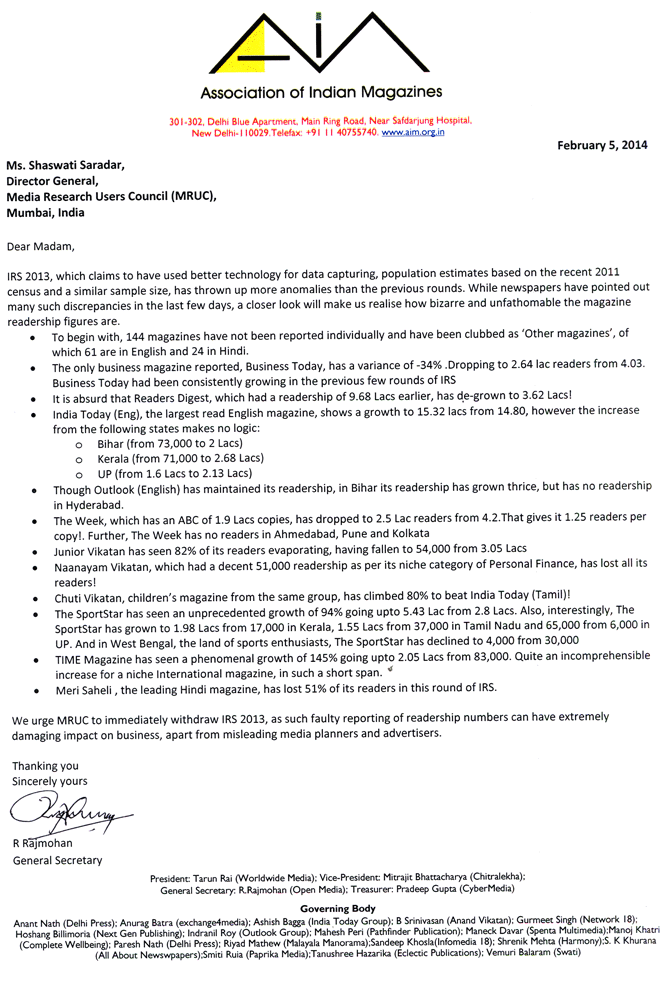
    The Association of Indian Magazine has also written to Media Research Users Council (MRUC) director-general Shaswati Saradar asking for the IRS 2013 to be withdrawn. “The current round of IRS has many glaring glitches when it comes to magazine readership. We urge to immediately withdraw IRS 2013,” wrote AIM General Secretary R Rajmohan in a mail to the MRUC.


    The text of the mail is as follows:


    “IRS 2013, which claims to have used better technology for data capturing, population estimates based on the recent 2011 census and a similar sample size, has thrown up more anomalies than the previous rounds. While newspapers have pointed out many such discrepancies in the last few days, a closer look will make us realise how bizarre and unfathomable the magazine readership figures are.


    To begin with, 144 magazines have not been reported individually and have been clubbed as ‘Other magazines’, of which 61 are in English and 24 in Hindi.


    > The only business magazine reported, Business Today, has a variance of -34% .Dropping to 2.64 lac readers from 4.03. Business Today had been consistently growing in the previous few rounds of IRS


    > It is absurd that Readers Digest, which had a readership of 9.68 Lacs earlier, has de-grown to 3.62 Lacs!


    > India Today (Eng), the largest read English magazine, shows a growth to 15.32 lacs from 14.80, however the increase from the following states makes no logic:


    o Bihar (from 73,000 to 2 Lacs)

    o Kerala (from 71,000 to 2.68 Lacs)

    o UP (from 1.6 Lacs to 2.13 Lacs)


    > Though Outlook (English) has maintained its readership, in Bihar its readership has grown thrice, but has no readership in Hyderabad.


    > The Week, which has an ABC of 1.9 Lacs copies, has dropped to 2.5 Lac readers from 4.2.That gives it 1.25 readers per copy!. Further, The Week has no readers in Ahmedabad, Pune and Kolkata


    > Junior Vikatan has seen 82% of its readers evaporating, having fallen to 54,000 from 3.05 Lacs


    > Naanayam Vikatan, which had a decent 51,000 readership as per its niche category of Personal Finance, has lost all its readers!


    > Chuti Vikatan, children’s magazine from the same group, has climbed 80% to beat India Today (Tamil)!


    > The SportStar has seen an unprecedented growth of 94% going upto 5.43 Lac from 2.8 Lacs. Also, interestingly, The SportStar has grown to 1.98 Lacs from 17,000 in Kerala, 1.55 Lacs from 37,000 in Tamil Nadu and 65,000 from 6,000 in UP. And in West Bengal, the land of sports enthusiasts, The SportStar has declined to 4,000 from 30,000


    > TIME Magazine has seen a phenomenal growth of 145% going upto 2.05 Lacs from 83,000. Quite an incomprehendable increase for a niche International magazine, in such a short span.


    > Meri Saheli , the leading Hindi magazine, has lost 51% of its readers in this round of IRS.


    We urge MRUC to immediately withdraw IRS 2013, as such faulty reporting of readership numbers can have extremely damaging impact on business, apart from misleading media planners and advertisers. ”