By Shashidhar Nanjundaiah
 The power to select is a privilege that we social media denizens have appropriated while airing opinions. The albatross around a mainstream media editor’s neck, though, is taking responsibility for that power to select in an age when content management beats that privilege. Content management is akin to what surveillance agencies do, listening to chatter between individuals and between groups to determine what content should go into mainstream media based on the popularity of words and phrases. In the world of content management, what’s unpopular is inconvenient, but even more so, what’s convenient must be made popular. I would like to cite three samples—retaining, of course, the privilege to be selective-from Indian media’s narrative of the US Presidential inauguration on January 20.
The inauguration of the Biden-Harris government in the United States was met with great celebration in the Indian media. Our raucous news television channels are the usual suspects, and much of this celebration may sound muted when you consider the biggest newspapers, but it is very much there. Let us not forget how content is the biggest rediscovery over the past decade, and the online news desks of newspapers and news channels have milked it impressively. Not story, not news, but content. Management of content entails much listening: Listening through spreadsheets of analytics and trends, that is. What runs these days as soft stories as the spokes of an umbrella “hub” story are those that gain virality. Soft stories have soft power.
The 1.38 billion of us Indians form a sixth of the whole world, so the strength in social media numbers is enough to make Indians win popularity surveys and to project Indians as the holders of the world. If social media is a leveller, the mainstream media is its amplifier. Our content management teams listen selectively and cover selectively, because selection is the privilege mainstream media would like to continue to exercise. When it does not come in the way of a media platform’s own political agendas, affiliations or compulsions, selection is obvious.
The Indian media’s coverage of Trump’s bumbling policies and even worse rhetoric caused much glee in the Indian media because they were picked up from the average Indian social media user’s schadenfraude—a word that is too commonplace for Shashi Tharoor, who must call it epicaricacy. Trump gave Indians great opportunity to claim one-upmanship over the White man. Brown and proud, one Indian Twitter user’s handle reads. It’s a running theme.
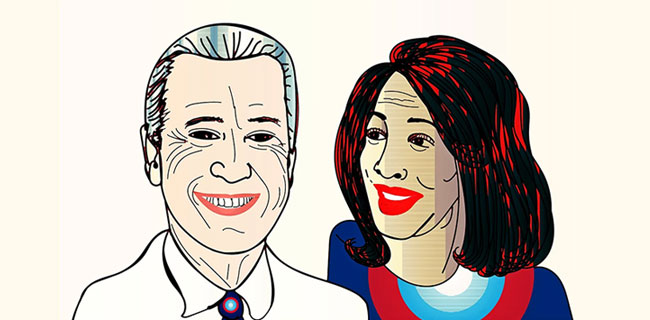
That is why Kamala Harris, the desi, came as a vindication for them. The media must join the mirth of the galleries in proving to each other that the US Vice President is Kamala Devi first before she is Harris.
Kamala’s saree
You can’t get more Indian than a saree. old picture of the Vice President in a saree with her Indian kinfolk. Television cameras reached Thulasendrapuram, a village in the coastal district of Thiruvarur in deep-south Tamil Nadu, where Kamala Harris’s relatives gathered around a public television set, reminiscent of the quaint Hum Log days, telling the reporter how excited the village was. Harris, on her part, had great fun with the Indian self-obsession, invoking chittis and her Indian tradition, knowing behind her full-throated laugh she was setting the Indian media on fire with those statements. “Will Kamala wear a saree to the inauguration?” was a serious question doing the rounds.
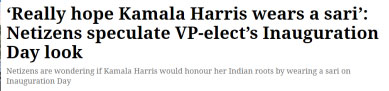
The Indian Express, Lifestyle, 19 Jan
As desi netizens “wondered”, mainstream media platforms were quick to jump on the question themselves, leaving out the “netizens speculate” part or words to that effect. After all, if netizens speculate, so must we.

India.com, Lifestyle, 18 Jan
Of course, it was about honouring her heritage. In response to an actual question at a media conference even before election results were in, Harris had skirted the question—pardon the pun—and had worded her response judiciously, “Let’s win first. My mother raised us with a very strong appreciation for our cultural background and pride. Celebrations that we all participate in regardless of how our last name is spelled. It’s the beauty of who we are as a nation.”
From a lifestyle/fashion question, it turned into a question for the “World” section—perhaps because it was a question about India’s prestige, somehow.

DNA, World, 19 Jan
Kamala and Kashmir
When such serious questions were being explored, only the boring regulars had space or time for the less widely popular subjects. Far less articulated, for example, was the fact that both Biden and Harris have taken a stance that will raise human rights issues in Kashmir. In the absence of a direct connect with Kamala Harris on the issue, the Indian media made do with statements from her desi relatives living in India. Some online portals, known for their more open stance on subjects inconvenient to the Modi government, speculated that the Biden-Harris government won’t go easy on the Kashmir issue.
Lo and behold, one of the early nominees in the administration included Sameera Fazili. News18 was among the few platforms that did pick up the wire on that news item, using a PTI story to inform us about pride and happiness—how happy her family was, how happy everybody in Kashmir was, and that she was a “bright child and brilliant in her studies” and “a very active person who loves skiing, swimming, tennis and travelling”. The news item kept out Fazili’s connection to the Kashmir issue. She and her sister had intervened in her cousin’s arrest under the Public Safety Act after the 2019 clampdown. Sameera’s sister Yousra Fazili gained fame after she testified vociferously in November 2019 against the arrest of their cousin Mubeen Shah.
But that would be inconvenient and perhaps ill-timed for our media to disclose. Perhaps it would put a sense of bonhomie that prevails in the world of articulation. World of diplomacy, another story.
Biden vs Hindutva
Another inconvenient issue is the Biden-Harris administration’s stand on Hindutva. In the United States, Indian Americans are not all techies. There are politically active community groups, too, and some work in affiliation to or support of the RSS, the VHP, and other Hindutva-affiliated associations.
That is why the omission of two prominent Indian American names in the list of 21 (and growing) Indian Americans in the Biden administration is news. Shah was part of the Barack Obama administration, while Jani worked as a Muslim Outreach Coordinator in the Biden campaign before the campaign managers learnt of his proximity to Narendra Modi and other BJP leaders. He was reassigned as National Asian American and Pacific Islander Director. Sonal Shah, with historical links to the Vishwa Hindu Parishad (VHP), is the daughter of the founder of Ekal Vidyalaya, the RSS-run school in the United States.
As many as 19 Indian American organisations had written to Biden during his campaign, pointing out that many individuals with ties to far-right Hindu organisations are affiliated with the Democratic party. While such an affiliation itself is ideologically paradoxical, community groups that work on the Hindutva agenda in the United States do not always showcase themselves as such, but often blend in through political or business systems. That is why it appears that the Biden administration is being cautious and thorough in its vetting process, something some experts say was not the case earlier.
But as Democrats under Biden and Harris continues to vet for more than 600 people in the administration, only a precious few media outlets—led by The Tribune—picked up the story. Kamala Harris has roots in India, and that familiarity only adds deeper, more critical insights with values that conform to global standards. This means the Biden administration is more, not less, likely to be more critical of internal strife in India.
Why talk of it when Twitter is exploding with jubilation and the numbers are up, and when a resurgently jingoistic Hindu majority does not want negative news about itself?
Mediated gap
There is a “mediated gap” here—a gap fuelled by the media based on false euphoria among denizens of the social media. It is giving us the assumption of a clever but false equivalence that in Biden’s and Harris’s eyes, what’s good for the Indian government is good for Indian people. All good, except that the idea of human rights doesn’t work like that, and of course our media knows that well.
It is more or less clear that the administration will work closely with Indian Americans and work to further ease up immigration norms. But that means the administration will welcome, work with, and sympathise with individuals who want to emigrate from countries like India to the States. Even the Indian government is working with the US government to ease H1-B visa norms that doesn’t really do much for India other than fuel further brain drain.
But apparently, pride and honour are the popular cultural triggers to exploit. While also intelligently tucking away real news in the annals of print pages, the Indian news media knows what to play up—vicarious pride and cultural honour. That’s what sells in India. The Indian media in the Modi tenure resembles American television and advertising content in the 1950s, selling muscular pursuit of happiness and euphoria and hiding the worst kinds of discrimination and social injustices. Exposing selected facts shows hypocrisy, because it means we don’t have the courage of conviction or the faith in people’s discretion of opinion.
As I said before, selection is a privilege the mainstream media loves to protect. In India, often that selection is unstated—but as a nation, our media literacy is growing to discern selectivity. Selective exposure, selective perception, selective listening, and selective coverage are a formidable ballgame to play.
As the founder of BeingResponsible, Shashidhar Nanjundaiah is attempting to build media awareness among school- and college-goers via Responsible Media Literacy. Prof Nanjundaiah has led media institutes to positions of repute and leadership. He is also an editor. You can reach him at shashi.nanjundaiah@hotmail.com. His views here are personal.