Tag: media consumption

  • INMA 2012: ‘Industry needs currency that measures across platforms’


    By Shruti Pushkarna


    Basant Rathore
    If you are having trouble in viewing this video, see link

    Like Day 1, Day 2 of the 6th INMA annual South Asia conference also witnessed some interesting panel discussions pertaining to issues facing the news industry today.


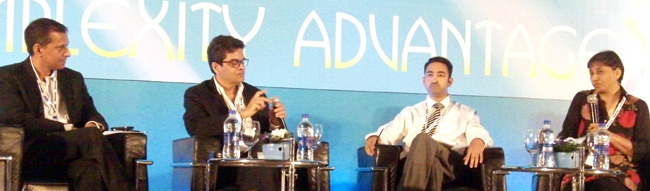
    The first half witnessed an engaging session on, ‘Increased Circulation, Dwindling Readership: Is It Time to Measure “Access”?’ The session was moderated by Lynn de Souza, Chairman & CEO, Lintas Media Group. The panelists included Paritosh Joshi, Independent Media Professional & Board Member of MRUC; LV Krishnan, CEO, TAM Media Research Pvt Ltd; and Basant Rathore, Vice President-Strategy, Brand and BD, Jagran Prakashan Ltd.


    The panel debated the need for new matrices of measurement which can complement the conventional audience measurement matrices, as today the audiences are increasingly becoming platform-agnostic.


    Ms de Souza said: “People seem to be very attached to these numbers. But while numbers are important, we need a currency that goes across platforms. We need to be able to measure new forms of readership. From circulation and readership, we need to change our metric to media access.”


    Lynn de Souza
    If you are having trouble in viewing this video, see link

    Mr Paritosh Joshi shared a similar view on the need to look beyond the primary level numbers which he felt are out of date. He said that there are two sorts of media consumption today, structured and unstructured. It is equally important to be able to measure and take into account unstructured media consumption. Just as there are enough screens available today and not just the traditional TV box, he said, the newspaper is not just in the traditional paper form, it is available in other forms across platforms.


    Mr L V Krishnan talked of two news aspects coming out in the digital world: “One is the increasing access which is changing things dramatically. The other is multiplicity of brands transiting between different mediums. For instance, a Bombay Times with Zoom or an ET Now with The Economic Times. The nature of one medium declining and the other growing will depend on what the creator of the brand wants to deliver via a particular medium.”


    While there was agreement on the importance of numbers and currency, the panelists also highlighted the need to move beyond the existing currency.


    Mr Basant Rathore of Jagran said: “Digitization has blurred not just geographical boundaries but also boundaries between mediums. Today we don’t have a clue of numbers in digital media, but they are definitely going to grow. If these can’t be measured, monetization becomes a problem. The advertisers know that the game is moving beyond the existing currency. The research we had till date was about currency but the advertisers are now talking about engagement.”


    Mr Joshi added: “The existing measurement systems are accused of fudging numbers. With the new IRS, even real time tracking of interviews is possible. It will be a like a core end satellite model and this will enable us to respond to changes that are happening in the environment. Earlier we looked at data in a cross-sectional slice but what’s of interest to an advertiser is what happens to a consumer through the day. With the new measurement matrices, we are thinking of capturing all digital research to get a horizontal longitudinal view of a consumer’s media movements.”


    The panel also agreed on the need for industry to be willing to adopt new matrices of measurement and to support measurement that looks beyond primary access numbers. Mr Rathore concluded: “Numbers will continue to be important because that’s the benchmark for trade to happen. But if you need to grow, it’s important to leverage the media brand across media platforms and so we need to know what’s happening across platforms. And that’s why we need to be open to the measurement of other metrics.”

     

  • The Anchor: BG Mahesh on 5 reasons why the future is regional language internet

    By BG Mahesh


    Diversity of India is the main factor:

    Official data related to literacy is 74.04 per cent. Now internet is used only by the upper middle class, slowly penetrating to the huge middle class sector, which is the largest in India. The upper strata of this middle class is moving to the upper middle class category and their aspirations are high.


    The Economy Factor:

    Indian internet penetration will double in coming years. Upper strata of the internet users may not understand Indian language but others, which is the majority, is going to outnumber this upper strata. If the economy grows, middle class internet usage will increase, which will lead to consumption of Indian language content.


    The changing in media consumption:

    One can see the phenomenal growth of Hindi language newspapers circulation during last five years, soon news papers will see stagnation in circulation and readership – users will be depending other media channels like Internet and Television.


    The increasing demand for mobile internet access:

    There are 898 million mobile subscribers in India, 292 million of these living in rural areas. The same data showed that 346 million Indian mobile users had subscribed to data packages. Telecom operators are already activating GPRS by default as they realize their users want mobile internet access. We need to recognize the fact that mobile internet (and possibly desktop internet) is not a luxury anymore but a necessity.


    Regional language internet involves masses:

    Unless there are content and services out there in a language the masses can understand why will they use the internet? Regional languages will bridge this gap. Advertisers are not for or against any language. Once they see there is a huge user base of regional language users, they will jump onto the advertisers’ bandwagon on the language sites.


    BG Mahesh is the Founder & MD of Oneindia.in


  • Media Matrix: Valuing Audience – Part II

    By Paritosh Joshi


    Remember the 5 weepies that you were forced to watch because of your spouse? The maverick British automobile journalist? The irritatingly intrusive news editor? If you do, we met last week. And even if you don’t, I’m going to try and make this week’s 870 words stand on their own feet.


    We signed off last week wondering about whether audience quality, and not just quantity, could be measured objectively. And whether current systems of audience measurement pay enough attention to measuring audience quality. The questions were tainted by an assertion that “In the relentless focus on audience volume as the prime metric, we have lost sight of audience quality”.


    Why does audience quantity take precedence over any other measure, particularly in a market such asIndia?

    • Almost every product category has low penetration, or in more technical terms, low Category Development Index
    • Marketers’ primary priority is to reach the widest audience to build awareness about their product/category to stimulate demand
    • When width becomes paramount it is easy to see why quantity always wins over quality


    The arrival of satellite television inIndiain the early 1990s was the first intimation of accelerating media proliferation. An unregulated regulatory environment in its early years and limitless viewer demand for exciting, entertaining content fuelled a torrent of channels, and indeed genre innovation which continues unabated over two decades on. Coupled with rising incomes in a domestic consumption fuelled economy and steadily growing literacy, India also saw simultaneous growth in the print media and, with the advent of better telecommunications in the last decade, the ‘new’ or digital media. Making systematic and reasoned choices in this era of abundance was no longer the simple exercise that media planning used to be in the stone age of media scarcity that preceded it.


    Enter- the media agency of record.


    The challenge for advertisers was just this: how to reach the largest audience at the least cost. Inevitably, the agency’s singular task was to stitch up defined audiences across multiple vehicles at the lowest CPT (cost per thousand) or CPRP (cost per rating point). Conversely, advertising sales personnel at all media outlets were under pressure to offer packages that were compared relentlessly on cost almost to the exclusion of everything. The age of quantity had arrived.


    We will leave the hurly-burly of the media market for a moment and look at how audiences are actually measured and how these measurements are consolidated into reports.


    Television measurement involves peoplemeters; devices connected to domestic TV sets that keep track of who watched what, when. These peoplemeters, once installed in a home, track TV consumption around the clock, through the week, across months and years. These days, most have inbuilt communication apparatus that enables them to transmit their observation record to a central server without human intervention. The central facility now consolidates thousands of individual viewer readings into audience ratings, again with little human intervention. Ratings report second by second ebbs and flows in audience aggregates. Cross sections – by second, minute, hour of any other time interval become more important than how a particular individual, or household, or even demographic, spent a day interacting with TV.


    Other media, most prominently print, are measured by large scale media surveys like the Indian Readership Survey or IRS. Thousands of households are contacted across the country to map print, TV, radio, digital and other media consumption along with detailed information on usage of a wide range of consumables, durables and assets (such as personal transport). Here too, the system is geared to deliver cross sections of readership, listenership and so on, rather than examining how an individual, household or defined demographic consumes across media and product categories.


    In days of yore when data tabulation, summarization and analysis was done manually, examining and interpreting research information, whether for  TV or any other media, on a ‘longitudinal’ rather than ‘cross-sectional’ was practically impossible. While individual cases might be studied, purely for anecdotal value, there was no practical way of subjecting, large parts of, or the entire sample itself, to cross-sectional study.


    WithMoore’s Law having given us exponentially growing computing horsepower and data warehousing, this impediment no longer exists. Imagine an individual’s TV consumption across a week. From spiritual or yoga type programs in the early morning, through news and business during the day to action, drama, music, talk and comedy in the evening night, she has a wide range of content on her plate. And when you start looking at her ‘TV timeline’, and start comparing and contrasting it with the thousands of others, you will find others that are rather similar, somewhat similar or rather dissimilar to hers. Simple, least squares type, approaches can scan across timelines to find patterns of behaviour.


    In much the same way, the entire mix of product and media consumption of individuals or households, rather than cross sectional tallies, can also be run on respondent level data in studies like the IRS.


    Shifting attention from cross sections to longitudes or timelines – of moving from a cross-sectional view of audiences to actually understanding how they behave and what they consume across time and place is the difference between understanding audiences as quantitative aggregates or behavioural phenomena.

    Paritosh Joshi was until recently CEO, Star CJ. He has been a marketer, a mediaperson and been a key officebearer on industry bodies. He can reached via his Twitter handle @paritoshZero