Tag: media and entertainment

  • Achche Din for M&E


    By Ajay Shah


    India is expected to become the third largest economy in the world by 2030 — after the US and China — and the GDP per capita is expected to grow from $1600 to $4,500 by 2030. As seen globally, an increase in the GDP per capita increases the proportion of the M&E industry’s contribution to the GDP. With a triple fold increase in GDP over the next 15 years, the M&E industry’s contribution to the GDP is expected to increase significantly. But this isn’t all. Here are eight reasons the country will be an attractive destination for M&E investments —


    1. Currently, the Indian M&E industry is growing at a CAGR of 13-14 per cent per year which is almost twice that of the global media industry. Despite the faster growth, advertising spends, which drive growth in M&E industry, as a percentage of GDP is 0.4 per cent, which is significantly lower than developed markets (0.7- 1 per cent). Over time, the M&E sector will witness increasing ad spends as a proportion of the GDP


    2. With over half a billion people under the age of 25, India is witnessing a rise in disposable incomes. Increasing income levels have also led to increasing spend on M&E, as evident from the fast growth of multiplexes  and the success of various sporting leagues in the last five years


    3. Compared to the most developed markets, India is a unique market with traditional media and digital media segments growing simultaneously. Traditional media is expected to continue on the growth trajectory because of the under-penetration of media segments in Tier II and III cities


    4. Several government initiatives, like the digitisation of Cable TV, Phase III auctions of FM spectrum and increase in FDI limits, will aid the growth of traditional media


    5. India is the second-largest internet market after China, with over 300 million internet users. Additionally, government thrust on the Digital India campaign will significantly increase internet penetration in the next decade, thus expanding the digital media opportunity


    6. The mobile subscriber base of 900 million users, sub-$100 smartphones, and one of the lowest data cost globally, is expected to drive a surge in mobile data traffic from 88 TB/Month in 2014, to 1,100 TB/Month by 2019


    7. With existing internet penetration lower than 25 per cent, India is already among the Top Five online video markets globally, in terms of viewership, and is expected to be the second largest market by 2017. As internet penetration increases, India will become one of the most important M&E markets


    8. Currently, investors are interested in TV distribution, cinema exhibition and digital media sub-segments, and we expect this trend to continue for the next few years


    Ajay Shah is Partner and Leader, Deal Advisory, Media and Entertainment at EY (Ernst & Young). Last week, EY released its 12th Media and Entertainment Capital Confidence Barometer


  • MIB looks ahead as Sectoral Innovation Council recommends embracing tech & new media

    By A Correspondent


    The Sectoral Innovation Council of the Ministry of Information & Broadcasting, under the Chairpersonship of Ms Asha Swarup, Retd Secretary, Government of India, on July 26 submitted its report to Minister for Information & Broadcasting, Ms Ambika Soni.  The primary objective was to design a policy ecosystem in which new ideas would be integrated into the mainstream and get converted into policy initiatives by the government.


    Ms Soni said that the issues deliberated upon by the Council would be looked into by the Ministry in the policy domain. The recommendations made by the Council in different Media and Entertainment sectors would act as a roadmap in the future. The Council, in its report, analysed the growth potential of the media & entertainment industry by recommending changes in critical areas such as broadcasting, print media, animation, gaming and VFX, Media education and films.


    The Council has made 64 recommendations in seven areas concerning the media and entertainment sector. Some of the key recommendations are:

    1. A comprehensive policy media policy that integrates all existing media segments and addresses the emergent issues. The council has recommended bringing out a National Media Policy that addresses the new media landscape.

    2. The government may look into the existing licensing procedures and requirements to ensure further liberalization and reforms in the broadcasting sector.

    3. Content innovation is required in the radio segment which would be possible only if the government comes up with a separate licensing model for niche channels.

    4. Ministry of I&B, as the policy head of public service broadcasting and community radio service could come out with a formal arrangement by which CRS could provide community based programme content to AIR and AIR could provide capacity building and training to CRS workers in content creation, management and operation of stations.

    5. The process of digitalization in DD and AIR was likely to release airwaves which after due utilization in house could be used for creating a public service broadcasting fund in line with USO fund of telecom sector. This fund could be utilized exclusively for public service broadcasting.

    6. In view of the potential in the films sector, the Council has recommended a National Film Policy that will address the role of the government vis-à-vis the private sector.

    7. Film Institutes in the country may be upgraded to ‘Centres of Excellence’. In the long term, these Centres of Excellence could become part of a Central University of Films, Broadcasting and Animation by an appropriate legislation.

    8. The government must have a National Policy for Animation, Gaming and VFX.

    9. The government should go for co-production treaties in the animation sector to ensure flow of international projects toIndia. Ministry could also consider giving responsibility to the Children’s Film Society and Doordarshan to produce animated content and create Indian IP.

    10. Reliable Single Source Data on all mediums of advertising should be made available by the government so that advertisers are able to take decisions on reliable data.

    11. Government should interact with key stakeholders and expedite a consensus on developing an alternative to TAM so that an appropriate mechanism is developed with industry participation to study audience viewing and listening behaviour and bring out reports on weekly basis.

    12. Government should regulate media education to ensure orderly growth of the discipline as part of higher education.

    13. Like medical education and technical education, Media Education to be regulated by a new organisation known as Media Education Council. The Media Education Council should be assigned the task of setting up curriculum for all levels, so that standardised curriculum with national accreditation becomes a possibility.

    14. There is need to make IIMC, FTII and SRFTI into real centres of excellence.

    15. The government should reformat the course curriculum, improve faculty of the institutes. These institutions could either be separate universities or become a part of one central university.

    16. National Awards for Innovation in different segments of M&E Sector be instituted by the ministry.

    17. New Media should be utilized for media campaigns by the government.

    E-mode transactions should be a priority for the functions of DAVP, RNI, CBFC and licensing activities of the Government for ensuring transparency.


    The Sectoral Innovation Council was set up on July 28, 2011 as part of the Government of India’s initiative of declaring 2010- 2020 as the Decade of Innovation. Accordingly, the Government set up a National Innovation Council with Mr Sam Pitroda as Chairman and 16 distinguished members. The members of the I&B Sectoral Innovation Council comprised of Chairperson, Ms Asha Swarup, retired Secretary, Government of India and 10 other distinguished members from the field of media and entertainment.


  • News Corp announces intent to split news & ent biz

    By A Correspondent


    News Corporation announced that it intends to pursue the separation of its publishing and media and entertainment businesses into two distinct publicly traded companies.


    Upon closing such a transaction, shareholders would hold interests in a publishing company, consisting of the largest collection of best-in-class publishing assets and a new digital education group, and a global media and entertainment company, each of which would benefit from enhanced strategic alignment and increased operational flexibility with respect to an unparalleled portfolio of assets, brands and franchises.


    News Corporation’s board authorized management to explore this separation after a board meeting.


    The proposed transaction would create global category leaders in both publishing and entertainment: a publishing company, which would be comprised of News Corporation’s newspapers and information businesses in the US, UK and Australia, the Company’s leading book publishing brands, its integrated marketing services company, its digital education group, as well as its other assets in Australia; and a global media and entertainment company, which would encompass News Corporation’s broadcast and worldwide cable networks, leading film and television production studios, television stations and highly successful pay-TV businesses in Europe and India.


    “There is much work to be done, but our Board and I believe that this new corporate structure we are pursuing would accelerate News Corporation’s businesses to grow to new heights, and enable each company and its divisions to recognize their full potential – and unlock even greater long-term shareholder value,” said Rupert Murdoch, Chairman and CEO of News Corporation.


    “News Corporation’s 60-year heritage of developing world-class media brands has resulted in a large and unparalleled portfolio of diversified assets. We recognize that over the years, News Corporation’s broad collection of assets have become increasingly complex. We determined that creating this new structure would simplify operations and greater align strategic priorities, enabling each company to better deliver on our commitments to consumers across the globe. I am 100 per cent committed to the future of both the publishing and media and entertainment businesses and, if the Board ultimately approves a separation, I would serve as Chairman of both companies,” he added.


    News Corporation believes that a separation of the businesses into distinct public corporations with their own identities and strategies would enhance overall shareholder value and allow each company to:

    • Focus on and pursue distinct strategic priorities and industry-specific opportunities that would maximize their long-term potential.
    • Benefit from greater financial and operational flexibility and better position each company to compete.
    • Respond and react more quickly to rapidly-evolving technology and global market opportunities.
    • Tailor its capital structure, and allocate and deploy resources in a manner consistent with its strategic objectives that best enhances value for its respective shareholder group.


    With more focus devoted to each business’ financial and operational structure, investors would be able to more clearly evaluate the inherent value of both portfolios of assets and invest in each company accordingly.


    The new global media and entertainment company that would be created through the proposed transaction would consist of News Corporation’s highly-profitable cable and television assets, filmed entertainment, and direct satellite broadcasting businesses, including Fox Broadcasting, Twentieth Century Fox Film, Twentieth Century Fox Television, Fox Sports, Fox International Channels, Fox News Channel, Fox Business Network, FX, Star, the National Geographic Channels, Shine Group, Fox Television Stations, BSkyB, Sky Italia and Sky Deutschland, among others.


    As a pure-play content producer and distributor, the company would build on its deep heritage in developing incredibly strong, premium content for distribution on screens of all sizes by leveraging its leading content across its entertainment and cable news verticals, as well as its unparalleled collection of regional sports networks, and the industry’s leading movie and TV production and distribution company.


    In addition, the entertainment company would benefit from its rapidly growing, high-margin cable network and pay-TV assets, and the distribution capabilities and opportunities associated with its unrivaled global footprint with significant scale across North and South America, Europe and Asia.


    The new global publishing company that would be created through the proposed transaction would consist of News Corporation’s current publishing businesses, as well as its book publishing, education and integrated marketing services divisions. The new publishing company would create a scaled publishing platform that would be one of the best capitalized in the industry. The publishing company would have the opportunity to leverage its trusted brands for innovation and value creation across all traditional and digital platforms.


    The publishing company would incorporate some of the world’s most successful print, digital and information services brands including Dow Jones, The Wall Street Journal, Dow Jones Newswires, HarperCollins, The New York Post, and The Daily, as well as offer the rich diversity of assets in Australia, including leading brands such as The Australian, The Herald Sun, The Daily Telegraph and The Courier Mail.


    In addition, the Company would include The Times, The Sun, The Sunday Times, as well as News Corporation’s integrated marketing services group and its ground-breaking digital education group, including Wireless Generation. With a balanced portfolio of stable and growing news publishing brands and other assets, shareholders would benefit from strong and consistent free cash flow generated by these businesses, over multiple platforms.


    Upon closing of the proposed transaction, News Corporation’s shareholders would receive one share of common stock in the new company for each same class News Corporation share currently held. Following the separation, each company would maintain two classes of common stock: Class A Common and Class B Common Voting Shares.


    Upon closing of the proposed transaction, Rupert Murdoch would serve as Chairman of both companies and CEO of the media & entertainment company. Chase Carey would serve as President and COO of the media & entertainment company.  Over the next several months, the Company will assemble management teams and Boards of Directors for both businesses.


    The separation is expected to be completed in approximately 12 months. Management is developing detailed plans for the Board’s further consideration and final approval. To execute the transaction requires further work on structure, management, governance, and other significant matters.


    After receiving final approval of the Board of Directors, News Corporation will convene a special shareholder meeting to consider the transaction.  This meeting is not expected to take place until the first half of calendar 2013.  During the closing process, News Corporation will remain focused on delivering the best possible results for the benefit of its consumers, customers and shareholders.


    In addition to shareholder approval, the completion of the separation will also be subject to receipt of regulatory approvals, opinions from tax counsel and favorable rulings from certain tax jurisdictions regarding the tax-free nature of the transaction to the Company and to its shareholders, further due diligence as appropriate, and the filing and effectiveness of appropriate filings with the U.S. Securities and Exchange Commission.


    The Company will provide interim updates as appropriate.  There can be no assurances given that the separation of the Company’s businesses as described in this announcement will occur.

     

  • @FF12: CCI is an overall market regulator: Ashok Chawla

    By A Correspondent


    Keynote speaker Ashok Chawla, Chairman, Competition Commission of India (CCI) opened his address by pointing out that the media and entertainment (M&E) industry is one of the fastest growing sectors in India today, with an expected CAGR of 14-15 percent. He attributed this to increase in disposable incomes and aspirational lifestyles.


    He said that with digitisation set to come in by July 1, the M&E industry witnessed consolidation which has ensured synergy for players looking for entry. The state has been acting as facilitator, and by not regulating directly, ensuring a balanced growth.


    Outlining this scenario, Mr Chawla proceeded to outline the role CCI performs in the industry. He said that CCI is an overall market regulator whose objective is to ensure that market forces operate with transparency and fair play. It has been put in place to identify the boundaries of behaviour of the industry.


    Mr Chawla gave an overview of the Competition Act and how it came into force in 2009, in spite of having been passed in 2002. The philosophy of the Act was that with deregulation, there is a need for a body which can look at behaviour and how businesses are conducted.


    Mr Chawla said that the Act has a two-fold agenda. It takes a look at, and if necessary action against, activities which are anti-trust and anti-competition in nature. It also ensures that the economic activity is not restricted and freedom of trade is not affected. The main objective is to ensure that the consumer should benefit by the more efficiency.


    He said that they keep an eye on the mergers and acquisitions (M&A) in all the sectors. Any M&A which goes above a certain threshold and can have an adverse impact on the market requires the mandatory approval of CCI, he added. The dissenters made to pay monetary penalties.


    Mr Chawla also outlined the role that trade associations and bodies should play. He said that rules framed shouldn’t inhibit non-members as it could be anti-competition in nature. The bodies shouldn’t encourage collective boycott of non-member players as it would be construed as engaging in anti-competition practices and abetting collusion among the members and let the consumers choose their preferences.


    He said that self-regulation was of prime importance to avoid infringement of law or market practices. He cautioned the players that consumers should be given primary importance and that should be the end goal of the businesses.


  • @FF12: Financing, a cause for concern in media and entertainment


    By A Correspondent


    The media and entertainment industry of India has scripted a glorious growth story in the past decade or so, and the future looks even more promising with digitization and the advent of technology across media verticals such as broadcast, print and also films. But one area of concern is the lack of private equity and VC funds showing adequate interest.


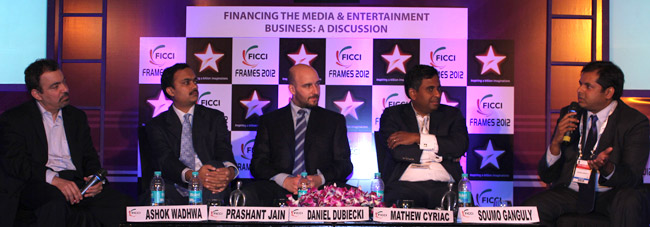
    In a session titled “Financing the Media and Entertainment Business” eminent personalities such as Prashant Jain, Executive Director, HDFC Mutual Fund; Matthew Cyriac, Sr Managing Director, Private Equity, Blackstone; Soumo Ganguly, Managing Director, Moxie Entertainment Pvt Ltd; and Daniel Dubiecki, Founder and Partner, The Allegiance Theatre, Hollywood shared their views on the subject. Ashok Wadhwa, Group CEO, Ambit moderated the session.


    Matthew Cyriac started off the session by pointing out that majority of the investments within the media and entertainment industry were made in television and print as they represent a fairly large share in terms of sheer numbers as against Internet and Radio . The Hindi GECs in TV is where typically where a lot of money into followed by regional GECs and sports channel. For print media, it was the regional publications command a lot of attention as regional advertising is very robust – one which extracts a lot of profit.


    Prashant Jain pointed out thata lot of companies in India have managed to get good funding and that it is not reflective of a very, very sorry picture as is being talked about. “It’s not that all of India in the media entertainment space not attracting funds. Companies like UTV and a few others have attracted investors.”


    Ashok Wadhwa remarked that the film industry in India is not institutionalised enough to attract private equity. Daniel Dubiecki spoke about the need to be more global in concept, widen the scope of the market and thereby making it more viable to attract investments in the films business.


    Photograph: Fotocorp

  • @FF12: Financing, a cause for concern in M&E

    By A Correspondent


    The media and entertainment industry of India has scripted a glorious growth story in the past decade or so, and the future looks even more promising with digitization and the advent of technology across media verticals such as broadcast, print and also films. But one area of concern is the lack of private equity and VC funds showing adequate interest.


    In a session titled “Financing the Media and Entertainment Business” eminent personalities such as Prashant Jain, Executive Director, HDFC Mutual Fund; Matthew Cyriac, Sr Managing Director, Private Equity, Blackstone; Soumo Ganguly, Managing Director, Moxie Entertainment Pvt Ltd; and Daniel Dubiecki, Founder and Partner, The Allegiance Theatre, Hollywood shared their views on the subject. Ashok Wadhwa, Group CEO, Ambit moderated the session.


    Matthew Cyriac started off the session by pointing out that majority of the investments within the media and entertainment industry were made in television and print as they represent a fairly large share in terms of sheer numbers as against Internet and Radio. The Hindi GECs in TV is where typically where a lot of money into followed by regional GECs and sports channel. For print media, it was the regional publications command a lot of attention as regional advertising is very robust – one which extracts a lot of profit.


    Prashant Jain pointed out thata lot of companies in India have managed to get good funding and that it is not reflective of a very, very sorry picture as is being talked about. “It’s not that all of India in the media entertainment space not attracting funds. Companies like UTV and a few others have attracted investors.”


    Ashok Wadhwa remarked that the film industry in India is not institutionalised enough to attract private equity. Daniel Dubiecki spoke about the need to be more global in concept, widen the scope of the market and thereby making it more viable to attract investments in the films business.


    Photograph: Fotocorp

  • Digital, growth mantras to drive agenda


    By A Correspondent


    Asia’s largest convention in the business of entertainment, FICCI Frames 2012, will be held at The Renaissance, Powai in Mumbai from March 14 to 16. In its 13th year, Frames is a three-day global convention covering the entire gamut of media and entertainment ranging from films to broadcast, which includes television and radio, to digital entertainment, animation, gaming and visual effects.


    The Summitwill be inaugurated by Government of India’s Information & Broadcasting Secretary, Mr Uday Kumar Varma. Senator Chris Dodd, Chairman, Motion Picture Association of America will deliver the keynote address at the inaugural session. Japanis the partner country at FICCI Frames 2012 and will be present with a high-powered delegation comprising key stakeholders from the Japanese media and entertainment industry.


    Frames 2012 will present opportunities for business networking, lobbying, and creative and financial collaboration and partnerships. There will also be a series of workshops and master-classes that will be conducted by venerated global gurus who will be busy highlighting the way forward to the assembled delegates. Nearly 2,000 Indian and 800 foreign delegates are expected to attend the event.


    The Who’s Who of the Indian media and entertainment industry will join hands with the global industry leaders and experts to discuss and debate and to announce new initiatives at FICCI Frames 2012. Mark Hollinger, CEO, Discovery, Carolyn Everson, VP-Global Marketing Solutions, Facebook, Cameron Bailey, Co-Director Toronto International Film Festival, Bruce Beresford, Director of Oscar-winning movie Driving Miss Daisy, Silas Hickey, Regional Creative Director for Animation at Cartoon Network, Max Howard, Global Animation Consultant and Lecturer on Producing Independent Animated Feature Films for the International Markets, Oscar-winner Harvey Lowry, Hollywood’s Special Effects Guru, and John Bashford, Vice Principal, LAMDA (The London Academy of Music & Dramatic Arts) are some of the globally well-known names who will be delivering keynote addresses, conducting workshops and master classes, and joining the panel discussions in various sessions at Frames.


    Other eminent speakers from the world of television, radio and print that would be present include television czarina Ekta Kapoor, Barkha Dutt and Vikram Chandra of NDTV, Sunil Lulla of Times TV, and Puneet Goenka of ZEEL. Print will be represented by Shekhar Gupta, Editor-in-Chief of the Indian Express Group and T.N. Ninan, Editor of Business Standard.


    Bollywood too would be adequately represented through eminent faces such as Yash Chopra, Karan Johar, Vidya Balan, Kamal Haasan, Imtiaz Ali, Anurag Kashyap, Farah Khan and Zoya Akhtar.


    The theme of this year’s event is ‘Embracing the Digital World’. Dr J S Sarma, Chairman, Telecom Regulatory Authority of India (TRAI) and Mr Uday K Varma, Secretary, Ministry of Information & Broadcasting, will identify and address immediate areas for successful implementation of the digital switchover and also on what’s next in the regulatory and market framework to enable and sustain the transition.


    The move to embrace digitization in Cable and Satellite TV services has become imperative as such services have grown exponentially inIndiain the last 17 years. A separate session at FICCI Frames 2012 will deliberate on ways to maximize the power of digital distribution. Industry leaders will share their experiences with Frames delegates, their perspectives on how funding challenges have been overcome in other jurisdictions and the takeaways forIndia. The panelists include Vivek Couto, Founder, Media Partners Asia; Anshuman Mishra, MD, Turner International India; Vikram Chandra, CEO, NDTV; Jagi Mangat Panda, CEO, Ortel; Prof Jonathan Askin, Professor of Law, Brooklyn School of Law, Former Senior Legal Advisor, FCC; Anita Wallgren, US Department of Commerce.


    The FICCI-KPMG study on Indian Media & Entertainment for 2012 will also be released on the occasion. Strong growth in tier 2 cities, the continued march of regional media and the rapidly expanding new media business helped the media and entertainment industry log a 12 per cent increase in revenues to Rs729 billion in a troublesome 2011, according to the report. Overall, the industry is expected to grow at a compounded annual growth rate (CAGR) of 15 per cent to Rs.1,457 billion by 2015.


    Further details on the event will be available at: http://ficci-frames.com/