Tag: media agencies

  • The Continuing Relevance of Media Agencies


    Excerpted from GroupM publication, The Media Landscape:

    It is clear that the global landscape is getting more complex rather than less. It is evident, for example, that the media market is fundamentally local and that budgets are allocated and transacted on that basis. Within any given market, shares of individual vendors vary widely, as does the volume of inventory that can be traded via automated systems.

    Aside from brand and social safety, an area where the leadership of media agencies is clear, perhaps the greatest advertiser challenges are in budget allocation and attribution. On the one hand, the walls of the walled gardens are rising; on the other, the ability to create “data clean rooms” within those walls is increasing. The challenge for everyone is that attribution across media types is of far less interest to the seller than to the buyer. Allocation and attribution are massively compromised by the balkanisation of data, and without the custom models built by agencies and advertisers together, any answer is partial at best. The fact that this process varies by market (as well as the data/regulatory environments of those markets) simply adds to the complexity.

    Advertisers also have an uneven and inconsistent relationship with data and marketing technology. In the case of the latter, media agencies provide a layer of capability, experience and peripheral vision that sooner or later can be of inestimable value to their clients. It’s hard to build and maintain a “tech stack”; it’s easier if a single marketing cloud vendor can fulfill many objectives. That’s certainly simpler than advertisers taking on the noncore function of systems integrator. Challenges arise at two levels: first when each component of the tech stack is not best in class, and then when a switch is required. By their nature, large agencies have visibility across the supply chain and of switching and onboarding processes and implications.

    Data presents challenges of its own: cost of acquisition, regulatory compliance, respect for the consumer, and risks related to data being used by sellers of media to the benefit of others in the category as a result of pervasive pixels placed on advertiser digital properties. Media agencies have particular expertise concerning the prioritiation and safekeeping of the data sets that thread the needle between relevance and compliance, which can also be applied to audience segmentation and directly to the purchase of media inventory. They also have a record of high standards of data security.

    It would be naive to dismiss in-housing; it is real, and for many marketers it has increased the speed and accuracy of decision-making. It is our view that in the environment described, in-housing is at best a partial solution, as most often it is restricted to channels that allow automation. Media in its entirety is a system of connections between brands and consumers, and it needs to be optimised in its entirety. It is also easier to execute in some markets for some channels than for all markets in all channels. In turn, this can create unfortunate incentives if attribution models are skewed to favour the channels and creative assets are managed by one party rather than another, and if different markets have different priorities caused by organisational structures rather than business needs.

    As media agencies, we are significantly invested in the success of our clients. It is obvious that their success is likely to prolong our relationships, and potentially increase the breadth and depth of our assignments. Part of being invested in that success is adapting to organisational constructs that our clients favour. Consequently, we find ourselves as partial enablers of in-housing, which, on the surface at least, is not in our interests. It is what might be called a “learning moment” for our sector—in which scope and reward rise with collaboration and proof of expertise rather than by right.

    Excerpted from GroupM publication, The Media Landscape Please visit https://www.groupm.com/news/groupm-media-landscapes to download the publication

  • Dentsu strengthens Southern India network

    By A Correspondent


    Dentsu Communications, a full service independent communications agency and a part of the Dentsu India Group, commences operations in Kochi.
     

    Rohit Ohri, Executive Chairman said, “Our commencement of operations in Kochi is part of our larger strategic plan of accelerated growth in India. We’re now fully equipped to offer integrated communication services to all our clients in the Southern India. Arijit Ray, CEO Dentsu Communications, Suresh Mohan Kumar, National Planning Head and Ashwin Prathiban, Regional ECD (South) will drive this new initiative. I’m confident that under their leadership, we shall see a new spurt of growth in this region.”


    Commenting on the expansion and the South market, Arijit Ray, CEO Dentsu Communications said, “We are extremely upbeat about our operations in the South. The Bangalore operation is our largest and most integrated with 3 pillar clients. Toyota, Nissin and TVS. With a clear focus on building the Bangalore operation into a hub of excellence to cater to all markets in the South, the capability and talent building process is bearing fruit. With a fully integrated, Creative, Events, Media and PR Team, that has conceived and executed the Etios Motor Racing programme, the team is set to leverage integrated opportunities on current and potential clients. What is heartening is that we have been able to build our strategic integrated capabilities around our clients brand and business mandates.”


    Adding further, Mr Ray said, “We see a lot of potential in Kochi. We have a great team that understands the local nuances to start our journey in Kerala. Saji Jayakumar our Kochi head and his team will surely do everything to make it a stellar operation.”


    Ashwin Parthiban, Regional Executive Creative Director, Dentsu Communications said, “Dentsu’s Kochi presence offers exciting creative possibilities, and an interesting opportunity to work on a mix of both local and national brands that are based in Kerala. There is a refreshing appetite for path-breaking creative ideas among clients here, and benchmarks are set very high. But most importantly, Keralites have a rich story-telling culture, not to mention a very evolved appreciation of film, and this mix provides delightful creative inspiration.”


    Suresh Mohan Kumar, National Planning Head, Dentsu Communications said, “Kochi office underlines Dentsu’s emphasis on and commitment to southern markets. Our key differentiator would be our ability to conceive and deliver totally integrated communication solutions. Bangalore will continue to be the planning and creative hub but we will tap into our teams’ local expertise to provide our clients with solutions that make a difference in the market place.”


  • Havas appointed global media AOR of Shangri-La Hotels

    By A Correspondent


    Havas Media Asia Pacific has announced its appointment as the global media AOR of luxury hotel group Shangri-La Hotels and Resorts. The agency has been tasked with handling the media planning and buying for the Hong Kong based hotel group, across all its markets and properties.

     

    The agency won the business after a pitch process, which involved several media agencies including Starcom and OMD.


    Pitch consultancy R3 managed the pitch process.


    Havas Media was selected for its ability to deliver media innovations and strong integrated solutions. The hotel account will be led out of the agency’s Hong Kong operations.


     

    Deryk Tang, Managing Director of MPG Hong Kong said: “This is an extremely exciting win for us and a testament to our extensive experience in the luxury and hospitality sector. We have a great synergy with the marketing team from Shangri–La.”


    Stuart Clark, Managing Director of Havas Media International APAC, said: “Shangri-La Hotels is a brand synonymous with Asian luxury and hospitality. They have produced some really interesting campaigns over the last few years, taking the brand into a unique territory within the category. We will leverage all our specialist resources in International and Luxury marketing to help them build on that platform in 2013 and beyond.”


    Shangri-La Hotels and Resorts currently has 76 hotels and resorts throughout Asia Pacific, North America, the Middle East and Europe and a room inventory of over 30,000. New hotels are under development in mainland China, India, Malaysia, Mongolia, Philippines, Qatar, Sri Lanka, Turkey and United Kingdom.


  • The Anchor: CVL Srinivas on 5 reasons all media agencies need to be creative

    CVL Srinivas

    By CVL Srinivas


    #1 Media is part of the overall creative product – media agencies cannot be divorced from ideas and creativity. While a great amount of number-crunching and accountability measures can be brought into play, ultimately it is the power of the idea that makes a brand. Media agencies need to contribute to these ideas and not come in their way.


    #2 The role of a media agency is changing from managing throughput to creating experiences. To be able to create experiences and not just deliver exposure for brands, media agencies have to think creatively about their business and their future. Otherwise media agencies will remain throughput engines and soon lose their relevance.


    #3 Digital is bridging the gap between media and creative. If digital media solutions are to be effective, media agencies need to contribute as much to the creative as to the digital media strategy.


    #4 The explosion of content is fuelling media solutions of a different kind. Today there are numerous opportunities to ride on existing content or create a solution through a piece of entertaining content. Media agencies are equipping themselves to deliver on this front. It’s like having a mini creative agency within a media agency.


    #5 Given the high level of fragmentation and the mushrooming of specialist agencies, be it in digital or analytics or content, media agencies need to creatively tap into the ecosystem and work with partners to ensure that they stay ahead of the game. Media agencies can no longer live in their own siloed world.


    CVL Srinivas is the Chairman, SMG India and Managing Director, LiquidThread – APAC


  • High five in DNA T20 season V @ New Delhi

    By A Correspondent


    With four successful seasons in the past, DNA gears up for its fifth season of what is popularly known as ‘DNA T20’ amongst top media agencies, at the Jamia Hamdard
    University grounds, New Delhi from March 31.


    DNA T20 has always positioned itself as a non-professional cricket carnival that brings with it a month-long dose of entertainment for the participating teams as well as their families, who come to cheer them up.


    The tournament offers to be a platform for DNA’s business associates, to know each other better beyond the boundaries of their offices, indulge in friendly banters over food and beverages, share spaces in pictures together and display their passion for the game on-field. It is that time of the year when ‘celebrating together’ is top priority on everyone’s mind and not trade, which is generally a routine throughout the year.


    With 12 participating teams facing against each other at an entirely different echelon, one need not be as talented as Tendulkar or as dedicated as Dravid. The DNA T20 raises the spirit of Cricket.


    Furthermore, lofty passions and the excitement of experiencing something ‘live and unrehearsed’ during the T20 matches spices up the game to a whole new level.


    Supported by Citibank and Frito Lays, with Carlsberg as the beverage partner, Crystal Mirage as the trophy partner, DNA T20 – Season V promises to be one fascinating event.


  • [LOOKBACK 2011] What creative & media agencies won

    By Ritu Midha


    A slew of international and national advertising and media awards dot the year. Agencies bag a prize, are written about, and in a few days, it is business as usual. The next set of awards comes up, another agency tops the chart, and the same cycle begins all over again.


    There are, however, agencies which garner awards consistently, across the award shows. Sometimes a few make a mark on the national awards scene, but don’t win so many accolades in international shows or it can happen the other way round.


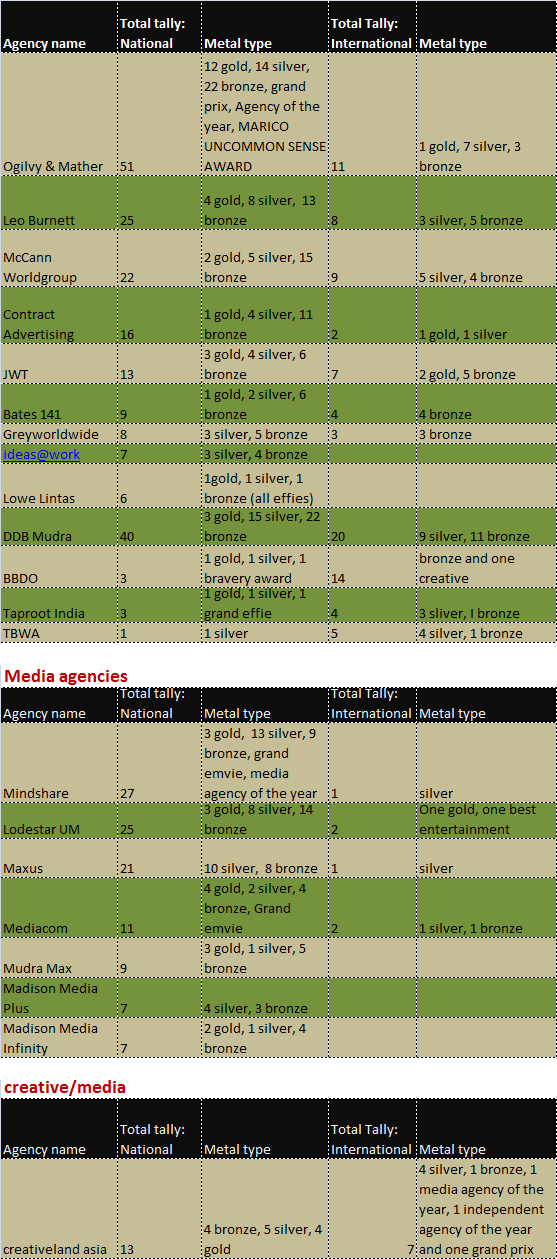
    The year 2011 had a few interesting ups and downs: BBDO which managed to bag 14 awards globally, got just three within India. Contract which got 16 within the country,  got just two globally. Mindshare won 27 awards nationally and one globally, Maxus had a score of 21 and one respectively.


    However, in the case of creative agencies, most national award winners have done well internationally too. (Perhaps the lesser number of global media awards has something to do with it!)


    Below is a quick look at how the key winners in national awards did globally, and in a few cases, how the ones which did very well globally, did in the national scene.


    Click here for a complete list of awards won by Indian agencies in the year 2011.

  • The Anchor: Lara Balsara’s 5 reasons media agencies should attract talent from outside

    By Lara Balsara


    #1 Thinking beyond numbers and objectivity. A typical media planner tends to think very objectively and tends to opt for plans and media that are supported by numbers and makes only data-based decisions. Whilst this is a basic necessity, you have to use your imagination based on quality of content, its appeal to different target audiences, etc for your plan to be a holistic media plan that is based on rigour and discipline but does not lose out on the soft factors. If you look only at hard numbers, most media plans would look exactly the same and that would not serve the brand’s purpose.


    #2 To come up with innovative and comprehensive solutions. Media in India has now been a specialist discipline for over 15 years and therefore there is a certain sameness in thinking that has come about among professionals. To counter this, you need people who are better with lateral thinking capabilities as they would balance a plan supported only with numbers. When you have a diverse talent pool working together, each individual brings in their own unique perspective and their area of expertise; as a result you come up with a brilliant strategy, idea and execution. At Madison Media, we have experts in analytics, account planning, creative and content integrated in the core media plan and we have seen this diversity work magically for our clients.


    #3 Scope of media is very broad. Today anything and everything is a communication medium, and the biggest challenge for media agencies is to come up with new and interesting ways to reach out and engage with audiences. Increasingly with so much noise in the marketplace, there is a need not just to expose your target audience to the message, but to affect them in a deep and engaging manner. If you look at media awards, which are a barometer of good media thinking, you will see some outstanding examples.


    #4 There isn’t enough talent available. It’s a simple issue of demand versus supply. Media professionals are in huge demand and there is a huge shortage of good talent available. Media agencies have no option but to look outside.


    #5 Media professionals rock. Having said all the above, you can’t underestimate the skill sets of media professionals; they are the most equipped to handle almost any job in communications, but the same can’t always be said of other communications professionals’ ability to handle a core media planning job.


    Lara Balsara is Director, Madison World.

  • RAMcheck: Media agencies on new FM listenership numbers

    By Robin Thomas


    The latest RAM data on radio listenership for the month of September to mid-October has thrown up a few surprises in radio listenership. New leaders have emerged in cities that were once strongholds of their rivals. Barring Kolkata where Radio Mirchi continues its leadership position, the remaining three markets – Mumbai, Delhi and Bengaluru have new No. 1s.


    Take Mumbai for instance, once a Radio Mirchi bastion, the latest RAM figures (category: all people 12+, all places of listening, shares) show Radio City as the number one private FM station in the city, slightly ahead of Radio Mirchi. However this time (i.e. week 38-42, 2011) Radio City had to share the No. 1 slot with the government owned FM radio – AIR FM2-Gold. Bengaluru where Big FM held its number one status for a very long time is now overthrown by Radio City. In Delhi Fever FM has become number one taking over from AIR FM2- Gold, Radio Mirchi which was number one in the city for very long time has slipped to number three position. These figures are according to RAM, All People 12+, all places of listening and all daypart (i.e. Sunday to Saturday 12 am to 12 am).


    In addition to these developments we find that when we compare week 35- week 38, 2011 (last week of August to 1st three weeks of September, 2011) and week 39- week 42, 2011 (Last 2 weeks of September and 1st two weeks of October, 2011) not all FM stations have witnessed growth in their listenership. When asked whether FM stations have reached a stagnation point in listenership, Mr Janardhan Pandey, Associate VP, Mudra Max explained, “It has not reached a stagnation point, but a period of stabilization. To further increase listenership, FM stations will have to take the quality of content and programming to the next level along with higher-level product promotions.”


    Mr Ajay Rao, Vice President, Dentsu observed, “FM stations do not have novelty working for them any more. It is today a force of habit for people who find themselves without a smartphone to keep them going. For the young people FM is losing out to other more engaging past times. Can one differentiate basis the content? Listeners tune in for music and switch channels during breaks.”


    AIR FM2- Gold which has been growing strong in listenership particularly in Mumbai and Delhi where it has emerged as a strong number two contender. What remains to be seen is whether this trend continues or will it see a decline or stagnation in listenership. Media planners are however of the view that since AIR FM2- Gold offer only specific contents it is not considered as often as the private stations. Mr Narendra Kumar Alambara, Vice President, Starcom Chennai was of the view that, “Since the entertainment content is limited in AIR, the advertisers do not consider AIR as often as compared to the private stations.”


    “AIR FM- Gold has been consistently delivering impressive numbers, this suggest that the music is most important content of a radio station and RJ/ innovations and promotions alone cannot keep you on top,” said Mr Janardhan Pandey.