Tag: Mayank Pareek

  • Tata Motors’ Harrier to be lead brand for IPL19

    By A Correspondent


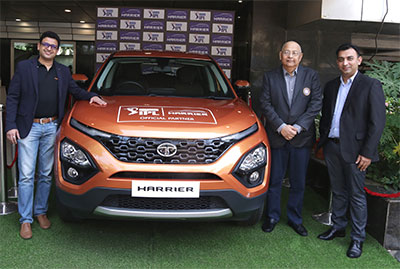
    The Board of Control for Cricket in India (BCCI) announced that IPL Official Partner Tata Motors will promote their newly launched SUV – Harrier as the lead brand for the Vivo Indian Premier League 2019 (IPL19). The recently launched Harrier will leverage the IPL19 platform to showcase the SUV, engage fans and deliver memorable experiences to them.


    Speaking on the development, Amitabh Choudhary, Acting Honorary Secretary BCCI, said: “We are excited to continue our partnership with TATA Motors and have their newly launched SUV, Harrier, as the Official Partner of the IPL19. Harrier’s exhilarating performance is very akin to the muscle that players put in to have the highest batting strike rate and win the Harrier Super Striker Award every match and for the season. We look forward to delivering great exposure to both the Harrier brand as well as Tata Motors.”


    Added Mayank Pareek, President Passenger Vehicle Business Unit, Tata Motors: “After a successful association last year, it is only fitting for Tata Motors that our premium SUV, Harrier, should be the Official Partner of one of the biggest sporting events across the World. Born of legendary pedigree, the Harrier has received a phenomenal response from customers across India. Much like the IPL, which is one of the most iconic global cricketing events, and is widely celebrated as a platform for budding talent and international cricket legends, the Harrier too is known for its exhilarating performance and exciting drive. We have elaborate plans to capture the audience’s attention in-stadia, on-air and across digital platforms, and hope to drive tremendous value from this association yet again.”


  • Tata Motors leans on ‘Messi’ magic for its Passenger Vehicles biz

    By A Correspondent


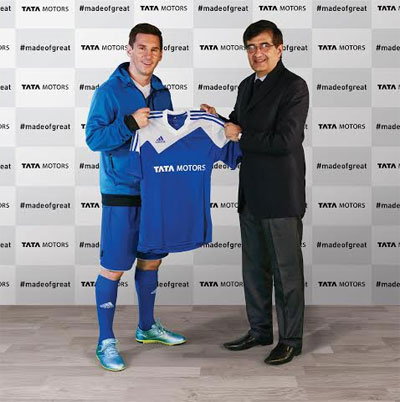
    After an exciting year of aggressive and highly engaging marketing campaigns for its new generation products like Zest, Bolt and GenX Nano, Tata Motors is all set to make huge strides in marketing its new product line-up, inspired by its Horizonext strategy. The Company has signed-up the football player star, 4 consecutive times Best Player of the World, Lionel Messi, in a long-term association as it global brand ambassador to promote and endorse its passenger vehicles, globally. To start with, Tata Motors will first roll-out the association campaign, #madeofgreat, starring Lionel Messi.


    This is the first time ever that the Passenger Vehicle Business will be undertaking an overall brand association campaign with a brand ambassador. The campaign is based on consumer insight and rides on a strong consumer motivation of ‘Seeking Excellence’ & ‘Self Belief’ which is epitomized by the confluence of two global brands- Tata Motors and Lionel Messi. The core idea of this campaign – Made of Great emerges from the inspiring thought of ‘What drives us from within is what makes us great’. The Company will also soon launch an exclusive, limited edition merchandising range of this association.


    Announcing the association, Mayank Pareek, President, Passenger Vehicle Business Unit, said, “We are very excited to have Lionel Messi on board. He is talent galore with conviction & is an icon for today’s youth. Watching him play football is magical. His determination on the field is awe-inspiring. He is a winner who is trustworthy, reliable, pioneering, simple and driven by self-belief, which is the core idea of this campaign – ‘What drives us from within is what makes us great.’ Tata Motors is driven by design, technology and strives towards excellence. Through this powerful campaign we will communicate the values & ethos of the passenger vehicle business. As we look to expand our footprint across the globe, Messi’s unique ability to appeal globally, transcending geographies, makes him ideal person to represent our brand, internationally. This is the first campaign in the series and many more will unfold as we move on in this long-term association. We hope our customers like this new campaign and we look forward to their continued support.”


    This campaign has been conceptualized by Tata Motors and Soho Square Advertising & Marketing Communications. The creative agency team lead by Kunal Jeswani, Anuraag Khandelwal and Satish deSa has spent over five months on the making of this campaign. It has been directed by Daniel Ben Mayor and filmed by team of international experts in Barcelona. Tata Motors has used the best graphic expert, Ambassador to bring alive the visual experience. Wizcraft is bringing this campaign alive on-ground, while DigitasLBi and SMG Convonix are seeding it across the digital platform, with Lodestar UM spearheading the media strategy.


  • Big Boss marketers go Saath Saat to beat Slowdown


    By Lijee Philip & Kala Vijayaraghavan


    By his own admission, Mayank Pareek, who is responsible for ensuring that cars keep moving out of Maruti Suzuki showrooms at a faster pace than never, says he has no personal life today. Cars are not moving at India’s biggest carmaker like they used to. “I am working seven days a week,” says Pareek, chief marketing officer. “Tough times call for tough measures. We can’t be selling cars sitting in the office.”


    In August, Maruti organised about 26,000 events aimed at the consumer, including exchange melas, camps for financing and AC check-ups. “The idea is to reach every potential consumer and convert them into a buyer,” he says. It’s a challenge for every chief marketing officer (CMO) in this slowdown, and it’s not an easy one to overcome. “There are no homogenous customers,” says Sunil Kataria, CMO at Godrej Consumer Products.


    In the first two quarters, the Indian economy has grown at a tepid 4.8 and 4.45 percent respectively. And the forecast for the entire year is only mildly better- 5.3%, according to a panel advising the prime minister last week. High prices and job insecurity, in the face of economic uncertainty, has upset consumer confidence, with spends on electronics and automobiles dropping for eight months in a row.


    Yet, Kishore Biyani, who knows a thing or two about the Indian consumer, feels this is not the time for companies to be defensive. “It is the time to be aggressive,” he says. “If marketers keep quiet, the consumer will keep quiet. One has to behave normally during such times.” Not CMOs, though, who are having to deal with reluctant consumers, tighter budgets, and a competitive and changing marketplace. Even as they pull these six levers to beat the slowdown, there’s a seventh one they cannot afford to let go off.


    1. Find new niches

    Alongside marketing campaigns aimed at the consumer in general, some companies are targeting niches for growth that is more visible, is easier to record and comes at a lower cost. For Maruti, this thinking has seen it pinpoint and drive into settlements, with a need and purchasing power, like priests in Tamil Nadu and turmeric growers in Nashik. “So, it’s not mass marketing, but niche marketing,” says Mr Pareek, the carmaker’s CMO.


    Having a widespread network helps as such campaigns become just incremental work for a sales team. They can make a catch and return to their bread-and-butter. More recently, adds Mr Pareek, Maruti has been adopting a similar strategy in Jamnagar, Gujarat, where groundnut and cotton farmers have seen a kicker in their incomes following a good crop and higher prices. Elsewhere in the state, its sales executives, pitching its Eeco as a cost-efficient mode of transportation, recently sold 40 vans to restaurant or motel owners on the highways of Ahmedabad and Baroda.


    Similarly, earlier this year, Vodafone launched a campaign for migrant workers in mid-town Mumbai to teach them how to use a mobile application of the Indian Railways to book train tickets. “A number of these workers have entry-level phones,” says Vivek Mathur, chief commercial officer, Vodafone India. “With an application, they see the utility of a data connection against MBs or GBs of a data plan.”


    Godrej Consumer found new consumers for its room and car fresheners, Aer, through a new distribution channel. In the first five months of launch, Godrej was selling Aer as an FMCG product, moving it through traditional and modern trade. After its consumer research showed home care and car care to be different segments. “Car buyers are very passionate about what they use in their car and spend time in car accessory shops,” says Mr Kataria of Godrej. “We quickly appointed separate distributors for car accessory shops.”


    2. Get out of the office

    It took several consumer interactions for Godrej realised its folly on how to distribute Aer. But those consumer interactions were not by default, but by design. This June, Godrej kicked off an initiative called ‘conquest’, whose objective is to have five employees meet 100 consumers in a week, gather information, process it scientifically and embed it into decision-making.


    The mid-course change in how Aer was to be distributed was one example of Conquest at work. “The main idea behind Conquest is to pick consumer knowledge first hand and work on it swiftly,” says Mr Kataria. “In regular research, there is a transition loss that tends to happen as research agencies moderate and diagnose data.”


    Most companies, in their own way, are strengthening their efforts to reach the consumer. In early-2013, mobile service provider Idea Cellular started participating in ‘haats’-local markets, typically organised on a weekly basis, both in rural and urban areas. Idea now sets up a permanent stall in haats in 450-500 districts, with each market serving a population of 2,500.


    According to Himanshu Kapania, chief executive of Idea, 60% of the company’s customers are in rural areas. Elsewhere, Axis Bank is also promoting more field initiatives to win new business. One such initiative aims to get more senior citizens to open accounts with the bank. Its product, called Senior Citizen Privileged Account, offers health checks, bill payment facilities, an ID card for medical emergencies and a CD of old movie songs. “Banking is not an acquisition business like FMCG,” says Manisha Lath, head of marketing, retail liabilities & electronic banking, Axis Bank. “It is really a relationship business.”


    3. Engage more with sellers

    Consumers are one touch-point of such outreach exercises. The other is the links between the company and the consumer: dealers and retailers. Increasingly, CMOs acknowledge, it is in their interest to do so as these two sets are influencing sales in a bigger way; they are no longer dormant channels and, today, have the power to convince consumers to choose a particular brand.


    According to Nilesh Gupta, director of consumer durables retail chain Vijay Sales, Apple is the only brand that has the differentiation for a marketer to call the shots, and even that is under question today. “There is no brand or product differentiation in the market today,” he says, in the context of consumer durables. “Usually, the dealer may have the final say in the brand choice picked up by the consumer.”


    So, companies are offering incentives. This April, Aircel launched a reward scheme for its retailers, targeting their wives: the wife whose husband sold the highest number of Aircel connections got a Hyundai Santro car, the runner-up got to meet MS Dhoni, captain of the Indian cricket team.


    If it’s not incentives, it’s meetings. “It is important in a downturn, and amid killing competition, to have your trade channels back you solidly,” says Salil Kapoor, CMO of Dish TV. “We have been directly meeting our top-performing 7,000 dealers of our 48,000 dealerships in the last few days to solve on-the-ground issues and motivate them.”


    “You manage dealer problems and they will manage yours,” says Chandu Virani, managing director of Balaji Wafers. For many years now, Virani has been holding an annual meeting of 25-50 dealers, of Balaji’s 800-plus dealers; he is now increasing their frequency. There is no talk of sales. Instead, Mr Virani listens to the problems of dealers and tries to offer immediate solutions.


    4. Make a rural push

    In today’s skidding market, the top-of-the-mind concern for dealers and companies alike is growth. Mr Kapoor of Dish TV says market trends in India, especially in urban areas, is a partial repeat of 2008, when a feeling of gloom pervaded over India following a financial crisis in the west.


    Concerns on job losses, a declining rupee and mortgages is an urban phenomenon, adds Mr Kapoor. “Half of the problem is sentiment-driven,” he says. “But the villages are not affected by this gloom talk.” Harvests in general have been good, yielding higher incomes for farmers, and this likely to see them spend more. Dabur expects growth in rural India to be 30-40% higher than urban markets.


    Mr Pareek of Maruti says the company has identified about 300 rural niches in recent years, which account for 10% of its domestic revenues.


    These include potato growers in West Bengal , blue pottery makers in Jaipur, timber merchants in Gujarat, turmeric growers in Tamil Nadu, granite pol i sher s in Hyderabad, painters in Madhubani in Bihar, and manufacturers of nuts and bolts in Sonepat.


    An August 2013 study by Nielsen, titled ‘India: Boom or Bust’, validates the rural push of companies. The report says that of the 400,000 new stores set up in India in 2012, more than 70% were in rural areas. CMOs expect companies to stay this course, not just in terms of where all they are but also in terms of what products they offer. So, for example, Emami, Dabur, LG and Videocon are looking to go beyond small packs and entry-level products, with larger packs and mid-range products, in the belief that consumers in rural areas will start upgrading. LG plans to ship more smartphones and flat-screen TVs to villages and smaller towns in this festive season.


    5. Entice with the price

    The Nielsen report cited above says the companies that did well are those that “were not so aggressive on price…they recognised the pressures on the consumer”. The report says that in 2012, the five fastest-growing FMCG companies in increased product prices by an average of 8.2%, against 11% in 2011. By comparison, the bottom five companies raised prices by a greater amount -12.5% in 2012, against 9.3% in 2011. In this slowdown, price has emerged as an important lever, both as perception and as real value. The auto industry, which is reeling under eight consecutive months of declining sales, leads the way, with price cuts and hefty discounts. For example, Hyundai pitched its Grand i10 Rs 50,000-80,000 cheaper than Maruti Swift; Ford launched its new and improved Figo at its previous-generation price, of Rs 3.99 lakh; manufacturers sought to disrupt the market with aggressive pricing of brand new models like Ford EcoSport (Rs 5.99 lakh) and Honda Amaze (Rs 4.99 lakh).


    In the FMCG space, bundling, promotions and discounts are galore on soaps, shampoos and laundry. So, for example, Hindustan Unilever is offering a discount on its premium detergent brand Surf Excel Matic, while P&G is offering 15% extra shampoo on its Rs 3 sachets. It helps them the cost of crude oil and palm oil, key ingredients for soaps and detergents, have declined 7% and 3%, respectively, in the past few months


    6. Keep innovating

    Even as they play defence and keep a check on prices, the slowdown winners also turn on the offence and keep innovating, observes the Nielsen report. More importantly, they support these new launches. The new launches made in 2011 by the five fastest-growing FMCG companies grew five times in value terms in 2012, against two times for the bottom five companies in the set.


    Devendra Chawla, president, Food Bazaar, a modern retailer, says FMCG companies have dared to take big bets with new product and category launches in 2013. The list of new product launches- not refreshes-in this slowdown is long and formidable. So, for example, with its whitening toothpaste, Colgate launched a new category, pricing its product at a 50% premium to other products in the market. P&G launched its big toothpaste brand Oral B in India a month back.


    There’s also HUL’s hair care brand Tresemme, Marico’s Saffola Masala Oats, Engage Deo by ITC, Park Avenue Beer shampoo, Instant Chinese noodles by ITC, Dettol Kitchen by Reckitt Benckiser, Odonil gel from Dabur, Alpino chocolates by Nestle. “The consumption economy is definitely leading to consumers willing to pay for differentiated products,” says Mr Kataria of Godrej, which has launched two new products and two product variants in the last 10 months.


    At Big Bazaar, for example, olive oil sells more than Marico’s Saffola. Mr Chawla says modern trade has helped companies drive sales in new categories: while its contribution in overall sales growth has been 7-8%, it’s been 35-50% in new-age categories such as anti-aging creams, health foods like oats and toilet cleaners. “In a way, it is a new marketing lever-focusing from general to specific, and with a long-term strategy,” he says.


    7. Keep thinking long term

    Rajiv Bajaj, managing director of Bajaj Auto, has a different thinking on offering too many brands. “The marketing principle is that the width of the brand portfolio must be inversely proportional to the breadth of the markets that one seeks to address,” he says. “Unfortunately, most marketers lead their companies to offer more and more brands as they seek to enter more and more markets.


    That’s usually the beginning of the misadventure to a sorry end.” In the domestic market, Bajaj has just two brands: Pulsar and Discover. K Ramakrishnan, president marketing of Cafe Coffee Day, also stresses on holding on to the basics as a guiding force. “Life (for a SMO) has always been full of complications and changes, and we have to accept that,” he says. “If there is primary focus on the value offered by the brand, I think, one is on safe ground.”


    It’s why Bajaj feels marketers should think less about the world and more about their brand. “When there are too many competitors and not enough customers, CMOs need to heed (marketing guru) Jack Trout’s advise, ‘differentiate or die’, and reorient their organisations from being manufacturers and sellers of products to becoming an engineer of categories and a marketer of brands.”


    Marketing consultant Suman Srivastava feels marketers are probably making little headway in unconventional ways to reach the consumer because the marketing tools being used today are primarily for FMCG products and evolved in the 1960s, for a different consumer. “Today, FMCG is just one of the various product categories,” says Mr Srivastava, founder of Marketing Unplugged. “The world has changed and the CMO has to change dramatically too. Their immediate instinct is to control the communication to the consumer like speaking from a podium; they are not having a conversation with them.”


    With Deepali Gupta and Writankar Mukherjee


    Source:The Economic Times

    Copyright © 2013, Bennett, Coleman & Co. Ltd. All Rights Reserved

    Licensed to republish
     

  • @AIMA Congress: ‘Marketing is always a challenge’

    By Shruti Pushkarna


    RK Swamy BBDO’s SK Swamy @ AIMA 2nd World Marketing Congress
    [youtube width=”400″ height=”200″]http://www.youtube.com/watch?v=WQ-UK3vd3v8[/youtube]
     Maruti’s Mayank Pareek @ AIMA 2nd World Marketing Congress
    [youtube width=”400″ height=”200″]http://www.youtube.com/watch?v=xKv0XlDoh8A[/youtube]

    Yashwant Sinha, Former Union Minister for External Affairs and Member of Parliament, summed up the crux of all discussions at the two-day marketing congress appropriately when he said, “Marketing, as a function will always remain a challenge to marketers because it is an art and a science that will continue to grow.” In the several sessions over the two-day congress, the concept of marketing was expanded to include spheres as diverse as politics, corruption, business and spirituality. Leaders from all walks of life converged at the congress to understand the nuances of marketing and how to leverage the power of marketing.


    The AIMA 2nd World Marketing Congress was held in New Delhi on March 2-3. The two day conference saw a panel of eminent speakers from various sectors who exchanged their thoughts on the changing dynamics of marketing. The theme of the conference this year was ‘Exploding Marketing Power. Speaking of the theme, World Marketing Congress Chairman & Chairman and Managing Director, BBDO RK Swamy, Srinivasan K Swamy said, “Marketing is the only thing that can deliver disproportionate results. Finance, manufacturing etc can only reduce cost to some extent, whereas marketing can provide excessive revenue and it has the power to bring on exponential return, that’s why we have this theme of exploding marketing power.” He also said, “The AIMA World Marketing Congress this year has raised the bar from last year to explore various dimensions of marketing not just in India but globally. The basic concepts of marketing have not changed in the last few decades but their implementation has. Marketing strategies start even before the product is launched, through the purchase and by means of post purchase offers.”


    This was also the third year running for the AIMA-RK Swamy High Performance Brand Award. This year the award was won by Wipro Technologies, with Axis Bank as the first runner up and Voltas Ltd as the second runner up.


    Staying relevant to the consumer

    In the session on ‘Extracting Full Value of Marketing Investments’ both Virginia Sharma, Vice President & CMO, IBM India and Aditya Ghosh, President, Indigo Airlines stressed on the need to stay relevant to the consumers. Ms Sharma said, “You have to stay relevant to the consumer and that’s the toughest job as a marketer. Brand visibility and awareness can be bought- you can plug your logo anywhere and everywhere but what you can’t buy is relevance. So what we need to do is to build authentic advocates for the brand because advocacy shapes belief.”


    Mr Ghosh said that all employees at Indigo are brand ambassadors for the airline. He said, “We need to ask ourselves how do we stay relevant to the customer and what is the customer really willing to pay for. Our aim is to concentrate on the product which remains relevant to the customers. Marketing does not define our business strategy but plays an important support role in pushing it further. Our marketing spend is less than 1 percent of our revenues. We create new innovative experiences and find various touch points with our customers that transcends into all our products and offerings.”


    Mr Ghosh also shared three strategic guidelines that Indigo follows.

    • Stay true to the brand value
    • Carefully curate every possible touch point
    • Make a buzz-worthy yet credible impression

    Mr Ghosh also said that a one-way marketing blast is not always necessary. It is important however to keep innovating the techniques of how you push your message across to the consumer.


    Stretching the product life cycle

    Nita Kapoor, EVP Marketing & Corporate Affairs, Godfrey Philips India Ltd chaired the session on ‘Stretching the product life cycle or product extensions’. In her opening remarks, she said, “Product extensions are fundamental to business strategy. Product extensions have a framework and their simple objective is to maximize revenue and create entry barriers.”


    Alok Bharadwaj, Senior Vice President, Canon talked about product life cycle management as something that is more to do with creating values for the brand rather than a marketing gimmick. He said that it is important to create and add value every time there’s a product extension. He said, “There are two compelling business drivers in product life cycle management. One is innovation, which helps provide new propositions for product extensions. The other is marketing, which makes these propositions relevant to the customer.” He also added that since change is happening globally especially due to fast changing technology, management of product life cycle has to be done globally as well.


    Mr Bharadwaj cited examples from technology products’ business cycle. He said, “Technology products have a slow start but they move up to the peak rapidly, staying at the peak only for a short while, they drop down quickly. Life cycle of these products is less than a year. So to make up for the loss in the second half of the product life cycle, a marketer has to capitalize by the time the product is reaching its peak and push for it to peak a bit higher. This is when product extensions come in.”


    Understanding the rural consumer

    The session on ‘Extracting the full power of Rural Marketing’ was chaired by Manisha Lath Gupta, CMO, Axis Bank and the keynote address was by Siva Nagarajan, MD, Mother Dairy. Ms Gupta started the session with a stress on the need to differentiate a rural consumer from an urban consumer. She said, “The needs of a rural consumer are very different from the needs of an urban consumer. As marketers we need to start innovating for the rural market.” She also said that the word ‘extracting’ had negative connotations attached to it, and as marketers one should really look at ‘serving the rural customer’. She said, “We should serve rather than exploit. We have to give back as much as we take. As marketers, we should be looking at developing sustainable livelihoods in rural areas.”


    Mr Nagarajan agreed with Ms Gupta on the need to redefine the rural consumer. He said, “We don’t even have a proper definition for rural. For us, anything that is not urban is rural. Rural consumer is not a poor urban consumer. Speaking of winning strategies for extracting the full power of rural marketing, Mr Nagarajan said, “Rural India holds a big opportunity for marketers. It is extremely important for marketers to understand rural mindset, their income & spending patterns, penetration of various products in the market and most importantly give value back to the producer. For brands to set up a strong base in a rural market it is essential to realize that the rural consumer is not a poor urban consumer. Marketers need to have an interdependent eco-system which involves players like Government, NGO’s, Banks etc. We cannot look at price-led innovation, rather we need to look at product value. Apart from vivid demos, rural marketing and brand building involves educating the trade and the influencers and not just regular above-the-line activities.”


    Making brands more meaningful

    The session on ‘How to make brands meaningful and powerful’ saw Mayank Pareek, Managing Executive Officer, Maruti Suzuki India Ltd. and Vishnu Mohan, CEO-Asia Pacific, Havas Media, debate and deliberate the need to make brands more powerful and the ways to achieve that.


    Mr Pareek said, “For marketers to make brands more powerful and meaningful, the biggest challenge faced by them is the buyers. Brands need to be relevant to what people are and what they want.” Citing examples of brands like Apple and Beetle, Mr Pareek emphasized on the need to create brands which ‘speak’ to prospective customers and go beyond just being ‘physical’ products.


    Mr Mohan cited some findings from a Havas study which pointed out that 70 percent of brands have no life, which means that if they were to disappear today, customers won’t care about them. The study also says that people in the Asia Pacific region are more concerned about environmental, health and social issues, and they are also more attached to brands as compared to the western world. The study also indicated that people’s expectation of companies’ responsible behaviour have risen over the past two years.


    So in a scenario where consumers recognize that environmental/social problems have an impact on their lives and that’s why they are willing to pay more for responsible products, the challenge for the marketer is to see if his/her brands are contributing to improve the lives of consumers.


    Speaking of what makes brands meaningful, Mr Mohan pointed out three key pillars


    • Personal well being- The customer wants to know how the brand impacts him/her, what are the personal outcomes
    • Collective well being- How does the brand impact the collective outcomes of people, society
    • Communications- Brands need to be able to talk to consumers, make them think and trust


    Mr Mohan concluded, “To be ‘valued’, brands need to transform from ‘value’ to ‘values’.”


    Making it ‘interesting’

    In the session on ‘Exploiting the power of Creativity’, R Balakrishnan, Chairman & Chief Creative Officer, Lowe Lintas India was at his creative best. He engaged the audience by playing some of the best TVCs to reinforce his idea that there are several ways of making things ‘interesting’. He said, “Marketing a brand is all about solving a problem as interestingly as possible after carefully understanding the need of the customer. Interesting can come in different ways, it can make people laugh or cry, or just make them say ‘wow’. Creativity today fundamentally revolves around making the boring seem interesting to the target audience. It can be done in various ways; by making a person feel like the hero of his own life, finding interesting insights about the new generation and translating it onto the advertisement or by giving an idea in a commercial which people can employ in real life.” Balki added, “You can’t teach people about creativity in a structured manner. However, structured thinking is required to make anything interesting.”


    Distribution is about managing the mind of the market

    The session on ‘Distribution/Channel Dynamics- Enhancing result’ was chaired by Paritosh Joshi, Chief Executive Officer, Star CJ Network India with an address by Amrit Thomas, CMO, United Spirits. Mr Joshi said, “Most people’s war stories that I have heard are to do with distribution. In a country like ours, availability comes before choice. Even before you get to choice, you have to arrange for availability. Also as distribution channels have evolved, the nature of the choice of marketers and the choice of customers has also become complex.”


    Mr Thomas said that brands are like ideas in our minds. He said, “The role of advertising is to plant that idea. Having planted that idea, you need to convert the idea into acts- sales. The big shift we are seeing in marketing is the new technology- web and mobile. These have made the propagation of ideas easier.”


    Speaking about enhancing results through distribution, Mr Thomas said that it is important to understand the mind of the market. He said, “The mind of the market is shaped by consumer, shopper, sales team and customer. Word of mouth/influence plays an important role in building brands and driving growth. Marketers need to understand and leverage touch points through consumers and shoppers interact with brands. Marketers also need to understand shopper and shopper occasions and make interventions to build competitive advantage at the point of purchase.”


    Conclusions

    The marketing congress ended with a valedictory address by Yashwant Sinha, who drew a parallel between the roles of a marketer and a politician and said that politicians try to market themselves continuously and if they stopped doing so, there would be no hope left for them in politics. He also said that he was surprised that not much technical work is done when it comes to marketing political ideologies.


    Speaking of a sudden upsurge in demand in India, he said, “We are seeing not ‘exploration’ of the market but ‘explosion’ of the market. So capacities will have to be increased in order to meet that demand.” He urged marketers to contribute a lot more towards rural India as he said, “A great deal needs to be done in the area of rural marketing.” He stressed on the need for marketers to ‘innovate’, to craft their messages in a way that will meet their target groups. He concluded, “Marketing, as a function will always remain a challenge to marketers because it is an art and a science that will continue to grow.”


    At the closing, World Marketing Congress Chairman & Chairman and Managing Director, BBDO RK Swamy, Mr Srinivasan K Swamy shared five personal takeaways from the congress.


    • Marketing is all about single-mindedness- He referred to the Indigo strategy cited by Mr Aditya Ghosh, President, Indigo Airlines, where they stress on not just flying planes on time but punctuality is woven into everything that they do at Indigo, even if it’s about starting meetings on time.
    • Value is more important- It is not that customers are looking for cheap products but they are looking for value for money.
    • Consumers are willing to pay- If companies are ethical, if they have CSR initiatives and they provide environmentally sensitive products, then the customers are willing to pay a higher price for their products.
    • It’s all about being interesting- Consumers like interesting things, interesting people and interesting products.
    • Intuition is passé- Today intuitive decision making is passé because there is so much one can do based on response driven marketing.