Tag: market research

  • Community panels will change the way research is done: Bruce Wells

    By A Correspondent


    In a business environment that’s getting increasingly competitive by the day, one can find clients making a beeline for research so as to stay ahead of the curve. Over the years, one is aware of the role that research has helped in making clients understand their TG and get closer to addressing their every need.


    From the traditional mode of questionnaire-filling & face-to-face surveys, market research today has evolved to include support from technological resources, including social media, which not only helps in lowering the costs and time but also gives customized information from the target audience. One such client that’s made an entry into India is Vision Critical – one of the largest global software developers for market research. Having achieved success worldwide, the company has entered India by associating with market research company, MRSS India.


    Bruce Wells, Managing Director and President, Asia of Vision Critical was in India recently and spoke to MxM India about his plans for India, expansion plans in Asia and how research software can alter the market research scenario in India. Excerpts:


    How would you describe your foray into the Indian market with a venture with MRSS?

    The Indian market plays a very important part in the global market research landscape and Vision Critical is very excited to partner with MRSS in India. We know that with the digital media coming of age and the rapid increase in the adoption of mobile phones and internet access represents an exciting opportunity for Vision Critical, given our suite of technology. So yes, the going has been exciting this far.


    Do you have a phase-wise activity plan that you’ve drawn up for the Indian market?

    The platform that Vision Critical has works across many different consumer segments such as media companies, FMCG clients, financial services, telecom, travel, and so on. What we are doing in India is looking at segments that have high growth potential, especially in the digital domain. We’ve been talking to some large multinationals and also local companies that have increased number of customers moving into the digital age.


    What is the investment push that you plan to pump into the Indian market?

    The way our business model works in Asia is that we are tying up with local market research companies that have a similar view and strategy in terms of recognising the opportunities of using digital communication. So, we have tied up with our strategic partner MRSS and we are working very closely with them in terms of giving them best practice, giving access to our technology…it’s a partnership model where we are investing our knowledge, experience and skills in supporting Majestic MRSS.


    Research activity in India is still looked upon as being a manual exercise with less inclination towards dependence on software. Going forward, do you see a shift taking place in the way research will be conducted in India?

    What we have observed in other markets is that, for example, people using social media for communication and engaging with the outside world is on an upward swing. This trend is not going to reverse. As the consumers consume media and use social media differently as a communication platform, so must brands and research companies adapt – that’s exactly where Vision Critical sits. Just as social media has changed the way people communicate, we believe community panels will change the way research is done.


    What has been the response from clients to software solutions being doled out by specialist firms like Vision Critical?

    If we look at the clients who are gravitating towards the new way of doing research, these are mostly companies with a technological background. So clients from telecom, ISPs, travel, retail, finance and so on are high on our list. But where we see a greater adoption of digital consumption, those are going to be the areas that we will prioritise in. As I said, it’s amazing to see such an alarming growth of the digital medium…especially the number of new mobile phone subscriptions in the country that’s growing at a staggering rate. So it’s an exciting place to be in.


    We’ve spoken to a host of clients and they have been pretty enthusiastic about the offering. The Indian research market industry is very smart – they produce some of the best research work ever seen. This validates our assumption that we are doing the right thing at the right time and the right place.


    What are the challenges facing research software companies like Vision Critical?

    The first challenge is to use our platform in the community panel space. The thing is that the consumer needs to be online so that will limit certain aspects of research that we will be able to touch on in the short term. The biggest challenge is moving from traditional methodology to something new. Also, the challenge is identifying companies that are ready to adopt new approach where we have seen great success with our technology in the West – from North America all the way through Europe, Australia and now Asia. So it is about finding clients who are eager to move to newer way of doing research.


    Any upcoming or developing markets that you plan to expand to?

    We are looking to expand into Mainland China, Singapore and Japan. These are our next markets to focus on. It will mainly be about focusing on countries that have high concentration on digital. As for the other markets, we expect to expand our footprint in Latin America, Africa and similar markets where we expect to see more people come online.


    What is the growth you are anticipating for Vision Critical in a year’s time from now?

    I would expect at least more than 20 clients to use our service within the next 6-8 months. I am a firm believer of the expression ‘success breeds success’. Once a few companies start using it and we get people aware of using community panel, then we will see what the scene is in other markets. The challenge right now is that most clients are not even aware that these types of technologies exist. But we hope to see people using community panels very quickly.

     

  • Media Matrix by Paritosh Joshi: Valuing audiences

    By Paritosh Joshi


    Media advertising has been priced based upon audiences that it reaches for a very long time. Audit Bureaux of Circulation were set up in Western Europe and North America by the early years of the 20th Century and even India’s own ABC has a hoary past, dating back to the 1930s.


    However, circulation audits only revealed the number of ‘revenue’ copies i.e. sold copies of a particular publication. This was not a particularly good guide to how many actually read it. Specialist publications may have sizable circulation but very few readers. Conversely, a general interest publication may appeal to many people and be shared around extensively.


    This was a serious deficiency. Market Research was a rapidly evolving discipline that offered a solution: readership surveys. Initially starting out as proprietary studies of individual publications, it soon became clear that for widespread use, they would need to be conducted at the industry level. Such studies, run by a ‘syndicate’ of clients have since been referred to as Syndicated Research.


    It was evident, even at the dawn of the age of measurement, that it was not enough to have a single number that represented the sum total of all readers. At the crudest, you would have to segregate males from females, children and teenagers from youth and adults. You would also want to discriminate on income-high, middle and low and by geography: rural or urban, state, district and town. These ‘demographic’ variables used to identify ‘segments’ have since become a staple of audience targeting.


    Brands and products would make specific media choices based upon the volume of a particular audience segment they delivered. Typically, the price of reaching a thousand individuals with a specific sized insertion became the basis of comparing a medium’s ‘efficiency’. This measure, variously called CPT (Cost per Thousand), CPM (Cost per Mille- mille being Latin for thousand) or simply the Mille Rate became the universal yardstick for evaluating the print media.


    Television began to grow in significance, first in theUnited Statesthen inEurope, after the end of World War II. Broadcast over the airwaves, television offered no ‘paid sale’ opportunity. Funding television could only be done two ways. Public broadcasting systems would be funded by the government exchequer and private broadcasters would have to earn revenue from advertising insertions. The pre-existing analogy of the Print media made it clear that television needed an audience measurement system. It was also recognized that viewers showed greater volatility than readers appeared to do, thus necessitating a much higher frequency of measuring the habit.


    A solution was found in asking randomly chosen viewers in a ‘panel’ to maintain a viewing diary. Diaries were collected weekly and collated to determine the ebbs and flows of viewership. Since the panel was relatively stable in composition and size, viewership was reported as a relative measure – the rating point. A rating point equals 1 per cent of the total audience. A show watched by every person on the panel would have 100 rating points. Since panels were constructed to mirror the overall population- being a representative random sample – the relative measure could be used to estimate the broader behaviour of the population. Inevitably extending the cost efficiency analogy from Print, it was only a matter of time before the cost of reaching 1 rating point began to be compared across shows. CPRP – cost per rating point – was born.


    And that is pretty much where the art and science of valuing audiences has rested, for over half a century.


    Now think for a moment about how you consume different media. There’s that television show well past your normal bedtime that compels you to stay awake until midnight – on a Tuesday. That automobile magazine with a big feature by a maverick British journalist that you spend a small fortune on every fortnight. And those news shows run by the world’s most intrusive interviewer that irritate the hell out of you but you watch with an almost masochistic regularity every night at 9. On the other hand, there are those 5 newspapers that are barely glanced at on your office desk, the daily weepies that you are forced to deal with as your spouse devours them every weekday or the fashion magazines that somehow land up in the bathroom stack. Surely there must be a difference in how they are evaluated by a media planner who somehow knows of your media habits? There should be. There aren’t.


    In the relentless focus on audience volume as the prime metric, we have lost sight of audience quality. Is it possible to objectively evaluate quality? Do current audience measurement systems pay adequate attention to measuring it? We will deal with these issues in Part II, next week.


    Paritosh Joshi was until recently CEO, Star CJ. He has been a marketer, a mediaperson and been a key officebearer on industry bodies. He can reached via his Twitter handle @paritoshZero


  • Claims, counter-claims rule IRS again


    By A Correspondent


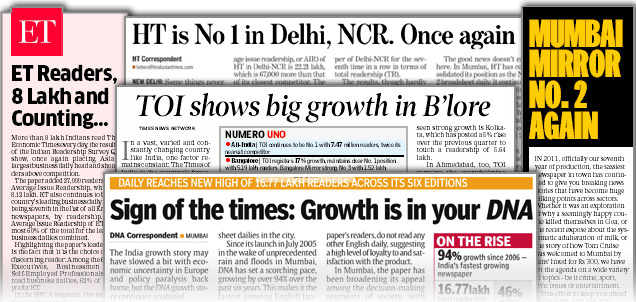
    It’s ironic. Mumbai is where most of the biggie media agencies exist. Some of the largest spenders are headquartered here. Still, publications pull out all stops to make crazy claims.


    Okay, they aren’t incorrect and the initiated amongst them can obviously see through the claims, but those who don’t – the lay reader, the young homemaker or the senior citizen who is not in the know – is sure to wonder what the truth. And if he/she subscribes to more than one paper, we are sure there will be some confusion.


    Obviously, the belief is that the reader is an ass. But this is a policy that can backfire terribly.


    But the confusion in a city like Mumbai is thanks to the two types of data that MRUC throws up in its IRSes – Average Issue Readership (AIR) and Total Readership (TR). Publications put up the data which throws them in better light. Also, newspaper X is a compact (tabloid- like-sized) newspaper while Y is a broadsheet. So one may be the #2 overall, another may be #2 broadsheet. Z may be #2 by TR and Y may be #2 by AIR.


    Fact is AIR is the accepted currency and there is a section which believes that a newspaper that comes free with another paper shouldn’t be taken for review. But there is a section which says that if a newspaper is able to attract revenues separately, that’s decidedly the best yardstick for the product’s utility. Perceived or otherwise.


    Sadly, the conferences which the Market Research Users Council and Hansa Research Group would conduct to release every round of the Indian Readership Survey have been done away with. The detailed dump is no longer handed out to the trade media. All of this charade of X, Y, Z could’ve been avoided had we got city and region-wise numbers from the MRUC (or via Hansa), but that’s not to be.


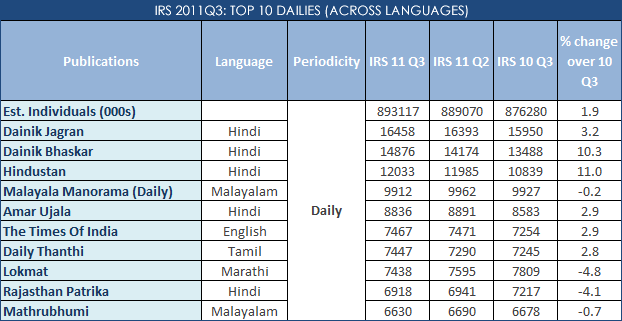
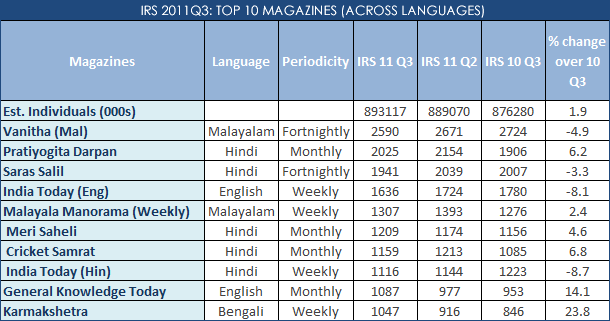
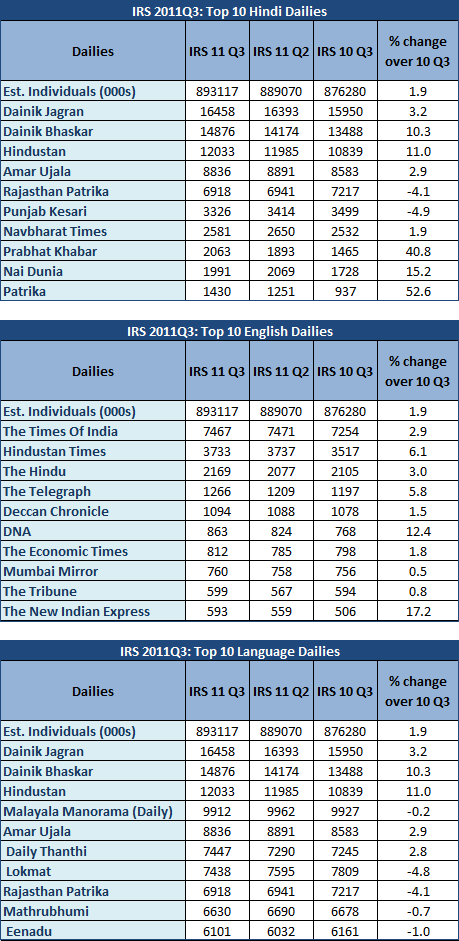
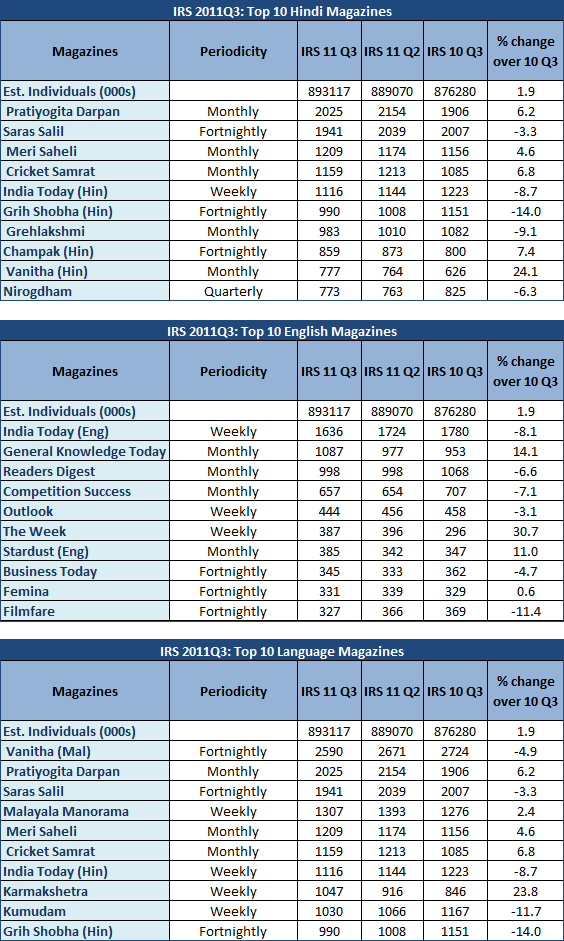
    Let’s look at the tables in detail (that we have based on the toplines publicly available).


    There’s no need of words. The growth or degrowth percentages tell the story. Some spectacular successes. Others not so.

  • The anchor: Naresh Gupta on 7 things research will never tell a marketer

    No self-respecting marketing executive can live without market research. Market research offers purposeful information to make plans, policies, programmes and procedures for any marketing activity. The market research industry is as old as the communications industry and, many would argue, more important than the mainstream communications industry. Yet there are pitfalls, and things that can’t be foretold. Here are seven things MR can rarely tell.


    #1 Reflect reality

    Market research is a post facto measurement of what had happened. The common belief is that research data reflects the current reality and hence can be used as a basis for predicting future. If that was the case then well researched brands would have never failed

    #2 Predict the future

    Research means placing human beings together in one place ask them their opinions and forming that as the basis for predicting the future. This is like saying that if you watch a lion in zoo, you will learn all about lions. The human zoo is no different from an animal zoo, and is rarely the right basis for prediction.

    #3 Is never free of bias

    Any form of research suffers from investigator bias and statistical errors. Research too is a classic case of stimulus response. The answers depend on what you ask, and that define the findings. Can research ever be free of bias?

    #4 Right answers depend on the right questions

    The new Coke is the stuff that is now a case study. While the new formulation tested well, scored on blind tastes and passed every test the research industry threw at it, it failed when launched. The consumer was not asked the most obvious question; will the formulation change the brand they love? Do they want the brand to change? The result was a massacre in the market.

    #5 No guarantee of success

    Testing a new commercial for predicting its success in market is a common practice. It is easy to score a commercial on emotional appeal, on message comprehension, on ability to create perception. Yet more commercials fail then succeed. We all know that, yet we are slaves to practice.

    #6 Does not replace experience and gut

    We need to remember that research is a tool, and not the decision. A marketer’s gut, experience, market reality are far more important than any amount of research data. Yet the tendency is to live more by research data and less by collective experience.

    #7 Quality matters

    We all know this.

    Right?

    Yet an average marketer rarely spends time on figuring out who will administer the stimulus for research. Will an average field executive be up to scratch? Will the average investigator strike the right balance of objectivity and expertise? Most researches are spoilt by simple overlooking of this crucial aspect. Next time, pay attention to field investigators.


    As a simple test try this, ban MR for a while, live by what you know as a marketer, trust your experience, trust your market feel, trust the hours you have spent in the field. Take the decisions that need to be taken, and use research almost as the last step to check gross negative. You just might speed up the process, learn a great deal more from mistakes, and possibly be more successful.

    Experience always triumphs over data.


    Naresh Gupta is Head – Brand Strategy, iYogi Technical Services