Tag: Market Research Society of India

  • Nitin Kamat is President, MRSI

    Market Research Society of India (MRSI), the apex body for market research in India, has announced the formation of the Managing Committee for the tenure of 2024-2027. Nitin Kamat, Chief Growth & Partnerships Officer, TAM Media Research Pvt. Ltd was elected President and takes over from Paru Minocha, Managing Director, South Asia, Insights Division, Kantar. Kamat worked as the treasurer for MRSI’s Managing Committee 2022-2024. He was also part of the MRSI’s ISEC Committee.

    Additionally, Puneet Avasthi and Shuvadip Banerjee were elected as Vice-Presidents, Anila Vinayak as the Secretary, and Parijat Chakraborty as the Treasurer for MRSI. The new Managing Committee was announced at MRSI’s 36th Annual General Meeting held on Thursday in Mumbai.

    Congratulating the newly elected President, Paru Minocha, Managing Director, South Asia, Insights Division, Kantar, and outgoing President of the Market Research Society of India said: “I am grateful for the unwavering trust MRSI members placed in the current Managing Committee. Key initiatives like the launch of the Socio-economic Classification System, ‘ISEC’, and the Market Sizing report of FY 2022-23, have given a new direction and scale to the vision of the association going forward. As I pass on the baton, I wish the incoming Managing Committee under the leadership of Nitin Kamat all the best.”

    On being announced as the newly elected President of MRSI, Nitin Kamat, Chief Growth & Partnerships Officer, TAM Media Research Pvt. Ltd., said: “I am honoured to take forward the role of MRSI President. The market research industry has seen a seismic shift, making it crucial to stay ahead of the curve. My focus will be to engage new minds, to not only maintain existing standards but also implement a new set of ideas and initiatives. In addition to building MRSI’s three Pillars – Profile, Pride, and Network, I firmly believe, ‘Building Trust’ is another crucial pillar that we will work upon. I look forward to strengthening global connects, deepening government connects and driving more initiatives for active participation from regional players. I am confident of achieving these goals along with the new elected managing committee members.”

  • Goodbye NCCS, Welcome ISEC

    Market research industry body Market Research Society of India (MRSI) has announced the adoption and implementation of its latest Socio-economic Classification System called ‘ISEC’. SEC systems are used by all research companies, advertisers, and measurement bodies to target households.

    Notes a communique: “The current socio-economic classification (SEC) being followed in India is based on ownership of consumer durables and vehicles. The growth in GDP and income, penetration of consumer durables, and ownership of vehicles has witnessed a significant increase, leading to the current socio-economic classification becoming less discriminatory and more volatile. The need to redefine the key variables led to the formation of a more stable, and more robust construct, ‘ISEC.’ Among the various industry stakeholders on track to adopt ISEC are The Indian Society of Advertisers (ISA), research users of various organisations such as ITC, Hindustan Unilever Limited, Marico, Dabur India, etc., research agencies including Kantar, IPSOS, as well as key media agencies. Representative of India’s social-economic strata, ISEC works equally well for urban and rural, is straightforward and quick and is not intrusive to administer.  A classification system spanning 1 to 12 tiers, ISEC is an open-source system and is available for all industry stakeholders.

    Said Mitali Chowhan, Director General at Market Research Society of India: “Socio-economic classification is the base of any targeted consumer understanding. At MRSI we recognise the need for an evolved SEC structure and ISEC is a system that is highly relevant. ISEC was developed by the industry, for the industry and unlike any previous classification system, it considers women’s education as a key definer of social capital, an attribute that is highly pertinent in current day. As an industry body, we are deeply invested in our stakeholders and the launch of ISEC is in line with our commitment to help our industry grow and evolve.”

    The communique further added: “Unlike NCCS that only factored the education of the chief earner and the presence of certain consumer durable items in the household, MRSI’s ISEC takes on a more advanced approach by including the occupation of chief earner, education of highest educated male adult as well as education of highest educated female adult. Created by a team of seasoned experts and professionals from across the research and insights industry using National Council of Applied Economic Research (NCAER), the Worldpanel division, Kantar, Indian Readership Survey (IRS), and referencing data from VTION,  ICUBE, among others.”

    In line with the roll-out of ISEC, MRSI organised a panel discussion that reaffirmed the importance of an evolved Socio-economic classification system to target consumers. Reinforcing ⁠their thoughts were senior industry leaders Amit Adarkar, CEO of IPSOS India, ⁠Jasmine Sachdeva, Managing Partner of Wavemaker India, ⁠Muralidhar Salvateeswaran, Chief Operations Office, Insights APAC at Kantar, ⁠Rajiv Dubey, Head of Media at Dabur India, ⁠Vivek Malhotra, Group CMO of India Today Group and Vinay Virwani, Head – Consumer Insights at Dabur India. The panel that was moderated by Shuvadip Banerjee, Chief Digital Marketing Officer of ITC Ltd and MRSI General Secretary  who discussed the increased need for a deeper understanding of consumer behaviour, media targeting, and challenges the industry is faced with given the existing NCCS construct.

    Here’s what the various experts said:

    Amit Adarkar, CEO of IPSOS India: “Socio-economic classifications are the starting point of any planning or decision-making, impacting almost all industries. Following a SEC system that is relevant, evolved and representative is hence critical. NCCS was introduced at the time when digitisation was gaining momentum and women representation in household decisions was marginal. Our country has evolved greatly since then and it is essential that we follow a SEC that is equally evolved.”

    K Ramakrishnan, Managing Director South Asia, Worldpanel Division, Kantar: “The challenges that companies are faced with these days are innumerable with the current SEC system adding to these challenges in terms of targeting and understanding behaviours. ISEC is a robust system that works well in both urban and rural India. It has more distinctiveness, a better distribution and it gives us the confidence that its structure will benefit brands and their decisions.”

    Sunil Kataria, Chief Executive Officer – Raymond Lifestyle – India & International, and Chairman of The Indian Society of Advertisers: “The development and progress of our economy is at a rapid pace. At such a pace it is even more important for us as advertisers and spenders to understand our consumers and their behaviour. ISEC is representative, relevant and robust. It gives us a holistic view of our audience segment and how they are equipped to make decisions. We welcome this new socio-economic classification and will continue to work with MRSI to further strengthen this system as and when required.”

    Shashi Sinha, CEO of IPG Mediabrands India: “A better and deeper understanding of consumer cohorts is always appreciated. It equips brands the opportunity to identify and target consumers in a sharper manner and opens up avenues for sharper communications. ISEC is highly discriminatory which is also crucial in current times. The implementation was long due and we are certain that this will help the industry considerably going forward.”

    Vivek Malhotra, Group CMO, India Today Group: “Following a socio-economic classification system that is representative of the population ensures that the industry is marching forward with efficiency. It ensures that the money spent is being spent correctly and more effectively. ISEC gives us that confidence and we are certain that this is a step forward in the direction of economic growth and development.”

  • Indian research & insights biz overtakes China, touches @2.9bn in FY23


    By Our Staff


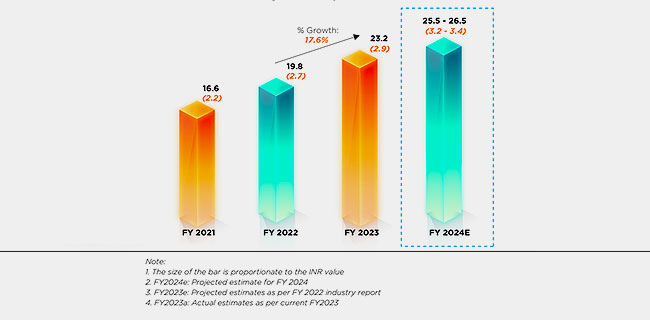
    Market research body, Market Research Society of India (MRSI) has announced the launch of its now-annual industry sizing report titled ‘The Indian Research & Insights Industry 2023 Update’. As per the report, India’s market research and insights industry grew by 17.6% in FY2023 reaching USD 2.9 bn from USD 2.7 bn in FY2022. Currently at the third position globally, and ahead of China, India’s market research and insights industry is further expected to reach USD 3.4 Bn in 2024.


    Notes a communique: “With a strong growth trajectory, supported with global confidence, India is considered a talent hub with strong analytics expertise. The growth witnessed aligns with the global research and insights industry, which posted a substantial 12% increase to reach USD 130 bn, over USD 118 bn in the previous year. Data analytics is the fastest-growing sector of the global insights industry in absolute terms.”


    Speaking on the industry’s growth, MRSI President Paru Minocha said: “The Indian research and insights industry witnessed another year of significant growth, achieving a substantial size of USD 2.9 billion. This growth is a testament to India being the focus growth market for companies and the market research industry’s ability to navigate challenges and capitalize on emerging opportunities to enable that growth. In addition, there is global confidence in India as a talent hub and as a market that is pivotal in offering valuable insights and research solutions.”


    Added Mitali Chowhan, Director General at MRSI: “The growth our sector is undergoing is very encouraging. This has helped maintain us our global ranking, and in fact has moved us up to the third position in the global Market Research and Insights industry. India’s significant capabilities, along with our industry’s ability to adapt effectively to challenges and thrive on both global and domestic fronts is something we can be proud of.”


    The BFSI, FMCG, Technology, and Healthcare sectors continue to contribute significantly to sectors growth and revenue. Emerging sectors like Telecom, Electric Vehicles, and Gaming have seen increased demand for analytics and custom research. While online data collection is gaining traction, traditional methods such as face-to-face interviews remain relevant for their cost competitiveness and ability to provide wider coverage of the Indian consumer.


    The executive summary of The Indian Research & Insights Industry Report 2023 is available to download on https://insight.mrsi.co.in/indian-industry-report/


  • India Shining in Market Research


    The Market Research Society of India (MRSI), the apex body of marketing research in India, released the a report titled ‘Research & Insights Industry in 2021’. The report, released by Piyush Goyal, Minister of Commerce & Industry, Consumer Affairs & Food & Public Distribution and Textiles on November 17-18, covers the expanded definition of ‘research and insights’ including the traditional market research agencies, pure-play analytics firms, captives of global companies, outsourcing and various technology providers.


    1.Definition and sizing of a new and up-to-date Construct of the Research & Insight Industry 2021
     

    2. Industry recovers post pandemic due to accelerated demand from analytics and international clients
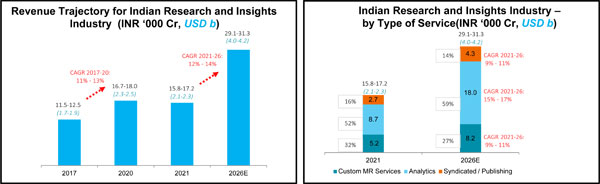
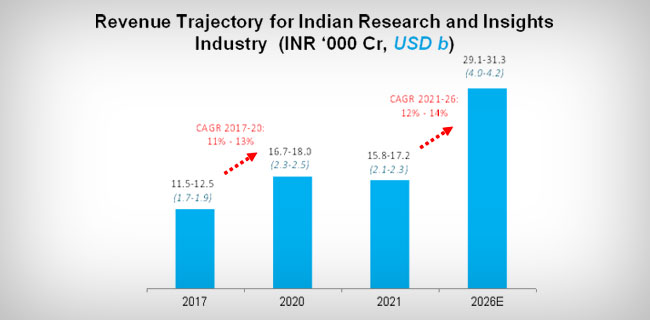
    The revenue of Indian research and insights industry is expected to double by FY26, primarily driven by the increasing demand for analytics, also fueled by international demand.

    FY21 revenue was expectedly impacted by the COVID 19 pandemic, with the biggest declines in custom MR services and syndicated products. However, robust international demand for analytics services ensured that the overall industry declined only marginally. The strong turnaround seen in H2 FY21 continues in the first half of current year (FY22), in line with economic recovery in both Indian and international markets.


    3. International business is expected to remain on a strong growth trajectory due to demand for analytics, and tail-winds for outsourcing
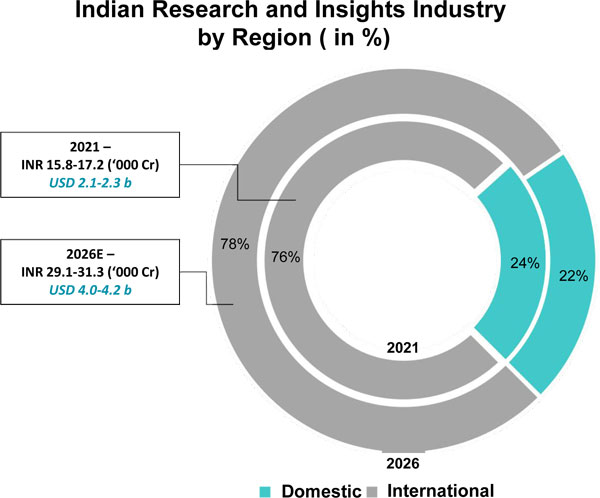
    International business grew at a robust pace in FY21 despite the pandemic and the trend is expected to continue.

    Key drivers for international business growth are demand for analytics and greater acceptance of the benefits of outsourcing in several major markets. These drivers should remain for the next five years.

    Domestic custom market research services to recover and grow at double digits in FY22, to reach pre- pandemic levels. Thereafter, growth till FY26 is expected to settle at a rate of around 6% to 7%.


    4. Consumer facing industries, ICT and BFSI are the verticals that will keep driving growth
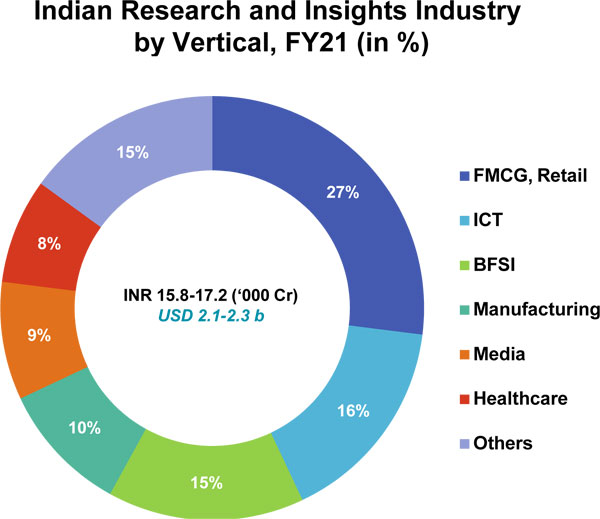
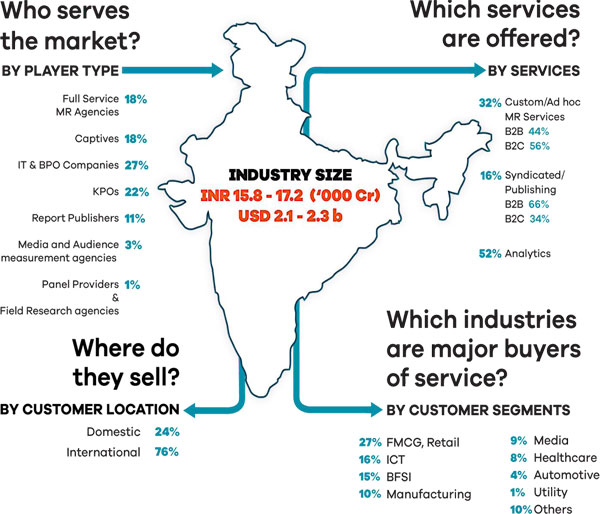
    FMCG, Retail, ICT and BFSI are the largest buyers of research and insights services in 2021, and these sectors will continue to dominate. Fintech and digitalisation will drive demand from these sectors, both in international and Indian markets.

    Verticals that got severely affected by COVID-19 in FY21, such as Travel and Hospitality, are expected to bounce back stronger post pandemic due to pent-up demand.


    5. The escalating importance of technology is blurring the lines between the types of organisations that serve the research and insights industry
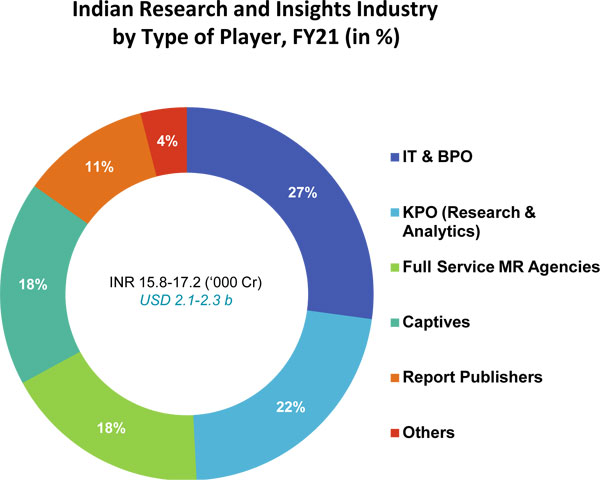
    Unlike most countries, the Indian industry is characterised by diverse types of players. Apart from agencies that cater to the domestic market, there are a large number of companies that serve international markets. These include those who provide purely research services, report publishers, diversified BPO and IT firms, KPOs and captives of multinationals.

    While these companies have different origins and strategies, the industry is witnessing a convergence in service offerings. The increasing importance of technology is accelerating this convergence, especially in larger firms that want to retain their share of the client’s wallet.


    6. Consolidation is changing the contours of the research and insights industry
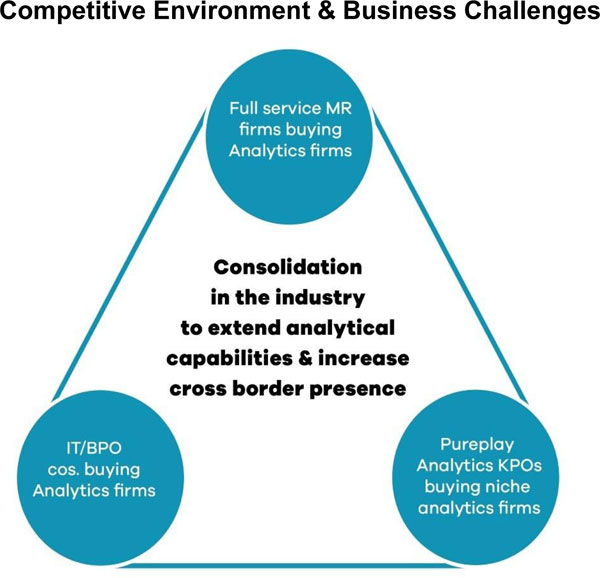
    With the role of technology growing dramatically and the declining share of traditional services, the definition of a “full- service” research agency is changing and lines between player types are blurring.

    Large full-service agencies and market research outsourcing companies are adding analytics to their offerings often through acquisitions. IT and BPO companies are muscling into market research as well as analytics. Report publishers are re-focusing on consulting or custom research. Large cash- rich companies in traditional consumer MR and IT/BPOs are aggressively acquiring niche analytics firms. This consolidation is likely to further intensify competition

    Enthusiasm for Indian start-ups, coupled with the robust global demand outlook, means that their private and public funding is likely to scale new peaks in India.


    7. A key business challenge for the industry to deliver on the growth potential Is attracting and retaining talent
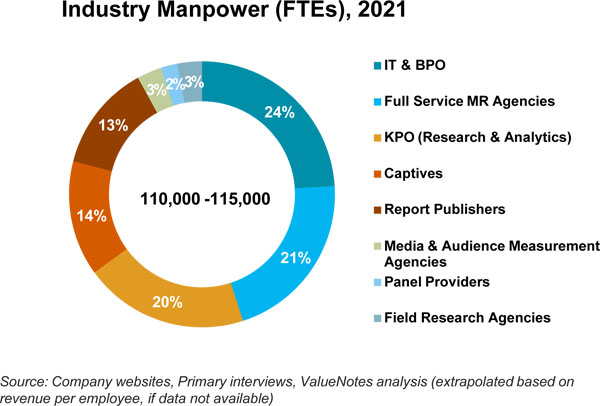
    Roughly 110,000 to 115, 000 full-time employees are estimated as the workforce for the research and insights industry in FY21.

    Workforce in analytics would increase by close to 15% annually, for the next few years. With the increased adoption of technology, full-service MR agencies and panel providers are likely to redesign or rethink their workforce to enhance IT and analytical skills and staffing.


    8. Unveiling the concept of “MR 3.0” and signposting the journey
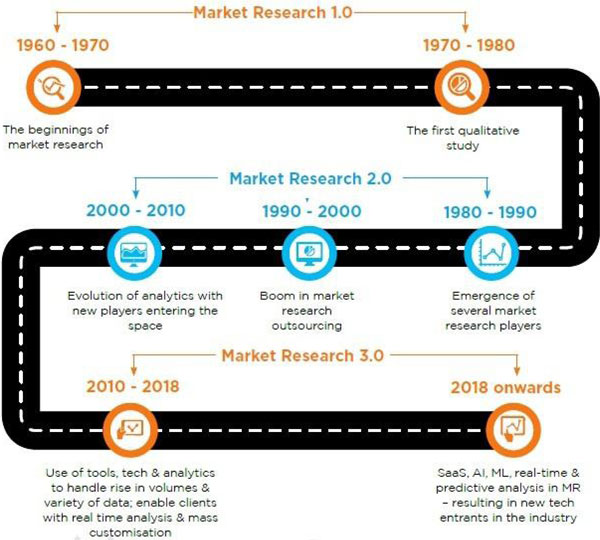
    The Indian research and insights industry is on the path to adopting and adapting to the current and up- to-date version of “MR 3.0”

    The consolidation of businesses and blurring of lines between types of players is part of this trend. The use of technology is another marker of the emergence of MR 3.0.


    9. Technology and changing customer needs are driving the transition to MR 3.0
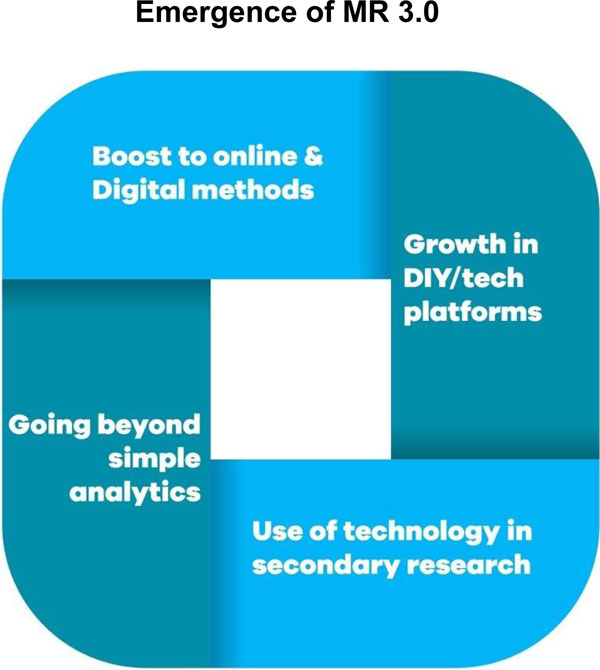
    COVID-19 forced businesses globally to accelerate their transition towards digital. Online data gathering methods, online qualitative and online panels have gained traction in India as well. Similarly, there is an increased use of technology and automated extraction tools in secondary research. Growth in DIY platforms is seen, and this will encourage small-budget companies to start using market research more often

    The researcher’s role is rapidly changing, with focus changing from data collection to data analysis. Moving beyond simple analytics, service providers are helping clients gain valuable insights using advanced analytics such as natural language processing (NLP), machine learning (ML), predictive analytics and decision intelligence frameworks.


    10. Looking forward to 2026, these trends will continue and intensify

    A. Moretechnology and business model disruption is foreseen

    Technologies such as AI and analytics are still in their infancy today. These will be the new economic currency for the market research and insights industry. Rapid digitalization will pervade more sectors and create more data trails.

    Productization and platform-based services will gain more traction.

    B. Blended Story Telling

    In the coming years, there will be specialists who would excel in Q & A based research and those who will excel in listening. The ultimate success paradigm would be one where best of both these are blended together to land powerful stories about why consumers are doing what they are doing, and how we can influence their choice decisions. That would lead to the creation of a new breed of researchers – Consumer Data Scientists: those who understand marketing, research and technology and have the ability to distil all three to deliver powerful insights


    10. Looking forward to 2026, these trends will continue and intensify

    C. The need for insights and data will become even more important in this radically changing world.

    The focus will shift focus from asking to observing, questioning to discussing, collection to analysis, insight to foresight, rational to emotional, large surveys to data streams, geographically fixed to mobile, siloed to converged, cognitive self-reporting to precognitive neurosensing, and project-based work to engagement-based consulting. Research and insights will find ways to integrate itself across the strategic decision- making process, will help clients pull insights from disparate data streams, will aggressively leverage foresight tools, will be nimble, and will make speed a core competence by fully leveraging the 24-hour global clock.
  • MRSI AGM elects officebearers

    By Our Staff


    Market Research Society of India (MRSI), the industry-led market research body, has announced the formation of the Managing Committee for the tenure of 2022-2024. Manish Makhijani, Global Insights Director of Hindustan Unilever Ltd. was elected as the new President and takes over from Sandeep Arora, Executive Vice President and Global Head – Research & Analytics Solutions, Datamatics Global Services.


    Additionally, Paru Minocha and Saurin Shah were elected as Vice-Presidents, Prashant Kolleri as the Secretary, and Nitin Kamat as the Treasurer for MRSI. The election of the new Managing Committee members was held at MRSI’s 34th Annual General Meeting on July 7 in Mumbai.


    On being elected as MRSI’s President for the next two years, Manish Makhijani, Global Insights Director, Hindustan Unilever Ltd. said: “I am incredibly privileged to carry forward the legacy of so many stalwarts in the industry. Our industry has come a long way and sits at the intersection of changing consumer behaviour, technology, and marketing solutions. It is now up to us to really bring out the contribution of insights into the growth of the business in this complex and evolving world.”


    MRSI’s Managing Committee Member for the term of 2022-2024

    Sr No Name Organisation
    1 Arora Sandeep Datamatics Global Services
    2 Bhattacharya Arindam Lucid Holdings India Pvt. Ltd.
    3 Banerjee Shuvadip ITC Ltd
    4 Chakraborty Parijat Ipsos Research Private Limited
    5 Chanana Dixit Toluna India Private Limited
    6 Gautam Mukul Purple Audacity
    7 Gray Derrick BARC
    8 Grover Sameer Crownit
    9 Kamat Nitin TAM Media Research Pvt Ltd.
    10 Kolleri Prashant NielsenIQ (India) Pvt Ltd
    11 Makhijani Manish Hindustan Unilever Ltd
    12 Malhotra Vivek TV Today Network Ltd
    13 Mishra Amitabh Dr.Reddy’s Laboratories
    14 Minocha Paru Kantar
    15 Namakkal Sathyamurthy DDB Mudra Group
    16 Nijhara Praveen Hansa Research Group
    17 Samuel Stephen Kantar Analytics Practice
    18 Shah Saurin Godrej Consumer Products Ltd.
    19 Upadhyay Girish Axis My India


  • Indian Research and Insights industry to double by 2026


    By Our Staff


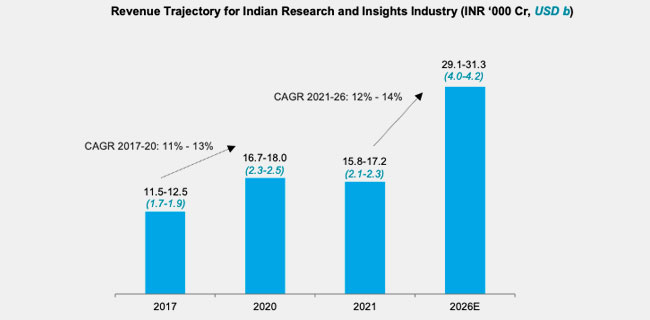
    The Market Research Society of India has launched the inaugural edition of its Indian Research & Insights (R&I) Industry Report. As per the report, the Indian R&I industry is expected to grow at a 12-14% CAGR to INR 31,300 crore by 2025-26, compared to INR 17,200 crore in 2020-21. Moreover, India is fast becoming the global analytics hub, with international markets accounting for 3/4th of its revenues. As per the report, the Indian R&I sector employs more than 125,000 people.


    During 2020-21, Marketing Analytics services accounted for 52% of the total Indian R&I industry revenues, while traditional Market Research and Syndicated/ Publishing services stood at 32% and 16%, respectively. By 2025 26, Analytics services will account for 59%, while Custom Market Research and Syndicated/ Publishing services will account for 27% and 14%, respectively, as per the report. The FMCG and Retail sectors are the largest consumer for Research and Insights with a share of 27%, followed by Information, Communications & Telecom (16%) and Banking, Financial Services & Insurance (15%).


    Commenting on the report, Sandeep Arora, President, MRSI, said, “The Indian Research & Insights industry has staged a robust recovery and is emerging as the most sought-after destination for analytics, globally. The availability of talent coupled with proven expertise in data handling, technology, infrastructure and cost competitiveness will lead to an orbital shift in the industry by 2030. We not only expect the R&I industry to grow 2X in the next five years but can safely estimate the industry size to reach $10 bn by 2030, especially with the strategic direction that most providers are adopting to move towards MR 3.0. We are excited and proud to launch the inaugural edition of the Indian Research & Insights industry report.”


    MRSI partnered with Value Notes as the research partner for the report. The report curates the findings from exhaustive desk research, secondary data of 198 companies, and more than 140 interviews conducted with the industry professionals. The 150+ paged report is available on a subscription basis on the MRSI website (www.mrsi.co.in).


    According to the study, the “global landscape for “research and insights” has evolved dramatically over the last decade. The explosion of data volumes, types of data and sources, and falling technology costs have driven client budgets towards tech-enabled solutions for both data collection and analysis. As a result, the scope of “research and insights” has substantially expanded and enabled many non-traditional methods as well as service providers.”


    Adds the report: “India emerged as a global player in IT services a little over two decades ago, and the global impact of Indian service providers continues to resonate. The Insights Industry in India has a diversity of research providers, along a continuum ranging from “traditional MR” players servicing domestic demand, to companies focused on the global opportunity. From the early days of outsourced MR operations and secondary research, the Indian Insight industry has moved up the value chain, and now supports sophisticated tech-enabled and analytics services. As a result, Indian providers earn around 3/4ths of their revenue from international markets. India is ranked fourth in position by industry size, according to the ESOMAR report on Global Market Research 2021. The country witnessed an increase in revenues with a growing share of tech-enabled research that comprises of a thriving analytics segment.”


    And what’s the future for the business?


    Today, notes the report, “growth is fuelled by the quality of talent (across skills and management levels) and technological sophistication. This is a giant leap forward from the early days when offshoring to India was primarily driven by labour rate arbitrage.”


    Consolidation is changing the contours of the industry, the executive summary of the report adds. “With the role of technology growing dramatically and declining share of wallet for traditional services, the definition of a “full-service” research agency is changing and lines between player types are blurring. Large full-service agencies are adding analytics capabilities inorganically and also selling DIY tools. Market research outsourcing companies are also adding analytics services, and some even getting into syndicated research. IT and BPO companies are muscling into market research as well as analytics. Report publishers are increasingly offering consulting or custom research services. Large cash-rich companies in traditional consumer MR and IT/BPOs are aggressively acquiring niche analytics firms and this consolidation is further likely to intensify to capture the share of customer wallet.”


    Enthusiasm for Indian start-ups coupled with the robust global demand outlook – mean that private and public funding is likely to scale new peaks in India, notes the report,” adding: “With the role of technology growing dramatically, clients are pushing their agencies to extend their services to include digital and analytics initiatives. While this means a larger pie for providers, the need to build capabilities and acquire talent is becoming critical. This is leading to increased demand for experienced data management and analytics professionals, as well as domain experts. As analytics becomes more core to decision-making, we expect further traction in acquisitions over the next few years. India boasts a large number of start-ups in analytics and these will prove attractive targets for a variety of players.”


  • BARC India’s Dr Derrick Gray appointed as the VP of MRSI

    By Our Staff


    Dr Derrick Gray
    Dr Derrick Gray

    Dr Derrick Gray, Chief of Measurement Science and Business Analytics at BARC India, has been appointed as the Vice-President of the Market Research Society of India (MRSI). Earlier this year, he was also appointed as the Chair of the Professional Standards Committee at the MRSI, where he will help guide the committee in ensuring strong ethical and professional standards for the Indian market research industry.


    Commenting on his appointment, Dr. Gray, said: “I am quite honoured to assume the role of Vice-President in the current Managing Committee at MRSI India. With my experience over the years in statistical research, measurement and data science, I am looking forward to working collaboratively with the team at MRSI. We hope to be able to make significant progress together as a team.”


    Added Nakul Chopra, Chief Executive Officer, BARC India: “We at BARC India are extremely proud of Derrick’s recent appointment and would like to congratulate him on his becoming the Vice-President of the Managing Committee at MRSI. We wish him all the success for this new role and look forward to him guiding market research in India to even greater heights.”


  • Esomar Apac 2020 to be held in New Delhi

    By A Correspondent


    Esomar in partnership with the Market Research Society of India is hosting the Asia Pacific annual conference from March 29 to 31, 2020 in New Delhi. The Esomar APAC 2020 partnership with MRSI is being billed as the largest gathering of research and analytics professionals in the Asia Pacific region with over 750 delegates attending three days of thought-provoking research papers and great keynote speakers from across the globe.

     

    Said Finn Rabin, Director General, Esomar on holding APAC 2020 in India: “India is now a vibrant research and analytics market – shown by Esomar’s GMR report to have grown by more than 40 per cent over the past five years – which underlines its importance as a source of world class talent to the industry. With technology, big data, AI emerging as new tools for generating insights, India is a leading hotspot for experimenting with and creating newer tools for our profession. In this fast evolving world of insights and its adoption of technology, India is simply the perfect destination for Esomar – in partnership with the MRSI – to host our APAC conference for 2020, with the theme of D.R.I.V.E. – Data; Research; Insights; Vision; Excellence.”


    Added Sandeep Arora, President of MRSI: “It’s going to be our moment of pride to showcase the exceptional brain power that India has to offer to the rest of world towards latest innovation in the space of consumer behavior and data science through this forum themed on D.R.I.V.E. And, an expected gathering of 750+ global delegates is only a testimony to that. The MRSI has long-standing relationships with ESOMAR for over 25 years, and through this conference, we intend to make these ties stronger!”


  • MRSI announces launch of Research and Insights Awards in India

    By A Correspondent


    The Market Research Society of India has launched what is being billed India’s first ever Research and Insights Awards – an award for excellence in insights and analytics for research and researchers from the Indian industry. The event will be held on December 19, 2019 in Mumbai.


    Said Sandeep Arora, President of MRSI: “The MRSI Golden Key Awards have been conceptualised to celebrate and acknowledge world-class contribution made by research and insights-led data scientists across India. To ensure that the credibility of these awards is unquestioned, senior cross-industry veterans would grace the renowned jury panel. Along with recognizing research and researchers that have impacted the industry, this one-of-a-kind occasion will witness a lot of fun and celebration too! We are really excited about it!”


    Added Manish Makhijani, Global CMI Director of Unilever: “We want to applaud and recognise great work that is being done in the industry which is fuelling the growth of different client organisations. And so, we have multiple different areas in which we want the work and people doing the work to be recognised – from new product development to communication to technology and even in social development research. We are eagerly waiting to see different nominations coming in and looking forward to celebrating research and researchers in the Indian industry,”.


  • MRSI appoints new President and Managing Committee

    By A Correspondent


    Sandeep Arora

    The Market Research Society of India held its 31st AGM in Mumbai at the MCA, Mumbai and conducted the elections for the Managing Committee for 2019-2021. The newly elected Managing Committee, at its first meeting also elected Sandeep Arora, Executive Vice President and Global Head – Research & Analytics Solutions, Datamatics Global Services, as the new President.


    MRSI thanked its outgoing President, Pravin Shekar, Chairman & CEO at KREA, Chennai for guiding the activities of the society for the last two years. The elected members of the new Managing Committee are: Ankita Dhanuka, Robas Research; Ashutosh Singh, Internet Research Bureau; Ashwani Kukreja, Tata Sky; Derrick Gray, BARC; K Vinay Kumar, Datawise Management; Manish Makhijani, Hindustan Unilever; NP Sathyamurthy, MRUC; Paru Minocha, Kantar IMRB; Praveen Nijhara, Hansa Research; Pravin Shekar, Krea; Priya Lobo, Ormax; Rashesh Rawal, Azure Knowledge; Sandeep Arora, Datamatics; Sanjay Pal, The Nielsen Company; Saurin Shah, Godrej CPL; Shaveta Bhardwaj, Kantar Millward Brown; Shelley Sengupta, Diageo; Sunder Muthuraman, Kantar Analytics; Tomson J Thundathil, The Malayala Manorama; and Vivek Gupta, Ipsos.


    Said Arora: “These are the most interesting times for Research and Insights industry. Never before was the need for consumer-behaviour led data scientists greater than today, to accurately provide holistic business foresights. There are a few legacy-led challenges which are slowing us from realizing full potential of this digital wave and I am confident that with due focus and patience, we will overcome those very soon!”


    Welcoming the new managing committee and office bearers, Shekar, said: “It’s great to see active participation from members, to volunteer and contribute in the Managing Committee and take our association forward. The new President, Sandeep Arora, clearly laid out the plans for the next couple of years, building on existing activities as well adding on newer initiatives including greater government coordination. I wish him and our team all the very best.”


  • MRSI announces new prez & mancom

    By A Correspondent


    The Market Research Society of India (MRSI) has elected an all-new president and appointed a new managing committee at its annual general meeting held late last month.


    The newly elected Managing Committee then at its first meeting elected Pravin Shekar, Chairman & CEO at KREA, Chennai, as the new President and also elected the new officebearers: Priya Lobo (Ormax World) and Sandeep Arora (Datamatics) as Vice Presidents, Roosevelt Dsouza (Nielsen) as the Secretary and Saurin Shah (Godrej Consumer Products Ltd) as the Treasurer.


    The other members of the Managing Committee are Ashwani Kukreja (Tata Sky), K Vinay Kumar (Datawise), Manish Makhijani (Hindustan Unilever Ltd), Preeti Reddy (Kantar IMRB), Raj Sharma (MRSS India), Sanjoy Datta (ITC), Sathyamurthi Namakkal (MRUC), Shabbir Habib (CalibeHR), Sinivasan Raman (Hansa Research), Sunder Muthuraman (Gain Theory), Sushma Chaudhuri (GfK India), Tomson J Thundathil (Malayala Manorama), Vidya Sen (Ipsos India), Vishikh Talwar (Kantar Millward Brown).


    Welcoming the new mancomand the officebearers, Sandeep Saxena, Director General MRSI, said:“We are grateful to all the Managing Committee members who have volunteered their time to guide the workings of the society and shape the agenda for the industry. I am looking forward to working with all to create even better value for our stakeholders.”


    Saxena also announced that the second edition of MRSI Connect will be held on July 27 in Bengaluru. Commenting on the event, Shekar said:“It’s a one-of-a kind event with a win-win situation for both, the buyers and sellers. We hope to see many more analytics, data and insights specialists to be a part of MRSI Connect 2017.”


  • MRSI appoints Raj Sharma as its media rep

    By A Correspondent


    The Market Research Society of India (MRSI) held its 28th Annual General Meeting (AGM) at MCA, Mumbai on June 17. The key plans that were announced in the meeting were:

    :: The development of a new socio-economic classification framework was announced

    :: A meeting of buyers and sellers for MRSI members to be held in July to facilitate data and analytics related technology providers to pitch their products and services to them

    :: Raj Sharma was appointed as the media spokesperson of the society


    Speaking at the press conference, Sanjoy Datta, President, MRSI, said “Last few years has seen a rapid change in the way people buy products and services and how they get information about brands. In this context, it is important to ensure that there is an up to date classification system which will allow brand owners to target their consumers more accurately.”


    MRSI is a 28-year-old body which has been helping big organisations in their market research but the awareness about the work they do is very dismal. “People still have no idea about market research” was a concern that was voiced in the press meet. So, that was a major reason for appointing a media representative. They hope that this step would help people in knowing about market research and the work that MRSI does.


    “Media today plays a very important role in shaping opinions in the society and hence to ensure that market research as a profession is viewed in the correct light, it is important to have a clear communication channel with the media. Raj Sharma has considerable experience bothas researcher and in interacting with the media and is therefore an ideal person for this role,” Datta added about the new appointment.