By A Correspondent
The second day of the 44th edition of the IAA World Congress organised by the International Advertising Association (IAA) saw several star speakers addressing a packed audience of professionals, practitioners, academics and students. The joint themes of ‘Brand Dharma’ and ‘Tech for Good’ were what everyone spoke on or discussed.
It was also time for felicitations and awards. Yusuf Ali, Chairman and Owner, Lulu Group, was felicitated by Srinivasan Swamy, Chairman & World President, International Advertising Association. In his speech, keeping with the theme of the conference, Ali reiterated to all the marketing and communications stakeholders to act responsibly towards the society and stay true to their business values.
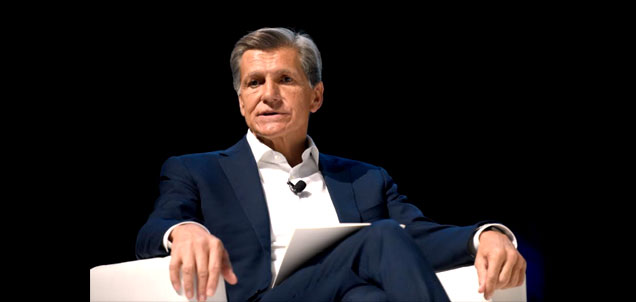
The IAA Golden Compass Awards were conferred to Marc Pritchard, Chief Brand Officer, Procter & Gamble and Andrew Robertson, President & CEO, BBDO Worldwide. The IAA Inspire Champion Awards was conferred to Raj Nayak, senior media professional and former Chief Operating Officer at Viacom18. The IAA Inspire Honorary Life Member Award was conferred to Ranil De Silva from Sri Lanka.
In the first session of the day, Paul Polman, President of the ICC, Chairman of the B-Team and Vice-Chair of the UN Global Compact. CEO Unilever made a passionate plea to companies to run their businesses by heart, because he felt that businesses can’t succeed in a society that fails.
Polman stated that value and trust are two important elements for a company. However, currently, trust is low in the industry because of fake news, frauds, unethical employment practices, sexual harassment etc, he said.
As advertisers, we should look and hear from a consumer’s viewpoint since consumers judge us by what we do, not by what we say, Polman said, adding: “You cannot run business with freedom without responsibility. If we don’t protect it, we won’t have a future. Partnership is important to work on sustainable growth. A partnership, which is for a common good. Putting other’s interests before ours is very important because although we have the resources to help the society, all we are missing is human will power. Tech has connected us better with people, but has also given us loneliness.†He ended his speech by urging the audience: “If you belong to 2% of population, think about 98% population and live responsibly.â€
Next up was Simon Kahn of Google APAC on the Future of Digital Immersion. According to Kahn, the next wave of technology will assist us, augment our experience and will help us accelerate things we need to get done.
The digital tech has started to help us in all practical areas, most progress which we have seen is in the area of speech recognition. We are now up to near human quality in speech recognition. In India recently, we worked with Flipkart when wanted to add the experience of haggling for the big billion day sales and it the result was many millions interaction with the tool with average time of engagement for min 6 minutes. Communication is also about gesture and nonverbal cues, hence we are training computers to replicate the same hence breaking down physical world barriers
This was followed by a panel discussion. Tom Doctoroff, Business Leader and Global Brand Builder on Derisk the future in conversation with Michael McQueen, Trend forecaster and Author and Tim Reid, Comedy Writer and Innovation Expert. Said Reid: “Best ideas come as jokes make your thinking as funny as possible. What makes is laugh are two things, first is the truth (as it is relatable) and the second is surprise, we experience, when something doesn’t quite fit in in the normal trend. Truth with the twist is the biggest thing that make us laugh. In an idea session, if we can get people to say something which has point of truth with an element of surprise and you will probably see a genius idea there somewhere and hence there is a science behind it creativity works better with humour.
Mcqueen, who has done a lot of work with millennials on what are they thinking and what are they looking at, shared his insights on decoding the millennial mindset and how one can bridge gaps. There are 34% millennial population in India, which is very important numerically and economically as they will enter spending peak by 2026. McQueen advised the marketers to market their products through them and not to them.
There was much anticipation for the session of Marc Pritchard, Chief Brand Officer, Procter & Gamble. After screening the latest ad campaign from his company in India, Pritchard started the conversation with the proposition of ‘What if brand could be force for good and a force growth’. He emphasised on living the brand’s purpose and not just talk about it. He stressed on the need of brands to align themselves with a purpose. He covered three major problems faced in the business diaspora; Gender Equality, Sustainability and Technology.
People expect more from brands, he said. They want the brand to take a stand on the social issues. 9 out of 10 consumers want brands to live with their values, they want brands to take stand. In sustainability there is a difference between what people say and do. 67% of the population talks about sustainability but only 30% of them actually act on it. Sustainable goals are equally good for the growth of the brands, he sai. He spoke about how P&G is doing its bit by using technology is work on a product that can eliminate need of water in cleaning,
“I urge to reduce renew and recycle water, energy and waste. It will be nice if all brands can come together.â€
Later, Chris Tung , CMO, Alibaba, spoke about the Alibaba model and how it has built for itself an ecosystem for brand-builiding. Mark D’Arcy, VP of Global Business Marketing and Chief Creative Officer, Facebook was in conversation with Hungama founder and digital pioneer Neeraj Roy. India is the second-largest market for Facebook. D’Arcy asked mainstream brands to be always being interesting and relevant in reference to content marketing. The journey from attention to action is interesting, he said. All touchpoints in the journey should be engaging and seemless. FB is deeply committed to innovation too. We have curiosity of constantly learning as an organisation is important. It helps in growing the business and help improve the culture.
The following session had Rahul Welde, EVP Digital Transformation, Unilever and Lindsay Pattison, Chief Client Officer, WPP in a chat with Ralph Simon.
The biggest change in marketing and technology sector is speed, Welde said. The results are quick which enables faster changes meeting the needs. Apart from technology, the most important assets in marketing are skills and talent. To make a greater impact, one needs to have a skilful leadership and talent pool in the organisation.
Said Pattison:Â Disruption is affecting everybody and every brand. India has a 14% ad spent growth which is highest in the world, making it the most potential market for the advertisers.
After some serious business truths, the audience witnessed an extremely engaging session by Jacques Seguela, Co-Founder of RSCG & Vice President of Havas Media where Seguela underscored the need for storytelling and emotions to not get disconnected in our pursuit of technology.Seguela, who was celebrating his 85th birthday on Thursday, receive a standing ovation. His session was followed by that of Ed Pank of Warc who spoke on ‘Tech for Good, Innovating for Social Impact’.
The final session of the day was by Ogilvy Chief Creative Officer and celebrate adperson Piyush Pandey offered a perspective on ‘Brand Dharma’ that made people sit up and take notice. “A lot of people spoke about sustainability, climate change and everything. I would like to draw your attention to sustainability of human emotions that are under threat in the digital world… Sustainability in environment is to make life longer but sustainability in relationships is to love and enjoy life.â€
The evening entertainment for the day was interestingly titled ‘Fashion & Flavours of India’. After a day packed with high energy session, the winding down was well-deserved.