By Our Staff
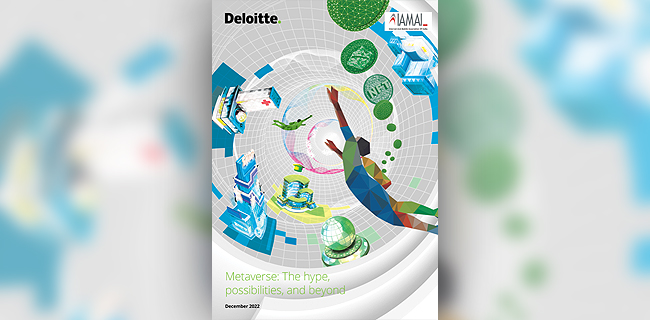
The Internet and Mobile Association of India (IAMAI) in association with Deloitte launched a report titled ‘Metaverse – The Hype, Possibilities, and Beyond’ at Digital Marketing Conference, ‘Marcon 2022’ in Mumbai on Monday (Dec 12).
The report was launched by Sreeram Ananthasayanam, Partner, Deloitte. The event also saw a panel discussion after the launch.
Here is the Executive Summary of the report:
Technology is getting affordable, scalable, and trustable, and transforming business models and consumer expectations. Robust and scalable digital infrastructure and applications are enabling personalisation for a generation that prefers differentiated experiences. In addition, alternative technologies (Decentralized Autonomous Organizations [DAO], Decentralized finance [DeFi], Nonfungible token [NFTs]) are disrupting digital ecosystems by disintermediating intermediaries and decentralising ownership. Technology is building decentralised trust to make processes and transactions efficient, transparent, and seamless.
One such technology is Metaverse, which refers to an immersive, interactive, and live virtual environment, distinguished by its ability to transport the real-world experience into a virtual world. In this world, people across locations can interact live and work in real time. This is supported by a digital economic infrastructure powered by virtual digital assets. Metaverse is a confluence of technologies that aims to integrate businesses in innovative ways, enhances operational efficiencies and transactions, and provides an experience par excellence. It creates new market avenues, which are futuristic, yet revolutionary. The exponential nature of technology growth is only going to make it more feasible and affordable. Several enterprises and customers are foraying into this space that is redefining business models and customer expectations.
In this report, we aim to understand how businesses engage and interact with each other in a Business-to-Business (B2B) and Businessto-Consumer (B2C) ecosystem. We believe that adopting Metaverse is possible through the merging together of the physical and digital worlds (phygital). It will help businesses reduce costs, collaborate in real time, overcome logistics issues, provide enhanced opportunities and productivity, improve feedback processes, and offer possibilities for product and service augmentations. All these will not only generate revenue but may tilt the competitive advantages in favour of those ahead in the adoption curve. It will enable businesses to take a step towards introducing environment friendly policies and sustainability.
Metaverse is a ‘virtual world’ with real people in digital avatars, who come together to interact and transact. Hence, the boundaries for work and play are blurred. Such a concept is hard to understand, monitor, and regulate because of the undefined rules and unimaginable complexities that may exist. In the following chapters, we begin with our understanding of Metaverse as the world is still exploring its confluence in the Phygital space. We also debate on the possibilities of different types of Metaverse architectures and their potential across enterprises. Subsequently, we discuss the challenges that will likely arise while implementing the Metaverse ecosystem and the possible measures to sustain business in a dynamic marketplace.
There is also a section that provides an overview of the applications of Metaverse and its potential across sectors. We will discuss the art of possibilities for enterprise Metaverse and how it will help enterprises scale and diversify their businesses and opportunities by using the myriad elements of the Metaverse economy. While most of the current use cases on Metaverse primarily relate to the B2C segment, this report also explains the potential enterprise-grade use cases that address the B2B segment.
Conclusion of the report:
The Metaverse technology is likely to see exponential growth in the coming years with rising awareness about its applications and rapid advancements in the digital infrastructure and digital natives gaining purchasing power.
On one hand, as the supply side of the Metaverse ecosystem develops, more organisations are likely to reorient their business to take advantage of this evolving technology. Several organisations have already announced their Metaverse offerings, which may help achieve the required scale and demand to improve cost-effectiveness and adoption rate. On the other hand, the demand side of this ecosystem. has been driven by demography, along with phygital worlds, virtual work/play facilitated due to the pandemic, and Moore’s law playing its role in making the infrastructure affordable.
The success of Metaverse penetration will depend on the time organisations take to understand its relevance to their business and the pace of this ecosystem’s development. The ability to ramp up the technical skills and readiness, and deal with rising cyber threats will be critical to its adoption. Governments can play an important role through the right regulatory policies and incentives for new-gen tech adoption.