Tag: Manmohan Singh

  • Vinod Dua – the Urbane Hindi Voice


    By Parsa Venkateshwar Rao Jr


    I must clarify before I go further that I watched Vinod Dua closely through all the election programmes that he presented with NDTV’s Prannoy Roy through the 1990s. (It was only in the last few that I came to know him slightly. I must also acknowledge that he was warm with new friends as well and never made you feel that you are a new friend.)  But it would be unfair to the man if we do not understand his place in the changing media scenario of the country after 1991. The tributes that I have read were that of his close friends, including journalists, but who bonded with him at a personal level. That he has so many friends showed the humane side of him. It is this humane side that was the undertow of his speech


    This was even before S P Singh launched the daily news capsule at 9.30 pm, where he signed off with his “intezaar kijiye kal tak”. Dua was a curiosity because the bilingual presentation was an effort by metro Indians to reach out to the Hindi heartland audience. Roy, or Dr Roy as he is known to many of his colleagues, seemed to have realised that without Hindi, the audience would be restricted to the drawing-rooms of the well-heeled. What made me curious as well as amused with Dua was his urbane manner of speaking Hindi, as smooth as the English spoken by Roy and others in the programme. One of way of sounding smooth and polished while speaking Hindi was to throw in a few Urdu words. But Dua did not follow that easy option. He spoke lovely Hindi, and pronounced the Sanskritised Hindi words with ease, without letting the accent fall too heavy on any syllable.


    I have always told myself that this Hindi was spoken with a clipped Oxford accent. It sounded good though there were times when the sophisticated ring of the voice became a little tedious even as Roy’s strangely accented English – outdoing the native English speakers – became an irritant.


    But looking back a quarter century and more later, it becomes easier to understand the social context. Dua’s was the first Hindi voice of liberalised India. Before him there were the admirable Hindi newsreaders on All India Radio and Doordarshan, who spoke Hindi with the perfect pitch and they made the unmusical official Hindi sound mellifluous. Economic reforms ushered in by the dull P V Narasimha Rao- Manmohan Singh duo excited urban, metro Indians. Roy and Dua reflected that excitement with their nuanced accents.


    It might seem uncouth to talk about accents while writing about Dua. But the voice and presence was what made a radio and television journalist. And Dua was that. Neither Roy nor Dua moved from print to the electronic media. Their native soil was the electronic media. When people liked Dua, and there were hundreds of thousands, they liked his sophisticated manner. In understanding Dua’s journalistic career, this becomes the keynote.


    One of the questions that came up as I was chatting with MxMIndia editor was: how is it that one of prime movers of television in liberalised India just fell off the map as it were. And it seems to be that he was left behind as what were his strong points – the urbanity in speech and manner – became a handicap as Hindi channels and anchors and reporters increased. The Hindi channels brought with them their earthy flavour of speech quite different from that of Dua. The Bihari accent, the UP accent, and even the Punjabi one, made a niche for themselves. The British Broadcasting Corporation (BBC) once stuck to its stiff upper lip Received Pronunciation (RP) but realised the need to democratise itself and accommodate regional accents of its journalists. Dua represented in a sense the Hindi Received Pronunciation, but soon the democratisation happened. S P Singh brought in earthiness and a certain authority because of his grasp of politics, and he did not fight shy of his Bihari accent. Dua knew his politics, but it seemed as though it was that of a slightly distant observer. The traditional hallmark of a journalist is his or her immersion in politics, and that non-English language journalists display to the hilt. Dua, the Hindi journalist, did not fit the bill. This is not a value judgment about Dua or Hindi journalists.


    Dua did a food show in Hindi, which is a lifestyle feature, and which political journalists are shy of doing because they would say that all they know is politics. For Dua, there were things other than politics in life. With his flair for singing, he could appreciate music along with food. And he loved his drink in the manner of connoisseur. He was an epicure in the general sense of term. He loved the good things of life and he enjoyed them. Dua was drawn into a controversy as the me-too movement caught on in 2018, but it came to nothing.


    It is important to remember Dua because for a flickering moment he projected a facet of Hindi language and journalism that was at once genteel and knowledgeable. And it is from this vantage point that he became a critic of the Hindutva politics of Bharatiya Janata Party (BJP) and of the manner of Prime Minister Narendra Modi’s government. The Hindutva side resorted to his crude arm-twisting methods by filing a case against him in Himachal Pradesh for being an ‘anti-national’, the charge that they bring against anyone and everyone who they disagree with and who they dislike. Dua challenged the false allegation and the Supreme Court ruled in his favour. This is a victory for Hindi journalists as well as journalists in general.


    It can be said that he fought the good fight against political tyrants as well as for his life. He won against the political tyrants and lost against the tyranny of the pandemic.


    Parsa Venkateshwar Rao Jr is a senior journalist and commentator based in New Delhi. His views here are personal

     

  • Ranjona Banerji: Economy on the front seat

    By Ranjona Banerji


    After months of political turmoil taking centre stage, the economy is back to dominating headlines. Ever since government went ahead with raising diesel prices and allowing foreign investment in multi-brand retail, we’re back to reading about various economic proposals, which are either going to change our lives or at any rate postpone complete devastation.


    This means that the usual political high rollers will have to be off the headlines for a bit unless they can stage some new theatrics. Mamata Banerjee may be the first to feel the pinch. In a story which talked about Banerjee wanting to make sure she is not consigned to oblivion, the Times of India chose not to use the TMC’s beloved leader’s photograph and went instead with US ambassador to India, Nancy Powell. Irony? Self-fulfilling prophecy? One can predict though that Banerjee is likely to see more of that happening.


    **


    The Economic Times, in somewhat unfortunate phrasing, headlines the next possible tranche of economic reforms, “PMO’s bucket list”. We understand that the prime minister is going to turn 80 this week but to link reforms to his dying wishes seems as yet a bit premature. Or does the newspaper refer to the prime minister’s office alone, an entity much hated by the residents of twitter?


    **


    The Times of India’s Mumbai edition has for a while now taken on Maharashtra’s deputy chief minister Ajit Pawar of the NCP, for his role in the irrigation scam that has been uncovered in the state. Pawar (nephew) when he was irrigation minister had apparently involved himself in practically every single deal and where subsequently, costs escalated. Another NCP minister Sunil Tatkare is already under the scanner for his tenure as irrigation minister.


    **


    The Indian Express has once more outlined for us the frivolous reasons used by police investigators to detain people under tough laws like the Unlawful Activities (Prevention) Act. These include children’s magazines and books of poetry – especially if they are written in Urdu. The Maharashtra police have the dubious distinction of considering ownership of Joseph Stalin’s biography a dangerous crime. This is in a country where Adolf Hitler’s Mein Kampf never gets off best-seller lists.


    Perhaps we need a more sustained campaign for better education of the police as well as greater use of forensic science in investigations.


    **


    On television, Rajdeep Sardesai on CNNIBN discussed with Arun Shourie why the diesel price hike was necessary and why FDI in multi-brand retail was not the end of the world. Karan Thapar on the Last Word also on CNNIBN discussed freedom of speech in the context of the contentious film on Islam and the needlessly violent protests against it. Arnab Goswami on Times Now took on the killings of sarpanches in Jammu and Kashmir, presumably by miltants. Goswami is very fond of the idea of Kashmir and works very hard to solve its problems – more than any other journalist in the country. One suspects however his rather black and white approach may not help in what is a very complicated situation.


    **


    If you want to look for TV news viewing from the main news channels that is minus the hysteria of prime time, the afternoons often pay dividends. Shiv Aroor of Headlines Today and Bhupendra Chaubey of CNNIBN both conduct well-behaved discussions – as was evident on the day Mamata Banerjee pulled the plug on her national role in Indian politics.


    **


    I apologise for the delay in posting this link from pointer.org. It discusses why “patchwriting” which is what both Fareed Zakaria and Samar Harlarnkar can be accused of, id as dishonest as plagiarism. Adds more depth to the argument but not more malice. http://www.poynter.org/latest-news/everyday-ethics/188789/patchwriting-is-more-common-than-plagiarism-just-as-dishonest/


  • Anil Thakraney: The MMS show

    By Anil Thakraney


    Usually, I review entertainment TV shows. This time, I shall dissect the PM’s address to the nation. It was quite a landmark event because the nation was so far convinced that MMS had lost his voice.


    One thing the PM did deliver on in his speech was his promise to get the ‘animal spirit’ back into the economy. Facing the camera, he wore the expression of a sheep caught directly in the path of a ravenous tiger. MMS must take tuitions in reading from the teleprompter. There are enough young TV anchors who can help him.


    One was expecting the maha neta to use the occasion to apologise to the nation for the various billion dollar scams that have happened right under his watch. Scams that have bled this nation of the tax payers’ money. But, not a single word on that. Instead, he focused on the importance of bringing Wal-Mart into India. This may have sent the stock market into a minor tizzy, but will have eroded his party’s chances of winning the next elections. Which anyway appear quite feeble.


    And, quite amazingly, the PM put out street talk on the price of diesel. That, why must the government subsidise fuel guzzling SUVs. Sirji, bachcha bachcha of this nation is asking the same question. We expect YOU to find the answers, and create a system whereby the SUV sahibs pay more for diesel, while the truckers continue to be subsidised. Thank you for whining, but that doesn’t help matters.


    Many Tweeters feel he’s the right PM. They say it’s better to have an economics expert in charge, someone who talks logic, rather than a rabble rouser who only appeals to the emotion. I agree, that’s very true. But then the nation’s economy has taken a crashing nose dive under the leadership of this so-called expert. So what’s the use of all that knowledge? The PM is better off taking up a job as a professor of economics. He’ll do swimmingly there, provided he can manage to keep the students awake.


    Yes, economic reform is important for the nation’s future. But we need a PM who can make it happen. Not someone who (allegedly) has all the answers, but is paralyzed by political games.


    Finally, Dr Singh must talk to the nation more often. All his faults aside, he does look like an angel, compared to all the screamers and howlers we are saddled with every day on prime time television.


    ***


    PS: Haha. Wonderful CV. Try creating a bio-data like this one. You might end up in a more interesting place. All the best!


    Link: http://curriculumvitiate.wordpress.com/the-cv/


  • Anil Thakraney: PM’s last desperate act

    By Anil Thakraney


    There is just one reason behind the PM’s sudden burst of energy (following his comatose posture since the year 2009) and the announcement of a slew of economic reforms. Uski lagi hui hai, as my tapori pal from Colaba says. MMS has been battling one mega scam after another, and at this rate, not only are his own days numbered, so are his government’s. Singh has also been getting repeatedly trashed in the media, both local and international. He knows he’s going down the tube, and the reforms are a last ditch measure to gain a few quick brownie points. The reforms package announcement has also moved the media’s attention away from the assorted scams, and this must have been a part of the master plan.


    No matter. Whatever be the reason, the reforms are more than welcome, at least some of the foreign investor confidence shall get restored. Even if the Congress’s allies and its rivals put in roadblocks along the way. I was in London recently, and over a drink, my corporate friends out there said to me the India Inc story is pretty much over, that the focus is back on China. And this is the general sentiment across the world. Clearly, something had to be done and done fast, and one hopes that MMS, now that he knows he’s crashing out, will set into motion many more reforms. Not just in aviation and retail, FDI needs to be invited into many sectors, particularly those related to core infrastructural projects, education and health.


    That the UPA isn’t coming back in 2014 is a given. It is also true that things won’t be any rosier under BJP’s leadership. (Unless Narendrabhai becomes PM, which is highly unlikely, what with his aides being sent to prison enmass on charges of rioting). Therefore, am happy that MMS has woken up at last, and is thinking about India for a change.


    It doesn’t sound very nice that the fading Manmohan Singh will be best remembered for facilitating the arrival of Wal-Mart and IKEA into India. But I can live with that.


    ***


    PS: Although I am not really a fan of swear words – I believe it’s the cheapest way to get attention – it is true that they are being flung around quite freely these days. And the ad world guys and gals are most notorious for this habit. Here’s an interesting article on how to use swear words effectively, and without causing offence. And how it can actually help in bonding with people.


    Link: http://www.tatler.com/news/articles/september-2012/mind-your-language


  • Ranjona Banerji: Foreign media is only credible observer of Indian politics

    By Ranjona Banerji


    There is now only one credible observer of Indian politics – the foreign media in India. We cannot fully assess if a politician is good or bad until a foreign journalist pops by, talks to a few taxi drivers and Indian journalists and then writes a complimentary (good) or scathing (bad) comment piece.


    Now, you’re thinking, aha, sour grapes but far from it. It is all a question of perspective. Indian journalists, especially in Delhi, are too close to the centres of power. They are so familiar with what’s going on and party to so many secrets that they now spend more time discussing whether the blue in Manmohan Singh’s turban has changed in the last eight years. (Some say yes, some say no and the rest are fence-sitters.)


    The foreign media however comes in from far away and has no clue about all this inner stuff. They attend a few parties (these are vital sources of information and political analysis, as those who read through the diplomatic cables made public by Wikileaks will know), meet a few Indian print journalists (bluer, paler, maybe both), they may meet a few TV journalists but that’s for entertainment since they have no political perspective, although I hear they throw really good dinner parties. And, obviously, the few taxi drivers. This is imperative as every traveller knows – one taxi driver can be equal to at least five other potential interviewees.


    Yesterday, I met a cabbie in Mumbai who told me that Indian politics turns on Uttar Pradesh. Now I know. If these foreign political commentators are really smart however, they will never even leave whichever country they come from (usually the USA or the UK). How else have I become a world renowned expert on Barack Obama and David Cameron? (Actually, by watching Comedy Central and Graham Norton.)


    Therefore we now know that Prime Minister Manmohan Singh is a poodle, useless, confused and steeped in doom and gloom. Everyone has said it from Time to the Economist to The New York Times to the Independent.


    The poodle reference can be translated in Indian terms to a puppet. Yes I know, Indian commentators have been saying that for years. But what do they know, eh? (On the other hand, their view has now been authenticated!) Meanwhile I must be off to watch a few more skits on Comedy Central so I can hone my analytical skills.


  • Ranjona Banerji: Don’t bother, Indian analysts… let Time do it

    By Ranjona Banerji


    The Indian media has taken a round beating here. Day after day, print and TV criticise the government and politicians. Columns, analysis, debates and discussions focus on the weakness, incompetence, “policy paralysis” of the current government. Does anyone care or pay attention? Of course not – unless the criticism comes in cartoon form about a person or issue long dead.


    But an article in the Asia edition of an American newsmagazine criticises the prime minister and the whole political community goes into a frenzy? Let us not be unfair to Time magazine, but the fact is that no one considers it to be a respected analyst of Indian politics. Nor indeed is the magazine the powerhouse it once was. Now if the Economist were to get so seriously critical, since it is known for its carefully considered views, then you might want to sit up and take notice.


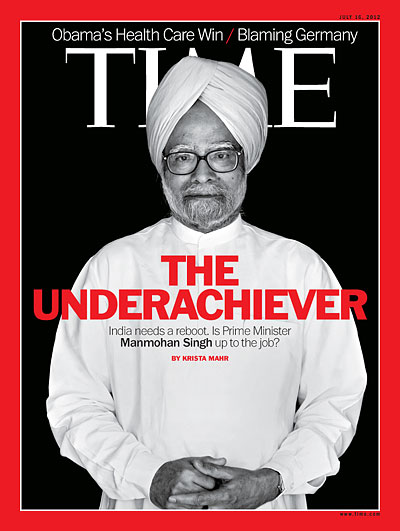
    Time’s “crime” is to call Manmohan Singh an “underachiever” and ask whether it is time for him to move over and let someone else become prime minister. This made the Congress jump to his rescue and the BJP to behave as if they’d won Uttar Pradesh.


    The Congress then looked back at an old Time article which had said Atal Behari Vajpayee was “asleep at the wheel” as prime minister. This was supposed to shut up the BJP as the same newsmagazine had also criticised them. Sigh.


    The BJP however could point out that Time’s tally is still higher since last year the magazine appeared to favour Gujarat chief minister Narendra Modi. Then the Congress can point out that Modi did not make it to Time’s poll of the greatest people in the world or whatever because of negative voting.


    And so we can go on and on about the various articles and activities of a barely read newsmagazine and the political classes can carry on doing even less than they do normally.


    As for all you analysts in the Indian media, why do you bother? Clearly, no one pays attention to all your criticisms and opinions. Congratulations are due to Time for having successfully upstaged the entire Indian media. Henry Booth Luce would be happy.


  • Anil Thakraney: Oye, ‘Time’ mein job milega?

    By Anil Thakraney


    TIME mag has termed our Prime Minister an ‘Underachiever’. I completely disagree with this description, it is much too kind. The truth is, and every sane Indian would agree, MMS has been a total flop show since he became PM once again in 2009. His government failed the country on every single parameter, and in particular, his team has damaged India’s growth story. Anyway, enough has been said on Manmohan Singh’s stellar performance, so I won’t delve on that.


    What got me interested is the impact of TIME’s cover story in India. Both, the politicians and the media got their knickers in a twist discussing this article threadbare. Almost as if the final report card had arrived from the Big Boss. As if what the goras, located thousands of miles away from the action, think of our PM is the gospel truth.


    All sorts of insinuations are being flung around. Some people suggest it’s a marketing gimmick from TIME mag to boost its circulation in India. One Left leader claimed it’s a conspiracy hatched by America to put MMS under pressure so that they can launch new businesses in India! And of course, the netas are busy hurling dirt at each other. As the BJP leaders gloat over the article, the Congresswallahs are firing back with: ‘Hello, but they were harsher on Atal Bihari Vajpayee!’


    However, what hurt me the most in this tamasha is that various Indian columnists and speakers have been dissing Manmohan Singh’s policies for a long time, but no one takes them seriously. It’s as if what India thinks about India does not matter. Quite obviously, after over six decades of independence, our colonial hangover hasn’t gone. No wonder then that some top industrialists from India happily meet the foreign press, while desi journos don’t even get a response to interview requests.


    My conclusion: To be taken seriously in India, I need to work for a foreign publication. That’s the irony of our existence. Therefore I am busy preparing my CV afresh, and will soon be knocking on the doors of gora editors. Jai Hind!


    * * *


    [youtube width=”400″ height=”225″]http://www.youtube.com/watch?v=aMfSGt6rHos[/youtube]

    PS: Glad this utterly charming ad from Chipotle won the Grand Prix at Cannes. My most favourite commercial of last year. Superb idea backed by terrific animation. It’s all soul, and it makes you think where we are headed. The film is particularly relevant in India, where we have lost our way in the mad ambition to be an industrialized nation. And yes, Coldplay’s haunting track, ‘The Scientist’, works wonderfully out here.


  • The Anchor: Asif Syed on 5 Things that are getting hotter in New Delhi

    By Asif Syed


    1. Manmohan Singh – Will the sardar become asardar?

    For a while now, many observers of the Delhi durbar have felt that the real Prime Minister wasn’t Manmohan Singh, (no, not Sonia Gandhi, she’s the super PM) but Pranab Mukherjee. Whether it was with government work, party work, troubleshooting for the UPA sarkar or heading 13 Groups of Ministers that deliberate on government policy, Pranab was the man. The joke is that the PM (Manmohan) spoke so little is because the real PM (Pranab) didn’t let him.


    Now with Pranab on his way to becoming President of our republic, many ministers in the Union Cabinet have found some additional breathing space, but none so much as Manmohan Singh. So much so that the very day he took over the Finance Ministry, the sardar ordered the government to go looking its lost “animal spirits!”


    So will the sardar become asardar or will the real number 2 – P Chidambaram, who was second only to Pranab in the GoM count with 12 in his kitty – muscle in and fill in the vacuum.


    2. The Summer of 2012

    The venerable Times of India has reported that Delhi has had the hottest summer in the past 33 years with the average temperature frizzing the mercury to an average of 41.25 degrees. Interestingly, and what is probably a sign of the times, the data for this investigative story was sourced not from the Metrological Department of India but from the website of the National Climatic Data Centre (NCDC) in the United States.


    Unlike Bombay and (ahem) some other parts of the developed world that have uninterrupted power supply, Delhi seems to have introduced the new concept of uninterrupted power cuts. Add to this the severe water shortage – basically no water at all from the MCD – and one gets situation where residents who are out on the streets to protest the lack of bijli get into a scuffle with each other over tankers delivering water.


    Of course, Lutyens Delhi, home to national level politicians, bureaucrats and businessmen has no bijli or paani problems. The air conditioners in the MPs homes are humming and sprinklers keep their lawns achingly green.


    There is fervent hope that the monsoon rains will bring some respite but they too seem to be avoiding Delhi and are stalled somewhere over central India. Maybe the ToI can talk to the NCDC about what to do…


    3. The most modern thing in Delhi

    Not all is bad in Delhi and the Delhi Metro Rail Corporation is the best thing going on the ground, below the ground and above the ground. It has changed the face of Delhi for the better like nothing else and with every phase of expansion it is bringing the spread out city of Delhi and the other parts of the National Capital Region closer to each other. It is the one thing that works in the city of a thousand hindrances and works very well.


    With two phases completed and almost 200 km of track laid and services running, the DMRC has commenced Phase III which it aims to complete by 2015 and Phase IV by 2021. By then the Metro will have more than 400 km of track and will reach every corner of the megapolis. It is already one of the most advanced metros in the world and soon will also be one of the largest. (check out this map – http://en.wikipedia.org/wiki/File:Masterplan_of_Delhi_Metro.png)


    Like Vicky the eponymous sperm philanthropist of the move Vicky Donor says to his nani, “Dill mein sirf do cheezein modern hain, ek hai metro aur ek tu.” I can’t vouch for the old lady, but he is bang on with the metro.


    4. News Capital

    For a city where the large majority of the people have at best only a passing acquaintance with the English language (or as they say in Delhi – bus sirf hi/hello hai), it is home to more English language newspapers, magazines and television news channels than any city in India.


    At last count there are more than 15 mainstream general and business daily newspapers being published from the city in English. The Millennium Post was the latest of the blocks and a couple more are reportedly in the pipeline. At this rate we run the risk of soon having more English newspapers than readers who read English.


    Throw in Hindi and other language publications and Delhi is probably host to the largest print news industry, with more print journalists than any city in the world. And in no other city can one find such a large number of journalists that speak, report and write in such a range of Indian languages.


    Sucking in all the content produced everyday and spitting it out in a physical form is a robust contract printing industry that is centred largely in neighbouring Noida. The printing industry there probably has the distinction of having not just the largest number of printing presses of all shapes and sizes of any city but of also printing newspapers not just in English in Hindi but also a number of other languages. For example, Vibha Printers (in NOIDA obviously) print newspapers in six languages.


    Never mind the lack of revenue, let alone profits, the news business inIndiais growing faster than ever before.


    5. Rahul Gandhi – naram but still garam

    As ever, Rahul Gandhi remains the hottest politician in India and with talks of an impending Cabinet reshuffle he is hotter property than ever.


    There is now talk about him finally finding a seat in the Cabinet as the Deputy Prime Minister, no less. The logic goes that this will be a suitable post for him to make his entry into the government as it won’t be decried as nepotism at its most obvious and it will still be a prominent enough to position him as the next leader of the party and the government. Party pundits feel the results of the next general election in 2014 will be determined by the ‘Youth Vote’ and who is better to capitalise on this demographic dividend than the youthful Rahul Gandhi.


    His middle-of-the-road pragmatism and firm resolve to stay away from the politics of caste and religion give him a universal appeal. And that, the thinking goes, will lead to a windfall of young urban and rural votes for the Congress and its allies.


    Though it would be wise to recall the ‘Rahul Effect’ in recent elections. Beginning with Bihar and followed by Pondicherry and most recently Uttar Pradesh, the last three assembly elections where he has played a significant role, it has become clear that Rahul’s presence alone does not bring in electoral results for the Congress party.


    However, the party, and specially dye-in-the-wool Congressmen, can’t stop gushing about him like schoolgirls with a crush on Ranbir Kapoor.


    Asif Syed is Editor and Publisher of Current and www.CurrentNews.in. He toggles between New Delhi, Mumbai and Buenos Aires


  • Ranjona Banerji: Is the media fickle, or just having fun

    Ranjona Banerji

    By Ranjona Banerji


    Television is, of course, very worried about the next President of India, but newspapers have given it the treatment it deserved – reporting on the news rather than trying to create it.


    Which means that Friday morning saw the straining of the ties between the UPA and Trinamool Congress get full play in the papers, although Mamata Banerjee’s mocking of the prime minister seems to have got a muted response.


    There has been a distinct movement to belittle Manmohan Singh and the media now appears to have been taken along for the ride. It seems a bit odd that rather take a non-partisan stand, the media has been party to this campaign. Or maybe it is not odd and I am not surprised.


    The downside for Team Anna is that Mamata Banerjee has stolen their limelight. Of particular interest is her declaration in today’s Times of India that she is a “simple man”. Indeed.


    * * *


    Mumbai’s newspapers have focused this week on the extraordinary behaviour of the Mumbai police, with its raids on bars and restaurants and treatment of customers. On Thursday, The Times of India, Mid-Day and Hindustan Times dedicated pages to the police’s highhanded methods and its reliance on archaic laws to harass people. Vasant Dhoble, the assistant commissioner of police who conducted most of the raids, was also targeted. Pritish Nandy has written an impassioned article on the destruction of civil liberties in Mumbai over the years in TOI.


    Some of this concerted media focus has prodded the minister of state for home to ask the police to exercise some restraint. There has also been some discussion to re-look at all these old and pointless laws.


    Friday’s Mid-Day has a story on how the protests against Dhoble and the police which started on cyber space are now entering real life as well. And, according to the paper the city’s “young leaders” like Milind Deora and Poonam Mahajan have also asked the police not to harass the innocent.


    * * *


    The unfortunate ego battle between Indian tennis stars Leander Paes and Mahesh Bhupathi has now got full media attention, especially as it affects India’s Olympic media chances. Here too, the media is divided between the two and as Bhupathi is better at building media relations, his case is being viewed with more sympathy. This is, in spite, of the fact that Bhupathi is the one putting up terms and conditions and refusing to play with Paes and also that Paes has bigger dibs on the Indian Olympic team because of his higher ranking.


    * * *


    The News Corp noose around British prime minister David Cameron gets closer and closer. Testifying in front of the Brian Leveson Inquiry into media ethics, Cameron tried to stand his ground that he had done no wrong but was hard-pressed to explain a text message from former News Corp CEP Rebekkah Brooks which said “we’re definitely in this together” just before the general election which the Conservative Party and Cameron won.


    The nexus between Britain’s political classes and the Murdoch organisation is no secret but its tentacles appear to have poisoned British polity, the establishment and the media itself.


    * * *


    Interesting to see after all the hoopla over former army chief VK Singh and all that bombastic media support, suddenly the media focus seems to have shifted to his detractors!


    Fickle or just having fun?


  • Congress-led UPA loses sheen as BJP inches ahead: ABP News-Nielsen Survey

    By A Correspondent


    The ABP News-Nielsen survey conducted on the eve of the UPA-II third anniversary has revealed that after eight years in power, the Congress-led coalition’s pull seems to be diminishing.


    The survey, conducted across 28 cities across the country in April-May 2012, revealed that the BJP would garner 28 per cent of the votes if Lok Sabha elections are held now, while the Congress would manage only 20 per cent.


    In fact, the BJP has turned out to be the most favoured party. In an interesting revelation, only 69 per cent of those who voted for Congress during 2009 Lok Sabha elections are still intending to vote for it, if Lok Sabha elections are held now. 31 per cent are moving away from it and 12 per cent now intend to vote for the BJP. Whereas for BJP, 84 per cent will stick with the party and only 2 per cent are switching away from it to Congress.


    In 2009 elections, 28 per cent of these respondents voted for Congress, while 27 per cent voted for the BJP. But for the BJP, the dip of 8 per cent in the Congress vote share is not a complete gain. The BJP is gaining only a marginal 1 per cent. The remaining 7 per cent dip in Congress vote share among these respondents is gain for regional parties.


    In the 2009 Lok Sabha elections, Congress had won 207 seats while BJP had got 116 seats.


    While 32 per cent believed the government’s performance was good or very good, a sizable 35 per cent rated the performance as average.


    Significant 21 per cent respondents said it was poor while 11 per cent rated the performance as very poor. The performance of UPA government has been rated slightly below average with a mean score 2.95, which is lower than the mean score of 3.22 last year.


    However, Manmohan Singh’s ratings are good with 37 per cent respondents saying his performance was good or very good. Another 33 per cent ranked him average, while 28 per cent believed his performance was poor or very poor.


    Around 32 per cent of the respondents felt that performance of UPA government is better or much better than its last term. A dip of 8 per cent is observed in the perception of people from last year survey, where 40 per cent of the respondents felt that the performance of UPA government is better than previous term. 39 per cent rated UPA performance as “about the same” this year, similar score in comparison to last year.


    Only 36 per cent of the respondents felt that performance of the PM is better than its last term. A dip of 8 per cent is noted in the perception of people from the last year survey, where 44 per cent of respondents said that the PM performed better than his previous term.


    When it comes to best leader in the country, Narendra Modi 17 per cent said he is the best leader over Manmohan Singh at 16 per cent. Modi was preferred at number four during last year’s survey (12 per cent).Manmohan was ranked at number 1 last year (21 per cent).  Rahul Gandhi’s scores have dipped from 19 per cent to 13 per cent this year.  Sonia Gandhi’s scores are down from 14 per cent to 9 per cent.


  • [MJR] Who will guard the Republic?

    By Ranjona Banerji


    The last week has been singularly dull as far as the news is concerned. No one jumped up and dominated the headlines as normal life (disaster, death, chaos, catastrophe, cricket, celebrities) continued on its normal course. But one question has been burning up the cyber waves and some print and hot air space: who will be the next President of India?


    Since many who live in neo-India believe that we already have and definitely should have an American-style presidential system (this justifying the large quantities of hamburgers and cupcakes which their progeny consume), the person who will assume this titular post is very important. The biggest problem for the President of India, as far as I can see, is whether they can stand for hours, saluting, during the Republic Day parade.


    But for neo-India, it is somebody who can represent India abroad and presumably, likes hamburgers and cupcakes. Even veggie hamburgers will do.


    The current incumbent, Pratibha Patil, has upset everyone in the ongoing battle of the Patils. The fact that she is building a house on army land has deeply upset a retired Lt Col, Suresh Patil. The fact that some rules were tweaked to build a very large house has got our hot air experts, our cyber warriors and large brigades of the generally self-righteous exceedingly upset. Anyway, she goes away in July.


    So then what?


    Some want the schoolchild-obsessed APJ Abdul Kalam to come back since he was popular though why we need a popular president beats me. Others think it is time Union Finance Minister Pranab Mukherjee was helped up the stairs to a ceremonious post. Still others think it should be Prime Minister Manmohan Singh who gets the privilege. Lok Sabha Speaker Meira Kumar’s name is up there in the mix. Former Lok Sabha Speaker PA Sangma (he was a popular speaker, now!) was suggested but party boss Sharad Pawar has shot that one down.


    The most unimpeachable candidate seems to be the venerable Dr Karan Singh, but he may well be too erudite and well-spoken for neo-India to appreciate.

    The twitterati, as puerile as they are pliable, think that porn star Sunny Leone is a good choice.

    I leave you to chew over these choices, none of which we will make.

    You have until July.


  • Leadership makes us tough, with ourselves first: DNA

    By A Correspondent


    Given Prime Minister Manmohan Singh’s recent statement that the “media should come together to exercise a degree of self-regulation and to combat perversions like paid news”, broadsheet Daily News and Analysis (DNA) announced its Code of Ethics on its front page.


    According to the paper’s leadership team and CEO Mr. KU Rao, the “road of integrity and honesty is always difficult but in the long run, we will come through as an organization that has greater value which will one day bear fruits for us as well as for our partners who work with us.”