The Advertising Standards Council of India (ASCI) has launched the #ChupNaBaitho, a call-to-action digital campaign, to create an awareness about objectionable advertisements and encourage consumers to report such advertisements. In the three-month pilot, ASCI will focus on Mumbai and New Delhi.
Said Manisha Kapoor, Secretary General, ASCI: “One of ASCI’s key objectives is to turn consumers into allies. We want them to be more aware of their rights and what constitutes objectionable advertising. We want them to report such claims to us and we promise to act quickly and decisively on such complaints. The overall goal is to drastically reduce the number of misleading and objectionable advertisements. Over the last few months, we have introduced several guidelines, reports and advisories like the ones on COVID-19 advertising and Online Gaming for Real money winnings. The Trust in Advertising report that studied how much faith consumers have in advertising is another example of how focused we are towards protecting consumers. #ChupNaBaitho is another step towards this goal. We want to encourage consumers, especially the youth, to report advertisements that they find objectionable. This campaign is just the start and will be followed by other such initiatives in the year.”
Eight out of 10 people trust advertising. That’s the basic standout from a study commissioned by the Advertising Standards Council of India (ASCI) and the Indian Society of Advertisers (ISA), and conducted by Nielsen.
The Trust in Advertising study was conducted with people across age groups in 20 centres in India, including metros, smaller towns and rural areas. The study found that eight out of 10 people trusted advertising messages across media.
TV (94%) was the most common medium for consumption of advertising, followed by digital (82%), print (77%) and radio (29%). Viewership of TV ads is driven by non-metro markets. Interestingly, viewership of ads on digital is the same in rural (82%) as it is in metros (83%).
Prasun Basu
According to Prasun Basu, Global Head, Strategic Alliances and New Verticals Nielsen, this demonstrates the growing importance and centrality of this medium in the hinterland. ASCI spotted early that the growing consumption of digital content and advertising pointed to a permanent change in consumer behaviour and marketing. Accordingly, it set up robust monitoring mechanisms for digital platforms alongside its monitoring of print and TV advertising. It now scans more than 3,000 digital platforms for misleading messages.
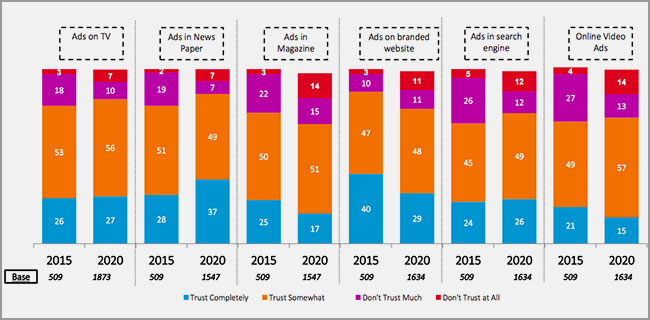
Advertising seen on traditional media continues to enjoy high trust amongst consumers. Advertising in newspapers (86%) emerged as the most trusted, closely followed by that on TV (83%) and Radio (83%). Text/SMS ads were the least trusted at 52%.
In terms of shifts, consumers put greater trust in advertisements consumed on TV, print, radio, social media, outdoor and search engines as compared to what they did in a similar survey conducted by Nielsen in 2015, but there is a fall in the percentage of consumers trusting text messages over this period (58% vs. 52%)
Among sectors, audiences displayed a very high level of trust for advertisements of educational institutions at 82%. This is possibly because culturally, Indians have a strong belief in education as a means to secure their future. Ironically, ASCI finds that a significant portion of misleading ads come from the education sector. ASCI therefore has a high focus on education sector advertising.
Manisha Kapoor
Said Manisha Kapoor, Secretary General, ASCI: “ASCI’s job of monitoring the education sector is even more crucial, given these findings. In India, the poorest of people prioritize education spends over other necessities. Most educational institutions promise job guarantees or make false claims of being the No 1 or guaranteeing 100% placement without any objective data or evidence. We are doing our best to make sure that such false advertising is removed from the market,”.
Sunil Kataria
Added Sunil Kataria, Chairman of ISA: “Brands are built on the back of long term communication with consumers and audiences. It is in the advertisers’ own self-interest to make sure that all communication is honest and truthful, so consumers can trust advertising messages, and thereby, brands. This study helps advertisers, agencies, media owners and planners understand what works well and introspect on what needs improvement”
The detailed findings of the study can be accessesd by clicking here
In August and September 2020, the Advertising Standards Council of India (ASCI) reports that it has looked into complaints against 317 ads, of these 64 were “promptly withdrawn by advertisers on ASCI’s intervention”. The independent Consumer Complaints Council (CCC) of ASCI evaluated the remaining 253, of which complaints against 221 advertisements were upheld. Of these 221 advertisements, 101 belonged to the education sector, 77 to healthcare, eight to food and beverage, seven to personal care, three to finance and investments and 25 were from other categories. Complaints against 32 advertisements were not upheld as they were found to not be in violation of the ASCI code.
Notes a commuique: “In August and September both, the education sector saw a sharp rise in institutes making misleading and false claims in their advertisements, claims such as top of their field, Ranking No. 1, 100% job placements, best institute, 100% passing rate, were the most used claims that violated ASCI’s code. One online learning app claimed to be the best and pioneer of live online classes. Many educational institutions didn’t have substantial data and surveys to support the claims they were making and the CCC recommended that these advertisements be declared misleading. ASCI also upheld misleading ad claims made on various digital platforms like Instagram, Twitter and Facebook.”
Said Manisha Kapoor, Secretary General of ASCI said: “Covid-19 related claims as well as misleading education claims continued to dominate the kind of complaints we received at ASCI during this period. The independent Consumer Complaints Council (CCC), which comprises members of civil society as well as industry, jointly view such advertisements and adjudicate. The CCC goes deep into understanding the underlying complaint and the advertiser response and justification before an opinion is given. ASCI’s only goal is to promote responsible advertising which safeguards consumers.”
The Advertising Standards Council of India (ASCI) has named Manisha Kapoor as its new Secretary-General. From September 1, Kapoor will take over ASCI’s secretariat responsibilities, including the consumer complaints redressal process as well as the marketing, public relations and social media initiatives. Kapoor has been part of ASCI’s Consumer Complaints Council for the past five years and is, therefore, closely associated with the advertising industry’s self-regulatory body. She will take over from Shweta Purandare who joined ASCI eight years ago as Chief Complaints Officer and took over in 2014 as the Secretary-General.
Said Rohit Gupta, Chairman of ASCI: “We thank Purandare for her work in achieving our vision and her belief in our goals and motto. She was instrumental in enabling ASCI’s closer engagement with the regulators resulting in ASCI signing MoUs with the Department of Consumer Affairs, the Food Safety and Standards Authority of India and the Ministry of AYUSH. As she embarks on the next phase of her career, we wish her the very best. We are delighted that Kapoor will take on the role now. We look forward to her valuable inputs and leadership.”
Added Purandare: “It has been an extremely enriching experience professionally through which I could contribute to ASCI’s transformation in terms of capacity, capabilities and stature. As I move on to undertake a new journey, I wish Kapoor the very best.”
Said Kapoor: “It’s an honour to be given the responsibility of leading ASCI’s vision for the future. I look forward to working closely with all of ASCI’s stakeholders and furthering its agenda of fairness in advertising.”
Kapoor has more than 25 years of experience in building brands and businesses. Having worked with companies like Hindustan Unilever and J&J India, she has also consulted with corporations on brand development and strategy for the past 15 years – first with MarketGate Consulting and more recently with Futurebrands Consulting. Kapoor has also worked with non-profits and the government on development sector projects.
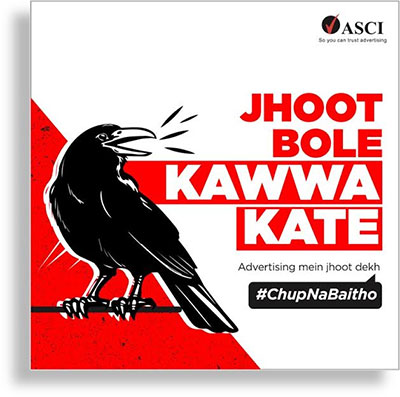 The Advertising Standards Council of India (ASCI) has launched the #ChupNaBaitho, a call-to-action digital campaign, to create an awareness about objectionable advertisements and encourage consumers to report such advertisements. In the three-month pilot, ASCI will focus on Mumbai and New Delhi.