Tag: Manish Tewari

  • Nominees announced for IAA Leadership Awards

    The International Advertising Association India Chapter has revealed nominations for the first 12 categories of the second edition of the IAA Leadership Awards. The nominees have been shortlisted from the fields of Marketing of various products and services categories.


    The IAA Leadership Awards will see a recognition of 21 individuals in as many categories who will be handpicked through a two-stage selection process.


    And the nominees are:


    Srinivasan Swamy

    Speaking on the nominees, Srinivasan Swamy, President IAA India and VP-Development, IAA Asia Pacific, and Chairman, R K Swamy BBDO said, “The nominees are the chosen few from the field of marketing, shortlisted via a scientific thought process and detailed research. By celebrating their achievements, we hope to motivate them to raise the bar year-on-year.”


    The awards will be presented on March 1 at the Grand Hyatt Hotel, Mumbai, with I&B Minsiter Manish Tewari as the Chief Guest.

  • Time to call Minster’s bluff. 6.5/10 performance by UPA-run I&B ministry


    By Pradyuman Maheshwari


    It’s perhaps unfair to damn only Information and Broadcasting Minister Manish Tewari for his performance. Successive occupants of that office – under various regimes – have made a mess of things over the years. Right from the time of BV Keskar, the first mantri who banned Hindi film songs on Vividh Bharati to occupants such as LK Advani, IK Gujral and Sushma Swaraj who didn’t do much for the sector. Ministers like Priyaranjan Dasmunshi and Anand Sharma were on war with many broadcasters and Ambika Soni was by far the best of them all though the digitization execution process was messed up when she was at the helm.


    Earlier this week, as part of the Bharat Nirman series of ads, the DAVP inserted an ad making several claims under the headline “Empowering People Through A Liberal Information Order”.


    I think it’s important that someone were to call the minister and ministry’s bluff. The text in italics is my response to the points made in the ad.

    • Several policies issued and implemented for the liberalization of Print Media Sector in last 10 years

    Is it? Like? Save appeasing the sector with DAVP ad hikes, there’s precious little done 

    • Television industry grew from Rs 18,300 crore in 2006 to Rs 50,140 crore in 2014

    This would have happened any which way. No marks for the UPA 

    • Total number of TV channels increased from 130 in 2014 to 788 in 2014

    Again no credit to UPA for this. In fact, the government has been sitting on many applications and approvals over the last few months 

    • 3 Crore Set-Top Boxes installed in the first two phases of digitization

    Yes, Digitization is an achievement of the government. But look at what happened with it? Chennai is not fully digitized. Kolkata faced several hiccups. Phase 2 is nearly 90 percent, which is heartening 

    • New policy guidelines for Television Rating Agencies issued in 2014

    One is not very sure whether the government should be getting into policing television audience measurement. That should be left for the industry. Thankfully, the government hasn’t got into IRS or advising ad duration on radio and column centimetres/ad-edit ratio in print 

    • New policy guidelines issued for Headend in the Sky (HITS) Broadcasting Services and Internet Protocol Television (IPTV)

    It is fine to issue guidelines, but an IPTV, for instance, has been a non-starter. And HITS is just about a nice acronym 

    • Radio industry grew from Rs 600 crore in 2006 to Rs 1540 crore in 2014

    Would’ve grown more had news been allowed. Isn’t it ironic that all and sundry can start news channels – on satellite and cable – and our radio folks aren’t trusted? 

    • 245 FM channels in 85 cities since 2005. In the next phase 839 channels proposed in 294 cities

    Phase III? Ha ha ha ha ha ha ha ha ha ha ha ha ha ha. Phase III has become a joke. We’ve heard about it just so often. Even the Mumbai Metro would’ve started, but our government would be sitting on the papers. 

    • Community radio stations increased from 64 in 2009 to 163 in 2014

    For a country of a billion-plus people, 163 community radio stations is an apology. Not enough done to evangelise it.

    • Foreign Direct Investment for five segments of broadcasting sector revised in 2012

    And what about news? So FDI can be upped in critical segments like telecom, but not so in news. Just why?


    • Overhaul of the Cinematograph Act, 1952 by Justice Mudgal Committee

    Some welcome steps here? Implemented? 

    • National Media Centre with ultra modern facilities inaugurated

    No point having just one in Central Delhi. The Central Telegraph Offices in various cities which had press rooms should’ve been upgraded too. News journalists exist in other parts of the country too, Mr Minsiter! 

    • National Museum of Indian Cinema being set up in Mumbai

    Better late than never… but would’ve been nicer to coincide with 100 years of cinema.


    What the ad doesn’t tell us is the several things the government hasn’t been able to achieve. Make Doordarshan an independent and top quality pubcaster like the BBC, for instance. Some attempts to improve DD News were nullified by interference in newsroom operations.


    Ever since Manish Tewari has taken charge as the Minister, he has waxed eloquent on the paradoxes of the industry qua (his favourite word) exigencies of the business. He has even tried to police the cable trade on ownership issues since the networks in his home state of Punjab are managed by his political rivals.


    The government has tried its best to keep the issue of self-regulation issues alive by scaring the news media on and off. Under the pretext of protecting the interests of consumers, the 10+2 ad cap was introduced which saw much resistance from news broadcasters.


    The government hasn’t been able to do much on Paid News. Newspapers still carry paid content with or without disclaimers in fine print.


    So how would you rate the last 10 years of the UPA-run I&B Ministry? I would give it a 6 on 10. Okay, let’s make it 6.5, because it could’ve even gotten worse.


  • IAA unveils 21 categories for leadership awards

    By A Correspondent


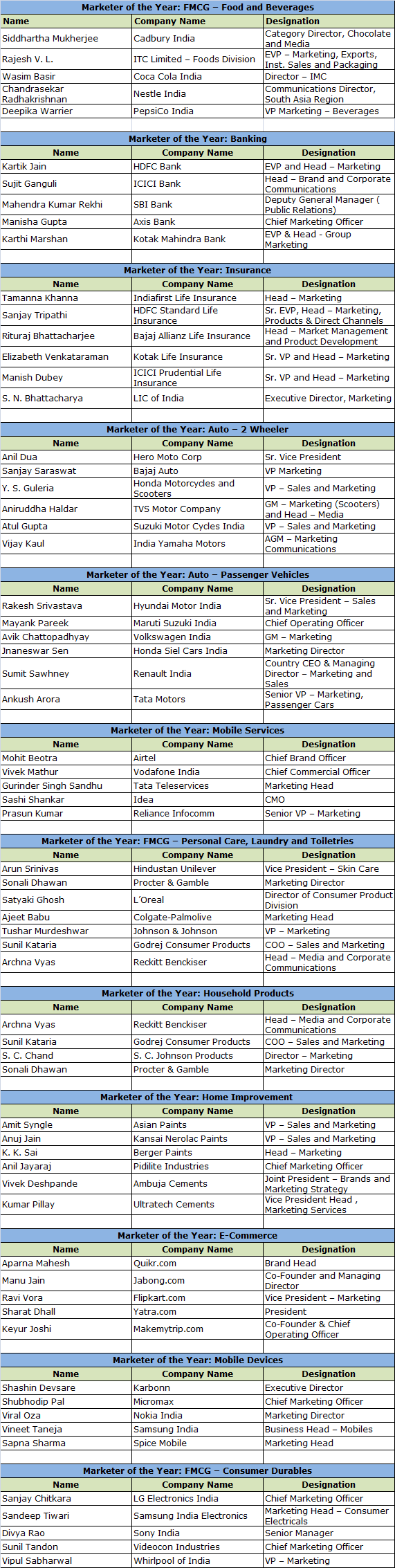
    The International Advertising Association’s India Chapter has unveiled the 21 categories for which its now-annual leadership awards will be held on March 1 in Mumbai. Presented by general entertainment channel Colors, the following are the 21 categories:


    1. Marketer of the Year – Banking

    2. Marketer of the Year – Insurance

    3.Marketer of the Year – Auto: 2 Wheeler

    4. Marketer of the Year – Auto: Passenger Vehicles

    5. Marketer of the Year – Mobile Services

    6. Marketer of the Year – Mobile Devices

    7. Marketer of the Year – FMCG: Personal Care, Laundry and Toiletries

    8. Marketer of the Year – FMCG: Foods & Beverages

    9. Marketer of the Year – FMCG: Consumer Durables

    10. Marketer of the Year – Home Improvement

    11. Marketer of the Year – Household Products

    12. Marketer of the Year – Ecommerce

    13. Media Agency Head of The Year

    14. Creative Agency Head of The Year

    15. CEO of The Year

    16. Media Person of The Year

    17. TV Anchor of The Year

    18. Editor of The Year

    19. Hall Of Fame

    20. Brand Ambassador OF The Year – Male

    21. Brand Ambassador OF The Year – Female


    Srinivasan Swamy

    Announcing the categories, Srinivasan Swamy, President IAA India and VP-Development, IAA Asia Pacific, and Chairman, R K Swamy BBDO commented: “After the great response we received for the first edition of the IAA Leadership Awards, we have made some marginal changes in categories this year to take into account some feedback received. The final winners are being determined now on a number of product and service categories and of course some Awards for senior practitioners. The IAA Leadership Awards is our endeavour to recognize and salute these outstanding talent which has made impactful contributions in the market space and the companies and brands they led.” I&B Minister Manish Tewari will be the Chief Guest at the awards event.


    Manish Tewari

    Three categories have been removed from last year’s list. These being: Marketer of the Year in Auto Commercial Vehicles, Travel & Hospitality and Media & Entertainment. The Marketer of the Year – Telecom Products category is now broken up into Marketer of the Year – Mobile Services and Mobile Devices. In addition, thee will be a Marketer of the Year for Home Improvement and E-commerce.


    The scope of the Marketer of the Year – FMCG: Personal Care category has been expanded to Marketer of the Year – FMCG: Personal Care, Laundry and Toiletries.


    To ensure the authenticity and credibility of the awards and maintain the highest level of transparency at all stages, IAA  looked at various performance criteria in every category under consideration, like revenue/market share growth, marketing initiatives undertaken, innovative schemes, launches, advertising spends etc to shortlist the nominees. Nielsen India was engaged thereafter to have the nominees voted upon by senior marketers from the same industry to pick the final winner. Ernst & Young has been commissioned to look at the process to satisfy itself of fairness and to officially tabulate the results.


    The IAA Leadership Awards, this year, are scheduled to be held on 1st March 2014 at Grand Hyatt, Mumbai. Honourable Union Minister of State for Information and Broadcasting, Sri Manish Tewari will grace the occasion as the Chief Guest. The awards night will be attended by the crème de la crème of the marketing, advertising and media fraternity to see some of their leaders carry home coveted trophies.


    The following were the winners of the IAA Leadership Awards 2013:

    Categories

    Winner

    Media Agency Head of the Year Sam Balsara, Madison World
    Creative Agency Head of the Year Piyush Pandey, Ogilvy & Mather India
    Marketer of the Year: Media & Entertainment Gayatri Yadav, Star India
    Marketer of the Year: Banking Sujit Ganguli, ICICI Bank 
    Marketer of the Year: Insurance Rita Bhattacharya, LIC 
    Marketer of the Year: Auto Passenger Vehicles  Mayank Pareek, Maruti Suzuki
    Marketer of the Year: Auto Commercial vehicles  UT Ramprasad , Tata Motors
    Marketer of the Year : Auto Two Wheeler Anil Dua, Hero Motocorp
    Marketer of the Year: Household Products Amit Syngle, Asian Paints
    Marketer of the Year: FMCG – Food & Beverages Chandramouli Venkatesan, Cadbury Kraft India
    Marketer of the Year: FMCG – Personal Care  Arun Srinivas, HUL
    Marketer of the Year: FMCG – Consumer Durables  Rahul Saighal, Samsung Appliances
    Marketer of the Year: Telecom Products  Anuradha Aggarwal, Vodafone
    Marketer of the Year: Travel & Hospitality  Manish Kalra, Make My  trip
    Best CEO  Y C Deveshwar, ITC
    Editor of the year  Jaideep Bose
    News Anchor of the year  Rajdeep Sardesai
    Mediaperson of the year  Shobhana Bhartia
    Brand Endorser of the year – Male  Salman Khan
    Brand Endorser of the year – Female  Katrina Kaif
    IAA Hall of Fame  Pradeep Guha


  • Corporate ownership of media is an inescapable reality as is surrogate political ownership: Manish Tewari

    (Text has been edited for style at some places. Some bold formatting and capitalizing of text has been retained)


    Honourable Vice President of India Hamid Ansari Sahib, Chairperson of the Press Council of India Justice Katju, Secretary I&B Shri Bimal Julka, Ladies and Gentleman.


    Allow me to commence by congratulating the Media fraternity on this auspicious occasion. The National Press Day always provides a unique opportunity to reflect on the state and the role of media in the current milieu.


    In the last two decades the media landscape has undergone an exponential transformation. This epochal change has been facilitated by the emergence of the World Wide Web. Starting life in the Defense Advanced Projects Laboratory of the Pentagon it has truly revolutionized the way we live and conduct our interactions.


    As I have stated on numerous earlier occasions:

    a) The internet is the largest experiment involving anarchy in history-and it has succeeded. (The last four words are mine).

    b) It represents the largest ungoverned space on planet earth.

    c) Never before in history have so many people from so many places had so much power on their fingertips.

    d) Every two days more digital content is created than from the dawn of civilization until 2003.

    e) What is evolving is a tale of two civilizations; one physical that has evolved over the millennia and one virtual that is still very much in formation.

    f) The New Media rides on the back of this World Wide Web.


    What still has not been analyzed in depth and detail is-how this democratization of news creation, aggregation and dissemination a bottoms up process – sans editorialization is impacting both print and broadcasting newsrooms in addition to transforming the contours of the media space.


    There are some other pertinent questions that the first generation of the digital age should address with some measure of dispatch to ensure that the process of defining agreed global rules of engagement commences in right earnest in the virtual civilization, for example – at what point does a personal “tweet” essentially a digital freedom of expression – turn into a “mass broadcast” – a telecommunications business, in effect one that has to be held to certain standards of accountability?


    Allow me to turn to the other hard question of our times and the subject of our deliberations today, i.e. media and public interest.


    Public interest has but myriad subjective connotations. It can and may mean various things to various people but what public interest certainly cannot mean is the promotion propagation and proclamation of private Interest in any area of human endeavor.


    Speaking in the Rajya Sabha in 1974, Late Shri R K Mishra an eminent journalist himself, made an incisive though a very blunt and some may term even a provocative observation about the Media and Private interest. An articulation that raises hackles in certain very influential quarters in our country whenever it is reiterated. He stated and with your permission quote;


    Now where is the freedom of the Press? What do we have? In India we have the freedom of the newspaper owner; In India we have the freedom of the newspaper proprietor and in some cases the delegated freedom which is enjoyed by the newspaper managers ……and the working journalists will continue to be paid employees doing whatever the newspaper proprietor wants him to do.”


    Pungent but profound words that have proven to be almost prophetic in their import. Though obviously this adage does not have universal application even in the Indian context but a few would seriously contest that selectively it is a non-sequitur. Rather than react with the usual display of indignation perhaps the media industry would be better served if stakeholders were to calmly and dispassionately consider evolving the means and measures of putting Chinese walls cast in concrete between commercial considerations and editorial autonomy. Recently in influential publications very eminent editors have voluntarily relinquished their managerial responsibilities. This is indeed laudable and an example that inspires emulation by one and all.


    On the occasion of the National Press Day we must rededicate ourselves to the cause of empowering the working journalist as well as creating the necessary wherewithal that supports truly Independent Media initiatives.

    Corporate ownership of the Media is an inescapable reality as is surrogate political ownership as well as government ownership in the public broadcaster format. While one can possibly argue about the pros and cons of each of these paradigms but life is circumscribed by the given reality and not the utopia of Shangri-las. The moot point being that there are diverse interests always at play in the media space. The challenge therefore is to always try and find the elusive golden mean so that Public Interest does not become a permanent casualty at the altar of competing and contradictory private interests. In the UK this dilemma was articulated cogently in 1995 by the then Conservative government’s White Paper on media ownership: The paper stated and I quote-


    A free and diverse media are an indispensable part of the democratic process. They provide the multiplicity of voices and opinions that informs the public, influences opinion, and engenders political debate. They promote the culture of dissent which any healthy democracy must have…. If one voice becomes too powerful, this process is placed in jeopardy and democracy is damaged.”

    That is perhaps why post The Lord Leveson enquiry the British government with broad Multi Partisan support promulgated the Royal Charter on Media Regulation recently despite opposition by powerful interests in the British Media Industry. Unfortunately this development has not found resonance in the otherwise vacuous realm of public polemics in our country.


    In both the Indian and even the global context certain structural paradoxes have emerged which require the focus of concerned, conscientious and committed stakeholders of the public discourse.


    THESE ARE:

    (a) PARADOX OF THE SHORT FUSE-INCREASED INFORMATION DISSEMINATION MECHANISMS QUA INCREASED INTOLERANCE OF THE OTHERS POINT OF VIEW.

    (b) PARADOX OF FLAWED REVENUE MODELS QUA QUESTIONABLE REVENUE GENERATION PRACTICES

    (c) PARADOX OF TRPsS QUA THE TRUTH

    (d) SENSATIONAL MEDIA TRIALS QUA A FAIR JUDICIAL TRAIL GUARANTEED BY ARTICLE 21 OF THE CONSTITUTION.

    (e) ANONYMITY MASQUERADING AS PRIVACY IN THE NEW MEDIA SPACE-THE SPECTRE OF THE ‘HIDDEN’ PEOPLE AND THE DARK NET.

    (f) NON EMERGENCE OF GLOBAL RULES OF ENGAGEMENT IN THE VIRTUAL CIVILIZATION.

    (g) LAST MILE NEUTRALITY AMONG CARRIGE PROVIDERS SO THAT CONTENT PROVIDERS GET A LEVEL PLAYING FIELD AND ARE ABLE TO REAP THE BENEFITS OF CONVERGENCE.

    AND THE QUINTESSENTIAL DILEMMA

    (h) SELF-REGULATION QUA A STATUTORY REMIT.


    If I were to liberate my thoughts from the seemingly vexed issues that bedevil the media remit and ask a very simple question as to what is the Fundamental Public Interest of our times? The answer can perhaps be articulated in one simple sentence- upholding the constitutional values which define the very idea of India. As we go about our everyday chores dark clouds of fascism loom ominously over the horizon- a great evil stalks our land. The first casualty of this specter would be the constriction of liberal spaces, curtailment of creativity and circumscribing the right to challenge the conventional and think off the beaten path. If the alleged expose about state sponsored stalking is correct I would be worried not as a woman but as a civil libertarian about the Orwellian state that some “esteemed” gentleman seek to construct.


    William Shakespeare in his epic Julius Caesar wrote

    “There is a tide in the affairs of men

    Which taken at the flood leads to fortune
    Omitted, all the voyage of their life
    Is bound in shallows and in Miseries
    On such a full sea are we now afloat
    And we must take the current when it serves
    Or lose our ventures.”


    History bears testimony to the harsh reality that evil has always triumphed when good men have chosen to keep quiet and do nothing. When the immediate has taken precedence over imperative! When like Lord Neville Chamberlain we have been naive enough to believe that compromising with the forces of fascism, right reaction and national subversion can buy us the peace of our times.


    At such a crossroads ladies and gentlemen do we today stand!


  • I&B consultative committee discusses Leveson Report and implications for India

    By A Correspondent


    Manish Tewari

    Minister for Information & Broadcasting Manish Tewari chaired a meeting of the Consultative Committee of the Ministry. The meeting discussed the Leveson Report and its relevance / implications in the Indian milieu. A presentation on the Leveson Report and its relevance and implications in the Indian context was made before the members.


    Welcoming the members, Manish Tewari said that in the last two decades, the media landscape has undergone an exponential transformation. In both the Indian and the global context, certain structural paradoxes emerged, which required the focus of concerned, conscientious and committed stakeholders of the public discourse. While there were diverse interests in play in the media space the challenge was always to find the golden mean so that the concerns of different stakeholders could be taken into account. Mr Tewari added that the Leveson Report was being discussed before the Committee so that the issues raised could be debated and discussed and the implications in the Indian context could be analysed. While the Government had always supported the ‘Self Regulation’ mechanism in the media domain, of late, a need had also been felt even amongst the stakeholders that a model statutory underpinning the self regulation framework may be looked at. The Leveson Report was an example of a model that had been conceived in the British context after due deliberations and debate. He further stated that the endeavor would now be to also compare other similar models around the world and understand the implications and applications better juxtaposed against the Indian context.


    While appreciating the initiative of the ministry in discussing the broad features of the report, Members of the Committee emphasized that discussions should be broadbased accounting for changes across the media space which included the broadcasting and new media also. Members also emphasized that while the current model was very country specific, an attempt ought to be made to discuss the matter with all critical stakeholders accounting for the diversity in the media space. Members also mentioned that the roadmap for the public broadcaster with regard to the regulatory mechanism could also be looked into so as to ensure a comprehensive analysis of the process. Members also felt that in order to ensure a roadmap for the future, it was necessary to outline institutional mechanisms which took into account the changes that were in the offing in the different media segments.


    Members who attended the meeting included Dr Anup Kumar Saha, Dr Sanjay Jaiswal, Shatrughan Sinha, Ramya Divya Spandana, Ahmad Saeed Malihabadi, Barun Mukherji, Bharat Kumar Raut, M P Achuthan, Mohammed Adeeb and Pyarimohan Mohapatra.


  • NBA welcomes Manish Tewari statement on 12-min ad cap

    Manish Tewari

    The News Broadcasters Association (NBA) has welcomed the recent statements of Manish Tewari, Minister for Information & Broadcasting, that news channels must get an extension on the 12-minute ad cap, “at least till the final phase of digitization is complete”.


    An NBA statement from Secretary General Annie Joseph  said that “it is happy that it has been understood that the industry is in a dire financial condition, like many other sectors of the Indian economy, with ad revenues being slow, carriage fees continuing to be burdensome and credible subscription revenues being out of sight”. “In a such a severe economic scenario in the country and on the ground, a forced curb on advertising will have a catastrophic impact on revenues of news broadcasters forcing many to take drastic steps that would have an unavoidable, adverse impact on quality of service and jobs. It is estimated that if the ad cap were indeed implemented at this stage, the revenue loss across news channels would be in excess of Rs 500 cr, forcing cuts of at least that amount in costs, if channels have to survive. The NBA respectfully agrees with the Minister for I&B that the 12 minutes cap on advertisements per clock hour be kept in abeyance and such restrictions “kick in only when the benefits of digitization are apparent so that broadcasting companies can make good their advertising losses with subscription fee”. NBA also urges that the burdensome and crippling nature of carriage fees which have no business to exist in a truly digitized environment is also addressed urgently.”


    NBA has requested the MIB and TRAI to come out with a final notification keeping the ad cap for news channels in abeyance as above, in the next 10 days as any delays beyond that will have an irreparable impact on the industry.


  • Government relationship with media an essay in persuasion not regulation: Manish Tewari

    By A Correspondent


    Manish Tewari

    Information and Broadcasting minister Manish Tewari has said that the process of mainstreaming self-regulation as a statutory mechanism ought to be led by the industry rather than the government. The minister emphasised that the government’s approach towards the media was an “essay in persuasion not regulation”. The stakeholders within the industry would have to define the equilibrium levels so as to ensure that the paradigm of transparency, fairness, sobriety and avoidance of sensationalism becomes the key driver of the National discourse in the media space. Mr Tewari stated this while speaking at a panel discussion on “Media Regulation: Is status quo the option?” organized by the Observer Research Foundation in New Delhi on Tuesday (August 6).


    Elaborating further, the minister said, digitization as a process could be leveraged to augment sample sizes by re-engineering every set top box to function as a virtual “People’s Meter”. Out-of-the-box innovation and creative thinking by media entrepreneurs could surmount the current challenges by a technological leap that could transform the dynamics at the back-end of the media sector, he said. Industry could then utilise the data and develop business models that were transparent and workable. This process would ensure an alternative to the ongoing conflict that broadcasters held responsible for much of its woes He emphasised that the way forward was also to fast-track Broadcasting Audience Research Council (BARC) as an industry led body that would provide a reliable measurement of popular viewership patterns and help broadcasters overcome corrosive narratives.


    During his address, the minister also touched upon the growing importance of the new media which had revolutionized the media landscape. The growth of the internet had led to a situation where there could be a conflict between the physical and virtual civilization. It was important to comprehend the fact that the power of expression and dissemination through the internet had added a new dimension to innovations in information dissemination, he said. While the opening up of the virtual space had led to democratization of the information paradigm, it had also led to “technology becoming a leveller”, the minister said. Mr Tewari further added that these developments could also lead to a situation where one could also face “balkanization of the internet” if agreed rules of international engagement did not emerge as a binding international compact that encompassed states and other entities who controlled the underlying hardware. This situation needed to be avoided at all costs so as to ensure that no artificial divisions are created in the World Wide Web on ideological entities and Westphalian lines.


    The Minister also emphasised on critical paradoxes within the media space that would need to be reconciled. These included proliferation of numerous mediums of communication as qua a growing intolerance to an opposite viewpoint, Right to a fair trial qua Trial by the media, Presence of flawed revenue models qua questionable methods of revenue augmentation, TRP qua the truth and the raging debate between self-regulation and statutory regulation. Source: Press Information Bureau press release


  • Keeping the Media Free & Fair


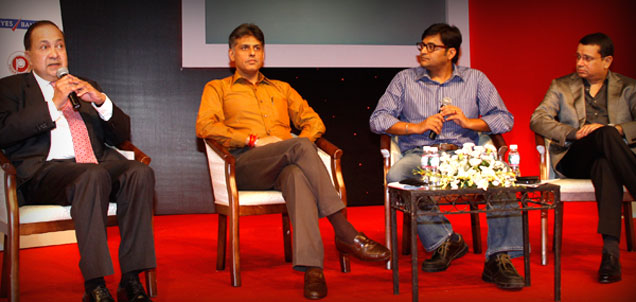
    Panel discussions can be quite boring but at the Press Club Mumbai’s RedInk awards last Saturday (May 25), the audience gathered was actually asking for more. This despite an awards presentation and of course drinks and dinner that were awaiting members of the fraternity.  The theme of the discussion was ‘Keeping the media free and fair’ and moderating it was Arnab Goswami, editor-in-chief, Times Now. Former editor-in-chief of the Hindu group, I&B Minister Manish Tewari and Star India CEO Uday Shankar were the panellists discussing the issue.


    Arnab Goswami: Keeping the media free and fair… I was just thinking if you ask Mr N Srinivasan today who has refused to speak to Times Now about 10 times in the last 10 hours, he will certainly say that media is too free and is completely unfair. That’s what it is all about. It is totally subjective assessment. I would restrain my own views, the problem is because on television, I tend to forget that I am an anchor. I have assumed the role of an analyst much too often. But I will try and hold myself back because I have three absolutely tremendous speakers here today, three people who represent different points of view voice of youth, men with great experience.


    I’d like to start this chat by first asking the most experienced gentleman as far as this profession is concerned, certainly on the panel, Mr Ram this question makes a few presumptions. Keeping the media free and fair, you assume that there is a threat that the media presently faces and it also makes the assumption that media might not be fair in the future. May I ask you to give your points of view on this?

    N Ram: Yes, I think that is a good entry point into this discussion. It is quite provocative assumption that you are not my friend, are we really free? I used to think that India, among the developing countries, was in an enviable position. And I have revised my view after that. Why do we say this so far as press is concerned, Article 19 (1) A, plus Article 19 (1) G equals freedom of press. That is not possible because qualified by the reasonable restrictions enabled by the constitution are the eight heads and no more. That be reasonable. And thanks to judicial interpretation, freedom of the press has come to stay. This is the great advantage in India, institutionally speaking.


    Unfortunately, the broadcast media and now news television in particular, haven’t been given the same status so far as freedom of speech or expression is concerned. Although in practice, they seem to be rather free as Arnab’s channels and many others bring out every day. So I am not quite sure of that but the problem today is that the so-called reasonable restrictions have turned down, some of them, to be mightily unreasonable. The law of criminal defamation is a daily threat to the press, to television. The contempt of court where judges decide their own cause – that is a problem although it’s not that frequently invoked. Legislative privileges poses problem here and there. Above all, the jurisdiction of criminal contempt, I think, is a major threat. Add to it the intolerance that we see around us. And not just from the govt, I must emphasise that, from many sources in our society including governments and state governments also.


    I think this has now changed the game so that the feeling of insecurity, what a famous American jurist called the chilling effect phenomenon. People censor themselves when they write or speak on television or so forth. Despite that we only admire our colleagues, including young men and women, who brave these hazards every day and take huge risk and end up in jail or have to appear in court on matters that wouldn’t get them in any trouble in a truly democratic system. So I have revised my view on this.


    The second part of question: are we fair? There also I have doubts because very often, the press as well as television – we fall short of the standards of fairness and justice that would be demanded of our institutions. Apart from the phenomenon of paid newsand  apart from problems like private treaties and so on which clearly militate against fair coverage, we have various other problems: hyper-commercialization in the news media, the control that proprietors exert over the content, poor material conditions of many of our colleagues. I recently read the longish report of the standing committee on Information Technology that your ministry has put out. It has got some interesting things to say on the condition of journalists in India including their remuneration. I think all this detracts from a healthy state in the media. I do not want to go on and deal with the central paradox of the digital age. I think on the whole, we fall short institutionally speaking, on the standards of fairness of justice which the public including politicians are entitled to expect from us.


    One of the issues which bothers me is editorializing in the guise of news. I speak of newspapers here, but it might apply to television. These days, the standard argument is that everyone knows what’s happening – breaking news on TV, you do not say it for the first time. The front page function of the newspaper has changed profoundly. So what do you do to engage the readers or audience? You editorialize, you give it colour. And in the process, I think the standards of journalism get affected. It’s not easy problem to resolve because merely dull recording, factual reporting, may not engage the audience and you may lose the plot but editorializing blatantly in the guise of news, I think, has become a vice in the Indian press but I also see it elsewhere. I see it in the UK, I see it in the US on sensitive international issues. We must do something about it. I am not talking about an anchor expressing strong views. I am talking about the reporter in the field compelled to editorialize in news reports.


    Arnab Goswami: On one side there are at this point of time, and I see them, moderate to strong disagreements of your views with those of Manish Tewari. You feel the medium is threat to profession and you also feel medium needs to live up to certain standards. You put these two very well. Manish, may I ask you to respond to that. I have three points which I would make. Mr Ra Mr Ram’s observations lead me to my first, which is to put it bluntly, this great concern of the falling standards of journalism that I hear from the political class of this country seem to coincide with the scams of the last three years. Ten years back, or pardon my saying so Manish, six years back there were challenges unique to news and Mr Uday Shankar – a purveyor of news television would know that there was lot of criticism of Hindi channels. Nobody complained about that as much as they started complaining about the falling standards of the profession, the lack of responsibility of journalist to coincide with the CWG scam and continues up to today. Why this concern, especially at the time of scams?

    Manish Tewari: When I think of what you have succeeded in doing, is narrowing the focus of something which should have been a far more esoteric and academic discussion. And I do not want to, because we have done it, night after night, for the simple reason that some of those gentlemen who were possibly responsible for putting out some of that stuff in the public space have now honourably retired. So I will allow them to rest. But to come back to a far more substantive point that Mr Ram made about the sum total of the freedom of the press that 19 (1) A and 19 (1) G adds up to the freedom of press. With all due respect to Mr Ram and I have great respect for him as a professional, I beg to disagree. And the reason I disagree is because 19 (1) A and the reasonable restriction of 19 (2) which apply to it, and 19 (1) G and 19 (1) 6 operate on two different fields altogether. While the former operates with the extrapolation of the freedom of the press from the freedom of speech and expression, the latter really applies to the entire business of the media per se. And there I think you need to make a distinction — a distinction between the freedom of the press and the freedom of the owner of the press. While I do not think anybody has an issue with the former, with regard to the latter, and at times we joke amongst ourselves that we give two sorts of licenses in the broadcasting space – a news licence and a non-news license, so I was thinking to myself that it is high time we start giving views license also because most of the times what you hear is views, and do not hear the news.


    So therefore, I think and that’s why when I outline those paradoxes, they are real situations which all of us collectively address as we go along. Because my apprehension is that increasingly you are seeing judicial intervention taking place in areas which should be preserved for self-regulation. And if we do not self-correct, and if we do not come to certain solutions, I am afraid that these interventions will just keep growing. You are concerned about falling standards of journalism. I have a very healthy respect for journalists. You would have never heard me talk about falling standards of journalism. In fact, I think in totality, journalists do a great job. And I am not talking about the national press. I represent a constituency which is one-third rural. We have journalists in the tehsils, and they run a far greater risk at reportage because of the tyranny of the state governments which Mr Ram referred to. Yes, there are people like the esteemed chairperson of Press Council of India, the former Judge of the Supreme Court who has concerns, I am not saying right or wrong, about “falling standards of journalism”. He is unfortunately not here, he is in the US . But next time he is here, I think we should have a discussion.


    Arnab Goswami: I have had the pleasure of having him in some discussions in the past. His interest lies more in Sanjay Dutt these days. I am glad to have problems in the profession and standards of journalism because many would say, Mr Tewari with great respect and this is what young journalists feel that the nature of journalism is changing. Yes, it is becoming more strident. Views are a right of expression of every journalist. And as far as self-regulation is concerned, I think Mr Tewari Mr Uday Shankar will elaborate further on this, in this Azad Maidan – here there was an almost riot-like situation, I have never seen journalist expressing his self-regulation so voluntarily as he did at that time. Now whether you talk about that or renewal of communal situation arising in Uttar Pradesh or during the coverage of Ayodhya verdict, one have never seen so much voluntary self-regulation so maturely from so many young journalists.

    Manish Tewari: Before you go to Uday, let me say: The difficulty with the whole self-regulation, for any regulatory mechanism to work, it has to be universal. It cannot apply to certain segment of media only. Therefore, you will have to find a way of making it universal and if the self-regulatory bodies do decide to take punitive action in a particular case, there should not be an option of opting out. ‘I am leaving the association, it’s my way or the highway’. So that is why I am saying that we are committed to the institution of self-regulation take route but I think we need to find a modus vivendi to make it universal so that it can be applicable across the board.


    Arnab Goswami: Mr Tewari, taking from what you said on ‘views’, I’d like to go across to Uday Shankar and get his side of the story as well. Uday, my question to you would be what really comes out of kind of observation that Mr Tewari makes out of views, I can interpret that differently. May be some people in the audience will feel that today because of the strength of views and directors of views, politicians are feeling more moral/public/ethical pressure to respond. So even though they would not like to respond to certain situations, they have to because of the pressure that the media puts on them. How would you like to respond to that in the light of the subject today of media being free?

    Uday Shankar: Whenever there is a debate on whether media is free and fair, I get a little suspicious depending on the nature of people who are talking on it. I am eminently comfortable when the gathering is of this kind because you have a point of view, you have practitioners who can throw light on this. As Ram said very clearly that fairness of the media is under question and should be questioned continuously. Not just in this country, but should be done everywhere. And it is not just about media, it is about any profession. What you are doing always has a scope for improvement and that should be done but usually people make the argument in this country, and recently more and more so, people make the argument primarily to suggest that since media is not fair, hence it must be curtailed because that is invariably the subject. As you said, there are eminent people who are concerned about falling standards in media and the practice of fairness in media. They have not once expressed concern about falling standards in their own profession. And I need to understand that everything is hunky-dory in legal profession? Everything is hunky-dory in judiciary? We have equal, if not bigger challenges, in this profession. But that does not mean that a journalist should be made incharge of regulating them. And similarly, if there are issues with journalism, we need to address them.


    I agree with the Minister that it cannot be an option, but it is optional primarily because it has got no institutional support from the State or the Government usually. Today, for first time in the last couple of years, regulation has been given a chance in television to an extent and I think it has made things a lot better than any official enforcement would have brought.


    Arnab Goswami: I think you have hit the nail on the head and I would like to go back to Mr Ram.

    N Ram: If I may pick three points. The first one is complaints come up when news media gets very active in investigating and exposing the wrong-doing corruption. I remember the struggle against the so-called anti-defamation bill of 1988 which came very close to the heels of our Bofors investigation. We had a spirited movement here in Mumbai. So it is true and an important point. Secondly, I am glad that the Minister brought out the distinction because put in another way, I’d say you must make a distinction between state of the news industry towards printed press and broadcast media and the state of journalism.


    The first may be reasonably buoyant although right now the economy seems to be hardened. The state of journalism is quite something else and very often in public discussions, these get conflated and I think, according to him as a lawyer comes straight from the constitutional self. Thirdly on regulation, the best discussion and debate I have come across on self-regulation was around the Leveson’s enquiry. Leveson eventually came to a very clever scheme in my opinion although for complex reasons, the British press has not yet signed onto it. What is the mode? independent self-regulation underpinned by legislation. That was the original idea. There was virtual revolt against legislation so, it is underpinned by Royal Charter, which itself is underpinned by legislation, by law. And yet, they have not signed onto it. I thought long and hard, why are they so scared of it and almost paranoid? Why are people refusing to come onto this? Because they are running scared of independent self-regulation.


    Self-regulation that is compelled in the sense, it’s a contradiction in terms but you are required to be self-regulated by system, readers, and viewers. Then I think it is a genuine check on the vices and malpractices of media. And that is the lesson I draw from Leveson. Fortunately, in India, you have a Press Council, which is largely toothless and I have read Mr Katju on it who has some valid points and suggestion he makes for licensing is totally unacceptable. But what is the problem here. The Press Council is not independent. It is packed, I would say it is infested, with our own kin and a few politicians. And Leveson wanted to avoid both. I think we have got the model completely wrong. And if you are really going to self-regulate, I do not think that self-regulation without statutory underpinning is going to get very far. It is a good worthy experiment but it does not go far enough. So how do you bring these two things on the same page? Press Council – not independent, toothless, but having a certain history, and a certain visibility. The other thing – self-regulation – which is not really independent enough although it is better than the Press Council. So how do you get them on the same page and how do you get the model right? That could be of great interest to us.


    Arnab Goswami: You know, 2- 3 years back, before Mr Tewari took over as the Minister, I had the opportunity of sitting in on a meeting where all channel heads were called. And the government, literally on a plate, offered statutory self-regulation. In other words, the govt told us that you self-regulate and we give you the power to do so. And the resistance from the channels at that point of time, which I think was worthy resistance, was that we will regulate ourselves not as a gift from you but as a right that we arrogate to ourselves. And I would just like to make that point following from what you said. But Mr Tewari, first of all I would like you to respond to the fairly straightforward observations of my friend Uday. Secondly, you talked about the foreboding possibility that in the near future you would not like to regulate the media but the judiciary might like to. Mr Tewari, of late, there has been more tension between politicians especially between your government and the judiciary than between the media and the judiciary. Tomorrow, if the judiciary were to regulate politicians, you would fight back. And in every point of time, there have been several discussions including editorial articles by your sitting ministers ( I do not know if you have written it yourself) where you basically told the judiciary not to encroach in the area of the executive. And today I want a concrete statement from you on whether you feel the media in this country represented by the several in this audience has the same right to defend its territory that you give yourself.

    Manish Tewari: I think, Arnab, the very straight answer to that is that I think that the media is very capable of fighting its own battle. I don’t think you need to fire the gun from our shoulders. If you feel that the judiciary is encroaching on to your turf, stand up and fight. Not withstanding the tension between political executive and the judiciary, which are inherent in the constitutional scheme of things and that’s the manner in which it has been designed. Judgment after judgement which is coming out of the courts is not coming out to regulate the politicians. The whole structure of democratic governance is designed in a manner whereby Parliament regulates itself. Judgment after judgment is telling us that please regulate the media. And that’s why I say, and to come back to your point of you’re sitting in a discussion’ and ‘you wanting it as a right and not as a gift from the government’, I think you have probably not studied the ASCI model. The ASCI model of self-regulation in the advertising space which is underpinned by a statutory rule in the advertising code, 7 (9) if I remember correctly, is a perfect model of self-regulation, which has a statutory basis. I think that’s something you should look at. BCCC should look at it. The NBA should look at it. And if you guys feel that advertising model has worked which according to ASCI and incidentally when it comes to surrogate branding and stuff like that we have, not withstanding the rules, deferred to what ASCI says.


    So it would be worth your while to really look at that model.


    Arnab Goswami: Mr Tewari, with respect, advertising is not journalism. Journalism is not advertising. Never the twain will meet.

    Manish Tewari: I think those lines are getting blurred. And they are getting blurred very quickly, my friend


    Arnab Goswami: Mr Tewari, I wouldn’t try to shoot from your shoulders. You said about what the judiciary thinks. Where do you stand?

    Manish Tewari: I do not have a mandate in this point in time to speak on behalf of judiciary but I do have mandate to speak on behalf of government. and repeatedly, we have demonstrated it through our track record that our relationship with media, not with standing the inherent tension, has been an essay in persuasion, has not been regulation. I think our track record for the past 9 years, speaks for itself.


    N Ram: I would agree with you on this. We have not faced any real problems from the central government in the recent period but why doesn’t the government take the initiative to get rid of the whole jurisdiction of the criminal contempt. And you can strengthen the civil law. But why do we still need this law of criminal contempt? Here I can say that it is an act of omission, it is becoming very costly for the freedom of the press and freedom of news television in India.


    Manish Tewari: Mr Ram, I think you made a fair point there. Because it is not only journalists, there are other lot of us who operate in the public space who are unwitting victims of the law of criminal defamation. But I think we need to tread very carefully because some of the judgements which have come out recently even with regard to civil defamation with due respect have been very excessive, therefore I think, the whole issue needs to be looked at holistically. And you make a fair point in regard to both the laws of sedition and the criminal defamation and possibly at some point in time when you do decide to revise a penal code which goes back to 1860, you need to look at lot of these issues afresh in contemporary sense of the word.


    Uday Shankar: I think we must understand that when we say we fear attempts to subjugate from political executive and bureaucracy, we are not saying that it is the only source of apprehension. I do not think judiciary left to itself, would accredit itself any better as far as regulating or gagging the media is concerned. When we say there are attacks on free and fair media, those attacks are not just from the political class. Left to itself, any group which is drunk on its power would attempt exactly the same thing because what the media seeks to do is question/ challenge the authority, which they do not like. If we dislike or push back against he attempts to control from the political class, we should be even more vigilant of such attempts coming from institutions and community like judiciary because at least here you can have a blunt debate and you can stand up. This whole shield of contempt is far more dangerous when it comes to pushing back attempts of gagging from institutions like the judiciary.


    The second point we should be conscious about is that media is just throwing a spotlight, it doesn’t decide anything. To that extent, it is a good idea to encourage a system where we are minimizing the scope for debate. It’s a good idea to encourage the space for good debate. And that good debate is not being restricted by these people. There is an internal attempt from the owners. Sometimes it is a very unconscious process of time and sometimes it is a conscious process of that space for debate being eroded by the ownership and the people who run media houses.


    Arnab Goswami: Do you believe, Uday – you have been into television journalism for long time now – this debate that you are talking about is making some people uncomfortable? If I were to report the BCCI story in a PTI wire copy-DD news (with all respect) form, then it would have no impact? Mr Srinivasan would be laughing. The fact is that people debate, people get involved in subjects and people want their own point of view. This same plurality of views that democracy gives us become a threat?

    Uday Shankar: I think it is indeed a threat whether it is the BCCI or the International Olympic Association or whether it is another field. Any authority or body is always unsettled by it. so that is definitely the case. The real issue is to come back the point that Ram made that there is a lot of opinion masquerading in news, I think that’s true and even bigger problem is that a lot of very poor opinion is masquerading in news. It is bad enought that it is opinion in garb of news and worse that it is really half-baked, ill-informed opinion. And in newspapers, I see, I see in name of analysis it is all opinion. While there must be analysis, I see no analysis but only opinion.


    And that brings me to another issue that we must address as journalists ourselves and that’s exposing ourselves to a lot of criticism is the issue of competence. I think the quality of journalists, and while in general we see a lot of good quality people and very good quality of journalism, but we need to conscious about quality of people who are coming into the business. I continue to get very concerned about quality of intake and the way this society has changed; the way employment universe has changed. Earlier, if you were a Liberal Arts graduate in the country, no matter how good you are, in the country you have two-three options only: you became a teacher or journalist. If you were slightly liberal radical in your approach, chances were you would end up either as a professor or become a journalist. Today, those people have many more options. As a result, the kind of people who are coming in media are clearly not equipped half the time to tackle the issues and do the stories they are supposed to be doing. And the effort that is going internally and somewhere it is also about the collapse of the entire institution of mentoring by the editor — that has collapsed. And that is particularly a big challenge in electronic media. And if we do not address that it becomes a very unvirtuous cycle where poor quality, poorly mentored people are doing poor quality stories: opinionating a great deal and hence exposing the whole institution to question and attacks.


    Compiled by Ananya Saha
     

  • Press Club Mumbai’s RedInk Awards presented

    By A Correspondent


    Maharashtra Governor K Sankaranarayanan and I&B Minister Manish Tewari presented the third edition of the Press Club awards held on Saturday, May 25 at the NCPA, Mumbai. Christened the RedInk Awards, the show was emceed by journalist Bachi Karkaria. A highlight of the evening was a panel discussion moderated by Times Now editor-in-chief Arnab Goswami on whether the media in India was free and fair. Former Hindu editor-in-chief N Ram, Minister Manish Tewari and Star India CEO Uday Shankar were the panelists.
    Veteran journalists Kuldip Nayar and N.Ram were awarded the RedInk Lifetime Achievement Awards for 2013 and around 20 other journalists received awards in various categories for excellence in journalism at the Awards event. Mr Nayar’s award was received by his wife.

    The sponsors of the event were Star India, Podar Enterprise, Glenmark Pharmaceuticals Ltd., Eros International, Yes Bank, Magarpatta City and Zee Entertainment.

    ** Detailed report and photographs on Monday, May 27 **


  • Governor K Sankaranarayanan, Manish Tewari at Press Club Mumbai awards

    By A Correspondent


    Maharashtra Governor K Sankaranarayanan and Manish Tewari will be the prominent guests at The Press Club Mumbai’s RedInk Awards. Veteran journalist Bachi Karkaria is to emcee the evening and a highlight of the evening – other than the awards of course – is likely to be a panel discussion moderated by Times Now editor-in-chief Arnab Goswami.


    As reported earlier veteran journalists Kuldip Nayar and N.Ram are to be felicitated with the RedInk Lifetime Achievement Awards for 2013 and more than 20 other journalists will receive awards in various categories for excellence in journalism at the Awards event.


    The 2013 edition of the RedInk Awards received over 900 entries from journalists all across India. Winners have been chosen in nine competitive categories including Sports, Media & Entertainment, Health & Environment, Crime, Business, Politics, Television Story, Science & Innovation and Photojournalism. The media partners of the event are Star India, Podar Enterprise, Glenmark Pharmaceuticals Ltd., Eros International, Yes Bank, Magarpatta City, and Zee Entertainment.


  • Think aloud for a Broadcast Regulator: Manish Tewari

    By A Correspondent


    Manish Tewari

    Reiterating the government’s commitment for smooth cable TV digitization and protecting consumer interests, Minister of Information and Broadcasting Manish Tewari has asked the broadcast industry to ‘think aloud’ for a separate broadcast regulator.


    Speaking at the 4th CII CEOs’ roundtable on broadcast, the minister mooted the idea of a ‘techno-commercial’ regulator for the broadcast sector, which is witnessing rapid changes in the wake of cable TV digitization. He also made it clear that content will not be regulated by the government.


    Mr Tewari said that a viable measurement system for assessing audience tastes and preferences would enable the broadcasting industry to position sustainable revenue models. The broadcasting industry needed to initiate immediate steps for setting up the Broadcast Audience Research Council (BARC), he said, adding that the digitization process had created a model where the given database emerging from the process could be analyzed and expanded exponentially. The government was willing to provide this data to an industry-created body. This body in turn could utilize the data for use in the public space. The initiation of this industry-led process would ensure a two-way flow of information necessary for analyzing advertising trends and models.


    KVL Narayan Rao, Executive Vice Chairperson, NDTV Ltd outlined how for some broadcasters, carriage fees remains burdensome and subscription revenues are not forthcoming as yet. “Issues such as TRAI regulation on 12-minute ad cap are the issues that need to be deliberated upon,” he said.


    Elaborating further, the Mr Tewari said that there had to be a balance between the evolution of technology and the regulatory architecture. In view of the changes taking place in the broadcasting space, a discussion was necessary within the industry regarding the need of a regulator on techno-commercial grounds. Referring to the digitization mechanism, he said that all stakeholders had to ensure that they work together for creating an enabling environment. “This is critical in view of the consumer being the biggest stakeholder and end-beneficiary. The government is aware of the needs of the consumer and desires that the whole process of implementation ought to be done causing the least pain to the biggest beneficiary, ie the consumer. Digitization as a process has to be viewed as a game changer as far as the media landscape in this country is concerned, as benefits will accrue to all the stakeholders involved and each plays a vital role in the growth of the industry,” he said.


    In a major relief to broadcast channels, Mr Tewari maintained that a solution would be brought about to the TRAI’s recent regulation barring television channels from telecasting more than 12 minutes of advertisements every hour. He said the broadcast landscape is changing in the country with digitization, and this issue of fixing time slots for advertisements will be taken up at an appropriate time. He also expressed concern over the TAM TRP data and said that the BARC should be created at the earliest.


    Uday Kumar Varma, Secretary, Ministry of Information & Broadcasting, said that the entire exercise of digitization was to bring out a transparent mechanism, credible subscriber data and finally ensure that the dividends of digitization reach the end consumers. “We have discarded a system which was not transparent and are moving towards a system which has to be transparent,” he said.


    The government favoured domestic manufacturing and deployment of set-top box and may also consider fixing certain percentage (for domestic manufacturers) for reaching out to the next 50 million consumers in the subsequent phases of digitization, Mr Varma said, and requested domestic set-top box manufactures to match up with quality, price, and competitive standards as acceptable to MSOs.


    The ministry is also looking at the status of channel aggregators, in the wake of queries on their ‘legal status’ in the digitization process.


  • Need for more wire news agencies: I&B Minister

    By A Correspondent


    Manish Tewari

    Minister for Information & Broadcasting Manish Tewari has said that taking into account the potential of the growing media sector and the flow of information in the news segment, there existed a case for more wire news agencies being established across the media landscape in the country.


    The potential was tremendous as these agencies facilitated information flow at the sub regional, regional and national level he said. The increase in number of news agencies would not only enable local based news being highlighted at the national level, it would also enable such agencies to balance news dissemination at the national and local level. Taking into account the diversity of information dissemination, such mechanisms would enable local issues to be highlighted as prominently as those at the national level. The minister was speaking at the 52nd anniversary celebrations of United News of India.


    Elaborating further, Mr Tewari said that there was an urgent need to outline sustainable revenue models. Quoting the instance of the digitization process the minister said it was an attempt to bring about transparency and a long-term sustainable process in the broadcasting sector which would help all stakeholders. The revenue models would also have to take into account the parameters that were addressing different audiences with the emergence of new media platforms and instant communication mechanisms.