Tag: Malayala Manorama

  • The Quint & Malayala Manorama partner with Ideabrew

    By Our Staff


    The Quint and Malayala Manorama newspaper have partnered with Ideabrew Studios to create, host and distribute podcasts.


    Through this partnership, Ideabrew Studios will host, distribute and monetise over 30 existing shows including top shows such as Urdunama, Qisse Kahaniyan and The Big Story. Together, they will also work to create rich content through new brand-led shows that appease the listener as well as benefit the brand partner.


    Said Shelly Walia, Executive Editor, The Quint: “The Quint has been a leader among digital news media companies in leveraging the power of sound through its episodic and serialised podcasts. Collaborating with Ideabrew Studios opens exciting prospects for us in terms of not only reaching out to our habitual listeners and finding new audience – but also getting to know them better. The data provided by Ideabrew is helping us better measure user numbers, understand user behaviour, and study demography in a more systematic manner. This year, there’s been an uptick in listenership across podcasting channels as the world returns to a post-pandemic normalcy – and for The Quint, the tie-up provides a timely opportunity to capitalise on this revival.”


    Speaking of its association with Ideabrew, Mariam Mammen Mathew, CEO , Manorama Online added: “”We are happy to start our relationship with podcast creators and hosting platform IdeaBrew. In a short time, our listeners have responded well to the interesting and rich content in English and Malayalam languages on different podcast platforms. Podcasting is disrupting the traditional radio space, making it an exciting time for the news industry. We are happy about creating rich news content that’s true to our brand and a refreshing cultural and technological change across our newsrooms.”


    Added Aditya Kuber, CEO of Ideabrew: “Whether it’s Covid-19 updates, political discord, a new space launch, or the latest celebrity shenanigans, news channels carry 24-hour news, giving you something to constantly ponder or worry over. Through our medium of audio content, Ideabrew aims to disrupt the way the audience receives and responds to daily news. Our podcasts are designed to engage in healthier outlets that allow our audiences the flexibility to choose when they want to consume their news and also stimulating formats in the form of in-depth analysis, interviews or opinions from experts on the subject to make news informative, wholesome and entertaining.”


  • Assoc of Indian Magazines invited for pre-Budget meet

    By Our Staff


    Association of Indian Magazines (AIM) had been invited to participate in the Pre-Budget meeting for union budget 2022-23 by the Department of Revenue & Tax Research Unit, Ministry of Finance. The meeting was held on December 8, 2021, under the chairmanship of Smt. Pragya Sahay Saxena, Member (L&S), CBDT, Department of Revenue, Ministry of Finance, Government of India.


    AIM was represented by veteran mediaperson Paresh Nath from Delhi Press and Raj Mohan, Malayala Manorama, both former presidents. The AIM representatives highlighted the “debilitating impact that the pandemic has had on print media, and therefore the need for government support in lessening the tax and custom duty burden in publishing”. Further, AIM representatives requested a level playing field between magazines and newspapers in various government policies, in both expenditure and revenue, as there has been a long-standing concern that magazines are not getting the same benefits as daily papers, even though both come under definition of ‘newspapers’ under the PRB act.


    The key points of the memorandum are given below and the memorandum submitted to the ministry has been attached with the mail.


    A. Government ads in Magazines

    Given that as per IRS 2019, the total reach of magazines at 8.7 crores, is about 20% the total reach of Newspapers at 42.5 crores, DAVP should mandate that 15%–20% of the total DAVP ad spend to be spent on the magazine industry. At present it is not even 1%. This should also apply to all budgets allocated by the all-government ministries and departments, in both central and state governments.


    B. Input Tax Credit

    It was requested that for the purpose of GST, the government allows full Input Tax credit for both newspapers and magazines. Currently, publishers can only claim proportionate credit as circulation sale revenue is exempted, while advertising attracts 5%. Since newspapers and magazines are single products, it will be more equitable if the entire input tax is allowed for publishing of that single product. This will also be in line with Governments’ stated mission of minimising tax on information and knowledge.


    C. Customs Duty on Paper

    There is 5% Customs Duty on imported paper used by  newspapers and magazines. Domestic production of Standard Newsprint (SNP) is inadequate to meet the demand and Glazed Newsprint (GNP) and Light Weight Coated Paper (LWC) are not being manufactured indigenously at all. Therefore it was requested that these duties be completely withdrawn.


    D. GST of 12% on Light Weighted Coated (LWC) paper up to 70 gsm.

    At present, there is 5% GST on Standard Newsprint (SNP) and Glazed Newsprint (GNP), while 12% on Light Weight Coated paper (LWC). Magazine industry is largely using LWC while newspapers use SNP and GNP. Therefore in the interest of equity, it was requested that GST on LWC be withdrawn, or bring it at par with 5%.


    E. Exemption of GST on the Cover Paper

    Magazine covers are printed on a thicker paper so that magazines can be preserved for a longer period. AIM requests GST be exempt on thicker cover paper, on Actual User basis with RNI numbers, or at least GST be brought down to 5% on par with SNP and GNP.


    F. Clarity of Levying GST on Digital Magazines

    Newspapers, Magazines are exempted from GST under tariff item 4902. During the lockdown in Covid Pandemic when physical delivery of magazines were stopped, digital magazines were made available to readers. Therefore AIM requested that the government give a clarity on this that magazines/newspapers in print as well as on digital platforms will be exempted from GST.


    G. Tax Holiday

    Given the extremely adverse circumstances, AIM has urged the Finance Ministry to consider a general tax holiday for three years


  • Leading newspapers collaborate for Onam shopping

    By Our Staff


    Leading newspapers Mathrubhumi, Malayala Manorama and The Times of India have announced a collaboration to create mass awareness for Onam festivities


    Commenting on this initiative, M V Shreyams Kumar, Managing Director, Mathrubhumi Group said: “Healthy competition in the marketplace will always stay, so is the opportunity to collaborate meaningfully if the purpose is right.  I’m grateful to Malayala Manorama and Times of India for finding merit in the proposition and readily accepting the same too.  It is a great pleasure to be working together. Business owners are excited about the opportunities in the market and consumers are waiting to grab their products and services, evident from our daily ad volumes.”


    Added Varghese Chandy, Vice President -Marketing & Advertising Sales, Malayala Manorama: “This is indeed a great initiative.  Onam is the beginning of the festival seasons in the country. Past few Onams were washed out due to floods, Covid etc. This year fortunately the markets are opened and am sure will be the most opportune time for marketers to leverage the Pent up demand and the Onam sentiments.  Who else knows this better than the leading print players in Kerala and that is what this collaboration is all about.”


    Said Partha P Sinha, President – Response, The Times Group: “Onam is a celebration of togetherness. In the true spirit of Onam, we are happy to join hands with Mathrubhumi and Malayala Manorama for ushering in positivity and change this festive season. We are glad to see that Malayalis have left the past behind and are ready to welcome businesses with zeal and warmth. Happy Onam!”


    The campaign will run across media assets of these three groups for the next few days.


  • Malayala Manorama revamps online video presence

    By A Correspondent


    Malayala Manorama has selected Brightcove video platform to power Manorama Online, the online news vertical of Malayala Manorama. As the leading Malayalam-language publications in India, Malayala Manorama serves news and entertainment content to local and Malayalee diaspora audiences worldwide.


    Manorama Online launched its video offering using Brightcove Video Platform in October 2017 with an exclusive video on-demand streaming of a beauty pageant titled ‘Miss Millennial’. Malayala Manorama is also using the Brightcove Video Platform to power the on-demand video content on five of its online properties comprising Manorama Online, Manorama News TV, Mazhavil Manorama TV, The Week, and Vanitha.


    Said Mariam Mammen Mathew, chief operating officer at Manorama Online: “Over the past few years Manorama Online has been hosting video content on third-party DSPs to monetise the videos. We soon realised that the prospects of monetisation on such platforms was limited. As news content consumption continues to shift towards to video, we needed to revamp our video platform to a platform that would give us more control our video inventory and help us to achieve sustainable ad funded revenue model.”


  • Push Integrated Communications wins creative mandate for Malayala Manorama television channels

    By A Correspondent


    Push Integrated Communications Pvt. Ltd. has bagged the mandate to handle creative duties for MM TV Ltd, – MalayalaManorama’s television channel business – following a multi-agency pitch. The account will be servicedfromthe Bangalore & Cochin offices of Push Integrated.


    MM TV Ltd., the organisation’s television business offers viewers Manorama News, Kerala’s No. 1 news and infotainment channel, and MazhavilManorama that is among Kerala’s most popular general entertainment channels.


    The mandate awarded to the agency was based on the incisive and insightful creative campaignsdeveloped for the two channels.


    Commenting on the development, Anil George, Chief Executive Officer of MM TV said, “We are happy to have signed Push Integrated Communications Pvt. Ltd to handle our creative duties. They have done some great work with brands and also came out as the best at the pitch. Shree, Anil and team are a very creative lot and we liked their creativity, energy and enthusiasm. They are excited too, to do creative work for the MMTV Network – Manorama News, MazhavilManorama, MazhavilManorama International and MazhavilManorama HD.”


    Sharing his views on winning the mandate, V.A Shrikumar, Managing Director of Push Integrated Communications said, “I can trace my relationship with MalayalaManorama to the time I had chosen the field of branding and marketing communications. Manorama had a role to play in lining up my first client, and further on, in crafting my career itself. When the pitch document for MMTV came to me, it was a feeling of déjà vu. When the teacher calls upon the student to play a role in ideating and designing his future contributions to society, it is a moment of great pride. This empowerment also comes with greater responsibility. We understood the DNA of the brand and our solutions, both creative and strategic, found resonance with team MM TV. I am looking forward to our work for MM TV hitting the media landscape. It would be a moment I will cherish forever.”


    Anil Rajgopal, Chief Executive Officer of Push Integrated Communications said, “The opportunity to work with the one thing constant in your life as a Malayalee, MalayalaManorama, is both inspiring and humbling at the same time. Manorama TV is the stallion that is showing its pedigree by covering great distances at the speed of light. To be given the opportunity to build on its aura as their communication and strategic partner is a huge responsibility. We were asked to showcase our thinking on two contrasting properties, one on Mazhavil and one on Manorama News. It is an honour that the same work we presented for the pitch is going into a multi-media campaign. MM TV is not just a business win for us at Push Integrated. It is an endorsement of our thinking and creative ability by one of the most respected banners in the country.”


  • Say Cheers! Madison predicts 16.8% adspend growth in 2014


    By Johnson Napier


    With so much being reported and analysed about how the oncoming Lok Sabha elections would benefit or harm the prospects of the economy, there is one section of the trade for whom the election year indeed holds good stead. Going by the growth projections that the election season are expected to bring in 2014, the media advertising business in India is in for a big surprise if numbers revealed in a recent report are anything to go by.


    According to growth projections released by the Pitch Madison Media Advertising Outlook 2014 report in Mumbai yesterday, the advertising revenues are expected to grow by a robust 16.8 per cent in 2014 at Rs 37,216 crores. This is a sharp rise from the healthy 11.1 per cent that was reported by the industry in 2013. In fact the growth in 2013 is much more then the benchmarked figure of 7.4 per cent that was initially predicted by the report.


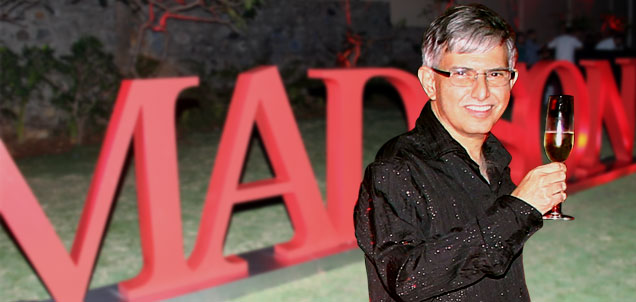
    Presenting the numbers to the fraternity in Mumbai, Sam Balsara, Chairman and Managing Director, of leading media services conglomerate Madison World said that the time to be cautious – which was the state that the industry was in for much of 2013 – was almost over and that the year ahead would be even more fulfilling with growth projected in the range of 16.8 per cent.  The report was presented by Madison World in conjunction with the exchange4media group’s Pitch magazine.


    “It is great to be clocking a growth rate in double digits, which has come as a boon to the industry that was stuck in clouds of uncertainty given the economic downturn that was witnessed for much of last year,” affirmed Mr Balsara. “Compared to 2012 that registered revenues to the tune of Rs 28,694 crore, the year 2013 reported numbers equalling Rs 31,877 crore, growing by 11.1 per cent. In fact 2014 would outperform the previous year and would register an estimated growth of 16.8 per cent, with revenues totalling Rs 37,216 crore,” said Mr Balsara, beaming.


    According to Mr Balsara, the core factor that would bring in the growth for the industry would be the Lok Sabha and the state Assembly elections scheduled for 2014. This would also include spendings by individual political candidates that would be investing money in reaching out to the masses.


    Presenting a medium-wise break-up to the gathering, Mr Balsara said that like last year, this year too belonged to Print that emerged as the numero uno medium. Advertisers took a liking to the medium as it reported a growth of 10 per cent with revenues equalling Rs 13,167 crore. This was largely due to increased advertising by sectors such as FMCG that contributed by 12.3 per cent to the overall ad pie (replacing Auto from the top spot) and Auto that contributed around 11.7 per cent. Education though saw a decline to 9.71 per cent versus 10.6 per cent share registered last year.


    When asked by MxMIndia to share his observations on the projections for the medium of Print, Varghese Chandy, Chief General Manager, Marketing, Advertising Sales, Malayala Manorama said that the growth was indeed a bullish one for the sector. “I am excited by the numbers that we have managed to throw up as a medium. The fact that we have still got the advertisers attention by being the number one medium of choice is a big thing.” Sharing further on what will drive the sector in 2014, he said that the Lok Sabha elections and the assembly elections that will take place in 2014 will bring in the necessary revenue growth that the medium is known for. But he had a word of caution for the magazine sector as he said that it would still be a task for magazines to contribute as much growth as newspapers too. “While niche and regional magazines will continue to deliver good growth, overall the magazine industry will still be challenged on the growth front.”


    Following the medium print closely was Television that recorded a growth of 8.2 per cent with revenues totalling Rs 12,410 crores. This was in sharp contrast to 2012 where the medium registered a zero per cent growth. Where sectoral contribution was concerned, Media, Retail, Alcoholic Beverages and Corporates registered a negative growth with only FMCG registering a positive growth for the medium. The medium is further expected to grow by 15 per cent in 2014.


    The next medium to vow the advertisers was Digital that has now become the third-most preferred medium for advertisers on a consistent basis. With revenues totalling Rs 3,050 crore the medium grew by a good 32.4 per cent and is expected to grow by 29.5 per cent in 2014 as well. Of this, display advertising will continue to have an upper hand compared to search with revenue numbers totalling to Rs 2,150 crore.


    Siddhartha Mukherjee, Category Director, Chocolate and Media, Cadbury India, Mondelez International was optimistic of the returns that the medium would deliver in 2014. Affirming to this writer, he said, “Going by the projections that were presented today and by the points bought up by panellists, there is no doubt that digital will continue to remain a go-to medium for many advertisers. That is what would be of importance to us too.”


    The mediums of Radio, Outdoor and Cinema combined accounted for the remainder 12-13 per cent of the ad chart with Radio accounting for revenues totalling Rs 1,097 crore (18 per cent growth), Outdoor clocking a growth of 6.2 per cent at Rs 1,977 crore and Cinema registering a growth of 10.4 per cent at Rs 167 crore.


    The evening also witnessed keynote addresses being delivered by dignitaries including Adi Godrej, Chairman of the Godrej Group, Uday Shankar, CEO of Star India, and Girish Agarwal, Director, Dainik Bhaskar Group who presented a roadmap that the industry could adopt to change their business fortunes and also derive positive growth for the several mediums under Media.


  • INMA 2012: ‘News is not static but dynamic’

    By Shruti Pushkarna


    Sanjay Gupta
    [youtube width=”400″ height=”225″]http://www.youtube.com/watch?v=alB7H-4TpGU[/youtube]

    The International Newsmedia Marketing Association (INMA) hosted its 6th annual South Asia conference in New Delhi on August 7. With its theme of ‘Complexity Advantage’, Day 1 of the INMA conference witnessed some power packed sessions.


    One such session, ‘The Future of News’, was moderated by Jacob Mathew, Executive Editor, Malayala Manorama and President, WAN-Ifra. The session saw a lively discussion by the two eminent panelists, Mr MJ Akbar, Editorial Director, India Today & Headlines Today and Mr Sanjay Gupta, CEO, Jagran Prakashan Ltd.


    The technological innovations and its resultant empowerment of individuals have significantly changed the way people consume news today. Introducing the topic,’The Future of News’, Mr Mathew raised a few key questions: “Would the existing formats be relevant to the future? How will we ensure that news is available anywhere anytime in any format to be consumed by our readers?”


    He added that the growth of print has still not been affected as much in South Asia and that the countries in the region should learn from the mistakes made by colleagues in the rest of the world.


    MJ Akbar
    [youtube width=”400″ height=”225″]http://www.youtube.com/watch?v=Z5gZXE8988w[/youtube]

    Addressing the basic worry around the future of news, Mr Akbar said: “The reason why news will always be in demand is because man is not a hermit. Man lives in a community and in any community, ignorance is the basis of all conflict. Curiosity is elemental to human experience and as long as curiosity remains a vital part, news will thrive.”  He added that news needs a vehicle and that will be provided by news organizations in the future as well.


    Mr Akbar alleged that the real problem facing the society today is not the future of news but the future of a ‘journalist’. He pointed out two traps that journalists today increasingly fall into: “One trap is a fish trap where a journalist looks at the bait and swallows it. This trap is a dangerous challenge to credibility of news as this form of journalism is based essentially on what the journalist has ‘heard’. The other trap is delusion trap where the journalist thinks he/she is more important than news.”


    Mr Akbar also compared the newspaper to a ‘thali’ which has a variety of food ranging from healthy ‘dal and rice’ to not-so-healthy ‘achaar'(pickle). He said: “No thali is complete without achaar, but on the other hand, achaar cannot replace dal and rice.”


    Coming back to the basic point in question of how big a threat does technology pose for the print industry, Mr Akbar said: “No technology completely destroys another. They all continue to exist together. The only thing that will be destroyed in the future will be your business plans which will have to be reoriented.” He added that there is no essential competition between products (radio, TV, newspaper), every product has its own rationale and news organizations have to be ‘format-driven’.


    He concluded: “As long as the newsmaker and the news owner understand that news is not static but dynamic, there’s no reason to worry.”


    Mr Gupta echoed Mr Akbar’s views and maintained that there will be news as long as there’s society and as long as there are incidents taking place. He said that the new technology does help in uncovering the truth faster and in an easier way sometimes, but the basics of news is to uncover the truth. It is important, he said, that news media engages audience in a public debate over issues that matter.


    Mr Gupta added that good journalism is good business and he concluded by quoting Google’s head of news products, Richard Gingras: “The pace of technological change will not abate, and to think of our current time as a transition between two eras, rather than a continuum of change, is a mistake.”


  • ‘If you’re not ready for digital, your company is’: Media Rhythm 4


    By A Correspondent


    Stratagem Media Pvt. Ltd, an independent media services company, held its fourth training program called ‘ReveNEW Concepts – The Media Rhythm series and Ideas’ on July 21 in Mumbai. The workshop saw participants from The Times of India, The Hindu, Malayala Manorama, Eenadu, Amar Ujala, MY FM and other media companies.


    Among the speakers were Mr Sundeep Nagpal, Founder Director at Stratagem Media Pvt. Ltd; Mr Suresh Balakrishna, CEO, Brand Programming Network; Mr Bharat Kapadia, Chairman, Whatuwant Solutions and Mr Madan Sanglikar, a digital media expert and CEO, AD2C.


    About bending backwards with ease:

    Mr Nagpal, the first speaker of the day, delved on ‘Bending back with ease’ wherein he asked the participants to first know what they are selling. He said that instead of selling many things at one time, there has to be some clarity and certainty of what is being sold and only then the expectations of the clients can be met. Mr Nagpal also spoke about the importance of reminding the consumers about the brand even after awareness is created: “A consumer needs to see the ad frequently. Time and again we have been able to convince clients that in a crowded market, playing one advertisement is not enough. Therefore a reminder is very important.”


    He also said that even though there is awareness, reminder and high impact, the brand may not sell as the problem could be because the competition is making more noise. “At times when everything is good, there is no recall because competition is making more noise. Response measurement is very tricky and must be done in a scientific way. Low response could be because of the lack of good features, price and distribution issues,” he said.


    Mr Nagpal also pointed out that it is very important to know the client’s business or product: “If you are managing client expectations, you must also know the client’s needs. When you do consultative selling, you can reduce the discount selling.”


    He also spoke about the two ways a brand can grow. First, get new consumers and second get the same old consumers to consume the brand more frequently. Some other ‘home truths’ Mr Nagpal shared were: remove discount, adopt differential and value based pricing.


    He said it is important to know the competition as is important to calculate, permute and innovate and that you can always refuse a business instead of selling lower than what you deserve.


    Customising media usage for brand communication:

    Mr Suresh Balakrishna kick-started his session by playing a one minute trailer of the film ‘Rocket Singh, Salesman of the Year’ as an example of how one should and can sell his brand to the consumer. He spoke about going beyond media objectives and looking at communication objectives, quickly pointing out that the media objective is only a channel; the client however wants a communication objective. “You need to create a connect between communication objective and media solution. It is important to understand the communication objective of the client, his needs and aspirations as well. You must, therefore, involve your clients and listen more to what your client wants.”


    Mr Balakrishan presented three case studies – Union Bank of India, Vodafone, and Cadbury Dairy Milk Shubh Arambh. He split the participants in different groups and asked them to do various exercises on the case studies presented. He gave the participants various challenges and asked them to come up with solutions to those challenges: how they would have connected with the consumers; how they would have amplified a particular campaign in the media or solved a certain problem in a different way.


    On Motivation and Innovision:

    Mr Bharat Kapadia spoke about the importance of motivation in an individual and the need for ‘innovision’- a combination of innovation and vision. “Everyone cannot have wrong card, what is important is how you play your cards. Unless ‘You’ believe that nothing is impossible, nobody will be able to help you out. Whenever you are given a tough task, don’t see it as impossible, but instead attempt it to raise the bar for yourself.”


    On the need for innovation, Mr Kapadia stated that even innovation needs to have a vision. He said that one needs to innovate, to not only stay ahead of the competition, but also to create a new experience or even to solve a problem which at first looked quite challenging.


    Mr Kapadia shared four crucial points for innovation: Uniqueness, Impact, Achieving the goal and Sustainability. He was quick to state that ideas and creations are nobody’s monopoly as each one is capable of generating ideas. Therefore, one needs to start thinking without any baggage.


    He also stressed that an idea needs nurturing, which could be achieved with the help of family, friends and colleagues. He asked the participants to mentor the ideas of their juniors, so that they would come up with better ideas. But he was also quick to stress that the real test lies in the execution of the idea. One must always think of the end objective of their idea, and the hurdles they might have to cross.


    Mr Kapadia also warned the participants about the dangers of an idea: “Be careful that your idea is not gimmicky and irrelevant, the idea must fit into the objective of the brand. A good idea becomes a great idea if it is implemented well.”


    He also told the participants not to be afraid of mistakes and failures, but to learn from them. Mr Kapadia shared his experience about how he managed to successfully execute the Bru Coffee aroma campaign on The Hindu and the challenges he have to overcome to execute the campaign successfully.


    Mr Kapadia also gave participants some practical or exercise work during his session. He asked them to come up with an innovation for any media vehicle for any brand, whether existing one or a fictitious one. He asked them to exploit the strength of that medium. The teams were split into five groups.


    While concluding his session, Mr Kapadia reiterated that an idea is no one’s monopoly. It must however be relevant, feasible and beneficial to the client. He concluded: “There is no dearth of money in the market because it is all about a good idea. If you come up with a good idea, then the client will also shell out the money required for that idea. A good idea can even bring new advertisers.”


    Teleporting to 2015:

    Mr Madan Sanglikar shared nine concepts on digital, emphasising the growth of digital and the implication of that growth to other medium and the brands. He spoke about the future of print, television, gaming, mobile, social media, e-commerce, data visualization and eco-system transition, pointing out the need to think digital, that innovations are also happening on digital, and the fact that digital media is the fastest growing medium in the country.


    He said that the growth of digital will see more advertising categories increasing their spends on digital. He also said that digital will reduce the urban- rural gap. On the future of print media: “Print will be the biggest beneficial from the digital growth among the media categories. Dailies and magazines will get a new lease of life and static and AV (Audio Visual) formats of content and ads will co-exist.”


    On the future of television, Mr Sanglikar said that television experience will get better, a lot of which will be gesture controlled. Online video format will merge with television; it will create an explosion of online and on-demand videos.


    Talking about the gaming market, he stated that it is expected to grow to Rs3,100 crore by 2015 and there is a shift of gaming from bedroom to living room, wherein it becomes a family entertainment medium.


    Mr Sanglikar gave the example of a bakery in London who used Twitter to attract customers to his bakery as an example of how social media can be used for enhancing the business. He said that very soon there will be no emails as corporate social network will see huge growth.


    On the e-commerce front, Mr Sanglikar stated: “E-commerce market is also growing tremendously. Online shopping is getting more interactive with more pay options available and newer shopping categories soon catching up.”


    Mr Sanglikar also explained the difference between paid media, owned media and earned media and how today we are witnessing owned media and earned media share growing. He concluded: “Digital is like another medium and not imbibing the medium will not work. If you are not thinking about digital, your companies are certainly thinking about it.”


    What the participants say:

    At the sidelines of Media Rhythm 4, MxMIndia spoke to some of the participants for their views on the daylong event. According to Mr Subin Thomas from MY FM: “It was very interesting and fun too. Mr Suresh Balakrishna’s session was especially very good. There has been lot of learning, especially about innovation and communication objective.


    Ms Zeenat from Eenadu said: “The workshop was definitely helpful for us as it helps us with new ideas. After being in the industry for a long time, you tend to get a rigid mindset but, when we attend such forums where so many different issues are discussed, it refreshes our thoughts and allows us to think differently. The session on digital will probably help us in our work in digital.”


    A Times of India participant said: “It was a good way of looking at certain things and even on media selling. All in all it was a good and interactive sessions. There have been some good learning and takeaways too. I would also be taking some of the takeaways from these sessions to my clients.”


    Mr Soham Khimani from Malayala Manorama said: “The sessions were really wonderful and the speakers too were good. There was lot of creativity in the session which is very important in media sales today.”
     

  • KAAA asks govt to end Kerala newspaper distribution impasse

    By A Correspondent


    Continuing with the situation that has been created by the newspapers vendors in Kerala, T Vinay Kumar, President, Kerala Advertising Agencies Association (KAAA) has addressed the issue. In a letter to its members he has mentioned how the strike has affected the advertising agencies and the loss of considerable amount of business in the last one week.


    As both the parties including the vendors and the publisher cartel being adamant with no signs of issue being resolved, KAAA has been left with no option but to interfere to safeguard its interests, and has made a statement in mainline dailies requesting the CM and the involved parties to take a stand to end this impasse.


    They have also planned a symbolic distribution of newspapers near Ernakulam Public Library today (March 29), followed by a meeting in front of the residence of Justice VR Krishna Iyer who will share his views on solving the issue.


    It has been more than a week since newspaper distribution in Kerala has come to a stop with Newspaper Agents & Distributors Association demanding 50 percent commission of the cover price of the newspaper, pension, medical insurance, extra payment for advertising supplements, and stoppage of inserts, among other things. The Hindu, Mathrubhumi and Malayala Manorama have vehemently opposed these demands while Indian Express has agreed to 40 percent commission.


  • IRS 2011Q4: Not much change in rankings but dailies witness significant growth

    By A Correspondent


    Top 10 Hindi Dailies:

    IRS Q4, 2010 v/s IRS Q4, 2011

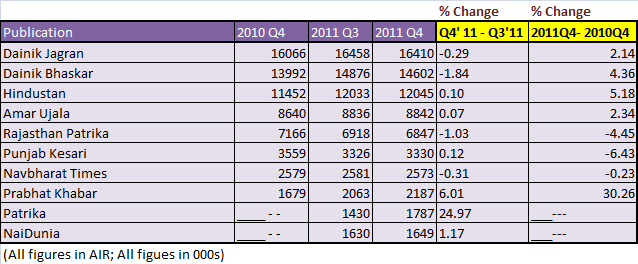
    There is not much of a difference in the rankings of the Top 10 Hindi Dailies. Dainik Jagran, Dainik Bhaskar,Hindustan, Amar Ujala and Rajasthan Patrika continue as the Top 5 Hindi Dailies. When compared to IRS 2010 Q4, IRS 2011 Q4 reveals the Top 4 Hindi Dailies, namely Dainik Jagran, Dainik Bhaskar,Hindustanand Amar Ujala have further strengthened their readership.


    A look at percentage change from Q4, 2010 to Q4, 2011 finds that Dainik Jagran has witnessed a growth of 2.14 per cent, Dainik Bhaskar grew by 4.36 per cent,Hindustanby 5.18 per cent while Amar Ujala grew by 2.34 per cent. The only Hindi daily to have witnessed double digit growth is Prabhat Khabar with a whopping 30.26 per cent growth in Q4, 2011 as against Q4, 2010. A total of five Hindi dailies have witnessed growth Quarter on Quarter.


    Q3, 2011 Vs Q4, 2011

    But the results for IRS Q4, 2011 Vs Q3, 2011 have a slightly different story to tell. The top two most read Hindi dailies – Dainik Jagran and Dainik Bhaskar – have witnessed a decline in Average Issue Readership (AIR), the decline is however marginal. Besides Dainik Jagran and Dainik Bhaskar, the Hindi dailies to have recorded growth in Q4, 2011 v/s Q3, 2011 are Hindustan, Amar Ujala, Punjab Kesari and Prabhat Khabar.


    Top 10 English Dailies:

    IRS Q4, 2010 Vs IRS Q4, 2011:

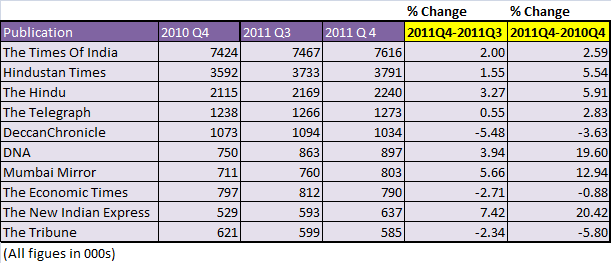
    The English dailies have performed exceedingly well in Q4, 2011. Seven out of the Top 10 English dailies have registered growth in their AIR. While DNA, Mumbai Mirror and The New Indian Express have registered growth in double digits, the top four English Dailies: The Times of India, Hindustan Times, The Hindu and The Telegraph have also witnessed growth quarter on quarter.


    IRS Q4, 2011 Vs Q3, 2011:

    The results for Q4, 2011 in comparison to the previous quarter also highlight the growth for most of the top Ten English dailies.


    Top 10 Language Dailies:

    IRS Q4, 2010 Vs IRS Q4, 2011:

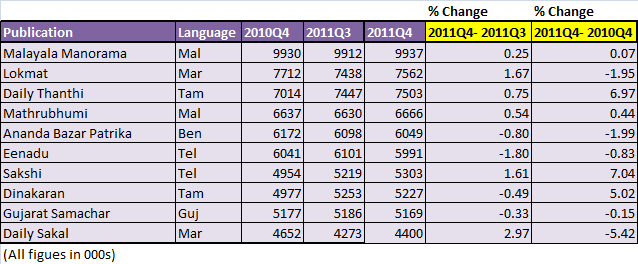
    The Q4, 2011 results as compared to the Q4, 2010 results have shown mixed reactions for Language dailies as only five publications witnessed growth since Q4, 2010 to Q4, 2011. Malayala Manorama continues to be the number one publication among the Language Dailies. According to IRS Q4, 2011 v/s Q4, 2010 findings, the Malayalam daily grew 0.07 per cent.


    Ranked second is Marathi daily, Lokmat which saw a decline of 1.95 per cent. The other Language dailies to have registered growth in their AIR are Daily Thanthi, Mathrubhumi, Sakshi and Dinakaran.


    Unlike the top two dailies, Daily Thanthi, ranked as third Language daily, grew by 6.97 per cent in IRS Q4, 2011 when compared to IRS Q4, 2010.


    It has been observed that the Malayalam dailies – Malayala Manorama and Mathrubhumi and the Tamil dailies – Daily Thanthi and Dinakaran have recorded growth in their AIR. Malayalam, Marathi, Tamil, Telugu, Gujarati and Bengali are some of the popular language dailies to have found a place in the Top 10 Language dailies.


    IRS Q4, 2011 v/s Q3, 2011:

    The top four Language dailies: Malayala Manorama, Lokmat, Daily Thanthi and Mathrubhumi have registered growth in their AIR numbers in IRS Q4, 2011 v/s IRS Q3, 2011. Besides the top four language dailies, Sakshi, the Telugu daily and Daily Sakal, the Marathi daily have also witnessed growth in their readership numbers.


    AIR or Average Issue Readership is defined as the readers of an average issue of a publication i.e. the estimated number of those who have read or looked at any issue of the publication within a specified time interval, which is equal to the periodicity of the publication (excluding the day of the interview). This is the preferred currency of media agencies across the country though often publications quote Total Readership (TR) when their AIR numbers are not impressive. MxMIndia only uses AIR in its IRS reportage.

  • It’s wait ‘n watch for TOI-Matrubhoomi alliance

    By A Correspondent


    After much speculation, The Times of India has finally made its foray into the Kerala market, forging a strategic alliance with Mathrubhumi to make inroads into this market. While for readers this alliance might be the best deal as just for Rs2 extra they get a copy of Mathrubhumi and the TOI with its many supplements, as a reader quipped: “This is not a bad deal for 2 bucks”.


    This exactly is the sentiment that TOI wants to ride upon – the bundling with a regional newspaper which the readers are familiar with and allow them to test something new definitely is a great way to enter a new market dominated by regional players.


    Kerala, in that sense, is a unique market with high literacy rates and people who are proud of their culture, willing to try something new but not at the cost of old. Hence, it is primarily seen as a two newspaper-market where one paper is regional, which appeals to the older generation and is more of a habit, and the other is an English newspaper appealing to the younger population.


    It is this younger population that TOI is trying to appeal to. The English newspaper market is primarily dominated by The Hindu, The New Indian Express and more recently Deccan Chronicle. The Hindu too has become aggressive and gone all out to protect its turf.


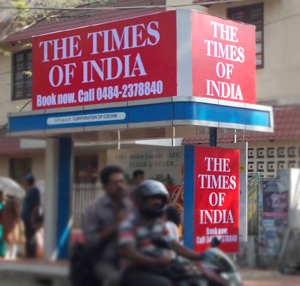
    Recently, on January 29, just two days ahead of the TOI launch, The Hindu and The Hindu Business Line launched its Kozhikode edition. This shows that The Hindu understands the might of TOI and has gone aggressive with its 360 degree campaign to reiterate its hold over this market. In fact, it has also taken around 30-35 hoardings to make itself visible while sources inform that TOI has taken up around 80 hoardings across to announce its presence in Kerala.


    The divide in Kerala, according to reading preference, is: South to Cochin (till Trivandrum) is where readers prefer Malayala Manorama whereas the area from Cochin to Kasaragoda is dominated by Mathrubhumi. This liking is also based on the political inclination too. Currently, TOI has come out with editions fromKochi, Thiruvananthapuram,Kozhikode, Kottayam, Pathanamthitta, Malappuram, Palakkad, Thrissur, Alappuzha and Kollam, thus being seen all over Kerala.


    However, it is learnt that the paper is having teething troubles: The newspaper is not available at many places; the hawkers union’s in Kerala raising ruckus over the availability of the newspapers in some pockets.


    Giving his view, Kiron Kurian, Group Manager, MudraMax said: “For TOI the real competition is The Hindu in this market. Their current strategy of tying up with Mathrubhumi, as I see, suggests that as the former caters to Sec A and B audience it will be easier to convert this TG to also adopt TOI as a second newspaper.”


    Swarup BR, Founder Stark Group, a Kerala-based 360-degree communication agency feels: “I think largely the TOI offering in Kerala market is nothing phenomenal from what has been seen in the other markets. There would be many people who would want to try out the newspaper and along with their aggressive marketing strategy, it should work out well for them.”


    However, for all, it’s ‘wait and watch’ to see how the market evolves. Some feel that a new trend might start with homes having three newspapers, with both Hindu and TOI having their share of readers. Also there could be revised rates to capture more audience.


    This TOI- Mathrubhumi alliance, while is advantageous for the former, will also be good for the latter as it might give it the much needed push that it requires to lessen the gap with the leader Malayala Manorama.


    Vidya Nandakumar, Business Director, LMG based in Cochin is doubtful that TOI will find it easy to break the monopoly of The Hindu. She said: “In Kerala people are die-hard loyalist and if they like a brand, it is difficult to make them switch. So it would be interesting to see how TOI gets them to convert.” She is of the opinion that probably it would be some pockets where TOI might succeed.


    But Mr Swarup countered: “Kerala is a ‘rurban’ economy; hence there is no clear divide between rural and urban. The brand proliferation too is across the market hence it is one big market. The opportunity for a TOI to reach across is immense. The entire state is a captive market, not just few pockets of interests. Yes, The Hindu is a formidable power and people would not be willing to give the newspaper so easily for TOI. So in that sense it would be interesting to see how the market plays itself out. It is possible that a whole new audience will evolve who will be readers of TOI.”


  • Radio Mango in 4th anniv mode, to consolidate in Kerala for Phase III

    By A Correspondent


    Radio Mango, an FM radio venture by Malayala Manorama, a Malayalam daily, aims to consolidate its position in Kerala once FM Phase III is officially rolled out. It is however not known which cities the FM station would bid for as they are currently awaiting clarity on the phase III. “We would definitely look to consolidate our position in Kerala. We are still unclear about the reserve price calculations and await clarity before finalising our phase III plans,” said Ravindran Nair, Director Programmes, Radio Mango.


    He further said, “We are confident of growth in 2012 since we have been steady since the last 4 years. The key factor in the quantum of growth, of course, would be phase III.”

    In Kerala Radio Mango is aired in Kochi, Trissur, Kozhikode and Kannur. Red FM and Club FM are its main competitors in these cities besides the All India Radio (AIR) FM stations. On November 29, 2011 Radio Mango will celebrate its fourth anniversary however the FM station seems to be in no mood for big celebrations.

    Radio Mango claims that its national and local advertising ratio is almost 50:50. Some of its national advertisers are Maruti, Hero Motors, Nokia, Blackberry, Max Bupa, Kenwood, Airtel, Docomo, Belkin, Ford, Hyundai, Sharp, and Philips etc. Nearly 80 per cent of songs aired on Radio Mango is Malayalam film songs and the rest 20 per cent from non-Malayalam music ie Hindi and Tamil songs. Besides its on-air activities, Radio Mango is quite active online too. It has over 5,700 likes on its Facebook page and nearly 300 followers on Twitter.


    In conversation with Ravindran Nair, Director Programmes, Radio Mango.


    Q: Since November 29, 2007 when Radio Mango first went on air, until the year 2011 how has the journey been for Radio Mango? 
    Radio Mango has had a great period of sustained growth since launch. We have been consistently No.1 in the state and have been figuring in the top 20 nationally in terms of reach. In IRS Q2, Radio Mango is 16th nationally, in terms of reach (11th if AIR stations are excluded). In terms of reach within a state, Radio Mango ranks 5th nationally! Radio Mango has grown by 45 percent in Yesterday’s listenership over the last one year. Within Kerala, Radio Mango leads the no 2 station by 81 percent in terms of reach. (All figures are from IRS Q2 2011).


    We have won several national and international awards including New York Festival silver and bronzes, Wow Experiential Marketing Award golds, ERA golds etc. In fact, we are the only radio station in India to have won Mirchi Kaan Award golds for two years running.  We also figure in the Limca Book of Records for our musical reality show ground event.
    Q: How do you plan to celebrate Radio Mango’s fourth anniversary?
    We don’t look at months and years as landmarks. We would rather have our achievements be the milestones. Hence, all our anniversaries are private internal affairs and we don’t tom-tom in public.
    Q: Can you throw some light on your phase III plans? Will the FM station expand in cities/ towns of Kerala or will the expansion be beyond Kerala i.e. other parts of India?
    We would definitely look to consolidate our position in Kerala. We are still unclear about the reserve price calculations and await clarity before finalizing our phase III plans.


    Q: How has the response from advertisers been? What is the national-local advertising ratio?

    The response from the advertisers has been good so far. The national and local advertising ratio is almost 50:50. Some of the national advertisers are Maruti, Hero Motors, Nokia, Blackberry, Max Bupa, Kenwood, telecom majors like Airtel, Docomo, Belkin, Ford, Hyundai, Sharp, and Philips etc.


    Q: For 2012 what are your growth targets? How will you sum up 2011 for Radio Mango? 
    We are confident of growth in 2012 since we have been steady since the last four years. The key factor in the quantum of growth, of course, would be phase III. 2011 has been a great year and we are very pleased with our overall performance. The Radio Mango brand has never been more robust and recognised.


    Q: Who is your creative and media agency?
    Our creative and media agency is Stark Communications.