Tag: Makemytrip

  • MakeMyTrip looks to get close to consumers with ‘Dil toh roaming hai’

    By A Correspondent


    MakeMyTrip unveiled its new brand-advertising campaign that has been conceptualized with the objective to strengthen the brand’s connect amongst travellers and drive its adoption among new consumers. Through this brand repositioning exercise and the new tag-line ‘Dil Toh Roaming Hai’, MakeMyTrip intends to be travel partner that fuels the growing travel ambition of customers at large.


    The campaign reflects the company’s strong connect and deep understanding of Indian consumers along with the width of its travel solutions. The film also integrates MakeMyTrip’s service offerings that enable a seamless and hassle-free travel experience. The voice over for the TVC has been given by the acclaimed Indian film and stage actor and director Naseeruddin Shah. The brand film will be promoted on TV, social media and digital platforms from 27th April.


    Commenting on the new avatar, Saujanya Shrivastava, CMO, MakeMyTrip said “MakeMyTrip has been instrumental in changing the way India travels. With the widespread adoption of Online Travel, it was imperative for us as the category leader to unearth a deep-rooted customer motivation and strengthen our association with customers. Leisure travel today is part of lifestyle discourse and there is a strong customer need to come across as “interesting”. Travel is a via media to increase the “interesting” quotient. Like financial or career ambition, people today have a Travel Ambition. The brand repositioning campaign seeks to partner the emergent customer in their growing travel ambition….”


    The story of the characters, in the ad campaign, has been brought to life by Joy Mohanty, National Creative Director, Publicis Capital. Talking about the creative concept, Joy said, “There was a time when it mattered if you were well-read. Today, it is of great importance to people to be well-travelled, and to have a repository of experiences to draw from. It is this that creates the ambition, or a khwaish, that every person wants to fulfill. Our new commercial is about these little stories behind the journeys, the desire to travel for oneself, or for someone else. It is this ambition that drives a son to take his 65-year old mum to see snowfall for the very first time, or for deadline-chasing dinks to lose themselves in the middle of nothingness. MakeMyTrip is the catalyst that helps fulfill these varied travel ambitions that are fast-growing in every corner of the country. And what better time to do this than the holiday season.”


  • Publicis bags MakeMyTrip biz

    By A Correspondent


    Saujanya Shrivastava

    MakeMyTrip has awarded its creative mandate to Publicis Communications. The pitching process included a total of 9 agencies including O&M, JWT, Lowe, Leo Burnett, Contract, Dentsu, Enormous and FCB (incumbent) had been part of the process.


    Welcoming Publicis on board, Saujanya Shrivastava, Chief Marketing Officer of MakeMyTrip said, “We are delighted to partner with Publicis to take the brand agenda forward and unlock growth opportunities in the online travel category. I am confident that Publicis, with the planning and creative horsepower it possesses will deliver on this exciting mandate. We look forward to the association which will kick-start with our new brand campaign to be launched shortly.”


    Hemant Misra

    Hemant Misra, CEO Publicis Capital added, “We unlocked some very interesting spaces that helped us win the pitch. This is one of those rare instances where the pitch work is also the final creative. The team at MMT has infectious passion that seems to have caught my entire team. We are looking forward to the travel ahead”


  • FCB unveils ‘Uncancel’ for MakeMyTrip

    By A Correspondent


    MakeMyTrip has launched ‘Uncancel’, a first-of-its-kind feature that enables travellers to reschedule a trip with just a click, instead of cancelling it altogether.  In an added delight, the trip is re-booked at the original cost, making it a win-win for the customer.


    The feature was conceptualized by FCB Ulka to enhance the company’s reputation as a customer-focused brand. Research indicates that customers face significant disappointment and distress while cancelling their travel plans and facing the prospect of increased cost of re-booking at a later date. This is also a big deterrent from undertaking the trip again – a sentiment that cut across age groups.


    FCB Ulka hit on the idea of “Uncancel” to establish how MakeMyTrip understands and appreciates the emotions attached to a trip. This feature was launched through social-media activation (including influencer and blogger engagement) and broad-scale digital advertising campaign. The entire campaign is centred on the powerful and emotionally resonant brand belief – “Some trips are more than just trips”. FCB Ulka has developed end-to-end communication including Customer Care Centre Scripts, Introduction Mailers, Digital Banners, and the launch films.


    Sachin Das Burma

    Sachin Das Burma Group Creative Director, FCB Ulka says: In Advertising, we usually wait for the client to develop the product and give us the brief to create communication. But in this case, we took the lead in recommending a product, scoping out its features and then designing the entire communication package. We were lucky to have a client who trusted our vision and persevered through a long period of conceptualization that involved massive changes at their end – in product features, processes and technology integration.”


    The communication campaign includes three short films, expressing how a trip can be more than just a trip, with the protagonist facing an impending cancellation. MakeMyTrip’s Uncancel then provides a way out for the traveller to continue with their trip at a later date. The first film is already live, and received tremendous positive feedback and brand buzz. The two films to follow will also be released on digital platforms only – marking another first for MakeMyTrip.


  • MobiKwik appoints Mrinal Sinha as Head of Strategy

    By A Correspondent


    Mobile wallet firm MobiKwik has appointed Mrinal Sinha as Head of Strategy. Prior to this, Mr Sinha was Founder and Executive Director at Brattle Foods, a food supply chain solutions and logistics business. He was instrumental in raising $8 million in equity financing and growing revenues to $10 million. At MobiKwik, he will helm the strategic roadmap with the management, identifying key opportunities for talent and technology acquisition, fostering crucial alliances and kick starting new revenue lines within the company.


    Said Bipin Preet Singh, Founder CEO, MobiKwik on the appointment: “Having established the MobiKwik brand as the leading mobile wallet in the country, we are now looking at strategic expansion and diversification. Mrinal will play a pivotal role in our further evolution thanks to his years of business development and corporate strategy experience across domains. We are pleased to have him on board.”


    On his appointment, Mr Sinha said, “My objective will be to leverage my education and experience to chart out the expansion strategy for MobiKwik, form key partnerships with banks, device makers and other payments companies. I am also looking forward to identifying new business lines for MobiKwik and set the ball rolling for the same in the near future.”


    Mr Sinha has a dual degree (Master’s and Bachelor’s in Technology) from the prestigious IIT-Madras. He also has an MBA from the Harvard Business School. He has worked with McKinsey & Company, Michael & Susan Dell Foundation and EMC Corporation. The appointment comes soon after that of former MakeMyTrip Vice President, Technology, Virender Bisht as the Chief Technology Officer.


  • FCB Ulka campaign for MakeMyTrip’s mobile app

    By A Correspondent


    Growing beyond just providing voice calls, text messages, games and music, mobile devices have now also become the preferred choice to do online bookings. Though the mobile phone is convenient in many ways yet sometimes it puts us in sticky situations. Bringing on this insight that phone can put you in trouble, FCB Ulka has come up with its new TVC for the MakeMyTrip mobile app.


    The commercial aims at empowering the consumers to make instant flights and hotel bookings from anywhere, anytime and redeem themselves when stuck in an awkward situation.


    Mohit Gupta, Chief Business & Marketing Officer, MakeMyTrip, said “Mobile is the perfect channel for a travel company to provide real value to the customer and create higher engagement by enabling an easy travel-booking experience. Mobile provides a smoother user experience, increased personalization and allows faster access to relevant information. The film exhibits how MakeMyTrip mobile app provides instant bookings and cancellations of flights and hotels from anywhere.”


    The latest TVC is about a husband who is getting ready for taking a trip to Bangkok. His wife asks if the family can join him but he is insistent that it’s an official trip he and cannot take them. In the midst of their conversation they get interrupted by his friend’s call. Since he is busy getting ready he asks his son to put the call on speaker. The friend goes on talking about how efficiently he managed to fool wife into believing that it is an official trip, while in reality they are going to Bangkok to have fun.


    The commercial closes with the thought that if a mobile can put you in trouble then it can save you from trouble as well. Panicking, the husband asks for the solution which is the MakeMyTrip mobile app and cancel his current booking and re-book a trip for his entire family instantly.


    Commenting on the TVC, Sanjay Tandon – Chief Operating Officer, FCB Ulka said, “Life is really really on the go nowadays. So are travel plans that seize us at a moment’s notice. That is a key role that we are sure makemytrip’s mobile app will fulfil. And we needed to present that in an unexpected burry way.”


  • Gamifying Corporate India


    By Lubna Kably


    At Accenture India, a roll of the dice is all it takes for an employee to become boss. But this out-of-turn promotion is only reserved for those with serious game.


    The management consultancy has introduced a four-level gamification tool which lets employees roll the dice and attempt questions on a wide range of topics relating to ethics and compliance, a company focus in 2014. Employees who clear all levels of the game are designated boss of a virtual organization.


    ‘The word ‘gamification’ – in play across organizations globally-is the application of video game techniques to a business setting in order to make tasks fun and engaging. A pat on the back by the boss has given way to badges awarded via internet or mobile app-driven gamification platforms. What’s more, these badges also count during performance appraisal. Companies also use leaderboards, which let players view one another’s scores, to encourage friendly competition. The main reason for the gamification of the workplace is a young, tech-savvy workforce which likes to mix work and play.


    Research firm Gartner has identified some areas where companies are using gamification such as training, employee performance as well as instilling behavioural change in employees.


    According to Gartner by 2015, 40% of Global 1000 organizations will adopt gamification as the primary means of transforming business operations. But, India Inc has a lot of catching up to do.


    “Currently, less than 10% of Indian corporates use gamification actively. Its true value goes beyond mere employee engagement to impact analysis as well as enabling companies to adopt suitable business strategies,” says Prashant John, executive director at ‘kwench, a gamification solution company.


    If the proof of the pudding is in the playing, Freshdesk a customer support software provider, stands out. “Ever since we introduced gamification features in our software products we’ve also deployed it internally for our own customer support staff,” explains Girish Mathrubootham, founder & CEO. The gamification feature gives points for meeting various parameters, such as fast replies or getting good client feedback. Monthly, four trophies are awarded, for instance, the ‘Customer Champion’ goes to the employee with maximum client satisfaction points. eMee’s gamified social appraisal system, which innovatively captures data points on employee performance, annually saves Persistent Systems, one of its first customers, nearly 30,000 management hours.
    L’Oreal deploys three gamification tools for recruitment from diverse fields such as marketing, human resources, sales and operations. “Gamification tools deployed by us call for solutions to real-life challenges. It helps us screen the applicant’s analytical skills which may not be possible via traditional hiring means. We attempt to recruit 20% of the company’s managerial cadre though gaming channels,” says Mohit James, HR director at L’Oreal.


    Companies are also using gamification tools to change behavioural patterns. At Accenture, a 75-day ‘Stepatholon’ gamification event, helped inculcate a healthier lifestyle. Participants were encouraged to take at least 10,000 steps a day which, in turn, helped teams advance on a virtual map and traverse the globe. Accenture India’s employees collectively covered a distance of over one million kilometres and burned an aggregate of nearly 107 million calories. Manoj Biswas, MD, Human Resources at Accenture India, says: “Gamification helps us to communicate differently. It also helps bring employees together around a single goal or idea.”
    “Going forward, gamification will increasingly involve embedding serious behavioural science elements engineered towards attaining desired business goals,” adds Rakesh Mishra, a researcher in this field.


    MakeMyTrip.com first used gamification for orientation of new recruits. TripOn, which was the gamification platform accessible on individual iPads, provided a competitive expedition into the company’s history, businesses operations, policies and people. Rajesh Magow, CEO says: “There has been an increase by at least 25% in satisfaction scores of new employees. They gain a sharper learning curve in terms of role expectations, performance requirements and cultural assimilation.” The company has now expanded gamification for international destination training programs.


    As the popularity of the gamification is set to rise, companies large and small are concentrating on providing gamification solutions. The games have clearly begun.


    Source:The Economic Times
    Copyright © 2014, Bennett, Coleman & Co. Ltd. All Rights Reserved
    Licensed to republish


  • ‘Digital First’ is theme of IAMAI’s Digital Summit

    By A Correspondent


    As a policy, MxMIndia does not link editorial coverage to business relationships. So even though we have concerns on the Internet and Mobile Association of India [IAMAI] policies on media partnerships for its events, our coverage of the trade body’s reports and events continues.


    And now that we are done with the disclaimer, here’s the main info: the IAMAI’s annual India Digital Summit will be held on February 6 and 7 with ‘Digital First’ as the theme of this year’s edition. If you thought that ‘Digital First’ would mean a lot of discussion on journalistic content, then the list of speakers doesn’t indicate that. The fourth edition of the India Digital Awards will be held on the evening of February 7.


    One of the key sessions in the Summit’s eighth edition is ‘Taking Digital Companies Public: The Journey & Its Learning’. The session will have Sanjeev Bhikchandani of Info Edge, Deep Kalra of MakeMyTrip, VSS Mani of JustDial and Suresh Reddy of Ybrant Digital discussing the merits of digital companies going public and response from public at large.


    The India Digital Summit 2014 will kickstart with IAMAI Chairman and Managing Director, Google India, Rajan Anandan delivering the welcome address followed by keynotes by Ajit Balakrishnan – Founder and Chief Executive Officer, Rediff.com and Chairman Emeritus – IAMAI and the often-on-News-TV Baijayant Panda, MP.


  • Whose Loyalty is it anyway?


    By G Seetharaman


    It could well have been just yesterday when you walked into your friendly neighbourhood kirana store and muttered to the shopkeeper the by-now-familiar line: “Kuch toh discount dijiye, main toh har baar idhar hi aata hoon.” The guy behind the counter perhaps wouldn’t be amused – particularly if he’s never seen you before – but he isn’t likely to show his irritation; instead he may well decide to reward you for your apparent loyalty by shaving a few rupees off your bill.


    Consumers love a bargain – and marketers love to show that they’re giving one. There’s a fair bit of role-playing with the shopper trying hard to show her loyalty and the marketer trying even harder to reward it. Those efforts manifest themselves in wallets swelling with loyalty cards of retailers, airlines and hotels. But are the points that consumers stockpile in the hope of encashing them one fine day juicy enough carrots to keep them coming back for more? Perhaps not.


    C Prabhakar, a Chennai-based company secretary, does not set much store by points-based loyalty programmes. “Rather than waiting for a really long time to earn enough points to redeem them for something I like, it makes more sense to just go ahead and buy it,” he says. Two years back, Mr Prabhakar became a member of the loyalty programme of the Landmark group, which has retail chains like Lifestyle and Home Centre. “Just because I have the loyalty card does not mean I’m going to go there again and again. If I happen to go there, I will use the card, that’s it,” he adds.


    Customers like Mr Prabhakar are a marketer’s nightmare and defy what companies are trying to achieve through loyalty programmes. Siddharth S Singh, associate professor of marketing at the Indian School of Business (ISB) who has researched loyalty management in the US and India, is not surprised. “Companies here have tried to imitate the West. Sometimes loyalty management firms that devise programmes for companies are not experts. They are just IT vendors,” he says.


    Not Very Loyal

    While some retailers in India handle their own loyalty programmes, most of them hire loyalty management companies to do it for them. The loyalty programme market in India is pegged at about Rs 5,000 crore; retail accounts for two-thirds of that, and travel and financial services for 10% each. The rest comes from other sectors including hospitality and also channel loyalty initiatives.


    Loyalty marketing research firm Colloquy estimates the number of loyalty programme members in India to be over 35 million. The points earned in a loyalty programme can be redeemed for discounts or other rewards like movie tickets, accessories and consumer durables. MS Ashok, chief operating officer of Accentiv India, a loyalty management company, says cost is a huge factor in the very limited nature of loyalty programmes.


    “Companies are not able to move their marketing budgets from ATL [above the line] to BTL [below the line]. Loyalty programmes should be a big part of any company’s marketing budget,” he notes. While advertising falls under ATL activities, loyalty programmes are under BTL.


    Bijaei Jayaraj, founder and chief executive of Accentiv’s peer Loylty Rewardz, says even globally loyalty programmes are not very evolved. “Loyalty programmes are much more than points. There are some associated things which companies do not do very well, like suggesting purchases based on a customer’s transaction history,” he notes.


    Loylty Rewardz runs programmes for banks like Punjab National Bank, Bank of India and the State Bank group. Vijay Bobba, managing director and CEO, Payback India, says a good points-based loyalty programme should see a redemption of at least 50% of the points: “There are very few such loyalty programmes here and no programme crosses 70%.”


    Not all brands need a loyalty programme. Those that are either truly aspirational or those that anyways provide total value for money for sure don’t. Mr Bobba gives the examples of Apple (aspirational) and Walmart (value-for money) that can afford to not have a loyalty programme.


    “Apple provides the most premium customer experience and has a huge following. Walmart sells at the lowest price possible.” For others who fall between these two ends of the positioning spectrum, loyalty cards are a great way to identify customers, adds Mr Bobba. Payback India runs a unified loyalty programme for several brands including Future Group, ICICI Bank and travel portal MakeMyTrip.


    Know Your Customer

    Srikanth Chunduri, co-founder of Emart Solutions India, which devises loyalty programmes for companies, says the problem lies in not understanding customers. “It took the guy at the coffee shop I visit regularly six visits to know me. My kirana store owner knows me better. He doesn’t give me discounts for being a loyal customer but gives me convenience of free home delivery,” he observes.


    Vinay Bhatia, vice-president, marketing and loyalty, Shoppers Stop, believes a piece of plastic does not create loyalty: “Points are just the transactional part of the programme. You have to go significantly beyond points.”


    He also says it is better to charge customers for a loyalty card than to dole out freebies. “When a customer pays, he takes interest and asks so many questions about the rewards. That’s what we want,” he adds.


    Shoppers Stop charges Rs 300 for a ‘First Citizen’ card. First Citizen along with Jet Airways’ ‘Jet Privilege’ is among the best known loyalty programmes in the country.


    Over 70% of Shoppers Stop’s revenues come from its 2.8 million First Citizen customers. Marketing professional Tanaz Makujina concurs with Mr Bhatia on the benefits of retailers charging customers for loyalty cards. A First Citizen member, she used to redeem her points but now does not visit Shoppers Stop because she does not like their collection. “I’m not brand-loyal when it comes to retail stores. As I’m not one of those people who will go to a particular shop just to earn points, I won’t pay for a loyalty card again,” says Ms Makujina who owns eight loyalty cards.


    Talking of the points she earns on her ICICI Bank debit card, she says that since she has to visit the Payback site to find out what her points will get her, she does not bother. According to a 2011 Cross-Cultural Loyalty Study by Colloquy, only 42% of shoppers surveyed in India belonged to a loyalty programme compared to 74% of Americans surveyed. Companies, expectedly, say points-based loyalty programmes are effective. “I don’t think there is disenchantment with the points system among customers. It works when you give significant value to your customers,” says Anil Ramachandran, who heads the credit cards business at IndusInd Bank.


    Devendra Chawla, president of Future Group’s Food Bazaar, says the group’s Payback programme has 1.1 million members. “One loyalty card across formats and different merchant establishments certainly works better for customers as they get points on almost every item they buy, and more points get accumulated,” he adds. Parag Rao, business head, card payment products, HDFC Bank, claims the bank’s credit cardholders have displayed the “highest rewards redemption behaviour in the industry”.


    HDFC Bank is the largest credit card issuer in the country, accounting for a third of the total outstanding cards. Kaushal Satam, head, Jet Privilege, says the relationship between accrual and redemption of points is a symbiotic one: “The ability to redeem points is as important as the opportunities to earn those and success in one area determines success in the other.”


    Points are Not Everything

    While marketers emphasise the need for points, they have also realised they have to think beyond points to get their customers to stick with them. Shoppers Stop, for instance, decided to expand its Durga Puja offers outside West Bengal last year and mined its First Citizen database for Bengalis in New Delhi, Mumbai and Bangalore and notified them about the offers.


    “We saw an incremental turnover of Rs 1 crore,” says Mr Bhatia. Apparel brand Louis Philippe also offers sweeteners beyond points to its “Upper Crest” members. “Events like theatre, golf tournament invites and red carpet invites to stores for wine and cheese evenings with Louis Philippe designers and marketing teams have been very well received by members,” says Jacob John, brand head, Louis Philippe India.


    Manisha Lath Gupta, chief marketing officer, Axis Bank, says points are a currency which should be used intelligently. She adds: “There should be different incentives for different customers. For instance, I could give people who have never swiped their debit card bonus points to get them to use their cards.” Axis Bank recently revamped its loyalty programme to make it a pan-bank loyalty programme which means customers can earn points not just on debit and credit cards but also on their savings accounts, internet and mobile banking. “Earlier, redemption of points was in lower single digits but now it is has gone up to 16-17%,” she says.


    Mr Chunduri of Emart Solutions feels companies should think of innovative ways to reward customers. “An online bookstore could send out invites to a book reading,” he says. Companies in India do not know how to leverage their database, according to ISB’s Singh. “That’s what Tesco and BestBuy have done. They focus on their most valuable customers,” he notes.


    Tesco and BestBuy are American and British multinational retailers respectively. Their loyalty programmes, along with that of Amazon’s, are considered among the best. With increasing options for customers for almost every product and service, retaining them is no walk in the park for companies. But such a scenario also provides them with an opportunity to make their loyalty programme stand out from their peers’. Only a handful have done that so far.


    Source:The Economic Times

    Copyright © 2013, Bennett, Coleman & Co. Ltd. All Rights Reserved

    Licensed to republish

     

  • Desi travel portals not amused as Google is set with flight search in India

    By Indu Nandakumar


    A fledgling effort by Google portending the launch of its flight travel search service in India is creating jitters among online flight aggregators, who fear their business model is under threat.


    Google, whose services include Gmail and YouTube, is “very close” to introducing Flight Search in India, according to people with direct knowledge of the plan. Flight Search – first launched in the US and then in parts of Europe – lets users compare fares offered by airlines and book tickets directly from airline websites. This could, in effect, make flight aggregators such as Makemytrip, Yatra and Cleartrip redundant, industry observers said. Another website, kayak.co.in lets users compare flight options from hundreds of travel sites at once.


    In response, the aggregators are considering steps to protect their interests, including a possible complaint to the Competition Commission. They claim discrimination by Google when it comes to search results for queries relating to online travel.


    Separately, Google is the subject of investigations by the Competition Commission based on complaints that it is abusing its dominance in the country’s search-engine market. In February last year, matrimonial site Bharatmatrimony.com had filed a complaint against it.


    Company already faces probes in US, Europe

    Last month, Google launched a ‘Start Searching India’ campaign aimed at providing users with instant responses on weather and flight status, among other things. This move was read as precursor to the eventual launch of Flight Search in India. Google India said in May that it does not comment on future plans or speculation when asked about its plans to launch Flight Search in the country.


    Hrush Bhatt, founder and director of travel portal Cleartrip, refused to count Google’s Flight Search as a direct threat but conceded that it could alter the way aggregators allocate their online marketing budget. “We are not sure what value Flight Search would add to consumers, especially if it can only let you compare prices,” he offered.


    Online travel firms such as Yatra.com, Makemytrip and Goibibo declined to comment. Google denied any knowledge of market participants planning to approach the Competition Commission but said that in the event of that happening, the company will extend “full assistance and cooperation on the matter.”


    “We’re always happy to answer questions about our business,” the company said. KPMG’s Tuteja said that Flight Search is likely to be popular among India’s fast-growing internet user base-150 million at the end of 2012-that has been increasingly been booking travel tickets and hotels through online portals.


    In Europe, Google’s Flight Search is under pressure from travel portals such as Expedia and Trip Advisor, which have filed antitrust complaints against Google with the European Commission for promoting rival services and disrupting fair competition in the online travel space. Flight Search makes use of the vast amount of flight-related real-time information from US based travel information company ITA Software.


    Source:The Economic Times

    Copyright © 2013, Bennett, Coleman & Co. Ltd. All Rights Reserved

    Licensed to republish

     

  • Saavn launches new ad platform

    By A Correspondent


    Indian music service Saavn has announced the launch of its new advertisement platform, Impact. This platform enables brands to identify, connect and engage with its 10.5 million users in India and across the globe.
     

    Impact is an innovative approach to digital and mobile advertising that gives brands 100 percent share-of-voice. Using Impact, brands get complete and exclusive access to all advertisement units on the Saavn web site and mobile apps for a set time period. These include Custom Skin, Web Display, Web Audio, Mobile Spotlight, Mobile Display, and Mobile Audio. Impact is a powerful model that allows brands to build positive associations with their products and services through music. The model has proven to create strong brand awareness, shape brand preferences and increase purchase consideration through undivided mindshare of listeners of Saavn across platforms.


    “In India, we all know that music plays an integral and meaningful part in every individual’s life. Impact is a powerful solution that enables the advertisers to build an emotional connection with their target audience during a passionate, social and engaging musical experience,” Vinodh Bhat, co-founder and CEO of Saavn, said. “The Saavn Impact model is based around engagement, curation and social sharing rather than the archaic click-through. Brands are able to measure ROI in meaningful ways, such as increases in perception, awareness, recall and purchase intent. The byproduct of our strong focus on the consumer experience is helping brands grow their businesses.”


    Some of the major brands utilizing Saavn to reach million of engaged users in India include: Samsung, Lay’s, Pantene, Pepsi, Nokia, Vodafone, Airtel, Hyundai, Domino’s Pizza, 7Up, Nielsen, MakeMyTrip, Max NewYork Life, Google Plus, Nokia, Vanish, Groupon, Intel and several others.


    Saavn delivers a comprehensive catalogue of Bollywood, Indian and regional South Asian music, licensed from more than 200 content providers. Saavn users can search, browse, and play a catalog of more than 1 million tracks; create and save their own playlists; and share their music tastes seamlessly via Facebook.


  • Google, HT Media, Vodafone bag ‘Best Companies to Work for’ accolade

    By A Correspondent


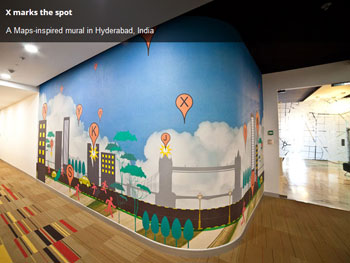
    A Google Maps-inspire Mural in the Hyderabad office. Photograph courtesy: Google.com

    It may not be the best of times to release a report like ‘The Best Companies to Work for’, given the low morale on the economy front and crunch in job opportunities prevailing in the marketplace. But there are companies that prefer to stand aloof from the depressing lot and would like to be counted as being amongst the best places to work for.


    The Economic Times in partnership withGreat PlaceTo Work have released ‘India’s Best Companies to Work for 2012′. The study throws up a diverse line-up of companies as favourites to work for.  Emerging the number one employer is Google India followed by Intel and NTPC at third. Further, five out of the top 10 companies are multinationals, pointing at the role played by global HR practices in stimulating employee satisfaction across workplaces in India.


    The study has been divided into the Top 50 and Top 25 best workplaces. When analysed further, only two out of the Top 25 Best Workplaces are companies which are new to the list of Best Workplaces, the rest having featured in the list in previous years. However, similar consistency is not seen in the Top 50 list in which there are 14 companies which have never featured in the list in India before.


    As for the standings, Gurgaon-based Makemytrip occupies the fourth spot, a drop from last year’s third rank. Amongst the media companies, HT Media Ltd is the only player to figure in the Top 25 list and is ranked 16th.


    Reacting to the win, Rajiv Verma, CEO, HT Media Limited, said: “This recognition is a testament to the strength and integrity of HT Media’s corporate culture. A few years ago, when we crafted a set of long-term goals for our company, we embraced the vision of being an ’employer of choice’. The recognition that we received from the study is a compelling sign that we have been moving in the right direction.”


    Other nominees include Cactus Communications that has been placed at number 20, Cleartrip Travel that is placed at 29th spot, Music Broadcast (operates radio channel Radio City) at number 41, Viacom18 placed at number 48 and Vodafone at number 49.


    In the category of Best in Class, Outdoor Advertising Professionals India Pvt. Ltd. achieves the top spot under Advertising & Marketing; Vodafone India Ltd. is number 2 under Telecommunications; Godrej Consumer Products Ltd., Procter & Gamble, Mars International India Pvt Ltd. and Mother Dairy Fruit & Vegetable Pvt. Ltd. are selected under FMCG; and Google India under IT.


    Some prominent companies that came up trumps across 22 sectors include: Vodafone India in Best Company in Large Organisations (more than 10,000 employees); Makemytrip, Cactus Communications & Cleartrip Travel Services under Professional Services, and HT Media Ltd and Viacom18 Media under Media.


    The study

    TheGreat Placeto Work® framework is based on over 27 years of research of the best workplaces across the globe from employees’ point of view. Some key trends spotted include: overall employee perception of their workplace culture has not changed significantly from 2011 – this is true for all companies, the Top 50, and Top 25 best workplaces in the Study. Thus, while individual companies may have done well or poorly in building trust with their employees, the workplace culture in India Inc., as perceived by their people, remains the same.


    Positive perceptions about their workplace culture continues to be high for senior management category compared to supervisory staff, with 7 per cent less supervisory staff giving positive feedback about their workplace culture. The study further reveals that 75 per cent of employees are below 35 years of age. While they are the majority in most organisations, their views about the workplace culture are significantly less positive than employees over 45 years in age. Only 20 per cent of employees, on an average, have worked in the same organisation for more than five years. There is a slow but gradual improvement in employee perception as one stays longer in an organisation, the study notes.


    As in the previous years, the Top 50 best workplaces are concentrated in Mumbai, NCR and Bangalore, but also have representation from Chennai, Pune, Hyderabad and Ahmedabad. 35 of the Top 50 have more than 1,000 employees, with 14 out of 50 having more than 5,000 employees. Only 7 of the Top 50 Best Workplaces saw employee increases of more than 30 per cent in the previous year, and 6 actually reduced their workforce.


    Also, the percentage of women continued to be low with only 5 of the Top 50 employing more than 40 per cent women employees. Women constitute less than 10 per cent of employees in seven of the top 50. Only three of the Top 50 have more than 30 per cent of their senior management as women. While 15 out of Top 50 best workplaces have employee attrition of over 20 per cent, however, in all major industries, attrition for the Top 50, on an average, is less by one-third to two-third of the industry average.