
Tag: Mahindra Group

  • Sundance-Mahindra award winners announced

    By A Correspondent


    Sundance Institute and India’s Mahindra Group have announced the four winners of the 2013 Sundance Institute – Mahindra Global Filmmaking Awards, in recognition and support of emerging independent filmmakers from around the world.


    The winning directors and projects are: Sarthak Dasgupta, The Music Teacher from India; Jonas Carpignano, A Chjana from Italy-US; Aly Muritiba, The Man Who Killed My Beloved Dead from Brazil; and Vendela Vida and Eva Weber, Let The Northern Lights Erase Your Name from UK-Germany-US.


    The awards were presented at a private ceremony at the 2013 Sundance Film Festival in Park City, Utah, USA, by Rohit Khattar, Chairman, Mumbai Mantra, Michelle Satter, Founding Director, Feature Film Program, Sundance Institute, and Paul Federbush, International Director, Feature Film Program, Sundance Institute.


    The Sundance Institute – Mahindra Global Filmmaking Awards are part of a multifaceted collaboration that exemplifies a commitment to and support of world cinema by the Mahindra Group, one of the largest industrial conglomerates in India known throughout the world for its dedication to excellence and to social responsibility, and the nonprofit Sundance Institute, one of the world’s leading cultural organizations. This is the third of the three-year collaboration between the two organizations.


    “At a time when there is no dearth of issues around the world that are crying out to be heard, the Global Filmmaking award recognizes independent film-makers who give expression to those voices. The Mahindra Group is proud to assist the Sundance Institute in this endeavour, which, in line with the Group’s ‘Rise’ philosophy, aims to drive a positive change in communities across the world,” said Mahindra Group Chairman & Managing Director Anand Mahindra.


    “We are grateful to the Mahindra Group for building with us, this multifaceted programme, which embraces our joint global commitment to nurturing new storytellers and getting their voices out to the widest possible audiences,” said Sundance Institute President and Founder Robert Redford.


    Rohit Khattar, Chairman, Mumbai Mantra, said, “These are exciting times for independent cinema in India and across the world. We feel privileged to help support Sundance Institute in its mission of nurturing and honing emerging talent. We congratulate this year’s four award winners and look forward to hearing much more about their incredible work in the future.”


    The Sundance Institute – Mahindra Global Filmmaking Award Nomination Committee for the Indian award winner included Anil Kapoor (Actor), Anjum Rajabali (Screenwriter, Film Professor), K Hariharan (Film Academy Head), Ira Bhaskar (Film Professor), Rajkumar Hirani (Writer-Director), Ramesh Sippy (Director-Producer), Sharmila Tagore (Actor), Shabana Azmi (Actor-Activist) and Shyam Benegal (Director).


    The winners of the 2013 Sundance Institute – Mahindra Global Filmmaking Award:


    Jonas Carpignano / A Chjana (Italy/US): After leaving his native Burkina Faso in search of a better life, Ayiva makes the perilous journey to Italy; though he finds compatriots along the way, they are unprepared for the intolerance facing immigrants in their newly-claimed home.


    Jonas Carpignano is an Italian-American filmmaker currently based in New York City and Rome. While raised and educated in New York, he has spent periods of time in Italy where he began his career working as an assistant director. Since enrolling at NYU’s Tisch School of the Arts, Carpignano has made several short films that have screened in numerous prestigious festivals throughout the world. Recently, he was awarded the Martin Scorsese Young Filmmaker Award, and his latest short film A Chjàna won the Controcampo Award for Best Short Film at the 68th Venice Film Festival.


    Sarthak Dasgupta / The Music Teacher (India): The life of a small town music teacher takes a sharp turn when an estranged ex-student, now a celebrity in the city, comes to visit after several years. The teacher, now lovelorn, prepares to meet her, not knowing if she still bears the same feelings about him as she did those many years back.


    Sarthak Dasgupta’s debut feature is the critically acclaimed The Great Indian Butterfly, which screened at several International Film Festivals before its release in 2010. Sarthak holds a Bachelor’s degree in Engineering and a Master’s degree in Business Management.


    Aly Muritiba / The Man Who Killed My Beloved Dead (Brazil): After the death of his wife, Paulo mourns her each day by repairing her clothes and tending to the personal belongings she’s left behind. One day, he finds a video tape that will change his life.


    Aly Muritiba is a partner at the independent production company, Grafo Audiovisual. As writer-director, he has directed six short films, a tele film and a feature film. His most recent short film, A Fábrica, is a winner of 60 film awards (including Best Live action in CFC World Wide Short Film Festival, Best Short Film in Cartagena das Indias and Honorable Mention in Clermont-Ferrand short film festival). A Fábrica was recently shortlisted for the Academy Award for Best Live Action Short.


    Eva Weber / Let The Northern Lights Erase Your Name (UK/Germany): When 28-year-old Clarissa discovers on the eve of her father’s funeral that everything she believed true of her life was a lie, she flees New York and travels to the Arctic Circle to uncover the secrets of her mother who mysteriously vanished many years before.


    Originally from Germany, Eva Weber is a London-based filmmaker working in both documentary and fiction. Her multi-award-winning films have screened at numerous international film festivals, such as Sundance, Edinburgh, SXSW, BFI London, and Telluride; and have also been broadcast on UK and international television. Her film, The Solitary Life of Cranes was described as “one of the most absorbing documentaries of the year” by The Observer newspaper in the UK, and selected as one of the top five films of the year by critic Nick Bradshaw in Sight & Sound’s annual film review in 2008. Eva is currently developing a number of feature projects, including the fiction/documentary hybrid ‘Ghost Wives’. She has also been selected to direct the 20-minute fiction film, ‘Field Study’. Funded through the British Film Institute’s shorts scheme, filming is scheduled for late spring 2013.
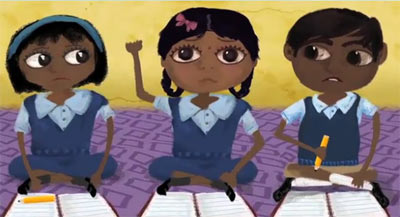
     

  • Nanhi Kali: Story of the triumph of communication

    By Tuhina Anand


    Project Nanhi Kali along with StrawberryFrog has set a fine example of what an evocative communication can do for a cause. When KC Mahindra Education Trust, a registered public charitable trust in India and Mahindra Foundation USA, both not-for-profit arms of the Mahindra Group commissioned StrawberryFrog NYC (known for being the world’s first cultural movement agency), it had an inkling of the path ahead. The task for the agency was to help create awareness and support for its Project Nanhi Kali globally, especially through digital and new media campaigns.


    For decades, Project Nanhi Kali relied on paid advertising to generate awareness and support. Seeing the immense potential of the world wide web and the recent social media boom, the management decided to focus all its resources towards the cause and completely reinvent its marketing strategy to harness the potential of the digital media and online space.


    The collaboration between Project Nanhi Kali & StrawberryFrog has witnessed the design and launch of some unique and successful digital campaigns like the ‘A Girl Story’ (http://www.agirlstory.org/), ‘Girl Store’ (http://www.the-girl-store.org/) and the more recent ‘Girl Epidemic’ (http://thegirlepidemic.com/).


    Through these innovative campaigns Nanhi Kali has not only been able to successfully create mass awareness globally and raise sponsorships amounting to $44,218 for the project as well as drive traffic to the official Nanhi Kali website and generate a buzz on online communities such as Facebook and Twitter.


    The StrawberryFrog-Project Nanhi Kali collaboration has witnessed the launch of some innovative and hard-hitting campaigns that have created a buzz online. StrawberryFrog has purposefully designed these campaigns to be provocative to create an initial shock and awe response to the campaigns, and thereby create awareness and break through the wall of indifference.


    The websites individually and collectively not only put the issue of uneducated girls being most vulnerable to exploitation upfront, but also provides the viewer with a solution to join the fight against it by sponsoring the education of young girls. The idea is to bring about a shift in the “culture of silence” in our societies and bring critical issues to the forefront and seek global support to bring about effective change.


    Sheetal Mehta, Executive Director Project Nanhi Kali, on the Girl Epidemic (the recently launched campaign) said: “The Girl Epidemic must be seen and shared, there’s never been anything like it.”


    She added, “The work for Nanhi Kali could convert those who think that creativity in advertising is on the wane. The sheer volume of first-rate award winning work being produced is impressive. From the simple brilliance of “A Girl Story” which is the world’s first donation-based online film series to another standout – The Girl Store an opportunity to bring e-commerce and creativity together in an innovative campaign and where you can buy a girl her life back before someone else takes it.


    The creative excellence, strategic smarts and work ethic of StrawberryFrog working on Nanhi Kali has helped spark something special for brand Nanhi Kali. Further, StrawberryFrog has always understood that a nonprofit has limited resources, and therefore the message being sent needs to be strong and powerful enough to start a movement. The momentum, being slowly built over the past four years, has created a body of work that is outstanding. We are seeing Nanhi Kali at its best.”


    Scott Goodson, Chairman of StrawberryFrog said: “Our goal with this work is to generate more money to educate girl children through Project Nanhi Kali. Period! And we wanted to do this with the greatest weapon we have at our disposal: creativity and innovation.”


    Here’s a look at what StrawberryFrog has created for Nanhi Kali Project


    The Girl Epidemic

    StrawberryFrog & Nanhi Kali recently launched the Girl Epidemic. It shows how girls in some parts of the world are treated as an infectious disease. It highlights the centuries-old absurdity that would value the life and potential of a young girl less than a boy, the result of which is the disappearance of girls, the selling of young girls as young as 8-years-old into sex slavery or marriage. The extremely powerful campaign brings home the message that this is wrong, that it must stop, and that education is the cure. In fact, it is the cure to solving the most important challenge we face as human beings. If you educate a girl, you educate a family, and as a result you reduce overpopulation, environmental impact, hunger, disease and a host of other world problems. The Girl Epidemic shows how educating a girl can save the world.


    The multiplatform Girl Epidemic campaign features an innovative e-commerce site. The main spark to ignite the Girl Epidemic is a major film production for YouTube and the Girl Epidemic ecommerce site where you can make donations. It is a unique trailer-style film that dramatizes an already disturbing societal norm. Young girls are often sold into sex slavery, child labor, and are frequently killed at birth because they are not of the desirable sex: male.


    The cure for The Girl Epidemic is education. Donating to www.TheGirlEpidemic.org can help change deep-seated social norms by allowing girls to receive an education, therefore transforming young girls to become valuable members of society – making them indispensable.


    The Girl Store

    In 2010 KCMET & StrawberryFrog together launched www.the-girl-store.org. ‘The Girl Store’ is an innovative website which allows the viewer to sponsor the supplies that allow an underprivileged girl in India to go to school and get an education. The Girl Store operates like an e-commerce site. The site asks visitors to a buy a girl her life back by donating school materials to underprivileged girls in India. Visitors can buy specific items, such as a backpack, workbooks, or school shoes for a girl pictured on the site.


    The core idea reiterated throughout the site is that the life of an underprivileged girl is not a condemned fait accompli. It is up to the viewers to change her destiny by ‘buying’ her life back – empowering her through education.  Funds raised through the site are used to provide holistic educational support (not only academic support through classes, but also material support in the form of a comprehensive material kit) to underprivileged girls in India. This website has raised $40,000 through online donations on the store, from 1115 donors globally till date providing educational support to 500 underprivileged girls in India.


    The site has received over 3 million hits till date, raising enough funds to send hundreds of girls to school, and has also received global media coverage. The ‘Girl Store’ has earned critical acclaim to its credit, including the ‘Bronze Pencil’ at the prestigious One Club Annual at One Show Awards held in New Yorkin 2011. It also received a ‘Bronze Cyber Lion’ at the Cannes Lions International Advertising Festival 2011.


    A Girl Story

    Launched in 2010, A Girl Story is a unique, donation-based film series that combines technology, film, and storytelling to shed light on the global challenge of educating young girls. The animated, emotional story follows the path of a young Indian girl named Tarla who wants to go to school to better her life. Whether she succeeds, however, is completely up to you, because Tarla’s story progresses only by audience donations that unlock new chapters within the film series. This website raised approximately $4,000 from 182 donors globally.


  • Life beyond cricket: 5 new leagues in 1.5yrs

    By Bhanu Pande


    If Pepsi’s latest commercial, ‘change the game’, prods people to switch from cricket to football, it hints at a fundamental shift in the way the cola major plans to use sports as a brand-building platform. It feeds off – and feeds into – a fundamental change happening in the Indian sporting landscape.


    Inspired by the success of the Indian Premier League (IPL) in cricket, almost every sport with some following in India is launching a city-based, professional league. Five new professional leagues have been announced in the last 18 months and, word is, two others are being revived. “The Indian sports consumer is looking for entertainment, diversion, passion and emotion,” said Shailendra Singh, joint managing director, Percept India, which is behind the Indian Boxing League (IBL). “League sport will ensure that.”


    But for leagues to become a permanent fixture, something only the IPL has managed so far, paramount is drawing sponsors and advertisers. If the initial response is any indication, sponsors of many hues are warming to them. Hero Motocorp is making big investments in hockey, the Mahindra Group in basketball, and the ongoing World Series Hockey (WSH) has Bridgestone and Vodafone among its sponsors.


    “Those chasing cricket will have to move to a life beyond it,” said Sanjay Sharma, head of JK Motorsport. “The canvas has to enlarge for brand marketers as cricket won’t continue to enjoy the status it does.” Besides cricket fatigue and the gathering momentum of other sports, there are three reasons why marketers and sponsors are gravitating towards these new leagues.


    Low-risk investment

    The new leagues offer a low-cost proposition. Unlike cricket, they don’t have to put a lot at stake. CVL Srinivas, chairman of Starcom MediaVest India, a global communication & media services group, said while sports is a good medium for brands to connect to the youth, the most popular of them, cricket, poses an entry barrier for many advertisers. “Many advertisers today see cricket as overpriced,” he said. “Emerging new leagues could give them an opportunity to enter sports in some way at a much lower cost.”


    Four years ago, when Bridgestone considered IPL as a medium for brand communication, it was put off by the price tags for premium rights. For example, DLF pays 40 crore per year to be the title sponsor of IPL. So, Bridgestone made a modest entry into cricket as a co-sponsor of IPL team Mumbai Indians. The decision to become the title sponsor for the ongoing World Series Hockey (WSH) came easy.


    The investment was low: Bridgestone is paying 2 crore per year in a three-year deal. And it gives the tyre company an opportunity to target North India, a market where hockey is popular and where Bridgestone was weak. “South India has always been our strong market and our association with Mumbai Indians is good enough to deliver there,” explained Vaibhav Saraf, GM (sales & marketing), Bridgestone India.


    Similarly, a 10-second spot on IPL cost 4-5 lakh, but just one-tenth on WSH. “Returns in non-cricket sports would be much lower,” Mr Srinivas qualified. Even then, the cost value equation works just fine for Bridgestone. “Even if our return on investment (RoI) from WSH is 10 crore worth of media mileage, we are happy,” said Mr Saraf.


    Besides Bridgestone, the other principal sponsors of WSH are Vodafone and Imperial Blue (Pernod Ricard India). “We evaluate all sponsorship proposals on a cost per reach and level of consumer engagement possible,” said Anuradha Aggarwal, senior vice-president-consumer insights & communications, Vodafone. “The WSH was efficient on both.” The early days of WSH have seen modest to half-filled stadiums.


    “Hockey is still not a proven sport, we are building it,” said Yannick Colaco, chief operating officer of Nimbus Sports, the promoter of WSH. “Some leagues in the past haven’t delivered, which is likely to make sponsors and advertiser sceptical for any new league.” Mr Colaco claimed the league has booked 15 brands on-air in the first week.


    He expects this number to increase to 40-50 by the time the tournament ends on April 2, yielding 50-60 crore from sponsorship and advertising revenues. “WSH is not here to topple cricket, but we hope to make it a strong number two property before we enter the second season,” he said, adding that marketers will have to have “realistic expectations” during early days and come in with a “long-term vision.”


    Proof of Concept

    One factor that gives the new leagues a greater chance is how they are structured. They follow the IPL model, which is city-based and essentially pays for itself by riding on a big TV rights sale. “IPL has proven that city loyalties exist, which has prepared the ground for other professional sporting leagues to take off,” said Darshan M, CEO of Machdar Motorsports, promoters of i1Super Car Race Series.


    In Premier League Soccer, Uro Infra Realty, a Kolkata-based real estate company, was the highest bidder for a franchise – 25 crore for Team Barasat over 10 years, or a franchisee fee of 2.5 crore per year. Each team can spend up to Rs 12.5 crore on players, which means Barasat (Uno Infra) will spend a total of 15 crore a year.


    Now, 50 per cent of the central revenues – essentially, the sale of TV rights and central sponsorships – would be equally divided among the six franchisees. In return, each team gets 2.5 crore as match rights fee for its five home matches. Then, each team can have eight sponsors, apart from ticketing and hospitality rights in home matches. “Considering the league will be broadcast in 50 countries other than India, it won’t be a problem for franchisees to recover their investment,” predicted Bhaswar Goswami, executive director, CMG, the promoter of PLS.


    The new leagues have learnt from the failure of the past. For example, the Indian Cricket League (ICL), promoted by Zee, died because it did not have a buy in from the Indian board that runs cricket in India and so could not draw the best of the current players. The new leagues are either taking the boards of their respective sports along (soccer, boxing and basketball) or are working towards it (hockey).


    Another learning is spreading it out. Premier Hockey League (PHL) – India’s first sporting league event launched in 2005 and WSH’s predecessor – was discontinued in 2008. “Any successful league the world over has had two fundamental elements: multiple ownership and multiple match locations,” said Mr Colaco of Nimbus. “PHL ignored both.” PHL teams were all owned by ESPN and all matches were held in Chandigarh. By comparison, WSH has eight franchisee teams playing in eight cities.


    When Fragmentation Works

    Sports promoters and marketers say sports like soccer and wrestling have a significant regional following, and brands can tap that. “For instance, a brand that wants to target audience in soccer-crazy West Bengal may want to ride the PLS,” said Indranil Das Blah, chief operating officer, Kwan Entertainment & Sport Solutions.


    Mr Aggarwal of Vodafone sees a fragmented market as more of an opportunity rather than a threat. “Marketing investments are fixed and need to deliver maximum RoI,” she said. “If local fragmentation delivers a higher RoI, marketers like us will not have any problem going regional.”


    Similarly, Mr Colaco points to how motor sports can target auto brands, be it cars, tyres, lubes or accessories. However, eventually, feels Mr Srinivas, leagues will have to make a national impact. “To sustain, they’ll have to become pan-India properties,” he said.


    Source: The Economic Times

    Copyright © 2012, Bennett, Coleman & Co. Ltd. All Rights Reserved


  • Retailers Mahindra group, Godrej Interio, Reliance Retail hire specialists to up sales

    By Writankar Mukherjee


    Whenever Mahindra Group decides to set up a new store for its speciality mother and child retail venture Mom & Me, it first looks out for ‘super moms and dads’ . These are experienced parents or grandparents who have the experience of raising a child and can offer customers, especially first-time parents, advice on choosing the right product and its usage.


    At last count, the Mahindras had appointed more than 60 super moms and dads across India, at a much higher salary than what its customer care executives earn. In the process, it is reaping huge business benefits. The conversion at the Mom & Me stores is more than 50 per cent, double the industry average.

    Conversion rate is the measure of the number of people who visit a shop making a purchase – a key indicator of a store’s success.


    “The last-mile service helps in increasing conversions, especially in tough times like this,” said Saloni Nangia, president of management consultancy Technopak Advisors. “The consumer experience also improves, and it builds a long lasting connect with them. In fact, such specialised talent will guide buyers to meet their specific requirements so that they are satisfied,” she added.


    In an emerging trend in the country’s Rs 20,000-crore organised retail sector, retailers are increasingly hiring specialists who can influence shoppers, provide personalised shopping advice and thereby increase conversion. As a result, shop floor jobs, earlier reserved for plus-two and general stream graduates, are now seeing a growing influx of specialized graduates or domain experts.


    Retailers see such specialised shop floor employees as critical to success in the current economic scenario, when consumer sentiments are down. Key retail categories like apparel, furniture and electronics are seeing far less trading, prompting retailers to spice up demand backed up by heavy discounts and promotions.


    Several studies have said consumer sentiments have been down for the past two to three quarters due to rising interest cost and inflation, though it improved in the urban markets from mid-January.


    Diamond jewellery chain, Orra, has started appointing designers at the shop floor to help customers in their purchase decision. The company has also started an extensive training programme for such designers on the various types of jewellery, gold and other precious stones.


    The company has hired one designer for each of its 33 stores. “The conversion rate has jumped by 10 per cent. We are now planning to increase the number of such specialised designers in the shop floor,” said CEO Vijay Jain. A 10per cent jump in conversion is no mean number, considering the per sq ft revenue in jewellery retailing is one of the highest in retail, as much as Rs20,000 per sq ft per month.


    Godrej Group’s furniture retailing arm, Godrej Interio has started training its existing shop floor employees on interior design and is also hiring specialised interior designers for its premium venture, U and Us, where consumers can design their own furniture.


    Hiring such specialists and training them is aimed at helping the sales force evolve as consultants, said COO Anil Mathur. Reliance Brands, a wholly-owned subsidiary of Mukesh Ambani’s Reliance Retail , which runs a chain of 55 premium stores for global brands like Diesel, Timberland, Ermenegildo Zegna, Paul & Shark and Steve Madden, has been hiring talent from fashion institutes to run the stores.


    This year, Reliance Brands hired 32 people from National Institute of Fashion Technology and three to four designers from London College of Fashion. The company refers to its store employees as ‘sales consultants’. Reliance Brands pays at least three times more salary to such employees compared with those in its other lifestyle formats. “We need such specialised talent, since a person buying a jeans for Rs15,000 at Diesel would require specialised knowledge on the product, design and far more engagement with the brand. Similarly, the average selling price at Paul & Shark is Rs24,000 and that at Ermenegildo Zegna is Rs 54,000. Selling such high-value products requires specialised skills,” said Reliance Brands president and CEO Darshan Mehta.


    The specialised hiring strategy also works for the employees as a second career opportunity. Mahindra Retail’s supermom and superdad concept, for instance , helps professionals coming from a break or as a post-retirement job opportunity . The super moms and dads have no sales targets either. The customer connect adds to the store’s sales; some of them end up dealing with sales worth as much as Rs 70,000, said Mahindra Retail CEO K Venkataraman.


    Architect Anjali Kar (name changed on request), joined Future Group’s furniture and home decor retail venture, Home Town in Kolkata, to gain experience in sales. “The selling experience and directly dealing with clients is a plus in career growth, more so if someone were to start up their own firm,” said Ms Kar.

    ‘Supermom’ Preeti Jhingran (46), joined Mahindra’s Mom & Me store in Bangalore after a stint with Genpact. She says the unique nature of the job impressed her. “I play the role of a mother to would-be parents,” she said. “In cities like Bangalore, where most young couples have nuclear families, all they need is some trustworthy advice which we provide by meeting their needs at the store,” she added.


    Similarly, pharma industry veteran Ganapathy Sankarnarayan (69), joined Mom & Me as a superdad, post-retirement . A soon-to-become grandfather with his children settled abroad, Sankarnarayan says he has already enjoyed being a grandfather at the store.


    Several new parents even leave their children with him while completing their shopping in the store. Retailers have started drawing career progression plans for specialised professionals . “The best way to dirty your hands in retail is on the shop floor. Such professionals can then move up the ladder,” said Mr Mehta. All in all, it’s a win-win for both.


    Source:The Economic Times
    Copyright © 2012, Bennett, Coleman & Co. Ltd. All Rights Reserved