Tag: Mahesh Ranka

  • So what does the IPL postponement mean for the Indian sports & marketing ecosystem

    Screengrab from IPLT20.com


    By Mahesh Ranka


    Mahesh Ranka

    The Indian Premier League is the biggest marketing and entertainment extravaganza that has had everyone hooked on to it for almost a decade-and-a-half.


    That the 2021 edition will happen or no was a question raised by many, who were only shooting their thoughts, while BCCI and all the franchise owners were very sure and positive for the show to go on. With so much at stake and all the possible arrangements, it was only safe to assume that IPL would set an example in keeping live events alive in these unforeseen and testing times.


    Come May 4, 2021, IPL was suspended and then postponed, to a date that’s not been decided yet.


    There were many quarters constantly voicing concerns about three key things happening – the Assembly Elections, the Kumbh Mela and the IPL in these pandemic times. To me, IPL was the safest bet and the BCCI took the right step in putting a pause to the event.


    In the past, IPL has shown it’s as much a festival as Diwali, as many category purchases have significant spike during these two festivals in India. Marketers will now be scratching their brains already to think of a Plan B.


    Will the impact of this be felt? It’s a no-brainer, the question should be where all, will the impact be felt?


    For IPL/ BCCI

    IPL is not going to see a significant loss of revenue from the central sponsors or the broadcasters for sure as the agreements ensure that.  IPL valuation may also undergo a correction, which may reflect on the teams too.


    A key aspect that will be at the centre of sports discussions will be from the global market perspective. Will this lead to concerns around many other cricket events, and other sports to be held in India?


    ICC T20 World Cup isn’t too far and there are already talks of “if it moves to Dubai, BCCI will still hold the rights”. While this is great for cricket, for sponsors of the ICC event, they would be merely exposed as brands on broadcast and would run a campaign that will not have the same flavour as the event being hosted in India.


    If it happens, the movement of the T20 World Cup will put tremendous pressure on holding a bi-lateral series and other sporting action in India, leading to opportunity and revenue loss to the board, fans as well as marketers.


    Commercial stakeholders:

    All the commercial stakeholders across would have to plan for a situation probably as unique as someone hitting a six off every ball in every over for 10 overs!


    Disney – Star India:

    As probably the single largest commercial stakeholder of IPL, Star India, has an uphill task on multiple fronts to realign its business and financial plans for the year. With a major part of the plan being IPL for Star Network as well as for Disney Hotstar, it’s going to be impossible in the near-term for Star to:

    :: Find quality and engaging content to fill the programming  gap on television as well as HotStar.


    With OTT growing significantly in  India, Disney-Star will have to scramble to get some very attractive programming to be on the growth path.

    :: Build advertising revenue and plan for longer deals.

    :: Push for subscription on OTT as well as television platforms. IPL being a key property to push subscriptions, a new plan will be in play to achieve objectives or even probably revise targets.

    :: Revenue loss for now from all the syndication of rights globally, will also be a revenue gap that will not be filled by any other means.


    All the above may leave an option open for competition to plan and execution some bold and radical moves to woo the audience.


    A Brand’s Biggest Vehicle – The IPL

    Brands and businesses plan their launches and campaigns specifically with IPL in mind. For them, the current situation will be a massive letdown, while some sponsors/ advertisers will be fine with the shift if IPL (whenever it happens), many will have to take a deep hard look at their half yearly plans if not annual.

    Very clearly, new age brands like Cred and Dream11 had massive plans, so did the beverage companies – especially soft drinks in their prime season. For these three  categories, the opportunity to exploit is suddenly missing, and they’ll have to think hard and formulate new plans, with revised targets, in shortest possible time!

    In fact their existing efforts (ad film, media plan, activation, etc)  and investments would have to be redeployed, scrapped or modified, as necessary.

    Let’s think about Kotak – that was targeting topical credit card sales, with  seven team associations Or Upstox, who apart from growth, would have also had valuation gains in their radar by the end of IPL 2021!


    Areas of concern for marketers that would crop up :

    Timing & Seasonality: Season time  for some and in the first part of the business year for others, all calculations would go haywire and would need some extraordinary thinking, planning and execution to see through the year as planned.

    Growth plans : The planned growth on the back of IPL campaign, will get a deep hard look-in for the scenario would change significantly. The impact of IPL is visible on any of the plans.

    Reeling with uncertainty : Even if the brands are happy waiting for IPL, in the current scenario Uncertainty is the only Certainty. A third and probably a fourth wave might hit us, and no exact idea when. In such situation, everything is going to be fluid! And it will constantly keep the marketers  on their toes for the  plans they want to  prepare and execute.


    IPL Teams:

    All the franchisees have secured reasonably good revenues from sponsorships. And with no more franchise fee, they are sitting pretty on top dollar earnings from the central pool, in addition to their own sponsorships.

    Almost all teams had made significant plans to leverage and build digital platforms and engagement, with the current development event those plans would  find it a challenge to meet the set objectives. A good chance of engaging with their fans will diminish fast, now that the IPL has been postponed.  Moreover, with the uncertainties, teams and their plans for to rest of the year will be fluid.

    BCCI had announced and wanted to auction two more teams to be brought into the fold of IPL making it a 10-team affair from 2022. With the current scenario – pandemic and economic, and uncertainty for now, BCCI may find it challenging to unlock the value as per earlier estimates. It could lead to rescheduling the auction and inclusion of two more teams in IPL by a year or so.


    Non Sponsor Brands – competing brands

    With the leading or newer brands  going big on IPL, one thing is for sure, each of them hoped to gain handsome returns.

    These brands end up simplifying  as well as amplifying the category (Upstox, Dream11, Unacademy) and also expand the market.

    The other brands in these categories would have plans basis the market familiarity and growth because of the larger spending brands; trying to take a small part of the pie.

    With the expansion of the market limited, each competitor would have to create new plans to further their growth.


    Ancillary Businesses

    All the constituents – ground management, display boards, bio-bubble, travel and  stay, production and other equipment , manpower etc. that are working with IPL directly or indirectly, will now have to look for opportunities, especially freelancers, temporary hires or contracted resources. IPL runs its own ecosystem and this time the ecosystem has been halted. There is a definite challenge in the market with respect to deployment of the resources.


    Opportunity for BCCI / IPL

    With the current situation and mood in the country, IPL could generate decent amount goodwill, by creating a movement towards support and help for the victims or sufferers of Covid19. Each IPL team and state board can take up a support role, helping patients with Oxygen, to  organise medical supplies.

    While the easiest way  to help is to donate  money towards the treatment of Covid-19 patients, they would serve themselves and the community well by creating a path breaking idea, involving all cricket fans similar of the one that Sport Club do Recife did in 2014 in Brazil.


    Mahesh Ranka is among the early specialists in the business of sports in India and is Founder and CEO, GamerChangerZ and Founder, Indus Sports. His views here are personal.


  • How & Why the U-17 W Cup can transform India’s sports landscape


    By Mahesh Ranka


    Indian football is at its Inflection point, waiting to explode, with the never-before focus and extensive media coverage of the FIFA U-17 World Cup. Never has India seen such high decibel, and mostly unpaid, coverage of a sporting event, probably outside a cricket event.

     

    The first ever truly world event is underway in India, the FIFA U-17 World Cup. And yes, the World’s watching. With 23 of the top teams in the world and the hosts competing to win the coveted title, this edition of the championship has more going for India, Indian Football and Indian Sports than any other sporting event hosted by India.


    A week into the FIFA U- 17 World Cup, India and it seems like Football (and the Indian team) is already a part of many a conversation. When you see Prime MinisterNarendra Modi, leading the Government of India support, The legend Amitabh Bachchan on the top-rated Kaun Banega Crorepati, and atleast one or two pages of coverage in leading dailies or definite part in the sports bulletins across channels, amongst many others supporting and urging India to follow football and support the event and team India, there’s only one way the event popularity is bound to travel.


    India – World’s New Playground!

    With India seemingly putting up a fantastic world event of the FIFA family, the country can put up claim and bid to host many more world sporting events. This bodes well for sports in general for India. Needless to say that with immaculate planning, the local economy gains in the short term and long term by hosting these events. Hosting of events has become a significant tool for combined Sporting and economic development across the world, and India must be on this bandwagon sooner than later.

    Thanks to FIFA, the digital following and information dissipation across over 10 million twitter followers alone, in addition to the local media coverage in at least 23 countries that are participating.

    This however is a long-term thought. Let’s see what we have in store in the near term. Football will grow, so will the following, the training and development and the infrastructure. Yes, this will all converge well for the corporate and sponsor support that becomes imperative these days for the growth, popularity and riches in the sports field.


    Focus on Football

    With the focus on football growing, government will actively look towards improving the infrastructure and support for benefit and development of the sport. With the current Sports Minister actually being a sportsperson, it’s likely that more action will happen on ground than being restricted to paper.

    The U-17 team of India and its performance clearly shows the potential Indian football has, and this will be heartening to the officials of the AIFF, who would want to have a programme to nurture and hone the skills of the current lot of youngsters, event as the senior team performance will be focus of improvement. This can only be done in form of a solid and scientific development programme set in a process that is replicable across the country.  We surely will have heroes more than that can be counted on the fingers of one hand, and that will help the following of the sport and potentially have footballing icons that will propel large scale support.

    Perception of football is likely to change, or the process started with Football be seen as a career option (mostly by parents of interested children), even as Indian Super League, I-league : in its new avatar will be present and be spoken about for five to eight months of a year, clearly showcasing a possible opportunity for potential players.

    We see some international clubs and development programs already in the country for some time and post the U-17 World Cup, more such providers will want to make India their home for new talent and business. It’s very clear that there is a massive gap in the current football in India (senior) and world over, and the only way for India is to close the gap rapidly, even leapfrog some aspects, as it’s done in many other fields.


    India the New market

    In many ways, the FIFA U-17 World Cup is like a test launch for FIFA’s ambition to spread football fever far and wide in India. There is clearly scope for at least 3 more sports (other than cricket) to have significant standing in India. FIFA would want to have Indian businesses spreading their wings globally be a part of the FIFA sponsorship programme, to widen the sponsorship and broadcast reach as well as create more competition for better pricing. E.g. Hero MotoCorp, with significant business interests in Football crazy markets, would be an ideal brand for FIFA to associate with in the current form.

    ISL and I-league import players and also have potential to export players to other markets, however larger football business in India will mean better financials and this may lead to many BIG names being a part of Indian football clubs.


    The Business of Football

    With the focus of the international community and India, firmly on Indian football, coupled with growth potential, it’s only natural that the final piece of the puzzle sets in. It usually becomes the most important part for inorganic and significant growth. Revenue.

    Broadcast, gate collection, licensing and merchandising and sponsorships are the key revenue earners for any sport. And one of the key pillars of the success of any sport is the volume of revenue generated through various avenues.


    Possible Rub-off Effect on other Sports

    Any significant cause brings in many effects, and with the potential of football, other sports would stand to benefit, as more people will be open to sampling different sports (watching/ participating/ competing). The focus of the administrators and government will also be on growing facilities and development plan for other sports. This effect should truly make India a multi-nation sports over the next decade or so.


    Mahesh Ranka is a sports management and strategy consultant and an expert on the business of sports.

  • Enough backers for payback series?


    By Johnson Napier


    The India-England cricket series that kicks off from November 15, 2012 is being billed as a revenge or payback series by most scribes who follow the sport closely. Be it the media, analysts, critics or even players/commentators, virtually all are going gaga about how the current series would be the one to watch out for as India will be fighting to prove its mettle as being the best in the business. The fact that the men in blue were thrashed badly by the Englishmen the last time they played each other makes the cause even more compelling. But is the prevailing sentiment as positive as is being made out to be, or will it be a tough ask for the channel as it begins its quest to draw in more audiences? And, more importantly, what is the response that can be solicited from the advertisers who of late are opting to stay aloof from their association with the sport?


    To begin with, the good news is that the tournament begins at a time when most of India is in the mood for celebration what with the festival season already underway. So while partying, visiting relatives and relaxing would be top of mind for most it would also mean being able to sit at home and watch Sachin Tendulkar or Virendra Sehwag get India off to a roaring start. And that’s what is leading everybody to believe that the Series will at least kick off on a high note.


    Ayaz Memon

    Anticipating a huge response, senior journalist, sportswriter and now commentator Ayaz Memon is hopeful that the current series will be a success. As Hindi commentator for the current series, Mr Memon sounded positive: “I feel the pressure is more on India as they have to prove a point on the home turf. The fact is that India hasn’t lost a home series since 2004, and also the record since the last 12 months hasn’t been good so the pressure is squarely on the Indian team. Also the team is not in peak form as can be inferred from their recent performances across other tournaments. So one can expect the Indian team to put up a compelling fight, to say the least.”


    Backing up his claim, Mr Memon said that the channel has been doing a good job promoting the series. “I will be doing commentary for Star in Hindi and I can tell you that they have done a good job in building up the tournament and promotion-led activities. Even on the print platform the exposure has been pretty good. But we will have to wait and see how it pans out over the next few weeks. But I am sure that the viewership will be higher than the previous Test matches. The fact that you have Sachin Tendulkar playing in the series along with Yuvraj, Harbhajan and also Kevin Pietersen from England etc, I think it will be a marquee series.”


    Balakrishna

    Backing Mr Memon’s optimism is PM Balakrishna, COO, Allied Media, who said, “From a cricket and sentiment point of view, I feel people are looking forward to the series. It is being touted as the Grudge Series going by the promotional activities that are being carried out by the broadcaster. The audience really wants to see India thrash the English. So based on the hype, I expect to see more crowds at the stadium and also more ratings for the broadcaster.”


    But while the initial sentiment seems bright it is definitely not easy predicting results before the start of the tournament. The prediction becomes even more difficult when the series begins with a Test match and not ODIs or T20 that can guarantee some decent TVRs. When asked about the possible ratings that can be expected, Mr Balakrishna said, “Test matches have never been about ratings like ODIs or T20. But maybe because of the fact that this is a long holiday week, one can expect high ratings at least from the initial match itself. While it would be difficult to hazard a guess, I would be happy to go with an average TVR of 2-3.”


    Kartik Sharma

    Kartik Sharma, Managing Partner, Maxus India was more forthright, saying, “Any cricket tournament involving India is always unpredictable but exciting. As Indians, we obviously want our country to win but a sport like cricket is always difficult to predict. If you ask me, the sentiments are purely driven by the results of the first few matches. And going by our ability to digest defeat, we Indians don’t really fare well in that department. By that I mean that if we lose a match or two, we tend to divert our attention to other sports or television properties. But then again, this being a festival/holiday season I expect at least the first few matches to have a decent viewership as people will be at home and thus would be able to watch the matches. By nature, Test matches anyway do not draw in more audiences compared to what the T20 or ODI matches do. So I am expecting an average TVR of 2+ for Test matches and an average TVR of 4+ for ODIs.”


    Mahesh Ranka

    Presenting another factor that could guarantee ratings or dismiss them, Mahesh Ranka, CEO, Indus Sports asserted that it may even depend on the opponent playing against India: “If it is Australia or even England, there could be some decent ratings expected, as these teams are ranked higher compared to what a Bangladesh or Zimbabwe series would draw. The thing about England is that we lost to them badly when we went there so hopefully, we can look forward to avenging that result through the current series. And if India happens to win the first match, you could expect more audiences (in the range of 20-30 percent more on the base figure) who will come in for the second match, and so on.”


    But in the overall analysis, Mr Ranka is of the opinion that the current series will not have anything great to offer in terms of viewership, at least as far as the Test matches go. “The ratings that Test matches have thrown up in the recent past kind of puts everything under the scanner. Though people (particularly media) tend to hype any tournament, Test matches have never really managed to draw in the audience (viewership). That’s because people have their own mindset behind watching any match and advertisers will always have to move along taking into account the risk of losing out on viewership.”


    On the interest shown by advertisers, Mr Ranka said, “From an advertiser’s perspective, one has to always look at why cricket is typically watched: it is brought for reach. There are two things to that. Firstly it is the festival season where advertisers have monies to spend and whether it is cricket or no, they will eventually spend at this time of the year. The rates that could be expected for Test matches in the current series would be in the range of Rs 50,000 to 1 lakh for ten seconds.”


    Taking a diplomatic stand Mr Sharma said, “The advertiser sentiment depends on the packages that are being offered by the broadcaster and there are various deals in store. But I wouldn’t be able to comment if the rates are more or less compared to the previous tournaments.”


    Presenting a bullish outlook, Mr Balakrishna said that from the advertiser’s standpoint, the sentiment seems pretty positive. “Against the backdrop of digitization, one genre that is the least affected always is cricket, as the sport is not always about being CPRP-led but also about hype and other such factors. So I do see a positive resonance to the whole series from an advertiser standpoint. Also, I am sure that the channel would have factored in the tough economic scenario and therefore would have come up with a competitive package for the advertisers, making it a win-win for both of them.”


    So whether it will be a winner or a dampener, what the India-England Series is managing to do is turn the spotlight back to cricket. Which is a good move considering that the recently held Champions League tourney didn’t go down too well with audiences. The icing on the cake would be if India manages to whitewash the team from England. TVCs have been saying that India “Angrezon ki band bajaayega” – that is, will thrash the English. Music to our ears or hitting the wrong notes? The game will tell.


  • Jaldi 5 with Mahesh Ranka: The Tendulkar impact is waning

    Okay, the ghost of the Champions Trophy T20 is behind us. The India team for the first two Tests has been announced. Cricket will soon be back on the front pages of the newspapers and essential chatter in the metros and local trains. And above all: Sachin Tendulkar (SRT) appears to be in good form. Since matters off the field (especially on monies in the game) get as discussed as matters on it, MxMIndia asked Mahesh Ranka, CEO, Indus Sports and Sponsorship, a few questions which every sports enthusiast would like to ask.


    01. Now that Sachin Tendulkar is back in the runs (albeit against Railways) in the Ranji Trophy, do you think the interest in cricket will rise again?

    Interest in cricket isn’t related to interest in Sachin Tendulkar alone… anymore. However, this will get all enthusiasts to sit up and take notice of his performance in the upcoming series… should he play. The fact that we are seeing cricket after long (CLT20 without Indian teams qualifying ahead was forgotten by people), and the holidays/festive season may enhance interest to some level.


    02. From the sales point of view, is it true a lot of viewer interest goes up and down given the way Sachin plays?

    It was the case until 2005-6. Post that, interest connected to SRT has really been achieving the 100th 100, 50th 100 in one format… and when he hit the first 200 in ODIs. Even today, many enthusiasts out of sheer expectancy of a good innings from the master batsman will switch off their TV sets if and when Tendulkar is out cheaply. The SRT impact however is waning thanks to a decent balance in performances (forget the last England-Australia tours).


    03. We’ve seen a lot of cricket this year, and we’ve also seen the interest go up and rock-bottom with Champions League. What’s your prediction for the rest of the cricketing season?

    The rules have always been simple… India performs (read wins or stages a heroic effort) and the nation watches, India performs badly… and no one’s happy… viewers, advertisers, media… even experts! We are very emotional about the performance, and that reaction is clearly visible across the spectrum.


    04. Over the last few years,other sports have gone up the popularity charts. Tennis, F1, Football and even hockey? Which sport do you think will be next to cricket in terms of sponsorship monies?

    Next to cricket, F1 seems like the strong one, thanks to the Airtel Indian Grand Prix. Football is creating its own ecosystem which generates a decent amount of sponsorship monies. The popularity of Indian football, however is limited. TV viewing is skewed to European football and Indian football has big enthusiasm in traditionally strong pockets only.


    Tennis had the makings of being #2, but it didn’t?


    It was a lot of media-created and fuelled. That probably pushed opinion. Tennis was getting popular thanks to the exploits of Saina…. and of course consistent performance of Leander Paes and Mahesh Bhupathi. Monetarily, it was never a big business spinner. Many companies invested and failed to raise the necessary sponsorship and other revenue options to run the effort successfully. Apollo’s 10-year plan worth Rs 100 crore crashed within two years of inception, Kingfisher Open, Sunfeast Open… never found support after the first round of deals (three years or so). So much so, that Globo Sports did not continue with the events they had created. Only Chennai open has survived all these years, and that’s thanks to the support of the Tamil Nadu government.


    05. Lastly, any truth in sponsors/endorsements playing a role in player selection or staying on even if he or she may not be in top form?

    In my position, I wouldn’t know the dynamics that go on in ‘selection’ of players or ‘staying on’ as it’s nowhere close to my function. Neither do we represent athletes nor do we manage their commercial interests. In the past, there have been cases that have been argued on the above, not only in India but also in foreign markets. It’s probably as true and as visible as betting in sports in India.


  • India out, advertisers still in!


    By Ananya Saha and Robin Thomas


    India might not have made it to the semi-finals of the T20 Cricket World Cup, but the advertisers and sponsors of the event are still cheering. ESPN Star had sold inventories to about 34 advertisers and, according to industry estimates, the advertising revenues that the channel made for the T20 World Cup are already in the range of Rs 250 crore. Are they complaining?


    Mahesh Ranka

    Mahesh Ranka, Founder & CEO, Indus Sports and Sponsorship, feels that India’s performance would hit the advertisers. He said, “The ad deliveries in the World Cup will be lower given that India did not make it through. However, the advertisers and sponsors would have taken the factor of India not making it through before they signed up. The bigger issue is for ESPN Star, whose inventory might be affected.”


    It is no news that advertisers and agencies always plan with such contingencies, of India not winning or getting out of a tournament, in mind. And especially in the case of T20, India was going to play either five matches or seven. With just three games left, from a sheer quantity perspective, it does not seem a big loss to advertisers.


    Anwesh Bose

    Anwesh Bose, Senior Vice President, DDB MudraMax Media, said, “Advertisers and sponsors have got their value already. Cricket is a non-cancellable property, so nobody is going to withdraw the money they have put in. For the T20 World Cup, sponsors buy the inventory for the entire tournament.” He added, “The broadcaster, in this case ESPN Star, holds back about 10 percent of inventory of finals and semi-finals, which they sell at a very high premium. Now that India did not go, they might not be able to command the premium for the inventory.”


    With India losing, ESPN Star has definitely lost an opportunity that they would have capitalised on if India had made it through.


    Vivek Srivastava

    Vivek Srivastava, Joint MD, Innocean Worldwide, said, “If you are a brand that looks at tactical use of such opportunities then you might sound like prophets of doom at this eventuality. However, most strategically driven brands today have long-term sports marketing properties and a long-term perspective on leveraging them. They look at a long-term engagement via a mega sport like cricket. Our client Hyundai has a long-term vision about integrating the brand and engaging with India’s passion for cricket as well as other cricket-playing nations via a five-year official partner status with the ICC. While India missing out on a semi-final berth hurts the emotions, it is business as usual.”


    Agreeing with Mr Srivastava is Hiren Pandit, Managing Partner-Special Projects at Group M who opined, “Advertisers have got more mileage and viewership during the T20 matches, and India’s exit will be slightly disappointing for them. Most of the advertisers in cricket are long-term advertisers, all the deals have been done earlier. India’s early exit may have been a missed opportunity but it does not mean that advertisers will not continue to sponsor the sport. Viewership will be impacted by India’s exit but there will still be some viewership.”


    The industry believes that the viewership will only see a minor blip, if at all. According to Satish Menon, CEO, Sports 18, while advertisers may be slightly disappointed with the loss, it is not going to stop them from advertising or investing in cricket in the near future.


    Mr Menon asserted, “When (Team India) does not do well it does reflect on the viewership and so on. As far as the viewership is concerned there will be a marginal dip, not a huge one because cricket is a universal game and a lot of the cricket fans or viewers also follow other matches equally. So I don’t think India’s exit will have any major impact on viewership and especially because it is the T20 World Cup.”


    Sudha Natrajan

    “When India is not there in a tournament, there is between 25 percent and about 35 percent drop in the viewership as compared to when India is playing. This is the sort of trend you see in the earlier games. If the games are interesting, the viewership could even climb, despite India’s exit from the tournament. The problem however is the buzz and the interest level that the country has when India is playing as compared to when they are not playing. So more than the TVR, it is the overall interest that you see diminishing,” concluded Sudha Natrajan, founder, TMC Corporation.


    Given that it is the festive season in India, the advertisers might not mind a few losses.


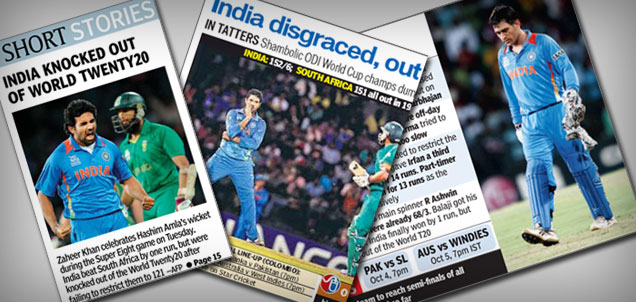
    Clippings above (LtoR) from DNA, Hindustan Times and The Times of India


  • Mixed response to Newscorp’s total control of ESS

    By A Correspondent


    The News Corporation and ESPN announcement that the latter would buy ESPN’s 50 per cent equity interest in ESPN STAR Sports (ESS) has been welcomed by the industry.  The transaction will allow News Corporation units to own and operate all of the ESS businesses while providing ESPN more independence and flexibility in future support of The Walt Disney Company’s overall efforts in Asia.


    There has been a mixed response to the development. For one, they say it’s an internal matter between the two shareholders and will not impact the bidding or media selling process. ESPN and Star Sports (and the other channels) were being sold as one unit, said one observer. Yes, even though it was a 50:50 jv, the feeling was that it was a little more aligned to Disney than Star, remarked a senior official in a rival network.


    Talking about the development, Hemant Kenkre, cricket analyst and a senior communications professional said: “I’m excited about the news as everyone knows that the News Corporation is an innovative organization. For instance, when they bought KBC to India, it changed the whole Indian GEC scenario. Even now they are one of the first organizations to launch fully HD channels. When one thinks of cable TV, News Corporation is the real king in India. Thus, one can say that they think differently so the sporting world too should get ready for a dhamaka. I’m sure even cricket fans will be happy with it because it will bring other sports on the forefront too.”


    Commenting on the news, Mahesh Ranka, founder & CEO, Indus Sports and Sponsorship said: “This only means that the war between sports channels in India will intensify. ESPN will now be able to launch new channels and I’m sure they will as they are a major player globally. It will also mean that now a broadcaster might have to dig deeper into his pocket as it might push broadcasting rights in the near future. Having said that, it is good news because it signifies the growth of sport broadcast industry in the country.”


    MxMIndia was unable to ascertain whether the terms of ESPN’s exit from ESPN Star Sports stipulates a cool-off period whereby ESPN will not be able to operate any similar channels in the region for a certain period. For instance, when Star pulled out its brand from the MCCS news channels, it was clear that it would not be able to launch Star News for the next 18 months after serving the notice (said to have been in January 2012).


    With inputs by Meghna Sharma


  • The Anchor: Mahesh Ranka on 5 reasons for watching sports live in the stadium & on TV

    5 reasons for watching sports live in the stadium as a regular FAN … not the AC/Corporate boxes type


    1. Well, the experience

    …. The noise… the atmosphere…. The crowd … the Mexican wave – it is unmatched in many ways. Of course, it depends from sports to sport. Like F1 is all about the fraction of a second “darshan” of the car and the vrooooom, Cricket is about being by your team and screaming your lungs out for them…..


    2. Closer to stars

    If luck favours, you end up meeting, clicking a snap, talking to the stars…professing love that otherwise seem so distant. Usually players are open to talk in the stadium (of course after the game), or calling out to them and their acknowledgement of the same… And it’s always something a sports fan cherishes.


    3. I Was There

    Key and landmark events become a kind of a HIGH to attend… at the World Cup Finals in 2011 that India won, the 1st Airtel Indian Grand Prix, watching Messi play… et al.


    4. Gang of friends

    It usually turns out to be the best way to be with friends… plan out a before and after the game activity. Argue, comment, pass opinions with friends…. It is a part and parcel of any game and being at the action always creates memories that last (for better usually)


    5. Get away with anything… well almost

    Where will you have green hair and paint your body with team colours ever … unless of course you are at the stadium… showcase your passion and fanaticism as much as you want….. possibly be shown on national TV…


    5 reasons for watching sports on TV, usually at home or a restaurant/pub


    1. Never miss action – the way you want

    Technology ensures that you don’t miss any part of the game… replays, analysis, numbers on the screen….. control of noise…. All with you.


    2. Comfort

    No sweating, no travelling, no dust….. just be with family and/ or friends… food… drinks … all flows… and yeah, mini contests within the game played… score, player performance, win-lose, goals, and so on….


    3. Go social

    ….. Frantic Twitter and FB updates have become a norm for many people and its best done from the comfort of home / pub.


    4. Economy

    Watching at home ensures you not just save the time but save money. It is far more economical to watch game at home…. Even in a restaurant…you may end up spending less than going to the stadium.


    5. Multi sport mix

    You’d not miss one action for the other…. Many times back to back or parallel events are being showcased that MUST be watched…. The luxury of switching channels, PiP tech, 2 TV’s etc ensure you are always in the know of all (almost) that’s happening.


    Mahesh Ranka is Founder & CEO, Indus Sports and Sponsorship