Tag: Mahesh Murthy

  • It’s Amazon v/s Flipkart & Snapdeal


    By Radhika P Nair & Aditi Shrivastava


    Amazon India is casting a snare to draw more small merchants into its fold as it battles India’s top online retailers Flipkart and Snapdeal for supremacy in the country’s booming ecommerce industry. Beginning Wednesday, merchants can sell their wares on the same day they register on Amazon’s portal compared with the nearly two weeks it takes on competing platforms.


    The world’s largest online retailer is also expanding the range of products that will be delivered to customers within a day, displaying the trademark aggression that marks its global operations nearly 10 months after launching services in India.


    “A few thousand sellers have already registered for the new service,” said Amit Deshpande, a director and general manager at Amazon India who said the company already has a roster of 4,000 sellers.


    These moves, coming days after the company launched a high-voltage advertisement campaign including television spots during the current edition of the Indian Premier League, is aimed at getting the largest number of merchants and the widest variety of products for Amazon customers.


    “Amazon is moving from first gear to fourth,” said Arvind Singhal, chairman of retail advisory Technopak. “They have the basics in place.”


    Amazon is Trend-Setter

    Market leader Flipkart, which just reached the milestone of $1 billion (over Rs 6,000 crore) in sales, also has about 4,000 sellers on its marketplace. But it follows an invite-only model to sign on sellers which is more time-consuming.


    “Even though I am already a seller on Flipkart, if I need to add a new category it will take about two weeks to start selling,” said Eshan Arif, 24, co-founder of Bengaluru-based music and movie merchandise store Hysteria. For a first-time registration it takes about three weeks from signing up to a live listing. Flipkart declined to comment for the article.


    Industry estimates peg Amazon India’s sales at over $200 million (Rs 1,200 crore) although the company declined to share sales numbers. At current growth rates, Amazon is capable of clocking sales of $1 billion (Rs 6,000 crore) by the end of March 2016.


    This will make Amazon the first online retailer in India to reach the magic number within three years of launch. Flipkart, which reached the milestone in March this year, took seven years. Snapdeal, launched in 2010, expects to reach $1 billion in sales this year.


    Snapdeal did not respond to email queries. Merchants who do business with all the top Indian portals said Amazon has taken a lead in categories including books and watches and is set to duplicate it in jewellery and baby care.


    The company’s latest delivery service, ‘easy ship’, will allow sellers to ask for a product to be picked up and shipped by Amazon. It will also provide cash-on-delivery for these sellers’ orders, an option so far available only to those who stocked products with Amazon. The service, which has 400 sellers already registered, will be available in 30 cities to start with.


    “We now have a complete suite of services for sellers which will help them sell more and make more money,” said Mr Deshpande, who has been with the company since 2010.


    This is just the latest in a string of initiatives from the Seattle-based company that is stirring up the Indian online retail industry estimated at $3 billion (over 18,200 crore).


    Last December, Amazon launched in-a-day delivery service forcing Flipkart and Snapdeal to follow suit. Flipkart and Amazon also launched their Apple iPhone and iPad applications within a day of each other. “Amazon is forcing Flipkart to push ahead with its customer and seller services,” said Ashish Jhalani, head of advisory services firm eTailing India. In Delhi and Mumbai, Amazon.in is piloting pick-up services where customers can pick up their orders from In & Out stores located at BPCL petrol stations.


    “Amazon is pretty much the trendsetter,” said Mahesh Murthy, founding partner at early stage venture fund Seedfund. “When Amazon started charging for delivery, Flipkart did the same.” Industry experts said Amazon India has done right by first focusing on backend processes instead of blindly chasing customers upon entry. “They built the logistics network, warehouses and built up a large selection of products that is helping them win customers now,” said Technopak’s Singhal.


    The company now has about 1.5 crore products listed on its site and two warehouses, each measuring over 150,000 square feet, in Mumbai and Bengaluru.


    Earlier this month, Flipkart said it had millions of products across 21 categories and 40 sub-categories. At peak times, the Bangalore-based company ships 1.3 lakh products a day.


    Amazon said its strong backend infrastructure is helping it scale up fast. “When we decide on areas of focus, we always work backwards from the customer,” said Mr Deshpande of Amazon.in. “Selection, delivery experience, logistics, payments and website experience are areas we are super-focused on.”


    Customers are taking note. “I used to buy books from Flipkart, but now I buy from Amazon.in as I see better variety there and it is the same price if not cheaper than Flipkart,” said Shradha Patnaik, 24, a communications professional who lives in Delhi.


    Merchants too are happy with their experience on the site. “Margin cut at Amazon is about 6-7%, compared with 10-12% at Flipkart,” said Hysteria’s Arif.


    While these indicate that Amazon is chipping away at the fortress that Flipkart has built, overtaking the market leader will take some doing.


    While prices in categories such as books are similar or Amazon.in is cheaper, in areas such as mobiles and tablets, Flipkart is cheaper in most models and brands. Flipkart is able to do this as WS Retail, a seller on Flipkart, is its subsidiary and gets most of its inventory directly from brands.


    “Flipkart’s WS Retail also buys outright from us and accounts for about 80% of our volume on Flipkart,” said Vivek Prabhakar, co-founder of design merchandise firm Chumbak, for whom online sites account for 18% of overall sales.


    Experts too believe that Flipkart has been able to fight back, for now. “Flipkart has the people and has built processes and technology. They are fighting back powerfully,” said eTailing’s Jhalani.


    Many believe the battle will only truly begin when Amazon.in launches apparel. Flipkart is believed to be in talks to acquire rival fashion portal Myntra to shore up its defences.


    Amazon, which launched other fashion categories lately, the most recent being shoes, is expected to launch apparel in the first two weeks of May.


    Source:The Economic Times

    Copyright © 2014, Bennett, Coleman & Co. Ltd. All Rights Reserved

    Licensed to republish


  • Bloomberg TV gets set for third season of The Pitch

    By A Correspondent


    Leadling English business news channel has announced the third season of its business reality show ‘The Pitch’.


    Entries from potential entrepreneurs are being accepted from July 19 and will not be taken after August 4. Aspiring entrepreneurs with sound business ideas can send in their entries through www.btvin.com/thepitch. The winner of The Pitch stands to win upto Rs 5 crore as seed money to set up her/his business.


    Sriram Kilambi

    Talking of the show, Sriram Kilambi, President – Bloomberg TV India said, “As a premier business news channel, we believe that we need to deliver more than just stock and trade news. Through ‘The Pitch’ Bloomberg TV India continues to strengthen its commitment to make a difference to viewers’ lives.”


    Following a nationwide call-for-entries, the jury comprising successful entrepreneurs like Mahesh Murthy, Alok Kejriwal and Vishal Gondal will identify the top 25 business plans and their creators, who could make it to the show. The jury will closely evaluate these aspirants not only on the brilliance of their business pitches, but also on their individual excellence and identify the final 10 aspirants who will appear on The Pitch.


    Mahesh Murthy

    Mahesh Murthy, Founding Partner of Seedfund and Jury Member at Pitch said “India has to come out of the work-for-others mentality. The one thing that will fulfill our potential as a nation is if we produce tens of thousands of new entrepreneurs.”


    The final 10 contestants will face challenges thrown to them by some of India’s most prominent business leaders each week. In every episode, a business leader will assign tasks to the participants. The tasks will challenge the aspirants on the most critical skills required to be a successful entrepreneur and by eliminating the weakest performer, narrow down to the most competent and deserving aspirant who goes on to receive the funding of up to Rs 5crore from the investors.


    The first two hugely successful seasons of The Pitch created history with more than 3000 entries in each season and saw stalwarts like Rahul Bajaj, Naina Lal Kidwai, Y.C Deveshwar, Kishore Biyani, N Damodaran and Ronnie Screwvala amongst others, challenge the participants with business tasks.


    The Pitch Season 3 is powered by Hyundai and will be supported by a 360 degree marketing campaign spread across Television, Outdoor, Print, OOH, Online, Mobile, Radio, Multiplex, Retail, Restaurants, Malls, etc.


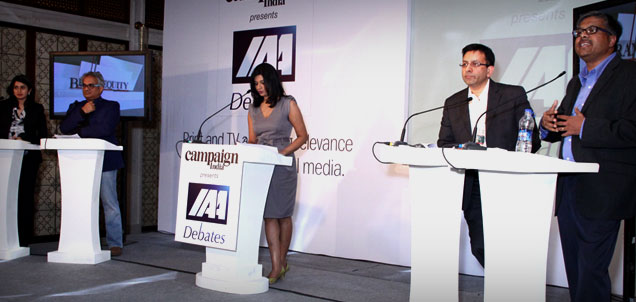
  • Is Digital eroding relevance of TV and Print?


    By A Correspondent


    The traditional media of print and television are under siege, as it were. Though they are still dominant media, they are seeing a sea change in the way they are being consumed. The explosion of new media also threatens their relevance and hold. Or so it is believed. But is it an overreaction and does digital not pose that much of a threat to TV and print?


    To find out, the India chapter of IAA organised a debate in Mumbai on Monday (Feb 18) on whether television and print are losing relevance with the growth of digital in India. The debate series is being sponsored by Campaign India and the co-chairs of the IAA debates initiative are Partho Dasgupta and Neville Taraporewalla.


    Seasoned professionals Virginia Sharma of IBM and Mahesh Murthy of Pinstorm (and Seedfund) argued for the motion while Sanjay Gupta of Star TV and Arunabh Das Sharma of The Times of India group argued against the motion. The debate was moderated by Sonali Krishna, Anchor of Brand Equity show of ET Now. A cross-section of industry professionals were in attendance. As were some representatives from MxMIndia.

    We bring you some of the highlights of proceedings. Note, this is only a part of what was discussed.


    Mahesh Murthy: If you look at the Census report, if you see rural India there are just 33 percent homes that have television vis-a-vis 54 percent that have mobile phones. Overall if one compares, urban plus rural, TV used to take 32 percent penetration in 2001 which has grown and is at 47 percent at the moment. But mobile has grown from 9 percent in 2001 to 56 percent today. Mobile today is 24 percent larger in Indian households especially rural where the number is about 50 percent more.

    If you look at the numbers further, television has about 111 million viewers whereas mobile has about 133 million users – which further consist of 400 million users of SMS, 900 million SIM cards, etc. When one compares the publication number of The Times of India that is at 3-4 million which is dwarfed by 18 million users of Facebook every day in India.

    If you look from the consumer’s POV the three most desired audiences from an advertiser’s perspective is the 15-24 yr-old youth that barely reads a paper or watches TV and is highly digital-savvy; 25-34 yr-old females – Facebook alone has 11 million of those and I do not think any other medium in India can give you that kind of access to this age group; and finally 35+ age group – it will be hard-pressed to reach a CEO today as long as he is on his tablet or i-Pad or email, etc.

    When we move on to the advertisers, all of two years ago digital was all of two percent of the ad pie which has now become about 8.5 percent, meaning that digital has grown by 400 percent while the share of television or print has gone down.

    If you look at how digital has been explored by other people like politicians who have more than 200 people to handle just the digital medium, which I do not think is the case with other media. Even when one looks at the credibility factor, Nielsen states that the most credible medium is word-of-mouth, followed by what strangers write online followed by what is written on websites and then comes print.

    So what we are seeing is that print and television are not going zero; while they still have relevance they are losing their relevance because of the advent of digital. I’d like to end by requesting each one to ask themselves as to where do you see yourself in the future – whether five years from now you’ll be seeking a job in a company that does not do digital. The honest answer will decide where your preferences will skew towards the end of this discussion.


    Arunabh Das Sharma: I’d like to begin by saying that what we are discussing here is relevance. Is it about ad dollars; is it about ‘x’ percent more mobile penetration or is it about what these media have stood for the longest time – which is curated content. What digital has done is created a proliferation of choice and when that happens big becomes bigger. In such a situation everything grows. I’d like to share here an example of how the growth of social media has fuelled the growth of television and print and how they the two mediums are getting healthier now that the investment in content is becoming stronger and stronger.

    In the 1950s, it was said that radio was going to kill the medium of print and was followed in the 1970s where it was said that television would kill the medium of radio… none of that happened. There is a reason why different media play different roles in our lives. A recent study by research firm Ipsos talks about what are the global rules that different screens play in your life. So while the mobile screen is a lover, the computer screen is a sage while the tablet is a wizard but the fact of the matter is that you need a lover, wizard and a sage; the fact of the matter is that every medium has a special role to play and we ourselves will be very myopic if we assume that television is linked to a cathode ray tube or that a newspaper is linked to a piece of paper.


    Virginia Sharma: Is your motion that TV and print continue to be relevant or that they are growing in relevance?


    Arunabh Das Sharma: I think the topic needs to be redefined whether print and TV are losing relevance but whether digital will ever gain relevance? In fact I’d like to say here that 2012 saw some of the biggest gains in stock prices of print companies because of one aspect – they had figured out their business model. The issue was that in 1992 when the readership started dropping they had to figure out a business model which wasn’t to be.


    Virginia: Do you have any comparable stats to validate your observation?


    Arunabh: It doesn’t even show on the scale for India. I’d like to add here that a lot of people wouldn’t know about this but a gentleman in the US just brought a bunch of regional newspapers with the assumption that the growth of print will happen through hyper-local and regional papers, which is exactly what will happen here too.


    Virginia Sharma: I’d like to start off by answering the question, ‘What does relevance mean?’ In today’s world relevance means business impact. The fact that it was said that digital does provide a platform of choice is correct; also the fact that social as a medium has grown is also correct.


    Arunabh: If relevance is defined as business impact, are we talking the same scale in that sense in India?


    Virginia: What I am saying is business relevance to advertising agencies…


    Arunabh: But I thought it was also about ad dollars…


    Virginia: No ad dollars is about expense. Business relevance is about business outcomes and about what the CEO measures, particularly the RoI. To quote numbers from a CEO study that was conducted, the use of social and web from 11 percent to 48 percent for social and from 37 to 49 percent for the web in the primary way to interact with the customers.  That for me is business impact and what the boss sees this as a way to engage the audience. What do most brands like Coca Cola, Pepsi, ICICI, HDFC etc have in common – it’s their innate belief that this medium is relevant and their investment in this medium is not just what the ad agency says it is.

    So, two big cases. First, the primary metric of the CEO study for marketers for success is RoI. You can measure RoI based on the ability to understand customers and target them with what they need. You can only measure digital better than you can measure print and television. Therefore the future for marketing where RoI is concerned as a primary measure for success has got to be digital if you want to make the case.


    Arunabh: I think the challenge is not about measurement but about conversion and that’s how a medium works. Measurement that you are saying is how many people have seen the ad not how many people because they have seen the ad went and watched something.


    Virginia: Measurement for me is actually measuring consumer behaviour and doing it successfully. To sum up, the business case is very simple, if you want a good RoI you have to use digital as a key medium to be able to feature consumers and that ultimately is going to be key.


    Sanjay Gupta: When I started working 20 years ago I thought print is going to die and today print is about Rs 14,000 crore from Rs 6,500 crore it was a decade ago. For television the growth has been from 5,000 crore to 16,000 crore. The key points that I’d like to present here are that firstly, consumers love television and it is thriving. The thing is that if you find something relevant you spend time with it. Around 700 million people in this country spend three hours every day watching TV. When they start it is for two hours, which then picks up to three hours. Also in the last one year, 70 million new people have started watching television. That’s more than the number of people who watch digital in any given point in a month. The same is the case in developed countries like the UK and the US where the time spent is around 4-5 hours every day.


    The other thing is that big is becoming bigger on television. The belief is that proliferation of choice will make users fragment. A recent example I’d like to share is of the movie ‘Dabangg’ which was watched by 150 million people. Even shows like Balika Vadhu etc aggregate about 40-50 million viewers in that half an hour. The point I’d like to make is that social media is actually helping the business become bigger and better. The people fall in love with our characters and they do that only on television and not anywhere else.


    Mahesh: So essentially your point is that even TV uses digital…


    Sanjay: TV does use digital. To quote an example our show Satyamev Jayate was the biggest show that we did and we used the channel of social media to make people come and watch it. It was in fact the highest trending topic on Twitter. So what I am saying is that digital is driving our business to do better.


    Virginia: Is it content that drives behaviour and interest or is it the medium?


    Sanjay: It is content. To cite figures, in the UK people watch about 80 minutes of video and out of that 80 percent is either pornography or YouTube – that’s the power of that medium there. Whereas if you provide good content it makes the viewer keep coming back to watch more and more.


    As to what is changing, digitization is changing the way television companies do business. Till now only 20 percent of the revenues from digital medium came to the broadcaster but the transparency with DTH that number is moving from 20 to 100 percent. So subscription revenues of TV companies have grown five times and what does it give us – the power to invest in content. That is what will make it even more relevant in the future.


    Murthy: So your point is that television is using DTH or rather digital to deliver itself to homes?


    Sanjay Gupta: The point I am making is that the medium is powerful, profitable and is growing. The fact is that people will not consume any one or two mediums, they will consume all the mediums. The question is: how do we use the power of each of these mediums as they have to be relevant.  So print and TV will not lose their relevance they will continue to grow. The real question is that we need content aggregators and devices. Digital as a medium is just an aggregator of content and fundamentally the question we need to answer is how meaningful can this content get on the medium if it has to grow even further.


    Arunabh: Statistics do give us a picture. The fact of the matter is that both these media are huge and growing. If they were not then we could have turned around and said that it is not but like all new media they are finding newer ways – whether through a screen, a mobile, an app – of growing the medium. We are not here to debate whether one medium is better than the other, the fact is that we as consumers love to consume media and do it the way we want to. It is not about whether x, y or z is losing relevance, the fact is it is bigger and it is growing. In fact the next round of growth is already visible to us – it is coming from regional markets. Because of our infrastructural issues it will take digital some time to pick up speed but until such time our friends in the digital world would do really well to figure out what kind of content creates stickiness and what kind of content keeps readers going for 175 years. The day one of these digital mediums complete a 175 years in the form and fashion from what they started then we can talk about it further.


    Virginia: I think the four of us together have made a very compelling case for the growing relevance of digital and that it is powerful, profitable and here to stay. Such a combination would make this medium indeed relevant. Print and TV is going digital, decision-makers are going digital, politicians are going digital… the big question is, which side do you want to sit on? And no, digital does not want to be the medium it was 175 years ago, it wants to keep up with the times as well as the generation it is catering to and it will constantly evolve and is eager to change. It will make money regardless of the shape it will take. The question is, are you ready for the future – digital?


    The debate was won by the team against the motion. Before the debate started, 44 people from the audience were against the motion and 31 were for it. After the debate ended, the numbers were 42 against and 34 for.


  • Can JWT create digital Hungama with stake buy?


    MxMIndia spoke to a cross-section of media professionals to elicit their views on the JWT Singapore acquisition of a majority stake in Hungama Digital Services


    Hungama’s telecom business is intact


    By A Correspondent


    Make no mistake. Hungama hasn’t sold out. Of the 1000+ employees, only 120 will be off to the new company which will only be 51 percent owned by JWT Singapore. And the key telecom business is intact, as are various others.


    When on Wednesday, leading advertising agency JWT confirmed its acquisition of a majority stake in Hungama Digital Services, the digital and promotions marketing division of Hungama Digital Media Entertainment. The size of the deal is not known, though the digital services division is said to have aggregated a turnover of Rs50 crore last fiscal. WPP reportedly earns revenues of over Rs 2500 crore from India and Hungama earned around Rs 450 crore last fiscal.


    The new entity which will be called Hungama Digital Services Pvt. Ltd.will be a full-service digital agency specializing in digital marketing and social media solutions. As part of the acquisition, Hungama’s activations arm, Hungama Promo Marketing will become a part of Hungama Digital Services Pvt. Ltd. and provide an engagement platform linked to online and offline deliveries.


    However, it is not known who from the existing team at Hungama Digital Media would move to the jv. “We haven’t received the new org structure,” a Hungama spokesperson told MxMIndia.


    Said Neeraj Roy, MD and CEO, Hungama Digital Media Entertainment, “With JWT, we are now part of the largest advertising network in the world. Hungama Digital Services is the coming together of two exceptional teams in a globally relevant market.” “With this partnership with JWT we hope to offer integrated digital and experiential services to our clients and prepare brands to connect, interact and now transact with their customers.”


    Hungama Digital Services has been a dominant player in the digital space for 13 years and is spread across six cities in India. In fact the creative services devision is what Hungama started out with over a decade back. The 120-strong team will continue to drive the agency, including servicing old and new clients and offer creative and promo marketing services, viral marketing campaigns, social media marketing and mobile marketing, applications, managing websites and video services.


    For JWT, it’s a good acquisition, an insider told MxMIndia. Said Colvyn Harris, JWT India CEO: “Digital is our next new frontier.The idea of the partnership is to build a digital offering for our clients so we can live up to being a ‘single source’ partner across all their ‘marketing solutions’ needs. What will be most effective in the future is a new set of talented, digital high end specialists who will add new skills and capabilities to what JWT already offers to its clients. We want all our clients to be leaders in their respective categories.”


    “We have greatly expanded our digital capability across the region, and we are not standing still. JWT will continue to hire new digital experts and explore possible acquisitions across the region this year,” said Michael Maedel, President, JWT Asia Pacific.


    See earlier report: JWT acquires 51% stake in Hungama Digital

    Raghav Anand, Segment Leader-Digital, Ernst & Young (The observer and often advisor)

    Raghav Anand

    I think Digital is an extension that every creative arm should have, but the real efficiency comes from how well it is syndicated with the overall collusion. Most of the agencies which have bought digital companies have not been able to integrate them into the overall setup, and hence not been able to leverage the synergy. So, how well you integrate and leverage the synergies will really decide whether it’s a fantastic acquisition or not. Apart from that, the other important things is that companies like Hungama are not just agencies, they are more of digital workflow companies which do a lot more than advertising and creative. They integrate into mobile and few other things. So it’s important for an agency to fully leverage them.


    Arvind Sharma, Chairman of the Indian Subcontinent, Leo Burnett (He recently acquired Indigo, a digital agency)

    Arvind Sharma

    Setting up an outfit from scratch has its own merit as you don’t have to pay a hefty acquisition price. However, I think this is a chicken and egg situation as the challenge is that when starting from scratch, you lack the scale and expertise in the beginning which is a handicap when attracting talent or meeting the needs of a client. You get stuck in sub-optimal size and scale. Particularly in Digital, one needs technical expertise and should be armed with a suite of capabilities to meet the clients’ demand. Therefore, it makes sense to acquire an agency of 150-plus people who are specialists, especially in the digital category which is witnessing a lot of interest from clients too. It immediately gives you scale and expertise. Also today clients want gamut of services under digital. They are not looking for few pieces of digital work; hence having an in-house digital agency helps in delivering.


    Mahendra Swarup, Former CEO, Indiatimes, Chairman, Smile Interactive (He’s worked with Pepsico, Indiatimes, Smile Interactive whose Quasar was acquired by WPP, and is now a well-known VC)

    Mahendra Swarup

    I think Digital is not an easy space to get into for traditional agencies. And at this point of time, digital agencies’ valuations are pretty realistic, so it’s always good for the traditional agencies to take over an existing team which understands digital. Also, the digital space is going to start growing at a fast pace, although at this point of time, it has a very low share of the total spends. But it will probably end up growing almost by 75 to 80 per cent year on year. So, it’s a big growth area. Also, I think organic development of a digital agency within an existing traditional agency is just not possible, the existing teams will not understand this space at all. So it’s more an acquisition of knowledge and competence, rather than of revenues. It’s only a question how do they (traditional agencies) get into a space which they will then grow faster.


    Alok Kejriwal, CEO & Co-founder of Games2win (He’s a contemporary of Mr Neeraj Roy…)

    Alok Kejriwal

    Whatever be the nature of the investment, I think it is brilliant that Hungama Digital has managed to get a partner like JWT. It shows that people who have been around and helped build the digital landscape over the last 10-12 years have finally begun to see the fruit of their labour as it has been one long arduous battle. Neeraj Roy has fought many battles to get media owners and brand planners to get convinced about the digital platform for India.


    Creative people are not like cement bags where you can go to the market and buy them. They are like yogis in the mountains. So when you get hold of a yogi, you’d do anything to keep him. It’s not one size fits all. JWT has a large client portfolio while Hungama has the digital capability. There are some cutting-edge creative digital agencies in the world that are the ones trying to set shop inIndia. For them to buy it makes a lot of sense, but then there are existing creative agencies inIndiathen why buy an outside agency when they are cutting-edge themselves? If you look at Quasar, which is a WPP company, they too are doing a good job. So it varies according to the needs of the marketplace.


    Mahesh Murthy, Founder, Pinstorm (He embraced digital early and is known for his forthright views on everything!)

    Mahesh Murthy

    India is one geography in the world where MNC agencies are absent among the large digital agency houses. The basic reason is perhaps their unwillingness to give up on their bread-and-butter – that is media kickbacks and TV film production over-billing. Both of these tend to disappear when you move online and digital-first agencies like Pinstorm have built large practices by focusing more on new technologies and processes, having avoided the kickback-led business that still drives mainstream advertising. Given India’s importance on their global client rosters, the MNCs here have finally figured out that if they can’t build a digital business themselves, they’ll try to buy one. I personally don’t think these random purchases will make much of a difference.


    Vikas Tandon, Founder & Managing Director, Indigo Consulting (Indigo was acquired recently by Leo Burnett)

    Vikas Tandon

    It is no surprise at all. The pace of change in the world today is stupendous, and digital media is causing consumer behaviour to change very rapidly. There is no time to build the expertise from scratch, and scale is also critical to success. Another compelling reason is there is not enough digital talent out there – a lot of the experience and expertise resides in entrepreneurial outfits. Hence acquisitions make eminent sense.


    Karl Gomes, Co-founder – AgencyDigi (He co-started the agency after a great run as a digital CD)

    Karl Gomes

    When it comes to digital, any news is good news. In fact if you look around in the media marketplace, there have been similar news developments that have happened in the recent past. The focus for agencies should be about coming up with the right idea and focus on the consumers and brands. In today’s world you have to collaborate. My only worry with these acquisitions is I hope they don’t treat them as another division but they work together and in a synergistic fashion. They need to be sitting together on the table when a brief comes across to them rather than just approach it passively. So, an acquisition like this should be good for both the people buying them and for people selling them. We have been approached by agencies but we are completely funded by clients and their business. So we will continue to run independently.


    Compiled by Shruti Pushkarna, Johnson Napier and Tuhina Anand


  • India’s Most Influential


    If you’ve been in the Indian media and are active on social networks, you just can’t ignore Mahesh Murthy (~5500 Facebook followers, ~18500 Twitter followers, 11600+ Linked-in connections!). On Saturday, he tweeted about the new Influencers rankings that his company Pinstorm produces, and the last time he did that, we noticed it was pretty well-received. However, we thought it would be a good idea to wait a bit and let the system get more robust. So when chanced upon his tweet on the Influencers 2.0, we checked out the list and invited him to write this piece for MxMIndia readers. And slipped in a request to send it the next day. That would be an impossible suggestion for most people, but we knew that Mr Murthy can will deliver. The Pinstorm founder and Seedfund managing partner is online nearly 24×7. Plus he understands the needs of our site and the profile of our readers: he has had first-hand experience of working with brands – now at Pinstorm and earlier with Ogilvy, Grey etc in advertising. He headed Channel [V] for a bit in the mid-1990s and a slew of media/onlne properties his companies PassionFund and now Seedfund have backed, including afaqs.com. – Ed


    By Mahesh Murthy


    Imagine you were a brand that bought a spot on Satyamev Jayate, or on one of the many IPL matches that we just got done with. Depending on the deal you struck, your placement must have cost you between Rs 2 lakh and Rs 10 lakh for every 10 seconds of airtime. Not counting the Rs 1 crore or so it must have cost you to produce the ad and pay the agency.


    Now both these programs got TRPs of around 3. That means around 3 per cent of India’s 121 million cable and satellite homes had tuned in. That’s 3.6 million households.


    Now imagine you were interested in the youth audience – and let’s keep it broad – say anywhere between 14 and 30 years of age. That would be about 1 such person per household – or 3.6 million people. And now let’s imagine you were interested in SEC A/B and not so much in C/D/E. So you have to cut that 3.6 million youth down to around 1 million at the most, that is if you’re feeling generous


    So it cost you around 500,000 or more rupees to reach 10,00,000 upscale youth once, for 10 seconds. On the programmes with the greatest reach in India. Most other TV programmes will have a fraction of this reach – where you’d be lucky to get 100,000 upscale youth watching your ad.


    Youth online

    Now let’s turn our attention to an entirely different medium. Let’s say that for some reason, Farhan Akhtar mentions your brand on a tweet. Or on his Facebook fan page. Or on a blog. Guess what your direct reach would be? About 10,00,000 people – mostly all upscale youth. Now let’s say just 1 per cent  of those re-tweet it. That’s 10,000 people. And if each of those re-tweeters has an average of around 150 followers, it’s now gone out to another 15,00,000 people. Even adjusting for duplication, that’s a total reach of 20,00,000 or more people. That’s more youth than the biggest TV shows in India can get you to.


    Now imagine that all of it is for free. Or, at best, for a teeny-tiny budget.


    And now imagine other people also talk of you online.


    Shashi Tharoor, our parliamentarian from Kerala directly reaches 13,00,000 people. Amitabh Bachchan reaches twice as many. Keeping showbiz aside, Yuvraj and Dhoni both directly reach more than Shashi Tharoor does. And the Dalai Lama, from his remote outpost in Dharamsala, directly reaches out to an amazing 44,00,000 people. The Delhi and Mumbai editions of The Times of India together don’t do that.


    But it’s not all celebs. Kiran Bedi reaches 4 lakh people online – mostly SEC A/B folks. That’s more than any show on MTV can get you across to. My friends Mehul Patel and Vishal of Pentagram can each get you to over a lakh people apiece, directly. More than any English business programme can.


    A section of the Pinstorm India Influencers 2.0 rankings of resident Indians (Please click to be taken to the live page)

    Mankind is the medium

    In this digital world, people don’t necessarily get their news and information from websites or TV channels. They get it increasingly from other people. The new medium isn’t digital: it’s you and me – and the places we talk.


    Facebook has 50 million Indians on it. That’s more people than watch Star Plus in the country. And 7 million of those are on Tata Docomo’s Facebook page. Approximately 7 times the monthly reach of MTV’s TV channel. So who needs who – does Docomo need MTV? Or is it the other way round?


    Once a Shahrukh Khan needed Filmfare and its circulation of 25,000. Today @iamSRK has a circulation of 25 lakh and a reach of twice as many. One would imagine a single tweet from him could double Filmfare’s newsstand sales if he chose to be gracious.


    Potential influence, not just reach

    But the power of different people on social media isn’t just that of their Facebook fan base or Twitter followers. That would be as silly as saying Doordarshan has a reach of 135 million just because every set in India can receive it.


    Social influence is measured based on many factors. How often do you talk – is it the notoriously taciturn @Aamir_Khan who has tweeted all of 90 times in the last few years? Or is it the motormouth @Agnivo who has tweeted over 2 lakh times in the same period?


    How often are your tweets forwarded or re-tweeted? What is the reach of those re-tweets? How often do people act on your tweets by replying to you – and how often do you engage back in conversation?


    All of these are factors that go into measuring one’s potential to influence online.


    The Pinstorm India Influencer Rank

    At Pinstorm we track the online influence of almost 5,000 Indian people and brands every day.


    We first created this list of social media mavens -and we add to it every month. Then we use scores from three different international measurement services – Klout, PeerIndex and Kred which look at an entity’s strength on Twitter, Facebook, LinkedIn, Quora and blogs – and then apply our own algorithm to these scores to arrive at a consolidated score and rank.


    Our scores are graduated out of 100 – and you can see them live at Pinstorm.com/ii. As at the time of writing this – and things can change every single day, Aamir Khan leads the individual influencer rankings with an II score of over 80 out of a possible 100. The only other entity with a similar 80+ score is NDTV, who heads our influencer rankings on the organisational or brand side.


    As you can imagine, Bollywood and sports personalities dominate the individual rankings, with 15 of the Top 20 individual rankings. The five exceptions being Rajdeep Sardesai, Shashi Tharoor, The Dalai Lama, Kiran Bedi and ex-adman and now comic tweeter Ramesh Srivats.


    Surprisingly, media properties don’t quite dominate the brand influence rankings, with just 8 of the top 20 positions. But cricket leads with 10 of the top 20: with CricInfo, CricketNext, IPL and 7 IPL teams holding top ranks.


    The best-ranked consumer brand in online influence terms is Samsung, followed by IndiaGames, Ixigo, Vodafone, Flipkart, Airtel and HCL.


    A section of the Pinstorm India Influencers 2.0 rankings of Indian brands (Please click to be taken to the live page)

    The purpose of maintaining these lists wasn’t just so social celebs could boast of their rankings to each other.


    Truth is that the vast majority of the 5,000 people we track aren’t celebs in the traditional media world. Perhaps you’ve not heard much of Madhavan Narayanan, Malini Agarwal, A R Karthick, Jaydip Parikh, Rahul Banker, Kaveri Ahuja or Sundar Raman. These people (and, I must somewhat embarrassingly add, myself too) appear in the Top 75 influencer list for India. With online influence scores greater than that for Viveik Oberoi, Shabana Azmi or the online avatars of The Economic Times, MTV or Star Plus.


    In India’s online world where there are more people on the net than there are TV sets – and where more people already access the net from their mobile phones than do from their desktops and laptops – where would you put your marketing rupees?


    At Pinstorm we suggest to marketers that a well-thought-through group of online evangelists, people who are interested in your product category and have credibility – should be lovingly tended and cared for. New announcements and launches should be shown to them first – because if they like what they see, they might talk about it online.


    And that combination of reach and credibility could do you a lot more good at lot less than a Rs 1 crore TV commercial shown repeatedly for Rs 10 lakh every 10 seconds.


    The Pinstorm India Influencer List is live and visible online at http://www.pinstorm.com/ii  We maintain lists across brands, residents of India, Indian non-residents and politicians. Mahesh Murthy is the founder of Pinstorm, India’s leading digital-first brand management firm.