Tag: Mahabharat

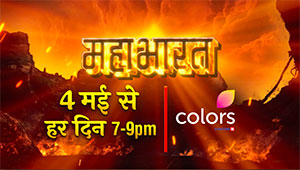
  • Colors acquires rights to air ‘Mahabharat’

    By A Correspondent


    Popular mythological show ‘Mahabharat’ is set to air on Colors starting today, May 4 daily from 7 to 9 pm.


    Said Manisha Sharma, Chief Content Officer, Hindi Mass Entertainment, Viacom18: “Due to the nationwide lockdown, the television landscape is changing quite significantly. The popular classics and erstwhile shows have found a renewed interest amongst the audience as they provide relief and induce nostalgia. We are elated to air Mahabharat on television to give our viewers another opportunity to relive the golden times.”


  • Top 5 Gamechangers on Hindi GECs in 2013


    By Shailesh Kapoor


    For the television industry, 2013 will be best remembered as the year of digitization. Similarly, we hope to remember 2014 as the year of a ratings system overhaul, with the industry shifting to the new system being developed by BARC. We are evidently in a period when technology and not content is emerging as the gamechanger.


    Yet, there were gamechangers that stood out on the content side in Hindi GECs too. Here’s a look at my list of Top 5 such shows. Established successful shows like Diya Aur Baati Hum, Saathiya and Balika Vadhu are not a part of this list, as their ongoing success is simply a continuation of what they promised in the last few years.


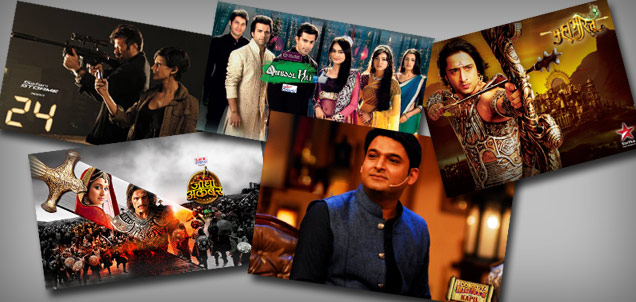
    5. 24

    The much-hyped 24 did not deliver high ratings. But it makes it to this gamechangers list for simply trying. As the Indian television market matures, we are bound to see fiction experiments beyond the regular family-based shows that currently rule the roost for the right reasons. When one such idea clicks, the floodgates will open. But 24 on Colors will always be remembered as the pioneer that brought this change. Here’s hoping for a more-Indianized second season.


    4. Qubool Hai

    Launched in late 2012, Qubool Hai scaled great heights of popularity in early and mid 2013, before losing some of the steam towards the end of the year. Driven by good casting that combined eye candy with solid performances, this Muslim social offered cultural variety, but with a contemporary and youthful treatment that had the college girls asking for more. Along with Sapne Suhaane Ladakpan Ke, it gave Zee TV a younger audience base that in turn helped the channel grow during the year, and sizably so.


    3. Mahabharat

    Star Plus challenged the status quo on production of daily fiction shows this year. After a rather half-baked attempt with Saraswatichandra, Mahabharat saw a real shift of scale. The show is easily the best-mounted fiction show ever in the history of Indian television. Its perspective on the epic tale is applause-worthy too, with considerable focus on the grey, than just the black and the white. Uneven pace and language comprehension issues may have limited its viewership in the early period, but the serial is now set for a creditable finish in 2014.


    2. Jodha Akbar

    Zee TV’s Jodha Akbar is a live case study on how to make a historical theme engaging by giving it a contemporary treatment. Story-wise, the programme uses the tried and tested elements of family and romantic dramas, exploited earlier to hilt in shows like Pratigya and Saathiya on Star Plus. It keeps the language simple, allowing for easy, fun viewing of what could have been an otherwise-overbearing show. Yet, the period look makes the show stand out in the crowd, offering the best of both worlds.


    1. Comedy Nights With Kapil

    This has to be a one-horse race if there ever was one. The success of Comedy Nights With Kapil on Colors cannot be measured by its ratings alone. Its consistently top-notch and flawless execution, combining fiction with live entertainment, has left me amazed episode after episode. How can you get something so right, I have often wondered. The show delivers two popular genres, which were beginning to look a bit jaded on television, in a refreshing avatar – Comedy and Bollywood.


    The comedy stays away from being crass or lowbrow at all times, yet manages to focus on popular culture and mass themes. The celebrity interaction is nothing we have seen before. It is audience-indulgent, not celebrity-indulgent. By now, it is common knowledge in the industry how celebrities aspire to be on the show and nervously prepare for it, so that they can match up to Kapil’s wit and timing.


    Comedy Nights With Kapil is the unifier show we have missed since KBC in 2000 – a show that various sections of the family and the society have an equal appeal towards. Thankfully, its success is not replicable, so we may not see too many clones coming out. Meanwhile, another 100+ delicious episodes await us in 2014.


  • Shailesh Kapoor: Myth-or-logical?!

    By Shailesh Kapoor


    We hear it all the time. That India is getting younger. That we should think of the 13-24 years segment as “screenagers”, not as teenagers or youth. That Facebook is bigger than Star Plus, Zee TV, Sony or Colors for them today. That they would rather watch edgy fiction content on Channel V than (what some believe are) afternoon soaps masquerading as prime time entertainment on television.


    Our marketers are obsessed with the young generation. Arguably, they have their reasons. “Consumption” is being increasingly fuelled by the youth, making them the low-hanging fruit for several product categories.


    But when it comes to television, there’s another story we need to know. A story that’s in sharp contrast to the oft-stereotyped tale of the screen-agnostic, gadget-happy youth. It’s the story of religious and mythological programmes continuing to succeed like never before. A story that may appear to be counter-intuitive to the young Indian theory, but is actually firmly grounded in the reality of our fascinating country.


    Over the last two weeks, the newest GEC on the block, Life OK, has scaled new heights, riding on the popularity of its flagship show Devon Ke Dev Mahadev. The recent ‘shaadi’ track, where Mahadev and Parvati get married, has been a runaway success. Mahadev now features in the top 7 Hindi GEC characters on popularity in our monthly research ‘Characters India Loves’, ahead of iconic characters like Akshara and Archana.


    Last Sunday, Zee TV launched the third television adaptation of Ramayan, with a simulcast on Doordarshan. The second adaptation provided a creditable launch pad to NDTV Imagine in January 2008. Sceptics argued that it worked because it came 20 years after the original Doordarshan version. However, that theory has been disproved with the encouraging response to the Zee TV show.


    To their credit, both Mahadev and Ramayan are well-produced programmes that manage to engage and entertain. But that’s not enough to explain their wide acceptance, especially in the wake of the young India theory. But there’s another reason indeed.


    We conducted a nation-wide study recently to understand the profile of the ‘remote controller’ in single TV households in India. The results were anything but ‘young’. In weekday prime time, the median age of the ‘remote controller’ is… hold your breath… 35 years, with almost 70 percent of them being women. So, from 7-11pm on Monday to Friday, when a large amount of advertiser money is being spent, a 35-year old housewife is the bull’s eye answer to “who decides what plays on TV”.


    On weekends, the median age gets a bit younger, but is still 25 years, with a near-equal male-female ratio. Technically, even this audience is outside the stereotypical definition of “youth”. After all, a large section of urban Indian audience (70%+) is already married at the age of 25.


    Can you see the chicken-and-egg question here? Do “youth” prefer Facebook and co. to television because they have no control over the remote, or do they lack control over the remote because they have voluntarily given it up? Complex as the explanation may be for this medium, I can safely say that the former is more accurate than the latter. In the way our family viewing patterns have emerged over the last two decades, the all-important remote control has acquired an ownership configuration completely divergent from what the young India theory should suggest. And these viewing patterns are unlikely to change in a hurry, till the multi-TV phenomenon begins to become a significant factor in India.


    That brings me back to mythology. It’s content made for the 35+ females segment. These are mothers whose kids are on the verge of entering their teenage. Reinforcement of religion, culture and values is of paramount importance, to both her own self and for her child. NDTV Imagine promoted Ramayan as “Ek Achhi Aadat”. Zee TV is promoting it as “Jeevan Ka Aadhaar”. Both messages aptly reflect the mindset of a 35+ woman who is battling generation gap and upbringing issues around her children. She loves to watch the “mythos”, and also hopes that her child watches along. Sometimes willingly, sometimes grudgingly.


    When Ekta Kapoor tried to push the envelope with Mahabharat, the audience rejected her idea of glamorizing sacred material instantly. But give it to them within their values framework, and there’s nothing more potent than good mythology on the small screen.


    So, for all the talk of being a young country, the pre-liberalization generation still decides what gets watched on TV. But then, we have always been a dichotomous country. One where Rakhi Sawant and Mahadev can get married with equal fanfare and razzmatazz.


    Shailesh Kapoor is founder and CEO of media & entertainment research and consulting firm Ormax Media. He spent nine years in the television industry before turning entrepreneur. He can be reached at his Twitter handle @shaileshkapoor


  • Want to recreate Ramayan’s magic, but difficult to fit into grandfather’s shoes: Amrit Sagar

    By A Correspondent


    Amrit Sagar

    Twenty years ago, Gods and mythology, not Aamir Khan, ruled the Indian television sets. In the late 1980s, streets would empty out on Sunday mornings as people sat glued to their TV sets to watch Ramayan and Mahabharat.


    Now Zee TV, which is re-entering the slot with a mythological show – Ramayan, hopes to create the same magic. “Ramayan is more than mythology; it is the ultimate story about our culture and family values and relationships. We all grew up on it, and we want the current generation to know about it. We wanted to tell the story, which left an impact on us, all over again…” said Sukesh Motwani, head – fiction programming, Zee TV.


    The channel has chosen the 11am slot because it feels that the story needs to be watched together as a family, and what could be more perfect that a Sunday morning.  It is happy that the slot is being relived again as various networks are launching shows on the same slot. “For the last few years, no one paid attention to the Sunday morning slot, but now things are changing. However, we do believe that the content is the main criteria which will make the show on that slot a hit or not,” said Mr Motwani.


    The channel also believes that times have changed and TV penetration and numbers have increased over decades but the whole Sunday morning experience can be brought back with a story as simple and universal as Ramayan.


    Sukesh Motwani

    Apart from the story, one more thing common between the original and the new Ramayana is the Sagars. Zee TV has taken on-board Sagar Pictures. MxMIndia spoke to Amrit Sagar, who along with Moti Sagar and Meenakshi Sagar, is set to recreate the classic…


    Many networks have showcased new avatars of Ramayan and Mahabharat, but failed to get the same response as the originals. So, how is this going to be any different?

    We must keep in mind that the stories for such epics cannot be changed. One has to tell the same story; however, the way it is told can vary from person to person and how lavishly the show is made. From that aspect, we have tried to make it bigger and better than anything seen before. Having said that, we have made sure that the story isn’t compromises with, so, have followed my grandfather’s and Tulsidas’ original.


    Audiences and mindsets have changed, so how will you make the show relevant for today’s generation?

    We are very much aware of this fact. Therefore, we plan to charm the audiences with the visual effects and sets.


    Will we see any new faces on the show? How did you choose the actors to play the characters, especially that of Ram and Sita?

    There will be new faces on the show and the ones which people have seen on television earlier are the ones who have never played such characters before. So, it is going to be a different experience for everyone. Also, an image of the god is very individualistic. The actors we have chosen to play Ram and Sita are the ones we thought suited the bill from our view point. We are keeping our fingers crossed… rest depends on audiences and how they welcome and perceive the characters.


    There are rumors of clashes because of current failure during the time of the telecast. Do you see that happening today?

    It’s difficult to predict that, but I hope we are also able to create the same passion and effect.


    Do you think Sunday morning slot will interest youngsters?

    Apart from the metros, I think Sunday is like any other day for the rest of the country wherein the day starts early. Also, it is about the family spending some quality time together. Therefore, I don’t think we will face any problem in attracting the audiences – old or young. I’m sure the show will be enjoyed by a whole family together.


    What kind of response are you expecting since the show will be aired simultaneously on Zee and DD?

    Of course, we are hoping to see a great response from the audiences as the reach will massive. We want to create the same magic again. However, I also know that it will be very difficult to fit into my grandfather’s shoes.