Tag: Magna Global

  • 11.8% growth to touch Rs 1.2tn in 2024: Magna forecast

    11.8% growth to touch Rs 1.2tn in 2024: Magna forecast

    The Indian advertising industry will grow from ₹1.1 trillion (US$13.1 billion) in 2023 to ₹1.2 trillion (US$14.6 billion) in 2024, 50% higher than pre-pandemic period, as per estimates released on Monday by Magn Global. However, print, radio and cinema are lagging 2019 levels. The advertising revenue is forecast to grow +11.8% in 2024 . It was +11.2% 2023..

    The digital media is poised for a +15.9% growth with share growing  from its current 47% to reach 50% of the total revenues by 2026. Social will overtake search to become the second-largest media after television. Traditional media is also experiencing growth year-over-year. Linear formats are likely to grow at +8.4% (8.7%, 2023) in 2024. Magna estimates +10% growth in 2025 and continue to grow at a CAGR of 10% to reach ₹1.7 trillion (US$21.1 billion) by 2028.

    Said Venkatesh S, SVP, Director – Intelligence Practice, Magna India: “The Indian advertising market is set to expand by 11.8% in 2024, reaching ₹1.2 trillion, driven by a robust 15.9% growth in digital media. Traditional media formats are also growing, enduring the relevance of Print, OOH and Radio in addition to Television. The government’s emphasis on digital public infrastructure is propelling digital ad spend to nearly half of total revenues by 2026. Our forecast highlights social media’s significant rise, overtaking search as the second largest media format after television.”

    Here is the rest of the information as received from Magna Global:


    Growth in India is projected to remain strong at 6.8 percent in 2024 and 6.5 percent in 2025, with the robustness reflecting, continuing strength in domestic demand and a rising working-age population according to IMF. With the per capita income increasing multifold, consumer spending outlook remains positive. India has been evolving as one of the world’s most dynamic consumption environments and is expected to maintain steady economic growth. The fastest growing economy is projected to surpass China’s growth rate by over 2% points. India, by 2028 is expected to become the 3rd largest economy leaving behind Germany and Japan.

    Inflation is projected to decline from +5.4% in 2023 to +4.2% in 2024 and long-term inflation estimates remaining anchored, monetary policy stance of central bank is expected to support growth.


    In 2024, total advertising revenue from ₹1.1 Trillion (US$13.1 billion) will touch ₹1.2 Trillion (US$14.6 billion). Digital formats or new media contribute over 60% to the incremental revenue. Digital is estimated to grow +15.9% and linear growth will be at +8.4%. In a normal year, H1 contribution is generally less than H2, however general elections scheduled from March to May followed by ICC T20 Cricket World Cup in June-July will boost H1 growth (+11.8%) equal to second half of the year (+11.9%). Both general elections and live sports will lead to a significant growth in adex across both Digital and Linear media.


    In 2023, listed companies’ average income and profits have grown in double digits. This is encouraging as private investment in capacity building and marketing activities will increase. Auto sector demonstrated significant growth across all segments in 2023, this is expected to boost marketing and advertising budgets in 2024. CPG continues to rise as more people start to move up the economic ladder and the benefits of economic progress become accessible to the public. The urban segment is the largest contributor, however, in the last few years, the growth has come at a faster pace in rural India. With normal monsoons expected, rural demand will pick up and this bodes well for the sector. Retail sector is experiencing exponential growth across pop strata. Sizeable middle class, changing demographic profile, increasing disposable income, and urbanization are some of the factors driving organized retail. E-commerce has transformed the way business is done and has enabled newer segments like D2C. Rapid expansion into Tier-2 and Tier-3 cities will aide sectoral growth.


    CPG, Auto, Retail, Government & Political advertising, and Finance are expected to be the most dominant sectors contributing to India’s adex growth in 2024, followed by Pharma, Education, Real Estate, Media & Entertainment and Building Materials making up the top ten sectors.


    Consumption trends continue to favour digital media. The liberal and reformist policies of the Government have been instrumental in developing digital public goods. All digital formats are growing at a healthy pace specifically social, video & audio streaming and online gaming. With the democratisation of content consumption, Ad-supported video on demand platforms have transformed viewership by providing easy and affordable access to live sporting events. As of 2023, wireless base stood at 1.15 billion subscribers and 95% of the data consumed have come from 4G connections. Rise in mobile penetration and decline in data costs is expected to add to the internet base. In 2024, digital ad spends will grow +15.9% to top ₹580 billion (US$6.9 billion). Social & Search with 34% and 33% shares drive the digital pie followed by Display & Video at 19% and 14%. In terms of growth, Social (+21.9%) and Video (+19.1%) are the fastest growing formats.


    Television reaches 778 million viewers (759 million 2022) and overall time spent has increased to 230 mins (218 mins 2022). Close to a third of homes do not have television and linear TV has potential to grow. Probable launch of Direct-to-mobile will increase the reach of Television, trials for this home-grown technology would soon be planned across cities. Overall Television ad revenues in 2024 will grow +8.7% to reach an estimated ₹393 billion (US$4.7 billion). Elections will drive advertising growth for TV, specifically for news and T20 World Cup will further boost revenues.


    Print media has reinforced itself as the most trustworthy source of information. The circulation in 2022-23 has gone from 391mn to 402mn copies and the largest local media is still relevant providing the geographical spread and audience size. Advertisers’ belief in this consumption story led to a handsome growth of +7.0% last year. In 2024, ad sales revenue will grow +6.1% to ₹188 billion (US$2.2 billion) but it is still 11% below pre-covid levels. Digital print revenue is estimated to be ₹13 billion (US$159 million). Drop in social media referral traffic as Meta dissociated itself with news is hurting publishers. Print advertising growth will come on the back of national elections and local elections in 8 states.


    Radio is still ailing from the slowdown caused during covid, recovering only 86% of the 2019 levels. While there is enormous increase in volumes, ad rates have remained soft. The long-standing challenge of audience measurement capabilities is hurting the medium. Increase in Government ad rates will help growth considering this is an election year. Government recommendations on News broadcast, reduction in license fee and mandatory FM tuner on mobiles will bring windfall to the industry. The revenue for 2024 is estimated to be ₹19 billion (US$231 million) reflecting a growth of +9.0% over previous year.


    OOH media is on a growth trajectory and is expected to cross 2019 levels this year. All 3 forms, Traditional, transit and DOOH is showing incremental revenues. Government push on infrastructure and urbanization will boost OOH inventory especially premium formats. In 2024 OOH revenue will increase +16% to reach ₹34 billion (US$402 million). DOOH share to total OOH is at 6%, growing at a CAGR of +33%, by 2028 share of DOOH will touch 11%. Roadstar, a unified audience measurement tool for the OOH industry developed by the national body for Outdoor Media, is likely to see light, this should help demonstrate effectiveness of the medium and facilitating growth. In-cinema advertising was the biggest casualty of covid which has recovered to the extent of 72%. Successive come back from all languages with box office hits in 2023 and good inflow of content in 2024 will drive both demand from advertisers as well as surge in audience foot falls. In 2024, the growth is estimated to be +19% to reach ₹8 billion (US$95 million).


    Added Hema Malik, Chief Investment Officer, IPG Mediabrands India: “India’s advertising industry is gearing up for an impressive 2024, with significant growth driven by pivotal events like the general elections and ICC T20 World Cup. We expect substantial ad spend increases across sectors such as auto, retail, and CPG. The anticipated 11.8% growth in ad revenues highlights the market’s resilience and potential. With rural demand expected to rise due to favorable monsoons and digital ad spend projected to reach ₹580 billion, the convergence of traditional and digital media presents unique opportunities for advertisers.”

  • Magna Global too forecasts Achche Din: 15.4% adspend growth in 2019


    India faced headwinds from two successive regulatory distractions in the form of de-monetization (Nov 2016) and Goods & Service Tax (July 2017). This held back the economic growth to 6.7% in 2017 (8.2% in 2015 and 7.1% in 2016) and its lingering effects continued in the early parts of 2018. With the negative impact fading, the economy is on the recovery mode and IMF has forecast a growth of 7.3% in 2018 and a consistent 7+% growth till 2023 in its October 2018 report. Advertising expenditure per capita continues to grow from ₹ 515.3 in 2018 to ₹ 586.7 in 2019.


    Said Shashi Sinha, CEO, IPG Mediabrands: “India is the only market in the world where Print continues to be dominant and is growing in all aspects – circulation, readership and geography. The medium is growing strongly on the back of language which has led to the growth in the number of language newspapers. Secondly, print is growing because of the credibility it offers in this era of fake news. There is no denying that there are platforms causing strain on Print but the attributes of well researched, in-depth content and authenticity can only be endorsed by Print and that makes the medium more credible and hence relevant for advertisers. In 2019 print will further emerge as a dominant force because of all the state elections and the general election and we expect the growth rate to be higher than 2018.


    2018:+14%

    Good monsoon backed by minimum support price for crops boosted consumption in rural markets. Consumers got the benefit of lower tax incidence post GST. Digital access got easier and device penetration made a significant positive impact on sectors like e-commerce, auto etc. This growing consumption is attracting the attention of the marketers. Measurement of rural media consumption by BARC and IRS is encouraging advertisers to invest. With economic activity resuming full throttle, overall industry is brimming with positivity and all sectors including Media and Entertainment has shown buoyancy and growth.


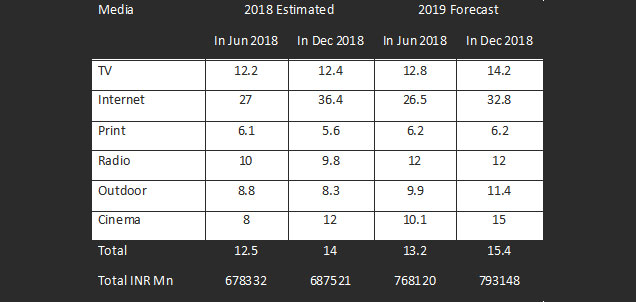
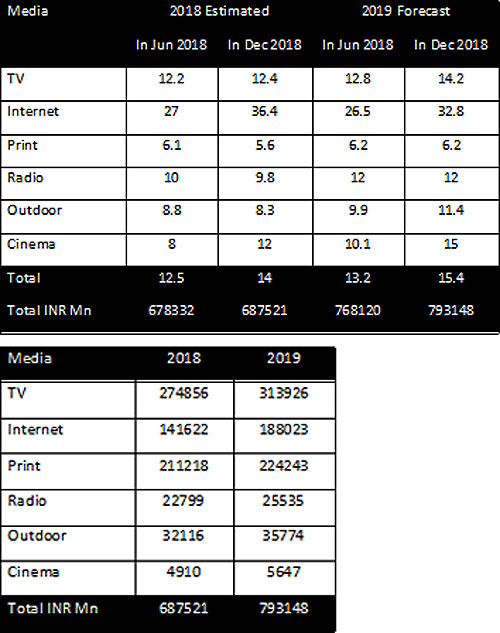
    Marquee events like IPL was a major revenue spinner despite aggressive acquisition cost. Extended festive period helped advertisers justify higher marketing investments. Magna estimates the ad market in 2018 to accelerate further compared to previous estimates and exit with a +14% growth (+1.5% higher than June 2018) notwithstanding the restraint caused by the natural calamity in southern part of India


    2019:+15.4%

    Digital is stimulating overall growth.  High-speed broadband and online video is driving elementary changes.  Though it is still a duopoly of Google and Facebook attracting >70% of the revenue, this will change the balance as OTT and E-commerce ad platforms are gaining scale and are increasingly attracting advertising monies. Advertiser’s confidence in the medium is very strong despite Face Book’s strategy to declutter ads on news feed followed by a rate increase and YouTube doubling rates for their premium assets. The market share of Digital will go up from 21% to 24% of total advertising spends with revenues touching ₹188 Bn in 2019.


    Added S Venkatesh, SVP, Magna India: “Digital is leading with +32.8% growth in 2019. Massive expansion in smartphone usage is shifting the consumption from collective to discrete. Streaming video will be the biggest gainer in terms of format and is estimated to double its revenue in 2019. Total revenues will grow from INR 687.75 Bn to INR 793.1 Bn.


    Television has immense headroom to grow with 34% of the homes still being Non-TV as per BARC. While organic growth is absolute, cyclical events like ICC World Cup and National elections will generate strong advertising demand. Healthy distribution realisation with digitization gaining momentum will reduce dependence on advertising and aid broadcasters demand better yield. Despite digital growth, TV continues to be dominant as it enjoys unmatched tor of audiences. With 40% allocation of advertising spends, TV will expand+15.4% in 2019 and will continue to grow CAGR +12.5% till 2023


    Print: Physical news delivery compared to global trend of negative growth has grown CAGR +1.9% in the last 5 years till 2017 as per ABC. Also the fact that readership has grown across age groups establishes print’s dominance, relevance and growth. English newspapers are facing stiff competition from Digital platforms and this drop in readers is offset by the growth in languages. Publishers are also gearing up to move beyond pure-play print revenue stream.  Print will attract a larger pie of the political campaigning and Government spends because of elections. Real Estate and Education advertising reaching its earlier peak will help achieve growth of +6.2% in 2019.


    “Lot of investment is going on Print digital properties including Google’s product Navlekha. The digital edition measurement from IRS when reaches scale will help publishers monetize both forms of readership”, added Venkatesh.


    Radio segment is facing surplus inventory because new station launches, in addition, music streaming apps have become easy to access because of fall in data prices. Fearing drop in listenership base, radio stations have cut down advertising load to increase engagement.  While some of the networks have been able to increase rates, this approach is affecting topline growth with advertising revenue witnessing a jump of +12% in 2019. Automobile, finance, real-estate and E-commerce are primary contributors to growth with Government and political spends increasing during the election window


    For OOH it will be a promising year with major contributions from OTT and Mobile Apps along with Telecom and E-commerce. Government’s promotion of welfare schemes and Election spending will sustain this momentum. Estimated to recover with a +11.4% growth the category continues to be data scarce and shall hold 4-5% share of total spending.


    Key Figures:

  • IPG Mediabrands revises 2016 Adex forecast from 18.4% to 16.2%


    By A Correspondent


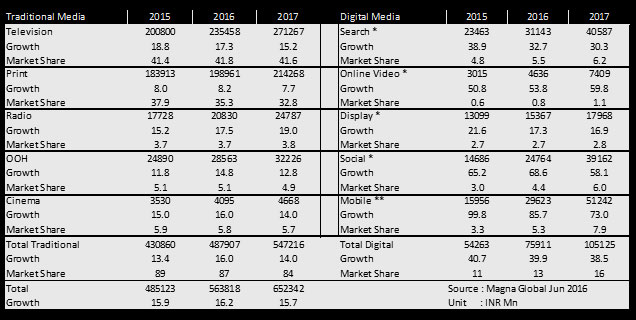
    IPG Mediabrands India has revised its Adex forecast for 2016 made in December 2015 of 18.4% to +16.2% .The size of the industry, is expected to touch 9 billion USD or 564 billion INR equivalents. This half-yearly report is put together by MagnaGlobal, the strategic global media unit of IPG Mediabrands.


    Magna Global also reports an early prediction of the India Adex in 2017, which it says will grow +15.7%. India pips Italy to get into Top 10 list this year and estimated to move up 4 ranks to become the 6th largest advertising market by 2020.


    India will retain its position as the fastest growing economy with real GDP (gross domestic product) growth of +7.5% in 2016. According to International Monetary Fund (IMF), India is likely to maintain the same GDP growth in 2017 as well. Consumer inflation slightly outside of target will force the central bank to hold onto its policy rates. However, the earlier reduction in rates gave the much-needed impetus to automobile, housing, durables and education sectors. The farm sector, if favoured with a good monsoon, will set to rebound its output. The report estimates private consumption to mirror the growth rates and push for higher marketing spends.


    This year, events like T20 World Cup, State elections, UEFA Euro 2016 will generate incremental spends. In addition, the 4G landscape destined to explode will make both service providers and handset manufacturers press the ad spend accelerator and Government investment on infrastructure and social awareness projects will hit a new high. E-commerce and automobile will continue to occupy significantly larger media space.


    Said Shashi Sinha, CEO, IPG Mediabrands: “The outlook is extremely positive as globally India remains one of the fastest growing markets. In fact, India is now one of the top ten advertising markets in the world.”  Talking about the revised forecast, S Venkatesh, EVP, Director Intelligence Practice, Magna Global – India, said: “Basis our initial read of the emerging trends we had envisaged a stronger headwind across digital formats on the mobile platform while the real numbers for H1 2016 suggests a lesser significant acceleration”


    SECTOR WISE DATA

    Television with 42% market share will grow +17%. The biggest contributor to revenue will be the T20 World Cup, Indian Premier League (IPL) and non-cricketing leagues buttressed by E-commerce, Telecom, Auto and CPG advertising. Addressable television and expansion of the measurement into rural India equips advertisers to reach more consumers and broadcasters to monetize now counted audience. Measurement will evolve to include addressable TV audience and though connected TV currently doesn’t pose a threat to linear advertising, it will open doors for more on demand content access. Mushrooming of both domestic and international OTT (over-the-top) players will eventually fragment TV viewing time.


    Print will continue to be the second biggest medium in India with 35% market share and ad sales growth of +8%. Conventionally print heavy advertisers in CPG, BFSI, Automobile and now E-commerce contributes to the segment growth.


    Digital formats continue to disrupt traditional with the highest growth at +40% and increasing its share of market by 2 points to 13%. Videos will be the fastest growing format driven by consumption on mobile devices. Screen time will only increase as smartphones get bigger with better displays and faster bandwidth. Trailing this trend expect advertisers to ear mark higher promotional budgets.


    Radio through foot print expansion along with increase in volume is estimated to grow +18% in 2016.


    OOH will grow +15% in 2016. Both these segments will hold onto their market share of 4% and 6% respectively.


  • Indian adspends to grow 18.4% next year: Magna Global


    By A Correspondent


    In its latest report on the global advertising marketplace, market services conglomerate IPG’s strategic research arm Magna Global estimates that media spends will grow 18.4 percent in 2016. Media owner advertising revenues grew by +3.2% in 2015 to $503 billion. This is lower than the previous forecast (+3.9% in June 2015) and represents a slowdown compared to the 2014 growth (+4.9%).


    Erosion in shares is a reality even for television: Venkatesh S 

    Like every year, we posed a few questions to Venkatesh S, EVP, Director Intelligence Practice on the basis of the numbers and report posted by IPG’s Magna Global


    16.3 percent this year as against your forecast at this time last year for 2015 being 13.3 percent. And now a forecast of 18.4 percent growth next year? Way too optimistic, na?

    In 2015 both television and digital has seen unprecedented utilization. In the case of television, supply restrictions have been breached even by the networks which were following earlier. On Digital, E-commerce, M-Commerce, other services like Housing and Quikr and auto aggregators have increased their spends


    Digital will see a one off blip in revenue in 2016 thanks to opening of new advertising platforms from Instagram and Twitter. Content creators like AIB and TVF have seen success in audience acceptance. Native advertising is another format which will start contributing to the overall pie.


    Television adspends are going to be down further next year as per your forecast. What would you attribute this to?
    From +18.5% to +15.1% is because of the NRS (non-recurring spends) getting neutralised. 15.1% is a very healthy growth when globally TV is diminishing


    The total market share of all digital has just got into two digits even though growth is very high. Your comments
    Digital is still 1/10th of traditional spends and traditional is still growing even at its current scale. 17% market share in 2016 will give this category scale and by 2020 we expect the shares to equal print.


    From the 12th largest in 2015 to the 7th largest in 2020. Given that we have a population of a billion-plus and are the world’s largest democracy with a not-down-in-dumps GDP, this rise from #12 to #7 is pretty slow, right?
    India is in the bottom of the Ad Spend per capita ranking (at $7 compared to APAC at $40 and Global at $87). I think we have made progress in making media accessible to the entire populace through cable digitisation, mobile penetration, radio privatization, publishers expanding their edition network etc. On the measurement front too TV has expanded. This will aid media owners to monetise their audience and in turn grow the advertising economy.


    So guess the biggest headline forecast is that India will see market share of digital equalling that of print by 2020?
    This was expected to happen one day and not that print has stopped growing but digital volumes are attaining scale.  While globally digital is going to be the number one category in two years, India will take a long time to achieve this.


    You hope that IRS or some such study will help print win back market share in 2016. Since it doesn’t appear to be happening as of now, is the erosion here to stay?
    Erosion in shares is a reality even for television. Measurement permanency will help reduce the intensity of this and gives an opportunity for the 2nd and 3rd rung publications to get their due advertising share.


    So which sector was the biggest advertiser in 2015 (sports, e-comm, telecom, polls…)? And which do you expect to be in 2016?

    Sports have been one of the marquee content because of ICC World Cup. In 2015 while E-commerce has been the major driver of growth in 2016, E-commerce and Telecom will fight out for a larger share of media space.


    As China is slowing down ((slightly), India has become the most dynamic economy among BRICs and among all the large nations monitored by Magna. Real DGP grew by +7.3% in 2015 and will grow again by +7.5% in 2016 according to the IMF, with consumer price inflation at around 6% per year. In that context advertising spending grew by +16.3% in 2015 to 487 billion rupees (approx. $8 billion) allowing India to become the 12th biggest ad market in the world at the expense of Russia.


    In 2016, ad revenues will be boosted by economic stabilisation and the incremental spending generated around non-recurring even-year events (US Presidential and General elections, UEFA Football championship in Europe, Summer Olympics in Brazil). Magna Global is hence predicting ad sales to grow by +4.6%, marginally less than its previous forecast. Neutralising the impact of non-recurring events (NREs) in 2014, 2015 and 2016 (generating approximately 0.9% of extra growth in even-numbered years), the global ad market would have grown by +4.1% in 2015 and +3.7% in 2016, which suggest no real 2016 acceleration in the underlying ad demand, beyond the cyclical drivers.


    In terms of geographies, Asia-Pacific was the most dynamic region (+6.5%). Latin America and Central and Eastern Europe, once the fastest-growing regions, are both suffering from dramatic economic slowdown reflected in ad spend cuts (-3% in CEE, +3.8% in Latam). Meanwhile, Western Europe continues its recovery (+2.9%), while North America is slowing down (+2.0%).


    Of the 73 countries analysed by Magna Global in this update, 62 experienced ad revenue growth this year and eleven (incl. Russia, Finland, France, Greece, Peru, Singapore) suffered a decrease. The biggest contributors to the 2015 slowdown are the two BRICs countries affected by severe economic difficulties: Russia, where ad revenues are now expected to decrease by -12% (previously -11%), and Brazil (+4.4%, unchanged). On the other hand, the 2015 growth estimate for China, India and the US have increased. For 2016, only four markets are expectred to remain in the red while 69 (including Russia) will experience some level of growth.


    Asia-Pacific: this year +5.6%, Next Year +5.2%

    Media owners ad revenues increased by an estimated +5.6% in 2015 to $146bn, making APAC the second-largest region with nearly 30% of global spend. This is down slightly from previous expectations of +6.3%, despite the fact that growth was slightly stronger than expected in two of the region’s biggest markets (China +9.9%, India +16.3%).


    Growth in 2016 is expected to be slightly weaker, at +5.2%, due to continuing slowing of the region’s economy. APAC is now the second-largest global region, behind North America, having passed EMEA, with 29% of global ad revenues generated in the region. Given the high growth rates expected in APAC going forward compared to EMEA, the region will become increasingly critical to global advertising spend growth, notes Magna Global.


    APAC’s GDP growth is expected to be +6.5% in 2015 according to the IMF, down from +6.8% in 2014. Economic growth will again slowdown slightly in 2016 to +6.3% as China continues to transition to a consumer economy while India accelerates. Despite concerns about APAC growth weakness and the spillover to the global economy, it’s important to keep in perspective that it’s only modest slowdown and APAC growth remains significantly ahead of most of the western world, notes the Magna Global report.


    India: this year +16.3%, Next Year +18.4%

    Advertising revenue increases by INR 68 billion to touch INR 487 billion in 2015.  On the back of increased volumes, Television revenue will add +18.5% (Dec 2014 +11.9%) to reach INR 200 billion.


    While television market share is up by a percentage point (41%) Print goes down from 41% to 38% to touch INR 183 billion (growth of +7.7%). In 2016 Television is estimated to grow +15.1% and Print +8.2%.


    Digital formats continue to grow the maximum at +49% to touch 57 billion rupees and thereby increase its market share to 12%. Ad sales generated from Video and Social increasingly will be through mobile impressions while Desktop in the near future will still be the domain for Search and Display. Share of mobile from 32% will be close to half the pie in 2016. Programmatic outside of Search will grow +5.7%.


    Newer formats and revenue streams (Twitter and Instagram opening up new advertising and influencer management platforms), bandwidth expansion through 4G launch and traditional advertisers increasing their digital budgets will contribute to the growth of +67.3% in 2016.


    Radio with a market share of 4% will grow +14% in 2015. Through the expansion of foot print and there by volume is estimated to add +16% in 2016. OOH will grow +11.9% in 2015 and by another +10.4% in 2016.


    Magna Global estimates total advertising revenue to touch 576 billion rupees in 2016.


    The T20 World Cup, encouraging response from audience to non-cricketing leagues, state elections, 4G launch are some of the drivers for the advertising economy in 2016. E-commerce will continue to pursue GMV’s, most action will be seen in the telecom sector followed by Auto and FMCG advertising.


    Digital television and expansion of the measurement panel will allow advertisers to reach more consumers and broadcaster to better monetize their audience in 2016. While so far India is bucking the global trend of declining spends on Print by growing at a high single digit rate, Digital market shares are projected to equal Print by 2020. Magna Global hopes the 2016 round of data will get the currency out of the data dark period and aid the category to fight market share erosion. The second round of the Phase III auction, commissioning of the new stations won in the first round of bidding will keep radio top-of-mind, the report adds.


  • Indian adspend to grow 15%: GroupM

    By A Correspondent


    GroupM forecasts adspends in India in 2016 to grow 15 percent. In February this year, GroupM had predicted Indian adspends would grow 12.6 percent. Like ZenithOptimedia and Magna Global, GroupM, has also issued its bi-annual global advertising expenditure forecast which predicts ad investment growth of 3.4 percent ($17bn incremental) in 2015 and 4.5 percent in 2016 ($22bn incremental).  These are slight downgrades from GroupM’s predictions at mid-year for 2015 and 2016 which were 4.0 percent and 4.8 percent respectively.  The detailed India numbers are set to be released by GroupM around end-January 2016.


    The forecast is published in GroupM’s biannual worldwide media and marketing forecast report, This Year, Next Year, available at www.groupmpublications.com. The intelligence is drawn from data supplied by WPP’s worldwide resources in advertising, public relations, market research and specialist communications by GroupM’s Futures Director, Adam Smith, who commented, “The outlook remains tough.  Marketers’ constrained pricing power in a deflationary world, a macro trend, prompts ongoing focus on cost control versus investment and this colors our outlook. Continued strength across the majority of the BRIC and Next 11 countries, notably mainland China, is a highlight of the forecast, but the Eurozone is still struggling to find traction.  While our outlook is overall positive, we recognize the downside risks of financial pressures in faster growth markets and the changing profile of China’s external demand.”


    Brazil, Russia China and India, GroupM believes will represent 23 percent of measured global ad investment in 2016, a proportion which has grown every year since they began measuring it in 2000, and GroupM continues adding a point a year for the BRICs in its modelled forecast through to 2020.


    Mainland China remains the largest contributor to global advertising growth, but GroupM has revised downward its 2015 forecast from 8.7 percent to 7.8 percent, and the 2016 forecast is also slightly reduced from 9.6 percent to 9.1 percent.  GroupM has observed that Chinese consumer demand remains strong, supported by wage growth, urbanisation, property wealth and supportive governmental policy. However, on the external side, less demand for primary resources, less foreign direct investment (FDI), less local tourism, and the impact of domestic goods and services replacing imports are among the top reasons for ad market slowdowns in Taiwan and Hong Kong.


    Elsewhere among the BRICS, GroupM predicts that India will be the fastest-growing economy in 2016, and the 2016 forecast is raised by two points to 15 percent.  India is a beneficiary of cheaper oil, as is neighbour Pakistan, which GroupM also upgraded in the forecast. Russia is at risk of another step down in the oil price, but absent another shock, a soft rouble and room to ease rates could assist quick recovery. GroupM expects a short, sharp ad recession of 13 percent in 2015 followed by 2 percent growth in 2016. And despite the Olympic summer, GroupM has revised Brazil’s 2016 down from 9 percent to 7 percent.  There, household spending continues to shrink as unemployment potentially reaches a ten-year high.


    The Eurozone now accounts for only 11 percent of global advertising, and Eurozone consumer price inflation remains near-zero; monetary policy is set to ease just as that of the US may tighten. Zero ad growth is forecast in France in 2016, and German and Italian annual ad growth for 2016 is anticipated to fall only between 1 and 2 percent.  Spain shows the Eurozone’s strongest recovery, but advertising investment in Spain will still be 55 percent smaller in real terms relative to its 2007 peak. In Europe, outside the Eurozone, high employment and other very positive trends make the United Kingdom the fastest-growing mature ad market in the world and the number three contributor to global ad growth in 2016 behind China and the U.S.


    In terms of investments across media types, the shift of advertiser investment to digital, of course, remains the biggest trend.  GroupM hasmaintained its midyear forecast and anticipates digital growth of 14 percent in 2016, commanding 31 percent of global ad budgets. This is a deceleration from the 17 percent growth predicted for 2015. The slower but ongoing strength of digital springs from many sources including organic take-up, technical innovation, advances in value, viewability and validation, automation and efficiency, better creative work, and the mastery of data.


    “Facebook is addressable and targeted at scale with requisite tools and automation that make it easy for advertisers to understand and use; so it is reaping advertising growth of 50 percent globally, including Instagram.  Organic Google website revenue is growing remarkably fast too at 25.5 percent, and they have streamlined YouTube into a complement to broadcaster VOD, even if it is not yet a real challenger on price or quality,” said Dominic Proctor, Global President, GroupM.  “We see that digital’s data and automation capabilities are inspiring the evolution of all media — in all markets across the globe — but digital will continue its powerful growth and market share gains.  This is despite the challenges in the digital space such as viewability, fraud, measurement and currency, all of which we expect to be solved by market forces.”


    According to a communique, GroupM believes 2015 will be the first year that absolute spend in traditional media went backwards in the ‘new world’ (Latin America, Central & Eastern Europe, and Southeast Asia). Only a half-point fall is predicted, but this marks rapid deceleration from the 17 percent growth recorded as recently as 2010. New world newspaper advertising first went negative for growth in 2012, followed by magazines in 2013. China’s advertiser exodus from TV to digital gave the extra push required to make 2015 a negative for traditional media in the new world. These trends are anticipated to ease slightly in 2016.


    Globally, print media’s share of advertising will stand at 18 percent in 2016, according to GroupM.  Print’s long-standing run-rate of annual loss is slowing from two points of share to one, but GroupM notes it is too soon to call it a stabilisation. The medium is embracing digital distribution, but only the strongest franchises are replicating their eminence in the digital domain. Common obstacles include fragmentation, chronic loss of reach, and lack of common standards in audience measurement and trading.


    Traditional TV continues to stand up well.  TV accounted for nearly 44 percent of global ad investment at its peak in 2012; since then it has shed about a point a year. China is responsible for most of this loss because TV advertising became more rationed and regulated while the digital ecosystem grew by leaps and bounds. The USA by contrast is perhaps the least-regulated and most competitive TV ad market, and its TV ad revenue share loss is less than the global average. It would look even healthier if its digital gains were properly consolidated with its traditional linear top line.


    “TV’s share is rising in almost as many countries as it is falling and contributors to the forecast identified three themes of untapped potential: relaxing regulation, improving the quantity and quality of VOD ad inventory, and format innovation. But every medium is in the midst of transformation; some to accelerate growth, others to decelerate share losses; and GroupM, as ever, plays a central role with the voice of the advertising customer to help shape the market to the advantage of our clients,” added Proctor.


    Most of the segment-specific forecast is global. The India numbers are set to be released by GroupM around end-January 2016.


  • Adspend grew 13.2% in 2014, forecast for 2015: 13.3%:MagnaGlobal


    By A Correspondent


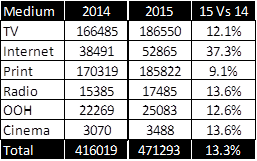
    India advertising revenue increases by Rs 48,420 million to touch Rs 416,019 million in 2014.


    Television revenue will grow by +12.1% to reach Rs 166485 mn while Print, though loses market share by a percentage point at 41% will grow by +10.4% to Rs 170319 mn. These two categories hugely benefited from the national elections in H1 2014 which contributed 25-30% of the incremental dollars.


    Digital media continues to grow the maximum at +39% to touch Rs 27686 mn and increased its market share by a point to 9%. Within digital while desktop grew at +26.4% mobile doubled its revenue though on a smaller base. Search and Display with 72% share dominates the pie but Social is closing ranks with Display.


    Radio on the back of increased volume will grow +12% and OOH at +12.3% to touch Rs 12385 mn and Rs 25339 mn respectively.


    Sectors contributing to the increase is led by retail especially e-commerce followed by telecom, FMCG and Automobile in addition to non-recurring political advertising.


    The outlook for 2015 is set to strengthen with improved confidence and business-friendly reforms. Falling inflation will support real income and promote consumption. Corporate investment momentum will gain because of political stability at the Centre.


    The BFSI category will see action with the government push for increased access to banking services, RBI opening up to payment banks and increase in FDI for Insurance. E-commerce will continue their customer acquisition spree though at some point in time customer experience & sustainability will start creeping in. Cellular phone and services, Auto and FMCG will support the momentum.


    Television will be exciting more than ever with Digitization though with decreasing pace, advertising time restriction pending decision, BARC’s viewership measurement and innovation in access tariffs by platform owners. Print industry awaits release of new round of IRS. Radio has been crying wolf for some time now and with the Government finally ready for Phase III, this medium will take a leap in spends. Digital will continue to expand the maximum, Digital India initiative by Government will add to internet access population and payment banks will boost e-retail.


    MagnaGlobal estimates total advertising revenue to touch Rs 471,293 million in 2015. India will be most dynamic among the four BRIC countries with expected growth of +13.3% in 2015


    Jaldi 5 with Venkatesh S, EVP, Director Intelligence Practice: TV & Print will play duopoly for some time to come in India


    01. Your forecast of 13.3 per cent growth in 2015 is resting on developments the timelines of which are unknown. For instance, we don’t know when the next IRS will be out, and if it does if the various players are going to accept. The adcap ruling is caught in the courts and then there is no solution in sight as yet. Activity on BARC is happening, but the launch date is not known. Radio Phase III has been happening for the last few years and it’s not happened till now. Digital, as you know, is just a pipedream. Spends via digital are so low. Pardon this rather long question, but don’t you think there are just too many ifs and buts here and that could impact your forecast?

    These are some of the key movements expected in 2015 which brings along its own challenges to each of the medium.  One will have to wait to see how much of these will impact on ad revenue.  Our 2015 forecast is neutral to all these movements.


    02. The BJP promised “achche din” but ask any media organisation and they’ll say that save the spends on the general and state elections, the spends haven’t really happened in right earnest?

    Large part of the spending is through offline which is measured. It is true that state elections impact on advertising have not been significant.


    03. Do you see spends from the government increasing in the next year, given that we have a regime that’s fairly publicity savvy?

    I won’t rule out some of the government flagship programmes getting marketed well. On the contrary this will swell competition in some of the sectors which will result in increased advertising.


    04. Your global report doesn’t paint a very healthy picture for India’s digital media.  India is not going to see Digital become the #1 media even in 2017. What do you think is the reason for this?

    Global share of Digital will catch up with Television only in 2019. India is a mobile-first country and though mobile-centric impressions are growing it is largely led by social, video is tied to bandwidth constraints and measurement is still a universal problem not limited to India. However the good news is mobile era has begun. Smartphone penetration, localisation, exclusive and compelling content, experimentation will aid growth


    05. In terms of adspends do you see a reducing reliance on traditional media like print and television in favour of digital and BTL in the coming years?

    Television and Print in the case of India will continue to play duopoly for some time to come. The first effect of losing share will be on Print though. Whenever the shift of budget from offline to digital happens, that will not be of equal measure because of productivity change from exposure to effectiveness.


    Magna Global Forecasts Global Advertising Revenues to Grow by +4.8% to $536 billion in 2015

    Top Stories

    1. Globally, media owner advertising revenues are forecast to grow by +4.8% in 2015 to $536 billion. The new growth forecast is in line with our previous forecast (+4.9% in June 2014) and represents a deceleration from 2014 (+5.5%).


    2. The stronger economic environment expected for next year (+3.8% for real GDP compared to +3.3% in 2014) will not quite offset the negative impact caused by the absence of non-recurring drivers like Winter Olympics, FIFA World Cup or the US mid-term elections this year. We believe these events generated one extra point of advertising growth in 2014.


    3. Despite the stability of our top-line growth forecast for 2015, significant revisions have been made on a country-by-country basis. On the upside, Australia, India, Japan, Spain and the UK will grow faster than previously forecast. China, Russia, Germany, Brazil and Canada will grow as well, but at a lower rate than previously expected.


    4. In the US, media owners advertising revenues grew by +4.0% this year to $165 billion – an acceleration compared to 2013 (+2.4%) but below our previous expectations. Factoring in the positive impact of non-recurring events in 2014, which accounted for approximately 1.5% of the total growth, the 2014 performance was not strong for an even year. The solid improvement in the US macro-economic environment since the second quarter has failed to translate into an acceleration in marketing and advertising demand so far. For 2015, we are expecting advertising revenues to grow by +2.7% (previously: +3.3%).


    5. As predicted, Western Europe finally returned to growth this year (+3.0%) and we are expecting a similar growth in 2015 (+2.8%). Our 2015 forecast for Eastern Europe is cut significantly, from +6.4% to +3.0% to reflect the massive economic headwinds faced by Russia and Ukraine. Asia-Pacific will continue high-single-digit growth (+6.4%). Latin American advertising spend will grow by double digits (+13%) with inflation (especially in Argentina and Venezuela) remaining the main driver, amidst a sluggish economic environment.


    6. The non-recurring sports events of 2014 contributed to the global growth of television (+5.2%). The FIFA World Cup was a clear positive in some markets like the UK and the US, but it was neutral in Germany and below expectations in Brazil. The Winter Olympics and mid-term elections bonanza proved below expectations in the US. TV is expected to grow again in 2015, globally, driven by a positive pricing trend in Europe and parts of Asia (+3.0%).


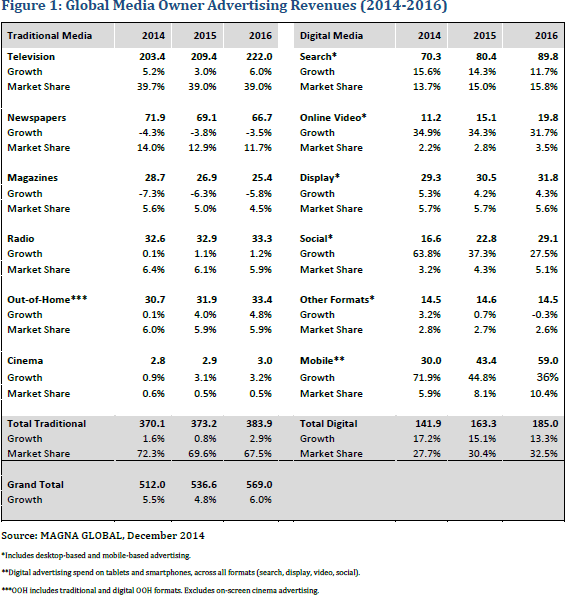
    7. Digital media grew strongly again this year (+17.2% to $142 billion) driven by mobile campaigns (+72%) and social formats (+64%). We forecast global digital revenues to reach 30% market share globally in 2015 (+15.1% to $163 billion). Based on our long-term forecasts, digital media will catch up with television in 2019, when both account for 38% of global advertising revenues.


    8. Digital media is already the #1 media category in 14 of the 73 markets analyzed by MAGNA GLOBAL in this update, including the UK (highest share in the world: 47%), Australia, Canada, Germany, China, Sweden and the Netherlands. In the US, digital will outgrow television revenues by 2017.


    9. Most other media categories suffered from the competition of television and digital in 2014. Newspaper ad sales decreased by an average -4.3% while magazines ad revenues shrank by -7.3%. Radio was flat (+0.1%) and out-of-home media grew by +3.4%.


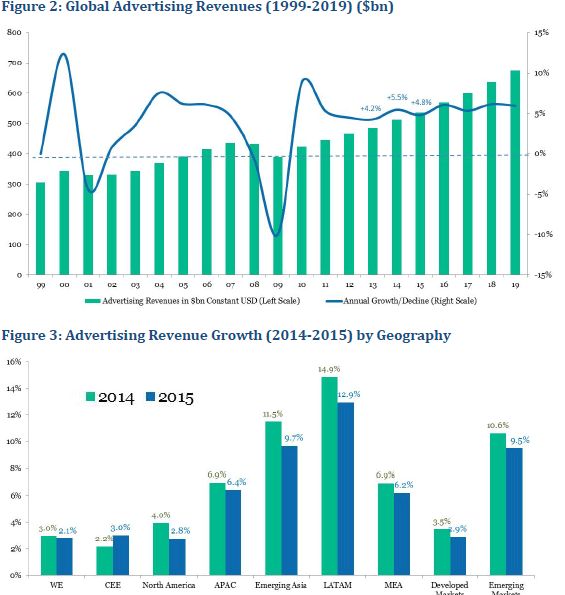
    In its latest study of global media owner advertising revenues, covering 73 countries, MAGNA GLOBAL estimates that ad revenues grew by +5.5% this year, to reach the half-trillion mark ($512 billion). Advertising sales will grow by +4.8% in 2015 to reach $536 billion.


    The new 2015 forecast is in line with our previous forecast of +4.9% published in June 2014. This represents a slight deceleration from the 2014 pace but factoring in the ad revenues generated by the non-recurring events of 2014 (mostly the Winter Olympics, FIFA World Cup and US mid-term elections) that accounted for approximately one point of incremental ad spend growth, the 2015 growth should be considered decent by recent standards. 2015 is still going to be stronger than the growth experienced in the last odd-numbered year of 2013 (+4.2%).


    This acceleration in the underlying growth rate reflects a general improvement in the current macro-economic expectations for 2015. In its October 2014 forecast update, the IMF anticipates global output (real GDP) to grow by +3.8%, which is marginally below its April forecast but still significantly stronger the level of economic growth recorded in 2014 and 2013 (+3.3% in both years).


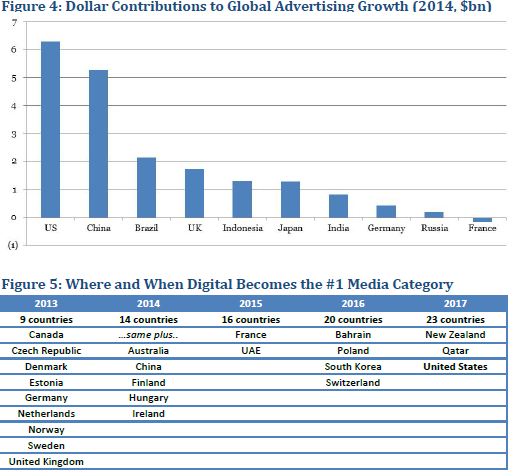
    Behind the apparent stability of our top-line growth forecast for 2015, some significant revisions have been made on a regional and country basis. Compared to our last global update in June, we increase the growth expectation for North America (from +2.5% to +2.8%), for Western Europe (from +2.5% to +2.8%) and for Latin America (from +11.5% to +12.9%). On the other hand, we reduce our forecast for Asia Pacific (from +6.9% to +6.4%) and for Central & Eastern Europe (CEE) (from +6.4% to +3.0%).


    Looking at individual markets, some of the most significant revisions in our 2015 forecasts are found among BRIC markets. China and Brazil advertising revenues are still predicted to grow by a decent amount (+8.6% and +5.9% respectively) although two to three points below previous expectations. Russia is the single biggest negative revision, due to the combination of declining energy prices and the partial withdrawal of Western investors amidst geopolitical tensions; the 2015 advertising growth forecast is cut from +7.0% to +0.8%. India will thus become the most dynamic among the four BRICs, with an expected ad spend growth of +13.3% following a similar pace in 2014 (+13.2%). The biggest upwards 2015 revisions come from Indonesia


    (from 13% to 17%) and Argentina (+22% to +36%) and the most significant among top 10 markets comes from the UK (from +3% to +4.7%).


    According to Vincent Letang, MAGNA GLOBAL’s director of global forecasting and author of the report: “In 2014, the long-awaited European recovery finally came in time to partly offset a weaker-than-expected growth in the US and the BRICs. In 2015, the lack of non-recurring events, the continued slowdown of the BRICs and the deflationary effects generated by the rise of digital media will inhibit global advertising growth, in a slight disconnect with the positive acceleration in the macro-economic environment”.


    Western Europe: Britannia Rules and the Eurozone Periphery in “V”-Shaped Recovery Mode

    As predicted Western Europe finally returned to growth this year (+3.0%) and we are expecting a similar growth in 2015 (+2.8%).


    Once again the UK advertising market increased strongly this year (+7.7%), driven by television (+5.4%) and digital media (+16.8%) in the wake of a buoyant economic environment (real GDP +3.2%). Television benefitted from incremental spend generated around the FIFA World Cup (partly broadcast on commercial network ITV) and the scarcity created by an unexpected drop in audience levels in the first quarter generated double-digit CPM inflation in the first half of the year.


    At the same time, the Eurozone periphery markets, which had suffered the most from economic recession and advertising recession over the last five or six years, have finally experienced the long-awaited recovery (Greece +7.7%, Spain +5.6%, Portugal +12%, Ireland +3.6%). Television pricing, recovering from the rock-bottom lows reached in 2013, was one of the key catalysts of that strong rebound, as soon as the economic environment merely stabilized. We believe all those markets will experience high-single digit growth again in 2015 even though the economic recovery remains modest. The sub-region grew by +6% this year and media revenues are expected to increase by +6.6% next year.


    Finally a third group of markets is displaying little or no growth in the context of a continued fragile economy: Italy (-1.8% this year, +1.1% next year), France (-1.1% in both years) and Germany (+1.8% this year, +2.0% next year). With a much weaker economy than anticipated (+1.4% in real GDP) Germany managed to grow advertising slightly. Paradoxically, Germany’s victory at the FIFA World Cup did not help because it was broadcasted on State-owned stations that are largely ad-free, and diverted audiences from commercial channels. By contrast the world cup was a clear driver in France, where leading commercial broadcaster TF1 was showing most matches, but even that was not enough to boost television’s pricing power beyond Spring as the protracted economic stagnation (+0.4% in real GDP) and historically low business confidence took their toll on marketing demand.


    Nordic markets displayed moderate growth this year (+1.5%) and should accelerate next year (+2.6%). The Winter Olympics of 2014 only had a small impact on the region despite the popularity of Winter Sports. The reason was the fact that the Games were generally not broadcast on commercial, ad-funded stations. The exception was Norway, where the availability of Olympic broadcasts on a commercial channel for the first time, contributed to a record +8.5% growth for the relatively small Norwegian TV market.


    Central and Eastern Europe: Hit by Russian Woes

    Central & Eastern European advertising revenues are expected to increase by +2.2% this year, a significant deceleration from last year’s +7.2% growth rate, and lower than our spring forecast of +6.3% growth. The region has experienced increasing headwinds: decreasing energy prices impacting the economies of several prominent CEE countries, as well as spillover from the tensions between Russia and Ukraine, including budget pullbacks as a result of general increased geopolitical uncertainty even in countries not immediately impacted by the conflict. Energy prices continue to fall and political tensions haven’t subsided. Many of these headwinds will linger, and growth next year is expected to be +3.0%, slower than previous expectations. In addition, the recovery towards the long-term trend of approximately +7% will be slower than previously forecast.


    While Ukraine is seeing the largest percentage declines in spend, the largest contributor to the decreased growth in the region is Russia due to its much larger market size. Not only is there the expectation of much slower Russian real GDP growth (IMF forecasts down over 1% since the spring), but Russia is also at the epicenter of many of the regional headwinds. Compounding these impacts are ad market specific headwinds, including the upcoming ban on Pay TV advertising as well as OOH inventory reductions.


    Growth in the region if one excludes Russia and Ukraine (although they represent 53% of the total spend in Central & Eastern Europe), is expected to be +5.2% this year, much closer to our previous forecast of +6.3% excluding Ukraine and Russia. Tensions are high, but spillover thus far has been manageable for the remainder of the region and hasn’t impacted growth quite as severely: Poland is expected to grow by +4.2% this year vs. our spring forecast of +6.4%, and Turkey is expected to grow by +7.3% this year, slightly down from our spring forecast of +8.8%.


    The highest growth in Central & Eastern Europe will be in Estonia, where the advertising economy will grow by +8.4% this year. The lowest growth will be in Ukraine, where total spend in local currency terms will shrink by nearly -20%.


    Within formats, we expect digital to continue to be the strongest growth driver in the CEE region, with growth of +19.0% expected this year. It’s almost the only ad format still growing, as TV and Radio (both +0.8% expected in 2014) are barely remaining positive. Newspapers (-9.7%) and magazines (-11.8%) continue to see sharp declines, and even OOH (-3.7%) is struggling. Historically one of the stronger regions driving global growth, CEE is now below the global average and falling behind other undeveloped ad markets such as APAC and Latam.


    Asia-Pacific: China Slows Down, India Accelerates

    APAC advertising revenues are expected to increase by +6.9% this year, slightly lower than last year’s +7.1% growth and marginally lower than our spring forecast of +7.6%. The chief driver of this slowdown is the softening economic prospects in the region.


    Chinese growth forecasts continue to move lower and GDP growth is pacing at the lowest rates in five years. While Chinese ad spend growth (+11.6% this year, +8.6% next year) remains significantly ahead of global levels, the weakness in housing sales, property development, and manufacturing activity continue to add headwinds to the economy.


    In Japan, the shock created by the sales tax increase this year has hit economic activity but this is more or less offset by a new inflationary economic environment driving up media costs; we thus expect advertising spend to increase by +3.0% this year and by +2.7% next year.


    The Indian advertising market showed strong growth this year (+13.2%) following two lackluster years (2012: +4.6%, 2013: +8.0%). The general elections that took place in the first part of the year generated massive incremental spend. The outcome of the election, bringing a new BJP-led Government to power, improved business and consumer confidence, which prompted us to increase our 2015 ad growth forecast to +13.3%. The new Government is also committed to invest billions in order to connect millions of rural Indians to broadband internet, in a plan advertised through a recent meeting between the new Prime Minister Narendra Modi, and the Facebook founder Mark Zuckerberg.


    The strongest growth in the APAC region in 2014 came from Indonesia (+21.5%). It has been another strong year for the Indonesian market off a low base (just $29 per capita is spent on advertising in Indonesia). The poorest performance in the region came from Thailand with a -2.3% decline in advertising spend, hit by a tumultuous year politically and economically.
    Digital remains the largest growth driver in APAC, and increased by +22.7% this year to represent over one quarter of total advertising spend for the first time. Growth continues to moderate, but digital continues to take share from every other format. TV remains the leading format in APAC, but digital advertising is rapidly developing and will pass television to become the leading format by 2019.


    Within digital, the fastest growing formats are social (+58.6% growth), followed by video (+37.6% growth) and search (+25.5% growth). Social spend has advanced rapidly and now represents 7% of all digital spend in APAC. Social and video are a focus of brands in APAC, and will grow to match what is spent on banner display by 2019. Mobile spending in the region represents over 20% of total digital spend this year, and this will rapidly grow to over 40% by 2019. Mobile spend on social formats continues to lead the way, and other formats will follow.


    Television remains the dominant format for advertising spend in APAC, and spend will grow by +3.5% this year and represent slightly over 40% of all advertising dollars. Broadcast television continues to dominate the TV landscape, although multi-channel television is gaining share due to slightly higher growth rates, and by 2019 will represent nearly one quarter of TV dollars. Print continues to lose market share, and newspaper and magazines together will represent less than one in five advertising dollars this year. This is down from one third of all spending as recently as 2008.


    APAC will continue to be one of the stronger regional drivers of global advertising spend, although its lead on the global growth rate continues to narrow. Its total share of global ad spend will only increase slightly between this year and 2019, from 29% to just over 30% of total spend.


    North America: Weaker-Than-Expected US Growth
    North America advertising revenues grew by +4.0% this year, with a similar growth on both sides of the border: US +4.0%, Canada +3.9%.


    For the US, +4.0% advertising growth in an even-numbered year (benefitting from massive incremental spend generated by Olympics and political spend), is actually a mediocre performance. By comparison, 2010 growth was +6.6% and 2012 grew +5.0%. This is all the more counter-intuitive that the economic environment keeps improving gradually.
    We believe three factors contributed to this tepid performance.


    First, the non-recurrent drivers proved below expectations for the first time in a number of cycles. The Sochi Winter Olympics delivered lower ratings and advertising revenues than expected, and our estimate for incremental advertising sales has been revised to $450m, down from $600m (the incremental sales delivered by the Vancouver Olympics in 2010). By contrast the FIFA World Cup generated the highest interest ever in America for a soccer event. Ratings grew by approximately 20% on Spanish-speaking television (boosting the revenues of Univision and the entire Spanish segment) and by 52% on English-speaking networks (ESPN & abc). However soccer remains a secondary sport in the US and the incremental ad sales, in the vicinity of $100 million, did not quite compensate for the lower-than-expected Olympic bonanza. The mid-term general elections generated less spending than the previous election cycle of 2012, partly because the main “battlegrounds” were located in relatively small markets while big markets like New York or California presented little uncertainty and therefore little incentive to throw huge amounts of ad spend. We estimate the incremental ad revenues to be around $2.2 billion, i.e. 17% smaller than 2012 and barely on par with 2010.


    A second factor was the micro-recession that the US experienced in the first quarter, partly due to a severe weather that hit retail, restaurants and automotive dealers, three of the biggest advertising spending sectors. The economy started to steadily grow again from the second quarter, but many advertisers had already entered into a cautious, saving mode.


    The last and most fundamental factor in the slowdown of 2014 is the shift of media mixes towards digital. The market share of digital media (27% in 2013, 30% this year) is barely above global average and still relatively low compared to the most advanced markets in Europe and Asia. We believe that in the last 12 months a number of large verticals that were lagging behind and relatively conservative in their media mixes (e.g. CPG/FMCG, pharmaceuticals) have started to embrace digital formats on a bigger scale. Thanks to the availability of new reporting tools and new buying mechanisms, digital media are increasingly used in branding campaigns and by brand-oriented advertisers, and not just in direct response campaigns or by direct response advertisers. Marketers are now more comfortable with the level of brand safety and accountability provided in the digital media space than they were just one or two years ago, and they are also keen to seize the opportunities created by data-based programmatic buying techniques. The shift to digital is having a deflationary impact on the entire market as digital formats, whenever comparable to traditional format, look cheaper and therefore erode the pricing power of traditional media categories.


    Weaker-than-expected even-year drivers and increased, diversified competition from digital media formats combined to cause a disappointing year for television. Overall TV ad revenues grew by +4.8%, i.e. below our spring forecast (+8.6%) and much below the previous even-year performance (+8.7% in 2012). Local TV ad revenues grew by +9% (compared to +16% in 2012) while non-political revenues were flat. Excluding Olympics, broadcast networks ad sales decreased by -3.9% and cable networks ad revenues slowed down to +3% (compared to +5.8% last year). Cable is still outperforming broadcast networks in viewing and monetizing trends but both national TV segments are now hit by the same syndromes: gradually declining ratings and reduced pricing power. This year’s TV Upfronts (advanced sales for the broadcast season 2014-2015) led to a decrease in volumes and lower inflation rates than in previous years while the “scatter” market (short-term buys) showed lower-than-usual price increases.


    Meanwhile digital media was the big winner in 2014, with ad revenues expected to grow by +15.6%. Search grew by +12%, video by +28%, social media by +65%. Those growth rates were partly achieved at the expense of traditional media, but also at the expense of traditional banner display (+1.3%) which represents only 16% of total internet advertising. Mobile impressions (on tablets and smartphones) accounted for $12.5bn (+77%); this represents 25% of digital media spend, compared to just 9% two years ago.


    All traditional media categories saw a decrease of market share. Print continued its decline with newspaper declining by -9.2% to $16.4bn and magazines losing -10.9% to $10.7bn; that does not include ad revenues derived by publishers from digital platforms, but those are not growing fast enough to offset the decline of paper-based sales. Radio ad sales decreased by -3.2% to $14.7bn; again that does not include digital radio advertising. Digital radio is growing double digit but again it is still too small so far to offset the erosion of revenues on the legacy linear broadcast platform. Out-of-home media revenues decreased by -0.8% as the growth of digital OOH sales (+16%) no longer offset the stagnation of traditional billboards (-0.9%) and in cinemas (-6%).


    For 2015, MAGNA GLOBAL is expecting US advertising revenues to grow by +2.7% to $169.5bn. This is equivalent to the 2014 growth if we factor out the non-recurring revenues of 2014, and slightly stronger than the last odd-numbered year (2013: +2.4%). Television revenues will decrease by -1.4%. Digital media will grow by +15.5% to reach a 31% market share. Newspapers will decrease by -8.2%, magazines by -9.4% and radio by -1.2%. OOH will re-accelerate to +3.7%.
    Latin America: Driven by Media Cost Inflation


    LATAM advertising revenues increased by +14.9% in 2014, accelerating from last year’s +13.1% growth. We expect that advertising revenues will grow by a similar rate in 2015 (+12.9%) despite the lack of the FIFA World Cup tailwinds seen in 2014. LATAM has the strongest nominal advertising spend growth of any global region, and is significantly ahead of the global growth rates of +5.5% this year. LATAM will grow from representing 8.5% of total ad spend this year to representing 13% of total ad spend by 2019.


    Ad spend growth in LATAM is a multi-faceted and paradoxical story. On one hand, economic growth in many of the largest markets is slowing down; the IMF recently reduced its forecasts for LATAM real GDP growth to just +1.3% this year and +2.2% next year, compared to the growth rates of 5%-6% experienced three years ago in the region; Brazil’s real GDP only grew by +0.3% in 2014 according to the IMF which also cut the 2015 forecast to just +1.4%. On the other hand, inflation is rampant in markets such as Venezuela and Argentina (30% or more), and moderately high in Brazil or Mexico (mid-single digit rates) which is driving media costs and, mechanically, media spend. As a result, much of the strong LATAM advertising growth (and almost all of it in Venezuela and Argentina) is a result of nominal price increases and latent currency devaluation rather than real term spending growth.


    Furthermore, the growth trajectory of the region was uneven throughout the year. The FIFA World Cup was a boost earlier in 2014 in many of the largest markets, especially in the host country Brazil. While overall the World Cup driver was not quite as strong as anticipated due to the economic difficulties and social unrest, it still resulted in high year-on-year growth earlier in the first half of the year. Run rates since then have come down dramatically so there is little positive momentum heading into 2015. Positive one-time event impact will be seen again in 2016 with the Summer Olympics in Rio. In 2015, many brands might therefore be conservative with regard to ad spending. Following a +12.2% increase this year, we therefore anticipate the market to slow down to +5.9% in 2015 (i.e. barely the national inflation rate), before reaccelerating to +8.3% in 2016 with the Rio Olympics.


    The highest growth rate in the region came in Venezuela (+40%) due to the very high economic inflation in the country, reflected in media costs. Argentina was a close second at +34% (with economic inflation in the vicinity of 30-35%). The lowest growth in LATAM was found in two smaller markets with low inflation and new regulatory restrictions that hit advertising spend this year: Ecuador (-3.7%) and Chile (-2.6%). Mexico grew by +9.4%, close to expectations.


    TV remains the dominant media format in LATAM, with total spend share of nearly 59%. While this is slightly lower than years previous, it remains the highest of any global region and well above the global average (39.7%). Digital, on the other hand, remains small in LATAM at just under 14% of total spend, far below the global average this year (27.7%). It is growing rapidly from a small base (+25.9% growth in 2014) driven by strong growth in social media advertising (+67.3%) and video (+51.2%). While search and display are currently the dominant digital formats in the region, social is expected to pass banner display to become the #2 digital format by 2019.


    Digital Media Reach 30% Market Share in 2015
    Digital media grew by +17% this year to reach $142 billion. This is $20bn more than in 2013. The rise of digital is barely slowing down compared to the growth experienced in 2012 and 2013 (18-19%). Digital media (search, display, video, social) now attract 27.7% of global advertising spend. Digital media revenues are expected to grow by +15.1% in 2015 to reach 30.4% market share.


    Digital is still significantly smaller than television on a global level (39.7% share in 2014) but it’s now slightly larger than print and radio combined, and digital media is already the #1 media category in 14 of the 73 markets analyzed by MAGNA GLOBAL in this update, including the UK (highest share in the world: 47%), Australia, Canada, Germany, China, Sweden and the Netherlands. Two more markets will join the list in 2015 (including France) and seven more by 2017 when the total reaches 23 (including the US). Other markets, like India or Russia, are lagging behind, but based on our long-term forecasts, digital media will catch up with television in 2019, when both account for 38% of global advertising revenues.


    In terms of formats and segments, digital is driven by social (+64% this year, +37% next year) and by video (+34% this year and next) while search remains robust (+15.6% this year, +14.3% next year) and banner display is barely growing (+5% this year, +4% next year) and actually shrinking in many markets. Paid Search remains the #1 digital advertising format, with 49% of global dollars, followed by display (21%), social (12%) and video (8%)


    Digital spend is also migrating towards mobile devices at an accelerated pace. Mobile-centric impressions (on tablets and smartphones) generated 21% of global digital dollars this year (nearly $30bn) up from 14% last year. Mobile advertising grew by +72% and we expect it to increase by 45% again in 2015. The mobile share of digital impressions and dollars varies greatly by format, with social being at the forefront (60% of total spend) and video lagging behind due to bandwidth and content limitation in many markets but the trend is similar on all formats. Driven by penetration and improvement in measurement, mobile will continue to grow to represent one third of total digital revenues by 2016.


    As mentioned earlier in the US context, we believe that one big driver in 2014 lied in previously-lagging spending categories (typically: FMCG/CPG) finally embracing digital formats on a large scale. Large mainstream brands started to divert sizable budgets from traditional media (as opposed to fueling digital marketing through small experimental budgets) to invest in all digital formats, and not just the safe option of premium display. The reason why previously reluctant advertisers have finally passed the exploration phase is the availability of new tools allowing marketers and agencies to manage and monitor digital spending in a more precise, transparent and effective ways than two years ago. Large brands and retailers also have new opportunities to leverage user data and client data to make digital dollars work harder and better. Digital media are thus increasingly used to complement traditional media plans in the context of branding campaigns, not just direct response. This is exemplified by the increase in the share of digital dollars sold on a CPM or impression basis, as opposed to clicks or performance (34% in the first six months of 2014 according to the IAB, compared to 31% three years ago).


    Digital media buying is also being revolutionized by programmatic trading technologies. Digital media inventory transacted through programmatic methods – data-based automated transactions including, but not restricted to, Real-Time Bidding (RTB) – reached $21 billion globally this year (+52%). Globally, programmatic spend grew to 42% of total display-related (banners, social, video) spend this year, compared to 33% last year. Programmatic techniques may have a deflationary effect on the digital media space as the so-called “remnant” inventory can be traded at lower costs per thousand impressions but, on the other hand, more of that low-demand inventory can be monetized today at scalable transactional costs. Perhaps more importantly, the new opportunities created by programmatic buying have contributed to make digital media more attractive to large advertisers blessed with large client databases and interested in the multiple targeting tactics accessible through programmatic platforms.
    The rise of digital has a dual effect on the total size and growth rate of the overall advertising market.


    On one hand, digital media are expanding the “media” pie by attracting budgets previously spent with below-the-line mechanisms (direct mail, directories, in-store etc.) and by “long tail” small and local businesses (some of whom were perhaps not spending anything in marketing). This is clearly a source of growth for search and social in particular.


    On the other hand, the budgets shifted from traditional media (TV, print, radio, OOH) to digital media create a deflationary environment, reducing the media pie and slowing down ad spend growth prospects in the mid and long term. We refer to this as the “digital deflation” phenomenon: when a dollar is shifted from traditional to digital media it’s no longer a dollar but 95 cents or less, simply because of the productivity gains created by digital and the lowest cost apparently required to achieve a given marketing goal. When shifting budgets towards digital, advertisers are not just following users and “eyeballs” but also expecting to save on their overall advertising and marketing spend. Any superior return on investment translates into optimization rather than increasing the investment. This trend has been at work for a few years but as digital media reaches critical mass, each market share point gained by digital has an increasingly big impact on traditional media. For instance in 2014, $7bn was shifted from traditional to digital media in the US. That’s the equivalent of the entire OOH advertising market, or half the radio market. Globally, it was more than $20bn this year.


    Overall we believe the expansionist effect has already played its part in the last 10 years whereas the deflationary effect gradually becomes more dominant. This is why MAGNA GLOBAL anticipates a weaker-than-before conversion factor between economic growth and advertising growth. In our long-term scenario the growth of advertising spending will lag behind GDP growth.


    The next MAGNA GLOBAL advertising revenue forecasts will be published in June 2015.


  • India ad rev to grow 11.3% in 2014:Magna Global


    By A Correspondent


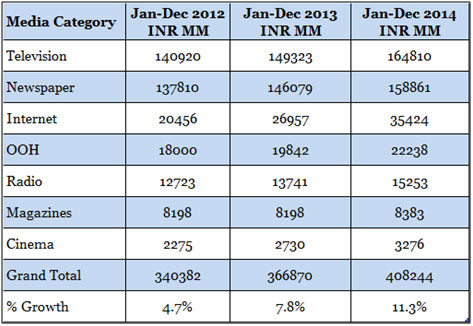
    Indian media companies will see ad revenues growing by 11.3% next year with the internet again leading the growth at 31.4%, according to Magna Global’s annual advertising forecast for the year 2014.


    The growth in television adspends will be 10.4%, while that for newspapers will be 8.8%. Magazine adspend growth will be 2.3% while OOH will be 12.1% and Radio at 11%. Cinema, given its lower base, will grow at 20%.


    Last December, Magna Global had predicted an 8.7% growth for Indian adspends. This was revised in June this year to 7.8%. The growth for 2012-13, although based on its current estimates, is 7.8 percent. Magna Global is the strategic media unit of global media agency conglomerate IPG Mediabrands. IPG Mediabrands is headed by Shashi Sinha in India.


    The economic environment remained weak throughout 2013 but is still expected to improve in 2014, especially in the developed world which has experienced four years of slow growth and stubborn unemployment, according to the IPG Mediabrands firm. As per the International Monetary Fund’s World Economic Outlook projections, India should re-accelerate at 5.1% following 3.8% in 2013. “That level of economic activity is not particularly impressive by historical standards but confidence indices keep improving and we believe advertising spending will reflect and amplify that economic trend,” said Venkatesh S, EVP, Director Intelligence, Magna Global, India.


    Venkatesh added that the growth estimates of 7.8 per cent for 2012-13 are end-2013 estimates and he does not foresee any extreme changes.


    Mobile share to total internet in adspends is 7.9%: Venkatesh S, EVP, Magna GlobalQ&A with Venkatesh S, EVP, Director Intelligence, Magna Global, India


    The annual forecast made in December 2012 had your annual year-on-year growth forecast for India pegged at 8.7%. In June this year, it was revised to 7.8% which has been maintained in your year-ahead report. Since we haven’t yet closed December, do you think this growth of Jan-Dec 2013 will stay at 7.8%?

    These are end-2013 estimates and we don’t foresee any extreme change in growth rates


    Any noteworthy changes in your estimate made in Dec 2012 and June 2013 to what it is now?

    Newspaper and Magazine growth rates have been revised downwards compared to December forecast and the growth rates are pretty the same as it was in June 2013.


    By your estimates now, will India be among the Top 10 markets five years from now? In December 2012, your report said India would be among the Top 10 markets in the year 2017. That was not the case when the mid-2013 numbers. What is the status as of now?

    Following a significant slowdown and given the current market environment, long-term forecast was revised downwards and is not in a hurry to be part of the Top 10 anytime soon. Currently India is the 13th largest advertising market and is forecast to retain its position in 2018.


    How does Indian adspend compare with our neighbours, BRIC countries and internationally?

    The adspend/capita in APAC varies significantly from $558 in Australia to $2 in Pakistan. While India adspend/capita is $5, its BRIC peers are way above – China $29, Russia $67 and Brazil is on par with the global average of $84. India is slightly in the high growth potential zone.


    Internet doesn’t seem to be growing at a significant pace – it continues to hover around 30-odd percent. Comments?

    India has been growing at a phenomenal rate compared to the global average (+15.5%) and also within APAC (+22.4%). Having said this, mobile internet is promising and will overtake desktop internet. However lots of questions need to be answered to see this medium unfold its potential.


    What would you say is the contribution of mobile as against the whole of the internet.

    Mobile share to total internet is 7.9%.


    And how does this compare with developed economies and BRIC countries?

    While BRIC countries are averaging 9%, developed economy is 15%


    Last December, you had predicted a 4.2 percent growth in the magazine sector. That is now 2.3 percent. Do you think there is a trend out there and we could magazines degrow even further?

    A small base of loyalty is a major deterrent for magazine publishers and advertisers, though language magazines still hold ground locally. Staying relevant to digital audience and retaining revenue streams is a challenge.


    Given an election year, shouldn’t we have seen a greater growth for newspapers?

    In 2012, the category saw a lower single digit growth rate. Our estimate for 2013 including political advertising is 6.0% and 8.7% in 2014.


  • India ad revenues to grow 11.3% in 2014: Magna Global. 2013 Growth: 7.8%

    By A Correspondent


    Indian media companies will see ad revenues growing by +11.3% next year with the internet again leading the growth at +31.4%, according to Magna Global’s annual advertising forecast for the year 2014.


    The growth in television adspends will be 10.4%, while that for newspapers will be 8.8%. Magazine adspend growth will 2.3% while OOH will be 12.1% and Radio at 11%. Cinema, given its lower base, will grow at 20%.


    Last year, Magna Global had predicted an 8.7% growth for Indian adspends. This was revised mid-year to 7.8%. The growth for 2012-13, although based on its estimates, is 7.8 percent.


    The economic environment remained weak throughout 2013 but is still expected to improve in 2014, especially in the developed world which has experienced four years of slow growth and stubborn unemployment, according to a communiqué. In its October 2013 update, the IMF forecast world output (real GDP) to accelerate to +3.6% in 2014. This is marginally below its April forecast (+4.0%) but still stronger than the 2013and 2012 growth (+2.9% and +3.2% respectively). The latest IMF update also confirmed that the Euro markets are finally emerging from recession as of the end of 2013 (+1.0% GDP growth expected in 2014, +1.4% in Germany). The US will accelerate from +1.6% to +2.6%. Meanwhile,the emerging “BRIC”economies will also re-accelerate after experiencing a “soft landing” in 2012-2013: India +5.1% (following +3.8% in 2013), Russia +3.0% (following +1.5% in 2013); Brazil and China’s are expected to grow by +2.5% and +7.3% respectively (on par with 2013).


    Venkatesh S

    That level of economic activity is not particularly impressive by historical standards but confidence indices keep improving and we believe advertising spending will reflect and amplify that economic trend says Venkatesh S, EVP, Director Intelligence, Magna Global, India.


    Look out for our detailed report on the Magna Global numbers on Tuesday, December 10


    Caption: India advertising revenue by media category 2012-2014