Tag: Lucknow Boy

  • More Mediaah!: Indian Express, Shekhar Gupta & Co send notice to Open, Vinod Mehta. Demand Rs 500 cr as damages

    By Pradyuman Maheshwari


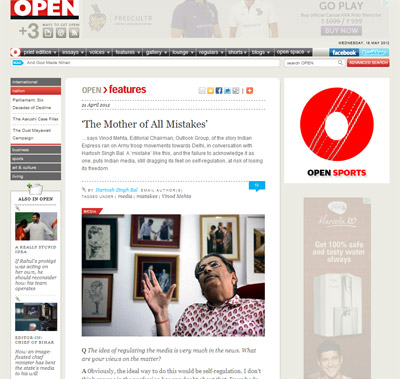
    The Indian Express group and four of its senior journalists (including editor-in-chief Shekhar Gupta) have sent a legal notice to Open magazine, its editor and other professionals. And above all to Vinod Mehta. The reason: in an interview to Open, Outlook’s Vinod Mehta rubbished the Express expose of a coup-like situation in the Capital.


    The Express is also upset with the publication of reactions that the interview elicited.


    I strongly recommend a read of the legal notice (currently posted in a blog that seems to have been created for the purpose — http://nobodyisusingthedword.wordpress.com/2012/05/15/indian-express- shekhar-gupta-threatens-to-sue-vinod-mehta-hartosh-singh-bal-open-magazine-c-repor/ .  Please don’t miss Pages 6 and 7, where the notice highlights a contradiction in Mehta’s statement on how he quit The Independent in the interview (as also made in a speech at the Press Club Bombay awards recently) and his book Lucknow Boy.


    The lawyer has asked for an apology, removal of the interview from the site and Rs 100 crore each for her clients. Note the money must be remitted even after the publication of the apology.


    Mediaah! view: I think the Express should’ve just let the interview be (link: http://www.openthemagazine.com/ article/nation/the-mother-of-all-mistakes). I don’t think the interview is damning the reputation of the Express or its editor-in-chief. And even if there is a belief that Vinod Mehta ought not to have said what he did and Open shouldn’t have published it especially since the coup story hasn’t been proven to be wrong, initiating a legal procedure is perhaps a bit much.


    Moreover, though it has established itself as an independent, gutsy publication, Open isn’t mass-circulated as, say, The Times of India. I must confess that even though I had been told about the interview, I read it only yesterday, after I heard of the notice. There is sure to be a fair bit of buzz in the social networks.


    I spoke to a senior member of the Open team who said the company lawyer was planning to respond to the notice and the magazine has no plans to pull the story off the Web.


    Final words: It’s imperative that while the media subjects everyone to criticism, it must be willing to take the heat whenever it’s subjected to it. Now, let’s hope Mediaah! doesn’t get a legal notice for writing all of this 🙂


    Buzz me if you have a story to tell. Confidentiality assured. There are various ways you can reach me:

    pradyumanm[at]mxmindia.com, BBM 23050B5D, Gtalk pradyumanm@gmail.com, Twitter @pmahesh and of course the mobile: 98338 76278.


    Disclaimer: Although he is CEO and Editor-in-Chief of this site, Pradyuman Maheshwari’s views in Mediaah! are not necessarily those of the rest of the team and MxMIndia.com.


  • Book Review: Lucknow Boy is a fluent, easy & juicy read

    By Ranjona Banerji


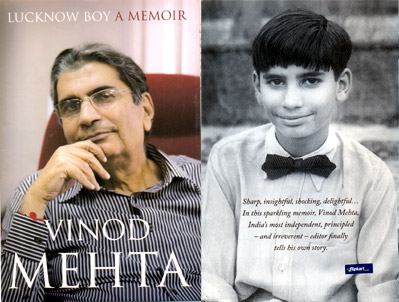
    If you want a fluent, easy and juicy read there’s nothing quite like hunkering down over a weekend with Vinod Mehta’s Lucknow Boy – especially of course for a media person. Yet, thanks to the letters page on Outlook, where so many readers seem to know him so well, one suspects that anyone interested in the news or the way the media runs will want to pick this one up.

    The story starts at the beginning with a solidly middle class upbringing in quieter, gentler times in charming and civilised Lucknow, which Mehta describes movingly but not in a maudlin manner. All those Outlook readers who fume at Mehta’s secularism can blame his childhood and this rather inclusive town in which he lived – as he himself does. Not quite sure what he was going to do with his life – apart from being a table tennis champion – a young Mehta landed up in England looking for opportunities and it must be said, girls. The swinging sixties provided the latter in plentiful apparently and also a variety of odd jobs. Mehta returned to India still with little clue about what he wanted to do and then headed for Bombay and advertising.

    From here it was a few skips and jumps to becoming the editor of Debonair which some might remember as India’s first “girlie” magazine. Mehta is one of a small but significant breed which started a career in journalism as an editor, without doing the slog. Those who are old enough (waaaaah!) will remember that in spite of the uncomfortable semi-nudes, Debonair had some good reading matter, using the Playboy model.

    The next episode in Mehta’s life led to his becoming a legend – starting and editing two classy newspapers from scratch (Sunday Observer and Independent) and recasting one (Indian Post) and resurrecting another (Pioneer). All four were well-planned, classy, stylish and paid attention to good writing. There are and must be a variety of views on them and not all of them positive but there is no doubt that they shook the establishment and frightened the fuddy-duddies.

    Not all were successes and Mehta himself suffered for decisions taken or managements changing tack. It is here that he is at his most acerbic about his fellow journalists and editors. The debacle at Indian Post where owner Vijaypat Singhania could not withstand political pressure was followed by another at The Independent. Mehta quit this paper a month after it launched when a huge scandal broke out over a story which said that YB Chavan was an American mole.

    Mehta describes all these quite candidly. The animosity he mentions shown by Times of India staffers to The Independent was quite amusing for those of us who were outside both: where the nose-in-the-air ‘we are Times journos and no one can touch us’ battled against the ‘we are the intellectually and stylishly superior’ Independent brigade. To be honest, both sides were a bit full of themselves!

    Mehta doesn’t hold his punches when it comes to Dileep Padgaonkar, who was editor of Times at the time and later with Lalit Mohan Thapar, owner of Pioneer. The end of his one month at the Independent also led to his shifting to Delhi and then to The Pioneer. The creation of Outlook follows a low period in his life and from here on, the way is up which is where the story pretty much ends.

    Lucknow Boy is a good nostalgia trip for those who are familiar with the place and time and will remember names and incidents. It is also a good lesson for those starting in the profession.

    Mehta also adds his views on people he has known and who have influenced him (yes, Sonia Gandhi is in one section and Editor the dog in the other) as well as tips to budding journalists. Expectedly, there is both humour and insight here.

    I have to thank Mehta for the huge space he has given to my old friend, the late designer MG Moinuddin whom he met at Debonair. Moin was indeed a massive talent and we were colleagues for many of the years that he moonlighted for Mehta’s various papers.

    In this very compelling read, there are some negatives, primarily when we reach the Outlook story. It gets a bit tedious and self-congratulatory – perhaps acceptable but still mildly annoying: all publications after all can come up with lists of some good story or the other it has done. However the sections on the letters to the editor, full of communal rants, as well as the fights between Ramchandra Guha and William Dalrymple are amusing.

    Although Mehta writes about the Radia tapes, where Outlook played a sterling role, I would have expected also some more stringent comment on the fallout as far as journalism is concerned. Mehta discusses Vir Sanghvi’s decision to step back from journalism but lets Barkha Dutt off the hook.

    There is one error which I have to point out because I take it personally. Mehta mentions that Bombay magazine wrote an item after the launch of Outlook. As one of the last employees of that wonderful magazine I can very confidently state that since it closed down in early 1991, there was no possibility of it having commented on Outlook’s launch in 1995!

    Also I must admit that I do not know Mr Mehta – I have met him fleetingly a couple of times so it is unlikely that he will remember. But this was undoubtedly one of the most enjoyable books I have read in recent times. Personal anecdotes and revelations are sparse but they are illuminating and even endearing. Every autobiography is entitled to its one-sided-ness and its quirks and that of course is why we read them


    Lucknow Boy by Vinod Mehta, Penguin Viking, hard cover, 325 pages, printed price Rs 499.

    Flipkart price: Rs 349.

  • Vinod Mehta: I just want to fade away quietly (Text + Video interview)


    This interview with Vinod Mehta was conducted in November 2011 soon after the launch of ‘Lucknow Boy’. As we look at the late Editor’s life and times, we replay this interview – in text and video – which so effectively captures what made him such a great journalist. Read on…


    By Shruti Pushkarna


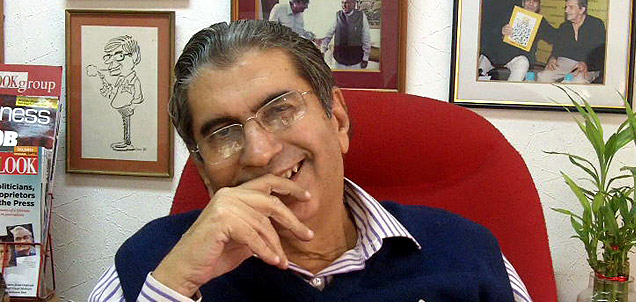
    Soon after he launched his memoirs ‘Lucknow Boy’ in the capital, MxM India caught up with Mr Vinod Mehta, Editor-in-Chief of Outlook magazine, for an exclusive interaction in his Delhi office. He spoke at length about his memoirs, his editorial journey and of course, his dog, Editor.

    Prior to his memoirs, Mr Mehta has also authored biographies of Sanjay Gandhi and Meena Kumari. In 2001, he also published a collection of his articles under the title, ‘Mr Editor, How Close Are You to the PM?’

    Popularly referred to as ‘one of the most independent editors’ of our times, Mr Mehta has founded and edited numerous publications, including The Indian Post, The Independent, the Delhi edition of The Pioneer and also India’s first Sunday paper, the Sunday Observer. At present he is the Editor-in-Chief of the Outlook Group, which brings out ten magazines including the weekly newsmagazine Outlook.

    Q: Tell us a little about your memoirs.

    It’s not just my life that I am presenting; it’s a snapshot of India from 1974 when I started, to 2011 which is now. And I am giving you a kind of history of India from that period, a personal history as I have seen it. So it’s more than my life, it’s a history of India – and whether they agree with my version of history or not, that’s another point but I have tried to present people, places, incidents that I saw and I interacted with since 1974. In that sense, this is not just about a journalist writing about his life, it’s about a very important period of India’s history which should be remembered, and I hope that I got some of it right.

    Q: Why Lucknow Boy? You’ve always prided yourself as a Bombay Boy…

    No, I was born in Lucknow, and studied in Lucknow and I reached Bombay much later. So I called it ‘Lucknow Boy’ because I am, my education etc. was all in Lukcnow.

    Q: Was it tough writing a free-and-fearless memoir? Especially the admission about your daughter?

    Well, these things are never easy but if you’re writing a memoir then you have to tell the story of your life and you must tell it in its entirety, the good and the bad. So you can’t hold anything back, otherwise it’s half the story.

    Q: Anything that you’ve not mentioned in your memoirs? In hindsight, would you have liked to include anything?

    No, no; I made sure that everything that I wanted to put in my memoirs, I did put in my memoirs. There were so many other things which were not important, the more important things I’ve put in my memoirs.

    Q: Given that you had moved jobs rapidly before Outlook, what’s the secret of your lasting so long with the Rajan Raheja group?

    Well, I’ve been here for 17 years and I think the mean reason is the fact that I got the kind of editorial freedom which I didn’t get elsewhere, so I lasted so long – because I was allowed to do my work, and I was allowed to produce a magazine according to what I thought was right, and what my colleagues on the staff thought was right, and there was very little or almost no interference from the proprietors.

    Q: We missed you at the World Magazine Congress. Why were you not there?

    Well, I am told the magazine congress was mostly about the management side of things and not editorial, but I wasn’t invited.

    Q: If given the opportunity, would you like to edit a daily newspaper again?

    No, I’m too old now. I’ve done three daily newspapers and now I don’t want to do anything new. I’ve reached the end of my career so I just want to fade away quietly.

    Q: Wouldn’t it have been good to have an Outlook current affairs programme for television, if not a full-blown channel?

    No, we thought about this many times in Outlook and nobody in Outlook, including the proprietor, was very interested in television, simply because there were so many other… there are already about 300 news channels. So we felt that we couldn’t provide anything new or different and we were quite happy with print. And since I’m mostly interested in print, I didn’t show any great interest, neither did the owners, to get into television.

    Q: Your word of advice to a wannabe media baron?

    Well, my advice to a new media baron would be – don’t get into this business if you are just interested in making money. This is a business where, of course, profits are important but this goes beyond profits. So if you have any kind of commitment to the country and if you can withstand occasionally some kind of losses even to your investment, then get into the business. But if you are getting into the business because you think there are profits, or you think that you will have great political clout in the government etc, then those are all the wrong reasons for getting into publishing.

    Q: And your advice to someone working with a wannabe media baron?

    Be good at your job, that’s very important. Whatever you do, you must be very good at your job, outstanding at your job; therefore if you are outstanding at whatever you do, if you are sub-editor, or a correspondent or a photographer, if you are outstanding in your job, somebody somewhere will always hire you.

    Q: Debonair is dead. Would you like to revive it?

    No, that was just the beginning of my career and I wouldn’t like to go back there. But the seven-eight years that I spent there were very interesting, and I learnt a lot in that period.

    Q: Back to the book: worried about it upsetting anyone? Vijaypat Singhania?

    I don’t think so, because I’ve been fair to everybody. In his case, he was also under a lot of political pressure so I had full sympathy for his situation, where between Indian Post and his own business interests, he couldn’t sacrifice his entire business interest because at that time you had this license permit raj and the government would be active in economic affairs.

    Q: Did you read those barons wrong… Singhania and Thapar especially? And Ambani and the Jains?

    No, I didn’t read them wrong because they also I suppose, did not realize how difficult it is to be a media baron at that time, I am talking of 1980s and 90s, when businessmen who had say 5 percent interest in publishing and 95 percent interest in other things. If they attacked the government, then their other business interests would suffer, and I don’t think they fully appreciated this.

    Q: Any career regrets?

    Oh, I think there are always some regrets, some things that you should have done and you didn’t do. But by and large, I think I have played it by the book, as I say. I have no regrets. I think life has been very fair with me.

    Q: Do you think the news TV folk sensationalize more than inform?

    Yes, I think there is some need for self-regulation, there is some need for accountability. You can’t have a free-for-all as far as the channels are concerned. And I think most channels now are realizing that they are losing public support; the most important thing is their viewers’ support and therefore they need some professional guidelines. There is that appreciation now and I think that in the next few months, you will see something, some self-regulation.

    Q: We know you don’t agree with this, but still: do you think news only constitutes current affairs and matters of national importance?  For instance, would current affairs only mean political news or also whom Ranbir Kapoor is dating?

    No, I think current affairs is current affairs, anything which is current, for example, film stars, Aamir Khan made a film called Peepli Live , that was very much part of news. Entertainment is part of news, entertainment and news are not separate, but I think that there is a place for everything. Entertainment has a place, national politics has a place, everything has a place. So you must find the right balance I think; that’s the job of an editor.

    Q: Is there a need for a Press Council-like body, or should the print media too have a NBSA- like self-regulator?

    Well, we do have a Press Council but I think even the print media now realizes that the Press Council doesn’t have any teeth, doesn’t have any punitive powers. So, there is some need even in the print media for a new set of guidelines.

    Q: Your dog is called Editor. If you had another dog, what would you call it?

    Editor Junior. Well I have already got Editor Senior so I got Editor Junior now. But I can’t keep another… We tried to keep another dog, my wife was very keen that we should have two dogs. But Editor wouldn’t just allow another dog to come in. So we tried once or twice, actually brought a dog into the house but he made life hell for that dog, so we finally had to give him away to somebody because he is very possessive and he likes 24/7 attention.
  • Vinod Mehta: When I became an editor, I started to learn (Video Report)


    In our tribute package to Vinod Mehta, we thought we should replay a video report of the launch of ‘Lucknow Boy’ where the late editor answered questions posed by Arnab Goswami. Read on… 


    By Shruti Pushkarna


    I used to be terrified at my ignorance, I knew absolutely nothing… when I became an editor, I started to learn.”

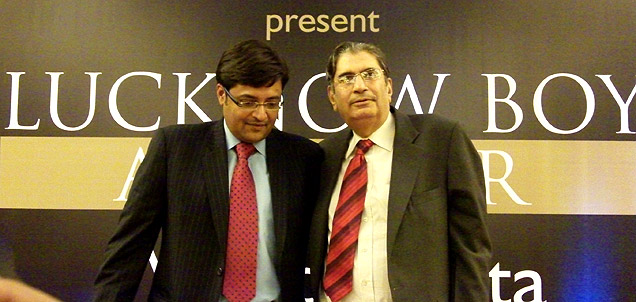
    It was as candid as it could get. Addressing an elite gathering of politicians, journalists, close friends and family, Vinod Mehta, Editor-in-Chief, Outlook, was at his ‘truthful’ best, as he shared his life experiences and views. It was at the release of his memoirs, ‘Lucknow Boy’ in New Delhi yesterday that Mr Mehta confessed, “We journalists have the best seats in the tournament, but some of us, editors particularly, think that we are players. “

    The book launch ceremony began with Mr Suhel Seth, Managing Partner of Counselage India, reading a few excerpts to an eager audience.


    Editor-in-Chief of Times Now, Mr Arnab Goswami was then invited to moderate a short discussion with the author. Mr Goswami admitted that to him, Mr Mehta was like, ‘the god of journalism, whom I admire the most.” Adding further, he related an incident from the previous night when he posed two choices to Mr Mehta, asking him which work out of the two was he more proud of, Debonair centrespread or the last page of Outlook. The reply, said Mr Goswami was in line with his habit of being upfront when very easily he chose the last page of Outlook, his own work.


    What followed was a candid one-on-one between the ‘king of television news’ as Suhel Seth billed Mr Goswami him, and one of the most ‘Independent’ editors of our times. Ranging from the reasons behind writing this book, to the greatest risks undertaken, to why a journalist and a politician can never be friends, Mr Mehta answered all questions posed by Mr Goswami. When asked if he were 35, would he do television, Mr Mehta, without mincing words, said, ‘Television does not interest me”.


    On why he wrote his memoirs
    [youtube width=”450″ height=”250″]http://www.youtube.com/watch?v=srM-E8i6wKI[/youtube]
    On why he doesn’t want to do Television
    [youtube width=”450″ height=”250″]http://www.youtube.com/watch?v=p2gxTDo_eFE[/youtube]
    On the need for editors to be able to ‘smell’ the news
    [youtube width=”450″ height=”250″]http://www.youtube.com/watch?v=RvuDgAPjIIQ[/youtube]
    On why politicians and journalists can never be friends
    [youtube width=”450″ height=”250″]http://www.youtube.com/watch?v=aZOKWWHH6uw[/youtube]
    On how does it feel to look back
    [youtube width=”450″ height=”250″]http://www.youtube.com/watch?v=ftm_IeG-zds[/youtube]
    On the best thing that has happened in journalism in the last 40 years
    [youtube width=”450″ height=”250″]http://www.youtube.com/watch?v=sBb7OzUOL8s[/youtube]
    And a reasonably fair attendance from the political world did not deter him from admitting that the one thing that he has hated all his life is to ask a politician a favour. Mr Mehta is of the strong opinion that politicians and journalists can never be friends. He said, “We follow two different vocations. Politicians are in the business of embellishment, spin, emphasis when emphasis is not necessary and sometimes they are in the business of telling lies. We as journalists on the other hand, with all our imperfections, are in the business of trying to get at the truth.”


    On a lighter note, Mr Mehta also shared some bits of his journey as an editor, as a student and above all, as a person.


    To recount some faces present at the gathering, first up politicians: MoS for Commerce & Industry Jyotiraditya Scindia, Union Urban Development Minister Kamal Nath, Union Petroleum Minister Jaipal Reddy, BJP MP Tarun Vijay, Chief Election Commissioner SY Qureshi, CPI National Secretary D Raja, Lok Sabha MP Jay Panda, MP and Chairman of IPL Governing Council, Rajiv Shukla and Former Minister of External Affairs, Natwar Singh. The media was represented by senior editors Tarun Tejpal, Saeed Naqvi and Paranjoy Guha Thakurta. Also, author Gurcharan Das and Indrajit Hazra of Hindustan Times, and of course the Outlook team.