Tag: Lokmat

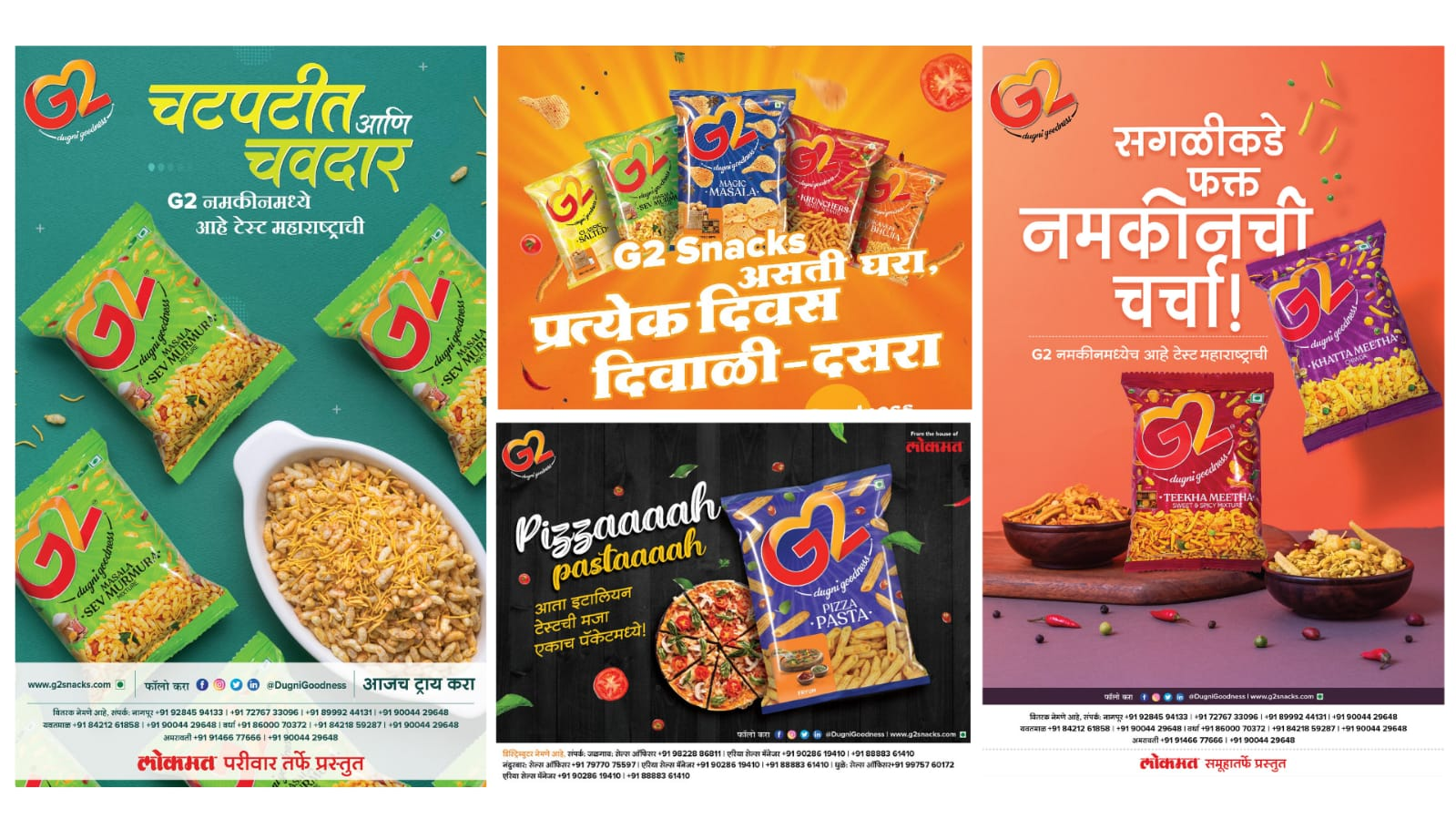
  • Lokmat’s G2 Snacks names Agency09 for creative communication

    By Our Staff


    G2 Snacks, a new entrant in the FMCG sector from leading Marathi daily group, Lokmat announces the appointment of Agency09 as its creative agency. Agency09 will be responsible in defining the brand communication via print that reaches the entire Maharashtra and explore the new-age audience’s engagement possibilities in the digital ecosystem.


    Speaking on the successful launch, Rishi Darda, Founder, Good 2 Great Industries Pvt. Ltd. said: “It is always thrilling to foray in a new territory and produce a world class product. With G2 Snacks, we are geared up to create a fantastic snacking experience, made with a combination of high quality standards and ethnic taste. And with a lot of integrity and honesty, we want to bring in the Dugni Goodness in the lives of people. We are excited to partner with AGENCY09 who displayed the right interest and expertise to bring this vision forward.”


    Added Tushar Khakhar of Agency09: “The team Lokmat has always given us great liberty in all our creative collaborations. We have some interesting and innovative work lined up for G2 Snacks, and are confident of ensuring that G2 becomes a household name.”


  • Lokmat launches ‘Influencer Katta’ show

    By Our Staff


    Lokmat has launches a new show called ‘Influencer Katta’. The show and the episodes are released on Facebook and YouTube handles of Lokmat Sakhi, a women-centric portal that was started earlier last year by Lokmat.


    Said Hemant Jain, Senior EVP & Head of Digital Business at Lokmat: “This is a fantastic opportunity for both the influencer and their followers to learn about and share a portion of their lives that is rarely spoken or heard about. It’s not just about the fame and glam, but also about the amount of effort that goes into it. Plus, a little more about their personal lives outside of social media to encourage their fans to join them on their quest!”


  • Lokmat Nagpur celebrates golden jubilee

    By Our Staff


    The Nagpur edition of the Lokmat newspaper is celebrating its golden jubilee year.


    Said Vijay Darda, Chairman, Lokmat Media Group: “We are overjoyed to be witnessing this extraordinary day. 50 years is a lot in terms of time but what we are truly celebrating is the passion, dedication and excellence that Lokmat Nagpur has created in this journey. We are proud of how far we have come and we are excited for the future.”


    Added Rajendra Darda, Editor-in-Chief, Lokmat Media Group: “As I reflect upon this five-decade long legacy of Lokmat Nagpur, I am inspired by the devotion that has gone into making Lokmat not just a newspaper but a platform. A platform committed to being the voice of the people and constantly standing up for what is right. On this remarkable occasion, the group celebrates the relentless efforts and unwavering dedication of every individual that is involved in their journey of taking high-quality journalism to the masses and amplifying the voice of the people over the years.”


  • Lokmat gets activisty on Bhandara Hosp fire incident

    By A Correspondent


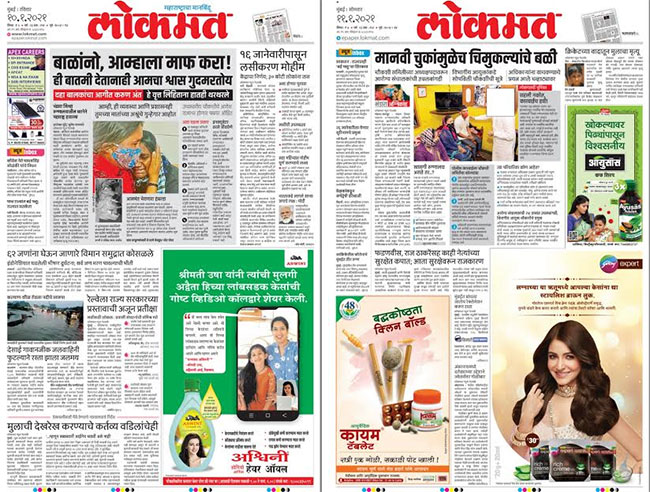
    On January 9, 2021 there was news of a fire in the neonatal care unit of District General Hospital in Bhandara in Maharashtra. As many as 10 babies were killed. There was an outpour of sympathy from politicians, celebrities and citizens on social media almost immediately after the news broke. Maharashtra’s Chief Minister instantly ordered a probe into the issue.


    Said Rishi Darda, Lokmat Joint MD & Editorial Director: “Lokmat has always taken a stand to favour citizens and this time was no different. The Bhandara Hospital fire incident has left the nation stunned and claimed the lives of 10 innocent babies. As a newspaper, we had to do something to apply pressure on the government to take strict and concrete action. We therefore have decided not to publish photos of any politicians visiting the Bhandara Hospital fire site. We demand action and not sympathy.”


    Darda also tweeted about it from his Twitter handle


    Added Darda: “Lokmat is the largest circulating Marathi newspaper in India and Maharashtra’s No. 1 newspaper for many years. We pride ourselves in being the voice of the public. Research-based news based on facts drives us and for us it has always been Journalism First. By not publishing the photographs of visits of politicians at Bhandara Hospital fire, we have reiterated our philosophy of #पत्रकारितापरमोधर्म”


  • Lokmat changes masthead to black from red

    By A Correspondent


    Lokmat changed its newspaper masthead to black from red to pay respect to the martyred CRPF jawans in Kashmir.


    Commenting on this initiative, Vijay Baviskar, Group Editor – Lokmat Media Group said: “Lokmat has come out with black masthead on the February 15 issue across Maharashtra, New Delhi and Goa editions. This initiative is taken to protest, mourn and pay condolence to the sacrifice of 44 CRPF jawans yesterday in Kashmir and our support with the families of the brave martyrs.”


  • Lokmat folds Sunday supplement ‘Manthan’ into its main issue

    By A Correspondent


    Lokmat has found that the readership numbers of its newspaper supplement is degrowing and to address the challenge, its Manthan pull-out will feature in the main issue from February 10 every Sunday across Maharashtra.


    Commenting on this initiative, Pushkar Kulkarni, General Manager Product Development – Lokmat Media said: “Every media house aims towards readers interests and thus we came up with this initiative of bringing ‘Manthan’ as a part of Lokmat main issue for our readers across the state of Maharashtra.”


  • After Pune, Lokmat eyes Mumbai, Kolhapur


    The Indian Readership Survey findings released earlier this year saw numerouno Marathi daily Lokmat gain leadership in Pune, a market that leading daily Sakal has always dominated.  Editorial and Joint Managing Director, Lokmat Media Group Rishi Darda has been leading the Lokmat all-new offensive on its leadership position. Excerpts from an interview:


    So where’s the bubbly, or should we say bhakarwadi?

    Bhakarwadis are on their way (smiles). Finally, what we’ve been announcing and talking about to everybody last three years that we have been the largest newspaper now in Pune hascome true. Obviously, there is a lot of excitement and celebrations planned through the whole year.

    And what would you say were the reasons for your performance in the Pune market?

    Primarily first, any announcement that any publisher makes has to be on the whole number as such. I think what we have recently seen is that people have been slicing each and every data and whatever is in their interest is being shown. Lokmat would come out as numerouno in each and every of those positions. We are No. 1 in Pune and We are No. 1 in Maharashtra in every sector. The Pune-specific success has been with two-three inputs. One of course has been editorial team which believes in ‘PatrikaritaParmodharma’ that is genuinely followed.

    PatrakaritaParmodharma?

    Yes, that’s been the motto from the very beginning. I think there was some kind of fatigue amongst readers. It was not the best product. Being the No. 1 for such a long time. I think readers were looking for something a lot more than that.

    You are obviously referring to Sakal?

    Yes. I think Lokmat came up with an editorial team which believed in courageous and unbiased journalism and that’s there to see. One was the product. The second part was creating the right perception in the market. This is how we started our journey of reinventing Lokmat. And we believed that our products were stronger than the perception in the market. And over the last three years that’s where our energies have gone into. I think every 10 days or 15 days there would be some other activation directly contacting or engaging with the reader. Small events, big events. IPs. Getting a lot of opinion-makers to the city. That’s been the case throughout. I think that’s helped us with the perception in the market.

    Are you saying it’s critical to have ground level engagement with readers to ensure that you boost circulation?

    I am talking about two different things. Soin circulation, readership would be mainly a part of your distribution. First, to get the product out there. We are in anindustry where distribution is key. As soon as the distribution problem was solved, I think we needed to look at our perception. The ground engagement helped us build the perception at the top of the mind when you have had a leader for about 70 -75 years. The difficult part is to make sure that even if you are getting the product that thereis an affinity towards the product. I think that’s where we worked on awareness from sampling to reading maybe once a week to reading twice a week to becoming the first newspaper in the day to be read.

    Pune is known to be a very city rooted in traditions where it’s tough to change habits of people.

    Our objective has always been to provide the right news and right insights to readers. Our challengehas never been the product. Our challenge was always the distribution. How do you make sure that your product reaches out to people and that is a concern with every publisher has. I think that if a lot of them came up with the right product, if the person starts reading my product he would fall in love with it. We achieved this through a smart way of marketing which was continuously breaking stories. There was a time when we had issues with distribution hence we created our own distribution channel.

    I think that was the starting point. I think for the first time in history in India we picked up cobblers, beggars just about anyone.  We created a team of about 3000 people who went around the city to go and start distributing the newspapers. So that was the starting point where people started getting the newspapers.

    The perception of Lokmatwas that it is popular paper in lower socio-economic classes.

    Right

    How did you effect that change given you have fairly healthy numbers in the higher SEC or NCCS classs albeit a little lesser than Sakal in Pune.

    In general, the problem has been of perception. So you get a brand from the US and when it launches in India, it will be always looked at as an International brand. Similarly, when a newspaper from Mumbai launches in Pune or Aurangabad or Nagpur, it’s always looked as a Mumbai newspaper that has come to Aurangabad or Nashik or any other place. When a newspaper from Pune launches in Aurangabad or Nasik or Jalgaon, it’s a Pune newspaper that is launched over there. So our numbers never said that. It was always in our mind that one is always from a rural part of Maharashtra. At that point, 15 years back, the same status was never given to a place like Aurangabad or Nagpur. There was a newspaper from the backward areas from Marathwada and VIdharba which was coming into Pune and Mumbai and that’s why the perception. If you look at our IRS numbers or the NRS at that time, Sec A and Sec B have always been strong for us. But like I mentioned in Mumbai and Pune to change that perception all the efforts have gone in creating ground events so to create a direct connect with readers.

    Over the last few years, the kind of IPs that we have created like the Maharashtrian of the Year determine in trying to get opinion-makers involved from every sector of the society. This helped in creating brand image of being in a higher category.

    Now the next step is to sustain the same leadership in the next IRS whenever it comes out and of course look at areas.

    I think the challenges is going to be more for the competitors because we are not going to be stopping here. Our next challenge is going to be Mumbai. The total readership of Lokmat is the largest in Mumbai also. LokmatSamacharis the No 1 in Nagpur. Kolhapur was another place and we are pretty sure in the next two surveys you will see that we come out as the No 1 in Kolhapur. So those are going to be the focus areas in the next few years.

    So the next frontier for Lokmat is Kolhapur and Mumbai?

    Yes, that’s right. In Mumbai also. I think what’s happened is there has been a lifestyle change. There has been a shift in the Maharashtrian community that has moved from Mumbai to Thane. So if you look at only Thane numbers I am very sure that in Thane district, Lokmat is No1 already. It is the Mumbai city where the number of Maharashtra Times and Loksatta would come out as No 1 and No 2 but already the areas which are highly dominated by the new Maharashtrian communities is already reading Lokmat.

    Sakal has been advertising about supremacy in ABC ratings. Why haven’t you participated in he ABC?

    We have made a written complaint to ABC about the numbers that are being mentioned by Sakal are not correct. They should be looking into it. Also, from the planner’s point of view, people look at IRS. So that’s why our focus has been IRS.

    Mumbai is a tough market in terms of perception and numbers.

    The challenge is the acquisition cost per customer which is very high in Mumbai compared to any other market when I reach out to, say, a hundred people. In Mumbai when you reach out to people, the percentage of the Maharashtrian community itself is smaller and then the conversion rate is still further down. That’s why the acquisition cost per consumer is very high and that’s something that we have been working on. But the first battle for us has been where people were not aware in a huge population where Lokmat was not known in Mumbai.  We have overcome that in the last few years by continuously engaging with them on-ground. Creating a lot of strong IPs. That has helped us to top-of- mind for readers. As soon as we are able to get into their houses, I am sure that we will see the Lokmat numbers going up quickly.

    Leadership in readership is one good benchmark of how one is doing. The other is revenues. How’s that doing for Lokmat?

    Regional markets are growing steadily. I understand there have been challenges with the English newspaper markets. But we want to see a huge spike and that’s going to be the new challenge that will be put up to the sales team. How do we make use of the leadership in the Pune market? We have been the largest newspaper in Maharashtra without being [leaders] in Pune. And Pune market is about 70% of the total Maharashtra market [outside of Mumbai]. How do I bridge that gap and grow in Pune is what the challenge is for us? That’s what our sales teams are going to go after.

    One last question. We have seen that giventhe fact that the English leadership has lost out bit to digital. Given that Maharashtra is fairly digital savvy, do you anticipate any challengeson that score if readership would move to digital. How are you addressing that?

    Sure. I think a person moves to digital for two reasons. Oneis cost and the other isconvenience. In the newspaper industry, the cost has always been low. I think the cost of raddi would be more thanthe price that we are paying for some papers. The second is convenience. I have always joked that if you keep your main door open of the house then the person can come to your bedroom and give you the newspaper. In places like Mumbai where the travel times are high, given the  convenience people have started moving to digital. If you are in a crowded trainit’s difficult to read the newspaper. But that’s not something that we are seeing other markets. Also, the literacy rate in a place like Maharashtra is growing fast. Thatis something that would help move to newspaper reading.


  • Lokmat highlights role of an ‘Inclusive India’ on eve of Independence Day

    By A Correspondent


    On the occasion of Independence Day, Lokmat along with Trinayani- a not-for-profit NGO launched a film bringing together persons with and without disabilities thus promoting inclusion. Through this film, Lokmat creates awareness towards citizens who are differently abled applauding them for their achievements.


    Speaking on this initiative Ritika Sahni, Singer – activist & Founder, Trustee Member – Trinayani NGO said, “I am happy to be part of this effort taken by Lokmat Media towards informing and hopefully enriching the lives of millions of people with this message of disability awareness. The film facilitated by Trinayani sends the message of how each one of us benefits by being inclusive, accepting and tolerant of disabilities and diversities.”


  • Lokmat announces #MahaMarathon across four cities

    By A Correspondent


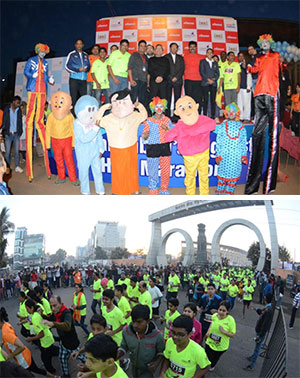
    Lokmat has announced a Maharashtra Special Marathon – Lokmat #MahaMarathon targeting 21km Half Marathons to be held in the four Maharashtra cities of Nashik, Kolhapur, Aurangabad and Nagpur. The event will be planned, organised and executed by Taplight, Lokmat’s Experiential Marketing & Brand Solution division.


    Said Ruchira Darda, Founder Of Lokmat Marathon & Chief Learning Officer, The Yellow Door whose brainchild the event is: “Marathon or running for your city is intrinsically connecting with a city’s wellbeing as not only does it invite everyone to come together and run but also integrates fitness in their daily calendar. More and more Marathoners are coming up from smaller towns with an aspiration to participate in National and International Marathons. Therefore at Lokmat, being Maharashtra’s No 1 newspaper, it was imperative to create platforms for runners from Tier 2 and 3 cities to come ahead, chase their dreams and fulfill their passion.  With an overwhelming response last year in Aurangabad alone, this year we are geared up to launch a large scale Maha Marathon with a great reach.”


    Added Aniruddha Hajare, Vice President & Business Head: “At Lokmat we have become the only significant bridge connecting brands with our readers in Maharashtra through unique engagement initiatives that yield response and give additional value to our partners. This Maha Marathon is an unique initiative targeted at bringing out the unfulfilled aspirations of people across Maharashtra who can participate, encourage others and create this as a practice ground for future growth. Along with great print led engagement, this Maha event will see host of on ground, online and pre event buzz created through series of partnerships thus aimed at providing immense value to all partners.”


  • On Lokmat’s Rising, with Rishi Darda


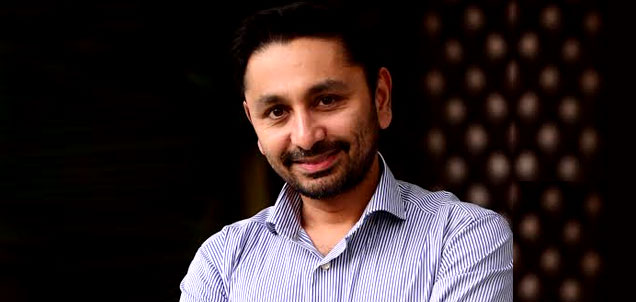
    Rishi Darda, Editorial and Joint Managing Director of the Lokmat Group, comes from a family that has been in public life for over four decades. But he’s determined never to let his family’s political leanings impact the media business of the Lokmat Group. Darda also has a lot of aces up his sleeve – a digital venture that’s set to grow and acquisitions, if there’s an opportunity. But most of all, to cement the newspaper’s leadership position in Pune. Excerpts from a freewheeling chat with Pradyuman Maheshwari…


    You and others in your generation don’t speak to the trade media much. Your uncle Vijay Darda has of course been a well-known public figure.

    That’s how it’s always been. Vijay Uncle, the Chairman, has been a political figure, as has my father. And both of them have been extremely ‘out there’ in public life. But we, the newer generation, have preferred to take a backseat and let our teams and products speak.

    It’s normally the other way around, isn’t it? The younger guys are more aggressive…

    Yes, but don’t make the mistake of thinking we’re not active. We’re very, very active — but a little in the backseat, actually. All of us are very involved with Lokmat, the media company, but just not ‘out there’.

    So how is the paper doing?

    I think overall, in the newspaper industry, regional still has a major scope to grow. Regional newspapers have continuously seen growth. First, because of the literacy rate. Then, the penetration of the newspaper is not as high in Maharashtra as, say, in Rajasthan. So I think there’s still a lot of scope for us to grow. And advertising has been good, except for the months of demonetisation.

    Given the fact that Maharashtra is more industrialised than other states, and the affinity towards English is more, do you still see as much of an appetite for growth as elsewhere?

    Growth for a newspaper would not depend so much on the language, but on the content. Mumbai, the metro, is more English-speaking. With Maharashtrians who understand Marathi – and may feel that they’re missing out on something the English-language papers provide by way of content – may cause a language shift. But I think if I’m able to give them content that they want, in their language, I don’t think there’ll be a shift.

    That’s what Lokmat‘s been able to do, quite successfully for some time. Outside Mumbai – in places like Nagpur, Aurangabad or Pune, the largest market is Marathi, and by a big margin.


    But in pockets of Vidarbha, for instance, Hindi has very large play too.

    Like I mentioned, if a person doesn’t understand Marathi, s/he’s going to look for other options. And Vidarbha borders Madhya Pradesh and Chhattisgarh, and there’s a lot of movement of population between these areas. But even if you look at Vidarbha, the largest newspaper over there is Lokmat Samachar and not Lokmat. So even in Hindi, we are still No. 1 in Vidarbha.

    As a strategy, in centres besides Mumbai, whatever language whatever mode people would want us to reach in, we would do that, whether its digital or print, Hindi or Marathi. In places like Aurangabad and Nashik, we saw a rise in English, so we’ve come up with our own. Lokmat Times is there and it’s been a ‘bold’ newspaper in both these places.

    In Mumbai though you’re there but you’ll are not No 1. What is the mix of the market like, and what is the future for that?

    Maharashtra is one of the most fragmented markets. So places like Khandesh, Vidarbha and Marathwada belong to Lokmat; Pune is with Sakal; Kolhapur, with Pudhari, and Bombay has Loksatta. Five years ago, we realised that if we looked at only Pune and Kolhapur as a market, it was equivalent to a Madhya Pradesh. If you look at Mumbai and Pune together, then it’s equal to three or four states of a Hindi newspaper. We realised the potential of Maharashtra itself was huge, and was not tapped by Lokmat. So in the last three or three-and-a-half years, we’ve made inroads into Pune and now are the largest newspaper there. As per the Hansa report, we are also No 1 in Kolhapur. Mumbai is the focus area, so for about a year-and-a-half, we’ve been focusing a lot of time and energy in Mumbai, and we’ve become No 1 in Thane. You’ve only got a certain amount of resources, so you need to start prioritising. So we’ve taken the Thane and New Bombay markets and been focusing on our Marathi newspaper [there].

    Are you’re looking at getting into Mumbai in a big way?

    We’ve already been there

    So getting into Mumbai through Thane and the outskirts?

    Yes, the dominant Marathi-speaking population is on the outskirts rather than in Mumbai, so over a period of time…

    Are you focussing on a certain socio-economic strata of society to grow the readership, or are you going to cater to the Sec A class?

    So the focus has always been on getting the highest readership among the Sec A and Sec B in Maharashtra, in every centre. The Hansa report in Pune shows us as No. 1 in Sec A and Sec B in PCMC. And even in the newer markets that we’ve focused on. Similarly in Mumbai, the focus will be a lot on Sec A and Sec B, and over a period of time, we’ll also get Sec C. I think there are advertisers for each of the categories.

    But there is a perception that Lokmat is essentially Sec B and Sec C…

    Yes, but that’s not true. I don’t know how this perception emerged, and in what quarters, but if you look at the numbers, every major advertiser — whether e-commerce companies or luxury cars – who’s looking at spending in a particular market, [has advertised with] Lokmat. Even the high-end real estate segment advertises with Lokmat in all the markets we are in. If the market is there, Lokmat has always been a part of it. If you look at IRS 2012, Sec A and the younger population have always been with Lokmat. And not just as a percentage, but in terms of actual numbers

    To get back to Pune, in a big ‘hoarding war’ last year, you claimed to be No. 1, which was disputed by Sakal. And then Maharashtra Times came up with a campaign saying they are the No. 1. So what’s the ground reality?

    On our part, we will not respond to any statements our competitors make. We’ve got a strategy that we’ll go ahead with, and let others respond to it. About three years ago, despite Lokmat being dominant in Pune, we were not N. 1. When we began to our focus on Pune, we found there was a huge vacuum and the need for an unbiased newspaper; a newspaper that was very aggressive in reporting. Pune, for almost 50 years, was used to goody-goody [papers]. But it was an international city which was going through a lot of issues, and editorially Lokmat was one of the first to bring all that out. We also ran the ‘Aata Bas’ campaign which was very successful.

    When you say unbiased, you obviously mean [in relation to] Sakal

    The reference is to Sakal, I think for all the right reasons. There was nobody else to compete with them, so there was complacency in their product, and that’s where Lokmat saw an opportunity. Our distribution strategy, where we explained what Lokmat is all about, worked extremely well. Till a few years ago, you looked at a certain market and went there with invitation pricing to increase the numbers. In Pune, we mapped each and every area of but only picked some where we would focus our energies and increase our market share.

    Dainik Bhaskar did that with some success with Gujarati and even Marathi

    Yes, so this was where we went out. Divya Marathi has done it, HT has done it, a couple of them have been successful and few haven’t been successful…

    But there are charges that Hansa report is not accurate?

    If you do not get [a corroborating] response in Pune, I’m ready to give a year’s advertisement for free. If someone goes out and meets the hawkers, and they don’t say Lokmat is the No. 1 newspaper in Pune, I’m ready to give out a year’s free advertisement and free subscription to that person. That’s the conviction we have in our brand in Pune today.

    The reason for quoting Hansa is that we’ve all been having some teething problems with the IRS that we’re expecting in December would give out clear numbers where Lokmat is No. 1 in Pune but you know, while it’s not there for all these years for the newer IRS to come so, and it’s also where you want it not only for the advertiser but also for yourself to find out whether you are really doing all the right things; Every market leader [in Sec C] including Sakal, has used Hansa.

    People I spoke to say Lokmat has become very aggressive, has increased considerably in sales and reach, but it may still not be the No. 1 that Hansa says it is…

    You’re fighting a brand which is actually 80 years old in that market. So perception-wise, it will take us a little time [to emerge as No 1]. But it’s definitely response-wise; advertisers who were spending hundred rupees with us, are now spending two hundred.

    How critical is the Pune market for you?

    Pune is the largest market of Maharashtra outside of Mumbai, so it’s extremely critical. If you look at all the markets, Pune is nearly the size of Rajasthan, so it is a very, very important market for us. The [biggest] Marathi advertising market is Pune.

    So what do you think went right for you, and wrong for Sakal, in Pune?

    I don’t know what went wrong with Sakal — I think somebody outside Lokmat, an independent person, might be able to tell you what went wrong with them. I think Lokmat has done a fantastic job, whenever we’ve created teams anywhere. Creating entrepreneurs within Lokmat has been a key strength for the company, and everybody who works in Lokmat feels like s/he belongs here and feels that it is his company. The passion with which each and every team member works in the market, is the response. The number of activation events Sakal does in a year, we do in a quarter. Our direct reach to readers is huge; our teams are not sitting in an ivory tower, speaking to readers. They’re on the ground, meeting with them, and trying to understand the pressing issues in Pune.

    They [Sakal] have had a CEO who is ex-Lokmat

    They’ve had a lot of people who have been ex-Lokmat and there’ve been lot of people who’ve been from Lokmat who want to come back to Lokmat as well.

    Having become a dominant player in Pune, would you say you’ve reached the point you wanted to reach in the print sector?

    I’m greedy. It would be tough to say that I’ve reached…

    So what’s the final frontier?

    The media is an industry that is continuously flowing and evolving. You want to be part of something big every time, and you want to keep creating benchmarks, which should get tougher. But Pune was very important for us, from the revenue, perception and readership points of view. It was critical for us to get it right, and I’m glad we did it. Something that really worked for us was also the Sakhi Manch. Having so many brand ambassadors talk about Lokmat, gave us more strength and perception.


    You’ve been a late entrant to the digital world but now you’ve got into it in a big way. So how key is digital for the group?

    I’d be kidding myself if I say that digital is just a passing phase. I think digital is going to be extremely dominant, along with print and other mediums. So the way we look at it is this: There’s a certain percentage that’s coming out of print, which is nearly 90-95 per cent of our revenue today. So how do you make sure that print becomes 50 per cent of your business, and 50 per cent of the revenue comes from all the other mediums — events, activations, digital? That’s a very important piece.


    Are you looking to orchestrate digital with print in a particular way?

    If you look at the top-end news sites in the US and remove the tech companies, the Googles and Yahoos of the world, nine out of the top 10 are brick-and-mortar companies that are in print and television, like CNN and the Times. Huffington Post is the only digital company, otherwise all of them are brick-and-mortar. We would be spending a lot of resources [on this] that’s why we wanted someone like Hemant Jain, an entrepreneur, to come in and set this up. It’s a different beast altogether.


    And how is that going? Sakal is or was leading in digital…

    While growing up, if you were reading Times of India, the first news site that you would go to is TimesofIndia.com, whether or not it’s a good site. In Maharashtra, today, 80 per cent of your digital traffic comes only from Mumbai and Pune, and those were two markets where Lokmat was not leading. So the advantage would have obviously gone to all the people who were No 1 in these two markets at that point. But, finally, it is your product that you can depend on, and I think the product that we are able to provide today, our Lokmat 2.0, should be out soon. And I can assure you that it is a far superior product than others in the competition. If the content and product are right, readers and advertisers will come.


    But advertising in digital is not as high as print…

    It takes time. If you look at India, print is [worth] about Rs 20,000 crore and digital is [worth] Rs 5,000 crore. So there’s still a major gap.


    You also have interests in television, with IBN Lokmat, right? So will you try to sync digital with that, or will it be totally separate?

    IBN Lokmat has its own website, but I think you need an independent, digital-thinking organisation. If you try to take a few things from print, a few things from television, it would not work. You need somebody who thinks digital first, and then comes back and says, ‘okay, these are the pieces that I need from your older organisations to fit it in’.


    Talking about community, how much of the success of Lokmat, the print product, has been because of community initiatives? I’m told it’s fairly big in pockets where you are strong, especially in Vidarbha and Aurangabad. So how much of a contributor is it, and what importance do you give to such initiatives?

    It’s very, very important. I’ll divide it into three or four sections. One is the forums like Sakhi Manch, Yuva Next and Bal Vikas Manch; then there are the IPs that we create; and third, are the client-led activations that we do. It’s been about 15 years since we started Sakhi Manch — and at a time when nobody had forums like these. These are paid members and not people who join free of cost. Sakhi Manch is a platform for women to come and talk, enjoy themselves and be entertained, informed and educated. This gives us direct access to our readers, and in Pune, I think there was a disconnect between the readers and the product we were coming out with. With Sakhi Manch, Yuva Next or even Bal Vikas Manch, our people are out there in the field, talking to children, talking to teachers and such to understand what they like about Lokmat, what’s not working etc. It’s a direct access to your readers. Today, we have a base of about almost three-lakh paid members across the state, which is a big number. And we’ve been able to take that database and go to our clients for events, like we’ve done with Reliance, Colors and Star…


    So they are paying you to be subjected to advertising?

    They are paying us to reach out to them. Otherwise also you know I think television channels are one of the largest advertising industry for the print, you know for any language, they are the top five


    What will be your next steps? You mentioned Pune, and Mumbai is big…

    Print expansion, of course, and the focus on Mumbai and Pune will continue. But personally, Taplight and ClickStart — these are the two areas that we’ve been focusing a lot of our energies on, as well as events and activation, which is moving very fast for us


    You’ve done quite a few events…

    Yes, we’ve done ‘Maharashtra of the Year’, ‘Maharashtra’s Most Stylish’ and a lot of client-led events. It’s given clients that confidence that when they come to us for events in Pune, we are able to fill a hall of about 2,000 to 3,000 people – whether it’s a Colors, Star Plus, Reliance, Dabur or ITC event. It’s about Lokmat’s reach. Taplight is ideal for this, and ClickStart is also big for us. We’ve kept a corpus of about Rs 100 crore to invest in different companies. So while Lokmat can create in-house products, the idea is to go out and bag a lot of these digital companies and either bring them in, or provide them with support functions and let the entrepreneurs flourish in their own way with whatever they are doing.


    With the IRS coming out soon, guess your next step will be to cement your position in Pune?

    Locally, in terms of the number of advertisers, I think we’ve already exceeded Sakal, because local does not really wait for an ABC or IRS. The local person who is advertising, looks only for responses, and when he sees that coming out of Lokmat, the shift happens.


    It’s often said that if a leader loses out on the dominant slot, it starts telling on the rest of the business as well. So do you anticipate any issues with your competitor?

    From their point of view, they are only present in Pune and not really in any other, markets.


    Apart from ClickStart, are you looking at anything else, like buying over any print publications and…

    We are continuously speaking to companies, and Hemant’s very actively involved in speaking to them about one, whether we buy them out, and second, how we can guide the entrepreneur. So places where we come in and run the management, we’ll be able to take up faster. But places where we’ve found that we are not able to add a lot of value other than support — that’s where we go and invest and support the entrepreneur

    Would you look at print acquisitions also?

    I think nothing is available, as such. We’ve been open to an acquisition for a very long time. We’ve been speaking to few of them, but I don’t think there’s anything there. But if there’s something that fits our strategy, and makes sense for us…  I would not do anything just for the glamour or sexiness of it. It has to make sense to my bottomlines.


    A question which you may not answer, if you don’t wish to. There are things that you may have inherited and can’t do much about it… like the earlier generation of leadership being involved with politics. Doesn’t a politically-connected ownership impact the credibility of a print product?

    My family has been a part of politics for about 45 years. My grandfather, who was a politician and founded Lokmat, was very clear, even at that time, that his politics should be separate from the paper. If we had mixed both, and become a mouthpiece of the party to which the family is attached, it’s would’ve been impossible to stay No. 1 for such a long time. We’ve been No. 1 for three decades now, so I think there’s something right that we’ve done right. We’ve been able to keep that balance right and been able to draw a line between politics and the newspaper. So while my grandfather was a minister, he was not involved in Lokmat. When my father became a part of the government, he was not involved in Lokmat at all, so I think we’ve been able to strike that balance. Also governments have changed; there have been Congress, BJP and Shiv Sena governments, and Lokmat’s still remained No. 1. If people saw us as favoring any one party, I think the shift would have happened.
     

  • UPL announces Lokmat Maharashtrian of the Year awards

    By A Correspondent


    Lokmat, the leading newspaper from Maharashtra and Goa, has announced the Maharashtrian of the Year Awards to be held on April 5 in Mumbai. The awards cover 14 categories as social service, politics, sports, arts, entertainment, medical, business, administration, infrastructure etc. There are 72 nominations from people across the state. The online voting is open on lmoty.lokmat.com. Voting is open till tomorrow, March 28, 2017.


    The jury panel this year comprises: Nitin Gadkari, Union Minister of State for Road Transport, Highways& Shipping, Dr Prakash Baba Amte – eminent social worker, ArnabGoswami – senior journalist, MilindDeora – former  minister, Mahesh Bhatt- film director, VikramLimaye – MD & CEO, IDFC, Sunil Sood- MD & CEO, Vodafone India, Vikram Shroff – Executive Director, UPL, DrRamakanta Panda – well-known Cardiologist, Vijay Darda- Chairman, Lokmat Media and Mrinal Kulkarni – popular actress.

  • Sakal & Lokmat lock horns on being #1 in Pune

    By A Correspondent


    The Lokmat billboard creative and right (circled): the Page 1 news item in Lokmat

    Leading newspapers Lokmat and Sakal have taken their battle to the streets or homes or wherever their topselling dailies are read.

    Lokmat is the numero uno Marathi daily in Maharashtra and Sakal, the undisputed #1 in the all-important business and education hub of Pune. However, over the years, Sakal has spread its tentacles across Maharashtra and Lokmat has been growing its circulation in Pune.

    In the last decade-odd, the marketplace was impacted by the entry of the Dainik Bhaskar group-owned Divya Marathi, but the competition between the traditional rivals stays.

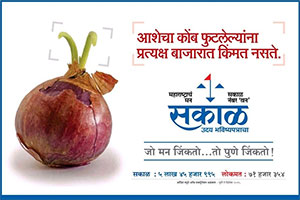
    The current war of words started with Lokmat taking over a hundred-odd billboards in Pune proclaiming that it’s the #1. And on Thursday, Sakal responded with a front-page lead report pooh-poohing Lokmat’s claim. The headline is aggressive and uses the Lokmat name in it (see image).


    Sakal hits back at Lokmat
    The creative of an ad in Friday's Sakal

    So what’s the truth of the matter? While Sakal quotes Audit Bureau of Circulations numbers, there are no recent IRS numbers to support the publication’s numbers. ABC numbers may be quoted by publications, but they aren’t recognised as standard benchmarks (or ‘currency’) by media agencies and advertisers. Meanwhile, Lokmat’s claim is based on research work done by Hansa Research. Now, while this study has been commissioned by the Lokmat group and hence may not be considered credible aver independent industry observers, it may be remembered that Hansa Research bears a stamp of quality and was firm entrusted with the IRS for many years, until the unified readership survey contract was awarded to Nielsen in 2012.

    According to an industry observer, while Sakal has been facing some heat from competition in recent years, it is still recognised as the leader in the Pune market and attracts maximum advertising. “It should’ve just ignored the Lokmat claims rather than giving competition free publicity on the front-page.”  In fact a report on the issue in the Sakal group’s English daily SakalTimes notes: “For Sakal, there is no need to take a note of the efforts made by Lokmat to falsely claim highest circulation.”

    Rugwed Deshpande

    Said Rugwed Deshpande, Director of Setu Advertising, a Pune-based creative and media agency: “When it comes to numbers, Pune thinks emotionally. It’s always Data vs Emotions for decision-making. Sakal enjoys great brand loyalty and affection from readers where as Lokmat has been trying their best to make its own space. Sakal has been far more active with their offline events and people connect initiatives.” And what is the view from advertisers, we asked Deshpande. “As far as local advertisers are concerned, they don’t believe in numbers be it circulation or readership. Most of them rely on their past experiences and the response that these publications have been delivering.” So will the war of words between the Big Two have an impact? “”The current campaign war doesn’t make any difference to the traditional advertisers. Nationally, numbers are more reliable source of information hence the impact of these research numbers would be probably different. Authenticity of official sources will ignite a bigger debate. As a Punekar, we don’t enjoy this war and believe in substance and content. No.1 is someone who understands us and speaks our language.”

    Newspapers, especially in traditional cities like Pune, have an emotional connect with citizens so it’s Advantage Sakal in Pune for now. Lokmat’s  tactic of taking on the leader met with much success in Kolhapur in South West Maharashtra where it took on Pudhari, the leading daily in the city. While Pudhari continues to be #1, it Lokmat has established itself in public as the #2.

    Meanwhile, on Friday (today), Lokmat has frontpaged a short news item on being #1 on the back of the Hansa Research findings.  Sakal too has carried an ad mocking at Lokmat’s claim and declaring that it is the #1 as per ABC data (on Page 5).