Tag: Lokmat Samachar

  • Lokmat Samachar launches 7th edition in Chhindwara, MP

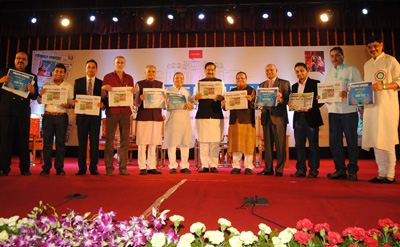
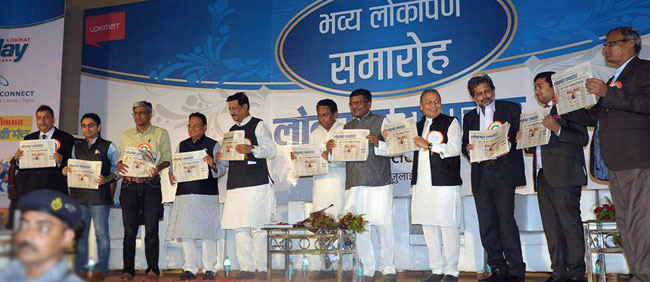
    Senior politicians and journalists at the launch of the Lokmat Samachar edition

    By A Correspondent


    The Lokmat group launched the seventh edition of its Hindi daily Lokmat Samachar with much fanfare in the industrial town Chhindwara in southern Madhya Pradesh last Friday (July 12).


    The edition was launched by Union urban development minister Kamal Nath who praised the Lokmat group for launching the paper in Chhindwara. “While Bhopal cannot become Chhindwara, Chhindwara can become Bhopal,” he said adding how the city had changed a lot over the years with its citizens redefining their concept of development.” An aggressive marketing drive was also initiated to coincide with the launch.


    Jaldi 5 with Vikas Mishra, Editor, Lokmat Samachar: Loads of surprises in store for readers

    A quick Q&A with Vikas Mishra, senior journalist and Editor of Lokmat Samachar.  The Hindi daily is published from Nagpur, Aurangabad, Akola, Kolhapur, Jalgaon, Pune and now Chhindwara

    01. It’s interesting that you have launched the first edition of Lokmat Samachar in Madhya Pradesh from Chhindwara and not a larger city like Indore or Bhopal? What was the reason for this decision?

    Chhindwara has very close contact with Nagpur and the distance is only around 130 km and earlier also Madhyanchal edition of Lokmat Samachar was circulated to Chhindwara and adjoining areas. There was a demand of readers to have a separate edition for Chhindwara because it’s a fast-growing city of Madhya Pradesh, hence we have launched our edition from here.


    02. You already have six editions in Maharashtra. Editorially, how much of a change will the Chhindwara edition have from the others edition in Maharashtra?

    We are having a separate edition of Lokmat Zamachar for the readers of Madhya Pradesh named Madhyanchal since two decades and it’s quite acceptable in several districts which are situated on the border of Maharashtra and MP. We already have bureaus in Bhopal, Indore, Jabalpur, Ujjain and Ratlam. We are making them more stronger.


    03. Any specific issues or campaigns that you expect to take up in the next few months at Chhindwara?

    Wait and watch. We have a lot of surprises for our readers which will be unveiled on a regular basis


    04. The language spoken by people in Chhindwara would be dramatically different from that of people in, say, Pune or even Kolhapur? Is the Hindi that use in the headlines and stories different in the Pune and Chhindwara editions to suit the local taste?

    Chhindwara edition of Lokmat Samachar may be the first independent edition of Madhya Pradesh but as mentioned earlier, we have had our Madhyanchal edition for two decades and hence have had a strong relationship with the readers of Madhya Pradesh. I personally know the journalistic taste of MP because I have spent 25 years in the state.  As far as the headlines and stories are concerned, we always try to write simple Hindi which is acceptable to each and every Hindi reader.


    05. In the run-up to the State Assembly elections in MP later this year, are you looking at expanding in MP and Chhatisgarh?

    The decision will be taken by the management.


    The event was also attended among others by Leader of Opposition in the Rajya Sabha Ravishankar Prasad, Maharashtra Chief Minister Prithviraj Chavan, Chairman and Editor-in-chief of Lokmat Media and Rajya Sabha member Vijay Darda, Maharashtra School Education Minister Rajendra Darda, Executive Editor of Aaj Tak Punya Prasoon Bajpai and Ashutosh, Managing Editor of IBN7.


    Editorial Director and Joint Managing Director Rishi Darda, Executive Director Karan Darda, Lokmat Samachar Editor Vikas Mishra, Product Head Mateen Khan, Resident Editor of Lokmat Samachar’s Chhindwara edition Devesh Thakur  were among those present on the occasion.
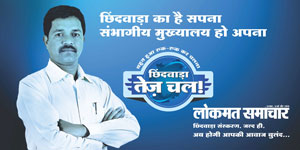
     

    The brand campaign for the Chhindwara edition launch of Lokmat Samachar


    A seminar on “Role of politics and media in the development of common man” was held on the occasion. The Maharashtra CM stressed the need for the media to maintain its neutrality and impartiality. He said both mediapersons and politicians carried a heavy responsibility on their shoulders. He expressed concern over a section of the media resorting to unscrupulous means to increase circulation. He said it is the primary duty of the media to inform the policies and programmes of the government to the masses.


    Speaking on the occasion, chairman and editor-in-chief of Lokmat Media  and Rajya Sabha member Vijay Darda said the main duty of the media is to bring about change in the life of the common man.


    He said Hindi can play a prominent role in unifying the country. He also added that Lokmat did not represent any political party but just acted as an impartial organ of public opinion.


    Maharashtra school education minister Rajendra Darda said there is a sea change in politics and media in the last two decades. During the pre-Independence era, there was coordination between the media and politics which is no longer seen. The media is the protector of the public interest.


    Ravishankar Prasad stressed the need for the media and politicians to establish a dialogue with the masses to prove their relevance. “The media should understand the agony and anguish of the common man and reflect the same through its columns only then it will win the appreciation and trust of the masses,” he said, adding: “The common man stayed buoyant about the future of the country.”


    Punya Prasoon Bajpai said there was a communication gap between the politicians and the common man. The politicians often use the common man during elections and then forget them till the next election. He also said the media needs to highlight the common man’s concerns to establish a link with the masses. If mediapersons or politicians establish a line of communication with the common man, the country will progress.


    Ashutosh said there has been a massive transformation in the country since 1950.  The country has seen technological as well as intellectual development. Common man has changed his thinking a lot. The Indian society has attained a maturity and they can no longer be conned by anybody. This is high time both politicians and mediapersons established a close contact with the common man and reflected his concerns.


    The Chhindwara launch marks the Lokmat group’s 21st edition in the country..
     

  • @INMA: Thriving in a digital world

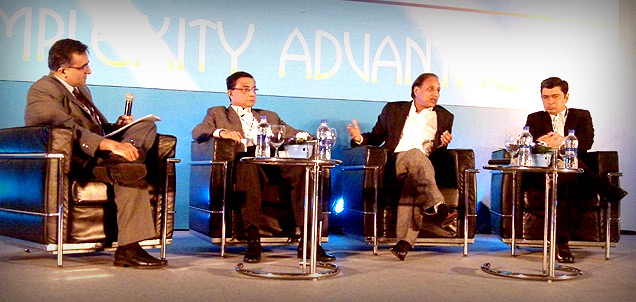
    L to R: Jehil Thakkar (KPMG), DD Purkayastha (ABP), Ravi Dhariwal (BCCL, INMA) and Santosh Desai (Future Brands)


    By A Correspondent


    The second day of the International Newspapers Marketers Association (INMA) South Asia 2012 conference in Delhi threw light on the complexities and challenges of the print newspaper media. The first session of the day was ‘Media 2020: A future backward kaleidoscope’. The session focussed on how the newspaper industry is readying itself to face the challenge from digital media usage.


    Mr Jehil Thakkar, Partner, Head-Media & Entertainment, KPMG India made some interesting observations about the levers that are changing the Indian newspaper industry. He pointed out how empirical studies prove that there exists a positive relationship between the wealth of a nation and newspaper readership: “There also exists positive correlation between growth of economies and technology adoption, which has significant potential to disrupt media consumption.”


    “The rapid proliferation of new-age devices and growth of alternate media has reduced newspaper consumption by 40 per cent with audiences preferring to access paper via their mobile phones,” added Mr Thakkar. According to him, technology would alter the workings of newspaper industry as coverage would become electronic, delivery would become faster; collaboration would become the key; cloud-based service would become a norm; interactivity through QR and barcodes would see an upsurge.


    DD Purkayastha
    If you are having trouble in viewing this video, see link

    Talking of how things will shape up in 2020, DD Purkayastha, MD & CEO, ABP Pvt Ltd said that the future belongs to newspapers who become hyperlocal as cities reach the saturation point. He said: “Regional publications will grow. And consolidation will happen at a much faster pace.”


    Mr Ravi Dhariwal, President, INMA Worldwide and CEO, The Times of India, noted how newspaper of 2020 will undergo a dramatic change. He noted: “Three critical things will emerge in 2020: what brand you own will become important as there will be many more brands on the digital media; curation of the product will become more important as the role of a journalist will shrink and need for analytical news pieces will arise; and business model will change as ad revenue will become a critical source of revenue. As technology improves, and people get more comfortable with using technology, the ad rates would only increase.”


    Mr Santosh Desai, MD & CEO, Future Brands India, remarked: “The larger issue that would emerge would be the tension between decentralisation of news media and fragmentation.” The panel, however, coherently agreed that despite the changes and challenges that the newspaper would undergo, it would still exist with the digital media.


    The session on ‘Increased circulation; dwindling readership: Is it time to measure ‘access’?’ saw panellists discuss the much-debated measurement metrics available. ‘Newspaper distribution channel: How best to nurture it for the future’ and threw light on the vendors and agents who distribute the newspapers. Moderating the session, Mr Sanjeev Vohra, Executive Vice-President – Audiences, BCCL, said: “The vendor currently exists as an independent businessman and as an investor in newspaper business.” His view was supported by Mr PS Venkat, Vice-President, Circulation, The Hindu, who said that changes are needed in distribution model to enable the vendors to become partners in progress.


    Mateen Khan
    If you are having trouble in viewing this video, see link

    Mr Mateen Khan, Product Head of Lokmat Samachar pointed out how the distribution channel in rural areas is still a problem, while it may not seem so in a metro. Taking the discussion ahead, Mr Rakesh Sharma, CEO, Aaj Samaj & ITV Group said: “There should be distribution points every three kilometres, and more distribution points.” He, however, noted that the vendors will remain the key to distribute newspapers in India beyond 2020. Mr OP Rajgharia, Chairman & MD, Overnite Express Ltd appreciated the effort put in by newspaper vendors to ensure the timeliness of delivery.


    ‘Needed to be sector-neutral’


    If you are having trouble in viewing this video, see link


    Bhaskar Das, President & Principal Secretary to MD, The Times of India Group, talks to MxMIndia on curating the INMA South Asia 2012 conference

    When I was talking to the organisers, and was given the task of preparing the content architecture of INMA, I told them very clearly that it is not about newspaper industry -it is about business. So, we have to be sector-neutral since principles of business are same. Newspaper is a sub-set of business. This was the first consideration.


    Secondly, in my case, the delegates were my guiding point. Why should people attend the conference? Are we going to be just another conference? How do I make it distinctive?


    The distinctiveness of the conference is that it creates fluid knowledge; knowledge that one can import when they go back. So, I had to ensure that they learn from each session. That led to the subject. In most of the conferences, people state the obvious. I thought why we don’t address the fact that there are complexities, there are challenges. Being an incumbent player, I realised that if we talk about problems, it is not solved. We should then talk about how we can leverage that problem or challenge. This led me to look for various industries. I scouted the internet, books, academic journals, about what happens when an industry goes through huge challenges, air pockets. There are initial signs of a problem, which I came to know of while researching, such as ‘butterfly effect’ that led to complexity science. This became the theme. The theme has to be intriguing to people rather than being a newspaper conference. The theme was then decided as ‘complexity advantage’. Now that complexity is a given, why not leverage it.


    On the audience mix:

    This time it has been a record attendance. I am not very happy but you to also have to market it that way. If one can maintain this level of content architecture, attendance will grow. For an event that happens once a year, I will have to sustain noise throughout the year. The community needs to talk about it, so that you can have user-generated content architecture next time. Then, there are regional peculiarities that may not be only one; there are eastern and western peculiarities.


    We also have to be industry- or sector-neutral in our audience mix. Why should they be from newspaper industry? Why not from television industry or from client side to discuss business? When people know what you are delivering, I am sure diversity will happen in the audience.


    The session was followed by speakers from Pakistan and Bangladesh who spoke on ‘Managing complexity in South-Asian markets – A Pakistan and Bangladesh Experience.’ The session saw interesting insights about newspaper industry in the two neighbouring countries.


    Industries across the globe are increasingly learning from other industries to improve their operating efficiencies and innovation capabilities across various spectrum of businesses. ‘Media learning from other industries’ saw three specialists from sectors such as retail, telecom and finance discuss the wisdom that newspaper industry could imbibe, given the onslaught of digital media. The panel discussed how the evolution could gain from the exploration of the new path.


    Mr Jaideep Ghosh, Partner, Management Consulting, KPMG pointed out that print media continues to remain the second largest medium in the Indian media and entertainment industry. He also pointed out the key challenges of talent, operational cost, monetizing digital media and fragmentation that the industry faces currently. He said: “Media can leverage data analytics to strengthen the understanding of its customers and build brand loyalty, much like the way telecom, retail and finance sector have done.”


    Drawing from the e-retail experience, Mr Rajiv Prakash, ex-CEO, FutureBazaar.com, said, “The audience is increasingly turning Clomosol, which is an aggregation of Cloud+Mobile+Social+Local. Thus, the digital consumer is a channel omnivore, and should be serviced at every touch-point.”


    Mr Jairam Sridharan, Head, Retail Banking, Axis Bank said that the newspaper organisations should focus on getting their product on mobile, rather than internet as, “the consumer is leapfrogging the internet and becoming increasingly mobile-savvy.”


    The closing session of the two-day INMA conference saw Prof Rishikesha T Krishnan., Chairperson, Corporate Strategy and Policy Area, IIM Bangalore talking about sustainable and thriving media business model that can successfully withstand the vicissitudes of business environment.


    He said, “The internet tends to dampen bargaining power of newspaper channels by providing direct avenues of access to customers. But the other hand, it will help the industry to create new substitutes, and new geographical markets will emerge.” He further noted, “The internet has and would result in targeted advertisements, disappearing role of editor as decision maker; fall in advertising revenues and young people moving away from printed newspaper.” The key decision variables, according to him, were how to embrace internet, and change strategy. Giving the example of Schibsted, Norway, he said that the paper now brings readers to its webpage through the front page and even Google was denied the permission to crawl its pages. “This helped them to monetise the banner ad on its front page,” Mr Krishnan said, adding, “Huffington Post has enaged in user-generated content, and its ad revenues are growing. Axel Springer/Bild has extended its brand to other media.”


    As Indian newspaper industry struggles with low cover price, growth of paid news, entry of non-traditional players, investment to establish presence in non-metros, the panel at INMA South Asia conference tried to address issues as closely as possible. Whether the industry would learn, and implement the learning remains to be seen.


  • Lokmat Samachar’s Pune edition launched

    By A Correspondent


    Maharashtra’s Chief Minister Prithviraj Chavan launched the sixth edition of the popular Hindi daily, Lokmat Samachar in Pune. Also present on the occasion were Minister of State for Education Rajendra Darda along with media luminaries Balbir Punj (senior columnist and RS MP from Rajasthan), Prabhu Chawla (Editor-in-Chief – The New Indian Express), Tarun Tejpal (Editor-in-Chief, Tehelka.com) and Vijay Darda, Rajya Sabha MP and Chairman of Lokmat Media Pvt Ltd.


    “Lokmat Samachar will enhance the quality of life in Pune and will make it more cosmopolitan,” said Chief Minister Chavan at the launch ceremony.


    A panel discussion on “The Relationship between Media and Politicians” was organized to mark the launch. “A journalist is also a politician. Not only should the media help in shaping public opinion, it should also play a critical part in the development of the political process,” the CM observed.


    Senior journalists and editors Mr Chawla, Mr Tejpal and Mr Punj highlighted the increasing complexities of the media world, and the need to maintain a balance in giving coverage and direction.


    “Media is a fish that lives in the vast ocean of democracy,” said Mr Punj. “Hence strengthening the media will result in the strengthening of democracy.”


    Highlighting the sharp difference between the cover prices of newspapers in India and abroad, Mr Tejpal pointed out that the readers India are not willing to pay enough money to run these institutions. “This is the structural flaw due to which quality deteriorates,” he said.


    Mr Chawla decried the increasing incidences of ‘paid news’ inserted by politicians, due to which media is facing a credibility crisis. “Media has become a victim of this phenomenon,” he maintained.


    Speaking about the Pune edition of Lokmat Samachar Rishi Darda, Joint Managing Director – Lokmat Media Pvt Ltd, said: “The Hindi-speaking population of Pune, which has emerged as an education hub and IT city, was in need of a national daily. Since Hindi is our national language and therefore connects people throughout the country, Lokmat Samachar would definitely fill the gap.”


    The newspaper offering consists of the main paper of 12 pages along with a 4 pager Apna Pune that will detail the local civic issues and also leisure options for the Puneites. For You for the young, Sakhi for Women and Lokarang Sunday supplement will accompany the paper on 3 different days in a week.


    This is the sixth edition of the popular newspaper which first appeared in 1989 in Nagpur, and was thereafter launched in Aurangabad, Akola, Kolhapur and Jalgaon in that order. Lokmat Samachar has 13.56 lakh readers as per IRS 2012 Q1 AIR


    Its Pune edition has a cover price of Rs3 plus an attractive subscription scheme.