Tag: Lok Sabha

  • THE NRI SENTIMENT

    THE NRI SENTIMENT

    Kunal SinhaAbout one month after the election results were announced and the new government took charge, what do non-resident Indians feel, and what are their expectations?

    I spoke to several senior executives in Indonesia and China about their wishlist from the new government.


    Political participation and cooperation

    NRIs seek greater inclusion in the political process. They expect the right to vote in Indian elections without having to be physically present in India, ensuring their voices are heard even from abroad. However, only about 118,000 NRIs registered to vote in the Lok Sabha 2024 elections, out of which 12,000 were eligible voters, predominantly from Kerala.

    The logistical challenges of traveling back to India to vote means many NRIs cannot participate directly in the electoral process. Additionally, they desire representation in legislative bodies or advisory councils, allowing them to voice their concerns and interests directly. Engagement in policy-making processes that affect the diaspora is also crucial, as it ensures that their unique perspectives and needs are considered in the governance of India.

    Poonam Sagar, Founder of Indoindians, Jakarta says, “OCI/PIO are said to have all rights as an Indian citizen except to vote & own agricultural land – however in reality there are many differences in policies, paperwork and taxation.”

    Soumen Biswas, Founder, Smartfactory4u, Shanghai, says, “Since moving to China in 2006, I’ve seen India’s global reputation soar during Modi’s tenure. As an NRI, I would be thrilled to see India-China relations improve even more rapidly.” According to many Indian business folk resident in China, the potential for India China trade is immense, and mutually beneficial as the balance of world power tilts eastwards.


    Business and Investment

    In fiscal year 2023- 24, the Indian diaspora, scattered across the globe, set a record by sending more than $100 billion in remittances to their families back home in India. This figure not only surpassed the previous milestone but also emphasised the key role of the Indian diaspora in India’s financial inflows.

    It’s worth noting that these remittances exceeded the combined net Foreign Direct Investment level and portfolio investment amounting to $54 billion. The scale at which Indians received their remittances in 2023 even exceeded the GDP of 11 countries recorded in 2022.

    While NRIs have been repatriating such large sums back to India, they find it almost impossible to raise funds for their own ventures overseas.

    Bipin Mishra, Founder and CEO, Ketitik.com, makes an appeal to policymakers in India. “As an Indian national running a startup in Indonesia, we would love if grants and support provided by Government of India is passed to us as well.  It has become very difficult for Indians to invest in Non Indian startups, if an exemption can be made for Indians to invest in Indian-owned foreign based start-ups, it will be a great”.

    Sagar would like the government to ease the repatriation of money from NRE accounts to NRIs, as well as make it easier for NRIs to invest in various financial schemes in India. “NRI’s need to maintain an active Indian phone number to manage their bank accounts etc in India – despite the advances in technology, this is still an issue. Aadhar card is required for most transactions in India, but it is difficult to get for NRI’s who have been overseas for many years and for OCI/PIO. Also, property sale TDS should be at par with resident Indians; after all NRI’s are also Indian citizens,” she explained.


    Connectivity and fostering cultural ties

    In December 2019, India and China were connected through 539 direct passenger flights. Now there are none.

    IndiGo and Air India had operated flights to China while Air China, China Southern Airlines, and China Eastern Airlines, had connected Beijing, Shanghai, and Guangzhou to Indian cities.

    The two countries suspended these flights during the Covid-19 pandemic and subsequent border clashes in June 2020. Flights have not resumed four years on. In the absence of direct flights, travelers between India and China must rely on connecting flights through third countries, such as Hong Kong, Bangkok, and Singapore. The detour adds time and cost.

    The lack of direct flights between the two nations poses major challenges for hundreds of Indians who study in China as well as the families of many Indians, including businessmen, who began to work in China after travel restrictions were lifted by both countries in 2022.

    Low levels of air connectivity are also a hindrance to trade and tourism between India and Indonesia. The island nation’s Hindu heritage can be leveraged for enhancing traffic into India, and much more can be done to promote various Indian destinations amongst the Indonesian population. “Tourism in India is underdeveloped while it has a massive potential. With safety measures and promotions, I would love to have more of my Indonesian friends travel and marvel at India,” says Mishra.


    Personal and family

    Many NRIs maintain close ties with their home country, and eventually wish to return. They expect the government to make that return smooth and hassle free. Sagar would like to see an enhanced duty-free allowance upon transfer of residence, and an increase in health insurance coverage. There also needs to be opportunities for NRI children to participate in national level entrance exams through satellite examination points at the Indian embassy in different countries.

    Biswas says: “Religious and communal harmony is the most important for Indians living in India. However, it gets more crucial for Indian expats. It has the ability to impact their survival in some parts of the world. Hence. I hope that the government continues to ensure that religious harmony remains intact.”

    He added: “I wish to see the government put significant effort into improving civic sense in our society. Great nations are built on the foundation of responsible and thoughtful citizens. Promoting civic awareness through social media, educational videos, and campaigns at transport hubs, schools, and workplaces can foster a more conscientious and responsible society, helping to build a stronger nation.”


    Kunal Sinha is a senior strategy and foresights executive based in Kuala Lumpur, Malaysia. He is the author of several books including The Future of India’s Rural Markets and Raw – Pervasive Creativity in Asia. He writes for MxMIndia every other Monday. His views here are personal.

     

  • Times Now announces ‘Swachh Neta’ voter-welfare initiative

    By A Correspondent


    In the lead to the upcoming Lok Sabha elections, Times Now has announced ‘Swachh Neta: Mission for Clean Politics’, with an aim to educate and empower the citizens to make an informed voting decision.


    Said MK Anand, MD & CEO, Times Network: “Times Now actively champions initiatives that lead to systemic reform. Our pursuit to effect meaningful change has been aptly captured in our brand promise – ‘Action Begins Here’, that we try to live up to. Swachh Neta comes at an opportune time when transparency and accountability in the political and electoral system of the country is the need of the hour. Through this endeavour we want to empower our viewers to bring positive change through informed and well researched voting.”


  • News18 India and CNN-News18 announce election-based programming

    By A Correspondent


    News18 India and CNN-News18 have lined up an extensive programming giving viewers access and insight into the upcoming elections. News18 India will present its programming under the umbrella branding ‘Sabse Bada Dangal’. The programming will also witness special edition of ‘Bhaiyaji Kahin’ and ‘Lapete Mein Netaji’.


    CNN-News18 will delve into all aspects of the Lok Sabha elections with its special programming ‘A Billion Votes’. With its diverse formats and data-driven programming, the channel will bring up-to-the-minute updates throughout the election.


    The programming will be led by the editorial team of the channels. On News18 India, Kishore Ajwani, Deputy Managing Editor, Amish Devgan, Executive Editor and Prateek Trivedi, Senior Editor, will be joined by prominent experts like Ram Kripal Singh and Shesh Narain Singh. CNN-News18 will feature top anchors – Bhupendra Chaubey, Executive Editor, Zakka Jacob, Editor – Output, Anand Narasimhan, Deputy Executive Editor, Marya Shakil, Political Editor. Complementing them will be a panel of eminent journalists and political analysts like Swapan Dasgupta, Vir Sanghvi and Ajoy Bose to name a few.


  • Public can seek MLM info filed by govt

    By A Correspondent


    The Ministry of Corporate Affairs is considering publishing names of Multi Level Marketing companies which come to its adverse notice.


    Giving this information in written reply to a question in the Lok Sabha on Thursday (Dec 13), Sachin Pilot, Minister of Corporate Affairs, however, said that the members of the public can view the names of the companies registered under the Companies Act,1956 and documents filed by any company on MCA-21 portal of his Ministry by paying a nominal fee of Rs 50.


  • Ranjona Banerji: NCP ties itself for Whiner of the Week award

    By Ranjona Banerji


    The winner of the presidential election maybe Pranab Mukherjee but the award for Noosemaker/Whiner/Tantrum Thrower of the week is divided between PA Sangma and Sharad Pawar. One is former NCP, the other current NCP and both founders of the NCP.


    Pawar suddenly decided that he was very upset with the sort of musical chairs being played at Cabinet meetings. I quite sympathise because I never liked musical chairs as a kid at birthday parties. Today’s children will not understand, but in the olden days birthday parties were an elaborate form of torture for children, who were forced to compete with each other and make fools of themselves in order to get a slice of cake and a few chips. Sounds a bit like today’s political parties actually.


    Anyway, Pawar felt that every time the music stopped, he was forced to sit in another chair. Sometimes it was the second chair (first being the prime minister) and sometimes it was chair 3 or 4. This was clearly insulting. He might have only nine MPs but why should that other chap from a much smaller state holding a job that Pawar once did get the second chair?


    Later we were told he was not so petty to be worried about chairs. All he wanted was a coordination committee. Whatever.


    PA Sangma, former Lok Sabha speaker and the country’s best known Tribal and Christian – according to him – wanted to become President of India. This is a legitimate goal, but Sangma, one might say, went about it the wrong way. He approached, of all people, Naveen Patnaik and J Jayalalitha for help. However powerful they may be in their own states, they did not have the numbers to make Sangma President.


    Since Sangma was part of the UPA, he could have at least spoken to someone within the coalition. Instead he chose to go out of it. After much reluctance, the BJP decided to support him. The UPA and two NDA allies supported Pranab Mukherjee. Everyone except Sangma saw Mukherjee’s victory as a foregone conclusion. Not because Mukherjee is much loved or the greatest person ever but because the UPA had the numbers. Then Sangma and the BJP said he wanted to be the loser with the highest number of votes (this is a strange award category known only to Indian politicians).


    Then Sangma said that he had to win for India’s Tribals and Christians. Most Tribals and Christians were silent. (As it turned out, not all of their representatives voted for Sangma.) Then Sangma said that Mukherjee had used a comma where it was not needed in his nomination form and had not used the right kind of nib in his pen. Also, he did not stand on the right side of the table when submitting the form (unlike Sangma who seems to be heading quite firmly to the right). Since Sangma was by now advised by the world’s biggest litigator Subramaniam Swamy, the plan was to go straight to the Supreme Court with 1,000 public interest litigations. The Election Commission blocked that route.


    So now that Sangma has not become president, he is nibbling away at sour grapes. He should not, because he is now eligible for the Best Sore Loser and Most Ungracious Defeat speech awards, with a good chance of winning both. The Congress used bribery, extortion and threats to get Mukherjee to win and the North East states (which elected Mukherjee by the biggest margins) betrayed him.


    Boo hoo hoo.


  • Tata Sky gears up for digitization with new ads

    By A Correspondent


    “Drop cable, upgrade to Tata Sky,” reads the latest ad of the direct-to-home (DTH) service provider, as the cut-throat rivalry between DTH players and cable operators intensifies in the countdown to the first phase of compulsory digitisation in the top four metros by June 30.


    “Your TV will continue to run on your inverter even during a power cut…isn’t this a reason enough to choose Tata Sky over cable,” said another advertisement, as the DTH major unleashes its third phase of print and out-of-home (OOH) ad blitzkrieg to lure millions of cable users in the top four cities to its services.


    Vikram Mehra, Chief Marketing Officer of Tata Sky, said the campaign is directed at educating consumers so that they can make an informed choice. “Our latest print campaign tells subscribers to do their homework before they buy a set-top box (STB) so that they chose Tata Sky and not just some dabba (box),” said Mehra. It’s not targeting any cable operator, he added.


    With over 9 million subscribers, Tata Sky is the second-largest DTH service provider in the country, after Dish TV.


    Last December, Lok Sabha passed the Cable Television Networks (Regulation)

    Amendment Bill, 2011, which makes it compulsory for cable companies to convert their analogue system to digital in a phased manner from June 2012.


    Consequently, in the first phase of digitisation, India’s top four metros – Delhi, Mumbai, Chennai and Kolkata – will have to replace all analog television networks with digital transmission from July 1, 2012.


    This means that all cable subscribers would need to get digital STBs in order to ensure that their TVs don’t go blank. By March next year, as many as 38 cities across the country would be brought into the digital fold.


    While phase 1 has around 10 million TV homes in the four metros, over 90 million analogue cable TV homes are estimated to convert to digital by the end of fourth phase in December 2014.


    Stakes are indeed high for DTH players who have a ready, captive base of millions of analogue cable TV customers, who just need to install a digital set top box in their homes.


    “DTH is expected to grow at a healthy CAGR of 20 per cent for the next 5-7 years,” said Abhishek Chauhan, Senior Consultant, ICT Practice, Frost & Sullivan, South Asia & Middle East. DTH contribution would increase to more than 30 per cent to overall the pay TV market, reducing the cable providers’ contribution to less than 65 per cent, he says. While the number of DTH households in the country is set to go up from 37 million in 2011 to 86 million by 2016, digital cable would see its subscriber base jump from a mere 6 million to 75 million, according to a recent FICCI-KPMG report.


    The number of cable and satellite (C&S) households is estimated to reach approximately 176 million by 2016, of which paid C&S households is estimated at 168 million, representing 89 per cent of total TV households. In 2011,146 million households in India had television sets; 119 million of which used cable or satellite services, says the report.


    While Tata Sky has been relentless in its campaign against cable, Dish TV has a different strategy. “Direct attack on cable operators is a short-lived approach,” said Salil Kapoor, Chief Operating Officer, Dish TV. Differentiated offerings and emotional connect with users is a sustainable strategy, he added. Dish TV has, in fact, tied up with neighbourhood operators to push its own set-top boxes and install connections.


    Meanwhile, Tata Sky has been running a campaign to shed its premium image and spread awareness about the impending digitisation and the value-added services that it offers.


    Perceptions on pricing in multiple television households, vacation time charges, relocation charges and prices about offerings are some of the issues that ‘Poochne mein kya jaata hain’ campaign started to address since last September. Created by O&M, the commercials urge consumers to ask while underlining the range of offerings.


    “Poochne mein kya jaata hai campaign was our way of telling customers that it’s possible to get a world-class service at an affordable price,” said Mr Mehra of Tata Sky. The latest campaign in this series informs one about the affordability of DTH services.


    Sonu & Cookie (characters from the last campaign), try to find items which are cheaper than Tata Sky. But every time they bring one to the shop, the shopkeeper surprises them by informing them that Tata Sky’s package is even cheaper.


    ‘Get the quality of DTH at the price of cable,’ says a print commercial of Den Networks, one of the largest multi-system operators having presence in a number of states, just a few months back. And a subsequent radio ad raised the pitch by mocking at DTH players – ‘DTH stands for Don’t Try at Home.’


    Tata Sky was quick to come up with a tit-for-tat print advertisement – “World-class digital box or any other dabba. What will you choose?”


    “Den has been the first cable TV MSO in India to launch a nationwide brand campaign, created by Bates,” said a Den Networks spokesperson, adding that different players will experiment with different types of messages and campaigns to attract subscribers.


    Digital cable has some inherent advantages such as weather-proof services that are not interrupted by rain, service through the local cable operator who is known to the household for years and is just a phone call away, to address any technical or service queries, the spokesperson says.


    While such kinds of advertisements may be attention-grabbing tactics, they also help consumers in making a better choice, say advertising and brand experts.


    “These are attention-grabbing tactics as consumers are in the process of making up their minds,” said Jehil Thakkar, Head, Media and Entertainment, KPMG. While now there is an opportunity for DTH players to acquire analogue subscribers from cable, the latter would obviously try its best to keep users under its fold, he added.


    Most advertising that we see around are intra-category fights, driven on the shoulders of brands such as Pepsi vs Coke, Rin vs Surf, Bajaj vs Hero. However, it’s the category versus category fight, for example GSM Vs CDMA, which is the game changer, say brand experts.


    In a fight like this, end consumers stand to gain, said Prathap Suthan, Chief Creative Officer of Bang in the Middle, an independent ad agency. “And this is exactly what is expected when it gets into a category versus category fight.”


    Tata Sky is clearly and visibly a better constructed and sustained brand among DTH players, feels Suthan. “When you stand for a category, and you represent a category (just as Tata Sky has done), other brands will look small or will be made to look small.”


    The other DTH brands, it seems, have sort of abdicated the position of category leadership to Tata Sky, he added.


    Source: The Economic Times
    Copyright © 2012, Bennett, Coleman & Co. Ltd. All Rights Reserved


  • Congress-led UPA loses sheen as BJP inches ahead: ABP News-Nielsen Survey

    By A Correspondent


    The ABP News-Nielsen survey conducted on the eve of the UPA-II third anniversary has revealed that after eight years in power, the Congress-led coalition’s pull seems to be diminishing.


    The survey, conducted across 28 cities across the country in April-May 2012, revealed that the BJP would garner 28 per cent of the votes if Lok Sabha elections are held now, while the Congress would manage only 20 per cent.


    In fact, the BJP has turned out to be the most favoured party. In an interesting revelation, only 69 per cent of those who voted for Congress during 2009 Lok Sabha elections are still intending to vote for it, if Lok Sabha elections are held now. 31 per cent are moving away from it and 12 per cent now intend to vote for the BJP. Whereas for BJP, 84 per cent will stick with the party and only 2 per cent are switching away from it to Congress.


    In 2009 elections, 28 per cent of these respondents voted for Congress, while 27 per cent voted for the BJP. But for the BJP, the dip of 8 per cent in the Congress vote share is not a complete gain. The BJP is gaining only a marginal 1 per cent. The remaining 7 per cent dip in Congress vote share among these respondents is gain for regional parties.


    In the 2009 Lok Sabha elections, Congress had won 207 seats while BJP had got 116 seats.


    While 32 per cent believed the government’s performance was good or very good, a sizable 35 per cent rated the performance as average.


    Significant 21 per cent respondents said it was poor while 11 per cent rated the performance as very poor. The performance of UPA government has been rated slightly below average with a mean score 2.95, which is lower than the mean score of 3.22 last year.


    However, Manmohan Singh’s ratings are good with 37 per cent respondents saying his performance was good or very good. Another 33 per cent ranked him average, while 28 per cent believed his performance was poor or very poor.


    Around 32 per cent of the respondents felt that performance of UPA government is better or much better than its last term. A dip of 8 per cent is observed in the perception of people from last year survey, where 40 per cent of the respondents felt that the performance of UPA government is better than previous term. 39 per cent rated UPA performance as “about the same” this year, similar score in comparison to last year.


    Only 36 per cent of the respondents felt that performance of the PM is better than its last term. A dip of 8 per cent is noted in the perception of people from the last year survey, where 44 per cent of respondents said that the PM performed better than his previous term.


    When it comes to best leader in the country, Narendra Modi 17 per cent said he is the best leader over Manmohan Singh at 16 per cent. Modi was preferred at number four during last year’s survey (12 per cent).Manmohan was ranked at number 1 last year (21 per cent).  Rahul Gandhi’s scores have dipped from 19 per cent to 13 per cent this year.  Sonia Gandhi’s scores are down from 14 per cent to 9 per cent.


  • The sunset gets closer…


    By A Correspondent


    The Lok Sabha has passed the much-awaited Bill for digitization of Cable TV in India with the assurance that cable operators will not be harmed from the proposed move. The digitization sunset date for the four metros is June 2012. For complete digitization of cable sector in cities with population of more than one million, the date is March 30, 2013, all urban areas by September 30, 2014, and the entire country by December 31 2014.


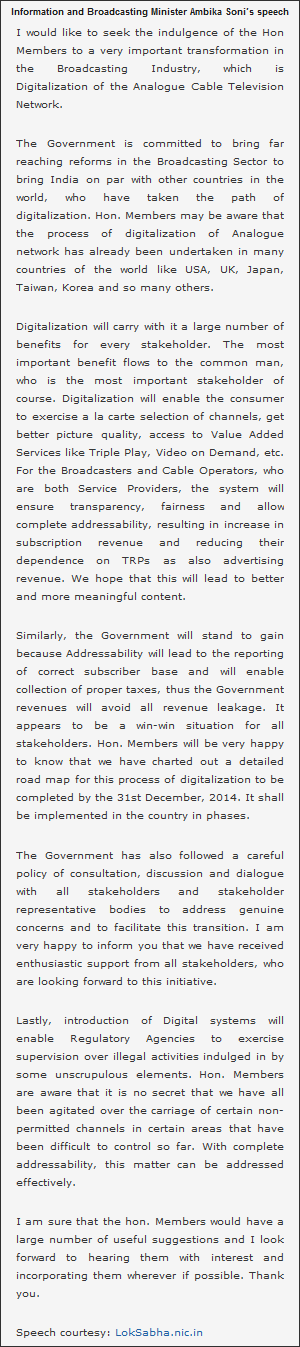
    Information and Broadcasting Minister Ambika Soni said that the move to convert Analog TV into Digital will bring India on par with other countries like US, Britain, Korea and Taiwan.


    As a matter of fact, digitization of TV will bring subscription revenues for broadcasters and of course the elimination of carriage fees from the broadcast ecosystem – something which, as experts believe, would eventually happen as complete digitization would set in. As for now, carriage fees is one big challenge all broadcasters are facing. Industry estimates suggest that roughly 20 per cent of a channel’s cost account for carriage fees. As per the new regime, all satellite channels will be beamed to houses through set-top-boxes.


    While most members supported the Bill, a few raised their voices against content being broadcast on some channels and the unjustifiable hike in the cable rates. Soni assured Cable operators that the move will not render them jobless, and that the government’s major concern was the viewers’ interest. She said that an enabling provision had put in place to the effect that only Rs 200,000 to Rs 300,000 would be needed by cable operators to move to digitisation.


    On the prices of set-top-boxes, she said, “The prices of set-top-boxes will fall. These will be available on installments and rent. Also, viewers don’t have to take a whole bouquet of channels. TRAI will impose a tariff capping for subscribing to channels.” She also said that digitization would provide consumers a la carte selection of channels and video-on-demand among other things.


    She added that the Headend-in-the-sky (HITS), which had so far failed, would take off with greater investments


    The ordinance was passed earlier this year to meet the deadline set for full digitization by December 31, 2014. The government will complete the process in four phases starting with metros.


    The Bill will now go to the Rajya Sabha for passing and then go to the President for her assent after which it becomes law. Mr Dinyar Contractor, Editor-in-chief, SCATMAG, is of the opinion that it is only a matter of time before Rajya Sabha will pass the bill.


    According to Mr Devendra Parulekar, Partner & Segment Champion – TV Distribution Ernst & Young, the development is a positive one as this will lead to transparency in the entire system while creating a win-win situation for every stakeholder. “Digitisation will provide customers with wider choices, better signal quality, HD content and niche content tailored to suit niche audiences.”


    Whether there will be an effect on pricing, he said, “With hyper-competition, I don’t think price points will rise significantly; they will more so be determined by the market forces. ”


    On what it means to MSOs, Mr Parulekar said that MSOs focus will shift from B2B to B2C. However, due to the short implementation time-frame, he said that MSOs are likely to lose round one of the battle to DTH players, who have already invested in mature back-end systems. She also said that there were punitive clauses against cable operators, MSOs or DTH operators who failed to show the must-carry channels, including the Lok Sabha and Rajya Sabha TV channels.


    “The jury is still out on how the sector would fare in the medium to long term, as digital cable+broadband has some inherent technological advantages over DTH, as well as the advantage of personalised service that cable offers to end-subscibers. These service enhancements will need infusion of large funds and hence the sector may see some transactions (M&A activity). With increased transparency in collection of subscription fees as well as tax collection, broadcasters can de-risk their revenue streams versus advertising revenue that they are presently overly dependent upon,” he added.


    Big story image: Fotocorp