Tag: Lodestar UM

  • Stagnancy stages a comeback in IRS 2012Q1


    By A Correspondent


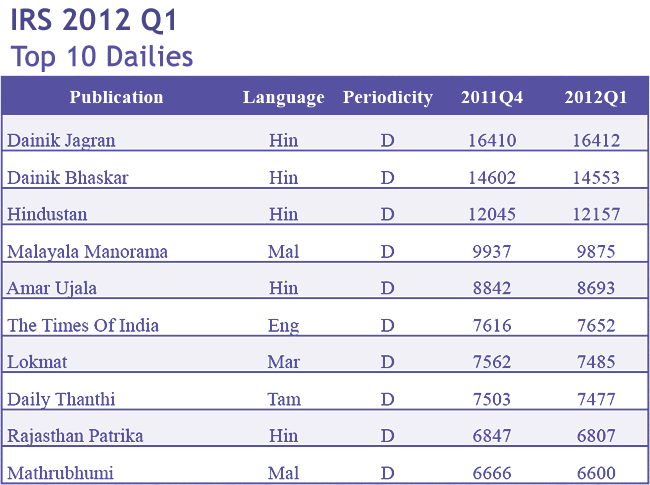
    The IRS 2012 Q1 readership results released by MRUC and Hansa has nothing new to tell but the obvious tale of the apparent rise in numbers of a few publications and the decline in readership of a majority of players. Going by the Average Issue Readership norm, in the Top 10 dailies there has been no change in the pecking order of the top performers but the readership of 7 out of 10 dailies has seen a marginal decline. Of the ten publications, five are Hindi in origin, two are in Malayalam, and one each in Tamil, English and Marathi.


    Emerging a frontrunner once again, Dainik Jagran manages to hold its forte showing slight readership growth with 16,412 in 2012Q1 as against 16,410 that it reported in 2011Q4. At No 2, Dainik Bhaskar has reported numbers totalling 14,553 a decline by 0.33 per cent from 2011Q4 figure of 14,602.Hindustansits comfortably at the third spot having reported a 1 per cent growth of 12,157 as against 12,045 reported in 2011Q4. Malayala Manorama is at the fourth spot with an AIR of 9,875 as against 9,937 in 2011Q4 – a drop of 0.6 per cent. Amar Ujala is next reporting an AIR of 8693 against an AIR of 8842 in 2011Q4 – a drop of 1.7 per cent. The Times of India English edition continues to see growth and comes in sixth with AIR of 7,652 as against 7,616 registered last quarter. Marathi daily Lokmat sees a marginal decline to end 2012Q1 at 7,485 compared to 2011Q4 AIR of 7,562. Tamil daily Daily Thanthi is next with AIR numbers of 7,477 as against 7,503 recorded in 2011Q4. Rajasthan Patrika with 6,807 and Mathrubhumi with 6,600 end the tally occupying the ninth and tenth spot respectively.


    Reacting to the overall trend, Dinesh Rathore, Vice President, MediaVest Worldwide said, “The study hasn’t thrown any new surprises. What is known is that the readership time spent on print is coming down these days, which is even lesser in case of magazines. Newspapers as a habit are not going to die soon but the time spent is surely on a decline. Also, if people were subscribing to more newspapers earlier, they are subscribing to one less now because of the options available on digital.”


    Highlighting her stance on the numbers, Anamika Mehta of Lodestar UM said: “What I infer is that the drop is very marginal. Print will continue to hold its ground in India. With literacy rates going up and the launch of several new products print will continue to drive growth in India . Also, what is seen is that there is a growth of consumption that is happening on the web and moreover, India is a very young country. Almost 60 per cent plus of the population are younger than 35 years. With these audiences the consumption is more on the web than on the physical newspaper. Also, we are seeing a lot of launches by players in the regional markets. So it’s not as bad as it seems.”


    Voicing a similar opinion as given by Mr Rathore, Priti Murthy, National Director – Insights, Maxus said, “I am not surprised by the overall trend that has been thrown up. Why do we read newspapers and magazines, for the sheer content that it provides and content is available faster in other mediums today – definitely digital and to a large extent even TV. I see this trend continuing in the next 3-4 years after which it will reach a saturation point. Also, how much ever tactical initiatives publications engage in to increase circulation, it clearly shows that readership is not going to increase. The time spent in reading newspapers and magazines will continue to see a decline. Also the new generation that is growing up may not grow up on a newspaper alone. They rely on mobile and other AV modes to receive their communication.”


    (AIR numbers; all figures in ‘000)


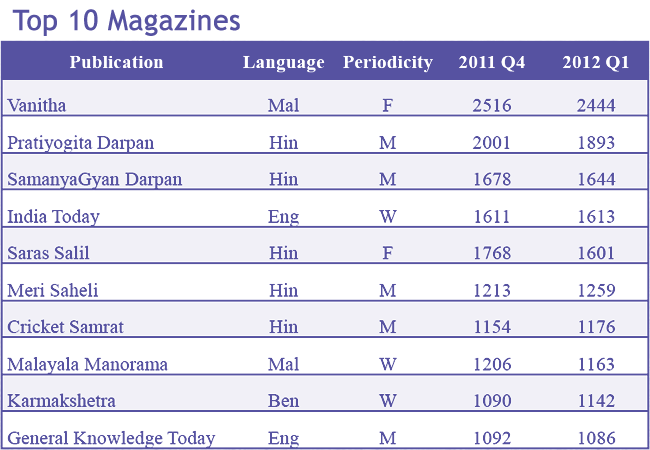
    The downfall story continues with magazines as well with leader Vanitha (Malayalam) reporting an AIR of 2,444 as against 2,516 in 2011Q4 – a decline by 3 per cent. Pratiyogita Darpan too sees a decline of 5.4 per cent having registered an AIR of 1,893 in 2012Q1 as against an AIR of 2001 in 2011Q4. SamanyaGyan Darpan sees a marginal decline with an AIR of 1,644 as against 1,678 reported last quarter. India Today is the topmost English magazine in this list and figures at the fourth spot with 1,613 as against an AIR of 1,611 reported last quarter. Saras Salil is next on the line-up and has reported a big drop of 9.5 per cent registering an AIR of 1601 as against an AIR of 1,768 reported in 2011Q4. Meri Saheli and Cricket Samrat have posted growth with an AIR of 1,259 and 1,176 respectively. Malayalam Manorama at 1,163 has seen a decline of 3.5 per cent while Bengali magazine Karmakshetra has seen a growth in its AIR at 1,142 as against 1,090 in 2011Q4. General Knowledge Today completes the list with an AIR of 1086.


    Throwing light on the trend spotted in magazines, Anamika Mehta said: “In the case of magazines, what we are seeing is that the time spent on magazines is going down but there are a lot of new and niche products being launched. A lot of international players too are coming into this market. So that should give it some scope for growth. But right now I think magazines are in a more worrying state than dailies in India but having said that I do not see the death of the medium coming here anytime soon.”


    (AIR numbers; all figures in ‘000)


  • Microsoft moves digital biz to Reprisemedia

    By A Correspondent


    Reprisemedia India will now handle the Digital Media AOR for Microsoft India across Display and Search. The business has been transitioned from WPP-owned Quasar and Publicis’s Performics.  Reprisemedia India will now work as an extension of Lodestar UM who has been the lead media AOR for Microsoft India for the past 10 years.


    “This shift aligns India with Microsoft’s global move to consolidate digital media buying and search with UM. 2012 will be a game-changing year for Microsoft with the impending launch of Windows 8, coupled with exciting developments across our entire product portfolio. We look forward to working with Reprisemedia and deepening our partnership with UM,” said Shafalika Saxena, CMO of Microsoft India.


    Anjali Hegde, CEO Reprisemedia India, added: “This is the most significant thing that has happened to Reprisemedia and we are really excited about the opportunity to work with Microsoft. It considers digital as a core and mainstream medium and that mindset allows a digital agency to push its boundaries of innovation and creativity – in short, a dream client to work for.”


    This new arrangement comes into effect from July and will leverage global expertise from across the many markets where Reprisemedia handles Microsoft’s Search business.


    “However, Reprisemedia India comes with an added advantage,” added Anamika Mehta, COO Lodestar UM. ” As a full-service digital agency, its offering extends far beyond Search, into the realm of Digital Display, Content and Application.  Reprisemedia will complement the unique strength of Lodestar UM within the Content space.”


  • Being on Cannes jury is no mean task


    By Tuhina Anand


    Being on the jury of Cannes Lions means serious business – being shut in a room for endless hours and going through thousands of entries to make a case for the piece you like. Undeniably, despite the work involved, the experience of being a jury at Cannes is a learning experience in many ways.


    Ryan Menezes

    As Ryan Menezes who was invited to be on the Cyber Lions jury in 2011 puts: “I thought, cool, after winning India’s first ever gold lion in 1996, I now get to judge the most cutting edge category of all. I was looking forward to a week of sun, sand and schmoozing. Yeah, right! It was cyber boot camp from start to finish.”


    Giving a peek into the work, Mr Menezes explained that first there’s a preliminary voting to determine the shortlist, which takes place online. This is even before you set foot in Cannes. He added: “Once you’re there, barely recovered from the seven course welcome dinner, you plunge into this seemingly bottomless pit of entries where you see some of the world’s best work, and some of the world’s best case studies for mediocre work. You quickly learn to check out the work first and skim through the somewhat exaggerated case studies, but with around 500 entries to be judged over 6 days, you’re looking at around 9 hours a day of sitting in front of a computer, with headphones. By the end of the day, you’re too drained to do anything more than crawl back to your fantastic Hollywood themed suite at the Palais Stephanie and pass out.”


    But wait, there are good parts too: “You get to hobnob with some of the best minds in the world, you get a peek into what’s going to happen in the future in the digital category in India, as we are light years behind. You learn stuff that can help you win pitches when you return (I have used this to great effect in two successful pitches this year) and you learn that craft is not dead, it has been resurrected and is alive and kicking serious butt in cyberspace. You get VIP entrances to the gala functions, reserved seats at the award ceremony, invites to the hottest parties, but you’re too dead so you take off to Paris or Amsterdam or Monte Carlo for some peace and quiet. And to sum up, what made the experience really worthwhile was the flawless orchestration of everything by the organizers from start to finish. And, of course, the jury members were fair – there was no lobbying, no camps and no crab mentality. Just a desire to give great work it’s due. And that’s what makes Cannes, well, Cannes.”


    Amer Jaleel

    Amer Jaleel, NCD, LoweLintas who was invited to judge the Press Lions in 2011 agreed with Mr Menezes. It was his first experience of judging at any festival and after his experience he feels that coming out with great creative work is difficult but judging so many good works is even more difficult: “While people come and congratulate you on being on the jury and then take off to enjoy the French Riviera, you have to get back to some serious work looking at endless entries. However, besides seeing the best works, what I enjoyed was interacting with the mindset behind those works.”


    “The debating that goes behind each piece of work and when you knock your head against somebody else’s work is the enjoyable part of being on the jury. The questioning, the conviction behind the works helps in validating your beliefs, assurance and creative thinking. It also gives you a peek into human behaviour as you see few pushing for some works with vested interest,” Mr Jaleel added.


    Shashi Sinha

    Shashi Sinha, CEO, Lodestar UM, who judged media Lions in 2008 feels that the experience at Cannes was of superior quality: “The screening process is intense and it’s time consuming. What I remember is that one got to see an amalgamation of digital and activation at Cannes which one is now beginning to see in India. This was four years back!”


    Being actively involved in the organizing of advertising industry awards in India, Mr Sinha pointed that a large jury at Cannes for each category works in favour of minimizing the biases. He also points that the entire process being digitized adds to making it a tighter procedure of judging.


    Priti Nair

    For the experience of being on the jury, Priti Nair of Curry-Nation who had judged the print category said: “It was a fascinating experience. First and foremost you feel enormously good and they make you feel enormously important as a judge! I was judging print and there were some 7000 entries. You get to meet and interact and have lunch with people whose names you have only read and whose work you have truly admired. What strikes is the smoothness with which the whole thing moves. It is thought through to the last detail in terms of how do you divide, how you score and how you make sure it does not feel unfair. Apart from this, you actually get to see work that you would never ever see anywhere. It is work sent from all over the world.”


    These could be lessons that Indian awards committee could also emulate here.


    While everyone praises the well-oiled jury process, the chance to see works from across the world and even interact with great minds in advertising, some are also of the view that being on such a platform makes you realize the drawbacks in Indian advertising and people practicing advertising itself.


    KV Sridhar

    KV Sridhar aka Pops, who was on 2010 Press Lions jury, pointed that the Cannes jury is different from any other international fest as there is representation from different countries. If there are 22 jury members they will be from 22 different countries. He said:, “There would be silent Japanese who will make an apt observation and there will be vocal Indians or South American jury. However, the Indian jury becomes a lone member as representation from South Asia is not so strong. So they fail to gang up and explain the nuances of advertising coming from their part of the world as compared to those from Latin American countries who do make a case of work coming from their part of the world.”


    He added: “I have seen is that jury members from other countries are well versed with works not just coming from their agency but also from their country. So they really put a strong case for their works. It’s like putting their country first and then the network. One is not saying that be blindly patriotic but one must stand and fight for a good piece of work from their country and explain the various cultural nuances which will help the jury in better understanding of the work. Also, the jury should share their inputs with the industry so that for the next time one is prepared well when sending entries for festivals like Cannes. There should be a platform created to share their learnings.”


    Pops categorically said that one should be familiar with the works coming from their own country: “Fight for the creative you like, it doesn’t matter which country it belongs to. Double tick if you like a work, as in Cannes if you blink you will miss the entries!  Ensure that the works you like makes to the next level and that will only happen if you fight for that work and lastly be honest to yourself.”


    Ravi Kiran

    Ravi Kiran, who judged the media Lions in 2010, makes a valid point when he says that while Cannes is for celebrating work, there should be focus on learning too. While few make it to Cannes, there should be means to make the entries available to people who work behind these entries, but are not at Cannes. He also noted that when it came to countries, jury came with a certain mindset, like in the case of India one would always look at scale, given its vast population. So anything on a small scale in certain categories where it applies would not impress juries for Indian works: “While we have heard that how you package the work matters at Cannes, I did feel that many entries coming from our country lacked substance. Packaging is important, but you can’t bluff the jury with poor substance in the garb of good packaging. Also there were many videos that went with the entries and I particularly felt that one should ensure that these videos are not too long, as no jury has the patience when going through 70-80 entries. In fact, the videos should be similar to 30 second ads that we make.”


  • How India fared @ Cannes in 2009-2011


    From the MxM Infodesk


    Adlanders from India wouldn’t want to forget 2009 in a hurry. If the slowdown of 2008-09 was one reason for gloom to descend on the industry, there was good news too – in the form of Cannes Lions – the pinnacle of award shows in the creative arena. With 25 metals,India beat all odds and set an example for global creative powerhouses to sit up and take notice.


    While the current economic growth has witnessed a decline in recent times, the number of entries that have been sent to Cannes Lions from India is at its highest. For the record, there are 34,301 entries from 87 countries that have been submitted to the Cannes Lions, of which 1,182 pieces have been entered from India. This is slightly more than the last year’s figure of 1,177 entries.


    A quick recap into India’s previous performances at the festival throws up interesting facts. Like 2009, the year 2011 too ended on a good note for India as it managed to accumulate a total of 24 metals – just one short of India’s highest ever tally of 25 Lions in 2009. With 4 Golds, 7 Silvers and 13 Bronzes, it was a memorable year for most agencies as hopeful entries ended up bagging the coveted metals. This was after India ended up putting 42 shortlists under its name.


    Mudra Communications emerged the ace performer as it ended up with three Silver Lions, five Bronze Lions and nine shortlisted entries. They were followed by BBDO India that bagged two Silvers, one Bronze metal and seven shortlists scoring 20 points. Ogilvy & Mather India with 13 points ended up third. McCann Worldgroup came next and was followed by Lodestar UM and Taproot India tying for the fifth place.


    As for the entries, the one that caught maximum attention was ‘Silent National Anthem’ by Mudra that won a total of four metals – one Silver metal and three Bronze metals. Another noteworthy entry was BBDO India’s ‘W.A.L.S – Women Against Lazy Stubble’ for Gillette that bagged the inaugural Creative Effectiveness Lion. Ogilvy & Mather too won metals for their entry ‘Train’ for Indian Railways and for Mentos Sour Marbels entries – Guillotine, Snake and Gun. McCann’s work for Onida Mobile Phones also enabled them to bag a couple of awards.


    In contrast, 2010 was one of the tough years for Indian ad agencies as they managed only 17 metals comprising 3 Golds, 6 Silvers and 8 Bronzes. The tally picked up pace towards the latter part of the event, offering a glimmer of hope to the delegates assembled, who otherwise were faced with the scare of India losing out on its popularity to outside countries.


    What was disheartening was that India drew a blank in most categories including Titanium, Integrated and Film Craft but finished well in Print, Design and Outdoor. While Publicis won a Gold Lion Campaign for the work done for Publicis Communications, Ogilvy won a Bronze Lion for the work done for Department of Posts. Aman Ki Asha and TransAsia Papers were the two entries by Taproot India that scored big at the awards. Tide Dirt Magnets by Leo Burnett was another entry that received due credits at the awards show. If not the metals, the delegates were perhaps comforted by way of august speakers who turned up at the event to share their knowledge on the given subject. It also witnessed Piyush Pandey and Agnello Dias taking part in discussions on the stage – a fact that was earlier moaned by Indian adlanders quite aloud.


    As for 2009, it was the best so far for India as it bagged 25 metals including 4 Golds, 7 silvers and 13 Bronzes out of a possible 42 shortlists. The highlight of the year was India winning its first Film Lion Gold, which was awarded to JWT India for the work done for The Times of India Chennai launch, entry titled A Day in the Life of Chennai. The entry by Senthil Kumar was awarded Gold in the Film Craft category and the in Music category. As for the agency tally, it was Ogilvy that emerged triumphant with 27 points followed by JWT India at 26 points. Publicis and Leo Burnett came third and fourth respectively. Other notable winners were Happy Dent’s Palace, Fevicol’s Bus, Neo Sports’s Gas entry, etc.


    Other notable winners included MediaCom India bagging a Gold Lion and a Silver Lion for ‘To Shave or Not to Shave’ campaign done for Procter & Gamble’s Gillette, Maxus bagging two Bronze Lions – one for ’20 Million Experiences’ for Tata Sky and one for ‘Midas Touch’ for Nokia India, Lodestar Universal bagging a Bronze for Nano and Madison Media winning a Bronze for ‘Say Condom, Aloud’ for BBC World Service Trust.


    Metals Tally in 2011

    Gold – 3

    Silver – 10

    Bronze – 10

    Creative Effectiveness metal: – 1

    Total No. of Metals - 24


    Metals Tally in 2010

    Gold – 3

    Silver – 6

    Bronze – 8

    Total No. of Metals - 17


    Metals tally in 2009

    Gold – 4

    Silver – 7

    Bronze – 13

    Total metals – 25


  • 1000 episodes, and counting!


    By Meghna Sharma


    Avika Gaur

    In 2008, when general entertainment channel Colors, was launched by Viacom18 – a joint venture between Viacom Inc and the Network18 Group, there was much promise of  a new spectrum of emotions and entertainment. While there were high profile reality shows on offer, the one serial that caught everyone’s attention was Balika Vadhu, a story of Anandi, married off in a rich family as a child. The show will complete 1,000 episodes today (May 14), a feat not many shows have accomplished in the Indian television industry.


    Ashwini Yardi

    Balika Vadhu show caught everyone’s attention because of its simple story and real emotions. Anandi captured the hearts of millions, making it the No 1 show at that time slot. Talking about Balika Vadhu, former programming head of the channel, Ashwini Yardi recollects: “It is the only show I said yes to in 30 seconds. Balika Vadhu is a cult show that portrays the journey of a child bride into womanhood. Even when the channel was launched, the show wasn’t promoted or marketed as much as the other shows. So, it has achieved everything on its own.”


    Child marriage isn’t something new, many young girls and boys are forced into it even today and the government and activists have tried to curb this social evil. Through the show, the writer and the channel wanted to convey the side-effects a child marriage can have on one’s life.


    Purnendu Shekhar

    “The realism in the characters and storyline is what made the show connect with its audience. We have never compromised of the plot and concept of the story to gain TRPs. Balika Vadhu is the first show which raised a social issue as its main plot on a primetime. And we wanted to educate people as well as entertain them,” says Purnendu Shekhar, the writer of the show.


    Agreeing with Mr Shekhar, Prashant Bhatt, fiction head, Colors says: “The story is the hero. The concept of the show decides how the look and treatment of the show will progress. So much so that the cast, the sites, the look, the makeup, even the language is completely tied to the concept. Balika Vadhu brought about authenticity, consistency and meaningfulness and that has worked. Today, Anandi, Sumitra, Dadisa, Bhairon and many others are household names solely because of the way the characters have been portrayed; the actors literally live their roles. The dialogues and its delivery has raised the bar completely. In totality, the show is an honest effort from our end to highlight issues to a mass audience and its acceptance is a great high for us.”


    Monaz K Todywalla

    Of the 197 weeks of being on-air, it’s been the No 1 show in the slot for 172 weeks. According to Monaz K Todywalla, general manager, Madison Media, the reason why the show has worked well for so long is: “The simple storyline of Balika Vadhu, in its early days was a refreshing change from the high drama soaps that existed. The show started off a new trend of addressing social problems that exist within the fabric of the country; people empathize with the story of a young girl who was married at a young age – the twists in her life deal with problems that women in India face. More importantly, because Anandi doesn’t play a victim, but fights odds to emerge a winner.”


    Deepak Netram, vice president, Lodestar UM, reasons why Balika Vadhu has been able to cut across masses. “The show was a milestone in the GEC space. It redefined a lot of trends and was a winner for the channel for a long time in many aspects. The show targeted a certain TG and that’s the audience many advertisers want too,” he said.


    OTHERS IN THE 1000+ EPISODES CLUB

    Kyunki Saas Bhi Kabhi Bahu Thi – April 2005
    Kahaani  Ghar Ghar Ki – Aug 2005
    Kasauti Zindagi Ki – May 2006
    Kumkum – April 2007
    Woh Rehne Wali Mehlon Ki – June 2009

    At 1,000 not out, Mr Shekhar shared that it wasn’t easy to keep freshness alive in a daily soap: “When I had written the show for Doordarshan in 1992, the show was supposed to have only 25 episodes. I feel till the time the viewers continue watching and enjoying the show, we’ll continue to write.” For the DD version, the young couple were supposed to grow-up in the fourth episode itself, whereas on Colors the show took a time-leap in the 517th episode.


    Jaahnavi P Paal

    But not everyone believes that the show must be allowed to continue till the ratings become negligible. TV analyst and columnist, Jaahnavi P Paal rues that Indian soap operas tend to lose the plot and drag. I guess the same has happened with Balika Vadhu too. Today, many avid viewers of the show have lost interest in it. Maybe that’s why it has lost its  number 1 spot. I’m a firm believer that a show must end at a proper time instead of being dragged.


    However, there’s no denying the fact that as a serial Balika Vadhu changed the trend with its interesting and unusual concept. Social awareness through primetime benefitted the show as well as the channel.


  • 6 Reasons why tonight’s the Big Night @ Goafest

    By A N Chorrea


    Yes, Balki doesn’t care an eff about it and the folks at Cag have serious issues about the innumerable fakes that come in as entries, but the Abby is the Abby is the Abby. So why’s it the Badi Raat?


    1. Because the Creative Abbys will be presented tonight


    2. Because even as some of the Creative Abbys were given away last night (and the Media Abbys too!), the meaty, glamourous ones are happening tonight.


    3. Because it will be interesting to see how many metals Agnello Dias nets tonight. Yesterday, wifey Nandini Dias’s Lodestar UM bagged several honours. Tonight could well be Aggie’s. Total domination by the Diases!


    4. Remember Bobby quit Mudra half-way, just as Sonal quit Bates half-way… It will be interesting to see the mix of emotions as their ex and current agencies walk away with honours (If it was a television event, I am sure the camera would focus on Bobby every time Mudra gets an award or on Colvyn when Aggie gets it for Pepsi… quite like they do in the film awards where you see Rekha’s expressions on Amitabh, Vivek Oberoi on Salman. Etc etc etc)


    5. It’s the last day of Goafest. May as well live it up!


    Click here to view all Goafest 2012 stories


  • Abby should be Indian in approach: Nandini Dias

    Nandini Dias, COO, Lodestar UM speaks to MxM India on being the agency to bag the highest number of awards at Media Abby and what the Goafest committee needs to do for the future. Excerpts:


    How would you rate Lodestar UM’s performance this year at the Abbys?

    I think we have performed very well this year. The total number of awards is only 27, which I guess is quite a small number. But within that we have won 6 awards, which is amongst the highest this year.


    Your opinion on the inaugural Grand Prix being constituted?

    Grand Prix has been a regular award in all the other advertising festivals, so it is a good thing that it has come here. We had all agreed in the pre-juding session that it has to be made a part of the awards and it has begun from this year. So I am glad about the outcome.


    Inclusion of South Asian countries at Abbys

    I am not sure about their participation. I think this is an Indian award and there are enough of other global awards, so I am not sure whether the vision is to make Abbys as big as other global awards like Cannes. But if that is the vision, then why just South Asia – there can be many other countries. I think we should continue these awards as Indian awards and not otherwise.


    Comparisons between Goafest and Cannes…

    The awards, I guess, could be better conducted and done in cooler times. It is too hot and for people like me who hail from here, this is a tough time to be here. Frankly, if India wants to do it global, then it can do anything as it is as good a style as anything else in the world. I have no doubt about the capability or the ability of the people concerned, but the question is: do you want another award that is international, global and fighting or do you want to make it an Indian award. So that’s a different division altogether.


    Click here to view all Goafest 2012 stories


  • The plan is to keep rolling out & expanding our analytics expertise: Sue Moseley


    It’s been a few weeks since IPG Mediabrands made its formal entry into one of the most promising markets – India, but it is clear on the traits that would drive clients to engage in solutions of the future. Led largely by data and analytics, the company expects market dynamics to hit a high note once it finds favour with clients across a broad range of sectors. Sue Moseley, Worldwide Director, Research & Futures, Mediabrands IQ Creation on her maiden Indian trip reiterated the company’s global promise of making data an integral part of a client’s growth strategy, especially in a media environment that’s been evolving over the years.


    In conversation with Johnson Napier of MxM India, Ms Moseley outlines the many advantages that an analytics division provides to foster growth plans of clients, on how clients have been queuing up to secure research & analytics services of the company, on how social media would alter advertising options for clients, and the company’s global plans to expand operations in emerging markets. Excerpts:


    Q: You’ve just about taken off in India while you have been around in the other markets for a few years now. Could you elaborate on how Mediabrands has progressed as a sought-after media solutions provider, especially in the realm of research, data and analytics?

    Mediabrands is all about our media assets, with the main agencies being Lodestar UM and Lintas Media Group (Initiative) and around that we have a lot of different companies that bring different expertise to the table. So it is a group of expert and specialist companies engaging in media services. The big advantage that we have found is that by bringing collaboration within the group is that one, there is no duplication taking place and therefore you are able to reinvest in research and development for the good of the company. That’s been very effective with our media agencies where we have come across situations where they both are looking at similar offerings such as research panels and stuff like that – there is no point in both of them doing it separately. Also, Mediabrands has organized its companies into one-to-one marketing, one-to-some marketing and one-to-many marketing companies. So they have companies to effectively deliver on that front. My role in that is handling Mediabrands IQ which is about data, tools and analytics. So it is about making sure that all of the media companies around the world have access to the very best. So it is a combination of delivering global tools and helping the local markets as well. Also, it enables us to learn what the local markets have to tell us, build that into our global tools and then using those global tools to work with global industry tools.


    What the global teams can bring is the experience from other markets such as where we have being doing a lot of analytics where digital and social media is very well established. So we have made the mistakes of learning everywhere else so that we can apply the best practice here. The best example that can be quoted here is our team that we have at Mediabrands with shopper marketing expertise. With the limited interaction I have managed to have with the team here in India, modern retail will see an overhaul with the coming in big retail giants like Tesco, Wal-Mart, etc. And so we have created research tools which looks at the consumer (shopper) and work back the other way round. So we have been sharing the techniques which can be adopted very easily in this market so that they can have a leading edge over everybody else in terms of shopper marketing.


    Q: Do clients of today understand the criticality and importance that an analytics and research division serves towards achieving an imperious objective?

    The demand from our clients running analytics is growing exponentially. The minute they see the power of what we can do they just want to have more and more. So typically, we find that when we start with the client to do a market mix modelling project, which is really to understand what is driving sales and all the different aspects like what is the impact on pricing, promotion, distribution etc and by deconstructing that you can build a better solution going forward. And the intent of this is to help clients save 10-15 per cent of their marketing budget which is the same levels of sales because now you have this science and fact-based behind your planning. We are finding this particularly useful in fast developing markets where you want experimentation and you want to learn about new things but you do not want to damage any new and existing trends. So by doing market mix modelling you can have a 10 per cent budget that you can deploy into testing and understanding newer media, social and techniques which then can be measured and can be used to spiral continuous improvement for our clients.


    Q: How can research and analytics be applied uniformly across the mediums of television, print, radio, etc? What is unique about the way Mediabrands goes about offering solutions to each of these mediums?

    The market mix model we use will tell you the contribution of every single medium – it will tell you how different mediums like television, radio, outdoor, etc are performing. I think where we are different to other companies is that we do that analysis and are able to activate it because the team that built our Econometrics software also built our Planning software. So the planners here that are looking at future activity have software that helps them select channels and optimize effectiveness. Traditionally that would mean just looking at reach and frequency which is the best we’ve got but if we have done one of our big analytics project we automatically load that data into software. So rather than say what is the forecast of this plan in terms of reach and frequency they can then say what is this plan delivering in terms of sales. So we are now shifting from talking about reach to business outcomes in terms of our activities across all possible channels.


    Q: Has it got to do with the recent worldwide shift carried out internally at Mediabrands that saw you progress towards a pay-per-performance model?

    What is happening at Mediabrands is that we are moving towards pay-for-performance compensation model. The reason we feel confident in doing that is because we can take all of this data and analytics and have a good understanding of what is possible, what we can achieve and most importantly, how to achieve that outcome. Our CEO Matt Seiler is passionate about this model and he has the right to feel so – the minute your company is focused very much on your clients profitability it makes the whole culture change that’s much more focussed on that business and that is going to have a much more positive impact on the clients.


    Q: Could you share a few examples of clients who have been exposed and are content with your service offerings?

    We do a lot of modelling work for Chrysler, Hyundai etc in the automotive sector; we do a lot of work for J&J in the FMCG sector; we do analytics for Tesco etc. So we do analytics across a very broad range of sectors. I think the power of putting clever mathematicians in these hubs that we have set up around the world is that they actually like to be challenged. You give them a challenge and they’ll provide a mathematical outcome at the earliest.


    Q: Could you quantify the global growth in client numbers witnessed by Mediabrands over the years?

    The growth has been phenomenal. We started in North America and then we rolled out to Europe and now we are rolling out around the world. From year one where we had 20 clients that number today is in excess of 150 clients. The speed at which this takes root is quite scary. I think this is because it appeals very much to the CEOs and CFOs across companies and is helping them cut marketing budgets during recession because now they have evidence and hard facts around the contribution that communications is making to their sales.


    We have about 150-odd clients now and we expect by the end of the year that figure should go up by at least another 100. And this will come from all our key markets across the globe.


    Q: As you move across borders and from the West to the East, what are the key trends that one gets to observe that are changing the market dynamics where the domain of research and analytics is concerned?

    A market like US is certainly ahead in terms of digital and social media analytics. The big trend that I foresee is in the social media space. I think consumer research has been such a life-blood for our business and I think there is going to be a big switch from consumer research to really deeply mining the social media space.


    Q: There has been a rise in the number of clients who are opening up to the concept of real-time data. How do you view this trend as an analytics expert?

    Real-time requires analysis; what we are doing is trying to get a balance between getting data fast and some of the fast data streams we get are actually from social. So if we can understand and use social to track effectiveness — like say for the automotive industry, website visits and things like the use of car configurator on the site is a very good indicator of subsequent sales. So we can use that data to make much faster decisions because we understand their relationship with sales. But across your total marketing mix, unique things take time to take roots -it isn’t real real-time. I think real-time really means that time span needs to collapse and also it has a big impact in the way the clients work when they set their annual budgets – they now need to rethink maybe to have a more flexible and minimum budget and then do a 20-25 per cent more flexible budget. You cannot make a difference if you have your budget already set at the start of the year. So it’s going to mean big organisational changes within clients and the way they currently work around real-time.


    Q: What are the challenges that real-time technology throws up to research agencies like Mediabrands IQ?

    The biggest challenge we face right now is making sense of the data. It’s now about ‘x’ bytes of data and making sure that we get access to it. Also the computing technology world is progressing rapidly and we now have managers and heads talk about how we are in the clouds with our data storage. It’s a space race to be the first and we are investing very heavily in making sure that we have got the right tools to understand social media to really understand the consumer’s pathway. At the moment there is a risk within the digital space in the sense that the last click you did was search or the last thing you did before you went click and bought something…so all the effectiveness is attributed to the last thing that happened before you made your purchase but it could actually be the other thing including the video that you saw, the blog that you read or the conversation that you were a part of… So we are investing real heavily to do some real analysis to say which of these component parts of the digital stream are adding value etc. So it’s constantly finding new techniques to unravel the data so that we get the real answers. So that’s the real challenge at the moment but it is fun.


    Q: It is said that the future belongs to Asia and Asia is not just about India and China. Where do you see the next big global stories arising from the APAC market?

    Our planning tools are in all of our markets. So we have North America, which is US and Canada then we have the G-14 markets and then we have the World Markets. The G-14 markets are like-minded in their approach so as to bring together the management under one regional manager because as I said, they are like-minded, progressive, most moving forward and that’s where the demands from those markets are different from the world markets. So the G14 markets comprise of Australia, Brazil, China, France, Germany, India, Ireland, Italy, Japan, Mexico, Netherlands, Russia, Spain and UK and World Markets include all other markets from Europe, Middle East and Africa; Latin America; and Asia-Pacific.


    It was only in the middle of last year that we became a G-14 market and I think it’s a challenge in some of our markets – like our Thailand market is extremely progressive and I can imagine because of that and the work that they are doing therefore makes sense potentially for them to make way into the G-14 umbrella and further expand that number.


    Q: As you move forward, and given the economic gloom prevailing around, what is the roadmap you have drawn up to achieve commendable growth for your division?

    The roadmap is certainly about rolling out and expanding our analytics expertise – we are recruiting heavily to build up talent. So rolling out more into shopper marketing and sports analytics would be our core agenda. Also we have set up consumer panels which are now in 51 markets covering 41 million consumers worldwide – we are building on tools so that we are able to extract data and bring it in context to that of the rest of the global market. Also, the other big thing is that we are doing more mining into social media and looking at the sentiment which I think it is really dabbling around the edges because sentiment isn’t the right thing to look at; it is much better to understand strands of conversation, what those topics mean and that is where we are really building our tools around.
     

  • 9 Indian entries in Festival of Media Montreux shortlist

    By A Correspondent


    The Festival of Media Global Awards 2012 received a record number of entries, with over 870 entries, from more than 50 countries. They celebrate the very best in media thinking from around the world and are a platform to promote the best in class, rewarding creativity and innovation that is at the very heart of effective media communications. India has had its share of mentions in the shortlist. Here goes:


    Best Communications Strategy

    Title: Change the game

    Company: Mindshare

    Brand: Pepsi


    Title: Making of a superstar

    Company: Mindshare

    Brand: Lux


    Best Contribution to a Campaign by a Media Owner

    Title: Making of a superstar

    Company: Gemini TV

    Brand: Lux

    Other credits: Mindshare


    Best Entertainment Platform

    Title: Little big film maker

    Company: Mindshare

    Brand: Surf Excel

    Other credits: Newscorp


    Best Use of Content

    Title: Little big film maker

    Company: Mindshare

    Brand: Surf Excel

    Other credits: Newscorp


    Best Use of Emerging Technology

    Title: Customising Technology to create world’s first light powered Facebook app, mobile app and billboard!

    Company: Maxus Bangalore

    Brand: Titan HTSE

    Other Credits: Titan, KRDS, Kinetic


    Title: Technology helped save 100,000 lives

    Company: Maxus

    Brand: Vodafone India


    Best Creative Use of Media

    Title: Auto rickshaws

    Company: Mediacom India

    Brand: Duracell

    Other credits: Mediacom India


    The Effectiveness Award

    Title: It’s a great time to be a family

    Company: Lodestar UM

    Brand: Microsoft

    Other credits: Excel Entertainment, Turner International, Star Plus


    In its sixth year, The Festival of Media 2012 will return to the Montreux, Switzerland on April 15-17, 2012. Billed as the world’s first celebration of media creativity and innovation, the Festival of Media sees global media specialists network with senior marketers, media owners and thought-leaders, to do business and debate the many changes in media that are altering advertising landscapes worldwide.


  • Y’day’s Big Story: Print wins with ‘hat ke’ ideas


    Bharat Kapadia

    By Akash Raha


    The readers of The Sunday Times of India of February 19 woke up to a special surprise as they were served coffee with their newspapers. Well, not literally. The Mumbai, New Delhi and Bengaluru editions had a unique dimension – they broke the olfactory barrier. Each copy filled the air with the rich aroma of coffee, spreading the message for Hindustan Unilever’s flagship coffee product, Bru Gold. Veteran mediaperson Bharat Kapadia’s firm, ideas@bharatkapadia.com, unveiled its first big idea for its clients Hindustan Unilever and The Times of India group.


    “The objective was to drive home the richness of fine coffee and I knew that we could conquer this final frontier in a newspaper,” Mr Kapadia said. “The aroma of food products can create a sense of craving and can be very effective way to lead the reader to consume it.”


    In a world where it’s critical to stand out in a crowd, an idea when executed effectively can be a winner and this can be a unique consumer experience with every new fragrance. Mr Kapadia should know. Having spearheaded several ideas with the publications he has led over the years, ideas@bharatkapadia.com is a specialized ideas consulting firm in media and marketing. The fragrant newspaper concept has been tried out earlier editorially by Dainik Bhaskar and possibly some others too, but it’s the first time by a national advertiser across multiple editions.


    What experts feel on innovation

    The Times of India has been in the forefront with innovations. It’s been said and discussed in various forums that the only way the print industry can maintain its vitality is by constantly innovating and thereby evolving. That innovation is a driving factor for success is a no-brainer, yet is our print industry doing enough to innovate and create more value for the advertisers? Earlier, MxM India got in touch with leading advertising practitioners to know more about current trends and innovations that are happening in the industry.


    Pratap Bose

    When asked if the print industry is innovating enough of late, Pratap Bose, COO, Mudra Group said, “When it comes to print, there is very little innovation that you see. Whatever innovation you see, once it is done it is repeated time and time over again. Various forms of jackets – half, straight, up, down … Nothing fresh is coming out in print these days. The one category that continues to be beaten down is print. Barring one or two innovations from The Times of India group, which are of course very good, there is not much in terms of innovations that is happening.”


    When asked to compare print with other media, Mr Bose said, “Well, I consider all media as media, whether it is above the line or below the line. But essentially what you are seeing in the innovation space is largely happening in digital, out of home and promotions. To an extent video as well, if you want to include mainline media. Cinema is again, very few… So really, good innovation is not happening on either print or TV.”


    An issue of deliberation also is that whatever little innovation that we see in the market, is it happening in all print forms, across all linguistic barriers alike? Are print innovations happening in both English and language publications alike, or is the innovation limited to top English publications… only those who get top-end advertising moolah?


    Answering the question, Nandini Dias, COO, Lodestar UM said, “Print innovations often needs the publishing house to be able to carry out the difference. The leading publishing houses like the Bennett Coleman or HT Media manage to pull off innovations easily. For example the Cannes Gold that we won for Garnier this year was aided by The Times of India. The Times of India managed to print the day’s issue on recycled paper; for people who understand printing, they will appreciate the sheer thickness of the paper, the kind of paper needed the production team to alter their normal process , experiment and get it right before the 100% recycled paper issue got printed. So innovation happens with publications with a modern sophisticated printing and production unit. It has nothing to do with the language of the publication.”


    Divya Radhakrishnan

    Divya Radhakrishnan, Manging director – Helios Media Pvt Ltd, said, “There are lots of innovations happening in vernacular press as well. In fact groups like Dainik Jagran, Dainik Bhaskar have pioneered many an innovative concepts. The extent of innovation blends into ground activation and other media owned by the same group. A good example of that is Jagran activations.


    But while we talk about all the advertising riches innovation can drive, we cannot help but talk about the content aspect too. Often, innovations in print are condoned because they hamper its readability. Some innovations distracts an diverts the attention of a reader, thereby hampering with the content. However, Ms Dias said that it is not always so. Such a case only happens when an innovation makes reading content difficult. “For example the half gate fold is often disliked by a lot of readers as it makes holding the paper difficult or sometimes fonts in a colour, which make reading tough. Other than that innovations are done to enhance the product values and to bring it alive to the readers.”


    Yet, innovation remains a key factor for the print players for sustenance in the long run. Moreover, the ability to carry off good and meaningful innovation certainly brings more to the table and helps grab the advertisers’ attention.”


    Ms Radhakrishnan said, “Innovations for the sake of innovation is a no-go. The key objective for the innovation is to stand out of clutter and deliver the message appropriately. Given the time-spent on print media being on the decline, it’s very important that the message is delivered in a single-shot and therefore needs to be placed innovatively to grab reader attention. Another often repeated mistake is repeating the same idea often which by definition kills the concept of innovation. For example, jackets.”


    Nandini Dias

    Speaking on how important it is for print publications to innovate to be successful, Ms Dias said “It’s important to be able to carry out innovative options. As advertisers often come up with solutions which do not conform, publications which can help communicate their ‘hat ke’ thoughts will benefit.”


    As Steve Jobs once said, “Innovation distinguishes between a leader and a follower.” For print players, it is imperative to constantly dream up winning ideas. So, we are likely to see more ‘hat ke’ and out-of-the-box innovations like the one created for Hindustan Unilever.