
Tag: local cable operators

  • Mumbai completes 50% digitization target

    By A Correspondent


    A review by the Ministry of Information & Broadcasting has revealed that in Mumbai, 50 per cent of cable TV homes have already been installed with STBs. Mumbai has an estimated requirement of 34.85 lakh STBs, and so far 17.07 lakh STBs have been installed. The MSO-wise installation of STBs in Mumbai is:


    National level MSOs: Hathway – 6.16 lakh, Den – 1.40 lakh, Digicable – 2.57 lakh, IMCL – 4.77 lakh, WWIL – 50,000 Independent MSOs - 1.69 lakh.


    Mr Ashok Mansukhani, President, MSO Alliance and director with Hinduja-owned IndusInd Media & Communications (IMCL) said: “We are committed to complete the installation by the deadline. However, since there is no agreement with the broadcasters, it is acting as a hindrance.”


    In the absence of the agreement, the price of channels cannot be decided, and the same cannot be passed on to the local cable operators (LCOs). The LCOs then have a problem giving a clear price list to the customers.


    The Cable Television Networks (Regulation) Amendment Act, 2011 has made it mandatory for switchover from the existing analogue Cable TV networks to Digital Addressable System (DAS) by December 2014, in the entire country in four phases. In the first phase, four metro cities of Delhi, Mumbai, Kolkata and Chennai are to be covered by October 31.


    The Ministry has been coordinating with the stakeholders regarding the preparedness of the industry for digital switch-over. Installation of Set Top Boxes in cable TV homes is the most crucial precondition for digital switch over of cable television.


    The Ministry is holding fortnightly Task Force meetings with all the stakeholders to take constant stock of the progress and to chalk out the measures to address emerging concerns. So far 14 meetings have taken place. The meetings are held with National level and independent Multi-Systems Operators every 15 days to assess their preparedness in terms of head-end capacities to carry minimum 500 channels from January 1, 2012 and the progress of installation of Set Top Boxes in cable TV homes. They have also been advised to prepare micro plans for completion of the requisite task within the deadline and complete all the infrastructural preparations within time.


    Meanwhile, in order to enable the MSOs to up-load the data on the website of the Ministry, the Ministry has put in place a software and the website has been enabled for the purpose of real-time collection of data. The software will automatically generate analytical information based on the data uploaded, resulting in a clear view of the progress made. This will not only be useful for MSOs and other stakeholders but also for the Ministry, as it will infuse transparency in the system, and enable timely corrective action.


  • So will Digitization mean more Revenues?


    By Ashish Pherwani & Devendra Parulekar


    It is estimated that India has 127 million C&S television homes, out of which around 32 million are DTH, 7 million digital cable and the balance 88 million analogue cable homes.  The first phase of digitization of analog TV broadcast, which covers the four metro cities – Delhi, Mumbai, Kolkata and Chennai – is mandated to be completed by June 2012, while the entire country is to be digitized by December 31, 2014 when analogue signals will be finally switched off completely.


    It is expected that the industry will need to invest around Rs75 billion in the process, and Phase I alone will need around Rs11 billion. This is based on the assumption that the cost of digitization per subscriber will be Rs1,500, out of which around Rs600 will be borne by the customer.


    The following present some of the key aspects of digitization:


    How does digital cable compare with DTH, the current digital distribution leader?

    Digital cable has the capacity to carry 1,000 Standard Definition (SD) channels and surpasses DTH, which can only carry 250-300 SD channels at present due to limited transponder availability. In terms of technology, digital cable is capable of having a “return path”, which is not possible in the case of DTH. This limits the latter’s scope to provide value-added services and dual play. Digital cable is able to provide a larger number of regional channels, and given the growth of the Indian media sector – fueled largely by regional content – this could be a significant advantage for it.


    However, in terms of customer connect, management capabilities and readiness, DTH players have a definite advantage, since while they have had B2C from the beginning, most Indian MSOs still have B2B. DTH players already have in place customer-centric systems and processes, including multi-lingual call centres and field engineer forces.  They understand the implications of running a B2C business, having already implemented subscriber management systems, customer relationship management systems, and so on.  Moreover, DTH players have already invested heavily on building their brands, using ambassadors such as Saif Ali Khan, Aamir Khan, Shah Rukh Khan and Abhishek Bacchan, thereby making DTH an aspirationally more desirable product.


    Due to the factors mentioned above, it is expected that there will be a churn of subscribers from cable operators to DTH, particularly in Phase I. While certain MSOs peg this churn at 15 per cent in favour of DTH, DTH players are more optimistic and expect to gain up to 40 per cent of MSOs’ customers. This churn will, however, largely depend up the readiness of MSOs to meet digitization deadlines and also take advantage of the marketing and sales efforts of MSO and DTH players.


    Another factor that needs to be considered is Headend in the Sky (HITS).  HITS operators may find it advantageous to assimilate smaller LCOs by becoming their technology service providers and providing them with content as well as SMS, CRM and billing services.  However, this could pose issues for MSOs, who are counting on aligning themselves with such LCOs.


    Evolution of the distribution system

    The distribution system comprises four key segments:

    • DTH companies
    • Large national multi-service operators (MSOs) – 5-6 players
    • Small MSOs with a regional presence – around 25 players
    • Small LCOs (local cable operators) – around 40,000 players


    Currently, national MSOs have interests in several smaller MSOs and LCOs. This is either in the form of investments or JV agreements.


    Going forward, the distribution system is expected to evolve, based on the ability of small players to scale up their operations. Today, the main role of an MSO is to buy content from broadcasters, decrypt it and distribute it to LCOs for last-mile distribution to customers. All customer-facing operations are performed by LCOs, which include billing, collection, repairs and maintenance.


    Once digital addressable systems are set up, some of the smaller MSOs or more competent LCOs may decide to provide all services to customers themselves. In this event, they may break away from their parent MSOs, and assisted by funding and systems setups, be in a position to manage their customer bases on their own, and thereby gain a large share of the total subscription revenue generated.


    Therefore, we expect that broadcasters may not only be dealing with the big 5 MSOs, but the big 50 MSOs as well in a short time, which would be a definite advantage for them.

    The depth of relationships of MSOs with their JV partners and the LCO community will be critical for a successful national roll-out.  It will determine which and how many LCOs team up with each MSO, as well as the share of revenue an MSO can expect to receive from LCOs.


    The entry of pure-play global cable operators such as Liberty and Comcast could result in consolidation of the industry.  The proposed change in FDI limits for all cable distribution to 74 per cent, and the sheer size of the Indian TV market, is sure to interest such global players. PE players have shown a significant interest as well, but appear to have taken a watch-and-wait approach to determine how phase I of the digitization process plays out before deciding on whom and how much they will fund.


    How will ARPUs move?

    Given the past as a benchmark, one likely scenario is that the base pack of free to air (FTA) channels is priced at around Rs100 plus taxes.  Earlier indications from TRAI indicated a rate of around Rs83 plus taxes, but given that several channels are expected to opt for FTA in the digital arena, this will probably increase.  The cost of this base pack is, therefore, expected to increase at an inflationary rate of around 8per cent every year.


    High growth rates of 10-15per cent are likely to be seen in tier 1 and tier 2 packages, which will comprise most of the popular pay channels, e.g., the GEC and sports channels, and be priced between Rs150 and Rs250 plus taxes.  Premium packages, priced at Rs300-500, and including packages that have a large number of niche and HD channels, will probably grow at 15-20per cent per annum.


    Compared to the current ARPU of Rs140 per subscriber, we expect that within two years, the average family cost per TV set will increase to Rs250, inclusive of taxes.  The important factor to note is that households with two or more TV sets (according to estimates as high as 20per cent or more in the four metros) are likely to opt for addressable digital systems, and thereby, increase the size of the industry significantly.


    Application of a price cap, either at per channel level or a package level, could prove detrimental to the roll-out of digitization.  The equilibrium brought about by market forces would ensure optimal price points from a customer perspective.


    The tax impact could be significant as well.  The so far largely untaxed 88 million analog subscribers will now be subject to taxation, and this is likely to result in an increased cost of Rs25-45 per subscriber per month.  In all probability, this cost (around Rs4,000 crore a year) will be transferred to customers by the industry, and therefore, ability to increase ARPUs may be impacted in the short term.  Therefore, the efficiency of the value chain will be critical in determining the actual incidence of taxes levied on LCOs, MSOs and broadcasters.  The cost incurred to digitize networks also needs to be considered in terms of a one-time write-off or by spreading its impact over several years.


    How will ARPUs be shared?

    Honestly, we don’t know.  Today, many LCOs retain up to 85per cent of the revenues they collect from their end customers due to under-declarations made by subscribers, and the balance is split between MSOs and broadcasters in a ratio of 1:2.


    Different MSOs are proposing different splits.  Some envisage an equal split between the broadcaster, MSO and LCOs.  Some expect LCOs to retain 50 per cent of the collection, even two or three years down the line (given that it would be difficult for them to give up their revenue share).  According to a recent news article, TRAI is considering a regulation whereby LCOs will retain 70 per cent of the collections.  Some sources indicated that MSOs may guarantee revenues for certain LCOs at their current take-home levels for a year or two.


    Eventually, once addressability sets in, the share of revenues is expected to be driven by services provided to the customer.  Broadcasters will get a share for the content they provide; MSOs for their buying efficiency and the technology support they provide;  LCOs a share that is proportionate to the last- mile and customer-facing activities they provide.  If we compare this to the telecom sector, 60-70 per cent of the revenues are retained by telcom, as compared to 90 per cent by MSOs and LCOs.  This percentage needs to come down to global levels, where less than 50 per cent is the share of the distributors.  But this will take time.


    How carriage fees are likely to move

    Every business has a cost of distribution, and media is no different.  The cost of carriage will remain, one way or the other, whether as a per subscriber technology, a provisioning cost, a fee to place a channel in a package or as one to position a channel within a genre.


    There is likely to be some reduction in carriage fees, since digitization will result in eradication of the artificial scarcity caused by the analogue infrastructure.  However, in the long term, carriage fees are expected to continue in one form or the other .


    In all probability, strong channels (and those that are included in much-demanded broadcaster bouquets) will end up paying a reduced carriage fee, and weaker ones will pay a higher amount.


    The role of TAM

    TAM is expected to continue being the leading provider of viewership measurement services inIndia, since no method or technology is currently planned in any large-scale STB implementation program or any other system to find out which person in a household is watching which part of which program.  It may be possible to determine how many subscribers have subscribed to a channel by aggregating data from leading MSOs, but that is not a measure of actual viewership.


    Alternative business models

    Broadcasters and distributors can now think about implementing channels by using innovative methods to share risks and rewards.  Some such methods could be:

    • Broadcasters selling channels to distributors to exploit these in the form of ad sales and subscription revenues
    • Re-packaging existing channels for local audiences of MSOs and larger LCOs
    • Creating channels based on dubbed content from popular channels, to be rolled out as regional language channels across larger MSOs
    • Broadcasters, etc., distributing specially packaged film or music channels on a revenue-sharing basis


    The recent recommendation made by TRAI to limit the total advertising time on pay channels to 6 minutes per hour and FTA channels to 12 minutes per hour could also have a significant impact on the number of channels that continue to “go pay,” should such recommendations become the law.  Such a rule would boost transparency in TV distribution, and given that advertisers would not be willing to pay twice for the same audience reach, would also push up per-channel prices significantly.


    Moreover, in addition to regular revenue streams, new ones would emerge for MSOs.  For example, Hathway has demonstrated that it can generate 10-15 per cent of its revenues through broadband, and this could become a service other operators can also begin providing. Video on demand, gaming and niche content could also be provided at local levels.


    In summary, although the timeline for digitization is aggressive, the ordinance is a concrete step toward enabling systematic growth in the industry and more equitable distribution of revenue across the distribution value chain. All stakeholders are expected to benefit from the digitization process – transparency generally ensures this. It is, therefore, in the best interest of the industry that all stakeholders ensure that this initiative is implemented in as speedy a manner as possible, and make sure that no political, regulatory or any other road-blocks interfere in the process.


    Ashish Pherwani is Associate Director, Ernst & Young & Devendra Parulekar is Partner, Ernst & Young
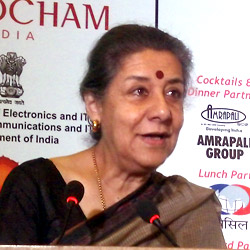
     

  • Digitization is going to be the biggest reform in broadcast sector: Ambika Soni

    By Shruti Pushkarna


    High drama ensued at the Assocham event inNew Delhias local cable operators (LCOs) flagged black ribbons at the Minister for Information and Broadcasting, Mrs Ambika Soni. The Minister was attending the 6th Annual Summit on Entertainment and Media organized by Assocham, Focus 2012: Digitization for Inclusive Growth. As the theme suggests, one of the primary issues discussed at the event was Digitization of Cable television.


    The LCOs were protesting against the recent tariff order issued by the Telecom Regulatory Authority of India (TRAI), which they claim is an unfair order against all small operators. Following the heated arguments between cable operators present at the event venue and the Minister, one of the cable operators, Sandeep Mcgee who is based inEast Delhithreatened to commit suicide in front of the Minister. Mrs Soni, however, tried to pacify the operators’ fraternity and asked them to file a formal letter with all their grievances against the tariff order and the regulator. She also promised to address their concerns and, if need be, raise the same with the regulator.


    Addressing the concerns of broadcasters on the carriage fee mentioned in the same order, Mrs Soni said that the government will consult all stakeholders before taking a final call on the regulations decided by TRAI under which the Multi System Operators (MSOs) are allowed to charge a carriage fee from broadcasters.


    Earlier, in her inaugural address, the Minister emphasized the importance of digitization for the entire industry and all stakeholders: “Digitization is going to be the biggest reform in broadcast sector and enable operators to expand their revenue sources by providing more choice and variety to customers. Digitization is imperative to tabulate subscriber base and reduce carriage fee. Digitization will also help reduce all human error in the process.”


    Defending the tariff order issued by TRAI recently, she said that the government indulged in exhaustive consultations with all stakeholders on all issues including the carriage fee, and the main aim of the new regulations had been to benefit the consumer. Mrs Soni said: “The TRAI tariff order makes the viewer the most important beneficiary; the choice will be with the viewer.” As for the broadcasters, she said digitization would help reduce the dependence on TRPs and bring in transparency where every broadcaster would be in a position to identify exactly how many people are subscribing to the channel.


    On the issue of media regulation, Mrs Soni said: “Let’s not condemn self-regulation per se because even though self regulation is a slower way of correcting things, it is still a surer way as it involves converting minds and hearts in the process.” She added that in the whole race to growth, the provisions of the Cable Television Regulatory Act were overlooked and it was a fault in the functioning of the government that the act had been ignored.


    On the issue of Paid News, she said that while it was the worst phenomenon that existed, it’s not as easy to detect paid news. She was responding to scathing criticism of the media by the Chairman of Press Council of India, Justice Markandey Katju in his keynote address at the same event.


  • [60 Days to D-Day] Digitization in 4 metros will not happen by July 1: JS Kohli

    Late Monday night, Telecom Regulatory Authority of India (TRAI) announced the new tariff structure for digital cable TV services. Under the new rules, all cable operators will have to mandatorily offer a Basic Service Tier (BST) to viewers which would consist of 100 free to air channels, including 18 mandatory Doordarshan channels, as well as the Lok Sabha channel. The tariff order states that apart from the mandatory channels in the BST, cable operators and Multi System Operators (MSOs) will have to provide customers a minimum of five channels of different genres.


    The authority also stated that MSOs will have to increase their channel carrying capacity. TRAI stated: “The Authority has mandated MSOs to carry a minimum of 500 channels from January 1, 2013. However, keeping in view that smaller MSOs having less than 25,000 subscribers may need some additional time for building capacity, they have been given time up to April 1, 2013.” The TRAI has prescribed that every MSO should have a minimum capacity to carry 200 channels by July 1.


    TRAI has also established new guidelines for revenue sharing between Multi System Operators (MSOs) and Local Cable Operators (LCOs).


    MxMIndia’s Shruti Pushkarna spoke to Mr Jagjit Singh Kohli, a veteran of the cable industry and CEO of cable distribution firm Digicable, on his reading of the latest order issued by TRAI and if he thinks the sunset date of June 30 is still achievable.


    What’s your first response to the Tariff Order?

    Well, the order is on expected lines, no big surprises there. Given the circumstances, I am happy with it, in the sense that we know the regulatory has been operating under tremendous pressure from various stakeholders, so given that situation, I am actually happy with the order.


    TRAI has observed that the Order will help profitability of channels. But carriage fee exists. Do you think the bottom line will be impacted for both broadcasters and the cable trade?

    The channel capacity is increasing to 500 channels, so automatically the pressure on carriage will reduce. So, although the carriage fee remains but the channel capacity itself is increasing so much that the price per channel will come down.


    Given the status as of today, do you see the implementation happening in the four metros before July 1?

    Now, that I don’t think will happen. We will need a postponement of at least three to four months. The tariff order has just come; there are so many other issues such as DAS licenses being not issued till date. To meet the deadline the industry needs to deploy atleast 150,000 boxes every day, only then will we be able to meet that deadline, and that’s impossible.


    What about the availability of set-top boxes?

    Even that is an issue. But even if set top boxes were to be made available, it would be very difficult to meet the deadline.


    Do you think the government is doing enough to promote the switch to digitization and explain the benefits to consumers?

    Yes, you can’t blame them on this. They have been quite aggressive on the timelines and in their campaigns.


    Are there any areas of worry in the run-up to digitization (given that we have just 60 days to go)?

    The only area of worry is that we will need some more time to meet the deadline, otherwise everything is fine.


    Photograph: Fotocorp


  • Govt can plug revenue leakage by banning carriage fees, says broadcasting industry

    By A Correspondent


    Industry sources have said that banning carriage fees in the new digitisation of cable distribution regime w.e.f July 1 is necessary to ensure that government can plug the huge revenue leakage upwards of Rs10,000 crore annually due to cable companies levying huge carriage fees and grossly under-declaring their subscriber base.


    Moreover, ensuring a “must carry” clause for all TV channels and putting an end to their regulatory pricing wherein TRAI mandates the price that viewers pay for every channel, are also critical to revive the sick TV broadcasting industry, which continues to reel under the triple burden of usurious carriage fees, regulated tariffs for their channels as well as getting a fraction of their due subscriber revenues.


    At present, over nine-tenths of TV channels are in the red and are unable to invest in quality programming, while many smaller/niche channels with big-ticket pedigrees – Imagine TV being the latest – have had to shut down.


    Another fallout of these distorted industry practices has been that potential new export avenues have closed, because India is not able to export television formats and finished content – while other industries like software, music and animation (which do not suffer such a usurious regulatory/industry scenario) have been big-ticket forex earners for over a decade.


    Industry sources said that TV channels collectively paid at least Rs3,500 crore last fiscal to cable companies and distributors as carriage and placement fees, of which news channels alone paid at least Rs1,500 crore. These carriage fees turned many profitable TV channels immediately into the red, thus denying the government a large income tax earning opportunity upwards of Rs1,000 crore per year.


    According to another industry estimate, given the estimated subscription revenues of all MSOs/LCOs in the country, the government has lost about Rs5,950 crore over the five-year period from 2006 to 2011 in service tax alone by reason of under-declaration while the evasion of income tax is about Rs17,413 crore over the five-year period 2006 to 2011; and loss of entertainment tax by states is in addition to that amount.


    Additionally, TRAI had, itself mentioned in a March 2010 paper that “there is evidence of tax evasion in the cable industry…the last publicly available CBEC report of 2005-06 shows only Rs75 crore of service tax being collected from the industry on a base of 68 million subscribers paying an average of Rs165 per month, the estimated service tax collection from analog cable should be in the range of Rs1,400 crore per annum”.


    Another estimate – from HSBC for 2011 – says that the government lost around Rs1,380 crore last year in entertainment and service taxes alone due to cable companies under-declaring their subscriber base by as much as four-fifths. This estimate assumed the potential revenue to government at Rs1,725.90 crore given a Rs165 ARPU for 67 million analog pay TV households and entertainment tax at Rs20 per household along with 12 per cent service tax.


    But because only 20 per cent or 13 million households are disclosed, the actual revenues collated were estimated to be only Rs 345 crore even as TV channels lost out on the bulk of their subscriber fees. These practices have ensured that India now has a cash-rich last mile; India already has the third-largest TV distribution industry in the world where viewers can and are willing to pay for content – borne out by the fact that pay TV penetration is as much as 80 per cent in India, which is amongst the highest in the world.


    On the contrary, TV channels, who actually create the content, get less than a fifth of what viewers actually pay the cable companies. However, broadcasters say that the only opportunity to correct these distortions and ensure that TV channels do not continue to close due to extraneous factors, lies in the digitisation of cable distribution, for which the government is currently putting together relevant rules.


    Under this, it will be mandatory for all viewers to get a digital set-top box and for operators to distribute channels in a digital and addressable format. This will give viewers a wider choice of channels with better viewing quality. In fact, digitisation is now being seen as the game changer for the entire Indian TV industry as it will also significantly benefit distributors the multisystem operators – (MSOs) and local cable operators (LCOs) – whose paying base will improve even further.


    In this regard, Dr Prannoy Roy, chairman, NDTV told ET, that “digitisation of cable distribution is a major step towards making India’s media achieve truly global quality”. However, Rajat Sharma, chairman, India TV, pointed out that digitisation will be “meaningless unless all channels are made available to the consumer and he is given the power to make a choice”.


    He told ET that this can be done “only if it is mandatory for the cable operators to carry all channels and ensure that set-top boxes have the capability to carry more than 500 channels” and added that the government must curb any effort to create an artificial scarcity at the head end or in the box in carrying the channels.


    Pointing to the other issue of price controls on TV channels, Uday Shankar, president, Indian Broadcasting Federation, told ET: “IBF has always believed that channel pricing should be kept under regulatory forbearance and market forces should be allowed to discover channel valuations. Internationally, apart from countries like China or Taiwan, there are no instances of government regulating the pricing of channels. Freedom in pricing is essential for channels to offer best in class, quality programming. In the absence of this freedom, broadcasters are compelled to somehow match spiraling input costs with regulated prices thereby running the risk of compromising quality”.


    He added that there is enough competition in every genre to “remove any fears of exorbitant pricing”, given that the consumer has a choice between multiple DTH platforms and cable operators and “as a result of that, we have seen that the ARPUs have been flat to down”.


    Source: The Economic Times
    Copyright © 2012, Bennett, Coleman & Co. Ltd. All Rights Reserved