Tag: Life Ok

  • Life OK’s Savitri running at a cinema near you

    By A Correspondent


    With competition growing, GECs today are finding innovative ways to market their shows. The latest to join the bandwagon is Life OK. The channel, for the launch of its latest offering Savitri, has joined hands with UFO Moviez.


    For the first time, the channel’s four-minute promotional content for a Hindi GEC show is being played in cinema advertising in digital theatres with the new film releases of the week.


    Speaking on the innovation, Pratik Seal, Marketing Head, Life OK said, “Life OK has always been a firm believer in disruption, whether in terms of content or our marketing strategies. UFO Moviez is a popular platform with a huge reach in Hindi Heartland. We are delighted that along with UFO Moviez, we were able to introduce our show and capture the attention of our audiences.”


    Commenting on this development, Siddharth Bhardwaj, CMO & NSH – Enterprise Ad Sales UFO Moviez said, “We are delighted to have partnered with Life OK; this partnership is an example of how UFO continuously makes an effort to innovate and provide value to the brands advertising on its network.”


  • Life OK and SAB: The see-saw continues…

    By Meghna Sharma


    In India there is no dearth of television channels. The competition is only growing and the race to lead in the TRP race is heating up. In the past few weeks, the two channels which seen an increase in their TRPs are Life OK and SAB TV which have been fighting for the fifth spot in the TRPs race.



     

    Life OK, the newest entrance in the GEC genre from the Star India stable, was launched in December last year. The network renamed and re-launched their youth-oriented channel Star One with new tagline ‘cherishing what you have’.


    On the contrary, SAB TV has been around for over a decade now but has gone through various transformations. In March 2005, SAB TV was acquired by Sony Entertainment Television and was transformed into a youth-centric channel. In June 2008, the channel announced that it would return to its roots by being repositioned as a comedy-centric channel.


    So what does the race for TRPs mean for the two channels and do they pose a threat to other GECs? MxMIndia spoke to a few media planners to see what is the future of the GECs and what shape will this ‘war’ take.


    According to the latest TAM data, in week 24, SAB TV has toppled Life OK and regained No 5 position. Whereas, last week (week 23), Life OK was the fifth most watched GEC.


    Sundeep Nagpal

    Sundeep Nagpal, founder director, Stratagem Media feels that these are momentary fluctuations and cannot be contributed to anything per se. “These channels have a small base; therefore, even a single factor can affect the ratings of the show – positively or negatively – depending on how it did on a particular week. Hence, I don’t think we should be alarmed by such fluctuations. And they won’t be able to impact the top 4 slots.”


    The two channels have positioned themselves differently, too. SAB TV is a comedy-centric channel which portrays itself has a family channel, whereas Life OK has shows full of melodrama like other GECs.


    Janardhan Pandey, associate vice-president, DDB Mudra Max feels that the two cannot impact each other drastically. “SAB has its own set of audience which won’t get influenced by other GECs and vice-versa. They will continue to do well in their own categories; the fluctuation between the two is possible but they don’t have the same hold as other GECs do. They still have a long way to go.”


    Jai Lala

    On the other hand, Priti Murthy, national director – Insights, Maxus, feels that though these channels might be still small fish, they cannot be ignored entirely. “Like these two channels, even number two and three slots have been fluctuating for a while now. So, slot five and six can create an impact too. One cannot rule out the possibility of them gaining to higher positions in the future if they come up with new and better content.”


    On the channels growth, Mindshare’s principal partner, Jai Lala feels that the two channels have grown since Imagine TV, a Turner International India Pvt Ltd entity, was shut down earlier this year. “The shutdown of Imagine TV has benefited these two who are now turning out to be competitors. However, they still have a small base compared to others and unless and until they cross the 200+ threshold, I don’t think that they can or will affect the channels like Star or Zee or Sony which have been ruling the top slots in the TRP race for a long period of time.”


    Uday Mohan

    “While these channels are doing well they have a long way to go in terms of reaching the numbers of the mainline GECs. They still don’t have the kind of appointment viewing that the mainline GECs generate….they might eat into the shares of other frequency channels but will not threaten GECs, at least not immediately,” added Uday Mohan, executive director – North, MPG.


    Most experts believe that there is nothing to be alarmed about the two channels see-sawing. What they do feel is that both the incumbent SAB and challenger Life OK will have to work harder if they want to reach the top slots.


  • Dial ‘M’ for Mobile & Money!


    By Tuhina Anand


    Bharti Airtel’s foray into mobile advertising or m-advertising opens up immense possibility in this space for a country likeIndiawhere mobile penetration is much higher than internet. Also the hand held device is something personal which many have the habit of checking frequently, hence the assurance that if a message is sent, the chances of it getting noticed is much higher.


    There are players who have been trying to explore this territory for a while but the limitation has been that they are all third party players and would need support of a telco. With Airtel’s entry, this space will get the much needed fillip and advertisers a better medium of targeted advertising.


    Airtel, being a leading telecom player, has the advantage of huge database and they can facilitate a targeted and customized communication for potential consumers. Mohit Beotra, Head, Emerging Business, Bharti Airtel Ltd, said: “Our perspective on mobile advertising is straight forward. We can help in targeting the right kind of customers based on the analytics. We have access to data that can help in increasing the effectiveness of a campaign. There is an opportunity for the marketers and our customers and we can help in facilitating that dialogue to reach to the right kind of people.”


    He added: “While we would like to open eyes to the kind of opportunity that m-advertising has for the marketers, we would also like to help them in constructing effective campaigns for them on this platform.”


    Airtel has a three-year deal with Mogae Digital, a company owned co-owned by Sandeep and Tanya Goyal, to be its sole and exclusive monetization partner. They will sell advertising solutions on behalf of Airtel and also drive marketing reach for the telecom giant. While it is estimated that mobile advertising will grow by more than 40 per cent in the next few years inIndia, Mr Beotra stated that these are merely figures floating around and one can’t surely put a number to it. However, he is sure that Airtel’s revenue from this venture would be significant in the coming years.


    A recent example of m-advertising is the launch of Life OK channel by Star which allowed the channel to target the viewers just hours before the launch as the message flashed on their screens when one finished their call thus helping in targeting the right consumers in the right place.


    Giving his take on Airtel’s move, V Balasubramanium, Chief Knowledge Officer & Director, Rainman Consulting, said: “It will be a catalyst for growth rather than re-defining m-advertising. It will help the m-advertising category to grow as telco companies can use the rich consumer behaviour insights they possess for an effective connect. As the effectiveness grow through their ablility to target the right consumer with the right message, then naturally more brands would flock in to this medium. This, I see, is a good start and I am sure the same will be explored by more companies. But the secret of success is how well you use your consumer intelligence from the existing data. Innovative analytics will thus play a big role for its success and that will be heart to success! As companies latch on to that then success is near the corner.”


    Sharon Aneja, Director, Earned Innovation & Business Head West, SMG Digital pointed out that for any one who is into the business of brand building, the real handicap is lack of information. If one has data, then half the battle is already won. She said: “Today, there is a need to get people interested at various points of purchase funnel and the communication should not stop once he or she reaches the shop floor. M-advertising can help in getting people more interested in the product even before the purchase decision is made. By taking a lead, Airtel has taken the industry leader position and set a precedent for others to follow in quality messaging and point advertising.”


    Ms Aneja feels that the move will open new doors, however the challenge is how one finds interesting ways to use that data. Having worked in theUKusing mobile advertising, she pointed that while the data protection rules are stringent there, the brands have used m-advertising to explore personalized messaging and targeted reach. She added: “I think in India, since it’s still the beginning of mobile advertising, one has seen a limitation in terms of offering which usually revolves around the WAP service. This however will change as technology comes into play. Also as the purchase funnel has changed, brands need to have several touch points to let the consumer experience and know more on the product. Something like location advertising would help on the mobile platform.”


    “The real opportunity also lies with the untapped reach which m-advertising can open up. This will give brands and marketers unprecedented reach to communicate to rural consumers which hitherto has been a challenge,” concluded Ms Aneja.


    Airtel’s m-advertising will be in compliance with TRAI regulation and would not reach those who have opted for DND. As Mr Beotra pointed that their customer base is huge and those on DND is not such a big number, hence in no way would those numbers affect the reach of Airtel’s m-advertising. However, the move has definitely opened up a new channel for advertisers who are pressed in today’s time to grab the attention of their consumers, both existing and potential in the cluttered market.

    Imaging: Rafiq (images: Microsoft Clipart)


  • Movies OK will focus on families: Hemal Jhaveri

    By Meghna Sharma


    After the launch of Life OK in December 2011, Star India is planning to launch a new channel on May 6 under the OK banner – Movies OK.


    The channel promises to be different from Star Gold, the movie channel launched by the network in 2000. “There is a difference between the two channels. Movies OK will focus on family audience. This means we are going to showcase movies which a whole family can enjoy together,” said Hemal Jhaveri, general manager, Star Gold, who heads the channel. The channel plans to concentrate on genres like comedy. “There is going to be more comedy and less action on the channel,” he added.


    Apart from content, the other thing which will differentiate the channel from the competitors is the treatment. “The promos are going to be very different and unique from what the other channels do. For instance, we are going to have a Best of Salman Khan Festival called ‘Bhai Ok Please’ where no film footage has been used. So, for the first time, people will see a promo for Salman Khan without him in it. Communication is going to be unique,” explained Mr Jhaveri.

     

    If that’s not enough, the channel also boasts of having a World TV Premiere every night by the end of this month. Mr Jhaveri said: “The 7 day 7 premiere is something which no other channel has experimented with earlier. I think it’s the first-of-its-kind in the world as well. So, every night at primetime, one will get to see movies like Kahaani, London Paris New York, Jodi Breakers and others. We are planning to build our channel as a unique platform.”


    The channel also hopes to use the learnings from their other channels, especially Star Gold which was revamped last year. So, one can expect shorter breaks.


    The channel has a library of over 1000 movies. “We have been investing in the channel from the past two-three years and will continue to do so in the future as well. Therefore, it’s going to be a unique library. Last year, we acquired the Viacom18 library so that will also add to it,” elaborated Mr Jhaveri.


    The Hindi movie genre enjoys the third largest viewership pie, trailing behind regional channels and Hindi GECs, according to a FICCI-KPMG report on the Indian media and entertainment industry, released in March.


    “There are various Hindi movie channels, but there is always space for one more, if it’s different and has good content,” said Mr Jhaveri. Agreeing with Mr Jhaveri’s sentiments, Ashwini Kamat, general manager, MediaCom added: “People don’t have loyalty towards movie channels. So, if a channel has a good library, then it doesn’t need to worry about others because people will switch to it, if they want to watch a particular film.”


    Janardhan Pandey, associate vice-president, DDB Mudra Max elaborated: “There is enough space on TV to launch a channel but all depends on if one can sustain it at the top slot. A new channel might showcase latest movies, but after some time, many stop investing in a new library and repetition starts. It is then people tend to move away from it. So, it might make an impact in the beginning, but it is difficult to say how a channel will do in the future.”


    However, advertisers aren’t optimistic about it. “One more channel means more segmentation. So, I don’t think it’s going to benefit us,” said Praveen Kulkarni, general manager (marketing), Parle. The categories which spend heavily on Hindi movie channels are services, auto, personal accessories and telecom. “Launch of any new channel means fragmentation and overall inflation for advertisers,” added LK Gupta, CMO, LG.


    The channel has a 360 degree promotional plan for the channel. It will also be promoted during Star’s new show, Satyamev Jayate, which will also be premiered on May 6. Radio and digital platforms will be used too.


  • Anil Thakraney: Sach Ka Saamna: A new low in TV programming

    By Anil Thakraney


    I watched two episodes of Sach Ka Saamna (SKS) Season 2, and I must say in contrast, Bigg Boss feels like a house of angels. SKS is a completely debauched and exploitative format, where the poor and the desperate are encouraged to wash their dirty linen in public. And in return, they could take home a crore of rupees. A few lakhs in the bag is almost a certainty.


    Some of the questions put out by the host would make even hardened souls cringe. They range from cheating at workplace to hatred for parents to adultery in marriage. And all this as the contestant’s family sits in the audience. Hottie host Rajeev Khandelwal sweetens the bitter pill by complimenting the buggers for being courageous, and that’s total bullshit. There is no courage out here, only exploitation.


    Remove the prize money, and no one would want to appear on the show, that’s the hard truth. So careers get destroyed, families get broken, marriages lie in ruin… but all justified under the garb of ‘speaking the truth’. Wow!


    The show’s TRPs for season 2 are quite poor. But that could be because this time it’s being aired on the channel Life Ok, Star One’s new avatar. More people will discover the channel and the pathetic show, so with time the ratings will go up. Who on the earth would want to miss out on such depraved programming? It appeals to the ultimate sadist in all of us.


    No, I am not being moralistic out here. And I am aware that desperate for viewership, channel heads would push the envelope on programming. But how can anyone justify blatant exploitation? I would be okay if they only featured loaded celebrities on the show. Richie-rich people who want us to enter their bedrooms only because they enjoy the trespass. But feeding on people’s poverty cannot be condoned at all. Hope Sach Ka Saamna dies a miserable death. Sooner the better.


    * * *


    PS: Must read for all creative people. Great tips on how to energize inspiration and battle creative blocks.


    Link: http://m.guardian.co.uk/culture/2012/jan/02/top-artists-creative-inspiration?cat=culture&type=article


    Former editor and ad man Anil Thakraney is editor-at-large, MxMIndia. The views expressed here are his own


  • Life OK’s gr8 start with 87 GRPs (report + analysis by Stratagem)

    By Rishi Vora


    While it may be still early days to declare Star India’s new channel Life OK as a success story in the Hindi GEC market, there is no doubt that it has delivered on the network’s goal No 1, which was to make an impact on the industry.


    The primary objective, as cited by a few industry observers, is to compete with the Sony and SAB TV combo, so that Star as a network could have a commanding position in a market which is now seen as hyper-competitive.


    So Life OK has clocked 87 GRPs in its first week, surpassing Colors’ 81 GRP launch back in July 2008. It may be recalled that Colors had left no stone unturned for the launch. The strategy was to start with the big-ticket show Khatron Ke Khiladi (with film star Akshay Kumar in a way giving a solid push to the channel), aggressive marketing, fiction shows, mythology, so on and so forth.


    One may argue that Colors was launched as the flagship channel of a joint venture company of two broadcast majors – Viacom and Network 18. Life OK in that sense is Star India’s second offering in the Hindi GEC sector. But, that has very little to do with what the channel has achieved in the first week as Star officials say that the idea is to compete with every channel in the market, it doesn’t matter if it means competing with elder sibling and No 1 channel Star Plus.


    An interesting observation: Imagine and 9x were launched in the same year (2008) and registered 55 and 21 GRPs respectively. Both the channels gradually grew in GRP terms, but as the market became competitive, the going for both channels became tough. While Imagine is still around (currently placed at No 7 with 67 GRPs), 9x may be on air, but even though it has been acquired by Zee, it has failed to create an impact . Of course there are several reasons attached to why the channel tasted early success and witnessed one of the most dramatic and talked-about downfalls.


    As for Life OK, its success at this stage can be attributed to the following: A sensible approach to launch the channel with a unique philosophy, marketing blitzkrieg (it is reported that Star India made an investment upwards of Rs 700 crore to launch the channel. The campaign, which is in full swing now, saw a three-day roadblock across Star India’s network, an outdoor plan reaching 100 towns, a week-long digital engagement programme which included an eight-hour-long concert, and of course getting Madhuri Dixit as the Sutradhar (storyteller). Plus, the fact that the channel did not bank on one particular show to deliver, and rather offered viewers a package of differentiated programming, the strategy to cut down on advertising inventory – all these factors put together have produced rich dividends.


    Official comments from the senior members of Star India and Life OK could not be obtained at the time of this report. However, industry observers believe that Life OK has what it takes to be a serious contender in the Hindi GEC market.


    Ashish Bhasin, Chairman India and CEO South East Asia, Aegis Media, observed, “Life OK as a channel has great potential.  However, the true test of a channel is after it has settled down for a few months. It is sometimes easy to get content for a short period but sustaining it on an on-going basis becomes a challenge. Ultimately, in my view, content drives the fate of any channel. If Life OK is able to sustain good quality content on an on-going basis for two or three years, it can definitely become a serious player. On the other hand, if the quality of the content starts to drop after the initial launch, then it’ll have a struggle ahead for itself.”


    Havas Media CEO – India and South Asia Anita Nayyar said, “With the kind of marketing backup and hype, the opening seems good and certainly a hike from the Star One deliveries. However, two-three weeks of sampling will continue and the actual stability will start setting in after a few weeks. Coming from the Star Network, the programming quality is very good.”


    On whether it will pose a challenge to the top players – Star Plus, Sony, Colors and Zee, she said, “It will be a strong competition in the GEC category for the No 3, 4 and 5 slots. Not sure about whether it will be another success story as big as Colors, as it had the advantage of differentiated content on the social platform when it launched. The content is interesting and should help stabilise around 60-70 GRPs from here.”


    In an earlier interview to MxM India, Star India COO Sanjay Gupta had mentioned that the No 4 position in the GEC line-up (currently held by Zee) would be a first good milestone to look at. In week 52, Zee is at 208 GRPs. Though he did not put a timeframe, going by what experts have to say, the channel will need to pick up on its early momentum and get there by bringing differentiated content – something Colors did very successfully.


    While Imagine has slipped to No 7 position and SAB is at No 5 with 122 GRPs, it looks like a serious battle from here on.


    An analysis by Stratagem Media Pvt Ltd on the launch of Life OK.Background 

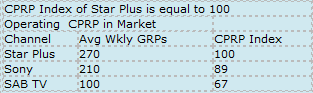
    It is a jungle out there in the media business. If you win the battle, you still have to worry about losing the war. Recently the Star Network launched another GEC called Life OK. Probably in the wake of competition from the Sony and SAB TV combo.The table 1, below depicts that the Sony and SAB combo was just about edging out Star Plus from the top GEC position, especially if it came at a more attractive rate (CPRP), as estimated in the table below.So, the not-so-hidden agenda of the Star network for Life OK would be to combine it with Star Plus and thereby fend against the Sony + SAB offensive, but without devaluing their trump card (i.e. Star Plus itself). Therefore, how would the new channel Life OK have to price itself, to overcome the Sony + SAB threat?


    Stratagem Media has undertaken a simple exercise to answer this question, for different levels of performance of Life OK.


    Objective of the exercise: To derive the CPRP Index of Life Ok @ different level of GRPs, if the CPRP of Star Plus is 100?


    Methodology: If the CPRP of Star Plus is 100, then what should the CPRP of Life OK be, if they have to match the CPRP of the Sony + SAB combo at different GRP ratios between the 2 channels.


    In the exercise below, the ratio of GRPs purchased between Life OK and Star Plus is assumed to improve in favour of Life OK, as its performance improves.


    *At these CPRPs, the Star Plus and Life OK combo will be as cost-effective as SET and SAB combo.


  • Life Ok will compete with Star Plus: Sanjay Gupta


    By Rishi Vora


    The new gleam in the sky from broadcast major Star India promises a unique viewing experience, differentiated content and a philosophy which it will thrive on. The idea is to have a challenger brand, one that’ll challenge even Star Plus – the No 1 channel in the GEC line-up today.


    Life Ok – the new avatar for Star One – was launched on December 18, 2011. The channel will target to first get to the 60-70 GRP mark, and from there its first big milestone – to be a significant player by winning the No 4 position and beating one of the four big players.


    How well it suits the Indian viewers is something to look out for. Meanwhile a quick glimpse of what the management is thinking. MxMIndia’s Rishi Vora speaks to Chief Operating Officer Sanjay Gupta on his expectations, and much more. Excerpts:


    Q: Why the decision to shut down Star One and launch Life Ok?

    Star One as a channel has been there for several years. But it delivered a very average sort of performance. It catered to a niche audience and never quite made an impact. In GRP terms, it clocked about 30-40 GRPs. So there was a need to ask tough questions. We thought there was an opportunity in the GEC landscape to come up with a channel that is unique and differentiated, going by the viewer and the way he consumes content. So we decided to rebrand Star One to Life Ok.


    Q: It is said that Star One was not given the required strategic push to compete with Star Plus and other GECs.

    Every business can reach its potential. The business idea, in the case of Star One, was to be a niche channel. So in thought terms, I don’t think we were very sharp. We did not have a content offering that was differentiated enough to create a long-lasting impact on consumers’ minds.


    Q: So was Star One treated like a second channel? Was it a conscious call that it should not compete with Star Plus?

    The question that we asked ourselves was: Should we continue to have a channel which is a second channel or should we really continue to have a channel which fights? Which may be second, third or fourth, but that’s not very important. We thought we should have a channel that’ll compete with every channel – be it Zee, Colors, Sony or even Star Plus. The whole idea of changing the name to Life Ok was to liberate the channel so that it could cater to consumers as a brand and as a content destination. So that it could be different and unique and in the process have a more meaningful presence than Star One.


    Q: So Life Ok is not going to be the second Hindi GEC channel of the Star Network?

    It is in the Hindi GEC, one more offering from Star India. Star Plus is our first offering. The reason why we have changed Star One to Life Ok is because this channel has come up basis our understanding of viewers and we believe there is a gap. The name carries a philosophy. Unlike Star Plus for example, where we connected Star and Plus-and it became Star Plus, Life Ok is a name with a purpose.


    Q: Was there any research done on the name? What was the thought process behind naming it Life Ok?

    The idea was to have a name which captures the philosophy of the channel. A lot of research and consumer work has gone into deciding the name.


    Q: Can you elaborate on the philosophy?

    Let me explain. We’re entering a very, very tough competitive market – the Hindi GEC market. So why will this work? In my view, this is likely to work is because this channel comes with a very unique promise which consumers and viewers will see every day. Stories and characters of this channel will come on every day – not for five days but for all seven days in a week. As a viewer you want to seek whatever you like – it can be music, films, radio, newspapers, and also in my mind the characters of the shows you watch on daily basis. So content will be offered to consumers seven days a week.


    Also, stories on other GECs are not pacy enough, in terms of the speed. So what we’re doing on this channel is, we will tell three stories in an hour unlike the norm which is two stories every hour. We will tell a story in 20 minutes, so when viewers come to our channel, they will find the stories very pacy.


    Q: What is the thought process behind the two-minute break?

    The two-minute break is again a viewer experience. I don’t want a big break. As a viewer that will put me off. A lot of people get distracted with a long break and end up not watching your show. So with three stories in an hour and the two-minute breaks, we’re telling the viewers that they don’t need to go anywhere. They know it’s coming back in two minutes, so they are more likely to be on your channel if the commercial breaks are not very long.


    Q: But that means there will be an impact on the bottomline.

    In the short run, yes. But in the long run, it brings you more eyeballs. Once we have a set of viewers, we can then make up…


    Q: What is the programming strategy for the weekends?

    Fiction shows, non-fiction shows, we will use Sach Ka Saamna every day including the weekends. We will also have movies on weekends, in the afternoons. Afternoon time is very important-the whole family gets together and watches TV. So yes, we will have a variety of content running on the weekends.


    Q: We’ve seen some failures in the broadcast industry – 9x and Real being prime examples. So what are the things that you need to be extra careful about?

    Doing a new channel is a very costly exercise. Therefore, there will be a huge amount of risk that you always run, whether you refresh a channel or you create a new channel. In either of the cases, it is important to have a differentiated offering. If the viewer is getting the same thing on many other channels, why is he going to watch yours? The idea for this channel, therefore, is to keep the viewer at the centre and offer him something unique. So if you’re able to stick to that – not only in the philosophy and the thinking, but also on the content you offer every day, then it gives you more chances of being successful.


    Q: True, but second GECs which have launched in the past haven’t done well. SAB, you may say, is an exception.

    Yes, Sony is a good example where it has two channels – Sony and SAB. And they’re working well, so if there is an appropriate positioning, relevant content, it would work. I think the learning which I mentioned earlier, if we have a unique proposition, keeping the consumer at the centre and differentiated content, it should work. And Sony and SAB is a good example in my mind to quote. Hopefully, Star One can learn from that and create a more meaningful positioning.


    Q: Are you going to roll out shows which cater specifically to the youth, the single largest segment of India? Something like Bigg Boss which does well in that department?

    We’re very focused on youth because we believe that is an important target audience. So if you look at the non-fiction we are beginning with – Sach Ka Saamna with Rajeev Khandelwal, where the big issue which we are tackling is corruption. Now, that is something which is at the top of every young person’s mind in the country. From the content, which you will see in the next few days, in terms of the message it delivers, it is not about saying let’s point fingers at others. It is about saying, ‘If somebody has to clean up the system, he or she has to start with us.’ That’s the message. And it is very much focused on the youth of India. Another show – Devon Ke Dev… Mahadev – we’re talking about one of the biggest gods of the country for whom most youngsters, especially women, fast for Mahadev in their early teens and before marriage. So that is a very unique thing we have on the channel and that’s the beginning of FPC every day. The rest of the content is dealing with absolutely the key issues which youth will emphasise on in a really big way.


    Q: But mythologies haven’t done very well for other channels. Colors and Imagine have tried it and haven’t produced fantastic results.

    I think Colors did fairly well on Jai Shri Krishna – the mythology serial they had. So if positioned well, it can work. We believe there is a market for mythology in a big way. It will have a different kind of emotion being catered to consumers.


    Q: Did you consider doing a big-ticket show like KBC, Bigg Boss, bringing a popular celebrity hosting the show?

    I think we have been very careful in the kind of emotions we want to deliver. And we wanted to be true to the philosophy of the channel that we’ve created. So we’ve stepped away from bringing a big celebrity. If somebody comes, he or she should be able to respect the values of the brand. And it is about cherishing what you have as a philosophy ‘Jo Apne Pass Hai Woh Khas Hai‘ and that’s why all the content pieces are on the lines of that philosophy. In fact everything we’re doing is true to that. And that’s the reason we’ve stayed away from having a big celebrity on the channel.


    Q: So going forward if there is a need to have a Amitabh Bachchan or a Shahrukh Khan, would you go for it?

    At this point in time I would say if it fits in nicely with the philosophy of the channel, then we will definitely consider it.


    Q: Why Madhuri Dixit as the Sutradhar?

    There is a lot of learning that’ll come out from the shows we’re putting up on the channel. What we wanted to do by bringing Madhuri was: as we show the content, everybody takes away their own understanding. What she does on the channel is, she poses questions, brings in her understanding and her life reality, and really puts a lens in front of viewers to evaluate and see the content well. And therefore, it really raises the question – are we really cherishing what we have or not? Or are we worrying only about possibly the dreams of future alone? And, in her life she’s done the same. She has been one of the big superstars and has taken a break – been a family person. So she has balanced her life very well. So the persona fits in well with the channel’s philosophy. And she hopefully will be able to raise the questions in everybody’s mind and help viewers view the content through a new lens.


    Q: But what is the fan following of Madhuri Dixit today? Do you think there are enough fans, because quite clearly, her days are gone.

    Firstly, all big stars have a really valuable equity in consumers’ minds. But the important thing is how this fits in with the channel’s philosophy. And in my mind, it fits in very, very well.


    Q: How has the response been from the trade?

    Mixed response, I would say. People are surprised that the brand name doesn’t carry Star in the name – that’s been one of the questions from a trade point of view. And they’re wondering why. And also the other trade response is that we have a good variety of content. So they feel that the content looks very powerful and hopefully, the next few months will tell us how the business goes.


    Q: What will be the channel’s reach on Day One?

    Star One today reaches out to around 40-45 per cent of people every week. Those are the people who come every week to view Star One. Hopefully those people would definitely come to see the channel and basis the marketing campaigns, other sets of viewers will get curious about the channel and they’d come and like to watch it. So anywhere between 40-45 per cent definitely should come and maybe some more would like to come and check out the channel. And finally the content strength will determine how many people will become regular watchers.


    Q: Do you expect to be the No 4 channel, beating Zee, say in a month’s time after launch?

    Star One is at around 40 GRPs right now. And if we grow significantly, that’s the first good number to look at, because this journey is a long journey. We are not starting it to really take a big leap in week 1or week 4. If you’re able to grow from where we are significantly, that’ll be the first milestone. And as I said earlier, it competes with every channel in the GEC space. If the content is powerful, it’ll grow – but the first initial aim would be to get to a 60 or 70 GRP mark. That will be an important milestone for us.


    Q: How long will the aggressive marketing campaign continue?

    We started this campaign around a week ago. We started it on December 12, it continues in full intensity now and it will continue for another few weeks. So it will be a four-week campaign which will run supporting the channel launch.