
By Radhika P Nair
It was a 10,000-a-month allowance from their parents for almost 18 months that helped Sachin Bansal and Binny Bansal launch an e-commerce website retailing books in October 2007. Today, the near-20% stake they hold, along with the top management, in Flipkart is valued at almost Rs 2,000 crore.

- Sachin Bansal
Sachin Bansal, the chief executive of Bengaluru-based Flipkart, says he has a knack for underestimation. That is exactly what happened in March 2011 when he and Binny Bansal, who are not related to each other, announced they would reach the $1-billion (Rs 6,100-crore) sales mark in 2015. Last week, the site, which now sells everything from books to electronics, apparel and jewellery, reached the milestone, a full year ahead of the target.
|
Flipkart, Lenskart, Myntra & Snapdeal: All have Bansals at the helm
By Biswarup Gooptu & Harsimran Julka
Even a decade ago, the name “Bansal” would have brought in images of coaching classes in Rajasthan’s Kota, but today it is the common factor binding the who’s who of India’s fledgling e-commerce sector.
Five young men who answer to that name have emerged as trailblazers of Indian e-commerce, taking on global biggies like Amazon and eBay for top honours in the country’s exploding market for online retail.
Online marketplaces Flipkart and Snapdeal, apparel retailer Myntra and eyewear retailer LensKart all have Bansals at the helm. Such is their clout that they account for nearly Rs 10,000 crore of the total online retail pie of about $2 billion.
But their adeptness at trade and commerce is not a state secret. As a sub-sect of the Aggarwal community, the Bansals are known for running a tight ship when it comes to business and entrepreneurship.
“We (Bansals) have the math, finance and data skills that are extremely important for e-commerce,” said Rohit Bansal who teamed up with schoolmate and Wharton alumnus Kunal Bahl to set up online marketplace Snapdeal in 2010.
The Bansals of the new economy also sport degrees from IIT and IIMs. The five Bansals with their four companies – Flipkart, Myntra, Snapdeal and LensKart – set up shop within the last seven years and control about 85% of India’s entire e-tailing industry.
But they have to contend with the might of $75-billion (Rs 4.5 lakh crore) Amazon, which entered India last year and is investing heavily.
Heading the fightback are Sachin Bansal, 32, and Binny Bansal, 31- founders of Bengaluru-based Flipkart – who met each other while studying at IIT-Delhi. Their company today generates about Rs 6,100 crore in sales, half the industry total.Flipkart is also the biggest challenge for Amazon, a company where both the Bansals honed their skills before setting up on their own in 2007. Coming second is Snapdeal, whose Rohit Bansal, 31, graduated ahead of Sachin and Binny from IIT Delhi.
“My ancestors from my paternal and maternal sides have all been businessmen,” said Rohit Bansal, who is from Malout, a small town in Punjab, just four hours from Chandigarh where the Bansals from Flipkart grew up.
Snapdeal’s turnover is now half of Flipkart, and it is expected to cross the $1 billion mark next year. The Bansals are making a mark not just in horizontal marketplaces, but also single-category retail. Bengaluru-based Myntra Designs, founded by another IITian Mukesh Bansal, is giving stiff competition to Flipkart in apparel, one of the highest-margin categories, where profits range from 30 to 50 percent.
“It has come full circle with me getting in fashion retail online,†said Mukesh Bansal, CEO at Myntra, who hails from Haridwar. His father had opted for a public sector job over joining the family business — ironically, clothes trading. “No family influence made me think of entrepreneurship. But the startup bug bit me in Silicon Valley,†said Myntra’s Bansal, 38, who moved to India to start Myntra in 2007. His venture is targeting sales of Rs 1,500 crore next fiscal from apparel sales, the largest in its category.
LensKart, founded by another Peyush Bansal, 30, is considering selling his other portals such as WatchKart, BagsKart and JewelKart to a horizontal player at the ‘right price’ to focus on the eyewear market. “My parents didn’t understand while I was starting up. But they came around later. You have to understand that they are products of their generation,†said Bansal, who is targeting revenue of Rs 100 crore from LensKart next fiscal.
RBI Chair Professor for Economics & Social Sciences at IIM Bengaluru Charan Singh says that a community’s dominance over a certain trade is a factor of its social interactions. “It can be likened to the Jewish community in the US which continues to hold top posts in US banking and technology industry.†Ashish Jhalani, head of retail advisory firm eTailing India, agrees. “Certain communities in India do encourage entrepreneurship. The Bansals and Aggarwals have definitely dominated businesses in India, particularly retail trading, for centuries.â€
(With inputs from Radhika P Nair)
Source:The Economic Times
Copyright © 2014, Bennett, Coleman & Co. Ltd. All Rights Reserved
Licensed to republish
|
“To say billion-dollar in 2011 was crazy when we were doing a $10 million (Rs 61 crore) run rate,” says Sachin, 32, in his first interview after the firm achieved the sales target. “It was just a belief.”
Sachin, like his co-founder, grew up in Chandigarh. That is not the only coincidence. Both went to IIT-Delhi and worked at different companies for about a year before ending up in the same team at Amazon. It was during this stint that the two decided to start up.
The duo pooled in Rs 2 lakh each and with two computers launched the site from their two-bedroom apartment in Koramangala, a primarily residential locality in Bengaluru where the company now has multiple offices. For 10 days, the site did not see a single sale and then a customer from Andhra Pradesh placed the first order for the book ‘Leaving Microsoft to Change the World’ by John Wood.
“We were not thinking about numbers then, but we knew something big can be built out of ecommerce,” says Binny. The two co-founders, who have a tendency to finish each other’s sentences in conversations, are close friends. What has helped maintain the bond through the ups-and-downs of entrepreneurship? “By fighting every day,” says Binny, 31, as the two burst out laughing. “But seriously, it is important to know what the other guy is thinking. That becomes very important as the message and the thinking become consistent. Communication is key.”
The two are demanding bosses, say their employees. “Both have high expectations, but that raises our bar. That makes working with them rewarding as well,” says Amod Malviya, head of engineering at Flipkart. He says the Bansals have complementary personalities. While Binny is analytical and driven by logic, Sachin is more instinctive and is driven by emotion and passion, says Malviya, who joined the company in 2010 as a senior manager.
Employees are also impressed by the simplicity the duo has managed to retain. As they live close to work, both walk to office. They also fly and stay budget while travelling and eat with other employees whenever possible. “They are very much in the Azim Premji mould and shy away from ostentation,” says an employee, who did not want to be identified.
Experts say the success of Flipkart can be chalked down to the founders’ attitude. “The two have the right attitude. They are cocky and confident, and along with that they have the ability to execute,” says Arvind Singhal, chairman of retail consultancy Technopak. This attitude has helped them deal with the ever-shifting baselines in Indian ecommerce.
After raising about $190 million (over Rs 1,150 crore) until 2012 from Tiger Global and Accel Partners, industry insiders had begun questioning the viability of the business, which was burning about 50 crore of cash each month. In 2012, the company took action, by tightening its employee base, using more technology to cut costs and shutting down its music downloads category, which was not scaling up. More importantly Flipkart, which started out as a direct seller of goods, changed to an asset-light marketplace model where multiple merchants, along with the company’s own WS Retail, sell to customers on the site.
In 2013, the company raised $360 million (about Rs 2,200 crore) in two tranches, primarily from South African Internet major Naspers at a whopping valuation of $1.6 billion (Rs 9,772 crore). At the time, Sachin termed the cash infusion as a “great validation” and one which refuted the scepticism about his company in particular and Indian ecommerce in general.
Supam Maheshwari, founder of online babycare site Firstcry, says Sachin and Binny Bansal managed to find early investors who kept backing them. “They executed well, especially in logistics and warehouse, and did not lose focus,” says Supam. “But they have had to spend a lot to reach the billion-dollar mark.”
Flipkart’s sales milestone could also send out a signal to international players that the Indian ecommerce market is mature enough for them to enter, says Maheshwari. One such player could be Alibaba, which only has its business-to-business portal at present in the country.
Comparisons with Alibaba’s Jack Ma are inevitable. Jack too started out from a small apartment in China’s Hangzhou in 1999.
Jack diversified into payments, cloud computing and multiple ecommerce models. Bansals have made their intentions to diversify clear and have already done so by opening up their online payments solution and logistics for use by other Internet companies.
Jack has, however, already beaten Amazon in China. Alibaba expects to triple the volume of transactions to $490 billion (almost Rs 30 lakh crore) in 2016. For Flipkart, the battle has just begun. Peyush Bansal, founder of Delhi-based eyewear e-tailer Lenskart, says competition will intensify between the large multi-category portals. Amazon, which entered the Indian market a little over six months ago, has rapidly expanded into 18 categories of products and has been busy setting up its logistics and warehouse network. Snapdeal, which is targeting $1 billion in sales next year, recently raised a further 830 crore from investors led by eBay. “The site that would come out on top could be the one with the deepest pockets or the one with the best economic efficiencies,” said Peyush Bansal.
Technopak’s Arvind says Flipkart, which employs about 10,000 people, will have to continue to maintain its lead in technology, customer experience, supply chain management and consumer logistics to hold onto leadership.
“It is like a three-hour movie where just the first 30 minutes are over; the plot is still unfolding,” says Arvind.
Flipkart, which has over 1,000 sellers on its platform, is now shifting focus towards scale with intelligence, which will lead its mobile commerce drive. Sachin believes mobile will revolutionise ecommerce and Internet businesses. “My four-year-old son does not even understand keyboard. He expects the television to also be a touchscreen device,” says Sachin, who expects Flipkart to become a mobile commerce platform in the near future with features customised to individual users. “The next six-and-a-half years are going to be even more exciting.”
(With inputs from Biswarup Gooptu and Harsimran Julka)
Source:The Economic Times
Copyright © 2014, Bennett, Coleman & Co. Ltd. All Rights Reserved
Licensed to republish
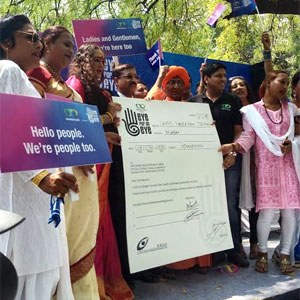 On April 15, 2014, India’s Supreme Court granted the country’s Transsexual and Transgender individuals the right to self-identify their gender. A landmark event that made India, the first country in the world to formally recognize Transgender and Transsexuals as the third gender.