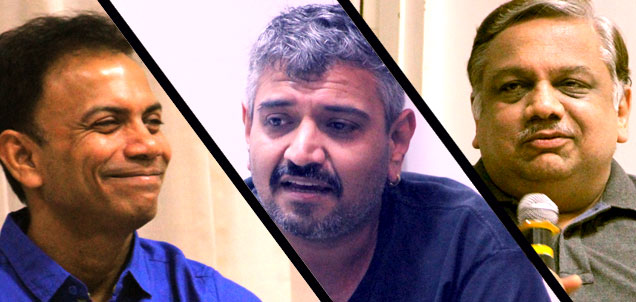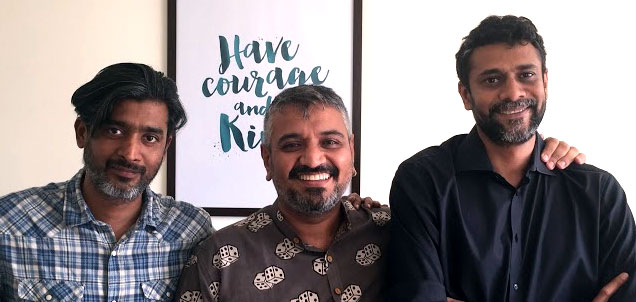
It’s the numero uno creative agency in the country. And it was among the earliest big agencies to go digital. Even as it started this transition over a decade ago, Ogilvy India is still perceived as an agency tied to the more traditional areas of television, print and outdoor. For this discussion, Vikram Menon, President and Country Head, OgilvyOne Worldwide India and Neo@Ogilvy; Kunal Jeswani, Chief Executive Officer, Ogilvy India, and Rajiv Rao, National Creative Director,Ogilvy India got together to speak with Pradyuman Maheshwari about Ogilvy India’s digital outlook…
Ogilvy has been in digital for many years, but it is perceived as a traditional television campaign agency. Why?
Kunal Jeswani (KJ): Because it is the best advertising agency in India, and possibly in Asia too. When you want to build something else within that kind of a unit, it takes a lot of effort, and years, for it to shine.
Rajiv Rao (RR): I think the shadow advertising agencies cast, is very large. If you are an independent agency, and into digital, people say: ‘Oh! Ogilvy also has digital’.
Vikram Menon (VM): The sheer size of this agency and the work it delivers overshadows everything, from an advertising standpoint. So it becomes far more difficult for a unit — regardless of what the unit is — to stand out.
Are you happy with the way things are?
VM: Absolutely. As a part of Ogilvy, you have resources and talent you can always rely on. We are 500 people; I don’t think there are many agencies of that size anywhere in the country.
Of all the large agencies, you got into digital fairly early. You acquired a digital agency many years ago, but the perception, that you are essentially not a digital agency, continues…
KJ: Ogilvy One was one of the first agencies in India to start taking digital seriously. We started making a transition from being a direct one-to-one agency, to a digital agency almost 12 or 13 years ago. Now, three things could have happened at the time. Either the advertising agencies Ogilvy and Mather- could have started declining, in which case we would have seen Ogilvy One shine a lot more than it does now. Or Ogilvy One would have been scrapped, or – as it has happened — advertising has continued to hold its own, and [Ogilvy has been] the best agency in the country for the last 12 years. Ogilvy One has been built up, gradually, as the largest digital agency in the country, but in terms of perception, it is still hard to break out the ‘we-are-an-advertising-agency-first’ mode. People need to see that right next to the advertising agency, sits this big, shiny, fantastic digital agency. We churn out 250 to 300 fantastic films a year, and you see it a lot more because it is on TV. Television is difficult to outshine. But anyone who has worked with Ogilvy One and seen the capabilities we have, will know it is great. [We] have done fabulously in [awards events like] the D&A Echos globally. We are listed eighth on Warc, and are the only Indian agency in the Top 50 I think. I think we were a little ahead of our time. The demand for digital work, and client spends started only five or six years ago.
Rajiv, Ogilvy has been a creative-led agency. Are you looking at digital as a part of the thing or you do stuff television and it is kind of shoveled in to digital?
RR: The approach to what we do is the same, whether it is digital or advertising. We look at every brief and try to make something as interesting and exciting for digital as we would for advertising. There is a lot of work we have done that you do not see on television. Television is the most visible medium, so that is another reason you do not see a lot of digital works, which are less in-your-face. Most of the time we create work for television first, and then adapt it to digital.
I was there at the Kyoorius Creative awards judging, the fact of the matter is while digital was there, print and radio, there were a 100-plus entries which entered but only four both categories which were shortlisted. Clearly, I think the focus is coming towards digital in a bigger way than the others.
KJ: In terms of spends, yes. If  I asked a client five years ago, where their spends were, they’d have television, outdoor, print, radio and then digital. Today, digital is right after television. But it differs from client to client. We have clients even now coming to us and saying: “Where is my Digital First work? I want to see it.â€
Only an agency like Ogilvy can convince clients that they need to use digital and it is a better way to communicate something. Are you all doing that?
KJ: I don’t think we need to. Every one of our clients is pushing us for fabulous digital work.
VM: We have passed that point where we have to convince people that digital is a necessity. Earlier, it used to be a tick box. But now it is integral to the campaign in itself, and measured on several different parameters. So there is no need to convince people.
What about digital-only clients?
VM: I don’t think there are too many clients like that. It may be an Ogilvy One only client rather than an Ogilvy One plus advertising client, but they also have their advertising agencies, and a lot of cases where you see digital leading the campaign. So the idea is first cracked and then we decide how it will work on mobile, social and all other platforms. And then we may do television also.
When a client is getting advertising work done for television, is separate thought going into digital, or is most of it the same?
RR: About 50 per cent of work is outside of the main campaign. Yes, we do a lot of it.
KJ: If you are doing a large ATL campaign, the campaign should have a digital face as well. It does not need to be the same thing, but it needs digital integration. There are times when you are silent on television. Most clients cannot afford to be on television throughout the year but you can afford to be on digital. You have your whole campaign amplification, idea amplification piece on it and then when you are off television, you do a digital-only campaign.
Rajiv, would you say the agency has changed over the years given the fact that it is now more digitally-active than, say, five years ago?
RR: Not just the agency, but even the environment across the industry. People are thinking of ideas and not films, about ideas that would go social and viral. It is a conscious decision which comes to people naturally.
The essence of this conversation is to see how Ogilvy has changed. So what are the kinds of services that you have on offer at Ogilvy One?
VM: We offer things across the spectrum. There’s just consulting at one end of the spectrum (which we do for a few clients like Aditya Birla), where we design programmes and then hand it off to the agency to execute it. From there all the way across is social media, in terms of what your presence should be across social channels, building websites, building your own media, the content that you are putting up there etc. For Rajasthan tourism, for example, we have done some hundred pieces of content for their website to make sure people keep coming back. Then there are things like social care, where we manage all the online complaints of Vodafone. Today it is very difficult to define digital as a space, but we have got a lot of offerings in that space, with full teams working on it.
As digital gets mainstreamed into the agency, will the entire agency be seen as a digital agency also? And will all agencies eventually be viewed that way?
KJ: Will Ogilvy be seen as a digital agency? The answer is no. I think the market will shift very fast, with all agencies, including Ogilvy, being able to do and deliver digital content and campaigns across the agency. Exactly the way we do a print ad, television or radio spot and outdoor. The entire agency will be able to churn out digital campaigns and video content and all other content seamlessly. At the same time, digital is going to get more fragmented and more specialist. You are going to need deeper e-commerce specialisation, performance-marketing specialisation, digital production and asset management-specialisation, data analytics specialisation linked to all the content and such, and all of that is what we, at Ogilvy, are going to be known for. I think that is where it is going to move. You need the digital content, campaign done; you do not need a specialised digital agency, every agency in the country will be able to do it soon.
Many years ago, a similar thing happened with big, creative agencies. Media agencies were de-merged and became independent. In the last few years, there has been a growing realisation that it makes sense to have full-service agencies. Given this background – that is the advantages and disadvantages of having media separated — do you think the digital part of business should be integrated with the creative?
VM: We are doing that, actually. We do have digital media, in a set-up called Neo, and it has been around for some time. But as of now, we are investing quite significantly in it. It has trebled in size in the last one-and-a-half years. We brought a new head, and we have been driving performance. We’ve got great models and tools for that, so you will see a lot more use from that.
In the past, media agencies have broken away from creative agencies. Do you think it is better to have a separate digital thing?
KJ: There was a time when you had one agency. Then it split, and media and creative were separated. Then came digital. You had digital agencies and you had digital media agencies. Every client is going to a separate media agency and a separate digital media agency. Then you had the digital media agencies splitting into three. Mainstream digital media agencies do all your buying and planning across channels, and you have specialist search agencies and specialist performance agencies. Now, most clients want one agency that does everything. Soon client will start asking, ‘Do I really need a digital agency to do all this stuff?’ Not really. They need specialist capability. So you will see more and more specialist capabilities inside the digital agencies separate, and you will see the basic capability delivered by integrated agencies like Ogilvy.
Rajiv, how do you look at performance and..
RR: (laughs) I don’t. But I agree with Kunal. I think there is a digital agency and there is an advertising agency and, I think at least for some time, it should be one unit. We are creating ideas which have to be adapted or transmitted into digital and vice versa, so it should be one unit. And yes, there are specialist parts of the digital thing which can be a separate entity. As Kunal said, the clients also want to go to one place and find all the digital solutions.
If you had to make a pitch to clients to show how different you are from earlier, and that digital is very much part of your offerings, what would it be?
VM: I would just like to position ourselves as a modern agency, in terms of the skills we bring to the table in delivering campaigns. I would stick to something as simple as that. Underneath all that, you have specialist skills that go towards making what I call a modern agency. It becomes complex to explain.
KJ: Let us look at why anyone comes to Ogilvy today. Any client, why do they call us? What would your perception be?
Piyush (Pandey) and Rajiv… (Everyone laughs)
KJ: Perfect! What do Piyush and Rajiv stand for? They stand for a fantastic creative product. That is why anybody comes to us for. They come to us for a fantastic creative product. I will be completely stupid to try and do something different with that, because it is not necessary. This agency is built on great story telling and fantastic creative. The only job Vikram and I need to do with Rajiv’s partnership and everybody else we have here is make sure that the great story telling, that fantastic creative spreads across every single channel that we have.
And, is that happening?
KJ: Yes, it is. We were already discussing that it is much more difficult for people to remember great digital campaigns because in India television campaigns come to you very easily as we are exposed to it.
Once upon a time, most digital campaigns used to be Gabbar Singh and Rajnikanth
VM: That was 10 years ago.
KJ: At heart, we are going to be a fantastic creative agency which delivers great storytelling across every single platform. But the bit Vikram was talking about, about being able to do a degree of modern marketing, also means we need to get more tech-savvy in the way we approach advertising. The data backbone, the technology backbone of the agency and the ability to deliver on digital. From the delivery point of view, one is the story and the second is being able to give the client confidence that we can build his mobile applications, websites and manage his social platforms. So, at heart we will always be a creative agency. I just need to build enough backbone to ensure clients also understand that these guys also have the technology, data and delivery chops.
Rajiv, are you looking at re-tooling your team for the new order, or is it just as it comes?
RR: The way it is right now, I don’t see the need to. Everybody across the agency — whether it is advertising or digital – is thinking in the same manner, and whether they are thinking about film or editing or anything else, the approach is very similar. When you have a brief on an exciting thing, most teams are thinking [in multiple ways], unless they are asked to think only film or TV. I really don’t think I need to make any changes.
KJ: At the same time in terms of messaging, everybody in the company understands we need to be fantastic. It is not a choice. We have training in place. We have done something called Digital Dojo, a three-day workshop for everybody. Right now, it is for our senior key managers, but it will distill down. Next month, we are doing an intensive digital planning workshop [about] the way we approach digital as a company.
Is it for everybody?
VM: The dojo was for creative; the digital and data-planning framework is going to infiltrate the entire organisation. So we are doing a two-day workshop next week for everybody again.
KJ: Every week there is a global webinar on a different aspect of social done by the best people in the world. It is done from New York and it is available to all of us. Everyone accesses it.
VM: Some of the sessions are for clients too.
The thing has to come from top down.
KJ: At the same time, our employees are not in school. I cannot take a ruler and hit people on their wrists and say, ‘you have to attend 10 sessions in the month’. We are not that kind of company. We are a creative company and at the end of the day we will make training accessible to everybody. Rajiv, Piyush, Vikram and I will send the message to everybody that this is important for them; they need to be thinking in these spaces and it is important for the company, and the rest of it is up to the employee.
This story first appeared in dna of brands on June 13