Tag: Kunal Bahl

  • Industry Reax to Budget 2020-21


    A cross-section of the industry reacts to Nirmala Sitharaman’s maiden Budget 


    Girish Menon, Partner and Head, Media and Entertainment, KPMG in India

    Although there was no direct reference to the media and entertainment sector in Budget 2020, the focus on improving India’s digital connectivity bodes well for the sector. The Honourable Finance Minister’s announcement that an amount of INR 6,000 crores will be spent on BharatNet initiatives will see more citizens connected to the proposed pan-India FTTH network. Media and entertainment is increasingly becoming a digital medium and an enhancement of the underlying digital communications infrastructure will support more immersive experiences. Finally, the focus on building a vibrant start-up ecosystem with measures to improve access to funding and IP protection will help India emerge as a global hub for technological innovation.


    Rakesh Jariwala, Partner – International Tax Services, EY India

    Removal of exemption on sale, distribution and exhibition of cinematograph film will subject theatrical revenues to domestic withholding tax considerations and could pose working capital considerations for already funding constrained film industry. Amendment of source taxation rule to include advertising income relating to customer based in India while global consensus is being formed on digital taxation rules may result in short term pain for the foreign businesses which do not have access to a tax treaty. Reduction of withholding tax rate on technical services to 2% will provide relief on potential rate related disputes on production services. Reduction in import duty of news print should help the ailing print businesses. 


    Ashish Bhasin, CEO, APAC and Chairman, India – Dentsu Aegis Network:

    I think this is a good budget in some ways because it has attempted to put money in the hands of the middle class through rationalisation of tax rates as well as has concentrated on looking after the agricultural sector, including introduction of best practises like storage for producers and other measures. However, I do feel that the expectations from the budget were much more and it does feel like a bit of a missed opportunity.


    While it is good to see that the dividend distribution tax has been abolished, I expected more on the rationalisation of direct taxes, particularly the cess introduced over and above the tax rates.


    It is good to see efforts being made to encourage new-age skill development as well as helping the start-ups and what’s particularly interesting is the proposal to set up data centre farms all over the country. This will prepare India for the economy of tomorrow. It is also good to see attempts at simplification of taxation through digitisation but the proof of the pudding will lie in seeing its implementation on ground.


    It would be fair to say that at best it is a mixed budget and while there are some encouraging decisions, enough does not seem to have been done for the situation the economy is in.


    Karan Darda, Executive Director, Lokmat Media Group:

    We welcome the proposed reduction in custom duty on import of newsprint and light-weight coated paper. In recent years, newspaper industry has been facing many headwinds and the environment has overall been very challenging. 10% customs duty was introduced last year and that added to the burden. The reduction in customs duty would ease the burden and help the industry in this critical juncture. 


    Anand Bhadkamkar, CEO, Dentsu Aegis Network (DAN) India:

    The budget has provided relief to middle class with lower tax rates which is a welcome move, as it will provide more liquidity. On direct taxes, the abolition of DDT and introduction of a tax dispute resolution scheme is a welcome step alongside tax reliefs for startups.


    The budget is focusing on easing and simplification of compliance, with changes in corporate laws as well as in GST and direct taxes. However, I was expecting further simplification of cess and surcharges beyond tax rates across slabs.


    The proposals for development of road infrastructure, setting up data centre parks and skill development initiatives are welcome steps in addition to allocations for social welfare schemes.


    However, the expectations from the budget were high on the background of current economic slowdown, and as such seems to be short on matching those expectations, with no specific industry sector focused sops to provide stimulus. While the budget shows focus on long term growth and social development, overall in the current scenario it looks like a mixed budget, falling a bit short of market expectations of more corrective measures.


    Gautam Sinha, CEO – Times Internet:

    Budget 2020 is a promising step towards establishing India’s future as an enduring digital economy. The increased focus on improving data connectivity under Bharat Net, steps to boost the smartphone manufacturing industry and the Rs 8,000Cr allocation for the National Mission on Quantum Computing & Technology will help build better digital infrastructure to support this sector’s rapid growth. Finally, deferring tax on ESOPs for startups is also a major move that will help promising startups attract and retain talent that would fuel our burgeoning digital ecosystem.


    Redickaa Subrammanian, Co-founder and CEO, Resulticks:

    Digital disruption has transformed India’s business landscape and the announcement for building more data centre parks will further aid in laying a strong foundation for a digitally connected country. INR 8000 crore allotment for developing quantum technology is impressive, and this in tandem with the grassroots level skilling initiatives, make for a strong technology ecosystem. Engineering students will also gain real-world experience through the new internship programs, creating a digitally skilled talent pool equipped to work in a digital economy.


    As a fast-growing AI and ML based technology start-up, we welcome setting up of the investment clearance cell. The proposed revisions in the income tax structure should lead to increased consumer demand and provide an overall impetus for economic growth in India. The announcement made in Budget 2020 showcases the government’s support for India’s technological advancement and we are excited about the entrepreneurial spirit it promotes.”


    Prashan Agarwal, CEO – Gaana:

    We appreciate the efforts of the government to boost the digital ecosystem in the country. The increased focus on improving connectivity under the Bharat Net scheme and the emphasis on Artificial Intelligence will allow OTT players to offer bespoke and personalised solutions to consumers. Additionally, the impetus to the smartphone manufacturing industry will make internet consumption accessible to a wider section of Indian society that will expand the scope of revenues for OTT players. The allocation of Rs 8000 crore for setting up the National Mission on Quantum Computing and Technology will also boost the development of the industry by making resources cost-effective.


    Mitesh Shah, Head of Finance, BookMyShow: 

    At the onset, we would like to laud Government for growth driven budget. We welcome the progressive policies aimed at encouraging rural demand, changes in personal taxes spurring consumption and impetus to infrastructure development, measures aimed at bolstering growth and reverse slowdown. Additionally, taxation related on ESOPs as perquisite and removal of DDT are significant moves. However, the benefits of taxation relief on ESOP should be expanded to companies at various stage of growth.


    Compliance on e-commerce has been increased by mandating them to deduct TDS @1% on all goods and services sold on e-commerce platforms. This would be in addition to TCS under GST and this amendment might further increase the cost of compliance for e-Commerce companies. Government’s vision to build data centre parks, allocation towards quantum computing and its focus on using artificial intelligence in statistical and other government departments will take India’s growth story to the next level.


    Increase in compliance on e-commerce by mandating deduction of TDS @1% on all goods and services sold on e-commerce platforms. This would be in addition to TCS under GST and this amendment might further increase the cost of compliance for E-Commerce companies. Government’s vision and focus on investing in new age technologies to build data centre parks, allocation towards quantum computing and its focus on using artificial intelligence in statistical and other government departments will certainly give an impetus to ‘Digital India’.


    Kunal Bahl, CEO & Co-founder, Snapdeal:

    Thankful to the Hon’ble FM for accepting the start-up sector’s request for ESOP taxation reforms. Also, the higher time & turnover limits for carry forward of losses for start-ups will enable them to optimize growth decisions in formative years.


    Overall, Budget 2020 is a thoughtful weaving together of specific proposals to tackle varied issues. Measures to improve access to finance for MSMEs and reduced taxation for the middle-income segment are welcome steps. Boosting physical infrastructure, expanding digital connectivity and growing use of technology in government functioning are important building blocks for the long-term growth of the Indian economy.
     

  • Does tweet spat herald consolidation?


    By Sagar Malviya


    Future Group CEO Kishore Biyani said the Twitter spat between India’s ecommerce poster boys Sachin Bansal and Kunal Bahl could indicate a consolidation wave triggered by Alibaba’s imminent entry into the space.


    Biyani, who runs the country’s largest brick-and-mortar retail company and is known to disparage ecommerce rivals, said social media had become the medium of engagement for many entrepreneurs. “Very often I see conversation as a precursor to hint something strategic or big. In this case, it could even be consolidation or something more,” he said.


    Flipkart’s Sachin Bansal vs Snapdeal CEO Kunal Bahl: Right guys stuck in a tough ecommerce battle


    By Biswarup Gooptu & Madhav Chanchani


    Three months into 2016 and the battle lines between India’s top two ecommerce companies are being drawn deeper. The exchange of barbs between Flipkart’s executive chairman Sachin Bansal and Snapdeal CEO Kunal Bahl on Twitter on Friday evening wasn’t merely a spillover of their rivalry but emblematic also of the significant pressure they are under with investors’ becoming tightfisted. It portends more ugly confrontations.


    “While in 2014 it looked like the game had consolidated between Flipkart and Amazon, the market suddenly opened with Snapdeal, Paytm and Shopclues jumping into the fray,” said Harminder Sahni, founder of retail consulting firm Wazir Advisors. “Now investors are evaluating (ecommerce firms) closely, so it becomes (important to establish) not only how good you are but also how bad the other players are.”


    This year is expected to be an inflection point for Flipkart and Snapdeal, which, along with Amazon, have dominated India’s $23-billion (Rs 1.5 lakh crore) market but are yet to show paths to profitability.


    Investors who have poured billions of dollars into Flipkart and Snapdeal are pressurising the firm’s managements to optimise their operations, curb discounts and focus on improving margins as they seek ways to sell their investments and maximise returns. Both Flipkart and Snapdeal are scouting for new investors to back them as they compete for top honours in India’s ecommerce industry while staving off the challenge from Amazon.


    Flipkart has been in the market awhile to raise $1.4 billion and, according to media reports, had approached Alibaba for funding, but investors have become fussy amid growing uncertainty.


    Snapdeal was able to raise $200 million in February in funding led by Ontario Teachers’ Pension Plan at a valuation of about $6.5 billion. A lot of that money, though, went to existing investors selling their shares in the company. “The pressure is too much,” said Sahni. “I don’t think we have seen this kind of a public spat between people from the industry in the modern times.”


    India’s ecommerce industry, though, is not in a position of uncertainty. In February, Morgan Stanley raised its forecast for the gross merchandise value of Indian online retailers to $119 billion by 2020 from its earlier estimate of $102 billion, indicating that more consumers are buying online.


    Source:The Economic Times

    Copyright © 2016, Bennett, Coleman & Co. Ltd. All Rights Reserved

    Licensed to republish


    While the Chinese ecommerce giant is a fringe player in its core business-to-business online trade in India, it has an indirect presence in the country’s ecommerce segment. It invested more than $500 million for a 40 per cent stake in One97 Communications, which runs Paytm, a wallet and ecommerce company, while Snapdeal raised $500 million from a clutch of investors including Alibaba last year.


    Alibaba said recently it will make a direct entry into India’s online space and is said to be looking at several options. One could be increasing its stake in Paytm and spinning off its marketplace into a separate venture.


    It has also been reported that it (Alibaba) was talking to the Tatas for a broader strategic alliance besides deepening its relationship with Snapdeal.


    The consolidation buzz in the ecommerce space has been strengthened by talks swirling around Flipkart. The Economic Times (ET) had reported on failed talks between the company and Amazon. Flipkart founders Sachin Bansal and Binny Bansal denied this.


    ET and a few other newspapers have also reported that Flipkart was in funding talks with Alibaba. The founders of Flipkart and Snapdeal had lashed out at each other on Twitter Friday night over Alibaba’s entry plans.


    Bansal, executive chairman of Flipkart, indirectly criticised the companies in which Alibaba has invested. “Alibaba deciding to start operations directly shows how badly their Indian investments have done so far,” he tweeted.


    Bahl responded with. “Didn’t Morgan Stanley just flush $5 billion worth market cap in Flipkart down the toilet. Focus on ur business not commentary :)”


    The reference was to a mutual fund managed by Morgan Stanley marking down the value of Flipkart’s shares by 27 per cent, signalling that global investors believe India’s largest Internet company may be overvalued. Flipkart had said in a press statement that it is valued at $15.2 billion. A 27 per cent drop would put this at $11 billion.


    In comparison, stocks of Biyani-owned entities — Future Retail, Future Consumer and Future Lifestyle Fashions — have gained 14-80 per cent on the BSE and have a combined market capitalisation of $1.5 billion. Biyani had accused online retailers of adopting predatory pricing two years ago. Earlier this month, he released a series of ads targeted at the three main online marketplaces — Flipkart, Amazon India and Snapdeal.


    Last month, investor Rakesh Jhunjhunwala said ecommerce companies were attracting too much investment without any meaningful retail disruption and was bearish on the business model. “I will consider buying Flipkart’s stake if it is valued at $100 million,” he had joked.


    The combined losses of the three leading online retailing platforms widened to Rs 5,052 crore in FY15 as they spent heavily on infrastructure and discounts to woo consumers.


    Source:The Economic Times

    Copyright © 2016, Bennett, Coleman & Co. Ltd. All Rights Reserved

    Licensed to republish


  • Ecommerce sector powering India’s SME growth, notes Snapdeal & KPMG study

    By A Correspondent


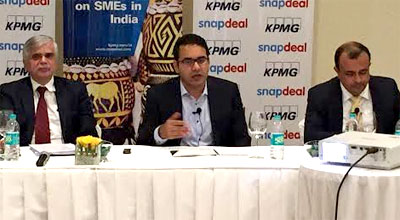
    Snapdeal released a first-of-its-kind study in partnership with KPMG titled ‘Impact of Ecommerce on SMEs in India’. The study examines the macro-impact of e-commerce sector on growth of SMEs in India and identifies remaining gaps in the eco system needed to be plugged to facilitate adoption of e-commerce by SMEs.


    The report compares the e-commerce led growth trajectory of SMEs in India vis-à-vis other emerging and developed economies. Additionally, it outlines different roles that various participants like the government, industry bodies and ecommerce companies themselves can play in making the SME ecosystem more robust.


    Speaking at the release of the report, Kunal Bahl, Co-founder and CEO, Snapdeal said, “At Snapdeal, we are working towards building the most impactful digital commerce ecosystem in the country and SMEs form the foundation of this ecosystem in many ways. With over 200,000 sellers operating on our platform, we felt the need to conduct a systematic unbiased study to identify opportunities and challenges to further accelerate the growth of the sector. We have taken a number of initiatives like seller training programs, seller financing program- Capital Assist and Snapdeal Seller Advisor Program, with an aim of creating life changing experiences for over one million sellers in the next three years. This study has given us deeper insights into what more we can do to enable small businesses become more successful online.”


    Richard Rekhy, CEO, KPMG India said, “The fast paced growth of the e-commerce industry in India represents an unprecedented opportunity for SMEs. We hope that the findings of this report will assist policymakers, industry bodies and e-commerce companies to strengthen the support ecosystem, which enables SMEs to ride the e-commerce growth wave successfully.”


    This report is the first in a series of initiatives that Snapdeal has undertaken for creating an ecosystem for MSMEs and leveraging ecommerce for their growth.


  • Snapdeal appoints Idi Srinivas Murthy as Sr VP-Marketing

    By A Correspondent


    Snapdeal has announced that it has appointed Idi Srinivas Murthy as Senior Vice President – Marketing. Srinivas joins Snapdeal after a string of successes in Marketing at The Coca-Cola Company and GlaxoSmithKline.


    His last role was at GlaxoSmithKline (GSK), where as Regional Director, Marketing – Africa based out of Johannesburg, he spearheaded GSK’s portfolio expansion, innovation, and consumer and medical marketing across 44 countries. Srinivas’ work has also been widely recognized with multiple industry awards. In 2009, he featured in Brand Equity’s Indian Marketers League which covered the country’s brightest marketers. Prior to his appointment at Snapdeal, Srinivas has been a part of sales and marketing success stories of multinational brands like Coca-Cola and GSK.


    At The Coca-Cola Company, he worked across different roles in Marketing and Operations. There, in his last role as Marketing Director India + South West Asia BU, he was responsible for leading Sprite to the number one beverage brand in the country. Srinivas’s expertise lies in leading global initiatives, building iconic brands and executing strategies to tap into emerging market opportunities across countries.


    He is an electrical engineer from Vivekanand Engineering College, Mumbai and an MBA from Indian Institute of Management (IIM) –Calcutta.


    ‘We are very excited to have Srinivas join the Snapdeal family. He comes with rich experience in leadership roles across various markets and I am sure his vast knowledge will add tremendous value and further fuel the Snapdeal growth story”, said Kunal Bahl, co-Founder and CEO, Snapdeal.


  • It’s a deal! Ratan Tata invests in Snapdeal

    By A Correspondent


    Ratan Tata, chairman emeritus at Tata Sons, has invested in Delhi-based online marketplace Snapdeal. The company did not disclose the amount invested. The announcement comes a day after Snapdeal entered into a partnership with Tata Value Homes to sell apartment units of projects spread across five cities, namely, Bangalore, Chennai, Pune, Mumbai and Ahmedabad.


    Snapdeal’s cofounder and chief executive Kunal Bahl termed Tata’s investment a validation of the company’s growth. “An investment by a legendary and respected figure like Mr. Tata is an excellent validation of our focused strategy on building a long term enterprise and marks the start of a very important phase for the company,” said Bahl.


    This investment also underlines the growing interest shown by India’s traditional industries in the fast-growing ecommerce sector. Recently traditional retail majors like Reliance and Arvind have made forays online.


    The sector has also attracted large investments in the past few months. Snapdeal raised over $233 million this year in two rounds from investors like eBay Inc, Singapore-based Temasek and Wipro chairman Azim Premji’s family office Premji Invest. Market leader Flipkart too raised two rounds of funding this year. In July it raised $1 billion from existing investors and Singapore sovereign wealth fund GIC. Global major Amazon also announced a $2 billion investment for its India operations in July.


    Snapdeal, which is estimated to have crossed $1 billion in sales this year, is rapidly adding new categories of products. Apart from apartments, it has launched a catering supplies segment recently. In the next few months the four-year-old platform is planning to add 10 more categories.  Bahl has stated in the past that the company will focus on adding new merchants, new categories and focus on mobile commerce to ensure growth.


    Source:The Economic Times

    Copyright © 2014, Bennett, Coleman & Co. Ltd. All Rights Reserved

    Licensed to republish