Tag: Kuldip Nayar

  • RIP, Kuldip Nayar


    By Ranjona Banerji


    “Can the Emergency be reimposed, I have often wondered? The Constitution makes it difficult because of the amendment that the Janata government effected. A Prime Minister has to get the approval of two-thirds of the members of both Houses of Parliament before such a step can be taken.

    “But seeing how conformist the press is today, I don’t think it would be necessary for the government to take any extra-constitutional measures. Newspapers and television channels have themselves become so pro-establishment that the government doesn’t have to do anything to make them fall in line.

    “However, one current development is ominous. Soft Hindutva is overtaking the print and electronic media. They go out of their way to blackout the minority point of view. One glaring example is a recent statement by a Muslim woman from Mumbai. She said that, as a Muslim, she could not get a house in any posh locality. In contrast, had this statement been made by a Hindu, newspapers and television channels would have reported it and commented for days to express their criticism.

    The Muslim woman’s statement was perfunctorily noted, but not debated or discussed. This does not behove a society that has enshrined secularism in the preamble to its Constitution. Still worse is that the excesses committed against the minorities are scantily reported and hardly discussed. Only 70 years ago, when we won independence to establish a secular and democratic state, we took pride in the fact that, despite the demand for Pakistan, the preponderant majority still believed in the idea of India that Mahatma Gandhi, Nehru, Sardar Patel and Maulana Azad subscribed to.”


    These are excerpts from an opinion piece by Kuldip Nayar, published on June 25, 2015 in the Indian Express, about Indira Gandhi, the Emergency and the Indian media.

    As all the tributes pour in for Nayar, who died at the age of 95 on August 23, 2018, his own words are far more significant for Indian journalists today. Sadly, many of the tributes written by former colleagues and proteges include those who follow none of his ideals. They may admire for his wit or his love of food or his compassion but for his journalism? If only he had more followers for that, and perhaps the state of Indian journalism would not be in the pathetic state it is.

    Nayar was best known to many for his opposition to the Emergency and the fact that he was jailed. But as every obituary has mentioned, he fought fiercely for the freedom of the press and for civil liberties. Take a look around you and try and identify how many editors you know who do either. Some, sadly, have fallen into that “conformist” mode and many others are directly involved in pushing the Hindutva agenda, soft and hard both.

    The Cobrapost sting into how easy it is to bribe media houses to push the Hindutva agenda is a glaring expose into our lack of ethics and please note how we have completely stopped talking about it.

    Nayar was also a great proponent of improving India-Pakistan relations and was a regular at candlelit marches at the Wagah border. Just the sort of person that Republic TV, Times Now and their copycats would call an anti-national and a traitor. It is nothing short of despicable, and also a bit amusing, to see tributes to him and his legacy by such “journalists” who are sold out to the powers-that-be and have absolutely no courage when faced with official or government anger.

    If indeed Nayar’s legacy of fearless journalism, of compassion, of championing human rights, is to be taken forward, then it cannot be done by most journalists who are in leadership positions today. They are the antithesis of everything that Nayar stood for. The hope, if any, lies with younger journalists who are willing to fight on, regardless of the obstacles ahead.


    https://indianexpress.com/article/opinion/columns/emergency-then-and-now/


    Ranjona Banerji is a senior journalist and commentator. She is also Consulting Editor, MxMIndia. The views here are personal.



  • Press Club Mumbai to honour Kuldip Nayar and N Ram with Lifetime Achievement Awards

    By A Correspondent


    The Press Club Mumbai has announced it will honour veteran journalists Kuldip Nayar and N.Ram with the RedInk Lifetime Achievement Awards for 2013 for a career dedicated to good journalism. The awards will be handed over by the Governor of Maharashtra, K Sankaranarayanan, on Saturday, May 25, at the Tata Theatre in Mumbai. More than 20 other journalists will receive awards in various categories for excellence in journalism at the Awards event.


    The Lifetime Achievement Awards were selected by the managing committee of the Press Club based on a survey of leading and senior journalists from across the country.


    “It’s a privilege to honour such distinguished journalists at the RedInk 2013 Awards. Their contribution to the media and professional achievements speak volumes and serve as motivations to us all. We are pleased to felicitate such inspirational personalities,” said Gurbir Singh, President, The Press Club, Mumbai.


    This year, The RedInk Awards received over 900 entries from journalists all across India. Winners have been chosen in nine competitive categories including Sports, Media & Entertainment, Health & Environment, Crime, Business, Politics, Television Story, Science & Innovation and PhotoJournalism. Some of the eminent judges included Ravi Shastri, Rahul Bose, Kumar Ketkar, Pritish Nandy, Minhaz Merchant, Shirish Inamdar, Hussain Zaidi, Khalid Mohammad and Colvyn Harris. The media partners of the event are Star India, Podar Enterprise, Glenmark Pharmaceuticals Ltd., Eros International, Yes Bank, Magarpatta City, and Zee Entertainment.


  • Ranjona Banerji: Why TV anchors must not write on edit pages

    By Ranjona Banerji


    I now understand the pain of being a TV journalist. There is no avenue within the medium to become a pontificator. For print journalists, it’s easy. You work a few years as a reporter-correspondent-sub-editor and then some boss type person decides you have some writing skills that can be further explored or some pages fall short of stories and some boss type person makes you write a quick news analysis or you are a boss type person and decide (or someone tells you) that the world wants to know what you think. And you know how angry print journalists can get if their “columns” are stopped, if you read the excerpts of Kuldip Nayar’s memoirs. The reader then believes that these columnists and analysts are experts.


    But what can a TV journalist do? Having spend years running from pillar to post saying “I am standing at the gate waiting for something to happen” interspersed with many in facts and of courses – “I am of course standing at the gate in fact” – does someone say to him or her, here’s half an hour of TV time as a reward for so much standing, now say what you want?


    No, instead you become a prime time anchor and you have to ask other people what they think. And some of those people, in fact, of course, have to be print journalists who have now become analysts and columnists. Talk about rubbing salt in it.


    The result is that you yourself don’t know what to think. If you have ever read any columns by famous Indian TV anchors (I think Rajdeep Sardesai and Sagorika Ghose of CNN-IBN and Barkha Dutt of NDTV, all have columns in Hindustan Times, which has reduced the effectiveness of its edit page by half) you will know what I mean. Half the time they plug their own channels and shows and the rest of the time they sort of sum up what’s happening. There’s very little original thought there except some anodyne comment. No provocation, no incisive comment, no contrarian viewpoints. This comes from years of TV panel discussions where you have to listen to other people. Print journalists are terribly egoistical and after a few years stop listening to other people and only like other people to listen to them. This gives them a great advantage as pontificators.


    (I must here advise newspaper editors to end this new trend of giving columns to journalists with little or no experience because they are even less readable than TV anchors. Youth may be attractive but it has its limitations.)


    What is the solution for famous TV anchors? Instead of bothering to write which they can’t, they should get their back on usual suspect panellists. Call them to their studios and make them question the anchor. The anchor will then hold forth while the panellists listen. However, the anchor is not allowed to ask questions…


    This way, we might find out if they can actually think. India wants to know.


    Ranjona Banerji is a senior journalist, commentator and Contributing Editor, MxMIndia. The views expressed here are her own. Twitter: @ranjona


  • The Press has lost its sheen: Kuldip Nayar


    Text and Video by Shruti Pushkarna


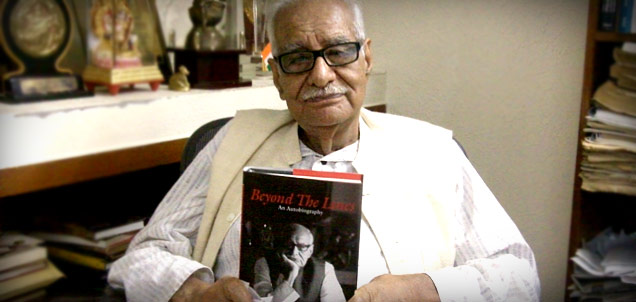
    Veteran journalist Kuldip Nayar memoirs, ‘Beyond the Lines’, are set to be released in the Capital today (July 11). He calls it a ‘political autobiography’ which recounts the political history of not just India, but Pakistan and Bangladesh as well.


    Now 89, Mr Nayar has been a close witness to a series of political events that unfolded in his journalistic career. An author and a human rights activist, Mr Nayar has also been a diplomat and Parliamentarian. He was appointed High Commissioner to Great Britain in 1990 and nominated to the Rajya Sabha in August 1997. He was media advisor to the late Prime Minister Lal Bahadur Shastri.


    He was also the former editor of the Statesman in Delhi, former Managing Editor of news agency UNI and former correspondent of the London Times. He still writes columns and op-eds for newspapers including The Daily Star, The Sunday Guardian, The News (Pakistan), Express Tribune (Pakistan), Dawn (Pakistan).


    A great believer in the power of press, Mr Nayar seems aware, and somewhere disappointed, at the emergence of the new ‘sensational’ journalism in the country. He feels that journalists today editorialize more than they report. As opposed to the ‘profession’ it used to be, Mr Nayar feels journalism today has become an ‘industry’, a ‘product’.


    In this candid one-on-one with MxMIndia, Mr Nayar shares his memories of journalism in the days gone by and the change he is witnessing today. Although he advocates self-regulation of the media, he believes that all journalists should prescribe to a strict code of ethics.


    Excerpts:


    This book is not based on columns. This is a book from my memory, 95 per cent of it is from memory, and only for about 5 per cent, I might have consulted my columns. It’s my political biography and it’s a current history of India, Pakistan and Bangladesh.You were among the first journalists to take your columns to the book form. Do you think that the book works better for a journalist?


    Have you given up on Indian media or Indian publications altogether?

    No, I have not given up entirely, because I still appear as a columnist in so many papers. Only the leading papers don’t publish my columns. I have full confidence in the press but I am disappointed that it has lost the sheen that used to be there in our times.


    Has it changed dramatically from the time when you were an active practitioner?

    Yes it has. Now it has become a product, then we were a profession, now it’s an industry. That way, independence is much less now. The influence of the owners and the corporate sector is much more than there was.


    Any other specific area where you see the change?

    Yes, the way of presenting news and the way of writing has changed. I find very few items of hard news now. In our times, we used to see what was happening in the cabinet and we even used to publish the cabinet agenda. Now it’s less inquisitive than before.


    In the Samir Jain incident you mentioned in the book, do you think the turning point in the treatment of editors by proprietors was when Girilal Jain has said to have slighted Samir Jain?

    That probably is one incident. The real watershed for journalism is the Emergency. That’s when the owners really saw that their pressmen caved in. So the owner thought that if they could cave in under pressure from government, they can also cave under my (owner’s) pressure. So the emergence of the owner started then, earlier the owner was nameless. But now we even see edits by owners and they decide who will write what.


    But there are still newspapers which are editorially driven…

    Very few.


    What’s your view of proprietors as super-editors especially in the regional, non-English media?

    That is a problem. Leading regional papers which have circulation in lakhs are owned by the same family, edited also by the same family and it’s being inherited down the generations, therefore it has become personal property. So this is a very serious issue.


    You’ve been an active votary of Indo-Pak ties, you are known to conduct candlelight marches to the Wagah border…do you think it’s correct for journalists to get ‘activist-y’?

    While I was in active journalism, I had certain views which I expressed, but did not participate in any activity. Now since I am only a columnist, I do take part in human rights violation, Indo-Pak relations and so on, because this is part of my ideology.


    You have also been quoted in the past to say that media plays a spoiler in Indo-Pak ties, that it only sensationalizes and most journalists have no sense of history…

    I think they (current media) don’t seem to have that sensitivity. I think media on both sides are still in the old age of mistrust, hatred and chauvinism. Things have changed in the region, so now we should be talking of conciliation. People on both the sides are willing to meet but media is a spoiler.


    Do you find newspapers having lost out in breaking news journalism vis-a-vis TV and the internet?

    Yes, newspapers are now breaking fewer stories, if at all they do, as compared to earlier. Television does much more. In our time, TV did not exist but now I can say that stories are broken by television network, and take the example of 2G scam, all these came from TV.  Newspapers followed up the story later.


    What’s your view on self-regulation versus government-controlled regulation of the media? You recently opposed the SC’s move to lay reporting guidelines stating that it will muzzle media. Is self-regulation the way forward?

    Yes, and why I say that is because however small regulation there may be, it will be controlled by somebody on the executive council. This question came up during Nehru’s time also, and Nehru said that he would rather have yellow press – sensational press – than controlled press. But I do want journalists to adopt a code of ethics. Editors’ Guild has formulated a code of ethics, Press Council has one, Press Commission had enunciated one. So I think we should have one code of ethics because the new type of journalism which is emerging is, at times, sensational, at times irresponsible and too much of editorializing. News is sacred, it should be conveyed as it is.


    What are your views on Paid news?

    Paid news is a recent phenomenon. This is the newspaper’s innovation and I think one of the biggest newspapers today initiated it. They are now selling space, not for advertisements, but space where the advertiser’s views will be presented as views from their correspondent. So it is really unfair to the reader who believes that news columns are sacred. You are selling the reader something motivated, some propaganda, through the credibility of your paper.


    Coming back to your book, any incident that you forgot to mention in the autobiography that you would like to share?

    Yes, there are quite a few…they were certain incidents about Mrs Gandhi’s regime which I should have included in the book. Also when I was in the Rajya Sabha, I had some exchanges with the Vajpayee government, I could have included those as well. Maybe I will do a sequel.


    Your message to a young entrant in the media…

    He or she should have commitment to certain values, commitment to the Constitution and commitment to the ethos of this country. Democracy, secularism and egalitarianism should be part of him or her while entering the profession.


    MxMIndia has partnered with Roli Books on the promotion of the book