Tag: KPMG report

  • Dark Days Ahead for Adspends


    By Indrani Sen


    Last week, KPMG released a report titled “Covid-19: The Many Shades of a Crisis” trying to provide stakeholders in media and entertainment a perspective of the effects of Covid-19 on M&E sector (https://home.kpmg/content/dam/kpmg/in/pdf/2020/04/the-many-shades-of-a-crisis-covid-19.pdf).


    The report reviews three alternative scenarios related to the overall performance of Indian economy. The first scenario assumes that the spread of covid-19 would be largely contained by April-May and Indian economy could grow in the range of 5.3-5.7% in FY21. The second scenario assumes that under the shadow of a global recession with a containment of spread of the virus in India, the country could witness 4-4.5% growth for FY21. The third scenario assumes a proliferation of the virus in India accompanied by a global recession, GDP growth could fall below 3%. However, the report does not throw any light on how the three alternative scenarios may affect the M&E sector in different ways.


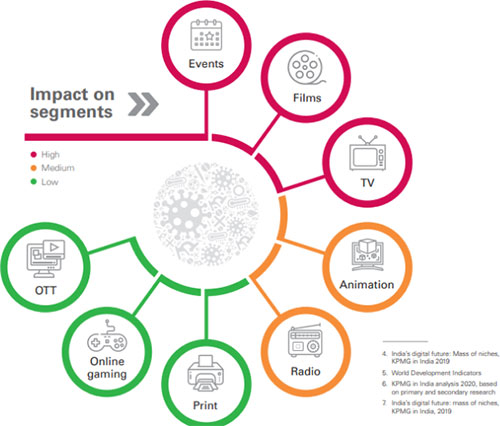
    The title “The many shades of a crisis” relates to how Covid-19 has affected the different segments in the M&E sector. The graphical presentation of their assessment (shown below) raises some doubts regarding the parameters used for making the assessment, particularly in relation to traditional media where print has been shown as having low impact against television having medium impact.


    Source: KPMG Report “COVID 19: The many shades of a crisis”


    While BARC data is showing a week-on-week increase in TV consumption, at the same time there is de-growth of advertising revenue leading to slowing down of monetisation with additional crisis of production of new content /episodes of the serials. KPMG has predicted for TV “slow ad spend recovery in medium term with long term risk due to digital competition”.

    On the other hand, KPMG has predicted “a new lease of life” for print riding on the credibility of the printed words against proliferation of fake news in social media and has advised print media to “leverage positive consumer segment and build strong digital products to capture the opportunity”. This advisory ignores the current scenario related to printing and distribution of hard copies of newspapers and the various hurdles which they may face in recovering their circulation and readership post COVID 19. It is difficult to agree with KPMG’s views that the impact of COVID 19 will be less on print than on television.


    Animation sector also has been hit severely as work from home poses a challenge to implementation of the tools and techniques which are difficult to access from home of the individual illustrators. High fixed costs and high investment costs of the animation sector clubbed with cancellation/ postponement of contracts have created a serious cash flow crisis.


    The impact on radio also has been quite high as there is a loss of listenership due to lack of travel and work from home. Many advertising campaigns on FM radio are linked with activation and events at various social gatherings which have been as badly affected as the events sector. KPMG agrees that ad spends on radio will take time to recover and assures that demand for timely localised content should remain high even after the recovery from the virus. Given the restriction on production of news content by FM radio, they can do very little to satisfy the demand for timely localised content during lockdown and after removal of lockdown.


    KPMG shows that Events and film sectors have been badly affected due to social distancing and the OTT and gaming sectors have gained riding on the additional time spent by people at home. KPMG predicts footfalls in cinemas may take a while to return to normalcy and live events may also take longer time to recover as consumers emerge gradually from the social distancing mode. Both OTT and gaming can benefit if the growth in current consumption can be converted to habitual activity.


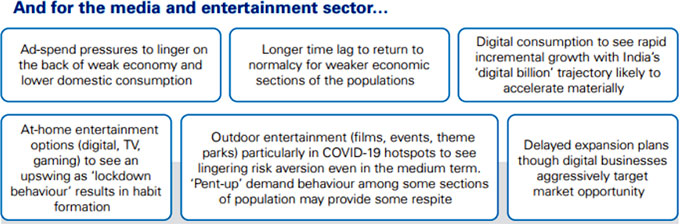
    Summing up, the KPMG report provides the following insights for the M&E sector:


    Source: KPMG Report “COVID 19: The many shades of a crisis”


    The above themes will play across the M&E value chain impacting supply chain, consumption and monetisation. KPMG apprehends that the gap between India and Bharat in consumption of various goods and services may widen due to the reverse migration from urban areas to rural areas as a result of lockdown and halt in all economic activities. Remote collaboration for creative ideation and scripting may last beyond COVID 19 altering the supply chain management of content creation permanently. Finally as far as monetisation is concerned, KPMG predicts longer timelines for ad spend recovery as the economy would continue to be under stress even after the virus is contained. The slowing down of the economy would have adverse impact on key advertisers in FMCG, auto, e-commerce etc. and they might take longer time to restore their ad spends to the level before the pandemic struck India.


  • Do loyalty programmes ensure brand loyalty?


    By A Correspondent


    Digital disruption and new generational influences are making customer loyalty tough to hold onto these days, but fresh thinking on loyalty programmes is key to winning and retaining customers, according to KPMG International’s The Truth about Customer Loyalty report.


    With the holidays nearing, KPMG’s  survey of over 18,000 consumers in 20 countries, with 1721 being from India explores the nature of customer loyalty and how some traditional loyalty programmes, long a mainstay of customer retention strategies, may not be keeping consumers brand-faithful.


    Said Harsha Razdan, Partner and Head, Consumer Markets and Internet Business, KPMG in India: “In India, brands and retailers are ready to run miles to acquire a customer. It becomes even more difficult to retain acquired consumers, unless there is a unique value proposition along with related benefits. The fact that over 55 per cent of consumers in India say they will buy from their favourite company even if it is cheaper and more convenient to buy from a rival company is further proof that loyalty endures. Loyal customers can be a reliable repeat source of revenue for retailers/brands.”


    “The study in India revealed that when a consumer is loyal to a brand, 93 per cent will recommend it to their family and friends. 47 per cent will remain loyal, even after a bad experience. This substantiates that retailers today will need to re-imagine and re-invent to continue to lure/excite the new digital tech-savvy consumer. They will need to invest in creating convenient loyalty platforms, educating consumers about the program uniqueness and get the consumer to experience the benefits that the program has to offer. These programmes should make the consumer feel special, wanted and proud of being associated with the retailer/brand. Retailers/brands should continue to engage with consumers while ensuring that consumer data and interests are protected,” added Razdan.


    What Indians feel:

    Of the over 18,000 respondents from 20 countries, 1721 were from India. The maximum number of respondents were millennials (in the 17-36 age group).

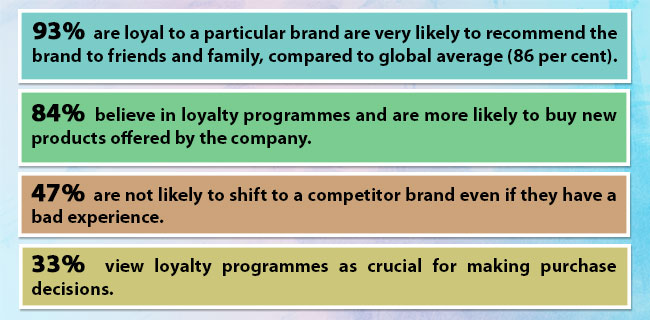
    — 93 per cent of the respondents who are loyal to a particular brand are very likely to recommend the brand to friends and family, compared to global average (86 per cent).

    — 84 per cent of the respondents in India believe in loyalty programs and are more likely to buy new products offered by the company

    — 47 per cent of the respondents are not likely to shift to a competitor brand even if they have a bad experience

    — 33 percent of the customers in India view loyalty programs as crucial for making purchase decisions


    What engenders brand loyalty today?

    Brand loyalty doesn’t only earn companies repeat business from their loyal customers–over 86 per cent of consumers globally, from Gen Z to the Silent Generation, say they would recommend a brand they loved to friends and family.

    In terms of earning customer loyalty, 59 per cent of the consumers surveyed globally said they are loyal to their favourite brand because of a personal connection compared to 74 per cent in India. 75 per cent consumers globally said their loyalty was driven by product quality compared to 81 per cent in India, 66 per cent consumers globally as compared to 74 per cent in India said their loyalty was driven by value for money and 57 per cent consumers globally as compared to 73 per cent in India said their loyalty was driven by customer service.

    Meanwhile, only 37 per cent globally see loyalty programs as an effective way to earn their loyalty. And 55 per cent of consumers who are enrolled in loyalty programmes internationally use them infrequently –a few times a month or less. 96 per cent of the millennials surveyed globally said companies need to find new ways to reward loyal customers altogether.


    Here is what KPMG recommends to improve customer loyalty programmes:

    Revitalise them.

    Around half of the surveyed consumers globally agree that companies should find new ways to reward loyal customers. This number stood at 97 per cent for India. Responsible personalisation, emotional connection and purpose-driven causes should be key considerations.


    Keep it simple.

    Make loyalty programmes easy to join and simple to use. Globally, 60 per cent agree loyalty programmes are too hard to join and/or earning rewards is a challenge. 80 per cent in Brazil and China feel that way, 76 per cent in India feel this way and as do nearly seven out of ten millennials globally. Lengthy registration processes, rules and conditions, technical difficulties with redeeming awards are all likely to turn customers away.


    Maintain relevance amid the noise.

    Retailers need to ensure their loyalty programmes stay relevant to customers. 49 per cent of loyalty programme members globally agree they belong to too many programmes. This is particularly the case for consumers in China (72 percent), Brazil (70 per cent) and India (61 per cent).  Too many programmes equate to too many apps, so it’s no surprise that customers forget their memberships, lose track of their points and perhaps decide that the rewards are not worth the effort.


    Promote awareness and familiarity.

    Regular communication to consumers through social channels, email or advertising can help programmes remain top of mind with consumers. More than one in three consumers globally who did not belong to any loyalty programmes globally said they were not aware of any. 17 per cent globally compared to 21 per cent in India have not joined a program. Lack of awareness (42 per cent) is one of main reasons stated by respondents in India for them not being part of any loyalty programme in India


  • An Intelligent, Immersive, Inventive World


    By A Correspondent


    KPMG in India in association with IMC and COAI launched a report on the TMT sector titled ‘Imagine a new connected world: Intelligent, Immersive, Inventive.’ at the India Mobile Congress 2019.  Among other highlights of the report, it notes 5G is slated to potentially add between 0.35 per cent to 0.5 per cent to the GDP of India. With potential still existing from existing technologies (2G, 4G) not fully exploited, India is expected to see a gradual migration to 5G by 2022. 5G is most likely to see widespread adoption by 2025 in India. Until then 2G, 4G and 5G will continue to co-exist. KPMG estimates that India Inc. has the potential to unlock USD48.69 billion (INR3408 billion) through the deployment of 5G over four years and the 5G contribution to annual GDP is likely be in the range of 0.35 – 0.5 per cent.

    The report takes a deep dive into the digital ecosystem enabled through 5G, blockchain technology, IoT, AI, cognitive computing, machine learning and AR/VR to name a few. While the current investment and focus is on creating an enriched omni-channel experience for customers, it is the use of bots and blockchain that are going to be game changers in enhancing customer experience over the next five years, as per the report. Further, on the need to address and allocate strategic importance to digital risk and data privacy, the reported highlighted that 57 per cent of the companies who have commenced work on digital transformation do not have a digital risk strategy, presenting a danger to the very existence of the organisations eventually.

    The report further throws light on the challenges in the implementation of the digital vision like financial stress in telecom industry, the high price of spectrum, inadequacy of a fibre network and the lack of device interoperability standards as well as suggests a way forward on how the industry could mitigate some of these challenges like the adoption of a sustainable and transparent pricing model, creation of Special Purpose Vehicles (SPV) to support international lending organisations, providing substantial investment into digital infra projects at cheaper interest rates, policy interventions in ease of doing business, and establishing funding mechanisms that provide grant funding to emerging tech start-ups.

    Said Satya Easwaran, Partner & Head – Telecom, Media and Technology sector, KPMG in India: “India has never been more alive in the telecom and technology space. We are excited to be a part of IMC 2019, at the core of all the action. There is a fundamental shift underway, with significant disruption and convergence in the roles of telecom and tech companies, as well as other sectors. This is leading to a wave of innovation and invention. It is imperative for companies to stay nimble from a strategic, business and customer experience standpoint, or else face potential losses or even bankruptcy. With the mobile data explosion over the last few years, rapid migration of customers to 4G, the advent of 5G in 2022, and all the associated technological possibilities in the next few years, we couldn’t be poised at a more pivotal juncture. There are some infrastructure and customer adoption challenges however, that we do need to address collectively as an industry. However as things stand right now, we are on the brink of an India which is intelligent, immersive, inventive.”

    Added Purushothaman KG, Partner and Sector Lead – Telecom, KPMG in India: “The future value that will be delivered through telecom operators is not by being the provider of ‘connectivity’ but as being a trusted partner and platform provider offering value and services and experiences to customers. We are living in exciting times where new technologies like 5G, IoT, AI and AR/ VR promise to revolutionise connectivity and unlock value by creating better, more secure and personalised experiences for everyone.”

    Commenting on the industry growth, Rajan S Mathews, Director General, COAI said: “The global digital revolution at present is led by the telecom industry, which is providing services beyond the conventional offerings of access, interconnectivity and applications. A testament to India gaining a competitive edge over its global players is the fact that it has the world’s cheapest mobile data at USD 0.25 per GB, resulting in higher usage by its citizens. Also, India has made great strides in other aspects of internet inclusion such as regional penetration and gender parity parameters. However, in order to deliver value in future, telecom operators will have to go beyond being the connectivity provider and become a trusted partner and platform providing value, services and experiences to customers.”


    Other Key technology trends of the digital ecosystem in India in 2019/2020

    :: Disruptive technologies: table stakes or future stars: KPMG surveyrevealed that while India Inc.’s current table stakes are on data analytics and cloud, IoT, blockchain and AI are projected to be strategic investments and robotics and AR/VR are the future stars

    > IoT will be the most immersive, intelligent and inventive of all technologies, and  soon be ubiquitous, incorporated into how we live, work and play

    > Blockchain is a technology trend that has seen wide implementation during 2019 and its applications will continue to expand beyond cryptocurrency

    > The survey ranked AI, AR/VR, cognitive computing and machine learning as the top technologies that will have the highest potential to generate immersive experiences but are nascent in terms of their evolution and adoption. AR, VR and AI will all come together to form ‘Extended Reality’ (XR)

    :: The transformation and adoption to the digital ecosystem:

    > Transformational changes in the telecom sector, technological advancements, positive policy intervention and increasing connectivity penetration have been key enablers of India’s digital dream.   KPMG in India analysis 2019 survey indicates that 43 per cent of companies have begun work on emerging technologies but almost 31 per cent are yet to develop a roadmap for digital strategy. The importance of digital transformation has been recognised but the journey in transformation is still evolving

    > As per the survey, sectors that are likely to be the most disrupted by emerging technologies are retail, then financial services and technology, in that order

    > 90 per cent of the respondents feel the need for product innovation with newer technologies and approaches is needed to enhance customer experience

    > While the current investment and focus is on creating an enriched omni-channel experience for customers imbibing AI and ML, survey respondents reckon face-to-face video communication, use of bots and blockchain that are going to be a game changer in enhancing customer experience over the next five years


    :: Digital risk and data privacy will need management screen time:With the near ubiquitous nature of digital technologies, digital risk acquires strategic importance and needs to be addressed. Adoption of multiple digital technologies by the enterprises exposes them to a myriad of vulnerabilities impacting consumers’ privacy. A data breach could ruin the reputation of organisations and it is important to note that the average total cost of data breaches in India in 2017 was INR 110 million (USD1.57 million) making it important to mitigate the security concerns.


    :: Challenges in the implementation of the digital vision:

    > Adoption of the National Digital Communications Policy 2018 (NDCP) needs to be done in a more efficient and productive manner

    > Financial stress in telecom industry coupled with high price of spectrum provides limited room for the industry to deploy and scale the digital infrastructure

    > Inadequacy of a fibre network and the lack of device interoperability standards are impacting the quality of technology implementation and limiting innovation in the sector

    > Enactment of the Personal Data Protection bill is a step in the right direction as far as data privacy is concerned but effective implementation and customer education is necessary to improve customer confidence in adoption of digital technologies.


    :: The need of the hour:

    Policy: Policy interventions relating to ‘ease of doing business’, RoW clearance, public-private partnership (PPP) models for infrastructure development, creation of a national portal to monitor and track development and adoption of emerging technologies, expediting the roll-out of smart cities, finalising the Personal Data Protection (PDP) bill, drafting an IoT policy and implementation of a national programme on AI will accelerate the adoption of digital technologies in the country. Additionally, in the long term, the domestic manufacturing for telecom equipment and fibre can be given a boost through direct tax incentives for reducing manufacturing cost, formation of special economic zones, increasing export incentives

    Investments: To promote investments in the sector, the government should create Special Purpose Vehicles (SPVs) to support international lending organisations and provide substantial investment into digital infra projects at cheaper interest rates

    Spectrum: As the country is gearing up for 5G, it is critical that the additional spectrum should comprise a mixture of coverage (i.e., lower frequency) and capacity (i.e., higher frequency) bands to ensure that networks can provide high speed, cost effective services in rural and urban areas

    Easing the financial burden of the sector: With the total levy of between 29 and 32 per cent in the form of GST, licence fee and spectrum usage charge (SUC) on the telecom sector, there is a clear need for levy rationalisation. The Universal Service Obligation Fund (USOF) contribution and SUC could be reduced to three per cent and one per cent respectively, to make the sector competitive. Further declaration of a three-year moratorium on spectrum payments to the government with abeyance on interest charge, refund of accumulated unutilised input tax of USD4.24 billion are some of the other demands of the debt-laden sector. The government could also consider doing away the levy of GST on government payments such as LF and SUC

    Ecosystem: Incubation hubs and accelerators along the lines of the Atal Incubation Centres (AICs) can be established, additional funding mechanisms like the VC funding scheme and Startup India which provide grant funding to emerging tech start-ups to facilitate their operation and business could be started, as well as the adoption of a sustainable and transparent pricing model




  • HalaPlay signs Krunal and Hardik Pandya as brand ambassadors

    By A Correspondent


    HalaPlay Technologies has announced their new brand ambassadors Krunal and Hardik Pandya. According to a communique, HalaPlay is offering winnings up to Rs 100 crore on its fantasy sports platform this cricket season.


    This new mode of gaming in India has a fan base of more than 20 million today and the Indian fantasy sports industry is worth INR 43.8 billion, it is estimated to reach INR 118.8 billion by FY23 according to the Indian Federation of Sports Gaming (IFSG) and KPMG report.


    HalaPlay recently received INR 40 crores in their Series-A round of funding from Nazara Technologies Ltd., India’s leading mobile games publisher and Delta Corp Limited, an India-based casino gaming company.