Tag: SANJEEV KOTNALA

  • Sanjeev Kotnala: Whose logo is it anyway?

    By Sanjeev Kotnala


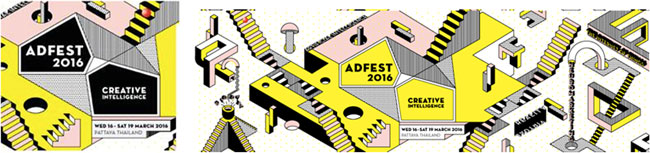
    The theme for Adfest Pattaya 2016 to be held  from February 16-20  is ‘Creative Intelligence’. Its logo has been designed by  Washington DC-based  award-winning studio Design Army.


    The new logo shape personifies the human brain, and represents the infrastructure base for our creativity. In illustrated concepts, the logo is surrounded by impossible shapes and eternal stairwells, which represent the information that swarms around us day after day; before embedding into our minds, changing, transforming and leaving as the start of an idea.


    Is it too much of an explanation for a simple event with a simple focused theme?

    The design is the outcome of theme interpretation by Design Army. As per Pum Lefebure, Co-Founder & Chief Creative Officer of Design Army, “‘Creative Intelligence’ is the ability to connect the dots in the information overload we receive on a daily basis. It is the way you sort through masses of text and visuals to pick and choose what is important and authentic, and translate that into an idea.”


    Additionally, a tiny red ball appears in each design execution, tying the concept together and embodying the idea of ‘Creative Intelligence’ – the ball represents ideas moving throughout our brains.


    Now Lefebure must know her business. She is an award-winning creative director and business leader. She was recently named by Graphic Design USA as one of the Top 50 People to Watch and singled out as a Rising Star by the Washington Business Journal’s Women Who Mean Business. Her work has won countless awards at shows including D&AD, One Show and AIGA. I am no one to question her design or her interpretation.


    I am a consumer of such events. A delegate.  I speak from a consumer/ audience point of view.


    Design for such a simple 3-4-day event with a focused  simplified theme has led to such an complicated logo that someone needs to take pains to explain the over-graphic elements.


    The process-led approach and interpretation has led to the complex design. Creative Intelligence on the other side could be considered as a positive productive output orientation that simplifies things, connect the dots and is able to produce relevant-easy to transmit message codes. In that case simplicity would remain the dominant guiding force.


    It is a point of view, which may not be shared by many. To me, the last year logo was an experience in simplified communication.


    The elements from were easy to adapt in every communication and they left their mark figuratively and literally.  It spoke in a very young colloquial way the language  ‘Be Bad’.


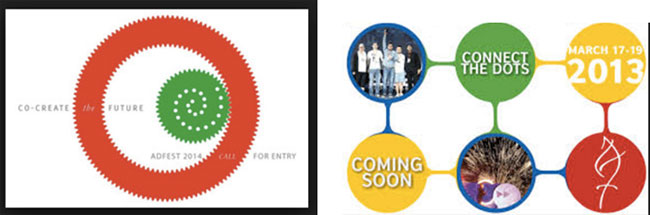
    Look at 2014 ‘co-creating the future’ and 2013 – ‘connecting the dots’ and I would rest my case.


    Just to take the argument further. Look at Adasia


    Look at Goafest


    All of these are almost self-explanatory. There are elements that are unobtrusive and easy to handle in multiple situations. There is no need to explain to the august industry representative what and why of the logo design.


    I personally believe that in the name of graphic elements, Design Army has over-complicated the logo. That’s a point of view I have. Maybe I am old fashioned in my approach.


    Then I checked the Cannes logo through the year. The biggest brand in Industry led global festival. It is so simple. It is well established and understood for what it will deliver. The respect exist and the only thing that changes is the number and the year.


    It does not even needs to specify its theme loudly, as it is understood that it will be at the current frontier of thinking.


    At the end I am not biased toward thematic and non-thematic direction for Industry event. I think themes do add a functional focus and defines expectations. What I promote is simplicity and real functionality in visualization.


    Sanjeev Kotnala with 28 years of corporate experience is the Founder of Intradia World. A Brand, Marketing & Management Advisor, he focuses on IDEATION (Harvest and Liberate) and INNOVATION (InNoWait) process and workshops. He is also a certified Life & ‘Mid life transition’ coach.Email sanjeev@intradia.in tweet @s_kotnala web: www.intradia.in  www.sanjeevkotnala.com.
     

  • Sanjeev Kotnala: What I would like to see happen at Goafest 2016

    By Sanjeev Kotnala


    April 7 to 9, 2016 will see the 11th edition of  Goafest. The event has survived a controversies and absenteeism. The team at the helm must be appreciated for doing such a fabulous job.


    This year afresh the Goafest team meeting important stakeholders – the advertisers, agencies, journalists and past jury members. That is a brilliant start.  I have shared my inputs on entry process. Additionally, I was happy to be probed for my input in a very informal way. I appreciate the intent and wish all the best to Goafest. We all seem to be on right track.


    I have attended all past editions and one can say I have a love-hate relationship with the event. I have seen it from many sides. I have been sponsor, a rebel, winner, jury member, and delegate and in one year even had a parallel party on the Conclave night.   You bet I will be there for the 11th edition too.  I may be seen as constantly cribbing and finding faults, but, trust me, that is ever the intention.


    There is nothing that needs to be held back. Here I am sharing some thoughts, in public. I am fully aware that it may not be possible to integrate few or all of them.  Still, here I go.


    DISPLAY ALL ENTRIES.

    Not just the winners. This will be a mark of respect to the creators. Someone found them worthy of the entry. I find this practice at Pattaya Adfest a brilliant initiative.  The delegate would gain a hell lot more from viewing entries than any knowledge sessions.


    DISPLAY ALL ENTRIES ONLINE.

    Post the event; all entries should be available ASAP for viewing online.  This will also become an industry archive and a narrative available for reference. The access codes of these should only be made available to delegates.


    JURY DISCUSSION.

    Jury is one of the most critical elements of any event with awards. The jury is also a statement of credibility.  Can the jury presidents across the different segment be available on stage to discuss the criteria of evaluation? Share in an open forum why a particular entry won, what made one entry jump or nudge the other entry?  Very transparent and open discussion. Not that it is a practice in all industry events. But that should not stop us from considering it.

    It will add a lot, give the entrants insights into what the judges were looking at. Also it adds to the event when the judges collectively before delegates state why what was chosen as the demonstration of excellence in the area.


    PARALLEL STREAMS.

    There are possible 16 to 18 knowledge sessions in the two-and-a-half day event. We are in an industry with multiple stream of specialisation. This straight one focussed knowledge sharing stream fail to excite all the delegates. Maybe pre-registered workshops are possible. Maybe a live contest like- Developing Print campaign is possible.


    BETTER MEDIA CENTRE AND COORDINATION:

    Media amplifies the industry event.  To facilitate it media centres need be better managed and coordinated.  Excellent connectivity is a basic requirement.

    In case the organisers make arrangements for the journalist stay, it must be close by and easily approachable. Providing space in the venue hotel (charging the journalist difference in cost) could also be considered.

    Press should be provided with a table-chair set-up in the session halls. .  While we are discussing halls, a smooth Wi-Fi is a must for delegates to ride.

    The media interactions with the speakers and interactions need to be pre-planned and streamlined with prior booking of slots.

    Trust media and share the winner list with complete detail and images of entries well in advance. Give this only to the senior representative so that better control is possible.


    GET MORE CLIENTS:

    This one is tough one. It is more of a wish.  I do not have any suggestions for this.


    FEWER AWARDS.

    We have an award for every possible thing. There are just too many awards. There is a feeling that this brings down the value and the cause behind repeated announcements ‘No gold in this category’, which is definitely demotivating.

    More awards means not enough time to showcase the complete work while being awarded. Moreover, Bronze winners do not get a chance to get on stage.  But when given an opportunity by the organising committee, I looked into the categories and subcategories and found that each one is properly defined and no clubbing is advisable.

    The only area (debateable) seemed that Outdoor, Ambient and experiential could be clubbed to form a real OOH category.

    Yet, two or three possible thoughts cross my mind.  In case any category does not get entries, which are more than a pre-decided number of entries, it should be dropped from next year. If in any category we get less than a publicly notified number of entries, let that not be considered for awards. Tough calls as there are possible arguments on both sides.


    STRICT ENTRY GUIDELINES.

    If the supporting AV is allowed for a max 2 minutes then jury should stop seeing it beyond that duration or just not consider it as part of supporting.

    Entries should not be accepted beyond the last date. This should be possible for date-marked-digital entries.

    Maybe organisers must ask entrant to provide an image or 30 second AV or whatever they define, which will be displayed as a standard display in case the entry win.  It will bring in uniformity. The function will be better controlled. It will help to treat every award winner at parity.


    PROMOTE REGIONAL ENTRIES AND DELEGATES

    Rope in national news and business TV channels as well as regional large newspaper groups to deliver the messages. To start with, they could look at towns like Ahmedabad, Indore, Jaipur, Cochin, Madhurai, Lucknow etc.

    Additionally is there a possibility NON-METRO DELEGATE FEE, as an initial push for non-metro market delegates should be considered.


    PROMOTE LESS ENTERED AWARDS.

    If the organising committee seriously believes that in a particular category there were fewer entries than expected. That there was work which somehow could not be entered. That it is something that should be pushed, then a roadshow or an effective programme to address the agencies / marketers/ brand in that category should be initiated.


    FIND WAYS TO INCENTIVISE ALL-DAY PARTICIPATION OF DELEGATES:

    It is not a problem of organising committee if people come for a day or part of the fest and leave. We understand that they have other commitments and work. Lst year, Goafest stopped the delegate pass for one and two days.  It would be wonderful if there were ways to incentivise all-day participation. Is it possible to create a delegate ticket–plus-hotel-plus flight ticket? Not done anywhere but that’s okay.


    DECREASE PANEL DISCUSSIONS:

    Panel discussions are fillers of an event. They do no justice to time and efforts invested by the delegates. Or may be in past, but they have been rarely well-managed.


    STRICT TIME KEEPING:

    An event of this stature should over-ride all considerations and constraints that may derail it on timelines. Let it become an example of time management with proper buffers. Restricted questions, may be tweeted for the speaker to answer.


    PRESENTATION QUALITY AND CONTENT:

    We always had fairly good speakers. There is less of agency-promoted speaker slots and paid speakers have been considered. It will be a bonus if they could just make that extra effort ensuring that the trend and discussion is relevant to Indian scenario, not dated and is customised to the fest. More so it will be appreciated if even the delegate seated in the last row could also read the slides. Sharing an advisory on font size, seminar area and use of excel is required.


    MORE SPACE FOR LATE NIGHT PARTIES.

    The last 2-3 years the evening parties have become cramped for space. There are legal and venue compliance that pushed the parties indoor. As a result, the fest sacrificed space for late closure. Maybe there is some way in increasing space made available for the parties. I have not been to Cannes for some years but when I did, I found the especially conducted- promoted parties by different brands /companies on the same day vying for the right audience.


    THINK SOMETHING NEW – SCRAP RAIN DANCE.

    Yes, it has been there since the start. Yes, it has been losing its pull. Yes, the crowd has been thinning at the rain dance.  I personally think it has lost its charm. It will be better if some other alternative engagement is found for the young crowd.  If there is no new thing- let rain happen.


    STOP FREE BEER

    I know I will be hated for even suggesting it. Free-flowing beer is so an integral part of the fest. The argument is not about getting drunk, there have been very few such cases through the years. It is not even about not all drink beer as there is option of soft drinks etc. The argument is to use the beer footprint for a better cause. Change a nominal fee for beer coupons-  say three-day 15 coupons for Rs 150. Give this coupon money to some local NGO for a worthy cause.


    HERE TO THE GOAFEST 11th EDITION.……………………………………………………………….

    Sanjeev Kotnala with 28 years of corporate experience is the Founder of Intradia World. A Brand, Marketing & Management Advisor, he focuses on IDEATION (Harvest and Liberate) and INNOVATION (InNoWait) process and workshops. He is also a certified Life & ‘Mid life transition’ coach.Email sanjeev@intradia.in tweet @s_kotnala web: www.intradia.in  www.sanjeevkotnala.com.

     

  • Sanjeev Kotnala: Digital needs new storytellers

    By Sanjeev Kotnala


    More and more campaigns in coming times are expected to break in the digital media. The relationship between digital and TV may never reach the TV–print equation. We know how TVCs are used as the starting point to create a print ad. I am not sure if the brand and agencies are taking concrete steps to prevent the situation.


    If I am to believe what I see and hear, in case of the brands using both digital and TV media, script is dominated from TV (the costlier media) point of view. This is a silly situation to be in.


    It is like commissioning a short story writer to write a longer story if not the complete novel. Now, the only art known to him is to be very precise and hold attention in short spurts.  Unfortunately this at times ensures that long digital ads are not a seamless story. They are a relay of situations repeatedly exposed to make the same point. They fail to build on to the tempo and push the viewer’s anticipation.


    We know that longer films are watched lesser number of times. Hence it has to deliver in fewer exposures. Importantly, in digital it needs to hold the audience in its first exposure.


    The Nescafe cartoonist is an exception. The film holds your attention as the story moves through paces and he thoughts are real. (link https://www.youtube.com/watch?v=GP_zdW6sl-k)


    The brand and agencies have been unprepared to create digital acts and ads that really exploit the media. Couple it with ad avoidance, ads playing in the background browser windows and ad-skipping digital media is known for. Not surprising that many digital film intervention fails to deliver the desired results.


    To break this barrier some of the brands like to get the brand association and presence in the very first part of the film.  There is nothing wrong in it, if you could keep the audience engaged for the rest of the film. Audience is not waiting to get engaged with the communication.


    Additionally every client wants a digital communication that can get viral. We know it will not happen- unless we have been able to trigger the behaviour of the audience.  Myantra with Whisper, Visit and Pregnancy has demonstrated it.  Again here is a story building up those fires emotions one can easily associate and expect.

    (link: https://www.youtube.com/watch?v=d7Bfi6d5mQk,  wait https://www.youtube.com/watch?v=aG9_2_3RYxw  Visit https://www.youtube.com/watch?v=Ef27m5ocK6Q  and Pregnancy https://www.youtube.com/watch?v=4l_-M93beYk )


    On the other side you have that the combinations of the situations are stitched together to make TV edits. In some case original 30 second edits stitched together make a digital ad.


    Remember the forgotten movie ads, every 30 second of it was a pearl, beautifully crafted directed and delivered, yes some 240 odd pearls could not hold the necklace together.  CInthol – alive is offline is one such ad (link https://www.youtube.com/watch?v=npVbzq4gxag)  It overplays the situation and treats audience as dumb. A classic case of creating for the lowest denominator. Two, the situation is not so common in India.  Lone rangers are still a new breed.


    The industry faces another problem. A short film of three to five minutes requires a different mind frame. The creative challenges are different and maybe industry is unprepared for it. Though the argument of basic remaining the same holds true, the end product still need to deliver to a new audience with a different pattern of media consumption.


    Before totally blaming agencies we must hold clients too responsible for the situation. They have been majorly exposed to AV and TVC. When they got this license to slow down and consume more time to tell the story, they went wild. The temptation to add and play scriptwriter-director got.


    Somewhere clients also need to be trained for the digital short films to flourish. The clients need to be  willing to experiment and take risk. Clients who are willing to cut-the-crap to cut-the-clutter and open to explore the options digital media presents.


    I am almost sure that the Kitkat 5-minute blank X’mas ad is not something we may get clients to approve. (https://www.youtube.com/watch?v=bHR-i2jbcIc  )  I am using this as an example of only experimentation and do not think it was a great ad


    ………………………

    Sanjeev Kotnala with 28 years of corporate experience is the Founder of Intradia World. A Brand, Marketing & Management Advisor, he focuses on IDEATION (Harvest and Liberate) and INNOVATION (InNoWait) process and workshops. He is also a certified Life & ‘Mid life transition’ coach.Email sanjeev@intradia.in tweet @s_kotnala web: www.intradia.in  www.sanjeevkotnala.com.


  • 15 must-reads for the High EQ Brand Manager


    By Sanjeev Kotnala


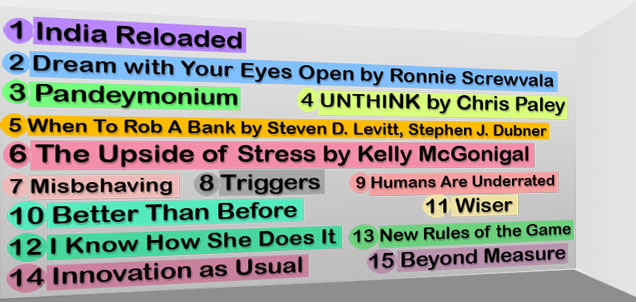
    This year been a mixed bag in terms of books that I have read or plan to read. I stayed focussed on business, marketing, advertising and media books, keeping my distance from anything political or fiction. But here are 15 books I believe one absolutely must read (if you haven’t already!) though not all of them were published in 2015. I tend to categorise my books into sections like ‘interesting, but not yet there’ and ‘selected for rejection’. But this list, I would say, is ‘highly recommended’.


    1. India Reloaded: Inside India’s Resurgent Consumer Market by Dheeraj Sinha

    This is an attempt to demystify the complex Indian market from an insider’s perspective. It draws upon a wealth of data, from consumer research, market data, macroeconomic research, popular culture and case studies, to provide a thorough and compelling insight into what makes for success in the complex Indian market. You may disagree with some of the arguments, but you will end up appreciating the approach. Read it to sharpen your presentations –and also perhaps for a confident discussion with a confused MNC client.


    2. Dream with Your Eyes Open by Ronnie Screwvala
    A book for every entrepreneur-in-the-making. Just go ahead and dive into the learnings that will tell you how to manage failure, inspire success, raise the bar of ambitions and help you think big. Ronnie makes one thing simple: It’s all possible. Just dream your own dream. And when you do, dream with your eyes open.


    3. Pandeymonium: Piyush Pandey On Advertising by Piyush Pandey 

    You just can’t miss this transparent, one-to-one session with Piyush Pandey and how he has observed things that have become the foundation of realistic and memorable communication. Read at leisure and you will see that no observation or experience is ever wasted.


    4. UNTHINK by Chris Paley

    This is a book which is tough to like, as it really asks you to invest time and follow the proposed thinking. But yes, there is a bit of quirkiness about the whole concept and that is interesting. Read to start mining more things from your unconscious mind.


    5. When To Rob A Bank by Steven D. Levitt, Stephen J. Dubner 

    If you loved Freakonomics and Think like a Freak, here are 131 cherry-picked blogs from the authors. Like what people lie about, and why; the best way to cut gun deaths; why it might be time for a sex tax; and, yes, when to rob a bank. Read on to realign yourself to start asking  questions.


    6. The Upside of Stress by Kelly McGonigal

    With a promise of sharing directions on ‘Why Stress Is Good for You’ and ‘How to Get Good at It’ this is a tempting book to pick up. Whether or not it will help you, is something you have to decide. Recommended by ‘The Positive Company’. If you believe that even stress can have positive impact, go for this one.


    7. Misbehaving: The Making of Behavioural Economics by Richard H. Thaler

    We do not follow the standards of rationality while making our decisions. Want to know how to stop misbehaving in a rational, economist way and make smarter decisions? Read on. The book states that “when economics meets psychology, the implications for individuals, managers and policy makers are both profound and entertaining”. Not much of a choice there.


    8. Triggers: Creating Behaviour That Lasts, Becoming the Person You Want to Be by Marshall Goldsmith 

    A book by one of the world’s foremost executive coaches on how to break that cycle of pre-set reactions and bring in meaningful, sustained changes in life. What and how you can be benefited by taking responsibility for actions and failure to act. Discover a new you with this one.


    9. Humans Are Underrated: Proving Your Value in the Age of Brilliant Technology by Geoff Colvin

    Read it before expiry era. It banks on the belief that essential human skills like empathy, social sensitivity, storytelling and creativity can never be replaced by technology. The way we are advancing I have my doubts about that.


    10. Better Than Before: Mastering the Habits of Our Everyday Lives by Gretchen Rubin
    To build happier, stronger and more productive lives, we continuously try evolving by creating new habits. Hence it is an important need to know how to change our habits. It helps to know why some habits are tough to create, more so if that is what you love or want to do. Read if you want to change within or change something within.


    11. Wiser: Getting Beyond Groupthink to Make Groups Smarter by Hastie 

    Group decisions are necessary. But they are hard to arrive at and can sometimes go wrong. If you want to avoid the pitfalls of group decision like cascade effect, polarisation and over-empathising, to reach better outcomes by using some suggested technique including ‘silencing the leader’, grab copy of this one.


    12. I Know How She Does It: How Successful Women Make the Most of Their Time by Laura Vanderkam  

    This one uses a hard, data-based approach to unearth the surprising patterns of working by women who are consistently able to strike a balance between work and family. And also being able to make time for what gave them pleasure and meaning. A must for working women like yourself


    13. New Rules of the Game: 10 Strategies for Women in the Workplace by Susan Packard  

    Where would your career be if you could understand how your colleagues –especially men–succeed and win at work? And if, in understanding and applying the rules, you could win, too? Get nearer to the gamesmanship that fosters creativity, focus, optimism, teamwork, and competitiveness. Read to start effectively using these 10 rules for workplace success.


    14. Innovation as Usual: How to Help Your People Bring Great Ideas to Life by Paddy Miller and Thomas Wedell-Wedellsborg  

    Forget brainstorming, idea jams or offsites. Create the ‘innovation architects ecosystem of 5+1 keystone behaviour’ where engaging in key innovation behaviours is part of daily work. So that innovation can happen in a way that’s both systemic and sustainable.


    15. Beyond Measure: The Big Impact of Small Changes by Margaret Heffernan 

    Sweeping changes have repeatedly failed to do better, to earn more, and create happier employees.  Maybe the route to build ideal workplace cultures and create seismic shifts by making deceptively small changes, can help engage and enhance productivity. Start the journey of small shifts with this book and enjoy some real-life examples underscoring the motto.


    Sanjeev Kotnala is a senior brand and marketing and management consultant. He is Founder of Intradia World. This article first appeared in dna of brands dated December 28, 2015.


  • Sanjeev Kotnala: Not Just a Silly Envelope

    By Sanjeev Kotnala


    I have started liking Indigo as an airline. They have business like efficiency and humane behaviour. The planes are neat and clean. The stark blue spruced up seats welcome you. There is no garbage and the support craft always smiling. They keep you busy by sharing irrelevant information as what city the Pilot belongs to and what languages the hostess can speak. But some how you start liking them.


    The food service is nice. You can preselect your options before boarding or you can make your mind referring to the last section of the magazine that is always there in the seat pocket.  Everything seems nice. The brand blue with the 21 dotted plane, the trivia on the sandwich boxes and the reusable cookie boxes everything seems to be in sync. It would be good if they update the trivia on the boxes frequently and have some sandwich options without corn.


    But, I am not complaining, if there was a loyalty card in Indigo, I would have signed for the membership.


    This time, while flying Mumbai–Nagpur I decided to change the regular jungle sandwich I have been ordering as breakfast. Scanning the list in addition to veg biryani etc. what caught my attention was the Samosa.


    “It will be cabin temperature sir,” the smiling hostess informed me.


    “It’s Ok”. I could have eaten it frozen old for that smile.


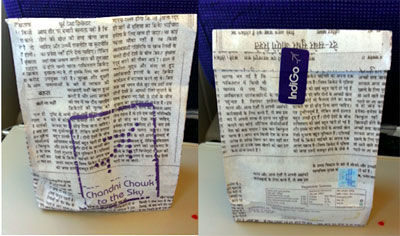
    I got my two pieces of samosa in a paper envelope. I liked it- sandwich in folded paper packs, cookies in reusable cylindrical boxes and samosa in paper bag. Someone was really particular about things. Close inspection showed that the bag was reprinted paper image and not the real newspaper for originality; I would have preferred the actual newspaper. The lead in the ink and mixing with food was not a problem as the packs were laminated form inside. But printing had the advantage, the additional information about content – cost and nutrient values were printed in the pack this avoiding need for additional sticker.


    I was enjoying the packaging and the detail the agency and client had looked at. It was all-good, till I started reading the news item on the pack. And then I realised in all its fineness and originality- in the marketing scheme of things- it was just a silly envelope for samosa. And surely after concept has been approved, no one had given thought to the final content that will feature in that reprinted newspaper packs that are stamped ‘ Chandani Chowk to the sky ‘.


    How tough was it to get it right. How could someone go wrong? Wrong or right is any way subjective. And that is for you to decide.


    The pack that I got- had an article titled ‘With time the relationship will improve’ – by an ex-test cricketer. Then just above where they mentioned MRP and nutritional values it read ‘ they use this for the terrorism acts in India and other countries- so does it men we…’ Somewhere else it said ‘The situations between the two countries is not conducive enough for cricket’. And right next to it ‘the common man in India believes that any money secured by any means that reaches Pakistan is used for terrorism in Indian and other countries. So, how will BCCI explain providing Pakistan such funds raised by cricketseries’? The side sleeve of the packet talks of ‘The fear of hell in heaven’.


    I am sure this is not a packet that Indigo really wants people to read while they are being served at 34000 feet. Any thing better feature-oriented that could bring smile would be better. Otherwise I have every reason to appeal that there is sheer discrimination. Rest all of the food items have their own colour packaging- it is only the Samosa served at cabin temperature that has to do with black & white envelope with a blue brand sticker closing the pack.


    Indigo can change the envelope and gets some good positive news or some humour feature instead of terrorism. Having my favourite Kangana Ranuat image may even help acceptance of cabin temperature samosas.


    It is consistency, innovation and service that make a brand. And Indigo is doing damn good work. So, this small lapse in judgement or oversight hurts. No element is small or big. Everything that the brand uses to interact with its customers is important- even this silly envelope.


    I wait for the day when some brand will use these paper envelopes for promotion and change the game.


    Sanjeev Kotnala with 28 years of corporate experience is the Founderof Intradia World. A Brand, Marketing & Management Advisor, hefocuseson IDEATION (Harvest and Liberate) and INNOVATION (InNoWait) process and workshops. He is devoted to enhancing human potential. He is also a certified Life & ‘Mid life transition’ coach.Emailsanjeev@intradia.in tweet @s_kotnalaweb: www.intradia.in,www.sanjeevkotnala.com.


  • Sanjeev Kotnala: Feel the Real – when will we see OOH in India taking such an action?

    By Sanjeev Kotnala


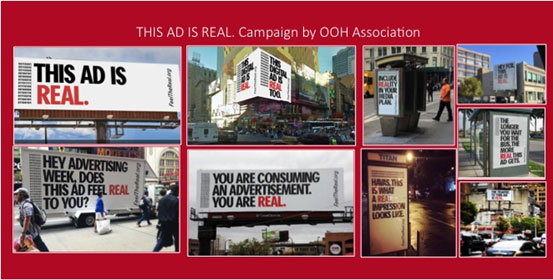
    OOH as a medium has always been sandwiched between traditional and emerging media. The traditional media brigade and the digital prosumers raise critical questions on OOH efficiency and effectiveness. Taking the bull by the horn and to demonstrate Real Power of OOH in driving digital engagement, OAAA (Outdoor Advertising Association of America, representing 90% of the industry revenues) and PNYC  (agency on record) launched “Feel the Real”, a huge campaign with more than 1600 OOH placements.


    I know that nearer home the situation is a lot different. But just like US, we regularly question OOH efficiency and effectiveness. Much of it comes from our inability to assign numeric values to OOH exposure like we do for other media.


    The campaign “Feel The Real” brings alive OOH as a REAL MEDIUM THAT REACHES REAL PEOPLE and helps drive significant digital engagement. Meanwhile, it takes a potshot at questioning the efficacy of digital; the new darling of media planners. It simply asks: How real is digital?


    The campaign is simple. Rail posters say, “You are consuming an advertisement. You are real,” Telephone kiosks ask, “Media planners, do you have a reality problem?”. Some signs close to media agencies call out the agency’s name or its executives.


    Stephen Freitas, Chief Marketing Officer of the OAAA in his interaction points out that   “The ‘Feel the real’ campaign highlights conventional reasoning that nearly half of the money spent on digital has been lost due to fraud and misrepresentation. Digital is suffering a reality problem, and we want to show how OOH – a real, tangible and quantifiable medium – can drive consumers to digitally engage with brands,”


    The campaign aims at building awareness of OOH’s ability to track and increase digital effectiveness and encourage media planners to incorporate more OOH advertising into their plans. It aims to drive conversation about the significance of real versus digital and ensure OOH gets the credit it deserves and to encourage media planners to view OOH ads as a medium that can accelerate a campaign’s digital, social and mobile elements.


    Now this may be in many ways be far ahead of the OOH-technology curve for India but we are fast getting there. There is a constant questioning of efficacy, effectiveness, clutter and avoidance of ads in other traditional and emerging media. It is the right time for OOH in India to take on the new technology by the horn and strike. To do so, it first needs to invest into technology and not be satisfied with stunts on sites.


    The US campaign was timed with the New York City’s Advertising Week. The real B2B campaign targeted media agencies and planners while making a larger call to the public to engage with the real world. It used static and digital OOH placements near media agencies and on heavily travelled commuter routes.


    The placements directed the viewers to www.feelthereal.org. The site playfully brings alive the fact how OOH can both complement and accelerate digital, social and mobile advertising.


    It is world that is in flux out there. In digital, data is available for host of parameters, but in recent times it has been losing credibility.   The industry is divided and is unsure whether real people view the digital ads. Additionally, the ads can be tucked away in non-viewing corners and may be traffic figures are the result of computerised ‘Bots’ without any real human being ever seeing them.


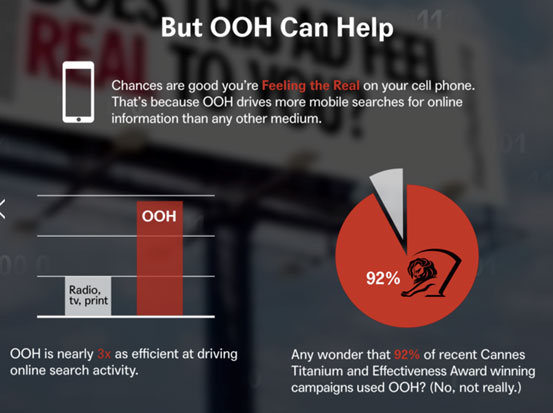
    OOH in the campaign  “Feel the Real,” suggests that in a world where digital and its ability to deliver what it promises is under significant scrutiny, out-of-home has a unique and compelling point of view that having one foot grounded in the real world matters. Placements like billboards and transit shelters don’t suffer such issues.


    The site www.feelthereal.org was interesting. When one lands at the site, a question is posed- if you had seen one of OOH ads. To make life easy, four playful options are provided from. “Yes, I saw it in the real world”, “Yes, I saw it online”, “No, I heard about it” and finally the cheeky one “No, I’m a robot.”


    OAAA and PNYC are collecting the data on traffic and engagement with the campaign’s site to demonstrate OOH ability to drive digital effectiveness. One of the questions pointedly asks if the visitor is from advertising and media. If they can show the tribe being engaged they will make the results stick.


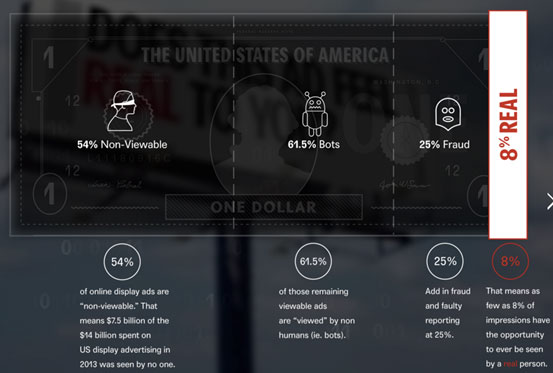
    Once you are engaged, the site takes you through a visual build-up that points out wastage in digital spends making a point that only 8% spends are really seen and thus effective.


    It then goes on to make an offer and tells you OOH can help


    I enjoyed the cheeky ‘How Real Are You’ game at the site. It asked me which all of the listed 20 activities was I involved in the last 30 days. The activities listed included things like Held a baby, accidentally clicked on a banner ad, sang or played an instrument with others, had a good cry, read a book to created a hastag.Once I played the game it declared me to be 40% real and suggested a host of activities to enhance my REAL quotient. These included, make a fort in your room using blankets and cushions, Eat breakfast outside, pick your own fruit from the tree, Go look for more OOH advertising, walk barefoot, swim underwater etc.… GO CHECK  HOW REAL YOU ARE at www.feelthereal.org 


    If you were not from media and advertising- it proposed that people are forgetting what it is to be a real person living in the real world. Then it shares some stark statistics. I am sure that maybe behind in OOH digital technology but these statistics maybe very much nearer to us. Things like-

    • 56% of Social Media Users Suffer From FOMO (Fear Of Missing Out)
    • 47 % of teens agree that they get uneasy or nervous when they learn through social media that some of their friends or peers are doing something that they are not.
    • 50% prefer digital communication; half of all Americans say they prefer to communicate digitally than talk in person, according to a Time Inc. study.
    • 24% have missed out on experiences: 24% of people say they’ve missed out on enjoying special moments in person because they were too busy trying to document their experiences for online sharing


    The outdoor medium’s growth in US has been fuelled by new digital billboards that can be updated dynamically and its ability to reach mass audiences in transit. For a marketer, out-of-home ads are appealing because they can’t be skipped or fast-forwarded like TV ads recorded on a DVR. Unlike digital ads, ad fraud isn’t much of a concern when it comes to buying billboards.


    In India, the OOH industry is still remains highly fragmented and unregulated. It can be argued that soon the OOH in India will also become a lot more digitally dominated where quick changes and time-share on the properties will be a reality. The integration with the digital platform is an eventuality. The process will hasten if the clients put money behind experimentation and technology.


    So, will the OOH association in India wait for the problem to be identified or will it take some proactive actions in making media planners re-evaluate the medium and the constituent members to self-regulate.


    Article based in initial write-up by Nathalie Tadena in Wall Street, The press release by OAAA and the experience at www.feelthereal.org


    Sanjeev Kotnala is Founder at Intradia World. A Brand, Marketing & Management Advisor. He conducts specialised workshops in the area of IDEATION (Harvest and Liberate) and INNOVATION (InNoWait). He focuses energy in enhancing client’s team’s potential and capabilities and decreasing their dependence  on external resources. Email sanjeev@intradia.in  or tweet @s_kotnala visit www.intradia.inwww.sanjeevkotnala.com. The views here are his own.


  • Save Print. Now!


    By Sanjeev Kotnala


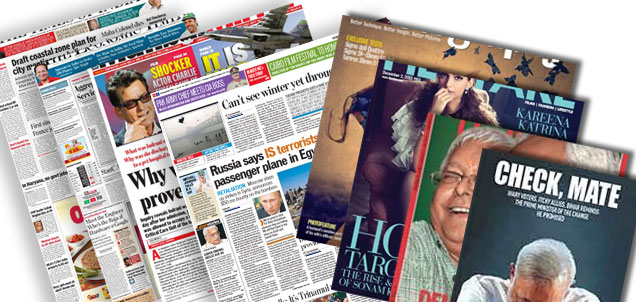
    The annual two-day INMA South Asia Conference commences in Delhi today. Like every year, delegates will join in, expecting to learn something new. However, by the evening, the corridor talks will as usual move towards mistrust and collective inertia in Print. The adventurous ones will start eulogising digital and once again sound the bell. The ring of the bell may be distant, but it’s there.


    This INMA session is immediately after the festive season of three months. Delegates will be high and intoxicated with the large format, big season ads. The mood will hopefully be upbeat. Unfortunately, a false sense of calmness will be appreciated in this unpredictable world.


    After yielding some ground in metro markets, it is time for print owners to take concrete steps in non-metro towns to stem the tide.  Otherwise eroding reader interest and advertiser’s heightened apathy to Tier-II and III towns will hurt.


    Due to Accessibility, Affordability and Availability issues, the digital invasion has been a lot more timid than disruptive. But things are changing. There are more regional satellite beams, next generation media leaps, activation, experiential, potential and possibilities sketched by radio along with the excitement of OOH. On the other side, the sheer orgasmic pleasure of having a brand TVC continues to tempt businesses. Like an aphrodisiac for the uninitiated.


    Apathy to print is transparently naked in creative for Metro markets. To paraphrase a line from Storyboard, it is as though “Print work in an Agency is done by people we don’t even know exist”.


    Unlike in the metros, clients and agencies in Tier-II and III towns continue to strongly believe in the efficacies of Print. Even without the art, craft and science of print creativity to leverage the medium, clients and the agencies know the impact it has and the loss they can suffer for not considering it.


    It is holding as of now, but when the tsunami of alternate media impact vehicles build up, clients may willingly start focusing on alliances outside of print. We already know of government thrust toward Digital coupled with control guidelines on Print spends.


    Print publishers can’t be blind. What are they waiting for? No one is going to stop ringing that bell. They need to act. They need to find plausible solutions. Or they can continue waiting for a miracle to happen. Should I suggest that we may soon need a ‘SAVE PRINT’ campaign much like the ones we conduct for our endangered species? This may sound exaggerated, but the situation is no longer rosy.


    Instead of an ostrich approach, there is still time for print to work in NON-METRO business environments. The charm of print may be stretched. May be we can still revive (sounds as if it is in ICU) the lost glamour, impact, understanding and the surprising art of print creativity. Oh, such are the fantasies of print lovers made of.!


    Print is happy with a short-range vision. In tea breaks, delegates may share success stories of how some of their clients have spent mini TV campaign budgets oncatalogue advertising with them. No one will question any of this. In fact, no one will have an answer to the question Anant Rangaswami raised: Why is it that clients who are so deeply involved in the development of a simple 10-seconder on TV,are completely immune to such waste in print


    The excuse has been that agencies simply deliver what the client demands. If the client wants a Becchu ad, he gets one. It does not stimulate creative thoughts.


    Print has done itself disservice by repeatedly projecting it as the best medium for announcement and tactical medium. Brand Building has been allowed to drift away to audio-video and the medium of clicks!


    Print was famous for well-crafted and impactful advertising creatives. There was an engagement of a different order. The game of seductionwas on. It’s all been forgotten. Even print publisher’s stay away from using print for thematic brand communication. They do announcement and town howler ads in B2B further strengthening the myth. Only Digital, TV and experiential gives the client and creative a kick.  Print is not sexy anymore.


    The whole industry has been victim to this closed ecosystem. Everyone has a converging point of view. ‘Print is this and print is that’. There are no ideas of what it can do, but there exists a collective acceptance of what print cannot do. Print is projected as a tactical and medium of immediate impact. And thus is created the self-fulfilling prophecy?


    There are continuous inputs and experimentation in other mediums. They have evolved in terms of art, science and craft. They are sexier and interesting. But print has royally remained static. The sales tactics and approach remain stagnant. The high cost of innovation prevents brands thinking to experiment. The news environment and ambience print provides is questionable. The position and placement of ads and content is ill managed.


    There is no one advising the client. Sales teams find it below their dignity to close the loop. Afraid of possible reactions, they do not connect back post the campaign. The post coitus hug is definitely missing.  Print publishers squarely fail to shoulder the responsibility of acting to enhance the understanding of the medium and its impact. Maybe collectively a BBDO ‘acts and not ads’ may work.


    It will be foolish to even suggest that the medium no longer works. It is like saying that the car does not move because I do not have the key. I am sure that ads like ‘Nude Model wanted’ or ‘Animals came from cities’ or ‘Merawala blue’ or ‘Nothing official about it’ will work even today.


    May be it is time for Print to take collective action. Maybe they could start with town wise minimum cover price. I know a question on this will be asked and will be underplayed by the panel facing it. Change in cover price even at the cost of some percentage of readers falling off is required to cover drops in ad revenue. Just a mere25 paisa increase in cover price across the nine brandsnot accepting IRS, can pay for better research many times over. Such a print cess when collated  can make it possible for a medium to rejuvenate itself with acts that an individualPrint brand canonly fantasise about.


    May be print can discount the non-discount ads. It will help promote brand building and thematic use of medium. It will be interesting to have special rates for ads that do not featurewords like “discount”, “announcement value”, “inauguration”, “limited period”,“Sale”, etc. Essentially encourage non-topical, thematic advertising.


    Print drastically needs fresh thinking and recharging. Will people secure withthe thought of their retirement plans survivein print to lead the way?


    Print must work with selected print-inclined clients and co-create disruptive cases demonstratingprint powerbeyond tactical communication.


    May be print can promote a real-life-real-brand print only campaign contest?I have always wondered why did print allowed ‘Think Print Contest’ to die. One can revive it.


    Other than news, print should embrace social media. They must share good print. Suggest and engage the B2B community.


    It is the responsibility of large print publishers tobring alive the print craft and educate the new creative generation in Tier-II and III towns. This can help reverse or at least slow down the debate on print effectiveness and investments.


    Awards like the Ink Awards should be collectively owned by the print category. Work out ways to make it a coveted award to win. Print needs to find idols for the new generation. There is no Ivan Arthur in sight.


    The Cannes TV showreel is an event. The Cannes print ad exhibition a dream.


    Print cannot stop scam ads, but can large print houses refuse to collaborate and stop providing free space in the name of B2B relationship.


    There is still time to control the game in tier-II and III towns. There are many possibilities and actions that print can take.  But in the end, it is for print to decide to act or remain silent witness to its own slow death.


    Sanjeev Kotnala is Founder at Intradia World. A Brand, Marketing & Management UnConsult Advisor. He conducts specialised workshops in the area of IDEATION (Harvest and Liberate) and INNOVATION (InNoWait). He focuses energy in enhancing client’s team’s potential and capabilities and decreasing their dependence  on external resources. Email sanjeev@intradia.in  or tweet at s_kotnala visit www.intradia.inwww.sanjeevkotnala.com. The views here are his own. Kotmartial appears every Wednesday on MxMIndia.com

    ………………………………………………………


  • Sanjeev Kotnala: Simple ways to find out if a brand is developing Positive Immunity

    By Sanjeev Kotnala


    In the last two articles ‘Are consumers developing Immunity to your messages’ and ‘How to develop Positive Immunity’ we have discussed the concept of PBI (Positive Brand Immunity). For the brand custodian, it is important to know the impact of their messages.


    There are three possible outcomes to such efforts. The consumer can develop Brand Message Immunity (BMI).  The efforts are wasted with no impact; the consumer is neutral to them. Or result in brand developing PBI.


    The aim is to use uncomplicated methods to determine the outcome.


    The simplest of all methods is to ask consumers, their net take-out of the message. We look for the residual impression or perception in their mind. This helps in doing a simple directional Brand Character and strength analysis. It is like asking ‘Does Fevicol has the best bond?’.


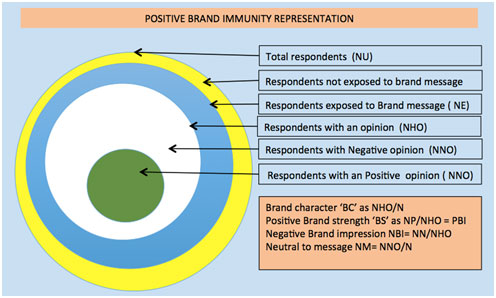
    If‘NU’ is the total number of respondents we connect with and ‘NE’ is the respondents exposed to the brand message. They will have an opinion or will have no opinion on the parameter.


    ‘NHO’is the number having an opinion on a set parameter on the brand. And ‘NNO’ (NE- NHO) is the set having no opinion.


    The second level is to find what is that impression. It is positive or negative.

    ‘NP’= the number of respondents who are positively inclined on the brand and ‘NN’ have a negative opinion. NHO= NP + NN

    In such a situation, we define Brand character ‘BC’ as NHO/N then
    Positive Brand strength ‘BS’ as NP/NHO = PBI
    Negative Brand impression NBI= NN/NHO
    Neutral to message NM= NNO/N


    The above example is a simplified version, where we have considered that only audience who have been exposed to message have an opinion on the brand parameter. In real life, people who have not been exposed will also have perceptions. And the diagram and values can be suitably be modified

    Tracking these comparable numeric values across competition will help us in fine-tuning our efforts. If one can isolate these figures for media exposed or lead media, it may help us determine media effectiveness.


    The brands aim should be to consciously focus on increasing the value of ‘NHO’ and ‘NP’. The high value of NNO is indicating creative inefficiencies.


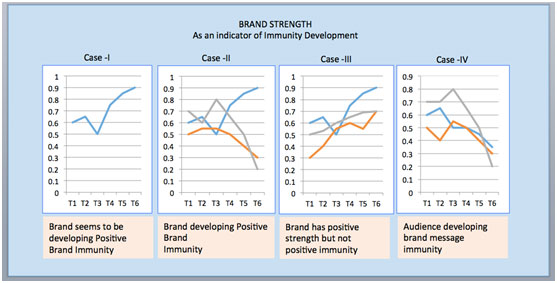
    If the trending line BS (numeric value) on a set message parameter is moving upwards (Case-I), the brand is developing Positive Immunity. It is a strong case when the BS for the competitive brandsisdecreasing (Case-II).


    If the BS value is climbing or high for all the brands (Case – III) then the consumer is developing immunity for the messages on that parameter, which is currently of  high importance.


    If the BS value for the all brands is all moving downwards (Case-IV) and is in low figure then the consumers has developing BRAND MESSAGE APATHY (BMA). It is the initial stage before immunity is developed.


    Another simple way is to use the Net-Brand-score result on ‘always- never’ scale. How likely they are to recommend the brand to their family and friends?  Use of ‘family and friends’ instead of ‘others’ is a stronger parameter. The respondents are forced to make a hard choice. They are clearly more accountable to friends and family than others in their circle.


    Priya Lobo of Ormax suggests use of perceptual scale than discreet values. The respondent places their brands visualising their level of confidence. It accommodates fractional differences andis a better measure of skew and inclination.


    But if there is no research planned, listening to chatter on social media can give directional inputs. Avoid using likes, shares and re-tweets as matrices for Positive Immunity. Positive Brand Immunity is a level before brand fanatics. Listen to find out if brand has succeeded in creating Brand influencers, ambassador and defenders?Use the tools to determine the size of Brand Bashers, which is reflection of Brand Immunity.


    These are some of simple ways to get directional recommendations.It is worth the brands time, efforts and money to get a research agency to probe the brands immunity levels. Hopefully that will help you enhance the effectiveness of your communication.


    Sanjeev Kotnala is Founder at Intradia World. A Brand, Marketing & Management UnConsult Advisor. He conducts specialised workshops in the area of IDEATION (Harvest and Liberate) and INNOVATION (InNoWait). He focuses energy in enhancing client’s team’s potential and capabilities and decreasing their dependence  on external resources. Email sanjeev@intradia.in  or tweet at s_kotnala visit www.intradia.inwww.sanjeevkotnala.com.


  • Sanjeev Kotnala: Is the Consumer developing an Immunity to your Brand Messages

    By Sanjeev Kotnala


    I hate it, when I am suffering from fever and my doctor refuses to prescribe painkillers or antibiotics. But his logic is simple. My body may develop immunity against prescribed chemicals and then I will need a higher dose. One day even the higher doses will stop working. A new prescription will be needed to treat the same problem. So an overdose and repeated prescription of same medicines is a sure trap. I will land  in a cycle for search of the next potent solution.


    You also must have heard this story before. The story of a shepherd who would playfully shout ‘Sher Aya, Sher Aya’ (the tiger has come). Villagers would rush to help him, but find no tiger. Then one day finally the dreaded tiger came. The shepherd shouted. But the villagers did not come to his rescue. They were sure it was another false alarm. The villagers were immune to his cries.


    The consumer is no different. S/he readily develops immunity to your repeated high dose of communication. Many times the brand remains blissfully unaware of it. It raises the dose and waits for it to be disappointed. All it needed was a new chemical to interface with the consumer. Find new messages, treatment or media to get him/ her to react.


    Unfortunately, the number of truly caring brands is low. And the consumers have seen through the screen of brand’s disguise while eyeing their wallets.


    It is a happy disruption when the brand custodians find a new trigger and insights. Soon the lazy category adapts the new mantra. It becomes the industry norm. As the consumer category DNA mutates, the new medicine impacts hurriedly moves on the curve of diminishing returns. None of the stakeholders is a winner in this case.


    The immunity developed is always potent.  It affects not just the default category but cuts across other similar categories. The brand custodians find another chemical and happily provide symbolic relief. They forget to focus on the root cause. They treat the same problem forgetting to read the consumer’s real evolved need.


    Immunity is the consumer’s AHA moment. It is when s/he says, I understand, I will no longer be affected by brands false pretentions. The earlier experiences are memories and I treasure them. You were useful to me in earlier life and avatar but I am a fast learner. Unfortunately you don’t think so. S/he no longer believes in the brand attitude. Nothing seems to move him/her. In this era of plenty consumers are not even looking at the brand for solutions.


    The brand custodians do what they are taught to do. Fire another research. They collectively fail using the same old techniques. They tend to use the same methods to reach them. They fail faster when the consumer stops trusting the messenger.


    For consumers, no news is good news. Even when their hearts are telling him to believe, their minds telling them to check for the catch. The believability and credibility is under scrutiny.  This is a polite way to say that there is a loss of Credibility.


    Let us take the case of multiple education awards and rankings. Each more unscientific in its approach and objective. Students don’t trust them anymore. They have their own sources. They tap into social media and connect with alumni. They connect with the current students to decide. The awards and rankings are more useless than ever before. I am willing to bet that the award organiser do not refer to their own results while deciding the institute for their child’s education. It does not mean that there is no scope for a really honest all encompassing ranking.


    This is festive time and talk of discount and sales is in the air. The consumer is no longer happy with the 15-20% sale. ‘Buy 1 get 1 free’ is dead. In some categories ‘Buy 1, Get 7’ is not exciting enough. The consumer has been over exposed to the pornographic sales tactics. Earlier it was a way to liquidate stocks. Now it is a way of life. Consumers have their own MVP (Maximum Value Price). They think the brand has been cheating them for long. The perceived relative price of every item is dropping faster than irrelevant value adds being provided by the brands. Premium brands in the race have lost their license to charge premium. There is a new defined immunity against MRP. Consumer treats the discounted price as the MRP and equates it against MVP. He is no longer easily seduced.


    The IVR system with ‘you are important’ was a breather. Now in its mutant version of ‘You are important to us, please wait’, it is helping accelerate immunity against the promise of service. The brands may find it better to deploy the ‘call back’ systems.


    Bulk e-mail marketing even if personalised is losing its impact. There is too much of it. The consumer is tired of deleting and unsubscribing. The brands, which take blanket permission under the comfort of long-winded acceptance and then flood the inbox, will lose out. The consumer does not only mark their mail as spam but subconsciously would be making the brands as irrelevant.


    The whitening and wrinkle-remedy creams are magical remedies that don’t work.  The consumer distrust is high. Consumer is more confident of their dreams and comfortable with their identities. Here it is no longer a case of over or under delivery. The promise though based on a relevant insight is over exaggerated.


    On the other hand, the deodorants ride a truly laughable execution underlining their highly improbable promise. Deodorants are fine. The consumer treats the category like AIB. Infact they are waiting for the new play that the category must soon discover.


    Whereas, ‘under-promise over-delivery’ (the biblical truth) in product experience or service helps developing POSITIVE IMMUNITY. It is like getting vaccinated. ‘Fevicol’ is a great example of it. The consumer is positively immunized. S/he blocks the possible impact of any message by any other brand in the category. In his/her mind, no brand can bind as powerful as Fevicol. Fevicol in a consumer’s mind is an expert. An expert who understands his/her world. Pathar Ki Lakir.  Written on rock.


    Positive immunity helps brands in case of crisis and reputation management. Nestle is a recent case. The amount of smiles and messages that greet the news of its revival is not funny. It has potential to brand December 15 (or the day of re-launch) as a date of Product Purity or brand resurgence.


    Positively immunised consumer looks the other way and pardons your minor mistakes. In best-case scenario, they are willing to stand up for you and defend the brand.


    Check if your Brand has Positive Immunity.

    May be it is time you included this in your agenda. In addition to repeated consumer insight study, also study consumer immunity. Check the things the consumer is immune to as a brand and the category. Evaluate how far your messages are overloaded and over exposed.


    Keep checking to time the introduction of the next chemical is needed. Do not think that every season or a pre-defined quarter is the time to introduce the new chemical in your interface with the consumer.


    Devote your energies to think ways in which you can make your brand gain positive immunity.


    Sanjeev Kotnala is Founder at Intradia World. A Brand, Marketing &  Management UnConsult Advisor. He conducts specialised workshops in the area of IDEATION (Harvest and Liberate) and INNOVATION (InNoWait). He focuses energy in enhancing client’s team’s potential and capabilities and decreasing their dependence  on external resources. Email sanjeev@intradia.in  or tweet at s_kotnala visit www.intradia.in  www.sanjeevkotnala.com.

     

  • Sanjeev Kotnala: Oh, these morons!

    By Sanjeev Kotnala


    Media brands in the B2B space take their business communication and related messaging very seriously. While I do not expect them to evolve to H2H conversation anytime in the near future, the fact remains that they do consider their B2B initiatives a very important part of their selling process.


    Media trade magazines are already thick with peak season advertising from a variety of media houses (in addition to e-mailers that have been pouring in).  I couldn’t help but bemoan yet again about something that has always bothered me.  Media brands believe in simple messaging. Which is good in principle, but it’s the manner in which they go about it that gets my goat. Media advertising during seasons always reminds me of announcements blaring through loudspeakers at a village mela. Ads that have been created without ever taxing a single grey cell, spewing out advertising that is totally devoid of engagement or involvement.


    It begins just before the busy and decisive festival period. In your face. Almost every media house worth your rupee begins screaming its guts out about being No 1, superhero, superman, God’s gift to mankind and the world’s most powerful remedy for all the ills your brand may be suffering from. And, amazingly, all this just days before ROs will be printed. Just days before the year’s most important season for advertising. Like touts at a pilgrimage centre, crowding around to stake a last minute claim for business.


    Ironicallym these are usually the very same media houses that cry in despair at clients not being present in media through out the year. When it comes to their own brands they seem to be good with this last minute, repetitive, irritatingly loud messages delivered in bulk. Do these media houses really believe that these last-minute loud claims work? Or are these ads placed by media houses supposed to act as confidence boosters for their own sales force? If so, do these sales teams really believe a six-page gatefold in a leading trade magazine would miraculously force a revision in the year’s most important media plan of a client? At T-minus 3 days to release?


    Let’s take Hindustan, it asks a very pertinent question- Can you afford to miss me? And as an after-thought, it presents some data about exclusive readers and decision-makers (25-40?), female and male readership in comparison to Amar Ujala in Uttar Pradesh. It tells you in no uncertain terms, one-subject-at-a-time, the “exclusive readership”, of Hindustan in each category.


    Was there something that I was missing? Is Hindustan really being missed from the plans?  Is this ad a result of market intelligence that probably said Hindustan was out off many media plans because all planners decided (“very wrongly”) that Amar Ujala had more “exclusive readers”? Whatever the reasons may have been, the ad itself is rendered in such an unimaginative way that it is certain to fail in inducing any reaction in trade.


    Malayala Manorama has usually impressed me with their communication. But this time I simply had to do a face-palm! ‘The Champion just became the Overall Champion”. ‘’The Leader just became a Record-breaking Leader”. ‘The Winner just became a Winner by Knock-out”. ‘The Number 1 just became The Absolute Number No.1”. Duh? And then we expect brand planners and clients to take them seriously?


    Even if such advertising is simply intended as ammunition for their sales teams, should it not matter what the message or creative conveys? May be they think they are talking to morons and as long as these ads get some basic exposure the message will filter in. If at all there is exposure, it is the exposure of an extremely lazy media brand. Wonder what they smoke. Sadly the list of such lazy brands is a long and depressingly lengthy one.


    So are there absolutely no media brands that have caught my eye this year? A couple did indeed. My FM, for one. This Tier-II radio brand usually comes up with good brand and category-centric work. Not that they do superlative standout stuff, but there is always certain freshness to their work. This season they have used two creative leaders to make a media statement that is laced with possibilities. They could have done with better art direction, though. The brand stands out with a consistency in brand colours, tonality and voice that is becoming rare these days. The interview format is reader-friendly and relevant. It speaks to and simultaneously challenges the creative, media and marketing fraternities.


    (Taking the thought further, believe industry gains when Industry seniors share their take on media capabilities and potential. Media association like IBF, INS etc are better placed to act on it then a media brand.  These observations then could be amplified across stakeholders, including one’s not residing in metros. )


    Media brands need to stop shouting themselves hoarse with their claims. It is not going to win the battle of wallet-share.  Media brands put disproportionate focus on this shouting. They forget that the media brands are made in the area they service. Marketing in addition to the numeric advantages, need to amplify the brands interface, trust, and faith and fit with the audience. Thus giving planner, buyers and advertisers a reason to  evaluate their strategy. The  brands today must be rationally emotional and memorable for them to resonate with the  morons.


    Sanjeev Kotnala is Founder at Intradia World. A Brand, Marketing &  Management UnConsult Advisor. He conducts specialised workshops in the area of IDEATION (Harvest and Liberate) and Innovation (InNoWait). He focuses energy in enhancing client’s internal team’s potential and capabilities. In process decreasing their dependence  on external resources. To connect email sanjeev@intradia.in  or tweet at s_kotnala visit www.intradia.in  www.sanjeevkotnala.com. The views expressed here are his own.

     

  • Sanjeev Kotnala: Say no to mediocre creativity. Amplify OOH experience

    By Sanjeev Kotnala


    There is too much of Out Of Home (OOH) advertising. It’s a space that is cluttered. It is tough to make a statement. It is tough to create an engaging experience.  It is tough to defend such an observation. Absolutely true for hoarding, bus shelter and other such traditional OOH still seeped in old technology that is inching forward at a pace slower than the Himalayan tectonic plate.


    Unfortunately, with the global distances shrinking and information becoming a democratic advantage, one gets enamoured by the global experimentation in this space. Creatively hungry teams in sync with the demands of a willing client are using cutting edge technology and digital interface to create experiences that stand out. Alas, all of this is miles away from Indian shores.


    It’s is definitely not the lack of technology. It is the dearth of clients with confidence willing to take the bite, willing to ride the OOH space. Indian clients want every bit of the enhanced experience and engagement but fail to appreciate the need of investment and commitment to make it a reality. The right results is more than a fault-free implementation, it banks on social media and the insights based creative capability. It banks on the implementation to generate waves in the unpaid media space.


    So, let me not ride in that painful and highly debateable zone. What comes first is the technology investment by media owners or the pathbreaking creative and commitment from a client.  Many questions, no answers. So after raising the subject, let me get back to reality, the basics. It helps to do so.


    Most of our bigger cities are full of potential. Let me take example of Mumbai city.  It is plastered with hoarding and sites. Are they legal or illegal is not the scope of this discussion.


    SV Road, Western and Eastern Highway, Mahim, Haji Ali, Peddar road, Sea Link approach… you name it and there is a junction with immense potential of creating a destination outdoor.  Such busy points of prime importance have a Cluster of hoardings. Unfortunately they are referred as Clutter by the misguided trade and media advisors.


    Let’s take a step back. Compared to print (an intended medium) where eyes narrow their vision to take in the news or ad, OOH is an incidental medium. I have never ventured out seeking a particular hoarding and I bet you have also not done the same. When you are moving, your angle of coverage is wide. Things keep getting in and out of your field of vision.


    You miss out the smaller things and details, unless they are dramatically different or critically important to you. In such a situation, a cluster stands out and becomes a prominent element in your vision and is tough to negate. Unfortunately, they can become blind spots due to inactive engagement. To stand out in this cluster all you need us a challenging creative.  But, what we do is to take the easy way out. We stay away from advantageous clusters. We try being isolated and independent. We do not leverage the possible amplification of a cluster. The mediocre creative that we are so emotionally attached to, pushes us to take such myopically safe actions. In process, all we do is to increase the chance of being missed. Live with lower efficiencies and effectiveness. Miss the chance of making an impact. We remain satiated with the Excel sheet 360-degree plans.


    Take the challenge, invest into technology, understand the audience and create some creatively appealing OOH work. Not the picture from print or a freeze frame from the latest TV commercial. Stop treating OOH as a support and reminder medium. Changing your attitude toward the medium may help you enhance the impact. In this era skewed toward digital, it’s time even OOH took advantage of new technology.


    Try approaching it differently. Say ‘No’ to the mundane non-engaging creative. Next time, think OOH as the lead medium. Next time, design a campaign as if no other medium was available. Next time, force yourself and your teams to push the limit.  And once you get your brilliant OOH answer, go ahead and create that statutory TV, Print and radio creative


    ………………………………..

    Sanjeev Kotnala is Founder of Intradia World. A Brand, Marketing &  Management UnConsult Advisory. He is a certified Life  and mid-life transition Coach. He  conducts specialised workshops in the area of IDEATION (Harvest and Liberate) and Innovation (InNoWait). He focuses his energy in enhancing client’s internal team’s potential and capabilities. In the process, decreasing their dependence  on external resources. To contact email sanjeev@intradia.in  or tweet at s_kotnala visit www.intradia.in  www.sanjeevkotnala.com.

     

  • Sanjeev Kotnala: Stop selling, media salespersons!

    By Sanjeev Kotnala


    The festival period is right here. It will decide the fortune of many media brands.

    There is nothing new in the system. Every trick has been experimented with. The relationship strengthening parties are over. The experiential engagements are on the high. The contest and rewards have slowly started lost their sheen.


    If you are in the plan, there is nothing much to worry about.

    The preferred media vehicle, the over-the-agency-commission commission, the slabs and all of them exist. They covertly work on an individual agency-client, agency- media or media – client combination. A true loyalty programme does not exist in media. Someday it will be launched. Till then, life will be different.


    The media plans are sealed or maybe there is a chance to get in.

    If you are not in by now, then you are not the natural choice. You are not even a choice governed by the unethical associations. That means you need to be sold.


    And here lies the issue. You must been at the wrong lamppost.

    You are a B2B media most likely selling to someone, who is not the final decision maker. It’s ritualistic for you to you to meet her/him. As per the guidelines you make yet another typical templatised presentations. A few cups of coffee and may be a few puffs are shared before you return to office. You are confident of now being in the plan.


    The agonising wait to hear the mobile ring or the RO on mail starts.

    So, the right question to ask is, why are you not in the plan in the first place? Forget you had the numbers or not. Forget if there were preferred associations between you-agency and/or the client. Forget how many rounds of mailers you have shared. Forget the Diwali gift that is still being wrapped.


    The answer is not complicated. It is simple and it stares at you.

    You have given it your best. You have tried selling your media. But, these have been wasted efforts. You have failed to create a passionate brand ambassador or an on-site salesperson within the agency and the client.


    If only there was a perfect clone.

    You need to create another salesperson, not in your organisation’s rolls. A person that best understand you and the media you represent. Someone, who believes in you, who has been primed up with insightful information. Who shares your enthusiasm and passion. Who is willing to question a plan without your media.


    Re-evaluate your job.

    You cannot get results by just selling the media you represent. If your media is a natural choice for some reason, then you are not contributing  enough. I have heard media owners say that 70% of the media business comes irrespective of the sales team and its efforts. Maybe they are being polite. The truth is that your contribution is required to raise this percentage and to bridge the gap.


    Increase efficiency of your efforts.

    To do so, you have just one alternative. Create clones of yourself at the media agency and the client’s office. Fire their imagination with possibilities. Pass on the passion, confidence and the aura of your media. Feed in information. Share all that will help your new onsite sales persons to look smarter. Help them promote your media as a recommended choice. And win arguments, if any.


    More importantly, live with the promise of fulfilling every promise you make. Ensure every promise made by your onsite sales person (in agency or clients’ office) while internally selling your media is respected.


    Is that not the easiest promotion you can earn?


    Sanjeev Kotnala is Founder at Intradia World. A Brand, Marketing & Management UnConsult Advisor. He conducts specialised workshops in the area of IDEATION (Harvest and Liberate) and Innovation (InNoWait). He focuses energy in enhancing client’s internal team’s potential and capabilities. In process decreasing their dependence  on external resources. To contact email sanjeev@intradia.in  or tweet at s_kotnala visit www.intradia.inwww.sanjeevkotnala.com.