Tag: Kotak Institutional Equities

  • Muted growth for TV adspends forecast: Kotak


    The ‘Media’ report by Kotak Institutional Equities reached our inbox on Friday and at first we ignored it as one of the several reports we receive from financial analysts and brokerage companies. But the subject grabbed our attention, and we decided to push the scheduled story for today by a day and publish the report as is:


    Here is the report:

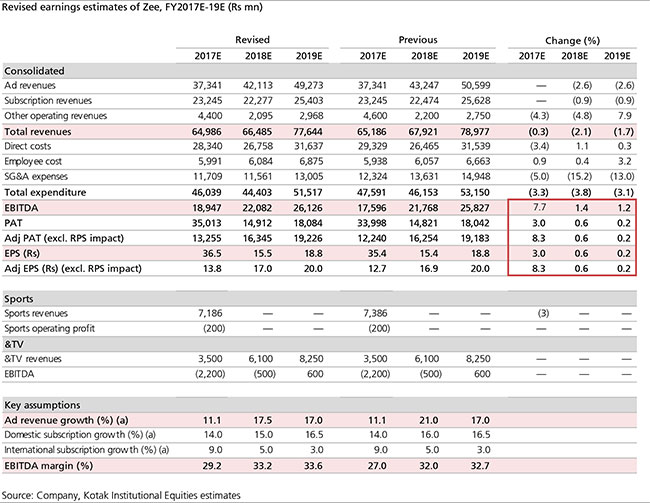
    TV advertising: CY2016 review, CY2017 outlook. We expect TV ad spends growthto be a tad soft at 10/13% in CY2017/FY2018 notwithstanding the low base given weak underlying trends in FMCG and some let up in competitive intensity. The outlook can improve during the year in the event of any stimulus from the government to boost consumption. We moderate FY2018E ad growth forecast for Zee but maintain earnings in view of margin levers available to protect earnings. We recommend adding Zee in the event of any near-term weakness in advertising growth /stock price.


    Television ad spends- a round-up of CY2016

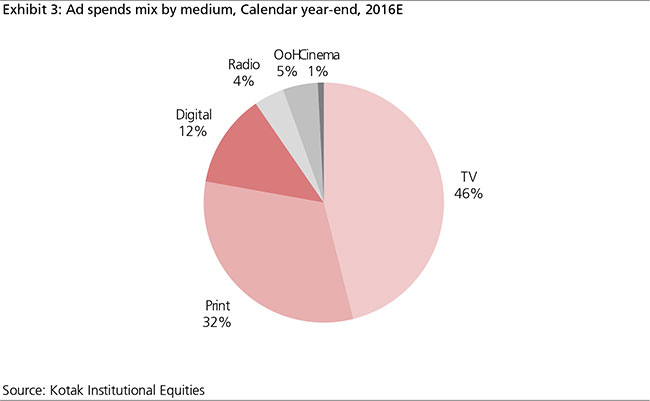
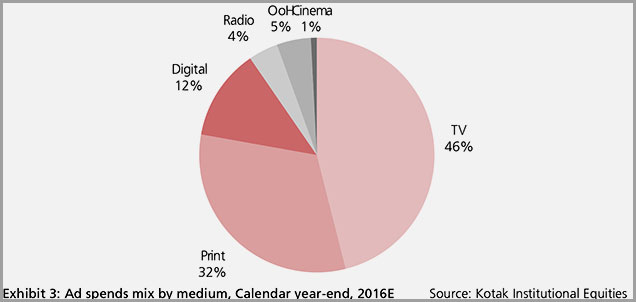
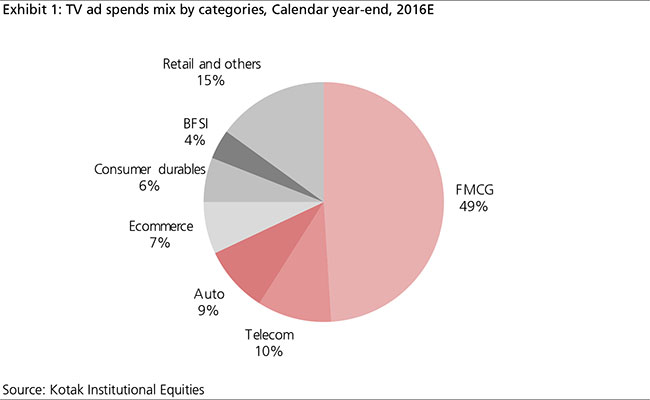
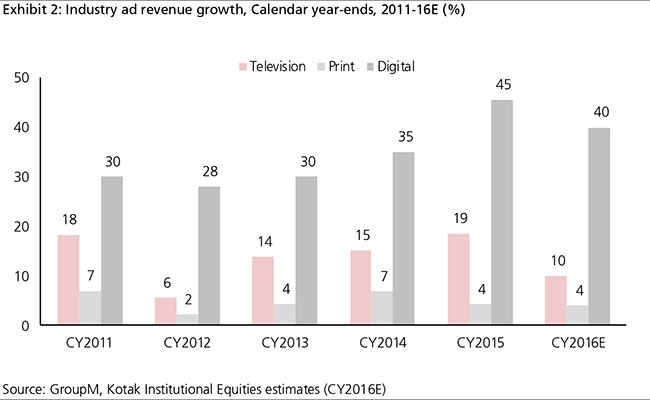
    TV industry ad spends in India grew by about 10% in CY2016E, below our beginning-of-the year expectation of 15% growth. Negative surprises during the course of year were from (1) demonetization (250 bps impact), (2) weak ad spends from FMCG category (50% of TV ad spends) as gross margin expansion paused and volume growth decelerated. The impact was partly offset by sharp increase in ad spends from Patanjali; (net impact 200 bps), and (3) delays in RJio launch and lower than expected ad intensity in telecom (10% of TV ad spends) thereafter (100 bps impact). On the bright side, auto (9% of TV ad spends) category grew in mid-teens. Internet/ecommerce (7% of TV ad spends) category growth moderated to a single digit on consolidation and constrained funding but held well on high base partly aided by heavy advertising by mobile wallets post demonetization. We estimate print/digital ad spends growth at 4%/40% in CY2016 as against beginning-of-the-year industry forecast of 6%/47%.


    CY2017 outlook- recovery in FMCG volume growth essential for strong ad growth

    TV ad spends growth is a function of (1) growth and profitability outlook of consumption categories (ad budgets are pegged as a percentage of revenues and tweaked based on profitability outlook), (2) competitive intensity (new entrants/ launches boost ad intensity in a category). We see moderation in both these trends in CY2017 after 3-4 good years. Key drags

    (1) FMCG: ‘weak volume growth + RM inflation (on the margin)’ environment can put pressure on ad budgets, (2) Internet/ecommerce: ad budget optimization can continue on funding constraints and consolidation. Given this, TV ad spends growth could be muted at 10/13% in CY2017/ FY2018 despite the low base as compared with 14-19% growth over the past 3-4 years. That said, we note there are several potential triggers that can spring a positive surprise in 2HFY18— (1) strong government stimuli to boost consumption, (2) acceleration in unorganized-to-organized shift after implementation of GST, and (3) rise in ad intensity led by Patanjali, Reliance Jio and/or Alibaba. We will keep a close eye on these variables.


    We continue to like Zee given comfort on long-term strategy, execution and profitability

    We expect Zee’s ad growth outperformance of 3-4% over the industry to continue in FY2017-18E led by (1) ratings share gain in Tamil, and (2) expected recovery in Zee TV’s ratings in 3-6 months. We moderate FY2018E ad growth forecast (ex-sports) for Zee to 17.5% (including 1.5% inorganic)


    A round-up of CY2016 TV ad spends

    TV ad spends in India increased by about 10% (KIE) in CY2016, below our beginning-of-the year expectation of 15%. The negative surprise in ad spends growth was due to

    (1) About 2.5% impact of demonetization.

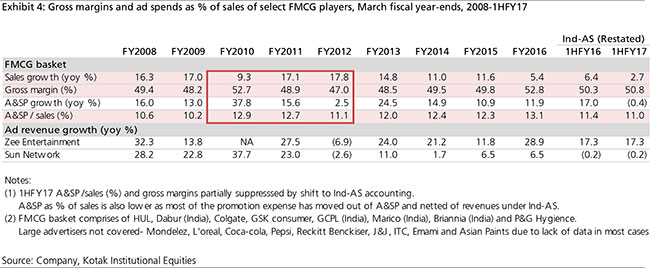
    (2) Weaker than expected ad spends growth of several large FMCG players on account of weak volume growth and a pause in gross margin expansion (Exhibit __). The impact was partly offset by sharp 30%+ increase in ad spends by Patanjali.

    (3) Delays in launch of Reliance Jio and lower than expected advertising intensity in telecom vertical even after the launch.

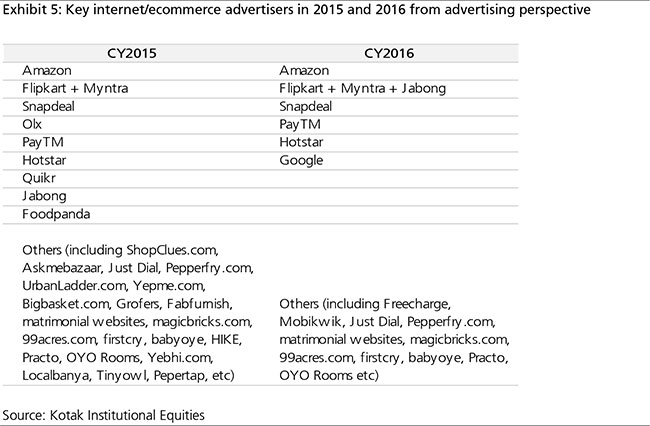
    (4) Internet/Ecommerce segment ad spends growth moderated to a single digit on expected lines given funding constraints and consolidation. We note that the growth was on a high base— ecommerce ad spends on TV grew more than 50% in the previous year. Additionally, several advertisers cut ad budgets or were shut down or acquired in CY2016 (Jabong, Foodpanda, Quickr, Housing.com, Fab furnish and Urban ladder). The impact was partly offset by ad spends growth from mobile wallets and a big campaign by Snapdeal in the December 2016 quarter.

    (5) Auto category reported healthy 15%+ ad growth led by new launches and maintenance campaigns.


    CY2017 TV ad spends outlook

    Ad spends depend on underlying strength in consumption demand, profitability outlook and competitively intensity. In uncertain environments such as the present, several advertisers refrain from finalizing annual ad budgets and instead budgeting is done on a quarterly basis and at times tactical approach is taken. Given many moving parts, forecasting ad growth is a tricky exercise. With that caveat, we detail our thoughts on ad outlook of key categories


    > FMCG (49% of TV ad spends): FMCG ad spends growth decelerated in CY2016 due to weak volume growth followed by impact of demonetization. We expect recovery from demonetization over the next 2-3 months or so, but recent increase in RM prices can put some pressure on margins which in turn could constrain double-digit increase in ad budgets in CY2017/FY2018.


    We highlight (Exhibit 4) (1) Gross margins of FMCG companies expanded by 300 bps over the past 2 years allowing them to invest RM cost savings in AS&P spends. Consequently, AS&P as a percentage of revenues expanded by about 80 bps for our FMCG basket in FY2016. This benign RM cost tailwind has receded and can become a modest headwind. As per KIE’s consumer analysts (please see 16th Dec 2016 consumer sector note ‘Marginrisks underappreciated’), several raw material prices have moved up on yoy basis and atcurrent prices, RM inflation could impact gross margin by about 100 bps for many companies, (2) RM inflation cycle in CY2010-12 resulted in a cut in AS&P as a percentage of revenues with some lag. Volume growth during that period was strong.


    At present, FMCG industry is facing weak volume growth and modest inflation in RM costs. It is tricky to predict whether companies would be tactical and cut AS&P as a percentage of spends to protect margins or change Advertising/Promotion mix to push volumes. Another variable is ad intensity— it has to be seen if Patanjali continues to advertise at 30%+ as was the case in CY2016.


    At a broad level, underlying trends for FMCG are not robust. However, even as near-term outlook is weak, FMCG ad spends can positively surprise 6-9 months out in the event of

    (1) any recovery in volume growth boosted by government stimuli, (2) acceleration in unorganized-to-organized story post implementation of GST. Any signs of this could propel FMCG to increase ad intensity, and (3) higher than usual ad intensity triggered by Patanjali. Further, we note that weak FMCG ad spends would be in the base to some extent starting 2QFY18E.


    > Internet/ecommerce (7% of TV ad spends): Funding constraints, lack of improvement in economics and consolidation will weigh on ad growth from this category. We note that internet/ecommerce ad spends grew many fold during CY2013-15 and boosted TV ad spends growth. This category grew marginally below industry in CY2016 even as it saw closures, ad budget cuts and consolidation thanks to the step up in advertising from mobile wallets. We expect this category to underperform TV industry in CY2017 as well, unless there is a meaningful rise in ad intensity induced by Alibaba (likely to entry Indian Ecommerce space directly or through its investee companies in PayTM and Snapdeal).


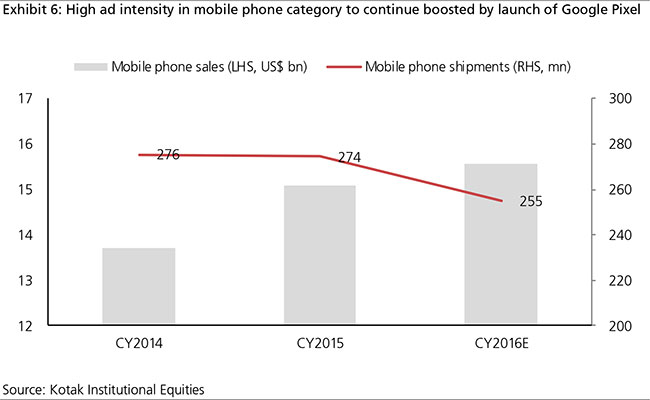
    > Telecom (10% of TV ad spends): This category comprises Telecom service providers, mobile handset manufacturers and DTH players. We expect strong growth led by (1) full-year impact of Reliance Jio and possible increase in ad intensity across telcos, (2) recent entry of Google in mobile handsets augurs well for the category even as absolute growth in smartphone sales value is negligible.


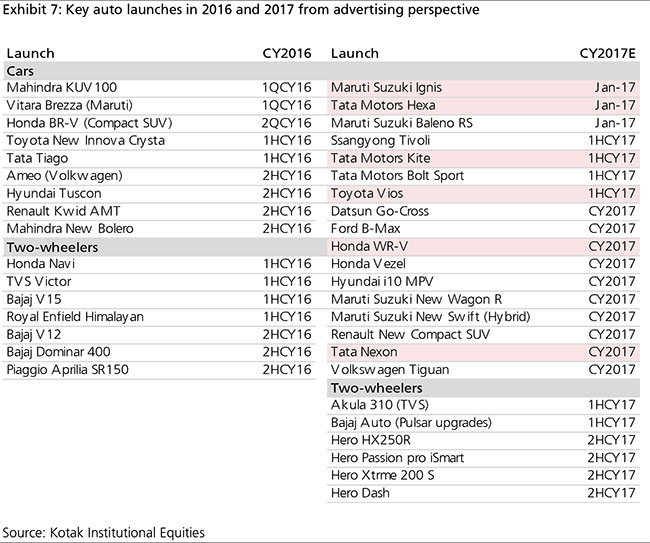
    > Auto (9% of TV ad spends): Auto ad spends growth is a function of new launches and maintenance campaigns. This category reported healthy double digit growth in CY2016 aided by new launches and high activity on maintenance campaigns from Maruti, Tata, Hyundai and Volkswagon. We believe the launch pipeline for CY2017 is stronger than for CY2016. Expect buoyancy in ad spends to continue.


    > Other categories. We expect steady growth in BFSI (4% of TV ad spends) and muted growth in consumer durables (6% of TV ad spends). Government ad spends (1-2% of TV ad spends) could grow 40%+ largely led by 30%+ increase in DAVP advertising rates. Growth in Retail category will depend on the impact of GST.


    We moderate ad growth forecast for Zee but broadly maintain EBITDA and earnings

    We trim FY2018E ad growth forecast for Zee to 17.5% (including 1.5% inorganic from RBNL’s channels) as we build lower ad growth for the industry (13% in FY2018E versus our earlier expectation of 15-16% given the low base). We broadly maintain our EBITDA and earnings estimates and build higher margins. We believe Zee has enough available levers (especially ad and publicity expense of more than Rs4.5 bn) to protect earnings and surprise on profitability. Strong growth in domestic subscription revenues aids profitability– Zee will likely report 14% growth in domestic subscription revenues in FY2017E and simultaneously 15-20%+ decline in carriage costs. We raise our FY2017E estimates as we expect much lower impact on EBITDA and earnings as against our earlier expectation.


  • Kotak partners Google to unveil Querimetrix

    By A Correspondent


    Kotak Institutional Equities, a division of Kotak Securities Limited, in collaboration with Google launched Consumer Querimetrix — a tool that demystifies and predicts near-term Indian consumer behaviour by analyzing Google Trends data.


    Using machine learning techniques and merging big data from Google Trends, the first edition of Consumer Querimetrix provides consumer insights into India’s evolving car buying journey. Using Google Trends data, the tool enables ‘nowcasting’ (near-term predictions) on consumer activity, capturing inflection points earlier than traditional forecasting tools to give a complete picture — on car launches, last mile hiccups, cannibals and competition.


    Each edition of the Consumer Querimetrix series will focus on consumer behaviour in a different industry.


    Launching the report, C Jayaram, Joint Managing Director, Kotak Mahindra Bank said, “The digital wave is challenging conventional business practices across industries. Ground rules are evolving rapidly along with the consumer and those in the business of business intelligence need new tools to keep up with the changing landscape. Consumer Querimetrix is our step in that direction. Today, the sheer volume of consumer-centric search data available presents a tremendous opportunity to analyze and throw up actionable insights. These takeaways would be useful to both companies and investors. KIE research is highly valued by our clients and the launch of Querimetrix will further strengthen our ability to cover the Indian markets in a holistic manner.”


    The first edition of Consumer Querimetrix which focuses on the passenger car segment highlights the extent to which the Internet is altering the ground rules for vendors of cars and allied products/services. With growing access to easy information online, the Indian car buyer’s journey from a whim to final purchase has changed dramatically. More than 75 per cent of car buyers are researching online for reviews, comparative specifications, financial products and used car markets before making a purchase. The first edition of Consumer Querimetrix also explains how the traditional ‘funnel’ model is giving way to a more complex purchasing path where ‘initial consideration’ may not always guarantee sales.  Although higher auto-related searches correspond to higher demand for cars, this does not hold true on a brand-wise basis.


    Speaking about the trends for the passenger cars industry captured by analyzing Google Trends, Vikas Agnihotri, Industry Director, Google India said, “With over 300 million Internet users online and growing, India today has a sizeable population which accesses the Internet on a daily basis, making search queries as the most dynamic data input to arrive at consumer insights through machine learning as illustrated by Kotak’s research. If we look at the search trends related to car finance and car purchases, we’re seeing a 40% year on year growth in car purchase queries on Google in India. Over half of the people who evaluate car purchases change their consideration set during their research phase – adding two to three new car models in their consideration, the only non-negotiables are price and color of the car. This alone proves the growing complexity for car OEMs in the country. With this report we’re attempting to demystify this changing consumer behavior into actionable insights for the industry.”


    Saifullah Rais, Quantitative Analyst at Kotak Institutional Equities and the architect of Consumer Querimetrix said, “In the absence of conventional rules, traditional decision-support systems are not very effective. They fall short on scalability and adaptability. Machine learning algorithms learn from data and do not rely on explicit rules, making them the most effective method of dealing with data explosion.”


    The Consumer Querimetrix report outlines the influence of digital marketplaces and calls for carmakers to reassess conventional business practices. The effect is visible as car loans are increasingly being sourced outside dealerships. This trend can eat into financing margins earned by dealers and hurt profitability. On the other hand, carmakers with captive finance arms can use this opportunity to innovate and differentiate themselves during the evaluation process.


    The first issue of Consumer Querimetrix establishes that Google search volumes can be used as a gauge for assessing new car launches. The report underscores the linear relationship between search interest and advance bookings during a car launch. Interestingly, higher traditional media spends do not always guarantee higher search interest.


  • Kotak partners Google to unveil Querimetrix

    By A Correspondent


    Kotak Institutional Equities, a division of Kotak Securities Limited, in collaboration with Google launched Consumer Querimetrix — a tool that demystifies and predicts near-term Indian consumer behaviour by analyzing Google Trends data.


    Using machine learning techniques and merging big data from Google Trends, the first edition of Consumer Querimetrix provides consumer insights into India’s evolving car buying journey. Using Google Trends data, the tool enables ‘nowcasting’ (near-term predictions) on consumer activity, capturing inflection points earlier than traditional forecasting tools to give a complete picture — on car launches, last mile hiccups, cannibals and competition.


    Each edition of the Consumer Querimetrix series will focus on consumer behaviour in a different industry.


    Launching the report, C Jayaram, Joint Managing Director, Kotak Mahindra Bank said, “The digital wave is challenging conventional business practices across industries. Ground rules are evolving rapidly along with the consumer and those in the business of business intelligence need new tools to keep up with the changing landscape. Consumer Querimetrix is our step in that direction. Today, the sheer volume of consumer-centric search data available presents a tremendous opportunity to analyze and throw up actionable insights. These takeaways would be useful to both companies and investors. KIE research is highly valued by our clients and the launch of Querimetrix will further strengthen our ability to cover the Indian markets in a holistic manner.”


    The first edition of Consumer Querimetrix which focuses on the passenger car segment highlights the extent to which the Internet is altering the ground rules for vendors of cars and allied products/services. With growing access to easy information online, the Indian car buyer’s journey from a whim to final purchase has changed dramatically. More than 75 per cent of car buyers are researching online for reviews, comparative specifications, financial products and used car markets before making a purchase. The first edition of Consumer Querimetrix also explains how the traditional ‘funnel’ model is giving way to a more complex purchasing path where ‘initial consideration’ may not always guarantee sales.  Although higher auto-related searches correspond to higher demand for cars, this does not hold true on a brand-wise basis.


    Speaking about the trends for the passenger cars industry captured by analyzing Google Trends, Vikas Agnihotri, Industry Director, Google India said, “With over 300 million Internet users online and growing, India today has a sizeable population which accesses the Internet on a daily basis, making search queries as the most dynamic data input to arrive at consumer insights through machine learning as illustrated by Kotak’s research. If we look at the search trends related to car finance and car purchases, we’re seeing a 40% year on year growth in car purchase queries on Google in India. Over half of the people who evaluate car purchases change their consideration set during their research phase – adding two to three new car models in their consideration, the only non-negotiables are price and color of the car. This alone proves the growing complexity for car OEMs in the country. With this report we’re attempting to demystify this changing consumer behavior into actionable insights for the industry.”


    Saifullah Rais, Quantitative Analyst at Kotak Institutional Equities and the architect of Consumer Querimetrix said, “In the absence of conventional rules, traditional decision-support systems are not very effective. They fall short on scalability and adaptability. Machine learning algorithms learn from data and do not rely on explicit rules, making them the most effective method of dealing with data explosion.”


    The Consumer Querimetrix report outlines the influence of digital marketplaces and calls for carmakers to reassess conventional business practices. The effect is visible as car loans are increasingly being sourced outside dealerships. This trend can eat into financing margins earned by dealers and hurt profitability. On the other hand, carmakers with captive finance arms can use this opportunity to innovate and differentiate themselves during the evaluation process.


    The first issue of Consumer Querimetrix establishes that Google search volumes can be used as a gauge for assessing new car launches. The report underscores the linear relationship between search interest and advance bookings during a car launch. Interestingly, higher traditional media spends do not always guarantee higher search interest.