Tag: Koo

  • Koo R-Day with new campaign

    By Our Staff


    Koo, the Made-in-India Twitter-like microblogging platform has launched a campaign around Republic Day. Called #TogetherWeKoo, it started on January 21.


    “India is a land of diversity, with 1000s of languages, and true expression lies in being able to speak from the heart, in one’s own language,” said Aprameya Radhakrishna, CEO and Co-Founder of Koo. “True democracy lies in giving a platform to everyone, and we invite you to join us on Koo and support this campaign of equal opportunity of expression.”


  • Koo strengthens leadership

    By Our Staff


    Multilingual microblogging and social networking service Koo has announced the appointment of Sunil Kamath as Chief Business Officer. Sunil will lead growth strategies, marketing, business partnerships, monetization and expansion at Koo.


    Aprameya Radhakrishna, Co-Founder & CEO, Koo, said: “We are pleased to welcome Sunil Kamath as our Chief Business Officer. Having taken businesses from India to global markets, Sunil has the right experience and proven expertise in scaling and consolidating platforms. With our aligned vision, we will continue to grow Koo as a multi-lingual platform from India to the world.”


    Speaking of his appointment, Sunil Kamath, Chief Business Officer, Koo, added: “I am excited to be a part of the Leadership at Koo, at this phase of hyper growth as more users join to express themselves in a native language, create hyperlocal content and discover language communities. I look forward to contributing in Koo’s journey to become the multi-lingual platform-of-choice for language speakers from across the world.”


  • Koo launches ‘Voices of India’ Report

    By Our Staff


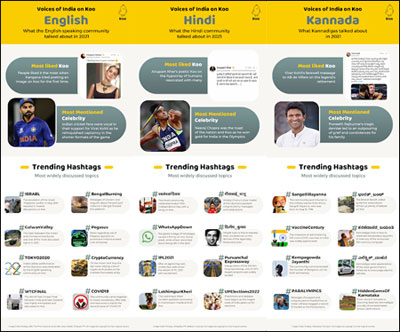
    Microblogging platform Koo has released a ‘Voices of India’ Report offering insights into how Indians across linguistic diversities think, feel and express themselves online on topics most relevant to them. The report is representative of user sentiments on the multi-lingual platform, which has witnessed 20mn+ downloads since its inception in March 2020.


    On the Koo App – #Covid19, #Tokyo2020, #IPL2021, #UPElections2022, #LakhimpurKheri trended the most among users. The platform had launched a slew of initiatives during the lethal second wave of the coronavirus to make it easier for people to find leads for hospital beds, oxygen cylinders, etc. and users alerted their communities and shared several precautionary measures.


    Politics and sports also garnered in much traction on the platform with #UPElections2022, #Tokyo2020 and #IPL2021 trending – as users shared their thoughts and opinions across languages. Virat Kohli and Olympic gold medallist Neeraj Chopra were among the most mentioned celebrities on the platform, as fans sent in their love and support to their sporting heroes.


  • Koo collaborates with Fortis to address exam stress

    By Our Staff


    Microblogging platform Koo has launched a special initiative in collaboration with the Fortis National Mental Health Programme to address examination stress.


    Speaking on the campaign and the dire need to combat exam-related stress in an effective way, a Koo spokesperson said: “Koo – as an innovative platform – promotes dialogue between people on a variety of important topics across a slew of native Indian languages. The issue of exam-related stress is something almost every student and their parents go through. Thus, a freewheeling chat with experts in native languages could help students and parents manage their stress levels better. We believe that social media platforms can play a significant role in knowledge sharing on key issues like stress management and combating exam fever to help build a happy India.”


    Added Dr Samir Parikh, Director-Fortis National Mental Health Programme, Fortis Healthcare: “Each year a huge number of students and their parents experience significant stress that builds up on account of the pressure of examinations. It’s always better to discuss and express what one is feeling through conversations. Providing the right tools and skills which have a scientific basis to students and their parents are crucially important in helping them manage their anxiety and perform at an optimum level. It’s imperative that exams be seen as a methodology to teach students critical life skills and not just as a mechanism to procure marks.”


  • Free Discourse in the Age of National Threats


    By Shashidhar Nanjundaiah

     

    Shashidhar NanjundaiahThe Twitter-Indian government war is gaining unprecedented but expected proportions. After BJP IT Cell head Amit Malviya’s tweet on the farmers’ protest was called out in early December by Twitter as “manipulative media”—its first ever time to do so for all the claims about Malviya as a repeat offender, the micro-blogging company now finds itself in trouble with the BJP government.

    If we must redefine our freedoms, and social media has defined it in its own way, there will be conflict. For the moment, this is a conflict of survival. And Koo comes as a great alternative.

    For the longest time, I have been uneasy with the term “social media”. Can we call it media, I would brood and ask myself. The reasons for my doubt were founded in the definitions we learnt about media. Of course, we have parsed and we have intellectualised it in technology terms—“the plural of medium” is the most common—to its description as “a marketplace of ideas” and most recently, as the non-common carrier of information and insight. For the longest time, the media had been regarded as innocent common carriers of information, much like the telephone.

    Not any longer. Editorial intervention in news still lends it the diversity of voices we have grown to expect it—at least it does so in theory. What Twitter and Facebook did not foresee, however, was that they, too, would be measured with the same yardstick. Surprised, young content moderators are now editors who must determine whether the liberation of expression they had envisioned for their users was too much.

    The less glamorous news item last week was that an Editors Guild of India webinar was cyber-bombed by a number of people who thought the topic—reporting from Naxal areas—was not convenient. Public webinars on platforms such as Zoom always held the technological peril of potentially being hijacked by disruptors. With social media, though, the disruption is a part of the very soul of the technology.

    But as diverse its voices are in principle, organisation remains the very soul of social media, along with its partner-function, transaction. Just as advertisers will take advantage of the big numbers—the soul of the economy of social media—so will organisers seeking to mobilise. If we trust individual minds to determine for themselves what their story should be, there are plenty of opportunities—free of charge—to affiliate with or endorse organised campaigns.

    So while technology has changed, not much has changed in the principle of organised campaigns. Whether it was India’s independence movement or Jayaprakash Narayan, galvanising likeminded people to voice their opinion has been central to change. Social media does beat geography in the mobilisation. Still, like Arab Spring, the real movement is on the ground for any real change to happen.

    That is why, whatever mobilisation of the farmers’ protest may have happened through hashtags, on-ground presence was always going to be critical. The Nishaan Sahib flag (not the Khalistan flag—that, indeed, is fake news that should have been shut down by the government) that fluttered atop India’s best symbol of our freedoms, the Red Fort, is far more emblematic than any hashtag. So while a crackdown on Twitter is underway, a person climbed a Red Fort flagpole at ease on Republic Day, and hoisted a Sikh flag. Police personnel, very much around the place, watched. How difficult was it for the police to prevent a single man from climbing on a flagpole? Questions are being raised whether actors and non-farmers joined the protest. Later, Delhi Police dug trenches and set up barbed fences on roads leading to the capital, and armed themselves with steel batons. It was given much media publicity, as though it were a larger warning. So on one hand, farmers physically violated norms in the capital and the police admitted them on routes that were not permitted.

    On the other, there were online voices that were protesting. While online mobilisation and endorsement was rife—some even calling Prime Minister Modi a potential perpetrator of genocide—this was no longer about the three contentious farm laws. Can such a movement, even considering “Khalistanis” are supporting it, be a threat to the government? Or would the government be better off acting confident of quelling such an attempt? Shouting angrily at Twitter and acting spooked at self-perceived “threats to security” are laughable, puerile actions.

    It all seemed topsy-turvy: the virtual was real, and the real, virtual. Twitter is defending free speech, and a democratic government is shutting it down.

    That is why the homegrown Twitter clone, Koo, comes as a big relief for the government and its political party. Tech-savvy and quick to turn opportunities into advantages, the government has claimed the Koo space to mobilise and co-opt it as a nationalistic platform. For “free discourse,” of course.

    When the US Democrats found that they did not have a strong enough point to claim that Trump instigated violence on the Capitol on January 6, they said simply that he was “responsible”. After Trump was acquitted this week after impeachment proceedings, even Republican leader Mitch McConnell joined the chorus to state that Trump did not do enough to stop the violence. It is reminiscent of what IT Minister Ravi Shankar Prasad and others in his government are doing: They are accusing Twitter of not doing enough. Maybe that is fair.

    But to claim that Twitter must editorialise to suit the government, weeding out inconvenient voices while the government’s own party routinely uses Twitter to spread fake news, is not fair. One is false narrative, the other is fake news. A media-literate government must understand that while we still don’t have laws to protect us from fake news, false narrative is not something you can censor. People at large and political parties and leaders are using instigating language on social media because it sells. Going after Twitter is tantamount to killing the messenger.


    As the founder of BeingResponsible, the author is attempting to build media awareness among school- and college-goers via Responsible Media Literacy. Prof Nanjundaiah has led media institutes to positions of repute and leadership. He is also an editor. You can reach him at shashi.nanjundaiah@hotmail.com. His views here are personal.
     

  • Koo raises $4.1mn as funding

    By Our Staff


    Microblogging platform Koo has raised $4.1 million as part of its Series A funding. Infosys veteran Mohandas Pai’s 3one4 Capital is the latest addition to the investors on board. Accel Partners, Kalaari Capital, Blume Ventures and Dream Incubator also participated in the round.

    Said Aprameya Radhakrishna, Co-Founder and CEO, Koo: “Existing microblogging platforms have not been able to grow beyond the English-speaking population. Koo enables free expression of thoughts and opinions for every Indian irrespective of the language preference. Koo will amplify the daily voices of India on an Indian platform.”

    Added Anurag Ramdasan, Principal, 3one4 Capital: “Koo is a very valuable and powerful platform in the Indian context. Social platforms focused on India need to be highly contextualised to the audience here beyond languages and must include community, moderation and content relevance. Both Aprameya and Mayank are proven entrepreneurs and have built large internet businesses before. We are happy to partner with them to make this atmanirbhar vision become a reality and to build sustainable and socially relevant platforms.”


  • Koo partners with Jan Ki Baat for elections

    By Our Staff


    India’s largest micro-blogging platform Koo announces its partnership with Jan Ki Baat to further reach and encourage Indian audiences to express their thoughts and opinions on everyday trending news.

    As part of the partnership, Pradeep Bhandari will use Koo, as a platform to run opinion polls, post the latest updates on election analysis and allow followers on Koo to express their thoughts and opinions on the elections.  This election year Jan Ki Baat will initiate conversations in regional languages, set the agenda & shape the narrative on Indian politics and Indian elections through factual, educative, data driven on-ground analysis through the Koo platform.

    Said Aprameya Radhakrishna, Co-Founder and CEO of Koo: “Pradeep is the master of election result predictions and his on the ground approach is what the youth of India would love to follow. The tie up with Pradeep and Jan Ki Baat will allow a vast audience who love local Indian languages to connect with him as he travels across India to bring the latest on elections in Indian languages on Koo.”

    Added Bhandari, who is Founder and CEO, Jan Ki Baat: “As India completes 75 years of independence in 2022, Indian languages will strongly shape & dominate the discourse of patriotic youth of India. I have personally experienced the power of Indian languages while travelling across 400 constituencies & connecting with people. Collaboration with ‘Koo’ will help ‘Jan Ki Baat’ reach the masses and involve them in this patriotic journey.”


  • Koo names Pitchfork Partners for comms

    By Our Staff


    Koo, the microblogging platform, has appointed Pitchfork Partners Strategic Consulting as its communications partner.


    Said Aprameya Radhakrishna, Co-Founder, Koo: “Koo has Indianised the micro-blogging format by creating an immersive language experience. Creators can now express themselves freely in their native language and users can follow them and their thoughts. We understand India’s language diversity is unique and a global solution doesn’t work for our people. We are committed to being a platform that helps create and carry the Voice of India to a billion Indians. We are happy to partner with Pitchfork to support us in our journey and take the platform’s message to a larger audience.”


    Added Jaideep Shergill, Co-Founder, Pitchfork Partners: “We’re delighted to partner with Koo. Our diverse experience with startups across sectors will facilitate us achieving milestones together. Technology is the need of the hour and apps such as Koo help the cause.”