Facebook has appointed Umang Bedi as Managing Director, India, where he will lead in building and maintaining strategic relationships with top clients and regional agencies in the country. He will take over from Kirthiga Reddy, who will be returning to United States to take on a new role at the company’s headquarters at Menlo Park.
Bedi comes to Facebook with close to two decades of leadership experience covering sales, marketing and partnerships where he successfully built teams and grew businesses for multinational companies. Prior to joining Facebook, he was Managing Director of the South Asia region at Adobe. He was responsible for growing their business in India and helping India grow to amongst the leading markets for Adobe in the APAC and global regions.
“India is known for its great talent pool and we are really pleased to have Umang Bedi, a proven business executive to lead our business in India. I also want to wish Kirthiga the very best in her new global role. Kirthiga has played a huge and key role in building our India business from scratch, and I know she will continue to deliver the same impact in the US.†said Dan Neary, Vice President, Asia Pacific, Facebook.
He further added, “Facebook is where people and businesses connect on mobile and with close to 150 million monthly active people in India, we see significant opportunities to help Indian business – large and small – deliver against their business objectives in the mobile world.â€
Facebook works with more than 85% of the top 100 advertisers in India identified by Kantar. 100% of those advertisers use video within their Facebook campaigns in India.
“I am thrilled to join Facebook and am looking forward to working with the talented teams in India, to help brands and agencies grow their business on our platform. For me it’s a promising opportunity to participate in India’s digital growth, and I can’t think of a better place to be at.†said, Umang Bedi, Managing Director designate, Facebook India.
Bedi is an engineering graduate from University of Pune, an alumni of Harvard Business School and the recipient of the prestigious ‘40 Under Forty: India’s Hottest Business Leaders Award 2014’ given by The Economic Times and Spencer Stuart in 2014.
Reddy is set to join the Global Accounts team at Menlo Park, CA where she will manage a set of global brands and also lead the emerging markets efforts globally for the Global Accounts team, which manages Facebook’s relationships with the world’s largest global advertisers.
Said Reddy, “After six years in India building our operations and business, it’s hard to leave a team I now call family. The good news is that we will continue to work together. As I look ahead, I am excited about how well positioned our business is, to grow from strength to strength with Umang’s leadership, and with my next opportunity to shape and drive our emerging markets strategy across some of the world’s biggest brands.â€
Umang will officially start at Facebook in July 2016. Kirthiga will start her new role in August 2016.
The ‘Financial Services Forum’, an event jointly hosted by Facebook and Publicis Groupe in India, had many key learnings for brands in the banking, financial services and insurance categories (BFSI).
The event included leaders from Facebook and Publicis, as well as marketers from the BFSI segments, and there were discussions on how to best leverage Facebook as a powerful tool in performance marketing, segmentation of consumers and extrapolation of data, personalized marketing, creative and visual storytelling and effective use of Facebook’s ad serving platform Atlas.
This forum is especially relevant in the context of the digital revolution that the country is undergoing and the resultant impact on the financial sector. There are over 200 million internet mobile connections in India – estimated in June this year, over 150 million in last October. There will be over 600 million smart phones by 2019. Every avenue remains transformed for the BFSI sector, be it transactions or marketing or creation of new products or channels and distribution.
Kirthiga Reddy, Managing Director, Facebook India said, “We are pleased to partner with the Publicis Groupe for the first ever Financial Services Forum. The financial services ecosystem has always been at the heart of economic growth and one of the first in adopting digital and CRM platforms in the country. This conference is about “growth” and how Publicis Groupe and Facebook can work together to help business in the segment grow, in the wake of the consumer’s shift from desktop to mobile.â€
Anupriya Acharya, Group Chief Executive of ZenithOptimedia Group says that in the context of the Indian government‘s call for financial inclusion coupled with the fast transforming consumer journey, the given mobile revolution and now the Digital India initiative, the time to hold a seminar such as ‘Financial Services Forum’ made perfect sense.
Acharya states, “The BFSI sector is set to undergo complete transformation in the next few years. Facebook, with its tremendous mobile reach and equity is not only a great platform for Social and Display but also a powerful tool for Performance marketing. And hence, holds great potential to accelerate growth and business for the BFSI clients. I think that the forum was quite successful in highlighting this and answered a lot of key questions for the marketers. We hope it will help our clients to reflect on their digital assets, on whether they are fully mobile ready for the many millions of addressable consumers on boarding, and how data driven insights can drive thumb stopping content.â€
Hanley King, Chairman, Starcom MediaVest Group, feels that Facebook’s immense reach, frequency of usage, deep mobile penetration and advanced targeting options, make it a platform like none other for the BFSI sector for driving both performance as well as brand awareness objectives.
Speaking on the sidelines of the first ever “Financial Services Forum†King remarks, “The question in everyone’s mind was how do we unleash the unique features of Facebook to drive tangible business results, especially in a category like BFSI which cannot purely depend on relevant exposures. What everyone took away from today’s event is that, in the context of the BFSI sector Facebook is not just a potent source for new customer acquisition but a powerful tool for driving customer retention, engagement and cross-sell opportunities.â€
King further added, “I am sure that the case studies, new product features and tools that were showcased helped our clients see Facebook in a new light and they were able to walk away with a road map on how to translate the platform’s reach, along with its precise and deep segmentation of audiences to achieve their business goals. It has always been our endeavor to bring forth to our clients the best-in-class in digital and we are committed to partner with our clients in their journey to exploit the potential of platforms like Facebook to enhance their business.â€
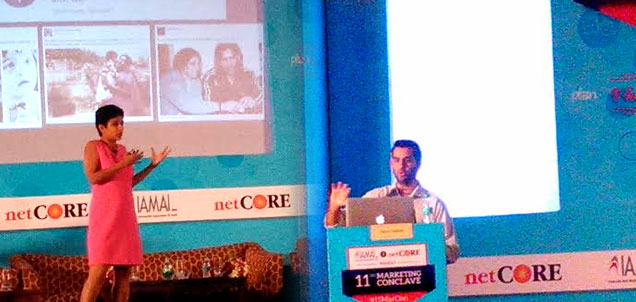
The first Indian Facebook employee, Kirthiga Reddy, now Managing Director, Facebook India left quite an impression on the audience with her talk entitled ‘Winning in a mobile first world’ at the 11th Marketing Conclave organised by the Internet and Mobile Association of India (IAMAI). FOBO or the Fear of Being Offline is a new term that is picking up in this day and age, she said. On Mother’s Day, India had the second highest ranking in terms of interactions with 1.8 billion interactions on the network. The older generation did exactly the same things we do, she explained, the only difference is that they did it in a different way.
63 percent of young people would prefer to give up TV rather than their phone, she said of a study. 62 percent of young people feel lost if they are not connected to social media. An IAMAI-BCG report estimates that by 2020, a whopping 500 million people will be connected to the internet. Back in the day, your kirana shop owner knew exactly what you needed when you walked into his store. That personalisation is missing today with the advent of the mass media, Reddy explained.
Satyan Gajwani, Chief Executive Officer, Times Internet, backed her up saying, “Technology allows the platform of digital advertising to enhance and create advertisements targeted at certain consumers. Hence we are seeing the growth of native advertisement, which breaks clutter and stops disruptive ads.â€
“Facebook is constantly and consistently integrating virtual reality. Innovations on the creative side of the real estate industry has provided enormous boost to virtual reality concept. Brands are focusing on reaching out to consumers in a personalised and creative manner. And the digital platform provides the best solution,†Reddy said. Out of 1.44 billion people who are on Facebook, 1.2 billion connect to it on a mobile device; she informed highlighting the genesis of a mobile-first world. There is also a growing trend of visual communication, Reddy added. First it started with text, then photos and now the world of video is expanding. Reddy cited the example of Facebook’s feature that allows a user to watch videos without sound on the mobile phone. The feature that is one of the latest, plays a video without sound as the user scrolls through his newsfeed. This will allow users to watch videos on their phones even during a seminar or meeting at work, she joked. Marketers ought to strive to drive awareness and retarget their audience, she said. The ‘cookie’ the dominant web metric used to track customer behaviour online will soon be ditched as it doesn’t correctly evaluate business results, she explained. This is the mobile first world and if we don’t adapt, we will be left far behind, she said.
There are 150 million smartphones users today, and that number is expected to go up to 500 million by 2018. Digital is the new advertising paradigm, Gajwani explained. The internet is driven by smartphones and the amount of digital content being created is skyrocketing. “The 300×250 size banner doesn’t have the same impact today, spots don’t have the same impact either,†Gajwani said. Smart and targeted advertising and marketing with precise solutions is what will drive the numbers, he added. We ought to be enablers and educators of what’s working and what is not. “The opportunity to get creative is here and is bigger than ever before,†he concluded.
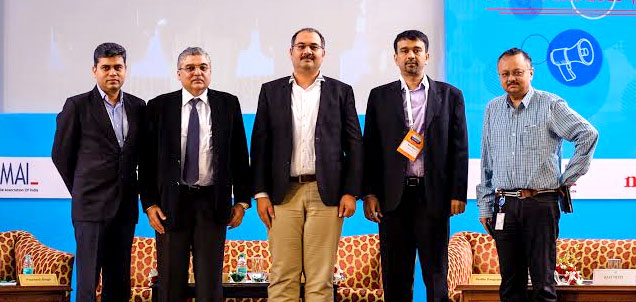
L to R: ​​Prashant Singh, MD, Nielsen, Ashish Bhasin, Chairman and CEO, Dentsu Aegis Network ( South Asia), Tushar Vyas, Chief Strategy Officer – South Asia, GroupM, Ravi Dixit, Head – Market Insights, Google and Partho Dasgupta, CEO, BARC India.​
By Dyanne Coelho
The eleventh edition of the Marketing Conclave organised by the Internet and Mobile Association of India (IAMAI) saw industry stalwarts from across platforms highlight key trends in the marketing world from the digital evolution, the changing role of the CMO, cross-platform marketing and the dawn of the mobile as the ‘first’ screen.
Day One kickstarted with a keynote address by Tushar Vyas, Chief Strategy Officer, South Asia, GroupM. “Today’s consumer doesn’t believe in the values of yesterday,†he began talking about how the mobile has taken over the internet and created a complexity in advertising.Rajesh Jain, Founder and Managing Director, netCORE Solutions emphasised that the trend of tracking consumer behaviour has grown mainly in the digital era. There is little or no data tracked in an offline world, like what a consumer goes and picks up in a grocery store, he said. “We ought to start thinking customer journeys,†Jain added. CVL Srinivas, CEO, GroupM South Asia delved into the challenges of marketing in the digital age.“There’s so much talk about digital, we forget that at the end of the day we’re in an ideas business,†he said, talking about how at times we get so overwhelmed with data that we lose focus of our core competency. “We ought to be able to change mindsets, not just technologies,†Srinivas added.
A panel discussion on the expanding roles of the CMO highlighted a study which said that by 2020, the CMO will be spending more on IT than the CIO. The speed at which the CMO needs to react is increasing, the panelists discussed.The argument of whether digital is being effectively integrated with other marketing media, or is just an extension, was the next hot topic of discussion. The panelists concluded that though the digital medium has taken the marketing world by storm, at the end of the day, it all boils down to how well you know and recognise your consumer and give them what they want, when they want it. The final session for Day One discussed whether we are ready for the transition from ‘mobile first’ to a ‘mobile only’ era. High value products like airplane tickets and high value electronic devices are likely to be purchased on the desktop rather than the mobile phone, the panelists discussed. Anurag Singh, Co-founder and ED – India (Ads Platform), Affle concluded by saying that there is no wrong and right, you have to decide what’s best for your consumer depending on what your product and service is.
Day Two saw industry captains like Kirthiga Reddy, MD Facebook, Satyan Gajwani, CEO Times Internet, Ashish Sahni, Head Digital Marketing Tata Motors, Ashish Bhasin, Chairman and CEO, Dentsu Aegis Network, Partho Dasgupta, CEO, BARC, among others. The bias of the internet towards the English language was discussed in depth, with panelists arguing that an increasing number of regional languages, especially Hindi are picking up and the internet needs to adapt, lest consumers feel choked by the pressure of being force fed English language content online. With availability of cheaper smartphones and accessibility to internet, vernacular content is going to drive growth in digital marketing. Gyan Gupta, COO, DB Digital said, “Hindi as a language is witnessing 40 percent penetration in the online space. With non-metros witnessing steady growth in internet penetration, the vernacular language is certainly the flavor of the day.â€
Ways and means of tracking consumer behaviour without being ‘creepy’ was the key point of discussion in the session entitled ‘Digital Footprints’ Data and Automation in Marketing: The modern marketers’ success mantra.’ How much is too much, was much talked about in the context of following consumer footprints in the digital space.
“The first thing advertisers ought to do if they want to undertake programmatic marketing is allocate 25 percent of the total marketing budget to it,†Reem Saied, Business Head, Cadreon India said while discussing ways and means of optimizing marketing efforts for an enhanced performance. The quality of talent that marketers need to hire have changed, Apurva Chamaria, AVP and Head of Global Brand and Digital Marketing, HCL Technologies said. “We now hire statisticians, technology experts and bring them into the marketing team. The pool we hire from has changed,†he explained.
“This is the age of technology where you can get hold of a specialised doctor on an app,†Rathin Lahiri, CMO, Meru Cabs said speaking at the session titled ‘Simplifying the Mobile Marketing Ecosystem’. The panelists discussed the advent of the digital evolution especially in the mobile space. Madan Mohapatra, Head Customer Strategy, Future Group, said, “If we are to look at the global advertising market, the industry around US $600 billion, with mobile advertising pegged at around US $100 billion. In India, mobile advertising is a fraction of global spends. The time has is ripe to increase mobile ad spend as growing captive consumers are found mobile.â€The mobile screen has forced the marketing ecosystem to evolve. “Digital is not something you can ignore. If you don’t speak for yourself, your consumers will take you down,†Akshay Sharma, Head – Marketing, Eros Digital exclaimed.
Kirthiga Reddy, Managing Director, Facebook India, highlighted how Facebook is attempting to innovate. “We are constantly and consistently integrating virtual reality. Innovations on the creative side of the real estate industry has provided enormous boost to virtual reality concept.†Talking about Digital Marketing, Satyan Gajwani, Chief Executive Officer, Times Internet, said, “Technology allows the platform of digital advertising to enhance and create advertisements targeted at certain consumers. Hence we are seeing the growth of native advertisement, which tears through the clutter.
Having an absolute, standard method for measurement of the attributes of all digital platforms is the need of the hour the panelists discussed at the session entitled ‘Establishing a common digital standard’. “Cross media measurement has been talked about for a while. We keep measuring the media, we forget to measure the consumer,†Ashish Bhasin, Chairman and CEO, Dentsu Aegis Network (South Asia) stressed. India is still far behind in trying to understand the consumers’ buying behavior, Prashant Singh, Managing Director; Nielsen said adding that the next step is for BARC to look at digital. BARC CEO Partho Dasgupta said it may not be correct keep citing examples of progress of digital in the US and the UK because “they may not be the best one can haveâ€. “95 per cent of videos are still consumed on television sets in the UK,†he added.
Thoughts, ideas, statistics and case studies made the two-day conclave an insightful and informative event. The programme brought together some of the brightest minds in the marketing fraternity together on one platform and thus enabled an educative exchange of thoughts and ideas to light the path forward for marketing in India.
Facebook along with GroupM has introduced ‘Brand Bazaar’- the inaugural FMCG Forum in India. The goal for this forum was to rethink the possibilities of the digital medium for brands in the FMCG category, the largest contributor to the Indian advertising expenditure. The Brand Bazaar forum was held in Gurgaon and Mumbai.
The forum was a mix of presentations and panel discussions by experts from Facebook, GroupM, creative advocates and brand custodians. After an introduction by Kirthiga Reddy, Managing Director, Facebook India and CVL Srinivas, CEO, GroupM South Asia, the event began with a keynote address by Ashutosh Srivastava, Chairman and CEO – APAC & Global Emerging Markets, Mindshare. He raised themes in his presentation- the usage of data to effectively target consumers via digital media and creating relevant content to capture the consumer online.
Commenting on the FMCG Forum, Kirthiga Reddy, Managing Director, Facebook India said, “The FMCG community in India has always been at the forefront of marketing. Now, with the consumer shift to digital and mobile, the whole ecosystem is redefining marketing once again. This forum is the coming together of experts from across the spectrum — marketers, media & creative agencies, researchers, and publishers — to leverage the power of personalized marketing at scale to build brands and move products off shelves in a mobile-first world.â€
CVL Srinivas
CVL Srinivas, CEO, GroupM South Asia said, “At GroupM we are constantly prepared to give brands an edge in an evolving advertising industry. The main reason to create an industry forum such as ‘Brand Bazaar’ is to talk about the most relevant aspects of advertising in the FMCG category- from investment and creativity in digital advertising, smart usage of data to target consumers or develop new channels of distribution for products. We found a partner in Facebook to work with us to address new ideas and concepts at this forum.â€
This was followed by a panel discussion on Return of Investment on Digital. The panel in Gurgaon comprised Gaurav Jeet Singh Head Media Services- South Asia, Hindustan Unilever Limited, Balendu Shrivastava, Facebook, Dolly Jha, Nielsen, Kartik Sharma, Managing Directory Maxus, South Asia, Uday Kagal, Milward Brown, and moderated by Sunder Muthuraman, Global Chief Strategy Officer, Gain Theory. The ROI on Digital session in Mumbai included panelists Priya Nair, Executive Director, Home Care, Hindustan Unilever Limited, T Gangadhar, Managing Director, MEC Global South Asia, with Balendu and Uday.
The second panel discussion was on Creativity and Content in Digital Media. Moderated by AnantRangaswami, Editor, Storyboard- CNBC TV 18, the Gurgaon panel included RuchiraJaitley, Senior Director, Social Beverages, PepsiCo, Joy Poole, Facebook and Fergus O’ Hara, Facebook. The Mumbai panelists were SrinandanSundaram, VicePresident and Category Head for Skincare, Hindustan Unilever Limited, Kunal Jeswani, CEO, Ogilvy & Mather India and Abhijit Avasthi, former NCD at O&M.
The forum also had speakers on E-Commerce: opening a new channel of distribution for FMCG companies. In Gurgaon this session was with I Srinivas Murthy, CMO of Snapdeal and in Mumbai with MihirMukadam, Vice President, Marketing at LocalBanya.com
Nishant Rao, Country Manager – LinkedIn, is the new Chairman of Internet and Mobile Association of India (IAMAI). Rao would be taking over from Rajan Anandan, Managing Director – Google India.
Nishant Rao takes over at a time when the industry is going through a growth trajectory with more than 300 million internet users and more than 200 million mobile internet users. He said: “This is an exciting phase in growth story of internet in India. The digital industry is growing steadfastly and with that we now have regulatory and policy issues cropping up. IAMAI has been working persistently towards the growth of the medium and is also working with all stakeholders to create a conducive digital eco-system. It is our vision to work closely with the government, agencies and members to ensure a healthy growth and functioning of the digital eco-system.â€
Vinodh Bhat, Co-Founder & President – Saavn is the new Vice-Chairman, who will take over his new role from Kirthiga Reddy, Managing Director, Facebook India. Kunal Shah, Founder – FreeCharge has been elected as the new Treasurer.
The new team was announced at the 11th Annual General Meeting, which was held today.
Rajan Anandan, Managing Director, Google India, is the new Chairman of Internet and Mobile Association of India (IAMAI). Mr Anandan will be taking over from Hitesh Oberoi, Managing Director and CEO, InfoEdge.
Speaking about his new role, Mr Anandan said, “I am excited to take over this responsibility at a time, when the industry is going through an exciting transition. The digital industry has reached an inflection point and is growing steadily. IAMAI, which has been working persistently towards the growth of the medium, is also growing. We plan to engage and interact more closely with the government to ensure that the online industry registers a balanced growth in the years to come and the internet user base widens.”
Kirthiga Reddy, Director of Online Operations and Head of Office, India at Facebook, is the new Vice-Chairman, and will take over her new role from Dhruv Shringi, Co-Founder & CEO, Yatra.
There is a revolution happening in India, and publications have to ride the wave. This has been the dominant theme ever since the digital eruption began, and the urgency has only grown. The message was echoed at the panel discussion on ‘The State of Digital Publishing – Challenges and Opportunities’ on the second day of the Indian Magazine Congress.
Kirthiga Reddy, Director, Online Operations, and India Head, Facebook, said that according to the Indian Readership Survey, digital media has been growing faster and bigger than print media, and its drivers are technology and changing consumer behaviour.
On the technology side, India has the highest growth rate in internet adoption. “We are in the midst of a smartphone, tablet, featurephone revolution,” she said. “On the consumer side, consumers want to find exactly what they want, when they want it, as the pressure of time is intensifying, and this is changing how people are doing things.”
There are three big opportunities in social media, Ms Reddy said. One is reach, the second is two-way interaction, and third is using that interaction for unprecedented personalization. “On the Facebook platform for example, you can reach one billion people globally. Marketers need to think about platforms including the lowest end feature phones, as well as using the range of regional languages.”
People do not just want to consume information, they want to interact and share it, she said. This desire to share is higher in India than the global average. Some best practices are to have a content strategy that leverages the power of each platform, it’s not about one content strategy for all. The most effective use of social media is when the company thinks of social media as part of everything that they do; it is not something separate.
Moving on to personalization, Ms Reddy said that in five years from now, it will be unthinkable that an individual goes to a website and sees the same thing as other individuals. Consumers are going to demand personalization. No one is going to have the time to flip through pages and pages of matter which is irrelevant to them. One challenge to highlight at this time, she said, is education to help people navigate the new world of new and social media.
Umang Bedi, Managing Director, South Asia, Adobe, said the global trend is to put digital first, and India has to keep in step. The way the world looks at content strategy is about taking content into a digital format first, giving the flexibility of creating content any time anywhere, and rendering that content and distributing it. Then it is about optimizing, personalizing and monetizing the content, breaking down the traditional silos. Adobe, he said, is very close to a solution for meeting the consumer need of personalized customization.
“Mobile traffic has exploded in India, and everyone wants to put content in digital format. And every time someone goes online and interacts, they leave a digital set of signals. Brands need to listen to these signals, assimilate data and make decisions based on these observations which are tailored to each individual. Conversions grow by 4x or 5x when brands are able to differentiate themselves in this way,” Mr Bedi said.
Punitha Arumugam, Director, Agency Business, Google India said that thinking about digital has to go beyond desktop and mobile, but the context is likely to become one comprehensive device – the Google Glasses – as early as by the end of the year. Adapting publishing to existing digital devices has to include developments of the future such as this, she said, which will change the way consumers interact.
The advent of technology has ended up making consumers increasingly lazy, she said, and this also influences the way brands reach them. She cited the example of pizza company Red Tomato, which has a fridge-magnet application that can be used to order pizza instantly based on previously ordered choices. However, when reading a magazine online, consumers behave the same way as they do with magazines in hard copy, she said. Which is, they stop at pages, stop at ads, etc, in contrast with other online behaviour which is search-oriented.
In the publishing space, magazines need to be frenemies rather than enemies, Ms Arumugam said, highlighting that collaboration can help the industry as a whole, and thereby benefit individual brands as well. She also added that measurement needs to include online readership as well as the traditional offline numbers, and the next IRS, in collaboration with Google, would be tuned to reflect this.
The discussion was moderated by Pradeep Gupta, Chairman and Managing Director of Cybermedia.
 acebook has appointed Umang Bedi as Managing Director, India, where he will lead in building and maintaining strategic relationships with top clients and regional agencies in the country. He will take over from Kirthiga Reddy, who will be returning to United States to take on a new role at the company’s headquarters at Menlo Park.