Tag: Kingshuk Nag

  • Should editors be liable for ads his/her news entity carries?

    Should an editor be liable for the ads his/her news entity carries? The questions warrants discussion and an answer given the legal tangle Kingshuk Nag, senior journalist, author and former Times of India Hyderabad editor finds himself in.

    Read his letter and send us your comments at editor@mxmindia.com. We will not reveal your identity if you’d like.

    Here’s the letter, published as is, with no changes made:


    Mr. Raj Chengappa,

    Chairman, Editors’ Guild of India

    New Delhi.


    Dear Raj:


    Can an Editor be charge-sheeted for misdeeds allegedly committed by advertisement department of the periodical that he edits?

    At first glance this would appear to be preposterous proposition, but I have been charge-sheeted by the Hyderabad Police on thewrong  premise that it is the Editor who controls the operations of the advertisement department.

    The facts of the case are as follows:

    The Central Crime Station (CCS) of the Hyderabad Police filed a FIR against me and some others (no 324 on 12/12/1914) under section 120 (B) (criminal conspiracy), section 379 (theft) andsection 467 (forgery of valuable security) of the Indian Penal Code (IPC). This was allegedly for ‘stealing’ some advertisements that came out in a rival newspaper and reproducing them in our own paper.


    After investigating the case for nearly two years, the Assistant Commissioner of Police (ACP) of CCS has now filed a charge-sheet in the court of XII Additional Chief Metropolitan Magistrate at Hyderabad. The sections of law under which the FIR was registered have now been altered.

    Now I (and some others) have been charged for violating Section 63 of The Copyright Act (1957). If the charges are proven I will be liable for a punishment that is not less than six months of imprisonment and which can extend to 3 years. A fine of not less than Rs 50,000 and which may extend to Rs 3 lakhs can also be levied on me.

    This letter has not been written for expressing my grouse against the police. Lawyers whom I have consulted told me that under The Press and Registration of Books (PRB) Act, 1867, the Editor notified under the Act and whose name is carried in the imprint line, is responsible for all matter carried under in the newspaper whether it is news, views, advertisement or something else. So is the publisher and the same is the case with the printer.

    I was the Editor (under the PRB Act) of the Hyderabad edition of The Times of India from July 2005 till September 30 2016, when I superannuated on reaching the age of 58. Earlier on between May 2000 and June 2005, I was the Editor (under the PRB Act) of the Ahmedabad edition of The Times of India.


    Coming back to the case mentioned above, it will be fought in the court of law on behalf by my lawyer and as they say, law will take its own course. I have no problem with is.

    My real problem is that the PRB Act is of 1867 vintage and the world has changed since then. Probably the Editor in those days was the master of all he surveyed. But this certainly is not the case today.

    As the world has changed, so has the economics of newspaper production and management. Because a newspaper that costs Rs 25 to produce is sold at Rs 5 or less, managements have increasingly taken recourse to advertisements to rake in revenues. These advertisement revenues go a long way in subsidizing the price of a newspaper for a consumer.But it also a fact that faced with pressure, certain publications resort to practices that can be termed as “paid news”. Stating it in general terms, ‘paid news’ are advertisements that are masquerading as ‘news’. While an advertisement is upfront, the ‘paid news’ deceives the reader because he thinks he ‘consuming’ genuine news.

    This letter is not to focus on the practice of ‘paid news’ but to point out that the Editor may be powerless to stop this practice yet he is liable for all the ‘paid news’ appearing in the periodical that he may edit. This is notwithstanding that some of the ‘paid news’ may violate various sections of law. The Editor is also responsible under law for all the advertisements published never mind that he has no control over their publication.

    Whatever be the case, there is need for looking once again at the PRB Act put in place a new Act that provides a contemporary realistic legal architecture to govern the operations of periodicals, including the role of the Editor.

    Needless to assert it is the business of the law makers to put in place a new framework for managing newspaper and periodicals. But in my humble opinion it is the job of the Editors’ Guild of India, as an important stakeholder, to flag the issue and initiate an internal debate amongst members and other respectable members of the press on this matter.

    My communication is to earnestly request you to start a debate on this very important subject. Believe me you will be doing our profession, a great favour.


    Sincerely,


    Kingshuk Nag

    Dated: 12 January 2017

    Email id and telephone number have been blanked out – Ed


  • Times of India Editor Kingshuk Nag clarifies: As Editor at TOI one is far more autonomous than can be imagined

    We chose to publish what was essentially a letter for internal discussion and consumption essentially to start a discussion on the issues plaguing not just The Times of India but a large part of the Indian news media.


    We know there’s widescale owner-/management-interference in editorial affairs. The Times of India suits do it in the open, many don’t. Paid content rules. Politicians strike deals with news media owners for plugs.


    Private Treaties (or ads against equity) is no longer a preserve of TOI owners BCCL. Many others are doing the same. Even those publications that once wrote loads damning the TOI’s Medianet policy, decided to introduce similar schemes for brands/lifestyle events/parties.


    And it’s not that all journalists come with a squeaky clean reputation. Vested interests play a huge role here too.


    As Kingshuk Nag, suggests in this clarification, The Times of India is one of the better places to be in for quality journalism. There’s a great deal of functional autonomy for editors of the main paper.


    Indeed, we are aware that at the time of the Gujarat law-and-order mess in 2002 that led to then Chief Minister Narendra Modi being denied a visa to the US, the newspaper’s Ahmedabad edition adopted a neutral stance and did not buckle under extreme political pressure at that time.


    Here’s Kingshuk’s Nag letter, published as is:


    The Editor,

    MxM India


    Dear Editor:


    This is regarding my letter to senior colleagues at TOI. While the letter you have reproduced is the one that I had written it was only meant for internal discussion.


    Though as a journalist I cannot question your rights as a journalist to reproduce information that you have accessed, your note that precedes the letter says that we at TOI (as journalists) face a dilemma on how to deal with a powerful marketing department. Unfortunately this has placed a somewhat misleading emphasis to the letter.


    Further down in the letter I have explained how I have never faced pressure internally from management about the stories in the paper. In fact, in my position I have really never had the occasion to interact (much less receive diktats) from the top management. As Editor at TOI one is far more autonomous than can be imagined. Two incidents come to my mind –although two decades old. I am citing these old incidents and not present examples only to maintain confidentiality in many matters (that have nothing to do with Deepika and BT).


    In my days, as Chief of Business News in New Delhi in the mid -1990s, I was approached by a top industrialist who was very upset about a report carried by us about his company. “I will complain to your vice chairman Sameer Jain, who is my childhood friend,’ he threatened and slammed the phone. A week later the guy was at my door. “What happened,” I asked. “Yaar that Sameer does not even take my calls. You only solve my problems”, he confessed.


    In the second incident, we (at Business Times, New Delhi) were summoned for a meeting to his room by our then chairman (now deceased Ashok Jain) a year or two after liberalization. The meeting went on for three hours but at the end it we were non plussed about what he was trying to communicate. After talking amongst ourselves we realized that our chairman was implying the following: “hey you young journalists you are going gung ho about liberalization and opening up the economy. But think of old industry also and what will happen to them. Write about them also.” He was very conscious about this and therefore beating around the bush. He would not even say anything directly


    If the owners keep a hands off approach in TOI, that may not be true everywhere else. A decade ago the owner of a leading newspaper invited me and told me that he wanted to appoint me as his publications National Political Editor in Delhi. He thrust an appointment letter which had the salary details unfilled and said: ‘you put your own figure.’ I was a little non plussed and before I could react he added: “To make your job easy, I have already hired the guys who will work with you and even decided their beats.” Needless to add, I terminated the conversation immediately.


    To reiterate, in my present job assignment the top management of TOI has no clue about what how I go about my work and neither do I intend to tell them!


    Thanks,


    Kingshuk Nag

    29 September 2014


  • SOS! Editor Kingshuk Nag laments decay in values at The Times of India

    This eloquent appeal to Times of India journalists and editors to reclaim their dharma found its way into the MxMIndia mailbox over the weekend. Written by Kingshuk Nag, Resident Editor of The Times of India in Hyderabad, it is a reaction to the whole fiasco between the glamour sections of the newspaper and first film star Deepika Padukone and then the world at large. The Times of India’s blatant sexism has been attacked by the national and international media and the open letter written by Priya Gupta, head of all Times’ supplements, only made matters worse.


    Mr Nag was earlier RE of The Times of India’s Ahmedabad edition where he and the newspaper took a resolute stand for justice during the Gujarat riots of 2002. He has also written a biography of Narendra Modi, now Prime Minister of India, plus books about the rise of the BJP, the Telangana crisis and the fall of Satyam.


    Mr Nag’s letter to his colleagues points to the dilemma faced by all journalists when they have to deal with a powerful marketing department and with impossible diktats that run counter to the ethics they have nurtured for years. It raises questions that we have all had to deal with at some point and underlines the fact that we cannot and must not give in. There is more at stake than individual careers.


    We publish the letter as is. MxMIndia has verified that the letter was indeed written (and mailed) by Mr Nag. Although this letter is published without Mr Nag’s permission, given its content and the fact that MxMIndia is read essentially by the media fraternity, we think it merits wider discussion in the news media ecosystem. – Ed


    Here goes the letter:


    Dear Editorial colleagues and co- pilgrims:


    Subject: Reclaiming Journalism

    The Navaratris having begun and Vijaya Dashami will follow in a few days. Traditionally this is considered to a very auspicious time and legends have it that this was when Lord Rama had invoked goddess Durga before launching all-out war against Ravana. Vijaya Dashami is the day when Ravana was vanquished the occasion is celebrated as the victory of good over evil.


    Good and evil are however subjective words and evil could mean to denote not only our external enemies but also our internal obstacles. In fact most often than not we are inhibited by obstacles that we place before ourselves and victory is to surmount these impediments to go forward on our path and practice our dharma.


    Nightmare

    For the last few days I have been disturbed a lot. This followed the by now widely publicized row that Bombay Times has had with Deepika Padukone. Our ‘vagina and tits’ reference in a story carried in the supplement has lot a drawn of adverse reference in even international media. I feel shamed and humiliated by the comments being freely passed about us including in competing publications.


    For me the worst nightmare would be if someone went to the Supreme Court with a PIL seeking printing of a statutory warning on the masthead of the paper. The warning is that “some of the news carried in this paper is paid for.” This would be a statutory warning like that carried on cigarette packets: “Smoking cigarettes is injurious to your health.” Somebody could also file a PIL asking for a definition of what a newspaper is.


    This is not an implausible scenario considering that the supplements carried along with the TOI main paper have provisions for medianet. These supplements – though they have their own editors and imprint lines – are distributed along with the main paper. Of course, we carry on the masthead a line called advertorial, entertainment promotion feature, as a safeguard. But can a court not go beyond this?


    A few months ago- in February end- at our brand editorial meeting in Sri Lanka- the managing editor of Bombay Times (the same person with non-editorial background who has written the vagina and tits story) made a suggestion that on Sundays probably the Bombay Times could on top and the main paper could be wrapped within.  I recollect vividly that the suggestion was met with a hushed silence and disbelief, till the CEO dismissed it saying: ‘that’s just an idea (which I read as meaning the idea of the person suggesting).


    Journalism: a lifestyle

    Almost all of us came into the sacred profession of journalism by choice. At the beginning of our career many of us had other options but through affirmative action chose this path. By doing so we forsook many ordinary pleasures of life. For us, there is no Sunday, no Holi, no Diwali. For us there is no watching a movie in a hall in the evening 6-9 show. Thus journalism has become a lifestyle for us and this is something that we wear on our sleeves- very proudly. For us nothing gives us more kick than paper well brought out, a page well designed, a story well written and a picture well displayed. Nothing is more dampening to us that spotting errors and misses in our paper every morning. It spoils our mood. Yet we cannot be described as living in our own world. We are perpetually on the ball, and I reckon the fastest decision takers. This is not only regarding news but also designing strategies to take on competitors. We can cut through clutter and zero on problems and devise solutions, faster than the fastest ‘managers.’ This is not an empty boast.


    The only constant in life is change. Times change and so do realities but values that we imbibe remain. We are all aware that a paper that we sell to our readers for Rs 3 costs us upwards of Rs 20 to produce. The difference is paid by the advertiser. Considering this I can affirm and proudly so that the advertiser has almost no say in the content our paper. This is something that is amazing and unbelievable but so it is. Also over my long years in the TOI – I am now in my 22nd year -I have not been subject to any owner/ senior management pressure on what can be carried in the paper. I have worked in four different centers of TOI: New Delhi, Bangalore, Ahmedabad and Hyderabad. In some of my job profiles I have faced external intimidation but no internal company pressures. For over 14 of these 21 plus years I have been the editor of an independent edition.


    Yet a bias against journalists can be discerned. Though this may not be an institutional bias but it sometimes does percolate down the line and is not pleasant to encounter. As an example two years ago just before Diwali, I ran into the director in charge of the Management Assurance Services (MAS), a function which is akin to internal audit. The director who had come visiting Hyderabad told me (in words to that effect) that all journalists were corrupt. When I glared back at him, he said ‘at least in Delhi’ but withdrew because I started at him harder. I wanted to tell him that he had no idea and clue about the complexities of the job of an Editor but thought it a waste of time to educate him.


    There are many other ways too where these biases show up but they are too numerous to be listed. All of you must have discerned this as well.


    Once upon a time, TOI was infested with union politics. I remember my early days in Delhi in the first half of the 1990s when the editorial floor would be taken by union netas who would climb on the table making incendiary statements and create ghadar all around. I have also seen political netas (including one who became a minister soon thereafter) throw stones on the glass door on the ground floor of the TOI office. Thank god we have left those days long behind. Yet at the same time the pendulum has swung from one extreme to other.


    Change but is all for the good?

    The country has also changed a lot in these years and we have to adapt ourselves to the new changes. Yet some things do not change. One of them is that good journalism is all about reporting events around you -without biases and taking sides. It is not about the worship of Mammon. In fact the worship of Mammon leads nowhere and our recent national history proves this.


    Ever since 1991 when the economy was opened, profits have become a sexier word. But this has been to what effect? When Manmohan Singh became finance minister in 1991, the rupee was around 26 to a US dollar. As is write as on September 26 2014, the rupee is 61 to a dollar. Our currency has declined sharply. What was all this liberalization all about, I wonder. If you want to get a reality check and feel first- hand how you ‘disempowered’ you are, you have to go abroad. India is actually a nation that lives beyond it means, which is why imports are higher than exports and our currency is getting constantly devalued. We not only import oil and coal, but also gold and even fruits and vegetables. What a sorry state of affairs! Increased consumption and consumerism may not be bad but only as long as you can afford it.


    Of course it has to be admitted that liberalization also unleashed the creative urge amongst the entrepreneurially inclined and the importance of this cannot be underestimated. As a result our business landscape has changed and there are tremendous opportunities all round. Yet our manufacturing remains below par and most of the so called economic growth is only real estate boom and pure speculation. This is not growth, but just an illusion of growth. Creating a monoculture and façade of unappetizing concrete structures cannot be described as growth; it’s just a pretension of growth. A huge part of the money created by speculation has entered politics and led to huge corruption, fall in moral values and resulted in ‘contractorization’ of politics. All these are valid concerns, which our journalism must aim to articulate.


    National Interests

    All of us have individual interests. Above them we have the interests of our family, friends and relatives. Above all this is the societal and national interests. What our societal interests are and what our national interests should be – could be a matter of debate. But we cannot forget that there has to be national interest. When a soldier goes to war we expect him to fight for the country and even die in national interest. We will not pardon a soldier who draws his salary but runs away from the battlefield. As journalists we cannot be say that we can run away from the national interest, whatever the compulsion is.


    Friends, I took the liberty of writing to you because you are my co travelers and co pilgrims on this path of progress of this great nation. I write to you because I am extremely troubled and nowhere to turn to. I hope we will be able to work together and reclaim journalism and give back to society what we take for it. This is what we owe to our great nation. This is our dharma.


    With Best Wishes foryou and your nears and dears for Vijaya Dashami

    Thank You,

    Kingshuk Nag

    27 September 2014
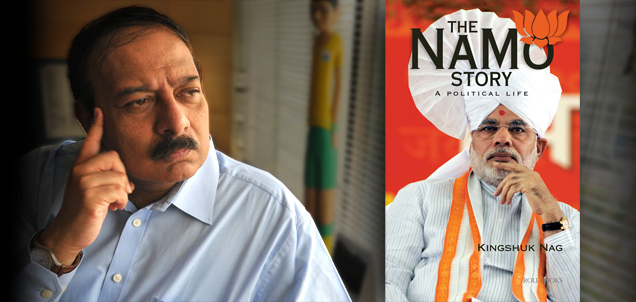
     

  • Upclose with the NaMo chronicler


    This month Kingshuk Nag completes 20 years with The Times of India. Many of these have been rather eventful, albeit in a sad way. As Editor of the Hyderabad edition he’s seen the current Telangana crisis and the Satyam fraud unfold and earlier as Editor of the Gujarat editions having been based in Ahmedabad from 2000-05, he witnessed the earthquake and communal tensions after the Godhra carnage. His book ‘The NaMo Story – A Political Life’ has been receiving rave reviews for a balanced account on the the politics and persona of Narendra Modi.


    Mr Nag’s book – his third, the first two being on Satyam and Telengana – was launched in Mumbai at the NCPA on Monday along with a panel discussion hosted by publishers Lotus Roli, the NCPA and Literature Live.


    In this exchange with MxMIndia, Mr Nag is candid about why it took so long for him to write the book, his views on the Gujarat strongman and whether he thinks the CM can be PM


    It’s been a while since you moved on from Gujarat, and Narendra Modi has been in the news all these years. Of course now the stakes are higher given his being a Prime Minister-in-waiting. What took you so long to write the book?

    My first attempt to publish a book on Modi was in 2002 right after the riots. I met a publisher, a leading one, with a chapter that I had written.  The publisher, the lead man who was also the owner read the chapter and said it was great.  But he said he wanted a pro-Modi book written because Modi was being bashed too much. Disgusted I left. I had no experience in book writing so I did not persist.  Three years later I was introduced to the chief editor of one of the top publishing firms. We started talking. I gave him a concept note and chapterization. After a while the guy got back to me and said no this book will make a hero out of Modi. I don’t want it. It was in my third attempt in 2011 did I find a publisher. That’s the reason for the book taking so long.


    What reviewers say
    Definitive must-read book: Ranjona Banerji in Sunday Mid-DayShort and balanced account: Rohit Bansal in Gulf Today


    You’ve watched him up-close when you were in Ahmedabad, editing The Times of India. Do you see a difference in Mr Modi from then to now?

    The basic character of the man has not changed. But after having said that today he is a far more confident man than what he was ten years ago. His body language shows that. His lean mean frame has undergone a metamorphosis. He looks visibly more prosperous. He is today more authoritarian than before. However, it is a fact that he is less inviting of the press than he was a decade ago. That’s because of the riots and Modi is ill at ease answering questions about 2002. So he is apprehensive of media interviews especially meeting national mediapersons.


    So did you interview him again for the book?

    No, I did not interview Modi again.


    In an attempt to be neutral, have you gone a little soft on Mr Modi? Given that your personal views on the CM (especially when you were editing TOI in A’bad) were reportedly dramatically different.

    I don’t think I have gone soft on him. It’s that the context has changed. If I had written the book in 2002 it would have been on the riots.  Since it is written now in 2013 it focuses on the national politics and politics of Modi rather than the riots.  A lot of people are finding fault with me for not writing more on the riots. They are accusing me of diluting my stand but I don’t agree with them.


    Having watched NaMo from close quarters and now from a distance and ditto with the media, do you think the media has changed its stance towards Mr Modi.

    Over the years, the media has become less strident about Modi though the opposition remains. That is because with the passage of time, priorities change. Also, due to efforts of NGOs and the action of higher courts, justice has been done in many riot cases.  Many people are happy with the justice done though Modi may not have been instrumental, for this they are satisfied. Also, with stories of rampant corruption emanating from the centre, Modi is seen in a less negative light . Further, the stories of rapid development of Gujarat have gone a long way in enthralling that section of the media that represents the dream of aspiring India.


    After Gujarat you’ve also seen a leader like YSR in Andhra Pradesh (as Editor of TOI, Hyderabad). YSR’s reign was cut short, but how would you compare the two regional leaders?

    Modi’s strategy in Gujarat has been to create a vote bank or rather to coalesce the votes using Hindutva as the glue. The strategy of YSR was different. He created a vote bank by giving out doles and everything free to the poor and not so poor by classifying them as poor. He gave free power to farmers. Rice at Rs 2 a kg, free scholarship to poor students, free houses to the poor, free medical facilities to the poor… even for operations. 85 per cent of the population got the benefits because of the manipulation of government statistics.


    Your view on all the hype and PR around Mr Modi… Vibrant Gujarat, hiring of a public affairs firm like APCO? Has it helped change perceptions about him.

    Modi realised that the riots had dented his image started wooing industry by giving unparalleled incentives. An essential part of the strategy is to create a hype about investment prospects in Gujarat and the guy who leads the state. Sometimes the hype is so unreal as if Modi is some superman. The hype has changed public perception because a lot of people believe that Modi is a great administrator. Also, remember, that the people are fed up with corruption and are looking for change. Modi is offering himself as the change like Anna Hazare two years ago. Whether the country will accept him as the change is a moot point but right now many find him acceptable


    Have you had a launch event in Ahmedabad?

    No launch event in Ahmedabad.


    Why not? Mr Modi is said to have this army of damn-the-critics brigade. How have they been with you post the book?

    No particular reasons. Actually the book was never launched officially.  Only yesterday in Mumbai, although the book has been in the market for a month and a half.  Modi’s men have not been in touch with me. But I heard that the book was spotted on his table.


    Three rapid-fire questions:

    1. Narendra Modi v/s Rahul Gandhi. Your choice:

    a. Can’t say.


    2. In the run-up to the 2014 elections, your view on whether Narendra Modi will apologise for Godhra and its aftermath?

    No


    3. Do you see Modi as Prime Minister?

    As PM: No


    The Namo Story – A Political Life

    by Kingshuk Nag

    Publisher : Lotus Roli

    Paperback, 200 + 8 page insert pages

    Price: Rs 295