Tag: Kashmir

  • Remembering Aug 5, 2019

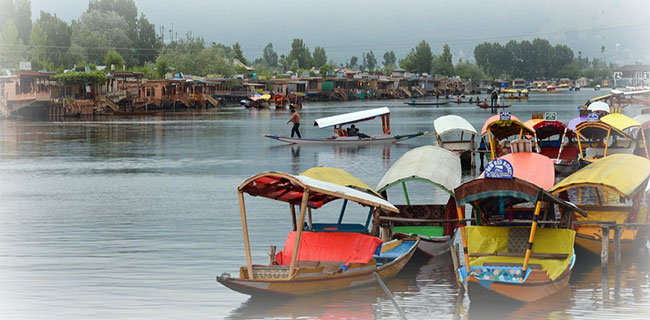
    File image of the housboats on Dal Lake in Srinagar


    By Ishfaq-ul-Hassan


    On January 25 this year, when 2G mobile internet was restored, it reminded me of a dialogue by legendary Sanjeev Kumar in 1975 film Aandhi’: `Waise bhi amawas pandhra din ki hoti hai, lekin iss baar bahut laambi thi;.


    I tried to correlate my digital Amawas with this dialogue which was craftily inserted in a famous Kishore Kumar-Lata Mangeshkar romantic number `Teri Bina Zindagi se’…, evoking a childlike response from Aparna Sen… `Nau baras lambi thi na’.


    For a journalist working in conflict zone for the last 23 years, I have seen ups and downs. I have worked in the pre- and post-Google era. I have seen how people coped when telephone services were suspended during Operation Parakaram. I have experienced the internet ban during 2010 and 2016 agitations. I have come across small internet breaks during encounters and law and order situation.


    But the suspension of the internet in 2019 was the most painful given that the people have become addicted to WhatsApp, Telegram, Facebook, Twitter, YouTube and others. My last WhatsApp message was on August 4 evening to my friend which reads: Has curfew been imposed.


    From that evening till January 25, I was living in pre-Google era with no access to internet. I was back to having steaming cup of tea with hard copy of newspaper every morning. I had literally forgotten the hard copy of the newspaper because I was more comfortable with e-papers. But then August 5 changed everything.


    On January 25, when I saw my internet signal, I could not resist the temptation of sending WhatsApp message to my friend. To my bad luck, my connection was too slow to send the message. And then came the announcement that social media is banned and only whitelisted websites can be accessed. It came as bolt from the blue. My digital sanyas, it seemed very prolonged like Sanjeev Kumar’s separation in Aandhi.


    Next morning when I left for office, I met a tech savvy friend who congratulated me for the internet restoration albeit with low 2G speed. I was not impressed and told him about my predicaments. He quickly suggested downloading VPN. Being a tech-handicapped journalist, I sought his help. And the rest, as they say, is history. Not one but multiple VPNs were downloaded on my phone. If one was blocked another was ready to be used. So my tryst with the digital world was complete.


    It was not so in last six months when journalists had to queue up at sarkari media centre, like students waiting to enter exam halls. Journalists had no access to phones or internet for first few weeks post August 5. Such was the communication ban that no local journalist could send stories. The phone suspension made it impossible to dictate stories to the newsdesk. Only television journalists, who had OB vans, were able to send their feeds and communicate with their offices.


    Few journalists, who were paradropped in Kashmir, were among the luckiest guys as they were provided all communication facilities for obvious reasons. But a large chunk of local journalists working for national and regional dailies were not able to send their copies. Later a media centre was setup in a local hotel which doubled up as conference room for sarkari spin doctors to project a rosy picture of the situation. Few computer terminals  with internet lease line connection were installed. But such was the rush that one had to wait for hours to access the mail.


    When I first accessed my mail, the inbox was full and it seemed it was waiting to explode. Had I not accessed the mail, my mailbox would have been blocked. When I sat on the terminal and started deleting mails, it took me few minutes.  A journalist colleague waiting in a queue gently tapped my shoulder asked, “Are you done?”. I was ashamed of myself for taking more than five minutes. I said sorry and logged out. It was not one off incident, it was routine for journalists to come to media centre, wait in a queue and then access the email. My journalist colleagues used to write copies on their laptops and bring it in their pen drives just to mail it to their offices.


    For senior journalists, it was nothing short of an embarrassment to literally beg junior colleagues to spare few minutes on the terminal so that they could access the mail.


    What has added insult to injury is that the journalists did not figure in any of the priority list of government. The internet was restored to hospitals, government departments, hotels and other offices, but newspaper offices and journalists were barred. Every day, a journalist has to go to media centre and wait for hours to access internet for few minutes.


    Back to my digital sanyas days, I learnt a lot. I read some books and watched downloaded international drama series including crime thrillers and famous web series. Most importantly, I competed with my son in playing games on the cellphone. I also learnt playing games and gave my son and daughter a tough competition. But again these games could not last long as every time a notice used to pop up to update them online


    Even after a year, only the low speed 2G internet has been restored. People are still craving for 4G speeds. But then asking such a question could well invite the wrath of the powers that be.


    Ishfaq-ul-Hassan is a senior journalist based in Srinagar. His views here are personal



  • Ranjona Banerji: Shameless Cowardice in Times of Strife

    By Ranjona Banerji


    After Lancet, the British Medical Journal has also written about the health effects of the government’s actions in Kashmir. This other respected medical journal has based its comment on a letter it has received from 18 doctors across India. The letter said that the government lockdown is a “grim” situation and has led to “blatant denial of the right to healthcare”.

    Having shot off an ill-conceived letter of outrage to Lancet for “interfering” in India’s internal matters, the Indian Medical Association now appears to be silent on the letter written by 19 Indian doctors. The issue is that of fake “nationalism” over the Hippocratic oath or even over humanitarian concerns, if you find the Hippocratic oath hypocritical and more honoured in the breach.

    Now, more doctors have issued a statement expressing concern about the health situation in Kashmir, questioning the IMA and asking for their peers to form a group, interact with the government and visit Kashmir to help with healthcare needs.

    In a normal world that is how one would expect people, doctors, the media to respond to a crisis. The IMA not only attacked the Lancet’s right as a journal to publish an opinion backed by facts but also ignored its own responsibility. Now that other doctors and journals have entered the fray, radio silence.

    However, perhaps given the current climate, one cannot blame the IMA for its cowardice. Over the past five years there have been any number of reports across the media of extreme government pressure to stop all criticism of Government. Prominent TV journalists from ABP News openly spoke about it and lost their jobs. Media houses like The Hindu and Bennett Coleman have been denied government ads. Now one hears that Mirror Now has also been threatened for criticism of the BJP-led Maharashtra government.

    The threat goes further as does the impact on the media and the running of it. The persecution of NDTV owners Prannoy Roy and Radhika Roy continues and now TV journalist Vikram Chandra has also been targeted. The collapse of the Indian economy – and it has collapsed even if media attention is being deflected by sharp news management by the Modi-Shah government and the BJP – has badly affected all aspects of the Indian media, from news to advertising to branding and marketing.

    Job losses, not being acknowledged by the government or reported widely across the media, are rampant within the media. News yesterday says DailyO, the opinion website launched by India Today, is shutting down. This is just the latest in a long list from NDTV to the ABP Group. There is no money, payments are delayed, running costs are in trouble, it’s that bad. In such a precarious financial situation, one is likely to see more capitulation before an authoritarian government rather than less.

    Of the many crises facing India today, Kashmir has been a touchstone for bad and irresponsible reporting and coverage by large swathes of the Indian media. And underlying that, is a bigger perfidy to the media mandate to share information with the general public. And that is the collapsing economy. Which affects everyone. Every news programme you see about the “tukde gang” or attacking some student leader or crucifying anyone who criticises the Modi-Shah government is a deflection, most likely ordered from the top, from discussions on impending disaster.

    Any news agency which tells you about the horror that was demonetisation, about job losses, about falling demand, about industry slowdowns, those are from journalists and their bosses who have immense courage in these difficult times. The rest are a bit like the IMA: showing shameless cowardice in times of strife.

    Ranjona Banerji is a senior journalist and commentator. She is also Consulting Editor, MxMIndia. Her views here are personal


  • Anil Thakraney: Media should highlight Kashmiri achievers

    By Anil Thakraney


    The last time I went to Kashmir was nine years ago. This was for the shoot of a Nestle Polo commercial (I was employed with Lowe, Delhi, at the time). One morning I woke up late for an early shoot, and missed the last Gondola cable car, which was to take me to the hills of Gulmarg, the shoot location. This compelled me to hitch a horse ride, and this one-hour-long journey gave me a chance to have a detailed conversation with the horse owner, Mohammed. On the state of things in Kashmir. What he told me was heart breaking. Let me skip the gory details and get to the main point he made: Most Kashmiris felt a terrible sense of detachment from India, there was absolutely no sense of belonging. This feeling got further reinforced in my conversations with the other locals.


    I believe things are far better now, the Gujarati tourists are back, and so are the Bollywood filmmakers. However, we are very aware that all it shall take is another massive terror strike to move things back to square one, Kashmir is such a fragile state. It’s been a long time now and the politicians have totally failed to deal with this mess. Which is why the role of the media becomes crucial. Two recent success stories from Kashmir caught my attention. One is about the Kashmiri cricketer who’s currently playing in the IPL: Parvez Rasool. And the other is about a lady doctor, Ruvaida Salam, from the strife-torn Kupwara district, who has managed to pass her IAS exams against all odds.


    These are fantastic stories, and I would urge the nation’s media (both, print and television) to not report them as regular snippets. The media should help turn these two (and others like them) into national celebrities. We must run a series of huge stories on their achievements so that Rasool and Salam become household names in India. This will inspire other Kashmiri youth to forget about militancy and Pakistan, and instead aim to become successful professionals. If this happens, over time, it will help demolish the one thing that keeps the Kashmiris from kicking out the militants from their soil: The sense of alienation.


    I do think these success stories are a superb opportunity for the media to directly affect the fortunes of this nation. And we must not allow them to slip by.


    ***


    PS: Evian has revived the dancing babies that were such a rage ten years ago. Simple, cute idea: Find a baby version of yourself in the mirror. Purity of water, purity of thought. Nice.