Tag: Karan Johar

  • Myntra stocks Mandira & KJO lines, Jabong gets Alia Bhatt

    By Tasmayee Laha Roy


    Online fashion retailers such as Jabong and Myntra are increasingly tying up with Bollywood celebrities to launch exclusive lines in a bid to attract more young consumers to shop for their garments on the internet.


    While Alia Bhatt has tied up with Jabong for her line ‘Alia Bhatt for Jabong’, Myntra — which launched Hrithik Roshan’s label HRX last year — now stocks Mandira Bedi’s sari collections as well as the Vero Moda Marquee, a limited edition collection designed by director Karan Johar in a tie-up with the European high-street fashion brand for women. Snapdeal has Shilpa Shetty Kundra’s jewellery line Satyug Gold.


    “Bollywood celebrities have always been considered as style icons and served as a muse for the high priests of fashion and most of these celebrities have a huge fan-following online. The same people who fall in the age group of 15-35 are also the ones who shop online. Thus to marry Bollywood and fashion online ensures success of the idea,” said Praveen Sinha, founder and MD at Jabong.


    Jabong officials said the site’s user base has shot up by 50,000 within a week of the launch of Alia Bhatt for Jabong this month. With ripped jeans, leather jackets and floral patterns, the collection makes a direct connect with Bhatt’s wardrobe in her popular films such as ‘Student of the Year’ and ‘2 States’. “Online shopping is the new rage…so this, according to me, was the best platform to launch my designs,” Bhatt said.


    Myntra has launched Farhan Akhtar’s Mard collection and Salman Khan’s Being Human, besides HRX. Roshan’s HRX has this month launched a range of active and women’s wear. “People love to dress up like their favourite stars and these initiatives have taken fans a step closer to their stars.


    Hrithik, for example, has been involved in every step of designing the outfits under his label,” said Ganesh Subramanian, COO at Myntra. He said Myntra plans to launch own labels of 4-5 leading Bollywood celebrities early next year. Karan Johar’s limited edition ‘Vero Moda Marquee’ collection, launched at the Myntra fashion week early this month, has proved a big hit.


    Source:The Economic Times

    Copyright © 2014, Bennett, Coleman & Co. Ltd. All Rights Reserved

    Licensed to republish


  • Directors discuss Bombay Talkies and 100 years of cinema

    By A Correspondent


    The directorial cast of Bombay Talkies made an appearance on the show Etc Bollywood Business with trade expert Komal Nahta. The team shared their experiences about each of their short films in the upcoming Bombay Talkies, which is slated to release today.


    The trio – Dibakar Banerjee, Zoya Akhtar, and Karan Johar – talk about the evolution of Bollywood over the past hundred years, the oldest movies that the directors have seen, the longest kiss on celluloid and the journey of each of their careers in Bollywood.


    This episode of Bollywood Business will be aired exclusively on Etc on May 3 at 8.30pm with a repeat telecast at 11.30pm on the same night.


  • Business, networking & more @ Frames 2013


    By Johnson Napier


    While you may be taking some time out to browse through this story, hundreds of delegates from different corners of India, and a few from around the world, would have converged at Hotel Renaissance in Mumbai. In fact it would suffice to say that those who have anything and everything to do with Media & Entertainment would have made it in large numbers today to be part of the biggest and only convention for the sector in India – FICCI Frames 2013.


    In its 14th edition, the event has a host of activities that have been planned out over a three-day course. To begin with, Day 1 would begin with a bagful of high-profile dignitaries who would be presenting their viewpoints and observations on the way forward for the industry. It would begin by a welcome address by Naina Lal Kidwai, President, FICCI and would be followed by a theme address by Uday Shankar, Chairman, FICCI Media & Entertainment Committee. Joining the two dignitaries on stage would be Uday K Varma, Secretary, Ministry of Information & Broadcasting, Govt. Of India who would be providing a vision statement for Information & Broadcast Industry. He would be followed by Guest of Honour Dr. Soon Tae Park, Deputy Minister, Ministry of Culture, Sports & Tourism, Republic of Korea who also would be highlighting his observations on the industry. Andy Bird, Chairman, Walt Disney International would be the next to hog the limelight as he would be presenting the keynote address at the event. Preneet Kaur, Union Minister of State for External Affairs, Government of India would be the other high-profile guest who would be delivering the inaugural address at the opening ceremony. The event will also see the felicitation of Subhash Chandra, Chairman, Zee Entertainment for his two decades of contribution to the broadcast industry.


    According to the organisers of the event, the aim of FICCI Frames 2013 would be to deliberate on the growth of the industry and find ways to maximize both its creative and economic potential by engaging with the billion strong consumer base in our country. To do that, there are key international thought leaders, studio heads and academics who’ve been lined up to speak on a range of topics covering the main objectives of the sector – digitization, making big budget films and being successful in Bollywood, censorship, marketing, exhibition, distribution, viability of the sports broadcasting business, the future of content consumption in an era progressively getting defined by the digital media, innovation and planning required in various policy issues within TV, cinema, animation and gaming.


    Uday Shankar

    Sharing his viewpoint on the event, Uday Shankar, Chairman, FICCI Frames 2013 said, “While the industry has made spectacular progress in the last 20 years in increasing the intensity of engagement with the Indian consumer through superior content, there is still a gap in our ability to monetize the engagement and use the resources generated to advance both access and content. The year 2013 is one of many milestones in the media and entertainment industry and Frames will offer an opportunity for us to put these developments into perspective, look at the larger picture and engage on such a bold and important theme.”


    Leena Jaisani

    Speaking on the core theme that has been shortlisted for the event, Leena Jaisani, FICCI senior director – M&E remarked, “This year the theme is ‘Engaging One Billion Consumers’. We work to make sure the entire media and entertainment sector takes the next big leap in maximising monetization, therefore the theme of engaging a billion consumers.” Adding further, Ms Jaisani said, “While the industry has made spectacular progress in the last 20 years in increasing the intensity of engagement with the Indian consumer through superior content – there is still a gap in our ability to monetize the engagement and use the resources generated to advance both access and content. Frames will offer an opportunity for us to put these developments into perspective, look at the larger picture and engage on such a bold and important theme.”


    Karan Johar

    Highlighting his outlook for the event, Karan Johar, co-chairman of FICCI Frames 2013 said, “It is a platform that brings best of the creative and business minds to engage with delegates. Delegates come to the event to seek different things. Someone’s agenda is to scout talent and another person may have just come to look for finance. Whatever time I have spent in attending sessions, I have learnt the most from them. In fact, I admitted this on the podium last year. There are certain things you are not aware of and sitting on the panel or in the audience you imbibe new things. This must be the experience that others also go through I guess.”


    In fact Mr Johar has a larger agenda that he’d be taking up where the film fraternity is concerned. He affirms, “The Rs 100-crore benchmark is limiting the growth and content of our films and we have to aim for Rs 1,000 crore from a film. It may not be possible today but we have to have a mandate to achieve that. FICCI will work towards a roadmap for Indian films to gross Rs 1000 crore for a film. It is not an impossible task. In fact we have a session on planning and creating a Rs 1000-crore blockbuster that promises to be interesting.”


    One of the reasons why the event manages to attract so many delegates is the quality of speakers who land up at the venue to share and dish out mantras and growth strategies. This year too there are a host of stalwarts that have been lined up including Andy Bird, Chairman, Walt Disney International, Anne Sweeney, Co-Chair, Walt Disney International & President Disney ABC Television Group; Bob Bakish, CEO, Viacom Media International, Teri Schwartz, Dean, University of California, Los Angeles (UCLA), Colin Maclay, MD, Berkman Center for Internet and Society, Harvard University, Andy Kaplan, President, International Networks, Sony Pictures Television, Mira Nair, film-maker, Dominic Proctor, President, Group M Worldwide, Seymour Stein, Vice President, Warner Bros Music, David Womart, the Producer of the Oscar-nominated Life of Pi, film maker Gurinder Chaddha, Jonathan Taplin, Director, Annenberg School of Innovation, The University of California school of communications and journalism, Andy Weltman, the international head of Pinewood studios, and Graham Broadbent, the British producer of the Best Exotic Marigold hotel.


    As is the norm, this edition of Frames too has a partner country and South Korea has bagged the honour this year. Pointing out the advantages of the association, Ms Jaisani said, “South Korea is the partner country at Ficci Frames 2013 and this year is significant as Korea and India celebrate the 40th year of the establishment of diplomatic relations. There is huge potential for collaboration in films, animation, gaming, technology and service offshoring between the two countries. Leading Korean companies in animation, broadcasting, mobile gaming and film will be available for biz matching. There is a huge synergy as India is looking at innovation from Korea and vice-versa they are looking at engaging Indian media companies for offshore services – especially in animation, gaming and VFX.”


  • Tryst with destiny @ FICCI Frames in March

    By A Correspondent


    Uday Shankar

    Announcing the launch of the 14th edition of India’s foremost business conclave on media and entertainment, FICCI Frames 2013, Uday Shankar and Karan Johar, the Chairman and the Co-Chairman respectively of the Media & Entertainment Committee, unveiled the theme of the conclave, ‘A Tryst With Destiny: Engaging a Billion Consumers’.


    Speaking on the occasion, Mr Shankar said, “While the industry has made spectacular progress in the last 20 years in increasing the intensity of engagement with the Indian consumer through superior content, there is still a gap in our ability to monetize the engagement and use the resources generated to advance both access and content. The year 2013 is one of many milestones in the media and entertainment industry and Frames will offer an opportunity for us to put these developments into perspective, look at the larger picture and engage on such a bold and important theme.”


    Mr Johar said, “The M & E industry has the potential to become the catalyst for social change and a force of good for every niche of society. FICCI Frames has been the most eminent platform for the M&E sector and its initiatives over the past decade have improved the quality of content generation, skill development and stature of the industry. We believe that our new agenda will be the change agent for social and commercial development, connecting a billion people, while shaping and informing their opinions and getting influenced by their collective needs in turn.”


    At Frames 2013, the aim is to deliberate on the growth of the industry and find ways to maximize both its creative and economic potential by engaging with the billion strong consumer base in our country. We have key international thought leaders, studio heads and academics lined up to speak on a range of topics covering the main objectives of the sector – digitization, making big budget films and being successful in Bollywood, censorship, marketing, exhibition, distribution, viability of the sports broadcasting business, the future of content consumption in an era progressively getting defined by the digital media, innovation and planning required in various policy issues within TV, cinema, animation and gaming.


    The line-up of stalwarts includes Andy Bird, Chairman, Walt Disney International, Anne Sweeney, Co-Chair, Walt Disney International & President Disney ABC Television Group; Bob Bakish, CEO, Viacom Media International, Teri Schwartz, Dean, University of California, Los Angeles (UCLA),  Colin Maclay, MD, Berkman Center for Internet and Society, Harvard University, Andy Kaplan, President, International Networks, Sony Pictures Television, Mira Nair, film-maker, Dominic Proctor, President, Group M Worldwide, Seymour Stein, Vice President, Warner Bros Music, David Womart, the Producer of the Oscar-nominated Life of Pi, film maker Gurinder Chaddha, Jonathan Taplin, Director, Annenberg School of Innovation, The University of California school of communications and journalism, Andy Weltman, the international head of Pinewood studios, and Graham Broadbent, the British producer of the Best Exotic Marigold hotel.


    Key stakeholders and regulators will also be present, from government to industry leaders. Attending for the first time will be the information ministers of SAARC countries, forming an exclusive panel on forging bilateral ties to augment growth amongst geographically and culturally connected countries.


    FICCI Frames 2013 will be held from March 12 to 14 at Hotel Renaissance, Mumbai.


  • Uday Shankar is new Chairman of FICCI’s M&E Committee

    By A Correspondent


    Uday Shankar

    The Federation of Indian Chambers of Commercie and Industry has announced the appointment of Star India CEO Uday Shankar as Chairman of its Media & Entertainment Committee. The position was held earlier by film-maker Yash Chopra who passed away in October this year. Mr Shankar will be supported by film-makers Ramesh Sippy and Karan Johar as Co-Chair of the Committee.


    Man Jit singh

    Mr Man Jit Singh, CEO, Multi Screen Media, will now be the new Chairman of the FICCI Broadcast Forum, a position held by Mr Shankar.


    On taking over as the Chairmanship, Mr. Shankar said that he would work with all industry stakeholders closely to formulate an agenda for sustained growth of the burgeoning entertainment sector and keep up regular and meaningful dialogue with policy-makers.


  • Reviewing the Reviews: Student Of The Year

    Student Of The Year

    Key Cast: Alia Bhatt, Sidharth Malhotra, Varun Dhawan

    Written By: Rensil D’Silva

    Directed By: Karan Johar

    Produced By: Hiroo Yash Johar and Gauri Khan


    By the time Student Of The Year released with its high-powered promotion, everybody knew a Karan Johar film was on the way.


    There is a way of viewing a typical and unabashedly escapist Bollywood film – you have to suspend all sense of reality. But, as so many critics have noted, even Bollywood aimed-for-NRI fantasies can get to be too much. The film got mostly condescending reviews with 2 or 3 stars.


    Anupama Chopra of Hindustan Times commented, “Karan Johar’s forte is excess. He creates fantastical worlds brimming with beautiful people and expensive things and yet anchors them in high emotion. His films work as both designer porn and soap opera. The pleasure you derive from his films is directly connected to your tolerance of candy floss. I’ve always been seduced. But the danger of candy floss is that it can quickly become vacuous and over-designed.”


    Rajeev Masand of ibnlive was sarcastic: “The hardest job on a Karan Johar film set must belong to the cleaners, who I imagine spend most of the day on their knees scrubbing floors, dusting furniture, and basically making sure everything is spotless. The director’s new film, Student of the Year, is set on an impossibly chic campus where good-looking teenagers are invariably breaking into song or breaking into fights. Yet you’ll never spot a carelessly strewn cola can or even a stray sheet of paper lying around in the corridors or in the canteen. Oh those poor cleaners!”


    Sukanya Verma of rediff.com wrote, “Treatment is Karan Johar’s forte and it is what makes his first film with rank newcomers, despite the absence of a logical plot, so fresh and zany. Unlike KKHH, which had the advantage of two superstars and one dazzling aspirant, neither of SOTY’s three key players are seasoned actors. Incisive as he is, the filmmaker is well aware of the strengths and limitations of his inexperienced cast, concealing their inadequacies to imply that strange allure of rawness while drawing on their eager energy to convey a refreshing charm.”


    Shubhra Gupta of Indian Express was left cold. “I have a bone to pick with Karan Johar, who invites us, once again, to witness a bunch of young students do their thing. Not because this is yet another impossibly swish ‘school’ which bears little resemblance to the posh-est educational institutions we have in the country: after the seismic shock of that first Riverdale-high-school-clone in ‘Kuch Kuch Hota Hai’, anything was possible. Not because we are asked to believe that these beautifully-toned, manicured, polished, perfectly-attired creatures are ‘students’ in their final year of school: a KJo film will faint at the thought of scruffiness, where even a muddy dab on a sweatshirt after a strenuous game of football appears artfully daubed. And so what if they don’t look as youthful as they ought, as long as they are good-looking, right?”


    In contrast, Madhureeta Mukherjee of TOI gushed, “It’s KJo-Wala Love! Served fresh and piping hot from the Dharma college canteen of romance. And it’s a high (class) school that you’d never want to miss a lecture of, ever. Except that it has its own set of Karan rules. Read the prospectus: 1. Leave your text-books at home but ensure you’re carrying your designer bags and heels. 2. Drive a Ferrari to school, or if you’re poorer, take a bike. 3. Dating, mating, separating and love lessons shall be part of the syllabus. 4. Girls, don your shortest minis, and guys, rip off the shirts. Welcome to St. Teresa’s. Rest assured, it’ll be a well-rounded entertainment experience.”


    Janhavi Samant of Mid-day hissed, “The students of the prestigious St Teresa school in Dehradun all exist in some strange North Indian bubble – male students show off their super-toned bodies and finely-honed muscles while swimming, running or dancing to wedding sangeet with their kurta buttons open. The heroine and her rival’s skirts are smaller than their bags and they continually hover around the said muscular heroes vying for their attention.”


    Karan Anshuman of Mumbai Mirror quipped, “Ah Bollywood. A genre so escapist, so unshackled to reality that it’d give JRR Tolkien a complex. And if the genre may be compared to The Lord of the Rings, then Karan Johar is its Gandalf. He waves a staff and sets the bar.  Make no mistake, I say this with utmost reverence because this is what the world (and I mean an audience that includes and goes beyond Indians and NRIs) expects and wants when they pay ticket money for a ‘Bollywood film’. And nobody does it better than Mr Johar. So here we go. Rich kids in designer labels? Check. Establishing characters through song and dance? Check. Superbly filmed wedding sequence? Check. Manipulative writing and background score designed to trigger your tear ducts? Check. A polished product in all technical departments? Check. Aim to make the film as unreal as possible? Check.”


  • @FF12: Adapt to the digital tide or be left out

    By A Correspondent


    In keeping with the theme, ‘Embracing the Digital World’, FICCI Frames 2012 got off to a wishful start at Hotel Renaissance, Mumbai on March 14 with a welcome address by the Co-Chair of FICCI Entertainment Committee, Karan Johar. After Mr Johar’s welcome address, Uday Shankar, CEO, Star India & Chairman, FICCI Broadcast Forum, proceeded to present his perspective on the Event and the broadcast industry in general. Making a dash for the core topic of digital, Mr Shankar began by stating, “Digitization is a big reality which will revolutionise the way content (creation and distribution) is offered.” Even though he said that digitisation will create a level playing field for the broadcasters and the cable operators, he had a word of caution to add when he said that his biggest concern was “the chaos which will be caused by the broadcast industry’s inaction”.


    Prithviraj Chavan, Chief Minister of Maharashtra was next and began by assuring how the current era was an “exciting time to be living in”. He said that the challenge would be to adopt the regulatory framework to new technology and ensure that over regulation doesn’t kill a good thing. He also said that the move towards digitization will create a huge employment opportunity but there is a need to explore how technology can empower the field of education. The Chief Minister also touched upon the need for regulation and suggested that instead of the state regulating the media, the medium should look at regulating itself.


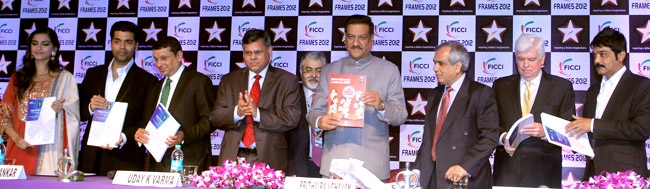
    Following the CM’s speech, the event witnessed the release of the FICCI-KPMG Indian Media and Entertainment Industry Report 2012; FICCI-Amarchand Lawbook and ‘Positivity: The impact of television on India’ by The Indian Broadcasting Foundation.


    Uday K Varma, Secretary, Ministry of I&B, opened his address next by stating that the concerns that the industry had over digitization and the Phase 3 of FM radio have been addressed by the move to allow 839 new FM stations and 500 community radio stations. He stressed that the government is committed to ensuring time bound digitization and said that come July 1, the four metros will switch over to the digital format and the plan is to ensure that the move to digitization is completed by December 31, 2014. He agreed that the challenge was mammoth – to convert 80 million analog connections to digital format, but added that it will ensure faster and deeper penetration. “This will address a plethora of issues facing the television industry, such as addressability, carriage fees, audience measurement and consumer preferences,” he said.


    Punit Goenka, CEO & MD, ZEEL too spoke about the pros and cons of digitization, how the ratings are inadequate and how self regulation was the need of the hour for the broadcast industry. Carolyn Everson, VP, Global Marketing Solutions, Facebook elaborated on how Facebook can benefit the media and entertainment industry and cited examples from music, gaming and films to drive home her point.


    Session highlights:

    Post the promises and pleasantries doled out by committee members and authorities, it was time for some serious discussion which began with a panel debate on ‘Addressable Digitization – The way forward’. Sanjay Gupta, COO – Star India, Sunil Lulla, CEO and MD Times Global Broadcasting, Sameer Manchanda, Founder – DEN Networks and Punit Goenka, MD and CEO, ZEEL comprised the panellists. The panellists agreed that digitization is the way forward and will soon be a reality. Uday K Varma, Secretary – I&B, put the ball in the industry’s court as he said that there were no political opposition to digitization and the parliament too passed the law in December 2011, therefore it is now incumbent upon the industry to make digitization a reality. Sunil Lulla pointed out that the there is greater good in digitization, but the industry has to do a lot of work over the next few years. Sameer Manchanda was of the view that digitization is a reality and that it will bring more number of channels. The session also discussed opportunities and challenges that digitization has to offer and how the industry was gearing for digitization – whether they are ready or not?


    A session on ‘Maximising the power of digital distribution’ saw industry leaders speak about the challenges that come along as the country is experiencing the much talked about shift – from analog to digital cable – the investments that goes into and many such challenges. Industry honchos such as K Jayraman of Hathway Cable and Datacom Ltd, SN Sharma of DEN, Anshuman Misra of Turner, Asia Pacific, Vikram Chandra of NDTV, Jagi Mangat Panda of Ortel, Prof Jonathan Askin, and Anita Wallgren, Government Attorney, US Department of Commerce made up for the panel.


    The panel agreed that while digitization comes in as a relief for broadcasters who will be benefitted from additional subscription revenue the relaxation on paying heavy carriage fees, and of course providing viewers with a superior content experience – MSOs and cable operators have to quickly respond to the digitization mandate by investing in set-top boxes – the cost that is only possible to recover after four years.


    Vikram Chandra talked about the difference digitization makes to the news industry. “Digitisation is important for news players. It is leading players in the news industry into areas they don’t want to be in. In the race of chasing TRPs, people are forgetting that digital has great potential that has to be tapped, a business model which needs to be looked at.” Mr Chandra also mentioned the role of tablets and high-end devices as new distribution platforms.


    Next was a session titled “Financing the Media and Entertainment Business” where the panellists comprised eminent personalities such as Prashant Jain of HDFC Mutual Fund, Mathew Cyriac of Blackstone, Soumo Ganguly of Moxie Entertainment Pvt Ltd and Daniel Dubiecki, Founder and Partner, The Allegiance Theatre, Hollywood.


    Mathew Cyriac started off the session by pointing out that majority of the investments within the media and entertainment industry were made in television and print as they represent a fairly large share  in terms of sheer numbers as against Internet and Radio. The Hindi GECs in TV is typically where a lot of money goes to, followed by regional GECs and sports channel. For print media, it was the regional publications that command a lot of attention as regional advertising is very robust and extracts a lot of profit.


    Prashant Jain pointed out that a lot of companies in India have managed to get good funding and that it is not reflective of the supposedly very, very sorry picture that was being talked about. “It’s not that all of India in the media entertainment space are not attracting funds. Companies like UTV and a few others have attracted investors.”


    In the session on ‘Protecting Copyrights, Infringements & New Trends i.e. Remake’, the panellists chose to rummage over the impediments surrounding copyright issues in the film and music industry in India. The panellists included Sai Krishna from Sai Krishna Associates, Deborah Benattar from the French Embassy, Jagdish Rajpurohit from RCL Motion Pictures, Bertrand Mouiller, former DG IFFPA and Amar Butala from UTV Motion Pictures.


    Sai Krishna provided a hopeful insight as he said, “The industry should take heart in knowing that the Copyright Amendment Bill is currently being debated in the parliament and is expected to be passed after the current Budget Session. There are provisions that can alter the way the entertainment industry functions in India.” But he cautioned that the Bill has its setbacks too, as there are no clear guidelines when it comes to copyright issues between the writer, music composer and the producer of a film.


    Mr Butala added, “We have made huge leaps in terms of legal paperwork with actors and performers where copyright issues are concerned. But it is just the start and the challenge will be to sort out legal issues and take the offenders to Court with the hope of finding a favourable outcome from the judiciary.” The panel proceeded to discuss the trend of moviemakers bagging rights for remaking movies and that there was a need for a law that would streamline procedures for the industry at large.


    Key takeaways:

    – Complete digitization makeover scheduled for December 31, 2014

    – Copyright Amendment Bill to be passed in Parliament soon

    – Digitization will encourage niche and differentiated content

    – Need for media to self-regulate self then wait for a nodal authority to do it

    – Digitization to create more employment opportunities
     

  • @FF12: Text of Star India CEO Uday Shankar’s keynote

    Good morning.


    Senator Dodd, Secretary Uday Verma, Chief Minister Chavan, Prosenjit, Jehil and my dear friend Karan Johar, the remarkable team of FICCI that has organized this fabulous event, friends from media, ladies and gentlemen.


    A couple of years ago when I was asked by FICCI to take over the chair of FICCI Broadcast Forum, none of us had an exact idea of the timeliness of that decision.  FICCI was seized off the maturity and the size of Broadcast media and felt that the time had come for it to sharpen focus on this aspect of media and not merely treat it as an adjunct of films.  However the momentous changes that have happened in the Broadcast media landscape in the last 2 years clearly justify the wisdom of FICCI.


    I find a powerful validation of the significance of television and broadcasting in “Positivity” – a report by the IBF on the impact of television. IBF has gone ahead and spoken to our viewers – the key findings of the research are gratifying and humbling for the industry. I don’t want to give too much away, but must highlight two interesting results – Over 90% of our respondents believe that television is a source of encouragement and motivation and a similar percentage of women respondents believe that Television has given them the confidence to believe in the capabilities and potential.


    Gratifying as it may be, it is just the beginning. We are at the cusp of what is set to completely transform broadcasting in India forever.  I am talking about the universal digitization of television distribution.  This is a subject that has dominated all discussions at all forums in the last year and I presume will continue to do so for a long time to come.  But let’s pause a minute and recall what the discussion is centered around.  Most of the discussions that I have participated in are still around whether digitization will happen and if it indeed were to go through, how chaotic it would be.  With all humility may I suggest that it is a meaningless discussion triggered by a bunch of retrograde interests who are living in denial.  Let’s get some basic facts -The Cable Television Networks Amendment Act is not the beginning of digitization.  Digitization of distribution is a big reality and the 40 – 45 million homes that have bought DTH boxes at some point or the other are a conclusive evidence of that.  In fact as we speak, India may just have overtaken the United States as the world’s largest DTH market.


    What Minister Ambika Soni, Secretary Uday Verma and his team are doing is to create a structured, institutional framework for shaping this big social reality.  More than 25 crore people who have stated their preference for DTH over analogue cable have clearly spoken out that this country is now ready for universal digitization and the current move is merely to create a level playing field.


    So, to the critics and the cynics who are still wondering whether digitization would happen, my answer is: Look around, it is already happening and the rest of it is bound to happen because even in this country it would be difficult to undo such a momentous shift. To those who wonder how chaotic it would be, my response is that there would be some chaos, but chaos is not necessarily bad if the alternative is status quo or regression.  When a transition at such a scale is happening that affects the illegitimate but strong vested interest in certain pockets, then there is an incentive to put up with chaos in the interest of the larger social objectives.


    Actually my biggest concern now is a chaos of another kind that we are all set to create by our inaction.  Whether we like it or not, in a few years time, the vast majority of this country will receive its content through digital media – digital cable, DTH, 4G, wireless and internet.  But are we preparing for that? The answer is a big NO.  I worry that while we debate a digital future day-in-and -day-out we are doing nothing to transform or find business models for a digital world. Let’s face it – universal digitization is going to force us to change the way we do business and we are so not ready for it.  We often blame the cable operators and MSOs that they are not ready but I am afraid that even the broadcasters and the content creators are not ready for a digital world.  Are we then setting ourselves up to become uncompetitive and irrelevant?


    In case you think I am a scaremonger, let me ask a question – we all know how many people DTH services and now a large number of them have evolved services like HD, DOLBY sound and digital video recorder and yet what are we doing differently to service this segment?  DTH has been around now for about 6 years and is there one thing that we as broadcasters or the content community have done that we could point out as an example of a strategy to exploit the new technology?  This is despite an intuitive and an experiential understanding that the behavior and the consumption patterns in DTH homes are significantly different from analogue homes. The data also show that the average time spent on content in digital homes is much more and yet we do not treat them differently.


    It is perhaps scary how we have force-fitted an analogue broadcasting model into the digital domain.  Is that what we are going to do even after cable goes digital?  I am afraid if the past behavior is anything to go by, we are not ready to offer anything significantly different and therein lies the biggest crisis and risk of a chaos.  We have often spoken about how digitization would enable a multiplicity of niche channels to emerge.  Digitization of TV and even film infrastructure for that matter can revolutionize the way media is consumed in India.  There is enough global experience to suggest that digitization leads to de-centralization, regionalization or localization of content creation and distribution.  Creatively, it is a huge catalyst for innovation and diversity.  Essentially what it means is that with universal digitization the business models of broadcasting which are built on centralized creation and distribution of content and even a centralized advertising revenue model may come under a huge pressure.  I am proud to lead one of the finest media companies in this country and the world and yet I must confess that all of us have built our businesses in an environment where access to distribution was complicated, expensive and even impossible.  That is all set to change. So the big incumbent advantage is set to slowly, if not rapidly disappear. Socially, it is all very desirable because the plurality of this country is very valuable and digitization is a big catalyst for that plurality.  But, are we ready to re-tool our strategies and our businesses?  The cable community is still busy lamenting the potential loss of carriage fees not realizing what an amazing opportunity it has to participate in the local economic boom that is sweeping most parts of this country.  The first phase of digitization that covers the 4 metros will be a huge unshackling of broadcasting and content opportunities.  These are the cities that have crumbled under the weight of analogue frequency limitations.  Just imagine the opportunities that these metros also our economic hotspots present when, from the first of July access to frequency will no longer be a constraint.  So to my mind the MSOs and the cable operators may potentially become a powerful content creator that the traditional broadcasters have to contend with. There may be new creative talent ready to ride this technological transition.  As the subsequent phases roll on, the decentralization of broadcasting is bound to gain enormous momentum.  However, I don’t see anyone trying to race ahead to take a pole position here.


    Now let’s look at the content and the creative community that I myself am a part of.  But I am struck by our obliviousness to the opportunities and changes awaiting us.  Let me explain this with a slightly different example.  It’s been for a few years now that HD TV sets have been available in this country.  While many people were buying them, their off-take was still low primarily because there was no HD content and nobody was willing to invest in HD content because there were not enough HD consumers.  It was the classic chicken and egg problem.  However early last year, when we at Star launched 5 HD channels with DOLBY 5.1 surround sounds even we were surprised by the rapidity with which HD gained acceptance. Today, in less than a year there are around 25 HD channels. But, I have to admit with a touch of disappointment that I am yet to see an adequate recognition of the potential of HD and a superior sound possibility by my fraternity.  It is a classic case of the old mindsets struggling with a new technology.


    Are we going to stay locked into this struggle or are we going to create a new generation of television which would be designed for the digital world?  It will require all of us to change.  The creative and broadcasting community has to change their approach to content and the distribution mindset needs to change equally. If you are a cable operator or an MSO -  carriage fees is not the reason why you came into this business and people do not take a connection so that you can earn carriage fees. We are all in the business of delivering best television experience for the consumers and they will be happy to pay for it.  There is enough evidence that people want to consume content and lots of it – but they love it when it is customized to their taste.  Today there is an opportunity to do that and let’s put our heads together to take advantage of that opportunity.  Let’s determine what we require from the Government and the regulator. I have been an admirer of the current information and broadcasting dispensation which I think has shown more vision than any other dispensation in my two decades of interaction with the broadcasting establishment.  However, let me point out that we still need a lot of official and legislative enablers to remove the bottlenecks on this expressway.  For instance, a clear policy to enable multiplicity of beams and splits would be a powerful trigger for proliferation of content and revenue opportunities.


    I could go on.  But I would like to end by just reminding you of the latest Oscar success from Hollywood – The Artist – which is an amazing portrayal of how a talented and accomplished artist from the silent era could become completely irrelevant because he refused to see that the times have changed. Let’s not try to thwart a revolution which people are crying for.  We will only hurt ourselves.  The question is whether we will lead the change or whether we will vacate the space for a new set of entrepreneurs and visionaries who will replace us.  It is up to us to use it or lose it. Thank you very much.


    Photograph: Fotocorp

  • @FF12: Opening session weighs pros & cons of digitization


    By A Correspondent


    FICCI Frames 2012, now in its 13th year, kicked off on March 14, Wednesday at Hotel Renaissance, Mumbai. The morning session started with a welcome address from Karan Johar, Co-chair, FICCI Entertainment Committee. After Mr Johar’s welcome address, Uday Shankar, CEO, Star India & Chairman, FICCI Broadcast Forum, took the stage to address the audience.


    In keeping with the theme, ‘Embracing the Digital World’, Mr Shankar said “digitisation is a big reality which will revolutionise the way content (creation and distribution) is offered”. Even though he said that digitisation will create a level playing field for the broadcasters and the cable operators, he had a word of caution to ad when he said that his biggest concern was “the chaos which will be caused by the broadcast industry’s inaction”.


    Mr Shankar was of the opinion that instead of lamenting the loss of carriage fees, the MSOs should appreciate the opportunity of “customisation and localisation of content” being presented by digitisation.


    Though Mr Shankar admitted that there is a need for legislative enablers to remove the bottlenecks, he also said that the broadcast industry is still not ready to move to the digital format. To drive home his point he used the example of the film The Artist, where the star of the silent era films loses out when he refuses to move with times. With this word of caution, Mr Shankar ended his keynote address.


    Prithviraj Chavan, Chief Minister,Maharashtra, next took the stage to talk about the “exciting times that we are living in”. He said that the challenge is to adopt the regulatory framework to the new technology and ensure that over regulation doesn’t kill a good thing. He also said that the move towards digitisation will create a huge employment opportunity. He stressed on the need to balance technology with creativity, adding that “growth should not be lopsided but all inclusive”.


    Shri Chavan also stated that the government is taking all possible steps to ensure that content piracy is curbed but accepted that the state has not delivered on its promises to curb piracy till now.


    He also touched upon the need for regulation and said that regulation is a major challenge. Shri Chavan suggested that instead of the state regulating the media; it should look at self regulation.


    Moving on, Shri Chavan welcomed the foreign delegates and announced that his government was creating new centres for film shooting in the state. He stated that the first such centre will come up atKolhapur, where entrepreneurs would be provided with lots of financial incentives. He said that the government will “protect any creative attempt within the framework and not allow any fascists elements to disrupt it”. He also assured the film industry that its concerns over policing on film locations would be looked into.


    The Chief Minister also released the FICCI-KPMG Indian Media and Entertainment Industry Report 2012; FICCI-Amarchand Lawbook and ‘Positivity: The impact of television on India’ by The Indian Broadcasting Foundation.


    Mr Jehil Thakkar, Head, Media & Entertainment Practises, KPMG made a brief presentation about the highlights of the FICCI-KPMG Indian Media and Entertainment Industry Report 2012.


    Senator Chris Dodd, Chairman, Motion Pictures Association of America, who took the stage next, underlined the need to look into stringent regulations against content theft.  “When content is stolen, 95 per cent of the people who contribute to the vitality and success of a film are adversely affected”, he said. Quoting an Ernst & Young report, he said, movie theft contributes to a loss of US$ 1 billion annually and threatens the jobs of half a million people. He stated thatIndiais among the top 10 nations as far as online copyright infringement is concerned. He said that technology (digitisation) and content need each other and one can’t be without the other.


    Mr Uday K Varma, Secretary, Ministry of I&B, opened his address by stating that the concerns that the industry had over digitisation and the Phase 3 of FM radio have been addressed by the move to allow 839 new FM stations and 500 community radio stations.


    He stressed that the government is committed to ensure time bound digitisation and said that come July 1, the four metros will switch over to the digital format and the plan is to ensure that the move to digitalisation is completed by December 31, 2014. He agreed that the challenge was mammoth- to convert 80 million analog connections to digital format but added that the move will ensure faster and deeper penetration. “This will address a plethora of issues facing the television industry, such as addressability, carriage fees, audience measurement and consumer choice,” he said.


    Mr Varma added that in order to combat piracy, they intend to carry out an all-encompassing multi-media campaign during the 12th five year plan period involving all stakeholders from the film and music industries.


    He also outlined the ministry’s plan to celebrate 100 years of cinema inIndia. Mr Varma said that the Government of India, in cooperation with the film industry, has a line of activities between May 3, 2012 and May 3, 2013. It also proposes to present a tableaux of ‘100 years of Indian Cinema’ at the Republic Day parade next year where the plan is that the stalwarts of the industry also take part.


    Mr Varma also announced that the government is setting up a National Film Heritage Mission to safeguard India’s celluloid history by undertaking picture and sound restoration of more than 2,500 films. In Addition, theMission, with a budget of over Rs500 crore, would also look at constructing preservation vaults for archiving restored material, and for conducting workshops and training.


    The session closed after a vote of thanks given by Dr. Rajiv Kumar, Secretary General, FICCI.


  • 11 reasons why I am going to be @ Frames this year

    By Pradyuman Maheshwari


    #1 This is my 11th FICCI Frames. Must say I had lost count of when the event was launched, except when I learnt yesterday that’s it’s the thirteenth edition of the event. If I remember right, I have missed out on just two years. So, couldn’t not make it this year.


    #2 This is the only time I visit the the Marriott property at Powai. The Renaissance is a great hotel and I quite prefer it to other convention hotels like Taj Palace in Delhi or Leela at Gurgaon, but three days of the trek here are enough for the whole year!


    #3 I can’t do without meeting my Frames friends. Yes, I don’t meet them for the rest of the year… these days I chat with some over Facebook or BBM, but nothing like meeting in the lobby at Frames.


    #4 Star-gazing! Thanks to the fact that Yash Chopra is chairperson of the entertainment committee and now with Karan Johar as co-chair, one can’t not find the big stars around. Last year, we had Vidya Balan pre-Dirty Picture. Now, we have Vidya Balan post-Dirty Picture. Ooh, la, la!


    #5 There is some serious discussion on digitization and with the presence of all stakeholders – the I&B secretary and the TRAI chairman, the key broadcasters and the distribution biggies, we couldn’t have had a better platform now that the sunset date in metro is a few weeks away


    #6 I enjoy Uday Shankar’s keynotes. The industry couldn’t have asked for a better champion. Given that his group is also into films in the country and his own background in news and print, there are few who have a more well-rounded view.


    #7 I am also looking forward to the session with all the legal eagles though I am unsure whether the time allotted will be sufficient for a reasonable discussion. Perhaps next year, there should be a day-long discussion with the law-wallahs.


    #8 Even though MxMIndia is a media partner and there’s no denying the fact that Frames is the premier event of India’s M&E sector, I have also been critical of a few of the earlier editions. It would get boring and I have seen no real merit in some of the deliberations. I have found media captains snooze and wish I had taken pictures of them. But I see that there is an attempt to get some new names in.


    #9 I really like Rajiv Makhni of NDTV and I’m going to try and attend all the sessions moderated by him. In fact I wonder he was only called for three of the sessions… why not all?


    #10 Clinch deals, exchange cards and pleasantries and promise to meet. Now that I am in an entrepreneurial mode, all of this assumes much importance.


    #11 And for the 11th reason why I am going to be at FICCI Frames this year: Be happy that you are part of the media and entertainment business. Okay, folks in other industry sectors may not think much of us and crib about our work – our newspapers, magazines, channels, films… whatever – but they can’t do without us.


    The views expressed here are my own, and not necessarily those of MxMIndia.com and my colleagues.